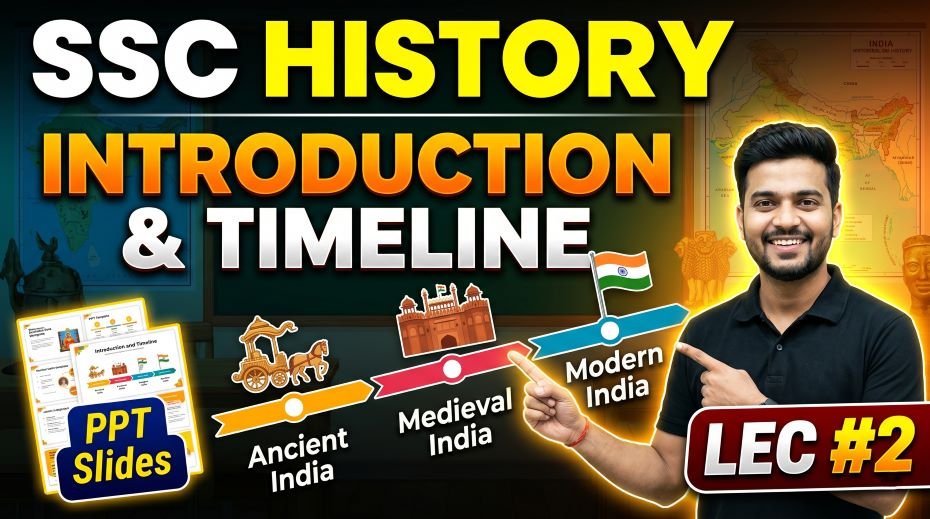
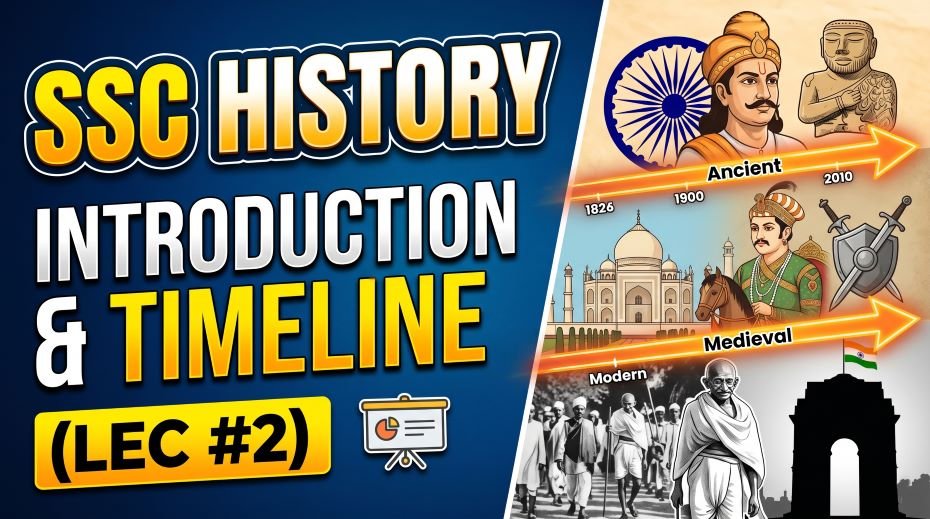
Today we will share SSC History Introduction and Timeline PPT Slides (LEC #2), SSC History Introduction and Timeline – Complete Notes for SSC CGL, CHSL, CPO and MTS, every building needs a foundation. In SSC History preparation, this lecture – History Introduction and Timeline – is that foundation. Without it, you are memorising isolated facts that have no context. With it, every historical event you study falls into place naturally because you know when it happened, why it happened, and what came before and after it.
This is Lecture #2 (Serial #27) from the Complete Foundation Batch PPT Series. With 39 slides – the largest lecture so far – it covers the complete landscape of Indian History: how history is studied (sources), how it is organised (periodisation), and how it unfolded from prehistoric times to independence (timeline). It also covers all major foreign travellers who visited India, whose accounts are one of the most-tested topics in SSC exams.
This article gives you everything in that lecture in detailed, exam-ready format – along with additional tables, a podcast discussion, and a complete Q&A section based on previous SSC paper patterns.
SSC History Introduction and Timeline PPT Slides (LEC #2)
Note: If you wish to download the entire SSC series (PPT slides), simply visit this redirect page. –REDIRECT PAGE
1. Periodisation of Indian History – How History Is Divided
The first thing any good history student does is understand how the subject is organised. Indian History is divided into three broad periods – and knowing the dividing lines between them is itself a testable SSC fact.
| Period | Time Span | What It Covers | SSC Exam Note |
| Ancient Indian History | Prehistoric Age to ~750 AD | From Stone Age to end of Gupta Empire and Harsha’s reign. Covers: IVC, Vedic Period, Mahajanapadas, Mauryas, Guptas, Sangam Age, Kushanas. | First historians to study: James Prinsep (decoded Brahmi script), Alexander Cunningham (ASI). Most SSC Ancient History Qs come from Mauryan and Gupta periods. |
| Medieval Indian History | ~750 AD to 1757 AD | From Arab invasion of Sindh to Battle of Plassey. Covers: Rajput era, Delhi Sultanate, Vijayanagara, Bahmani, Mughal Empire, Marathas, Sikhs, Bhakti-Sufi movements. | Battle of Plassey (1757) as the dividing line between Medieval and Modern is the most tested fact in this category. Know the 5 Delhi Sultanate dynasties. |
| Modern Indian History | 1757 AD to 1947 AD | From Battle of Plassey to Independence. Covers: British expansion, reform movements, revolts, freedom struggle, partition. | This section has the highest SSC question density. Viceroys, Acts, INC Sessions, and the Independence Movement are the four highest-yield sub-topics. |
Important: Why Battle of Plassey (1757) Is the Dividing Line Between Medieval and Modern
This is one of the most tested conceptual questions in SSC History. The Battle of Plassey (1757) marks the beginning of British political control over India. Before Plassey, the British were traders. After Plassey, they became rulers – first of Bengal, then progressively of all India. The Government of India Act 1858 (when the Crown took over from the Company) and 1947 (Independence) are the other key dates that bookend Modern History.
2. Complete Indian History Timeline – From Prehistoric Age to Independence
This is the most important table in this article. Study every row. For SSC exams, pay particular attention to the date column – sequence-based and identification questions depend entirely on your command of chronology.
| Period / Event | Date / Year | Key Facts for SSC Exams |
| Prehistoric / Stone Age | ~2,500,000 BC – 3000 BC | Paleolithic (Old Stone Age): Use of crude stone tools; nomadic hunters. Key sites: Bhimbetka (MP), Hunsgi (Karnataka). No agriculture, no pottery. |
| Mesolithic Age | ~10,000 BC – 6000 BC | Transitional period. Microlithic (small stone) tools. Beginnings of domestication of animals. Rock paintings at Bhimbetka. |
| Neolithic Age | ~6000 BC – 1000 BC | New Stone Age. Polished stone tools, agriculture begins, pottery. First settled communities. Key sites: Mehrgarh (Balochistan) – earliest Neolithic site in South Asia (~7000 BC). |
| Chalcolithic Age | ~3000 BC – 1500 BC | Copper + Stone Age. First use of metals (copper). Pre-Harappan cultures: Ahar, Jorwe, Malwa cultures. |
| Indus Valley Civilization (IVC) | ~3300 BC – 1300 BC (Mature Phase: 2600–1900 BC) | Also called Harappan Civilization. Major cities: Harappa (Punjab, Pak), Mohenjo-daro (Sindh, Pak), Lothal (Gujarat), Dholavira (Gujarat), Kalibangan (Rajasthan), Rakhigarhi (Haryana – largest IVC site). Features: town planning, grid system, drainage, granaries, Great Bath. |
| Vedic Period – Early Vedic (Rig Vedic) | ~1500 BC – 1000 BC | Aryans settle in Sapta Sindhu (Punjab region). Rig Veda composed. Tribal society, pastoral economy. No urban settlements. Gods: Indra, Agni, Varuna. Varna system emerges. |
| Vedic Period – Later Vedic | ~1000 BC – 600 BC | Aryans expand to Ganga-Yamuna doab. Sama, Yajur, Atharva Vedas composed. Agriculture becomes primary. Varna system becomes rigid. Mahajanapadas begin to emerge. |
| 16 Mahajanapadas | ~600 BC – 325 BC | 16 major republics and kingdoms. Most important: Magadha (Bihar) – rose to dominance. Other key ones: Kosala (Ayodhya), Vatsa (Kausambi), Avanti (Ujjain), Licchavi (Vaishali – republic). Bimbisara (Haryanka dynasty) first major king of Magadha. |
| Rise of Buddhism and Jainism | ~563 BC – 483 BC (Buddha’s life) | Gautama Buddha (born Lumbini, 563 BC; attained Nirvana at Bodh Gaya; first sermon at Sarnath; died at Kushinagar, 483 BC). Vardhamana Mahavira (599–527 BC) – 24th Tirthankara of Jainism. Both movements challenged Brahmanical dominance. |
| Persian and Greek Invasions | ~518 BC – 325 BC | Darius I (Persia) annexed Punjab and Sindh (~518 BC). Alexander the Great invaded India (326 BC) – Battle of Hydaspes (Jhelum) against King Porus. Alexander’s troops refused to march further east. Withdrew 325 BC. Impact: trade routes opened between India and the West. |
| Nanda Dynasty | ~345 BC – 321 BC | Last pre-Mauryan dynasty. Capital: Pataliputra (Patna). Mahapadma Nanda – first non-Kshatriya king. Last ruler: Dhana Nanda – overthrown by Chandragupta Maurya with help of Chanakya (Kautilya). |
| Mauryan Empire | ~321 BC – 185 BC | Founded by Chandragupta Maurya. Greatest empire in Indian history at that time. Key rulers: Chandragupta (321–297 BC), Bindusara (297–272 BC), Ashoka (268–232 BC). Ashoka’s Kalinga War (261 BC) – his conversion to Buddhism. Arthashastra by Kautilya. Megasthenes (Greek ambassador) wrote Indica. Capital: Pataliputra. |
| Post-Mauryan Period | ~185 BC – 320 AD | Sunga Dynasty (185–73 BC) – Pushyamitra Sunga kills last Mauryan ruler. Kanva Dynasty, Satavahanas (Deccan), Indo-Greek kingdoms, Kushanas (Kanishka – 1st century AD; 4th Buddhist Council in Kashmir). Sangam age in South India. |
| Gupta Empire | ~320 AD – 550 AD | Called the Golden Age of India. Key rulers: Chandragupta I (320–335 AD), Samudragupta (335–375 AD – ‘Napoleon of India’), Chandragupta II / Vikramaditya (375–415 AD). Fa Hien’s visit (405 AD). Nalanda University. Literature: Kalidasa (Abhijnanasakuntalam, Meghaduta). Mathematics: Aryabhata (zero, pi). |
| Vardhana / Harsha Dynasty | ~606 AD – 647 AD | Harshavardhana ruled from Kannauj. Last great empire of North India before Islamic invasions. Chinese pilgrim Xuanzang (Hiuen Tsang) visited. Harsha was a patron of Buddhism. Hiuen Tsang’s account: Si-Yu-Ki. Harsha defeated by Pulakesi II (Chalukya) at Battle of Narmada. |
| South Indian Kingdoms – Sangam & Post-Sangam | ~300 BC – 900 AD | Sangam age (Tamil literature, three kingdoms: Chera, Chola, Pandya). Later: Pallavas (Mamallapuram shore temple, Kanchi), Chalukyas of Badami, Rashtrakutas. Kailasha Temple at Ellora (Rashtrakuta). Pallava king Mahendravarman I promoted rock-cut architecture. |
| Arab Invasion of Sindh | 712 AD | Muhammad bin Qasim (Umayyad Caliphate) defeated Raja Dahir of Sindh at Battle of Aror (712 AD). First successful Islamic conquest of India. Sindh and south Punjab came under Arab rule. Limited to Sindh – did not spread further into India. |
| Rajput Period | ~700 AD – 1200 AD | Rise of Rajput clans across North India: Pratiharas (UP/Rajasthan), Paramaras (Malwa), Chandellas (Bundelkhand – Khajuraho), Chahamanas/Chauhans (Ajmer). Prithviraj Chauhan III – last great Rajput king. Defeated at Second Battle of Tarain (1192) by Muhammad of Ghor. |
| Mahmud of Ghazni’s Raids | 1000 AD – 1027 AD | 17 raids into India. Primary motive: plunder, especially the wealth of temples. Most famous: Somnath Temple raid (1025 AD). Did not establish permanent rule. His court historian: Alberuni wrote Kitab-ul-Hind (account of India). |
| Battles of Tarain | 1191 AD & 1192 AD | First Battle of Tarain (1191): Prithviraj III defeats Muhammad of Ghor. Second Battle of Tarain (1192): Muhammad of Ghor defeats and kills Prithviraj III – decisive Islamic conquest of North India begins. |
| Delhi Sultanate | 1206 AD – 1526 AD | Five dynasties: (1) Slave/Mamluk (1206–1290): Qutub-ud-din Aibak, Iltutmish, Razia Sultana, Balban. (2) Khilji (1290–1320): Alauddin Khilji. (3) Tughlaq (1320–1414): Muhammad bin Tughlaq, Firuz Shah Tughlaq. (4) Sayyid (1414–1451). (5) Lodi (1451–1526): Ibrahim Lodi (defeated at First Battle of Panipat by Babur). |
| Vijayanagara Empire | 1336 AD – 1646 AD | Founded by Harihara I and Bukka Raya. Capital: Hampi (Vijayanagara, Karnataka). Greatest ruler: Krishnadevaraya (1509–1529) – Amukta Malyada (Telugu work). Defeated by Deccan Sultans at Battle of Talikota (1565). |
| Bahmani Sultanate | 1347 AD – 1527 AD | Founded by Alauddin Bahman Shah. Capital: Gulbarga, later Bidar. Later broke into 5 Deccan Sultanates: Bijapur, Golconda, Ahmadnagar, Bidar, Berar. |
| Mughal Empire | 1526 AD – 1857 AD (effective decline: 1707) | Founded by Babur (defeated Ibrahim Lodi at First Battle of Panipat, 1526). Key rulers: Babur, Humayun, Akbar (Din-i-Ilahi, Ain-i-Akbari, Abul Fazl), Jahangir (Thomas Roe – British ambassador), Shah Jahan (Taj Mahal), Aurangzeb (Alamgir – decline of Mughal Empire). Battle of Plassey (1757) ends effective Mughal power. |
| Marathas | ~1674 AD – 1818 AD | Founded by Chhatrapati Shivaji Maharaj (1674 – crowned). Guerrilla warfare (Ganimi Kava). Peshwas after Shivaji: Balaji Vishwanath, Baji Rao I (greatest Peshwa), Balaji Baji Rao, Madhavrao. Third Battle of Panipat (1761) – Marathas defeated by Ahmad Shah Durrani (Abdali). Anglo-Maratha Wars ended Maratha power (1818). |
| Rise of Sikhs | ~1469 AD – 1849 AD | Guru Nanak (1469–1539) – founded Sikhism. 10 Gurus. Guru Gobind Singh (10th Guru) founded Khalsa (1699). Maharaja Ranjit Singh built Sikh Empire (1801–1839). Anglo-Sikh Wars: First (1845–46), Second (1848–49) – Punjab annexed by British. |
| Advent of Europeans | 1498 AD – 1750 AD | Vasco da Gama reaches Calicut (1498) – first European sea route to India. Portuguese: Goa (1510, Albuquerque). Dutch, English, French follow. English East India Company formed (1600). First English factory at Surat (1608). Battle of Swally (1612) – English defeat Portuguese. |
| Battle of Plassey | 1757 AD | British (Robert Clive) defeats Siraj-ud-Daula (Nawab of Bengal) with help of traitor Mir Jafar. Effective beginning of British rule in India. Bengal passes to British control. |
| Battle of Buxar | 1764 AD | British (Hector Munro) defeats combined forces of Mir Qasim, Nawab Shuja-ud-Daula of Awadh, and Mughal Emperor Shah Alam II. Treaty of Allahabad (1765): British gain Diwani (revenue rights) of Bengal, Bihar, and Orissa. More significant than Plassey – establishes real British supremacy. |
| Regulating Act | 1773 AD | First step by British Parliament to control East India Company. Warren Hastings became first Governor General of Bengal. Supreme Court established at Calcutta (1774). |
| Permanent Settlement | 1793 AD | Lord Cornwallis – fixed land revenue with zamindars permanently. Pauperised peasants. Created a loyal class of zamindars but destroyed traditional village economy. |
| Various Acts – Charter Acts | 1813–1858 AD | Charter Act 1813: Opened India to Christian missionaries; Company’s trade monopoly ended (except tea with China). Charter Act 1833: Company’s commercial functions ended; became purely administrative. Charter Act 1853: Last Charter Act; introduced merit-based recruitment. |
| Revolt of 1857 | 1857–1858 AD | 10 May 1857 – Meerut. Sepoys, peasants, zamindars, and rulers unite. Leaders: Mangal Pandey, Bahadur Shah Zafar, Rani Lakshmibai, Nana Saheb, Tatya Tope, Begum Hazrat Mahal, Kunwar Singh. Suppressed by 1858. Government of India Act 1858 – Crown takes over from Company. |
| Socio-Religious Reform Movements | 1828–1900 AD | Brahmo Samaj (1828, Raja Ram Mohan Roy). Arya Samaj (1875, Dayanand Saraswati). Ramakrishna Mission (1897, Vivekananda). Aligarh Movement (Sir Syed Ahmed Khan). Prarthana Samaj. Theosophical Society (Annie Besant). Abolition of Sati (1829, Bentinck). |
| Formation of Indian National Congress | 1885 AD | Founded by A.O. Hume (retired British ICS officer). First session: Bombay (1885), President: W.C. Bonnerjee. Moderate phase (1885–1905): Dadabhai Naoroji, Gopal Krishna Gokhale. Surat Split (1907): Moderates vs Extremists (Tilak, Lal-Bal-Pal). |
| Partition of Bengal and Swadeshi Movement | 1905 AD | Lord Curzon partitions Bengal (October 1905) on religious lines. Massive protests – Swadeshi Movement, boycott of British goods. Partition annulled in 1911. Capital shifted from Calcutta to Delhi (1911). |
| Home Rule Movement | 1916 AD | Tilak (Poona) and Annie Besant (Madras) launch separate Home Rule Leagues demanding self-governance within British Empire. Lucknow Pact (1916) – Congress and Muslim League cooperate. |
| Rowlatt Act and Jallianwala Bagh | 1919 AD | Rowlatt Act (March 1919) – imprisonment without trial. Hartal called. 13 April 1919 (Baisakhi): Brigadier Dyer orders firing at Jallianwala Bagh, Amritsar – hundreds killed. Hunter Commission formed. Rabindranath Tagore returns knighthood in protest. |
| Non-Cooperation Movement | 1920–1922 AD | Gandhi launches NCM after Jallianwala Bagh. Khilafat cause joined. Hartals, boycott of British institutions. Chauri Chaura incident (February 1922) – Gandhi withdraws movement. Nagpur Session of INC (1920) adopted NCM. |
| Simon Commission and Nehru Report | 1927–1928 AD | Simon Commission (1927) – all British, no Indian member – boycotted (‘Simon Go Back’). Nehru Report (1928, Motilal Nehru) – proposed Dominion Status. Jinnah rejected it – two-nation theory strengthened. |
| Civil Disobedience and Dandi March | 1930 AD | Lahore Session (1929, Jawaharlal Nehru presides) – Poorna Swaraj (Complete Independence) declared. Dandi March (12 March – 5 April 1930) – Gandhi leads 241-mile march to Dandi, Gujarat to make salt. Civil Disobedience Movement begins. Gandhi-Irwin Pact (1931). |
| Round Table Conferences | 1930–1932 AD | First RTC (1930): Congress boycotts. Second RTC (1931): Gandhi attends. Third RTC (1932): Congress boycotts. Communal Award (1932, Ramsay MacDonald) – separate electorates. Poona Pact (September 1932) – Gandhi-Ambedkar agreement on reserved seats. |
| Government of India Act 1935 | 1935 AD | Largest act of British Parliament for India. Introduced provincial autonomy, bicameral legislature. Basis for Indian Constitution (emergency provisions, Directive Principles concepts). Elections held 1937 – Congress wins in 8 provinces. Resigned 1939 at start of WWII. |
| Quit India Movement | 1942 AD | 8 August 1942 – Gandhi gives ‘Do or Die’ call at Gowalia Tank Maidan, Bombay. All Congress leaders arrested. Underground leaders: Jayaprakash Narayan, Aruna Asaf Ali (hoisted flag at Gowalia Tank). Parallel governments in Ballia (UP), Satara, Midnapore. |
| Indian National Army (INA) | 1942–1945 AD | Subhash Chandra Bose (Netaji) formed Azad Hind Government (1943, Singapore) and led INA (Azad Hind Fauj). Slogan: ‘Jai Hind’, ‘Dilli Chalo.’ Ranis of Jhansi Regiment – women’s unit of INA. INA trials (1945–46) – Red Fort trials – massive public sympathy for INA. |
| Independence and Partition | 1947 AD | Mountbatten Plan (June 1947) – Partition of India and Pakistan. Indian Independence Act (July 1947). 15 August 1947 – India independent. Jawaharlal Nehru’s ‘Tryst with Destiny’ speech. Pakistan created: 14 August 1947. Lord Mountbatten – last Viceroy; first Governor General of free India. C. Rajagopalachari – first and only Indian Governor General. |
3. Sources of Indian History – Literary, Archaeological, and Foreign Accounts
How do historians know what happened thousands of years ago? Through sources – and understanding the types of historical sources is a high-yield topic in SSC History. This chapter is typically tested through direct definition questions (What is epigraphy?) and attribution questions (Who wrote Rajatarangini?).
| Category | Sub-Type | Examples | SSC Exam Focus |
| Literary Sources | Indigenous (Written by Indians) | Vedas (Rig, Sama, Yajur, Atharva), Upanishads, Puranas, Epics (Ramayana, Mahabharata), Arthashastra (Kautilya), Indica (Megasthenes), Buddhist Jatakas, Jain Agamas | SSC asks: Who wrote Arthashastra? What is the oldest Veda? Which Greek ambassador wrote Indica? |
| Literary Sources | Foreign Accounts | Indica – Megasthenes (Mauryan era, Greek). Al-Beruni’s Kitab-ul-Hind (Mahmud of Ghazni era). Marco Polo (13th century, South India). Ibn Battuta (Muhammad bin Tughlaq era). Hiuen Tsang / Xuanzang (Harsha era). Fa Hien (Gupta era) | SSC frequently asks which traveller visited during which ruler’s reign |
| Literary Sources | Biographies & Chronicles | Harsha-Charita (Banabhatta – biography of Harshavardhana). Rajatarangini (Kalhana – history of Kashmir). Prithviraj Raso (Chand Bardai). Akbarnama & Ain-i-Akbari (Abul Fazl – Akbar era). Baburnama (Babur’s autobiography – in Turki/Chagatai) | SSC asks: Who wrote Rajatarangini? Who wrote Ain-i-Akbari? What language was Baburnama in? |
| Archaeological Sources | Inscriptions (Epigraphy) | Ashoka’s edicts (Brahmi script) – largest source of Mauryan history. Allahabad Pillar Inscription (Samudragupta). Aihole Inscription (Pulakesi II – mentions Harsha’s defeat). Nasik Inscription (Satavahanas). Hathigumpha Inscription (Kharavela of Kalinga) | SSC asks: Which script did Ashoka use? What is epigraphy? Allahabad Pillar Inscription records whose achievements? |
| Archaeological Sources | Coins (Numismatics) | Earliest coins: Punch-marked coins (Janapada era). Indo-Greek kings issued first portrait coins in India. Gupta gold coins (highest quality). Kushana coins. Coins are important for dating ancient rulers and trade routes | SSC asks: Who issued the first portrait coins in India? (Indo-Greek rulers) What are punch-marked coins? |
| Archaeological Sources | Monuments & Architecture | IVC sites (town planning). Mauryan pillars, stupas (Sanchi Stupa). Gupta temples. Ajanta and Ellora caves. Delhi Sultanate architecture (Qutub Minar). Mughal architecture (Taj Mahal, Red Fort, Fatehpur Sikri) | SSC asks: Who built Qutub Minar? (Qutub-ud-din Aibak started, Iltutmish completed). Who built the Taj Mahal? (Shah Jahan, in memory of Mumtaz Mahal) |
| Archaeological Sources | Excavations | Archaeological Survey of India (ASI) – founded by Alexander Cunningham (1861). IVC excavations: Harappa (Daya Ram Sahni, 1921), Mohenjo-daro (R.D. Banerji, 1922). Lothal (S.R. Rao). Kalibangan, Dholavira, Rakhigarhi | SSC asks: Who founded ASI? Who excavated Harappa? Who discovered Mohenjo-daro? |
Key Terms from Sources of History – SSC Must-Know Definitions
- Epigraphy: The study and interpretation of inscriptions carved on stone, metal, or other surfaces. Ashoka’s rock edicts are the most famous example.
- Numismatics: The study of coins. Coins help historians date rulers, understand trade networks, and identify artistic styles.
- Palaeography: The study of ancient scripts and handwriting. James Prinsep’s decoding of Brahmi script (1837) is the most important achievement in Indian palaeography.
- Archaeology: The study of human history through excavation of sites and analysis of physical remains. The IVC (discovered 1921–22) is the most important archaeological discovery in India.
- Epigraphy vs Numismatics: Both are archaeological sources. Epigraphy = written inscriptions on surfaces. Numismatics = study of coins. SSC sometimes asks which is which.
4. Foreign Travellers Who Visited India – Complete Table
Foreign travellers’ accounts are one of the richest sources of historical information about ancient and medieval India – and one of the most popular SSC exam topics. The pattern is always: traveller + ruler/period + name of account. Memorise these three pieces of information for each traveller.
| Traveller | Nationality | Ruler / Period | Date | Key Account & SSC Focus |
| Megasthenes | Greek | Chandragupta Maurya | ~302 BC | Indica – describes Mauryan society, administration, Pataliputra city, 7 castes of India. SSC loves: who was Greek ambassador to Chandragupta? |
| Fa Hien (Faxian) | Chinese | Chandragupta II (Vikramaditya) | 405–411 AD | Came to study Buddhism, visit holy sites. Account: Fo-Kuo-Chi. Noted the prosperity and mild governance of Gupta Empire. SSC: which Chinese traveller visited during Gupta period? |
| Hiuen Tsang (Xuanzang) | Chinese | Harshavardhana | 629–645 AD | Account: Si-Yu-Ki (Records of the Western World). Describes Nalanda University, Harsha’s administration, and Buddhist centres. SSC: who wrote Si-Yu-Ki? Which Chinese visitor is associated with Harsha? |
| Al-Masudi | Arab | Post-Caliphate rulers of India | ~943 AD | Muruj-ul-Zahab (Meadows of Gold). Arab geographer who described India. |
| Alberuni (Abu Rayhan) | Persian (in Ghazni’s court) | Contemporary of Mahmud of Ghazni | ~1024–1030 AD | Kitab-ul-Hind – systematic study of Indian society, science, religion, philosophy. Called the father of Indology. SSC: who wrote Kitab-ul-Hind? |
| Marco Polo | Italian (Venetian) | Pandya kingdom (South India) | 1292–1294 AD | Described the Pandya kingdom and South Indian trade. First European to write detailed accounts of South Asia and Southeast Asia. |
| Ibn Battuta | Moroccan Arab | Muhammad bin Tughlaq | 1333–1347 AD | Account: Rihla (Travels). Served as Qazi in Delhi Sultanate. Described postal system (dak chowki), coins, and Muhammad bin Tughlaq’s eccentricities. SSC: who wrote Rihla? Which traveller served under Tughlaq? |
| Abdur Razzaq | Persian | Vijayanagara (Deva Raya II) | 1442–1443 AD | Detailed account of the Vijayanagara Empire. Describes Hampi as a magnificent city. |
| Athanasius Nikitin | Russian | Bahmani Sultanate | 1469–1474 AD | First Russian to reach India. Account: ‘A Journey beyond Three Seas.’ |
| Vasco da Gama | Portuguese | Zamorin of Calicut | 1498 AD | Discovered sea route to India from Europe around Africa (Cape of Good Hope). Reached Calicut (Kozhikode), Kerala. Opened Europe-Asia trade directly. |
| Thomas Roe | English | Jahangir (Mughal) | 1615–1619 AD | First official British ambassador to India. Obtained trading rights for the East India Company at Jahangir’s court. |
| Francois Bernier | French physician | Aurangzeb / Shah Jahan era | 1658–1668 AD | Travels in the Mogul Empire – describes Mughal court, economy, famines. Noted the lack of private property in land. |
| Tavernier | French jeweller | Shah Jahan / Aurangzeb | 1641–1668 AD | Described the Mughal diamond trade, Golconda diamond mines. Saw the Taj Mahal under construction. |
Top 5 Foreign Travellers for SSC – Quick Revision
- Megasthenes – Chandragupta Maurya – Indica (Greek ambassador, ~302 BC)
- Fa Hien (Faxian) – Chandragupta II / Gupta era – Fo-Kuo-Chi (Chinese, 405–411 AD)
- Hiuen Tsang (Xuanzang) – Harshavardhana – Si-Yu-Ki (Chinese, 629–645 AD)
- Alberuni – Mahmud of Ghazni’s era – Kitab-ul-Hind (Persian, ~1024 AD)
- Ibn Battuta – Muhammad bin Tughlaq – Rihla (Moroccan Arab, 1333–1347 AD)
5. Key Historical Terms and Concepts for SSC Exams
A. What Is History?
History is the systematic study of past events, particularly human affairs, based on evidence from written records, archaeological finds, oral traditions, and other sources. The word ‘History’ comes from the Greek word ‘Historia’ meaning ‘inquiry’ or ‘knowledge acquired by investigation.’
B. Primary vs Secondary Sources
- Primary Sources: Created at the time of the event or by someone who was directly involved. Examples: Ashoka’s edicts, Baburnama, inscriptions, coins, archaeological remains.
- Secondary Sources: Created after the event, based on primary sources. Examples: modern history books, encyclopaedias, textbooks.
C. Important Historians and Their Contributions
- Kalhana: Wrote Rajatarangini (12th century AD) – the first systematic attempt at writing history in India.
- James Prinsep: British scholar who decoded the Brahmi script in 1837 – making Ashoka’s edicts readable.
- Alexander Cunningham: Founded the Archaeological Survey of India (ASI) in 1861 – the ‘Father of Indian Archaeology.’
- John Marshall: Director General of ASI during the discovery of IVC (1921–22). Harappa was found under Daya Ram Sahni and Mohenjo-daro under R.D. Banerji, both under Marshall’s leadership.
- V.D. Savarkar: Wrote ‘The Indian War of Independence’ (1909) – called the Revolt of 1857 the ‘First War of Indian Independence.’
D. Important Ancient Literary Works and Their Authors
- Arthashastra – Kautilya (Chanakya) – Mauryan era – Treatise on statecraft and economics
- Indica – Megasthenes – Mauryan era – Greek account of India
- Ashtadhyayi – Panini – 4th century BC – Sanskrit grammar (world’s first grammar text)
- Mahabhasya – Patanjali – ~2nd century BC – Commentary on Panini’s grammar
- Milindapanho – ~1st century BC – Dialogue between King Menander (Milinda) and Buddhist monk Nagasena
- Rajatarangini – Kalhana – 12th century AD – History of Kashmir
- Harsha-Charita – Banabhatta – 7th century AD – Biography of Harshavardhana
- Prithviraj Raso – Chand Bardai – 12th century – Account of Prithviraj Chauhan
6. Podcast Discussion – Understanding History Introduction and Timeline (Multiple Perspectives)
Three voices – an SSC Mentor, a History Expert, and an SSC Topper – discuss the most important aspects of this foundational lecture for exam preparation.
| Speaker / Role | Question | Answer / Perspective |
| Host (SSC Mentor) | Why does an SSC History paper always start with introduction and timeline – and why should every aspirant study this first? | Because everything in history is connected. If you do not know whether the Mauryan Empire came before or after the Gupta Empire, you will get cause-effect questions wrong every time. The timeline is the skeleton of all of History. Once it is fixed in your mind, individual chapter facts hang naturally onto it. SSC often asks ‘which came first’ or ‘what happened as a result of’ questions – those are impossible to answer without a solid sense of chronology. That is why this PPT lecture – despite having just 39 slides – is arguably the most important one in the entire History series. |
| Guest 1 (History Expert) | What is the difference between ‘sources of history’ and ‘periodisation of history’ – and why does SSC test both? | Sources tell us how we know history – through inscriptions, coins, literary texts, archaeological finds, and foreign accounts. Periodisation tells us how we organise history – into Ancient, Medieval, and Modern. SSC tests sources because questions like ‘who wrote Indica?’, ‘who excavated Harappa?’, ‘what is epigraphy?’ are direct from the sources chapter. SSC tests periodisation because the dividing line questions – ‘which battle marks the beginning of Modern Indian History?’ (Battle of Plassey, 1757) – come up every year. Both are high-yield topics from this introduction lecture. |
| Guest 2 (SSC Topper) | What is the single most-tested date or event from the entire Indian History timeline in SSC exams? | In my experience preparing for SSC CGL and CHSL, the Battle of Plassey (1757) and the Government of India Act 1858 appear most frequently in some form. But if I had to pick just one event that SSC has asked about the most across all exam types, it is 1857 – either a date, a leader, a cause, or a consequence. Outside of 1857, the First Battle of Panipat (1526) and the INC’s founding (1885) are the next most tested. Know the year, the parties involved, and the result for each of these – and you have covered a huge chunk of Modern History. |
| Host (SSC Mentor) | The timeline includes prehistoric periods like Paleolithic and Neolithic ages. Do these actually come in SSC exams? | Yes – more than most students expect. Questions like ‘What is the oldest prehistoric site in India?’, ‘Which age is associated with Bhimbetka?’, ‘What are microlithic tools?’, ‘Which site is the earliest Neolithic settlement in South Asia?’ (Mehrgarh, 7000 BC) do appear – especially in SSC MTS and occasionally in CHSL. The Stone Age section is short to study but has a very good return on time investment. Bhimbetka rock paintings are a favourite – they are associated with the Paleolithic and Mesolithic periods, and are a UNESCO World Heritage Site. |
| Guest 1 (History Expert) | Foreign travellers are a separate chapter in many history books but appear in this introduction. How important are they for SSC? | Extremely important – and very easy marks if you remember the pattern. The pattern SSC follows is: traveller name + ruler he visited + book/account name. Three combinations are asked most: (1) Megasthenes + Chandragupta Maurya + Indica. (2) Hiuen Tsang + Harshavardhana + Si-Yu-Ki. (3) Ibn Battuta + Muhammad bin Tughlaq + Rihla. If you know these three cold, you have covered 80% of foreign traveller questions. Add Alberuni + Mahmud of Ghazni + Kitab-ul-Hind and Fa Hien + Chandragupta II + Fo-Kuo-Chi, and you have covered 95%. |
| Guest 2 (SSC Topper) | What is the best method to memorise the complete Indian History timeline for SSC? | Do not try to memorise everything at once – that is a recipe for forgetting everything. Instead, use anchor dates. Pick 5 dates that you memorise first because everything else slots around them: (1) 321 BC – Mauryan Empire begins. (2) 320 AD – Gupta Empire begins. (3) 1206 AD – Delhi Sultanate begins. (4) 1526 AD – Mughal Empire begins (First Battle of Panipat). (5) 1757 AD – Battle of Plassey (British rule effectively begins). Once these five anchors are fixed, every other date finds its place naturally – before or after which anchor? That simple question organises your entire timeline. |
| Host (SSC Mentor) | The PPT series calls this ‘History Introduction and Timeline’ – but 39 slides is quite large for an ‘introduction.’ What does it actually cover? | The 39 slides of LEC #2 cover much more than just a brief intro. They include: what history is and why we study it, the three main periods of Indian History with their defining characteristics, all major sources of history (literary, archaeological, foreign accounts), the complete chronological timeline from prehistoric India to independence, key foreign travellers and their accounts, and important historical terms like epigraphy, numismatics, and palaeography. It is essentially a foundation-building lecture that makes every subsequent chapter easier to understand because you always know where each topic fits in the larger story of India. |
| Guest 1 (History Expert) | What is the most common mistake students make when studying Indian History for SSC – especially related to chronology? | Confusing the Mauryas and Guptas. Both are great empires, both are from Bihar (Magadha), and both have a ‘Chandragupta’ as founder. Students frequently attribute Gupta-era achievements to the Mauryas and vice versa. Key distinction: Maurya = 321 BC, Chandragupta Maurya, Ashoka, Arthashastra, Megasthenes, Fa Hien (actually Gupta). Gupta = 320 AD, Chandragupta I, Samudragupta, Chandragupta II (Vikramaditya), Kalidasa, Aryabhata, Fa Hien. The 600-year gap between them (321 BC vs 320 AD) is something to consciously fix. SSC examiners know this confusion and regularly design options to exploit it. |
| Guest 2 (SSC Topper) | Any final advice for making the most out of the History Introduction and Timeline PPT? | Three things. First – convert the timeline table into a physical timeline on a long strip of paper and stick it on your study wall. Visual, spatial memory is much more powerful than reading-only memory for dates. Second – make flashcards for foreign travellers: traveller name on front, ruler + book name on back. Test yourself daily for one week – you will have it permanently. Third – for sources of history, remember two names above all others: Alexander Cunningham (founded ASI, 1861) and James Prinsep (decoded Brahmi script, 1837). These two men are the reason we know so much about ancient India, and SSC loves asking about them. |
7. SSC Exam Q&A – History Introduction and Timeline (Previous Year Pattern)
These 15 questions cover the highest-tested topics from the History Introduction and Timeline chapter, mapped to specific SSC exams.
| # | Question | Answer | Exam Relevance |
| Q1 | Which battle is considered the beginning of Modern Indian History? | Battle of Plassey (1757) – where the British (Robert Clive) defeated Siraj-ud-Daula (Nawab of Bengal) with the treachery of Mir Jafar. This effectively began British political dominance in India. | SSC CGL, CHSL, MTS – Very High |
| Q2 | Name the three main periods of Indian History and their time spans. | Ancient: Prehistoric to ~750 AD. Medieval: ~750 AD to 1757 AD (Battle of Plassey). Modern: 1757 AD to 1947 AD (Independence). The dividing line between Medieval and Modern is the Battle of Plassey. | SSC CGL, CHSL – fundamental |
| Q3 | Who founded the Archaeological Survey of India (ASI) and when? | Alexander Cunningham, in 1861. He is called the ‘Father of Indian Archaeology.’ ASI is responsible for excavating and preserving India’s archaeological heritage, including IVC sites. | SSC CGL, CHSL, CPO |
| Q4 | Who decoded the Brahmi script, enabling us to read Ashoka’s edicts? | James Prinsep, in 1837. This was a turning point in our understanding of ancient Indian history – Ashoka’s edicts suddenly became readable, revealing the extent and character of the Mauryan Empire. | SSC CGL, CHSL – High |
| Q5 | Who was Megasthenes, and what did he write? | Megasthenes was a Greek ambassador sent by Seleucus Nicator to the court of Chandragupta Maurya (~302 BC). He wrote ‘Indica’ – an account of Mauryan India, describing Pataliputra city, Indian castes, and the army. | SSC CGL, CHSL, CPO – Very High |
| Q6 | Which Chinese traveller visited India during the reign of Harshavardhana, and what did he write? | Hiuen Tsang (Xuanzang), who visited 629–645 AD. He wrote ‘Si-Yu-Ki’ (Records of the Western World). He described Nalanda University, Buddhism’s decline, and Harsha’s administration and generosity. | SSC CGL, CHSL – Very High |
| Q7 | Who wrote ‘Kitab-ul-Hind,’ and what is its significance? | Alberuni (Abu Rayhan al-Biruni), a Persian scholar who came with Mahmud of Ghazni (~1024 AD). ‘Kitab-ul-Hind’ is a systematic and objective study of Indian society, religion, science, and philosophy. He is called the ‘Father of Indology.’ | SSC CGL, CHSL – High |
| Q8 | What is the difference between Paleolithic, Mesolithic, and Neolithic Ages? | Paleolithic (Old Stone Age) – crude stone tools, nomadic hunters (~2.5 million BC–10,000 BC). Mesolithic (Middle Stone Age) – microlithic tools, animal domestication begins (~10,000–6000 BC). Neolithic (New Stone Age) – polished stone tools, agriculture, settled communities (~6000–1000 BC). Key site for all three: Bhimbetka (MP). | SSC CHSL, MTS – Moderate-High |
| Q9 | Who excavated the Indus Valley Civilization sites – Harappa and Mohenjo-daro? | Harappa: Excavated by Daya Ram Sahni (1921). Mohenjo-daro: Excavated by R.D. Banerji (1922). Both sites were discovered under the direction of John Marshall (then Director General of ASI). IVC is also called Harappan Civilization. | SSC CGL, CHSL – Very High |
| Q10 | What was Vasco da Gama’s significance in Indian history? | Vasco da Gama (Portuguese) was the first European to reach India via the sea route around Africa’s Cape of Good Hope. He arrived at Calicut (Kozhikode), Kerala in 1498. This discovery opened direct trade between Europe and India, eventually leading to European colonialism. | SSC CGL, CHSL – High |
| Q11 | What is epigraphy, numismatics, and palaeography? | Epigraphy: Study of inscriptions on stone, metal, or other surfaces (e.g., Ashoka’s edicts). Numismatics: Study of coins – used to date ancient rulers and understand trade. Palaeography: Study of ancient scripts and handwriting. SSC often asks definitions of these terms as part of ‘sources of history.’ | SSC CGL, CHSL – High |
| Q12 | Who wrote Indica? Who wrote Rajatarangini? Who wrote Arthashastra? | Indica: Megasthenes (Greek ambassador to Chandragupta Maurya). Rajatarangini (‘River of Kings’): Kalhana – first systematic history of Kashmir (12th century AD). Arthashastra: Kautilya (Chanakya) – treatise on statecraft, economic policy, and military strategy (Mauryan era). | SSC CGL, CHSL, CPO – Very High |
| Q13 | What were the main features of the Indus Valley Civilization? | Planned cities with grid layout, underground drainage system (most advanced of ancient world), standardised weights and measures, granaries, Great Bath at Mohenjo-daro, no temples found (yet), pictographic script (still not deciphered), trade links with Mesopotamia, terracotta figurines, and bronze ‘Dancing Girl’ statue. | SSC CGL, CHSL – Very High |
| Q14 | What is the significance of the First Battle of Panipat (1526)? | Babur (Mughal) defeated Ibrahim Lodi (last Lodi Sultan of Delhi Sultanate) at the First Battle of Panipat on 21 April 1526. This ended the Delhi Sultanate and established the Mughal Empire. Babur used gunpowder and artillery (tulugma warfare) for the first time in India – a decisive military advantage. | SSC CGL, CHSL – Very High |
| Q15 | What is the importance of the Allahabad Pillar Inscription for Indian history? | The Allahabad Pillar Inscription (composed by Harisena, court poet) records the military conquests and achievements of Samudragupta (Gupta Empire, ~335–375 AD). It describes him conquering kingdoms across India and is the primary source for Gupta history. Samudragupta is called the ‘Napoleon of India’ based on this inscription. | SSC CGL, CHSL – High |
8. Smart Study Strategy for History Introduction and Timeline
Anchor Date Method – Fix 5 Dates, Then Fill the Rest
The biggest challenge in History is chronology. Use this five-anchor method to organise the entire timeline in your memory:
- Anchor 1 – 321 BC: Mauryan Empire begins (Chandragupta Maurya). Everything ancient slots before or after this.
- Anchor 2 – 320 AD: Gupta Empire begins. The 600-year gap between 321 BC and 320 AD contains the post-Mauryan period.
- Anchor 3 – 1206 AD: Delhi Sultanate begins (Qutub-ud-din Aibak). Medieval History effectively starts here.
- Anchor 4 – 1526 AD: First Battle of Panipat (Mughal Empire begins). Babur defeats Ibrahim Lodi.
- Anchor 5 – 1757 AD: Battle of Plassey (British rule effectively begins). Modern History starts here.
Foreign Travellers: The Name-Ruler-Book Formula
For every foreign traveller, remember exactly three things: (1) their name and nationality, (2) the Indian ruler during whose reign they visited, and (3) the name of the account they wrote. Make a flashcard for each traveller with these three pieces of information. Five travellers – Megasthenes, Fa Hien, Hiuen Tsang, Alberuni, and Ibn Battuta – cover 90% of all SSC questions on this topic.
Sources of History: Group Into Three Buckets
Do not try to memorise sources as a flat list. Group them into three buckets: (1) Written Indian sources (Vedas, Arthashastra, Rajatarangini), (2) Foreign accounts (Indica, Si-Yu-Ki, Kitab-ul-Hind), and (3) Archaeological sources (inscriptions, coins, excavations). When an SSC question asks about a source, your first mental step should be: which bucket does it fall into?
also read: SSC History Syllabus Topic Wise PPT Slides (LEC #1)
Conclusion
The History Introduction and Timeline lecture – LEC #2 of the Complete Foundation Batch PPT Series – is the one lecture that makes every other lecture easier. Once you have the periodisation, the key timeline events, the sources of history, and the foreign travellers fixed in your memory, you have a mental framework that every subsequent chapter clicks into.
Do not skip this foundational content in a rush to get to the ‘real’ chapters. The questions on sources, travellers, and periodisation are among the easiest to score in SSC exams – they are specific, factual, and once memorised, they stay with you. The complete timeline table in this article is your primary revision tool. Come back to it before every mock test.
The next lecture in this series moves into Ancient Indian History – starting with the Indus Valley Civilization. Follow this blog for chapter-wise articles, detailed Q&A tables, and podcast-style discussions for every lecture in the Complete Foundation Batch PPT Series.