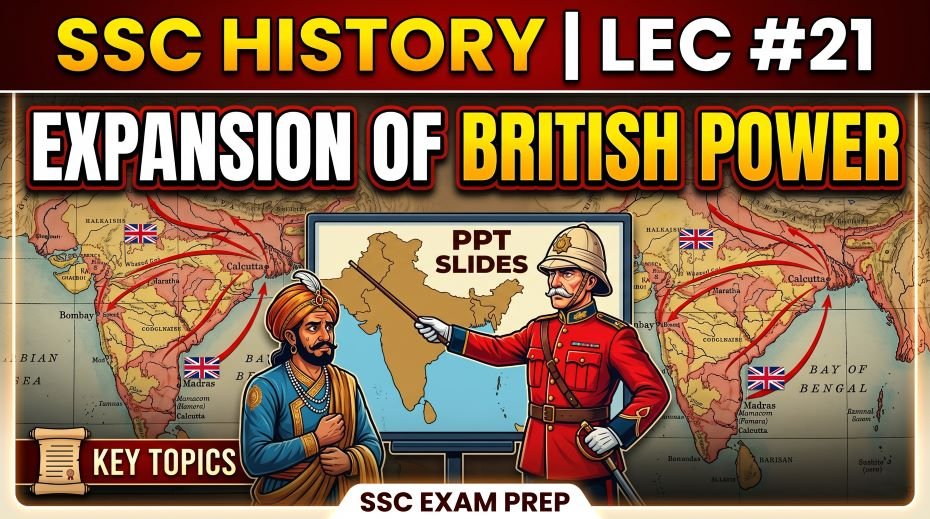
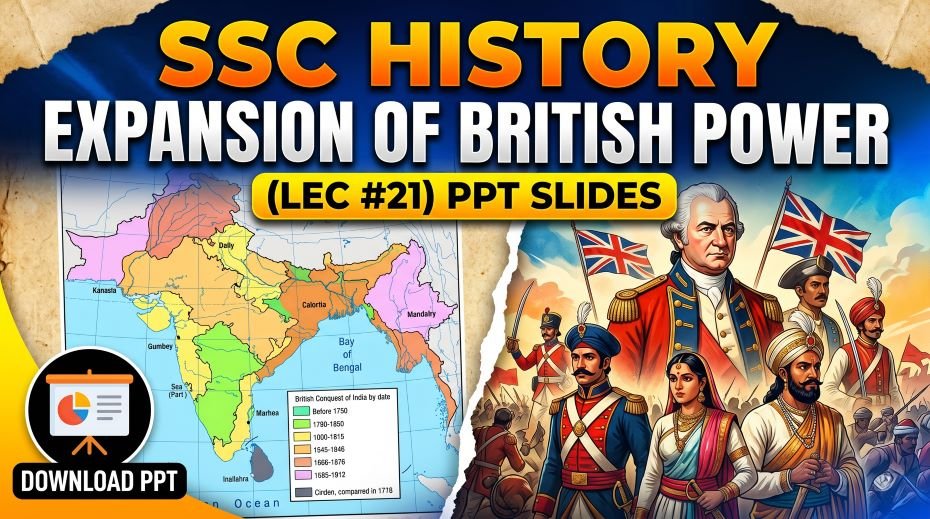
In this article we will discuss about the SSC History Expansion of British Power PPT Slides (LEC #21), Complete Study Guide with Timeline, Tables, Battle Notes, Treaties, Governor-Generals, Podcast Q&A & 30 Practice MCQs.
Section 1: PPT Resource Overview – What You Get in Lecture 21
Before diving into the content, here is a complete at-a-glance overview of the PPT resource this article is based on. Use this table to quickly understand the scope, coverage, and exam relevance of the Lecture 21 PPT from the Complete Foundation Batch for All SSC Exams.
| PPT RESOURCE OVERVIEW – LEC #21 | |
| Complete Foundation Batch for All SSC Exams | History PPT Series | |
| Lecture Title | Expansion of British Power in India (ब्रिटिश सत्ता का विस्तार) |
| Lecture Number | Lecture 21 |
| Serial Number | #46 in the Complete Foundation Batch PPT Series |
| Total Slides | 76 High-Quality PPT Slides |
| File Size | 21 MB |
| Subject | Modern Indian History |
| Series Name | Complete Foundation Batch for All SSC and Other Competitive Exams (PPT SERIES) |
| Target Exams | SSC CGL | SSC CHSL | SSC MTS | SSC GD Constable | RRB Group D | Delhi Police | State PSC |
| Topics Covered | EIC Founding → Carnatic Wars → Battle of Plassey & Buxar → Mysore Wars → Maratha Wars → Sikh Wars → Subsidiary Alliance → Doctrine of Lapse → 1857 Revolt |
| Key Personalities | Robert Clive, Hyder Ali, Tipu Sultan, Lord Wellesley, Lord Dalhousie, Lord Cornwallis, Lord Bentinck, Warren Hastings |
| Format | Visual PPT Slides with Maps, Timelines, Policy Charts, and Exam-Focused Summary Boxes |
| Medium | English with Hindi keywords (bilingual SSC-focused) |
| Difficulty Level | Beginner to Intermediate – suitable for first-time and revision learners |
| Recommended Study Time | 3 to 5 days (first read) | 1 day (revision) |
| PPT Source / Website | slideshareppt.net |
| Content Category | General Awareness – History (Modern India) – SSC Foundation Batch |
| Best Combined With | This article’s Timeline Table, MCQ section, and Podcast Q&A for maximum exam readiness |
| High-Yield Chapter | 30–40% of SSC Modern History Questions Come from This Topic | |
How to Use This Article: Start with the Master Timeline table in Section 2. Then read topic-wise notes in Sections 3 to 11. Use the Podcast Q&A (Section 12) for conceptual clarity. Finish with the 30 MCQs in Section 13 for exam readiness.
SSC History Expansion of British Power PPT Slides (LEC #21)
Note: If you wish to download the entire SSC series (PPT slides), simply visit this redirect page. –REDIRECT PAGE
Section 2: Master Timeline – Expansion of British Power (1600 to 1858)
This is the most important reference table in this article. Every SSC aspirant should be able to recall the key events in this timeline from memory. The table is organized chronologically and includes the exam significance of each event – helping you prioritize what to study deeply versus what to skim.
Pro Tip: Print this timeline on one page and paste it at your study desk. Revise it every morning for 10 minutes. Over 60% of SSC Modern History questions on British expansion can be answered using this table alone.
| Year / Period | Event / Milestone | SSC Exam Significance |
| 1600 | East India Company (EIC) Founded | Charter by Queen Elizabeth I; start of British commercial presence in India |
| 1608 | William Hawkins at Surat | First British attempt to establish a factory; initially rejected by Jahangir |
| 1612 | Battle of Swally | EIC defeats Portuguese; Thomas Best wins; factory rights granted in Surat |
| 1615 | Sir Thomas Roe at Mughal Court | Ambassador of James I; secures formal trading rights from Emperor Jahangir |
| 1639 | Fort St. George, Madras Founded | First fortified British settlement; base for South India expansion |
| 1651 | First Factory in Bengal (Hugli) | British commercial entry into Bengal; foundation for future Bengal conquest |
| 1661 | Bombay Transferred to British | Charles II receives Bombay as dowry from Portugal; leased to EIC for £10/year |
| 1690 | Calcutta Founded by Job Charnock | Fort William built; later becomes capital of British India – very high SSC frequency |
| 1707 | Death of Aurangzeb | Mughal decline begins; power vacuum exploited by the British and Marathas |
| 1717 | Farrukhsiyar’s Farman | Duty-free trade rights in Bengal granted to EIC; called ‘Magna Carta of EIC’ |
| 1744–48 | First Carnatic War | Anglo-French rivalry; Battle of Adyar; Treaty of Aix-la-Chapelle; status quo |
| 1749–54 | Second Carnatic War | Clive defends Arcot (1751); Dupleix recalled; French power declines sharply |
| 1756 | Black Hole of Calcutta | Siraj-ud-Daulah captures Fort William; 123 British die; justification for Plassey |
| 1757 | Battle of Plassey (June 23) | Clive defeats Siraj-ud-Daulah; Mir Jafar’s treachery; British POLITICAL power begins |
| 1760 | Battle of Wandiwash | Eyre Coote defeats Lally; France eliminated as rival power in India permanently |
| 1761 | Third Battle of Panipat | Ahmad Shah Abdali defeats Marathas; Maratha power temporarily collapsed |
| 1764 | Battle of Buxar (Oct 22) | Munro defeats Mir Qasim + Shuja-ud-Daula + Shah Alam II; real British sovereignty |
| 1765 | Treaty of Allahabad | Diwani Rights granted to EIC over Bengal, Bihar, Orissa – financial sovereignty |
| 1766–69 | First Anglo-Mysore War | Hyder Ali wins; Treaty of Madras; first major British military defeat |
| 1772 | Warren Hastings as Governor | Dual Government abolished; Bengal revenue reform; Regulating Act (1773) follows |
| 1773 | Regulating Act | First Parliamentary control over EIC; Governor-General post created; Supreme Court set up |
| 1775–82 | First Anglo-Maratha War | Battle of Wadgaon (British defeated); Treaty of Salbai (1782) – status quo |
| 1780–84 | Second Anglo-Mysore War | Hyder Ali dies 1782; Tipu continues; Treaty of Mangalore – Tipu wins; British humiliated |
| 1784 | Pitt’s India Act | Dual control: Board of Control + EIC; greater British government oversight |
| 1790–92 | Third Anglo-Mysore War | Cornwallis defeats Tipu; Treaty of Seringapatam; Tipu loses half his kingdom |
| 1793 | Permanent Settlement of Bengal | Cornwallis fixes revenue permanently; Zamindari system; landlords empowered |
| 1798 | Subsidiary Alliance Introduced | Lord Wellesley’s policy; Hyderabad accepts FIRST; Indian rulers lose sovereignty |
| 1798–99 | Fourth Anglo-Mysore War | Tipu Sultan killed defending Seringapatam (May 4, 1799); Mysore falls to British |
| 1800 | Fort William College Founded | Lord Wellesley; training institution for British civil servants in India |
| 1803–05 | Second Anglo-Maratha War | Delhi, Agra fall; Scindia and Bhonsle defeated; vast territory acquired |
| 1817–18 | Third Anglo-Maratha War + Pindari War | Peshwaship abolished; Baji Rao II exiled to Bithur; Maratha Confederacy ends |
| 1829 | Abolition of Sati | Lord Bentinck; supported by Raja Ram Mohan Roy; landmark social reform |
| 1833 | Charter Act – Bentinck becomes First G-G of India | Governor-General of India (not just Bengal) for the first time |
| 1835 | Macaulay’s Minute | English adopted as medium of instruction; transforms Indian education system |
| 1838–42 | First Anglo-Afghan War | Disastrous British campaign; army largely annihilated; lesson in overextension |
| 1843 | Annexation of Sind | Charles Napier annexes Sind; famous quote ‘Peccavi’ (I have sinned) |
| 1845–46 | First Anglo-Sikh War | Treaty of Lahore; Kashmir sold to Gulab Singh; British Resident placed at Lahore |
| 1848 | Satara Annexed (Doctrine of Lapse begins) | First state annexed under Dalhousie’s Doctrine of Lapse; SSC frequently asks |
| 1848–49 | Second Anglo-Sikh War | Punjab fully annexed; Koh-i-Noor taken; Maharaja Duleep Singh deposed |
| 1848–56 | Lord Dalhousie as Governor-General | Railways, telegraph, postal reforms, universities; greatest territorial expansion |
| 1851 | Electric Telegraph Introduced | First line: Calcutta to Agra; Dalhousie’s modernization initiative |
| 1853 | First Railway in India (Apr 16) | Bombay to Thane; 34 km; Dalhousie’s legacy – directly asked in SSC |
| 1853 | Jhansi Annexed (Doctrine of Lapse) | Rani Laxmibai’s husband dies; adopted son rejected; Jhansi annexed; fuels 1857 revolt |
| 1854 | Nagpur Annexed (Doctrine of Lapse – Last) | Final state annexed under Doctrine of Lapse; Nagpur goes to British |
| 1854 | Wood’s Education Despatch | Framework for modern Indian education system; universities planned |
| 1856 | Annexation of Awadh (Oudh) | NOT under Doctrine of Lapse; annexed for ‘misgovernance’; Wajid Ali Shah exiled; major 1857 cause |
| 1856 | General Service Enlistment Act | Sepoys must serve overseas; violates Hindu caste norms; triggers 1857 revolt |
| 1857 | First War of Indian Independence | Mass revolt against British rule; Greased Cartridge controversy triggers it; EIC rule ends |
| 1858 | Government of India Act | EIC dissolved; British Crown takes direct control; Queen Victoria’s Proclamation |
Section 3: Arrival of Europeans in India – The Competitive Backdrop
The British did not arrive in isolation. Several European powers reached India before them, creating a competitive colonial environment. Understanding this context helps you answer chronological-order questions in SSC exams.
Order of European Arrival – A Frequently Asked SSC Sequence
- Portuguese: Vasco da Gama reached Calicut (Kozhikode) in 1498 – the first European to reach India by sea via the Cape of Good Hope route
- Dutch (Netherlands): Dutch East India Company (VOC) founded in 1602; established trading posts in India; eventually declined after losing to the British at Battle of Bedara (1759)
- British (English): East India Company founded December 31, 1600; first factory at Surat (1608)
- Danish: Minor presence; eventually sold all settlements to the British in 1845
- French: French East India Company (Compagnie des Indes Orientales) founded in 1664; became Britain’s most serious colonial rival through the Carnatic Wars
Key SSC Fact: Vasco da Gama = 1498 (Portuguese). EIC = 1600 (British). VOC = 1602 (Dutch). French EIC = 1664. The Portuguese arrived a full century before the British became a trading force in India.
Why the British Ultimately Succeeded Where Others Failed
- Superior naval power and consistent home government financial backing
- Mastery of divide-and-rule politics – exploiting rivalries between Nawabs, Nizams, and Maratha chiefs
- Joint-stock company model allowed pooling of massive private and public capital
- Pragmatic alliances – British backed whoever would weaken their current biggest threat
- Industrial Revolution back home gave them superior weapons, logistics, and manufacturing
- Willingness to engage in bribery, diplomacy, and battlefield warfare simultaneously
Section 4: The East India Company – From Spice Traders to Rulers of India
The East India Company (EIC), formally the ‘Governor and Company of Merchants of London Trading into the East Indies,’ received its royal charter from Queen Elizabeth I on December 31, 1600. What started as a trading venture to break the Portuguese spice monopoly evolved into history’s most powerful corporate empire.
Key Milestones of EIC’s Early Presence in India
- 1600: EIC charter granted – 125 shareholders, initial capital of £72,000
- 1608: William Hawkins attempts to establish a factory at Surat – initially refused by Emperor Jahangir
- 1612: Battle of Swally – Thomas Best defeats Portuguese fleet; factory rights granted at Surat
- 1615: Sir Thomas Roe arrives as Ambassador of King James I; secures formal Mughal trading rights
- 1639: Fort St. George built at Madras – first fortified British settlement in India
- 1661: Bombay received by Charles II as part of the dowry from Portugal’s Princess Catherine; leased to EIC for £10 per year
- 1690: Calcutta founded by Job Charnock; Fort William established – later becomes capital of British India
Farrukhsiyar’s Farman (1717) – The Magna Carta of EIC
In 1717, Mughal Emperor Farrukhsiyar issued a royal farman granting the EIC duty-free trading rights throughout Bengal. The Company secured this privilege through a diplomatic mission led by John Surman. This agreement is historically called the Magna Carta of the East India Company. It gave the EIC a decisive economic edge over all rivals and is a standard SSC exam question about the most favorable trading privilege granted to the British by the Mughals.
Section 5: The Three Carnatic Wars – Eliminating the French Rival
The three Carnatic Wars (1744 to 1763) decided which European power would dominate India. The Anglo-French struggle was the decisive contest of the 18th century, and Britain’s victory permanently established its supremacy on the subcontinent.
First Carnatic War (1744 to 1748)
- Cause: Spill-over of War of Austrian Succession in Europe (Britain vs France globally)
- Key battle: Battle of Adyar (1746) – French under Marquis Dupleix capture Madras
- Outcome: Treaty of Aix-la-Chapelle (1748) – Madras returned to Britain; status quo restored
- SSC significance: Robert Clive first appears; French demonstrate military capability
Second Carnatic War (1749 to 1754)
- Cause: Succession dispute – French backed Muzaffar Jung (Hyderabad) and Chanda Sahib (Carnatic); British backed Nasir Jung and Muhammad Ali
- Key event: Robert Clive’s legendary defense of Arcot (1751) for 50 days – turned the war’s psychological momentum
- Outcome: Dupleix recalled to France in 1754; French political influence collapses
- SSC significance: Robert Clive established as military genius; British proxy politics succeeds
Third Carnatic War (1756 to 1763)
- Cause: Seven Years War (1756 to 1763) – Britain vs France globally
- Key battle: Battle of Wandiwash (January 22, 1760) – British General Eyre Coote decisively defeats French General Lally
- Outcome: Treaty of Paris (1763) – France retains only Pondicherry (without fortifications)
- SSC significance: France permanently eliminated from Indian power politics; Britain becomes dominant European power
Section 6: Conquest of Bengal – The Financial Foundation of British India
Bengal was the richest province of the Mughal Empire. Its conquest gave the British the financial engine they needed to fund military campaigns across the entire subcontinent. The events of 1756 to 1765 are the most critical years in the history of British expansion.
Black Hole of Calcutta Tragedy (June 1756)
Nawab Siraj-ud-Daulah attacked and captured Fort William in June 1756. According to British accounts, 146 European prisoners were confined overnight in a small room measuring 18 by 14 feet; 123 supposedly died from suffocation. Historians dispute these exact numbers, but the British used the incident as a rallying cause to justify their subsequent attack on the Nawab.
Battle of Plassey – June 23, 1757
- British commander: Robert Clive
- Against: Nawab Siraj-ud-Daulah of Bengal (army of approximately 50,000)
- British force: approximately 3,000 soldiers
- Decisive factor: Mir Jafar (Siraj’s commander-in-chief) was bribed and kept his 35,000 troops idle during the battle
- Outcome: Siraj-ud-Daulah fled, was captured, and executed; Mir Jafar installed as Nawab
- SSC exam key: Plassey gave Britain POLITICAL power over Bengal but not financial/administrative control
Battle of Buxar – October 22, 1764
- British commander: Major Hector Munro
- Against: Coalition of Mir Qasim (Bengal Nawab) + Shuja-ud-Daula (Nawab of Awadh) + Shah Alam II (Mughal Emperor) – three powerful rulers combined
- Outcome: Complete British victory; all three rulers defeated
- Treaty of Allahabad (August 1765): Shah Alam II grants Diwani (revenue collection) rights over Bengal, Bihar, and Orissa to EIC
- SSC exam key: Buxar is MORE significant than Plassey; it gave financial sovereignty and confirmed British administrative control
Section 7: All Anglo-Indian Wars – Comprehensive Comparison Table
This table provides a one-stop reference for every major war the British fought to expand their power in India. Use it for rapid pre-exam revision.
| War | Years | Type | Peace Treaty | Outcome / Significance |
| First Carnatic War | 1744–48 | Anglo-French | Treaty of Aix-la-Chapelle | Status quo; Madras returned to British |
| Second Carnatic War | 1749–54 | Anglo-French | No formal treaty | French power weakens; Dupleix recalled; Clive rises |
| Third Carnatic War | 1756–63 | Anglo-French | Treaty of Paris (1763) | France eliminated from India permanently |
| First Mysore War | 1766–69 | Anglo-Mysore | Treaty of Madras | Hyder Ali WINS; British humiliated |
| Second Mysore War | 1780–84 | Anglo-Mysore | Treaty of Mangalore | Tipu Sultan WINS; British humiliated again |
| Third Mysore War | 1790–92 | Anglo-Mysore | Treaty of Seringapatam | British win; Tipu loses half kingdom + hostage sons |
| Fourth Mysore War | 1798–99 | Anglo-Mysore | No treaty – conquest | Tipu Sultan KILLED; Mysore annexed |
| First Maratha War | 1775–82 | Anglo-Maratha | Treaty of Salbai (1782) | Status quo; British gained nothing significant |
| Second Maratha War | 1803–05 | Anglo-Maratha | Treaties of Deogaon+Surji | British WIN; Delhi, Agra captured; vast territory |
| Third Maratha War | 1817–18 | Anglo-Maratha | No single treaty | Marathas DESTROYED; Peshwa abolished; British supremacy |
| First Afghan War | 1838–42 | Anglo-Afghan | No successful treaty | British DISASTER; army annihilated; lesson learned |
| First Sikh War | 1845–46 | Anglo-Sikh | Treaty of Lahore | Punjab survives; Kashmir sold; British Resident placed |
| Second Sikh War | 1848–49 | Anglo-Sikh | No treaty – annexation | Punjab ANNEXED; Koh-i-Noor taken; Duleep Singh deposed |
| Anglo-Nepal War | 1814–16 | Anglo-Nepal | Treaty of Sugauli (1816) | Nepal reduced to current boundaries; Gorkha recruits allowed |
| First Burma War | 1824–26 | Anglo-Burmese | Treaty of Yandabo (1826) | Assam, Arakan, Tenasserim ceded to British |
Section 8: The Anglo-Mysore Wars – Hyder Ali and Tipu Sultan
The four Anglo-Mysore Wars represent the most intense and prolonged military challenge the British faced in India. Hyder Ali and Tipu Sultan were exceptional military commanders who came closer than anyone else to reversing British expansion in South India.
Hyder Ali – The Rise of Mysore
- Born around 1722; rose from a low-ranking soldier to de facto ruler of Mysore by 1761
- Modernized his army using French military advisors; introduced disciplined infantry and artillery
- Won the First Anglo-Mysore War (1766-69) – Treaty of Madras humiliated the British
- Launched devastating invasion of the Carnatic in the Second Anglo-Mysore War (1780); died of cancer in December 1782
Tipu Sultan – The Tiger of Mysore
- Succeeded his father Hyder Ali in 1782; continued the Second Mysore War
- Treaty of Mangalore (1784): Tipu wins – all territories mutually restored; British humiliated for the second time
- Third Anglo-Mysore War (1790-92): Cornwallis leads combined British-Maratha-Hyderabad force; Treaty of Seringapatam – Tipu loses half his kingdom and surrenders two sons as hostages
- Innovator: developed iron-cased rocket artillery, a world military first; introduced a new calendar and coinage
- Diplomat: sought French alliance with Napoleon Bonaparte; contacted Ottoman Empire – this alarmed Lord Wellesley
- Fourth Anglo-Mysore War (1799): Seringapatam stormed on May 4, 1799; Tipu Sultan died fighting in the breach – he refused to flee or surrender
- Legacy: Called ‘Tiger of Mysore’; the last ruler before 1857 who posed a serious existential threat to British India
Section 9: The Anglo-Maratha Wars – Defeating the Last Great Indian Power
The Marathas were India’s most powerful indigenous political force in the 18th century, controlling vast territories from the Deccan to Delhi. Their destruction in three wars (1775 to 1818) cleared the way for complete British dominance of the subcontinent.
First Anglo-Maratha War (1775 to 1782)
- Cause: EIC interfered in Maratha succession – backed Raghunathrao (Raghoba) as Peshwa against the ruling council (Nana Fadnavis faction)
- Battle of Wadgaon (1779): Maratha forces under Nana Fadnavis surrounded and defeated a British army – Convention of Wadgaon (British humiliated)
- Outcome: Treaty of Salbai (1782) – status quo; British gained nothing; Maratha power intact
Second Anglo-Maratha War (1803 to 1805)
- Trigger: Peshwa Baji Rao II accepts Subsidiary Alliance (Treaty of Bassein, December 31, 1802) after being defeated by Holkar – Scindia and Bhonsle resist
- Key victories: Arthur Wellesley wins Battle of Assaye (1803) – Wellesley calls it the fiercest battle he ever fought
- Delhi and Agra captured; Scindia and Bhonsle sign humiliating treaties
- Outcome: British gain Central India, parts of Rajasthan, Delhi territory – massive expansion
Third Anglo-Maratha War and Pindari War (1817 to 1818)
- Pindaris: Armed freebooters under Maratha protection; British demanded their suppression
- Peshwa Baji Rao II attacks British Residency at Pune; Bhonsle and Holkar join – all three defeated rapidly
- Outcome: Peshwa pensioned and exiled to Bithur (near Kanpur); Peshwaship abolished permanently
- Nana Sahib (Peshwa’s adopted son at Bithur) would later lead the 1857 revolt – a direct consequence of this annexation
- Significance: British paramountcy established over all of India except Punjab and parts of northwest
Section 10: Two Most Important Policies – Subsidiary Alliance and Doctrine of Lapse
10A: Subsidiary Alliance (Lord Wellesley, 1798)
The Subsidiary Alliance was the most elegant tool of British expansion – it allowed the British to control Indian states without the expense and risk of direct military conquest. Under this arrangement, Indian rulers retained their thrones while losing all real sovereignty.
Core Terms of the Subsidiary Alliance:
- The Indian ruler must station British troops in his territory
- The ruler pays for these British troops – either in cash or by ceding territory
- The ruler must not maintain any independent foreign relations
- The ruler cannot employ European nationals without British consent
- A British Resident is stationed at the ruler’s court as an observer and controller
States That Accepted the Subsidiary Alliance:
- Hyderabad – 1798 (FIRST – most commonly asked in MCQs)
- Mysore – 1799 (after Tipu Sultan’s defeat)
- Tanjore, Surat – 1799
- Awadh (Oudh) – 1801
- Peshwa Baji Rao II – Treaty of Bassein, 1802
- Scindia, Bhonsle, Holkar – after Second Maratha War, 1803 to 1805
10B: Doctrine of Lapse – Complete Details and SSC Table
The Doctrine of Lapse, implemented by Lord Dalhousie between 1848 and 1856, was the most aggressive annexation policy in British Indian history. It generated more resentment among Indian ruling classes than any other policy and is considered a primary cause of the 1857 revolt.
The Doctrine stated: Any princely state under British paramountcy would be annexed if the ruler died without a natural (biological) heir. Adopted sons were explicitly NOT recognized for purposes of succession or inheritance.
| # | State Annexed | Year | Key Facts & SSC Exam Note |
| 1 | Satara | 1848 | FIRST state; ruler died without natural heir; benchmark case for the policy |
| 2 | Jaitpur | 1849 | Annexed in same year as Sambhalpur; ruler had no biological successor |
| 3 | Sambhalpur | 1849 | Odisha region; important for SSC – often paired with Jaitpur in MCQs |
| 4 | Baghat | 1850 | Hill state in present-day Himachal Pradesh region |
| 5 | Udaipur | 1852 | Rajputana state; later restored to the royal family after 1857 revolt |
| 6 | Jhansi | 1853 | Rani Laxmibai’s husband died; adopted son Damodar Rao rejected; became symbol of 1857 resistance |
| 7 | Nagpur | 1854 | LAST state under Doctrine of Lapse; Bhonsle ruler died; rich territory in Central India |
| – | Awadh (Oudh) | 1856 | NOT under Doctrine of Lapse – annexed separately for ‘misgovernance’; Nawab Wajid Ali Shah exiled; most inflammatory annexation |
Critical Exam Distinction: Awadh (1856) was annexed on grounds of ‘misgovernance and anarchy’ – NOT under the Doctrine of Lapse. This specific distinction is tested directly in SSC MCQs. Dalhousie wrote a detailed memorandum justifying the Awadh annexation separately from his Doctrine of Lapse reasoning.
Section 11: Complete Governor-Generals Reference Table
This table covers every Governor-General from Robert Clive to Lord Canning. Memorize the ‘Key Contributions’ column – these are directly asked in SSC examinations.
| Governor-General | Tenure | Post / Title | Key Contributions | Notable Fact |
| Robert Clive | 1757–67 & 1765–67 | First Governor of Bengal | Battle of Plassey, Dual Government system, Diwani Rights secured | Father of British India |
| Warren Hastings | 1772–1785 | First Governor-General of Bengal | Regulating Act (1773), Pitt’s India Act (1784), Rohilla War, First Maratha War | Impeached but acquitted |
| Lord Cornwallis | 1786–1793 | Governor-General of Bengal | Permanent Settlement (1793), Third Mysore War, Cornwallis Code | Father of Indian Civil Service |
| Lord Wellesley | 1798–1805 | Governor-General of India | Subsidiary Alliance, Fourth Mysore War (Tipu killed), Second Maratha War, Fort William College | Called himself ‘Bengal Tiger’ |
| Lord Minto I | 1807–1813 | Governor-General | Charter Act 1813 (trade monopoly ended) | Ranjit Singh – Treaty of Amritsar (1809) |
| Lord Hastings | 1813–1823 | Governor-General | Third Maratha War, Pindari War, Anglo-Nepal War (Treaty of Sugauli 1816) | Established British paramountcy |
| Lord Amherst | 1823–1828 | Governor-General | First Anglo-Burmese War (1824–26), Treaty of Yandabo (1826) | Annexation of Assam begins |
| Lord William Bentinck | 1828–1835 | First Governor-General of India | Abolished Sati (1829), Suppressed Thuggee, English education, Macaulay’s Minute (1835) | Greatest social reformer G-G |
| Lord Auckland | 1836–1842 | Governor-General | First Anglo-Afghan War (1838–42) – disastrous defeat | Afghanistan remained independent |
| Lord Ellenborough | 1842–1844 | Governor-General | Ended Afghan War, Annexation of Sind (1843) | Napier: ‘Peccavi’ |
| Lord Dalhousie | 1848–1856 | Governor-General | Doctrine of Lapse, Railways (1853), Telegraph, Postal reforms, Punjab & Awadh annexed, Universities | Greatest expansionist; sowed seeds of 1857 |
| Lord Canning | 1856–1862 | Last Governor-General; First Viceroy | 1857 Revolt suppressed, Government of India Act 1858, Queen’s Proclamation | Clement Canning – merciful policy post-1857 |
Section 12: Important Battles – Quick Reference Table
All major battles are listed with commander names, year, and outcome. The ‘Outcome’ column uses color cues: green for British victories, red for British defeats – helping rapid visual memory.
| Battle Name | Year | Parties Involved | Outcome | SSC Significance |
| Battle of Plassey | 1757 | Robert Clive vs Siraj-ud-Daulah | British Victory | Mir Jafar’s betrayal; EIC gains political control of Bengal; Clive hero |
| Battle of Buxar | 1764 | Hector Munro vs Mir Qasim + Shah Alam + Shuja-ud-Daula | British Victory | More decisive than Plassey; Diwani Rights granted 1765 |
| Battle of Wandiwash | 1760 | Eyre Coote (British) vs Lally (French) | British Victory | France eliminated from India; British supreme European power |
| Third Battle of Panipat | 1761 | Ahmad Shah Abdali vs Marathas | Abdali Victory | Maratha power collapsed; paved way for British expansion |
| Battle of Adyar | 1746 | French (Dupleix) vs British | French Victory | First Carnatic War; French temporarily occupy Madras |
| Battle of Assaye | 1803 | Arthur Wellesley vs Scindia-Bhonsle | British Victory | Second Maratha War; Wellington calls it greatest personal battle |
| Battle of Seringapatam | 1799 | British vs Tipu Sultan | British Victory | Tipu killed; Mysore falls; Dalhousie’s biggest southern conquest |
| Battle of Wadgaon | 1779 | Marathas vs British | Maratha Victory | First Maratha War; British humiliated; Convention of Wadgaon |
| Battle of Sobraon | 1846 | British vs Sikhs | British Victory | First Anglo-Sikh War; Treaty of Lahore follows; Kashmir sold |
| Battle of Gujrat | 1849 | British vs Sikhs | British Victory | Second Anglo-Sikh War ends; Punjab annexed; Dalhousie |
| Battle of Kirkee | 1817 | British vs Peshwa Baji Rao II | British Victory | Third Maratha War begins; Peshwaship abolished 1818 |
| Battle of Swally | 1612 | Thomas Best (British) vs Portuguese | British Victory | First EIC military victory; factory rights in Surat granted |
Section 13: Important Treaties – Quick Reference Table
Treaty names and years are standard MCQ fodder. This table gives you all major treaties from the Carnatic Wars to the Sikh Wars in one view.
| Treaty Name | Year | Between | Key Outcome |
| Treaty of Aix-la-Chapelle | 1748 | Britain & France | End of First Carnatic War; Madras returned to British |
| Treaty of Madras | 1769 | British & Hyder Ali | End of First Mysore War; British sign humiliating treaty; mutual assistance clause |
| Treaty of Salbai | 1782 | British & Marathas | End of First Maratha War; status quo; British gained little |
| Treaty of Mangalore | 1784 | British & Tipu Sultan | End of Second Mysore War; Tipu Sultan wins; mutual restoration of territory |
| Treaty of Seringapatam | 1792 | British & Tipu Sultan | End of Third Mysore War; Tipu loses half kingdom; sons as hostages; indemnity paid |
| Treaty of Bassein | 1802 | British & Peshwa Baji Rao II | Peshwa accepts Subsidiary Alliance; triggers Second Maratha War |
| Treaty of Allahabad | 1765 | British & Shah Alam II + Shuja-ud-Daula | Diwani Rights granted over Bengal, Bihar, Orissa; EIC gets financial sovereignty |
| Treaty of Lahore | 1846 | British & Sikh Darbar | End of First Anglo-Sikh War; Kashmir sold; British Resident at Lahore |
| Treaty of Amritsar | 1846 | British & Gulab Singh | Kashmir sold to Gulab Singh for Rs 7.5 million; Dogra dynasty of J&K created |
| Treaty of Sugauli | 1816 | British & Nepal | Anglo-Nepal War ends; Nepal reduced to current boundaries; Terai given to British |
| Treaty of Yandabo | 1826 | British & Burma | End of First Anglo-Burmese War; Assam, Arakan, Tenasserim ceded to British |
| Treaty of Paris | 1763 | Britain & France | End of Third Carnatic War / Seven Years War; France retains only Pondicherry |
Section 14: Podcast Interview – Expert Q&A for SSC Aspirants
The following table presents a podcast-style interview format. These are the most commonly asked and most frequently confused questions from the Expansion of British Power chapter, answered in full from an exam strategy and conceptual understanding perspective.
| # | Question (SSC Aspirant Asks) | Expert Answer – Exam-Focused Explanation |
| Q1 | Why is Battle of Buxar more significant than Plassey for SSC exams? | Plassey (1757) gave Britain political power through betrayal and diplomacy. Buxar (1764) was a real military triumph against three combined rulers simultaneously. More importantly, the Treaty of Allahabad (1765) after Buxar granted the Diwani Rights – the right to collect revenue from Bengal, Bihar, and Orissa. This is financial sovereignty, not just political influence. SSC examiners distinguish: Plassey = political turning point; Buxar = real/financial sovereignty. When asked ‘which gave Britain real administrative power,’ the answer is always Buxar. |
| Q2 | What was the Subsidiary Alliance? Which state accepted it first? | The Subsidiary Alliance (Lord Wellesley, 1798) required Indian rulers to: (1) station British troops in their territory at their own expense, (2) give up independent foreign relations, (3) accept a British Resident, and (4) not employ European nationals without British approval. In exchange, Britain offered ‘protection.’ The ruler kept his throne but lost all real power. Hyderabad was FIRST (1798), then Mysore, Tanjore, Awadh, Peshwa (Treaty of Bassein, 1802). This is one of the single most-tested topics in SSC Modern History. |
| Q3 | How do I remember all four Mysore Wars and their outcomes without confusion? | Use this sequence: War 1 (1766-69) = Hyder Ali WINS (Treaty of Madras – British humiliated). War 2 (1780-84) = Tipu Sultan WINS (Treaty of Mangalore – British humiliated again). War 3 (1790-92) = British WIN (Treaty of Seringapatam – Tipu loses half kingdom, sons as hostages). War 4 (1798-99) = British WIN decisively (Tipu DIES defending Seringapatam). Memory hook: ‘Lose, Lose, WIN, WIN – Tipu’s career went from lion to legend.’ The turning point was Lord Cornwallis joining War 3 personally. |
| Q4 | Explain the Doctrine of Lapse clearly – which states, which year, and how to distinguish Awadh? | Doctrine of Lapse (Dalhousie, 1848-56): A state is annexed if ruler dies without a BIOLOGICAL heir. Adopted sons not recognized. Sequence: Satara (1848, FIRST) → Jaitpur & Sambhalpur (1849) → Baghat (1850) → Udaipur (1852) → Jhansi (1853, most famous) → Nagpur (1854, LAST under this doctrine). CRITICAL SSC DISTINCTION: Awadh (1856) was NOT annexed under Doctrine of Lapse – it was annexed on grounds of ‘misgovernance and anarchy.’ This distinction is asked directly in MCQs. Dalhousie had a biological succession issue as justification for all 6 Doctrine states but not for Awadh. |
| Q5 | Which Governor-General should I study most intensively for SSC CGL Tier 1? | Rank by SSC question frequency: (1) Lord Dalhousie – Railways, Doctrine of Lapse, Awadh, Telegraph, Postal, Universities – generates most questions. (2) Lord Wellesley – Subsidiary Alliance, Fourth Mysore War, Fort William College. (3) Lord Cornwallis – Permanent Settlement, Father of ICS, Third Mysore War. (4) Lord Bentinck – Sati abolished, English education, Macaulay. (5) Warren Hastings – First G-G, Regulating Act, Rohilla War. Study them in this priority order for maximum marks per minute of study time. |
| Q6 | What makes Tipu Sultan historically unique – why is he so frequently asked about? | Tipu Sultan is frequently tested because he represents multiple exam angles: (1) Military innovation – he pioneered rocket artillery in India, a technology the British later studied and adopted. (2) Political resistance – only ruler who died fighting rather than surrendering or accepting Subsidiary Alliance. (3) Diplomatic outreach – contacted Napoleon Bonaparte and Ottoman Turkey for anti-British alliances (a reason Lord Wellesley used to justify the Fourth Mysore War). (4) Administrative achievements – introduced a new calendar, coinage, and land revenue system in Mysore. (5) Symbol – called ‘Tiger of Mysore’ – his personal flag bore a tiger motif. |
| Q7 | What is the best 90-day study plan to master British Expansion for SSC CGL? | Days 1-15: Read Lecture 21 PPT (76 slides) cover to cover. Annotate the timeline table in this article. Days 16-30: Focus on the 5 key Governor-Generals and their policies. Create memory hooks. Days 31-45: Study all wars – Carnatic (3), Mysore (4), Maratha (3), Sikh (2). Learn treaty names + years. Days 46-60: Subsidiary Alliance + Doctrine of Lapse deep dive. Solve 100 previous-year SSC questions on these two topics alone. Days 61-75: Practice MCQs from this article + 3 mock tests. Days 76-90: Rapid revision using only the timeline table and Governor-General notes. Target: zero wrong answers on British Expansion chapter. |
Section 15: 30 High-Frequency MCQs with Answers
Based on the pattern of previous SSC CGL, CHSL, MTS, and GD Constable papers. Use these as a self-test before your exam. Cover the answer column and try each question first.
| # | Question | Answer |
| 01 | Who gave East India Company its first royal charter? | Queen Elizabeth I (1600) |
| 02 | First British factory in India was set up at? | Surat (1608, William Hawkins) |
| 03 | Who founded Calcutta? | Job Charnock (1690) |
| 04 | Farrukhsiyar’s Farman is called the Magna Carta of? | East India Company (1717) |
| 05 | Battle of Plassey was fought in? | 1757 (June 23) |
| 06 | Who betrayed Siraj-ud-Daulah at Plassey? | Mir Jafar (Commander-in-chief) |
| 07 | Battle of Buxar was fought in? | 1764 (October 22) |
| 08 | Treaty of Allahabad (1765) granted what to EIC? | Diwani Rights – Bengal, Bihar, Orissa |
| 09 | Which battle ended French power in India? | Battle of Wandiwash (1760) |
| 10 | Who introduced Subsidiary Alliance? | Lord Wellesley (1798) |
| 11 | First state to accept Subsidiary Alliance? | Hyderabad (1798) |
| 12 | Tipu Sultan was killed in which year? | 1799 (Fourth Anglo-Mysore War) |
| 13 | Treaty of Mangalore (1784) was signed after? | Second Anglo-Mysore War – Tipu Sultan wins |
| 14 | First railway in India ran between? | Bombay and Thane (April 16, 1853) |
| 15 | Who abolished Sati in 1829? | Lord William Bentinck |
| 16 | Macaulay’s Minute (1835) recommended? | English as medium of education |
| 17 | First state annexed under Doctrine of Lapse? | Satara (1848) |
| 18 | Last state annexed under Doctrine of Lapse? | Nagpur (1854) |
| 19 | Awadh was annexed in 1856 on grounds of? | Misgovernance – NOT Doctrine of Lapse |
| 20 | Punjab was annexed after which war? | Second Anglo-Sikh War (1849) under Dalhousie |
| 21 | Who sold Kashmir and to whom? | British sold to Gulab Singh (Rs 7.5 million, Treaty of Amritsar 1846) |
| 22 | Koh-i-Noor was taken during which war? | Second Anglo-Sikh War (1849) |
| 23 | Fort William College was founded by? | Lord Wellesley (1800), Calcutta |
| 24 | Permanent Settlement of Bengal (1793) was introduced by? | Lord Cornwallis – zamindari system |
| 25 | Who is called Father of Indian Civil Service? | Lord Cornwallis |
| 26 | Charles Napier is associated with? | Annexation of Sind (1843); ‘Peccavi’ |
| 27 | Third Battle of Panipat (1761) was between? | Ahmad Shah Abdali vs Marathas (Abdali wins) |
| 28 | Tipu Sultan introduced which military innovation? | Rocket artillery (iron-cased rockets) |
| 29 | Which Act created the post of Governor-General first? | Regulating Act of 1773 |
| 30 | The 1857 revolt ended which company’s rule? | East India Company (EIC) – Crown rule begins |
Section 16: Rapid Revision Notes – Last-Day Cheat Sheet
Must-Know Years
- 1600 EIC founded | 1612 Battle of Swally | 1690 Calcutta founded | 1717 Farrukhsiyar Farman
- 1757 Plassey | 1764 Buxar | 1765 Diwani Rights | 1773 Regulating Act | 1784 Pitt’s India Act
- 1799 Tipu Sultan killed | 1802 Treaty of Bassein | 1818 Marathas finished
- 1829 Sati abolished | 1835 Macaulay’s Minute | 1848 Satara (first Doctrine of Lapse)
- 1853 First Railway (Bombay-Thane) | 1854 Nagpur (last Doctrine of Lapse) | 1856 Awadh annexed | 1857 Revolt
Memory Hooks for Wars
- Mysore Wars: Lose → Lose → Win (Tipu loses half) → Win (Tipu dies). Two humiliations then two victories.
- Maratha Wars: Nothing gained → Big win (Delhi, Agra) → Total destruction. Escalating British success.
- Carnatic Wars: Status quo → French decline → France eliminated. Progressive British dominance.
- Sikh Wars: Kashmir sold, Punjab survives → Punjab annexed, Koh-i-Noor taken.
Governor-General Signature Policies – One-Line Memory
- Clive = Diwani Rights (1765) | Hastings = Regulating Act (1773) | Cornwallis = Permanent Settlement (1793)
- Wellesley = Subsidiary Alliance (1798) | Bentinck = Sati abolished (1829) | Dalhousie = Railways + Doctrine of Lapse
Doctrine of Lapse – Order Trick
- ‘Sat Ji Sambha Bag Ud Jha Na’ = Satara → Jaitpur → Sambhalpur → Baghat → Udaipur → Jhansi → Nagpur
- Awadh is SEPARATE – annexed for ‘misgovernance,’ NOT Doctrine of Lapse
Also read: SSC History Advent of Europeans PPT Slides (LEC #20)
Section 17: Conclusion – Your Roadmap to Mastering British Expansion
The expansion of British power in India from 1600 to 1857 is not just history – it is the backbone of the Modern Indian History section in every SSC examination. The 257 years covered in this chapter include military strategy, political manipulation, economic extraction, administrative transformation, and the birth of Indian nationalism in resistance.
The SSC Foundation Batch History Lecture 21 PPT Series provides the visual and structural foundation. This enhanced article extends that with nine comprehensive tables, detailed topic notes, a podcast-format Q&A, and 30 practice MCQs – creating a single complete resource that covers every angle of this chapter.
Your Pre-Exam Checklist
- Master Timeline Table: Recall all 48 events from memory – at least once before exam day
- Five Governor-Generals: Know Clive, Cornwallis, Wellesley, Bentinck, Dalhousie and their exact policies
- Four Mysore Wars: Outcomes in sequence – especially who won each and which treaty followed
- Doctrine of Lapse: All 7 states in order + Awadh distinction
- Subsidiary Alliance: Terms + Hyderabad was first
- Battle of Buxar vs Plassey: Why Buxar is more significant
- All Treaties Table: Treaty names, years, and which war they ended
- 30 MCQs: Score 28+ on the practice section in this article before your exam
Consistent daily revision using the timeline table, combined with the 76-slide PPT from Lecture 21, will ensure complete command of this chapter. The foundation is already built – now it is simply a matter of repetition and retention.