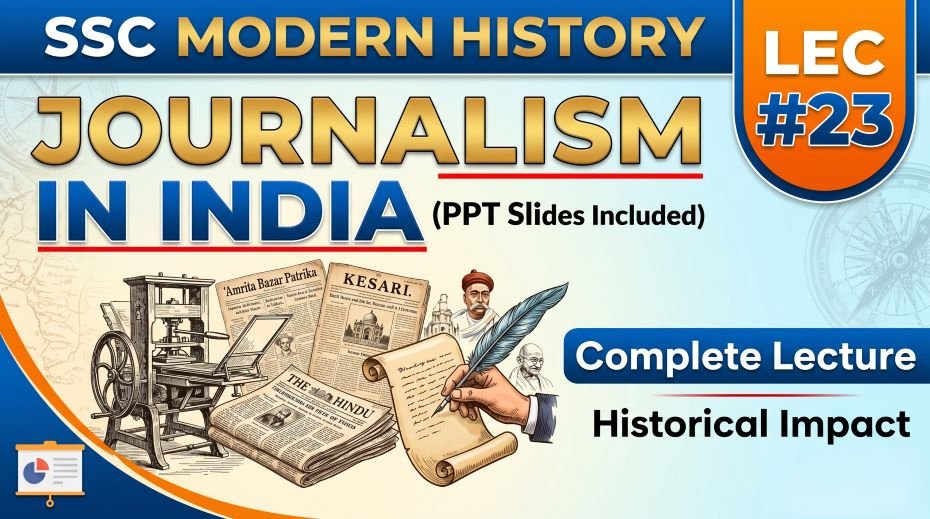
Welcome to Lecture 23 of the SSC Modern History Journalism in India PPT Slides (LEC #23) – PPT Series by SlidesharePPT. This lecture covers Modern Indian History: Journalism in India (भारत में पत्रकारिता) – one of the most direct and scoring chapters for SSC CGL, SSC CHSL, SSC MTS, SSC GD Constable, and RRB Group D exams.
In this article, you will find a complete study guide built around the 58-slide PPT – including a master timeline, all important newspapers with founders, press laws table, key journalists, a Podcast-style Q&A, and 30 practice MCQs with answers.
The PPT slides are embedded below with (iframe code on google slides) – self-made, regularly updated, and fully ready for both online and offline classroom use. Whether you are a teacher running a regular or marathon batch, or a student doing last-minute revision before your exam, you can use these slides directly on any device without downloading anything.
Section 1: PPT Resource Overview
| PPT RESOURCE OVERVIEW – LEC #23 | |
| Complete Foundation Batch for All SSC Exams | History PPT Series | Journalism in India | |
| Lecture Title | Journalism in India (भारत में पत्रकारिता) |
| Lecture Number | Lecture 23 (LEC #23) |
| Serial Number | #48 in the Complete Foundation Batch PPT Series |
| Total Slides | 58 High-Quality PPT Slides |
| File Size | 12 MB |
| Subject | Modern Indian History |
| Series Name | Complete Foundation Batch for All SSC and Other Competitive Exams (PPT SERIES) |
| Target Exams | SSC CGL | SSC CHSL | SSC MTS | SSC GD Constable | RRB Group D | State PSC |
| Topics Covered | First Newspaper in India → British-owned Press → Indian-owned Press → Press Regulations & Acts → Vernacular Press → Role of Press in Freedom Struggle → Key Journalists & Editors |
| Key Names | James Hicky, Raja Ram Mohan Roy, Bal Gangadhar Tilak, Dadabhai Naoroji, Surendranath Banerjea, Annie Besant, Lokmanya Tilak, G.K. Gokhale |
| Difficulty Level | Easy to Moderate – high return on time invested |
| Recommended Study | 1 to 2 days (first read) | Half day (revision) |
| PPT Source | slideshareppt.net |
| Best Combined With | LEC #21 (British Power) + LEC #22 (New States) for full Modern History coverage |
| Exam Tip: 5–10 direct MCQs from Journalism chapter appear in SSC CGL & CHSL every year | |
SSC Modern History Journalism in India PPT Slides (LEC #23) – (iframe and html combination)
Note: If you wish to download the entire SSC series (PPT slides), simply visit this redirect page. –REDIRECT PAGE
Section 2: Master Timeline – Journalism in India (1780 to 1947)
Every newspaper founding, press law, and key event – in chronological order with exam significance.
| Year | Event / Newspaper | SSC Significance |
| 1780 | Hicky’s Bengal Gazette founded | James Augustus Hicky; FIRST newspaper in India; published Jan 29, 1780; critical of EIC; shut down 1782 by Warren Hastings |
| 1780 | India Gazette | Second newspaper in India (Calcutta); British-owned |
| 1784 | Madras Courier | First newspaper in Madras (Chennai) |
| 1789 | Bombay Herald | First newspaper in Bombay (Mumbai); later merged with Bombay Gazette |
| 1791 | Bombay Gazette | Early influential English paper in Bombay |
| 1799 | Censorship of the Press Act | Lord Wellesley; ALL publications required prior government approval before printing – strictest early press law |
| 1818 | Samachar Darpan | First Bengali newspaper; started by Serampore Missionaries (Joshua Marshman); also called Digdarshan (1818 – educational journal came first) |
| 1821 | Sambad Kaumudi | Raja Ram Mohan Roy; first Indian-owned Bengali newspaper; advocated social reform, widow remarriage, abolition of Sati |
| 1822 | Mirat-ul-Akhbar | Raja Ram Mohan Roy; FIRST Persian-language newspaper in India; advocated freedom of press |
| 1822 | Bombay Samachar | Oldest surviving newspaper in Asia (still publishing); Gujarati language; founded 1822 |
| 1835 | Metcalfe’s Press Act (Freedom of Press) | Charles Metcalfe (Acting Governor-General); repealed all restrictive press regulations; called ‘Liberator of the Indian Press’; press enjoyed freedom for 43 years |
| 1838 | Bombay Times | Later became The Times of India (1861); English daily |
| 1851 | First Electric Telegraph in India | Calcutta to Agra; revolutionized news transmission; accelerated newspaper growth |
| 1861 | Times of India established | Merger of Bombay Times and other papers; most influential English daily |
| 1868 | Amrita Bazar Patrika | Started as Bengali paper by Sisir Kumar Ghosh and Motilal Ghosh; converted to English overnight in 1878 to avoid Vernacular Press Act |
| 1875 | The Hindu founded | G. Subramania Iyer and others; became leading South Indian English daily; based in Madras |
| 1878 | Vernacular Press Act | Lord Lytton; targeted Indian-language newspapers criticizing British rule; gave magistrates power to seize press and paper without trial; MOST controversial press law; repealed 1882 by Ripon |
| 1878 | Amrita Bazar Patrika converts to English | Overnight switch to English to escape Vernacular Press Act – famous act of press resistance |
| 1880 | Kesari and Mahratta | Bal Gangadhar Tilak; Kesari (Marathi) + Mahratta (English); most radical nationalist press; used to mobilize masses |
| 1881 | Tribune (Lahore) | Dayal Singh Majithia; important Punjab newspaper; nationalist voice |
| 1881 | The Bengal Gazette (new) | Not to be confused with Hicky’s; Surendranath Banerjea’s paper – called ‘Ambassador of Indian Nationalism’ |
| 1905 | Yugantar | Extremist Bengali newspaper; Bhupendranath Datta and Barindra Kumar Ghosh; advocated armed revolution |
| 1906 | Kal | Bal Gangadhar Tilak prosecuted for ‘seditious’ articles in Kesari about Chapekar brothers |
| 1906 | Indian Sociologist | Shyamji Krishna Varma; published from London; radical nationalist paper |
| 1907 | Kal (Sandhya) | Brahmabandhav Upadhyay; extremist Bengali paper |
| 1908 | Newspapers (Incitement to Offences) Act | Aimed at papers inciting violence; used to prosecute Tilak – sentenced to 6 years in Burma (Mandalay) |
| 1910 | Indian Press Act | Lord Minto; required press to deposit security; forfeited if seditious content published; major restriction |
| 1913 | Al-Hilal | Maulana Abul Kalam Azad; Urdu newspaper; criticized British; seized twice by government |
| 1914 | Al-Balagh | Maulana Abul Kalam Azad; second paper after Al-Hilal was seized |
| 1916 | Home Rule League papers | Bal Gangadhar Tilak (Marathi) and Annie Besant (New India + Commonweal); mass political mobilization through press |
| 1919 | Rowlatt Act | Extended wartime press restrictions into peace; triggered Gandhi’s first nationwide non-cooperation; Jallianwala Bagh followed |
| 1919 | Young India & Navajivan | Gandhi; Young India (English) + Navajivan (Gujarati); became primary tools of mass communication during freedom movement |
| 1920 | Independent (Allahabad) | Motilal Nehru; important Congress paper |
| 1932 | Harijan | Gandhi; English weekly; voice of Dalit rights and Hindu-Muslim unity |
| 1947 | Press Trust of India (PTI) formed | After independence; replaced Reuters as main Indian news agency |
Section 3: Role of Press in India’s Freedom Struggle
The Indian press was not merely an information medium – it was the primary weapon of political mobilization before radio and television. Understanding its role helps answer ’cause and effect’ SSC questions.
Three Phases of Indian Journalism
- Phase 1 (1780–1835): British-owned, missionary, and early reformist press. Hicky’s Bengal Gazette, missionary papers, Raja Ram Mohan Roy’s reform press. Government imposed strict censorship.
- Phase 2 (1835–1878): Golden Age of Press Freedom after Metcalfe’s Act (1835). Indian-owned papers multiply. English papers (The Hindu, Tribune) and vernacular papers grow side by side. Press becomes voice of Indian intelligentsia.
- Phase 3 (1878–1947): Press becomes weapon of mass nationalism. Vernacular Press Act (1878) triggers defiance. Tilak, Gandhi, Azad use newspapers to mobilize millions. Government responds with increasingly severe press laws. Press and freedom movement become inseparable.
Key Contributions of Press to Freedom Movement
- Spread ideas of nationalism, self-rule, and anti-colonialism to literate Indians across all regions
- Exposed British policies – drain of wealth (Naoroji), indigo oppression, famines, racial discrimination
- Coordinated mass movements – Non-Cooperation (Young India), Civil Disobedience, Home Rule (New India)
- Created a pan-Indian political consciousness that crossed language and regional barriers
- Gave nationalist leaders a platform to reach thousands simultaneously – before the era of radio
Section 4: Important Newspapers – Complete Founders & Facts Table
The most comprehensive newspapers reference for SSC. Every paper listed here has appeared in previous SSC CGL, CHSL, or MTS examinations.
| Newspaper | Year | Founded By | Place | Language | Key SSC Facts |
| Hicky’s Bengal Gazette | 1780 | James Augustus Hicky | Calcutta | English | FIRST newspaper in India (Jan 29, 1780); anti-EIC; shut by Warren Hastings 1782 |
| Samachar Darpan | 1818 | Joshua Marshman (Serampore Mission) | Serampore | Bengali | First Bengali newspaper; missionary press; Marshman also ran Digdarshan (1818) |
| Sambad Kaumudi | 1821 | Raja Ram Mohan Roy | Calcutta | Bengali | First Indian-owned Bengali paper; advocated Sati abolition, widow remarriage |
| Mirat-ul-Akhbar | 1822 | Raja Ram Mohan Roy | Calcutta | Persian | First Persian newspaper in India; advocated press freedom; Roy shut it in protest of press laws |
| Bombay Samachar | 1822 | Fardoonjee Marzban | Bombay | Gujarati | Oldest surviving newspaper in Asia (still published); 200+ years old |
| Rast Goftar | 1851 | Dadabhai Naoroji | Bombay | Gujarati | Founded by ‘Grand Old Man of India’; advocated drain of wealth theory |
| Amrita Bazar Patrika | 1868 | Sisir & Motilal Ghosh | Calcutta | Bengali → English | Converted to English overnight (1878) to escape Vernacular Press Act – famous defiance |
| The Hindu | 1875 | G. Subramania Iyer & others | Madras | English | Became leading South Indian nationalist paper; still published |
| Kesari | 1881 | Bal Gangadhar Tilak | Poona | Marathi | Radical nationalist paper; ‘Lal-Bal-Pal’ era; Tilak imprisoned for Kesari articles twice |
| Mahratta | 1881 | Bal Gangadhar Tilak | Poona | English | English companion to Kesari; reached educated nationalists |
| The Indian Mirror | 1862 | Keshab Chandra Sen | Calcutta | English | First daily newspaper owned and edited by an Indian |
| Voice of India | 1883 | Dadabhai Naoroji | London | English | Advocated Indian interests to British Parliament and public |
| New India | 1902 | Bipin Chandra Pal | Calcutta | English | Extremist nationalist; partition of Bengal agitation |
| Al-Hilal | 1912 | Maulana Abul Kalam Azad | Calcutta | Urdu | Anti-British; seized by government twice; Azad deported from Bengal |
| Yugantar | 1906 | Bhupendranath Datta & Barindra Ghosh | Calcutta | Bengali | Revolutionary; advocated armed uprising; sedition cases |
| Young India | 1919 | Mahatma Gandhi | Ahmedabad | English | Primary Gandhi mouthpiece; Non-Cooperation Movement propaganda |
| Navajivan | 1919 | Mahatma Gandhi | Ahmedabad | Gujarati | Gandhi’s Gujarati paper; mass reach in western India |
| Harijan | 1932 | Mahatma Gandhi | Poona | English | Campaigned for untouchability abolition and Hindu-Muslim unity |
| New India (Annie Besant) | 1914 | Annie Besant | Madras | English | Home Rule League movement; Besant arrested 1917 – backfired and boosted movement |
| Commonweal | 1914 | Annie Besant | Madras | English | Companion paper to New India; Home Rule agitation |
| Independent | 1919 | Motilal Nehru | Allahabad | English | Congress-aligned; Nehru family’s political mouthpiece |
| Sandhya | 1904 | Brahmabandhav Upadhyay | Calcutta | Bengali | Extremist; called for armed revolution; sedition prosecution |
Section 5: Press Laws & Regulations – All Acts in One Table
Press Acts are the second most-tested sub-topic in this chapter after newspaper founders. Know the year, the Governor-General who passed it, and what it did – especially the Vernacular Press Act and Metcalfe’s Press Act.
| Press Act / Law | Year | By Whom | Key Provision | SSC Significance |
| Censorship of the Press Act | 1799 | Lord Wellesley | All publications needed prior government approval before printing | Most severe early restriction; triggered by French Revolution fears; repealed by Hastings |
| Licensing Regulations | 1823 | John Adam (Acting G-G) | No publication without licence; licence could be cancelled anytime | Used to suppress Raja Ram Mohan Roy’s Mirat-ul-Akhbar; Roy shut paper in protest |
| Press Act (Metcalfe’s Act) | 1835 | Charles Metcalfe | Repealed ALL previous restrictive press laws; freedom of press granted | Metcalfe called ‘Liberator of the Indian Press’; press free for 43 years (1835–1878) |
| Vernacular Press Act | 1878 | Lord Lytton | Targeted only Indian-language papers; magistrates could seize press without trial; no jury | MOST controversial; called ‘Gagging Act’; repealed 1882 by Ripon; Amrita Bazar Patrika converted to English overnight to escape it |
| Newspapers (Incitement to Offences) Act | 1908 | Lord Minto | Papers inciting violence could be seized; editors prosecuted for sedition | Used to imprison Tilak for 6 years (Mandalay); targeted Bal-Pal-Lal era extremist press |
| Indian Press Act | 1910 | Lord Minto | Security deposit required from all publishers; forfeited if seditious content found | Extended press control; Al-Hilal (Azad) seized under this; 944 publications affected |
| Press Act 1931 | 1931 | British Government | Renewed restrictions during Civil Disobedience Movement | Gandhi’s Young India and Congress papers targeted |
| Rowlatt Act (Press provisions) | 1919 | Lord Chelmsford | Extended wartime press censorship into peacetime; no jury trials for press offences | Triggered Gandhi’s first nationwide hartal; led to Jallianwala Bagh massacre |
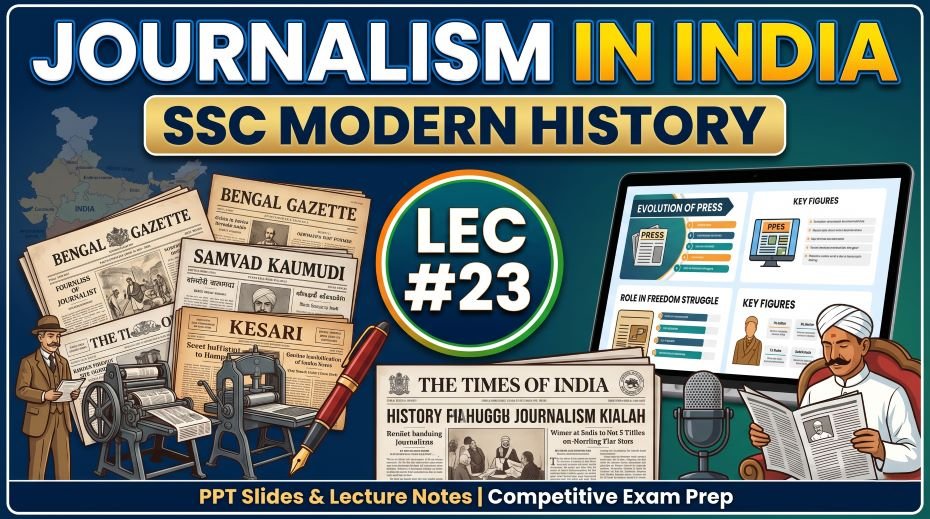
Section 6: Key Journalists & Their Newspapers – Quick Reference
Many SSC questions link a journalist to their paper or their paper to a movement. This table covers all major journalist-paper-movement connections.
| Journalist / Publisher | Nationality | Newspaper(s) | Key Contribution & SSC Fact |
| James Augustus Hicky | British | Bengal Gazette (1780) | First newspaper publisher in India; critical of Warren Hastings and EIC; imprisoned and press seized |
| Raja Ram Mohan Roy | Indian | Sambad Kaumudi (Bengali, 1821); Mirat-ul-Akhbar (Persian, 1822) | Father of Indian Renaissance; used press to campaign against Sati; shut Mirat-ul-Akhbar in protest of 1823 Licensing Act |
| Bal Gangadhar Tilak | Indian | Kesari (Marathi, 1881); Mahratta (English, 1881) | Used press to radicalize nationalism; imprisoned twice for Kesari articles (1897 & 1908); called press ‘weapon of the masses’ |
| Mahatma Gandhi | Indian | Young India (English, 1919); Navajivan (Gujarati, 1919); Harijan (English, 1932) | Transformed press into mass political tool; wrote personally in all three papers; Young India had 40,000+ readers |
| Maulana Abul Kalam Azad | Indian | Al-Hilal (Urdu, 1912); Al-Balagh (Urdu, 1914) | Most important Muslim nationalist journalist; both papers seized; deported from Bengal |
| Annie Besant | Irish-British | New India (1914); Commonweal (1914) | Theosophist; Home Rule League leader; arrested 1917 – arrest turned her into a martyr and boosted Home Rule movement |
| Dadabhai Naoroji | Indian | Rast Goftar (Gujarati, 1851); Voice of India (London) | ‘Grand Old Man of India’; press used to propagate Drain of Wealth theory; first Indian MP in British Parliament |
| Surendranath Banerjea | Indian | The Bengalee (1879) | ‘Surrender-not’ Banerjea; used press during Partition of Bengal (1905) agitation; called ‘Ambassador of Indian Nationalism’ |
| Bipin Chandra Pal | Indian | New India (1902) | Part of ‘Lal-Bal-Pal’ trio; radical nationalist journalism |
| Sisir Kumar Ghosh | Indian | Amrita Bazar Patrika (1868) | Converted paper from Bengali to English overnight (1878) to escape Vernacular Press Act – most famous act of press defiance |
| G. Subramania Iyer | Indian | The Hindu (1875); Swadesamitran (Tamil) | Founded The Hindu; important South India nationalist voice |
| Motilal Nehru | Indian | Independent (1919) | Congress leader; Allahabad-based paper; Nehru family’s political tool |
| Charles Metcalfe | British (pro-press) | – | As Acting Governor-General (1835), repealed all press restrictions; earned title ‘Liberator of the Indian Press’ |
Section 7: Important ‘First’ Facts – High-Frequency SSC MCQ Area
‘First’ questions are the easiest marks in this chapter. Know all of these:
- First newspaper in India: Hicky’s Bengal Gazette (January 29, 1780, Calcutta) – by James Augustus Hicky
- First Bengali newspaper: Samachar Darpan (1818) – by Serampore missionaries (Joshua Marshman)
- First Indian-owned Bengali newspaper: Sambad Kaumudi (1821) – by Raja Ram Mohan Roy
- First Persian newspaper in India: Mirat-ul-Akhbar (1822) – by Raja Ram Mohan Roy
- First newspaper in Madras: Madras Courier (1784)
- First newspaper in Bombay: Bombay Herald (1789)
- Oldest surviving newspaper in Asia: Bombay Samachar (1822, Gujarati – still published)
- First Indian-owned English daily: The Indian Mirror (1862) – by Keshab Chandra Sen
- First to give complete press freedom: Charles Metcalfe (1835) – called ‘Liberator of Indian Press’
Section 8: Podcast Q&A – Most Frequently Confused Topics
| # | Question | Expert Answer – Exam-Focused |
| Q1 | What was the FIRST newspaper in India and who started it? | Hicky’s Bengal Gazette, started by James Augustus Hicky on January 29, 1780 in Calcutta. It was also called the Calcutta General Advertiser. It was a weekly paper, fiercely critical of the East India Company and Warren Hastings. Hastings used legal charges (debt, libel) to shut it down in 1782 and confiscate Hicky’s press. SSC direct MCQ: First newspaper = Hicky’s Bengal Gazette = 1780. The second paper was the India Gazette (also 1780). Bombay’s first paper was Bombay Herald (1789). Madras’s first was Madras Courier (1784). |
| Q2 | Which press law is most important for SSC, and what is the Vernacular Press Act (1878)? | The Vernacular Press Act (1878) under Lord Lytton is the single most asked press law in SSC exams. Key points: (1) It applied ONLY to Indian-language (vernacular) papers – NOT to English papers, which is why it was called discriminatory; (2) It allowed magistrates to call newspaper editors, demand a bond (security), and if broken – seize the press and paper WITHOUT any trial or right of appeal; (3) It was nicknamed the ‘Gagging Act’ by nationalists; (4) The most famous act of resistance: Amrita Bazar Patrika (Calcutta) converted from a Bengali paper to an English paper OVERNIGHT to escape the Act; (5) It was repealed by Lord Ripon in 1882. SSC may also ask: ‘Who repealed the Vernacular Press Act?’ → Lord Ripon (1882). |
| Q3 | Who is called the ‘Liberator of the Indian Press’ and why? | Charles Metcalfe, who served as Acting Governor-General of India in 1835. He passed the Press Act of 1835 which repealed ALL existing press restrictions – the 1799 Censorship Act, the 1823 Licensing Regulations, and all other controls. This gave Indian newspapers complete freedom of the press. The Indian press remained largely free for 43 years (1835–1878) until Lord Lytton imposed the Vernacular Press Act. SSC MCQ pattern: ‘Who gave freedom to Indian press?’ → Charles Metcalfe. ‘Who was called Liberator of Indian Press?’ → Charles Metcalfe. |
| Q4 | How did Bal Gangadhar Tilak use journalism as a tool of nationalism? Why was he imprisoned? | Tilak founded two papers in 1881: Kesari (Marathi – for the masses) and Mahratta (English – for the educated). He used these papers to: (1) Criticize British policies openly and fearlessly; (2) Popularize the Ganesh Chaturthi and Shivaji festivals as nationalist gatherings; (3) Support the Chapekar brothers who assassinated British plague officials in Pune (1897) – his articles on this led to his FIRST imprisonment (18 months, 1897); (4) Write articles on the Bengal partition and extremist nationalism – his 1908 articles led to his SECOND imprisonment (6 years in Mandalay, Burma). SSC tip: Tilak imprisoned twice for Kesari articles – 1897 and 1908. |
| Q5 | What was Gandhi’s role in Indian journalism and which newspapers did he run? | Gandhi ran three newspapers: (1) Young India (English, from 1919) – his primary political mouthpiece during the Non-Cooperation and Civil Disobedience Movements; had circulation of 40,000+; (2) Navajivan (Gujarati, from 1919) – reached the masses in western India; Gandhi often translated Young India articles into Navajivan; (3) Harijan (English, from 1932) – focused specifically on untouchability abolition, Hindu-Muslim unity, and village reconstruction. Gandhi’s journalism was unique: he wrote personally in each paper, used plain accessible language, refused advertisements from businesses that conflicted with his values, and saw the press as a tool of ‘constructive programme’ not just political agitation. |
| Q6 | What was Maulana Abul Kalam Azad’s contribution to Indian press? | Maulana Azad was one of the most powerful journalist-politicians in the freedom movement. He founded two Urdu newspapers: (1) Al-Hilal (1912) – a radical weekly that combined Islamic scholarship with Indian nationalist politics; it reached a circulation of 26,000 (extraordinary for 1912); the British seized it twice and ultimately suppressed it permanently; (2) Al-Balagh (1914) – started after Al-Hilal’s suppression; also seized. Azad was deported from Bengal under the 1910 Indian Press Act and the Defence of India Rules. He was the youngest Congress President (1923, at age 35) and later India’s first Education Minister. SSC tip: Azad = Al-Hilal (1912) + Al-Balagh (1914). |
also read: SSC Modern History Rise of New States PPT Slides (LEC #22)
Section 9: 30 High-Frequency MCQs with Answers
Cover the answer column and self-test. Target: 28+ correct.
| # | Question | Answer |
| 01 | First newspaper in India was? | Hicky’s Bengal Gazette (January 29, 1780, Calcutta) |
| 02 | Who started Hicky’s Bengal Gazette? | James Augustus Hicky |
| 03 | First newspaper in Madras? | Madras Courier (1784) |
| 04 | First newspaper in Bombay? | Bombay Herald (1789) |
| 05 | Oldest surviving newspaper in Asia? | Bombay Samachar (1822, Gujarati, still publishing) |
| 06 | First Bengali newspaper in India? | Samachar Darpan (1818, by Serampore Mission / Joshua Marshman) |
| 07 | Who started Sambad Kaumudi and Mirat-ul-Akhbar? | Raja Ram Mohan Roy (1821 and 1822) |
| 08 | Mirat-ul-Akhbar was in which language? | Persian – first Persian newspaper in India |
| 09 | Who is called ‘Liberator of the Indian Press’? | Charles Metcalfe (Press Act of 1835) |
| 10 | What did Metcalfe’s Press Act 1835 do? | Repealed ALL previous press restrictions; gave complete freedom to Indian press |
| 11 | Vernacular Press Act was passed in which year and by whom? | 1878, Lord Lytton – targeted only Indian-language newspapers |
| 12 | Vernacular Press Act was nicknamed? | ‘Gagging Act’ by Indian nationalists |
| 13 | Who repealed the Vernacular Press Act? | Lord Ripon (1882) |
| 14 | Which paper converted to English overnight to escape Vernacular Press Act? | Amrita Bazar Patrika (1878), by Sisir Kumar Ghosh |
| 15 | Kesari and Mahratta newspapers were started by? | Bal Gangadhar Tilak (1881); Kesari in Marathi, Mahratta in English |
| 16 | Tilak was imprisoned for 6 years (Mandalay) due to articles in? | Kesari (1908) – under Newspapers Incitement to Offences Act |
| 17 | Tilak’s first imprisonment (1897) was also for articles in? | Kesari – regarding Chapekar brothers and British plague officials |
| 18 | Al-Hilal newspaper was started by? | Maulana Abul Kalam Azad (1912, Urdu) |
| 19 | Gandhi’s English newspaper was? | Young India (1919) |
| 20 | Gandhi’s Gujarati newspaper was? | Navajivan (1919) |
| 21 | Gandhi’s paper for Dalit rights was? | Harijan (1932) |
| 22 | New India and Commonweal newspapers were started by? | Annie Besant (1914) – Home Rule League movement |
| 23 | Rast Goftar newspaper was founded by? | Dadabhai Naoroji (1851, Gujarati) |
| 24 | Amrita Bazar Patrika was founded by? | Sisir Kumar Ghosh and Motilal Ghosh (1868) |
| 25 | The Hindu newspaper was founded in which year? | 1875, by G. Subramania Iyer in Madras |
| 26 | Censorship of the Press Act (1799) was passed by? | Lord Wellesley – required prior government approval for all publications |
| 27 | Indian Press Act 1910 was passed by? | Lord Minto – required security deposit; forfeited for seditious content |
| 28 | The Bengalee newspaper was associated with? | Surendranath Banerjea (1879) |
| 29 | Who founded Yugantar, the revolutionary Bengali newspaper? | Bhupendranath Datta and Barindra Kumar Ghosh (1906) |
| 30 | The first Indian-owned daily newspaper in English was? | The Indian Mirror (1862), by Keshab Chandra Sen |
Section 10: Rapid Revision – Last-Day Cheat Sheet
Must-Remember Pairs (Newspaper → Founder)
- Hicky’s Bengal Gazette → James Hicky (1780, FIRST)
- Sambad Kaumudi + Mirat-ul-Akhbar → Raja Ram Mohan Roy (1821, 1822)
- Kesari + Mahratta → Bal Gangadhar Tilak (1881)
- Young India + Navajivan + Harijan → Gandhi (1919, 1919, 1932)
- Al-Hilal + Al-Balagh → Maulana Abul Kalam Azad (1912, 1914)
- New India + Commonweal → Annie Besant (1914)
- Amrita Bazar Patrika → Sisir Kumar Ghosh (1868) – converted to English overnight 1878
- Bombay Samachar → Fardoonjee Marzban (1822, oldest surviving paper in Asia)
- The Hindu → G. Subramania Iyer (1875)
- Rast Goftar → Dadabhai Naoroji (1851)
Must-Remember Press Acts
- 1799 Censorship Act → Lord Wellesley (prior approval required)
- 1823 Licensing Regulations → John Adam (licence required; Roy shut Mirat-ul-Akhbar)
- 1835 Press Act → Charles Metcalfe (all restrictions repealed; ‘Liberator of Indian Press’)
- 1878 Vernacular Press Act → Lord Lytton (‘Gagging Act’; only vernacular papers; repealed 1882 by Ripon)
- 1908 Newspapers Incitement Act → Tilak imprisoned 6 years
- 1910 Indian Press Act → Lord Minto (security deposit; Al-Hilal seized)
3 Most-Tested One-Liners
- First newspaper in India = Hicky’s Bengal Gazette = 1780 = James Hicky
- Liberator of Indian Press = Charles Metcalfe = Press Act 1835
- Vernacular Press Act = 1878 = Lord Lytton = Gagging Act = Amrita Bazar Patrika escaped by converting to English
Conclusion
Journalism in India (LEC #23) is a focused, high-return chapter. The 58-slide PPT gives you the visual structure; this guide gives you every table, fact, and pattern you need for SSC. Master the Newspapers table, the Press Acts table, the Journalists table, and the 30 MCQs – and this chapter is fully solved.