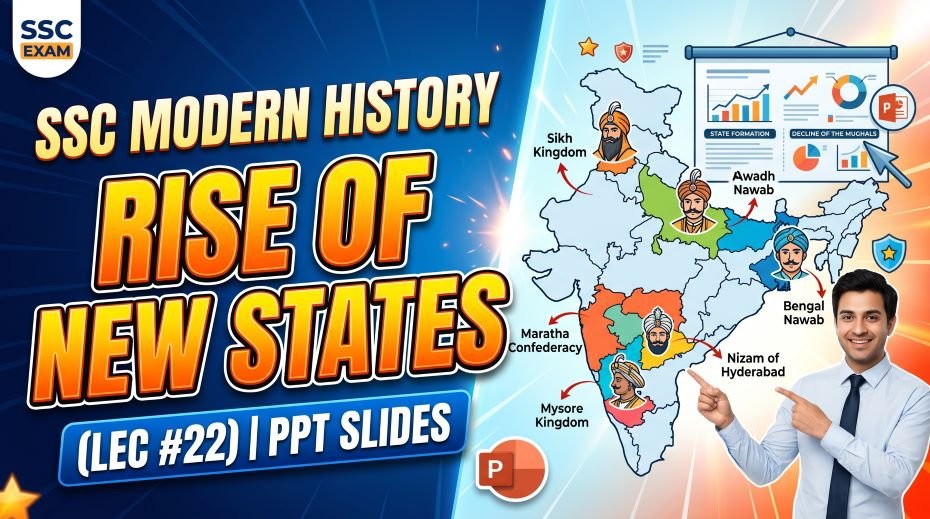
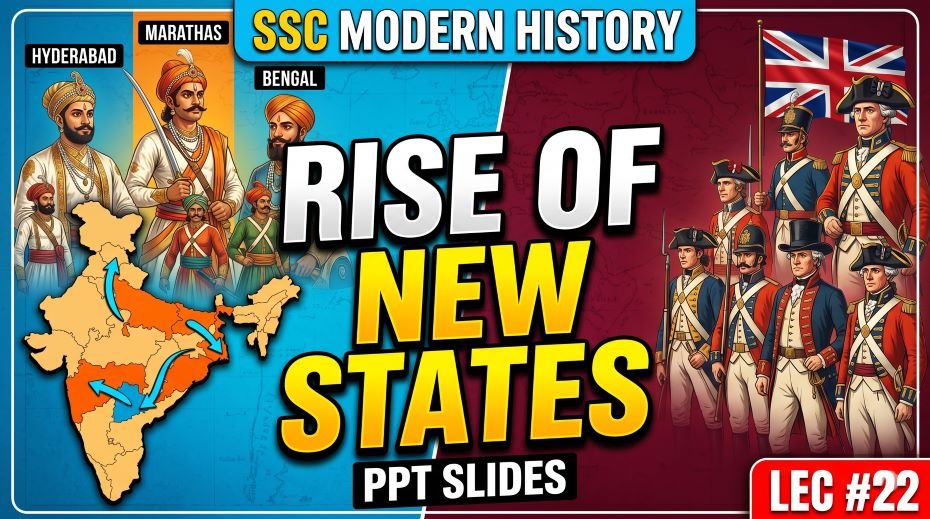
This article covers the complete Rise of New States chapter – SSC Modern History Rise of New States PPT Slides (LEC #22), from the collapse of the Mughal Empire (1707) to the absorption of the last independent successor states by 1849. It includes a full PPT overview card, a master timeline (42 entries), a New States comparison table, complete Nawab lists for Bengal and Awadh, Peshwa lineage table, invasion comparison, Podcast Q&A, and 30 MCQs – all built around LEC #22 of the SSC Foundation Batch PPT Series.
Section 1: PPT Resource Overview – At a Glance (LEC #22)
This table gives you the complete profile of the PPT resource – Lecture 22 of the Complete Foundation Batch for All SSC Exams. Understand the scope, target exams, and how to use this resource before diving into the content.
| PPT RESOURCE OVERVIEW – LEC #22 | |
| Complete Foundation Batch for All SSC Exams | History PPT Series | Rise of New States | |
| Lecture Title | Rise of New States in India (नए राज्यों का उदय) |
| Lecture Number | Lecture 22 |
| Serial Number | #47 in the Complete Foundation Batch PPT Series |
| Total Slides | 47 High-Quality PPT Slides |
| File Size | 12 MB |
| Subject | Modern Indian History |
| Series Name | Complete Foundation Batch for All SSC and Other Competitive Exams (PPT SERIES) |
| Target Exams | SSC CGL | SSC CHSL | SSC MTS | SSC GD Constable | RRB Group D | Delhi Police | State PSC | UPSC etc. |
| Topics Covered | Mughal Decline → Bengal Nawabs → Hyderabad → Awadh → Mysore → Marathas → Rajput States → Jat Kingdom → Sikh Power → Kerala (Travancore) → Rohilkhand |
| Key Personalities | Nizam-ul-Mulk, Murshid Quli Khan, Alivardi Khan, Saadat Khan, Martanda Varma, Suraj Mal, Banda Bahadur, Ranjit Singh, Shivaji |
| Format | Visual PPT Slides with Maps, Lineage Charts, Policy Notes, and Exam-Focused Summary Boxes |
| Medium | English with Hindi keywords (bilingual SSC-focused) |
| Difficulty Level | Beginner to Intermediate – suitable for first-time learners and revision |
| Recommended Study Time | 2 to 3 days (first read) | 1 day (revision) |
| PPT Source / Website | slideshareppt.net |
| Predecessor Lecture | LEC #21 – Expansion of British Power (Serial #46) – strongly recommended to study first |
| Best Combined With | This article’s Timeline Table, New States Comparison Table, Podcast Q&A, and 30 MCQs |
| High-Yield Chapter | 15–25% of SSC Modern History Questions on Post-Mughal States | |
Study Tip: Lecture 22 (Rise of New States) directly follows Lecture 21 (Expansion of British Power). Study LEC #21 first to understand WHY the British could expand – then study LEC #22 to understand the states they were expanding into. Together, they cover 70% of the SSC Modern Indian History syllabus.
SSC Modern History Rise of New States PPT Slides (LEC #22)
Note: If you wish to download the entire SSC series (PPT slides), simply visit this redirect page. –REDIRECT PAGE
Section 2: Master Timeline – Rise and Fall of New States (1680 to 1849)
This timeline covers the complete lifecycle of post-Mughal successor states – from Aurangzeb’s death to Punjab’s annexation in 1849. Each event includes its SSC exam significance. Revise this table daily in the final weeks before your exam.
| Year / Period | Event / Milestone | SSC Exam Significance |
| 1680 | Death of Shivaji | Maratha kingdom survives; succession struggle begins; Aurangzeb launches Deccan campaign |
| 1681–1707 | Aurangzeb’s Deccan Campaign | 27-year campaign; Mughal treasury drained; army exhausted; empire fatally weakened |
| 1707 | Death of Aurangzeb | Mughal fragmentation begins; 12 emperors in 50 years; nobles (Amirs) seize real power |
| 1707–1712 | Bahadur Shah I | Last effective Mughal emperor; weak successors follow; Sayyid Brothers rise |
| 1713 | Murshid Quli Khan – Nawab of Bengal | First independent Nawab of Bengal; transferred Mughal revenue system; Bengal becomes autonomous |
| 1713–1722 | Farrukhsiyar – Mughal Emperor | Sayyid Brothers dominate; Farrukhsiyar blinded and killed (1719); Mughal decline accelerates |
| 1717 | Farrukhsiyar’s Farman to EIC | Duty-free trade in Bengal; ‘Magna Carta’ of EIC; seeds British commercial dominance |
| 1720 | Sayyid Brothers Overthrown | Nizam-ul-Mulk engineers overthrow; consolidates his own power in Deccan |
| 1724 | Nizam-ul-Mulk founds Hyderabad | First Nizam; declared independence from Mughals; Asaf Jah dynasty begins |
| 1722 | Saadat Khan founds Awadh | Persian noble Burhan-ul-Mulk; made Awadh hereditary; first Nawab of Awadh |
| 1724–1748 | Murshid Quli Khan’s successors – Bengal | Shuja-ud-Din (1727–39) and Alivardi Khan (1740–56) continue autonomous Bengal |
| 1739 | Nadir Shah’s Invasion | Persian ruler sacks Delhi; Peacock Throne taken; Koh-i-Noor taken; Mughal prestige destroyed |
| 1740 | Alivardi Khan – Nawab of Bengal | Seized power from Shuja-ud-Din’s son; resisted Marathas; kept Bengal prosperous |
| 1743 | Martanda Varma unifies Travancore | Kerala state; defeated Dutch at Battle of Colachel (1741); modern Travancore army built |
| 1748 | Ahmad Shah Abdali’s First Invasion | Afghan ruler begins series of invasions; Mughals helpless; Punjab repeatedly plundered |
| 1748 | First Anglo-Mysore War preparations – Hyder Ali rises | Hyder Ali rises in Mysore army; de facto ruler by 1761; Mysore state revived |
| 1748–1754 | Peshwa Balaji Baji Rao (Nanasaheb) | Greatest Peshwa; Maratha power at peak; controlled Delhi to South India |
| 1750 | Suraj Mal becomes Jat ruler of Bharatpur | Most powerful Jat leader; built Lohagarh Fort (never captured); controlled Agra region |
| 1751 | Saadat Khan II (Safdar Jung) – Awadh | Second Nawab of Awadh; alliance with Marathas against Afghans; expelled from Delhi court |
| 1756 | Siraj-ud-Daulah – Last independent Bengal Nawab | Succeeded Alivardi Khan; fought British; defeated at Plassey (1757); Bengal independence ends |
| 1757 | Battle of Plassey | EIC defeats Bengal Nawab; beginning of the end for independent successor states in east |
| 1758 | Marathas capture Punjab & Peshawar | Peak Maratha expansion; Raghunathrao reaches Attock; Marathas at maximum territorial extent |
| 1760 | Battle of Udgir | Marathas defeat Nizam of Hyderabad; Marathas reach peak; overstretch begins |
| 1761 | Third Battle of Panipat | Ahmad Shah Abdali defeats Marathas; Peshwa Vishwasrao killed; Maratha expansion reversed |
| 1761 | Hyder Ali – de facto ruler of Mysore | Ousts Nanjaraj; formally controls Mysore; expands against Coorg, Malabar, Bednar |
| 1762 | Banda Bahadur – Sikh uprising context | Sikhs consolidate in Punjab after Mughal persecution; Misls system forms |
| 1763 | Mir Qasim – Battle of Patna (Bengal) | Last serious Bengal resistance to EIC; Battle of Buxar follows (1764) |
| 1764 | Battle of Buxar | British defeat Mir Qasim + Shuja-ud-Daula + Shah Alam II; British control north India |
| 1765 | Robert Clive – Diwani Rights | Bengal, Bihar, Orissa under British revenue control; North Indian successor states weakened |
| 1771 | Marathas restore Shah Alam II to Delhi | Mahadji Scindia escorts Mughal Emperor back; Marathas act as ‘protectors’ of Delhi |
| 1775 | Ranjit Singh born (later rules Punjab 1799–1839) | Future Lion of Punjab; unifies Sikh Misls; creates most powerful post-Mughal Indian kingdom |
| 1782 | Hyder Ali dies; Tipu Sultan succeeds Mysore | Tipu continues Mysore’s independence; Treaty of Mangalore (1784) – last British setback |
| 1784 | Treaty of Mangalore | Tipu Sultan wins Second Mysore War; last time an Indian ruler forced a treaty on the British |
| 1790s | Maratha Confederacy – Peak of Scindia power | Mahadji Scindia dominates Delhi and north India; commands Mughal Emperor; Maratha power resurges |
| 1795 | Battle of Kharda | Marathas defeat Nizam; last major Maratha offensive victory before British wars begin |
| 1799 | Tipu Sultan killed; Mysore falls | Mysore’s independence ends; Wodeyar dynasty restored under British; South India secured |
| 1799 | Ranjit Singh captures Lahore | Unification of Punjab begins; Treaty of Amritsar (1809) with British; Punjab stays independent |
| 1802 | Treaty of Bassein | Peshwa Baji Rao II accepts British Subsidiary Alliance; beginning of Maratha collapse |
| 1803–05 | Second Anglo-Maratha War | Scindia and Bhonsle defeated; Delhi falls; Mughal Emperor becomes British pensioner |
| 1817–18 | Third Anglo-Maratha War | Maratha Confederacy destroyed; Peshwaship abolished; all successor states under British control except Punjab |
| 1839 | Death of Ranjit Singh – Punjab weakens | Internal succession wars; British exploit divisions; leads to Anglo-Sikh Wars (1845, 1848) |
| 1849 | Punjab annexed | Last major successor state absorbed; British paramountcy complete across entire India |
Key Pattern for SSC: Notice how each successor state went through the same arc – rise during Mughal weakness, peak of independence, then British Subsidiary Alliance or military conquest. Understanding this arc helps you answer ’cause of fall’ questions for any state.
Section 3: Decline of the Mughal Empire – Why New States Could Rise
The rise of new states was not accidental – it was the direct consequence of the Mughal Empire’s collapse after 1707. Understanding the causes of Mughal decline is essential because SSC frequently asks ‘which factor caused the rise of regional powers’ or ‘who was responsible for Mughal decline’.
Primary Causes of Mughal Decline
- Aurangzeb’s 27-year Deccan Campaign (1681–1707): He spent nearly three decades fighting in the Deccan – exhausting the treasury, alienating the army, and neglecting the rest of the empire. When he died, there was no administrative structure left to hold the empire together
- Weak Successors – ‘War of Succession’ Culture: After Aurangzeb, 12 emperors ruled in approximately 50 years. Many were murdered, blinded, or deposed by nobles. Bahadur Shah I (1707–12) was the last emperor with genuine authority
- Rise of the Nobles (Amirs): The Sayyid Brothers (Hussain Ali Khan and Abdullah Khan) became ‘kingmakers’ between 1713 and 1720 – making and deposing four emperors. This demonstrated that the emperor was no longer the source of power
- Nadir Shah’s Invasion (1739): The Persian ruler’s sack of Delhi was a psychological and economic catastrophe. He took the Peacock Throne, the Koh-i-Noor, and over 70 crore rupees in treasure. Delhi itself was massacred. The Mughals never recovered their prestige
- Ahmad Shah Abdali’s Invasions (1748–1761): The Afghan ruler invaded India five times. At the Third Battle of Panipat (1761), he destroyed Maratha power – eliminating the most capable force that might have replaced the Mughals
- European Commercial Power: The EIC’s Farrukhsiyar Farman (1717) gave British traders duty-free access to Bengal – draining economic resources and creating a commercial empire that eventually became a political one
- Jat, Sikh, Maratha, and Rajput rebellions: Multiple regional powers asserted independence simultaneously, making coordinated Mughal response impossible
The Sayyid Brothers – Kingmakers of Delhi (1713–1720)
- Hussain Ali Khan (Viceroy of Deccan) and Abdullah Khan (Wazir)
- They elevated Farrukhsiyar to throne (1713), then had him blinded and killed (1719)
- They installed three more emperors in quick succession
- Nizam-ul-Mulk engineered their downfall in 1720 – then immediately went to found Hyderabad
- SSC Key Fact: The Sayyid Brothers are called ‘kingmakers’ – this specific term is asked directly
Section 4: All Major New States – Complete Comparison Table
This is the most comprehensive at-a-glance reference for all major successor states. Compare founding dates, founders, capitals, and how each state ultimately ended – all the information SSC examiners typically ask in one table.
| State | Founded By | Period | Key Rulers | Capital | How It Ended | SSC Key Facts |
| Bengal | Murshid Quli Khan (1713) | 1713–1757 | Murshid Quli Khan → Shuja-ud-Din → Alivardi Khan → Siraj-ud-Daulah | Murshidabad | Battle of Plassey (1757) – Siraj defeated; Bengal lost to British | Richest province; first independent successor state; EIC’s Farrukhsiyar Farman (1717) weakened Mughal control here |
| Hyderabad | Nizam-ul-Mulk / Asaf Jah I (1724) | 1724–1948 | Asaf Jah I → Nasir Jung → Muzaffar Jung → Salabat Jung → Nizam Ali Khan… | Hyderabad | Lasted until 1948 – longest surviving successor state; merged with India by police action | FIRST to accept Subsidiary Alliance (1798); Nizam was wealthiest Indian ruler; dynasty lasted 224 years |
| Awadh (Oudh) | Saadat Khan / Burhan-ul-Mulk (1722) | 1722–1856 | Saadat Khan → Safdar Jung → Shuja-ud-Daula → Asaf-ud-Daula → Wajid Ali Shah | Faizabad (later Lucknow) | Annexed by British in 1856 on grounds of misgovernance | Wajid Ali Shah exiled; annexation caused widespread anger; major cause of 1857 revolt |
| Mysore | Hyder Ali (1761 as de facto ruler) | 1761–1799 | Wadiyar dynasty (nominal) → Hyder Ali → Tipu Sultan → Wadiyar restored | Seringapatam | Tipu Sultan killed 1799; Wadiyar dynasty restored under British paramountcy | Only state where ruler died fighting; Tipu’s rocket artillery; strongest military resistance to British |
| Marathas (Peshwas) | Shivaji (1674 as Chhatrapati) | 1674–1818 | Shivaji → Sambhaji → Rajaram → Shahu → Peshwas (1713–1818) | Pune (Poona) | Peshwaship abolished 1818; Baji Rao II exiled to Bithur | Largest post-Mughal empire; covered 1/3 of India at peak; three Anglo-Maratha Wars before defeat |
| Punjab (Sikhs) | Ranjit Singh (1799) | 1799–1849 | Sikh Misls → Ranjit Singh unifies → after 1839: Sher Singh, Duleep Singh | Lahore | Punjab annexed 1849 after Second Anglo-Sikh War | Strongest post-1800 Indian kingdom; only state that maintained true independence until Ranjit’s death |
| Jat Kingdom | Churaman / Badan Singh (early 18th c.) | ~1710–1826 | Churaman → Badan Singh → Suraj Mal → after Suraj Mal: decline | Bharatpur | Bharatpur remained partially independent until 1826 | Suraj Mal most powerful; Lohagarh Fort never captured; controlled Agra-Mathura region |
| Rohilkhand | Ali Muhammad Khan (1720s) | ~1720–1774 | Ali Muhammad Khan → Hafiz Rahmat Khan | Bareilly (Moradabad area) | British-Awadh alliance destroys Rohilla state in Rohilla War (1774) | Rohilla War is one of Warren Hastings’ controversial actions; asked in SSC about First Anglo-Maratha War context |
| Travancore (Kerala) | Martanda Varma (1729) | 1729–1949 | Martanda Varma → Rama Varma → … | Thiruvananthapuram (Trivandrum) | Merged with India in 1949 | Beat Dutch at Battle of Colachel (1741) – only Asian victory over Europeans in this era; SSC high-frequency fact |
| Rajput States | Various Rajput chiefs (post-1707) | Post-1707 | Jaipur (Jai Singh II), Jodhpur, Udaipur, Bikaner, Kota etc. | Jaipur, Jodhpur etc. | Most accepted British Paramountcy and British protection under Subsidiary Alliance from 1817–18 | Jai Singh II of Jaipur – astronomer king; built Jantar Mantar observatories; most notable Rajput ruler of the era |
Section 5: Hyderabad – The Most Durable Successor State
Hyderabad under the Asaf Jah dynasty (Nizams) was the longest-lasting and most significant of all successor states. It survived from 1724 to 1948 – outlasting the Mughal Empire, the Maratha Empire, the British East India Company, and even the British Raj itself before being merged with independent India.
Nizam-ul-Mulk – Asaf Jah I (1724–1748)
- Born Qamar-ud-Din Khan; served under Mughal Emperors Farrukhsiyar, Rafi-ud-Darajat, and Muhammad Shah
- Was appointed Viceroy of Deccan; after defeating the Sayyid Brothers’ influence, became de facto independent
- In 1724, he defeated Mubariz Khan at the Battle of Shakar Kheda and declared himself Nizam (Governor) – establishing hereditary rule in Hyderabad
- Twice called to Delhi as Wazir (Prime Minister) but always returned to Hyderabad – showing his primary loyalty was to his own kingdom
- Founded the Asaf Jah dynasty (also called Nizams of Hyderabad) that lasted 7 generations
Hyderabad’s Key Role in the Carnatic Wars
- French and British both fought proxy wars THROUGH Hyderabad’s succession disputes (Second Carnatic War, 1749–54)
- French backed Muzaffar Jung for Hyderabad throne; British backed Nasir Jung
- Hyderabad was the FIRST state to accept Wellesley’s Subsidiary Alliance (1798) – a defining SSC MCQ
- Under the Subsidiary Alliance, Hyderabad ceded the Rayalaseema districts to pay for British troops
Section 6: Nawabs of Bengal – Complete Timeline Table
The Bengal succession is one of the most important sequences in SSC Modern Indian History. It ends with the Battle of Plassey (1757) – the single most transformative event in the entire British expansion story. Know every Nawab, their reign, and their relationship with the British.
| Nawab of Bengal | Reign | Key Actions & Events | SSC Significance |
| Murshid Quli Khan | 1713–1727 | Governor of Bengal under Mughals; shifted capital from Dacca to Murshidabad; made Bengal virtually independent; reformed revenue system; transferred Bengal treasury to Delhi but kept control | Shifted Bengal’s capital to Murshidabad (named after himself); first truly autonomous Nawab; established hereditary succession |
| Shuja-ud-Din | 1727–1739 | Son-in-law of Murshid Quli Khan; peaceful reign; extended authority to Bihar and Orissa; maintained prosperity | Continued Murshid Quli’s policies; Bengal stable and wealthy |
| Sarfaraz Khan | 1739–1740 | Weak ruler; son of Shuja-ud-Din; defeated and killed by Alivardi Khan at Battle of Giria (1740) | Only reigned 1 year; killed by his own governor – shows succession instability |
| Alivardi Khan | 1740–1756 | Seized power from Sarfaraz Khan; repelled repeated Maratha invasions of Bengal (paid chauth); refused to give trading privileges to EIC; kept Bengal prosperous | Bargi raids by Marathas traumatized Bengal; Alivardi’s last warning to Siraj-ud-Daulah about trusting EIC proved prophetic |
| Siraj-ud-Daulah | 1756–1757 | Last independent Nawab of Bengal; captured Calcutta (Black Hole incident, 1756); defeated by Robert Clive at Battle of Plassey (June 23, 1757) due to Mir Jafar’s betrayal; captured and executed by Mir Jafar’s son | Only 23 years old at Plassey; Mir Jafar bribed by British; Siraj’s death marks the end of Bengal’s independence – most critical event in British Indian history |
| Mir Jafar | 1757–1760 & 1763–1765 | British puppet; placed on throne after betraying Siraj; removed when he could not pay tributes; replaced by Mir Qasim; reinstated again 1763 | First ‘puppet Nawab’; became symbol of betrayal in Indian history; used derogatorily as ‘Mir Jafar’ to mean a traitor |
| Mir Qasim | 1760–1763 | Tried to be genuinely independent; abolished internal duties (rahdari) for all traders equally; British objected; Battle of Patna; allied with Awadh + Shah Alam II → Battle of Buxar (1764) | Last genuine attempt to resist British in Bengal; Battle of Buxar ends all resistance; Mir Qasim flees and dies in poverty |
Why Bengal Was the Richest Prize
- Bengal generated approximately 40% of the Mughal Empire’s total revenue – it was India’s most productive agricultural and commercial province
- Murshidabad was one of the wealthiest cities in the world in the early 18th century – rivaling London
- The EIC’s Bengal trade (silk, cotton, saltpetre) was its most profitable – control of Bengal = control of EIC’s entire business model
- The Diwani Rights granted after Buxar (1765) gave EIC revenue from Bengal, Bihar, AND Orissa – the entire northeastern India
Section 7: Nawabs of Awadh – Complete Timeline Table
Awadh (Oudh) was the most strategically located successor state – sitting between Bengal and Delhi, with a rich agricultural economy and a population that provided a large portion of the Bengal Army’s sepoys. Its annexation in 1856 directly caused the 1857 revolt.
| Nawab of Awadh | Reign | Key Events | SSC Exam Focus |
| Saadat Khan (Burhan-ul-Mulk) | 1722–1739 | Persian immigrant; appointed Subahdar of Awadh 1722; made it hereditary; reorganized revenue; resisted Marathas; invited Nadir Shah to India (1739) – then killed himself in shame | Founder of Awadh dynasty; his invitation to Nadir Shah is a famous SSC controversy |
| Safdar Jung | 1739–1754 | Son-in-law of Saadat Khan; also Wazir of Mughal Empire; allied with Marathas; driven from Delhi court 1753; returned to Lucknow; built Safdarjung Tomb in Delhi | Safdarjung Tomb in Delhi is his legacy – SSC may ask this; last Mughal Wazir with real power |
| Shuja-ud-Daula | 1754–1775 | Fought at Battle of Buxar (1764) against British alongside Mir Qasim and Shah Alam II; defeated; Treaty of Allahabad – ceded Kara and Allahabad; later helped British in Rohilla War (1774) | Critical link in Buxar story; his change of sides (fighting British then helping them) is frequently asked |
| Asaf-ud-Daula | 1775–1797 | Shifted capital from Faizabad to Lucknow; great patron of arts, music, Urdu poetry; built Bara Imambara (1784) | Bara Imambara (Lucknow) – an SSC architecture question; era of Awadh cultural peak |
| Wajid Ali Shah | 1847–1856 | Last Nawab of Awadh; known for patronage of Kathak dance and thumri music; deposed and exiled to Calcutta by Lord Dalhousie in 1856 on grounds of ‘misgovernance’ | Annexation of Awadh (1856) by Dalhousie on grounds of misgovernance (NOT Doctrine of Lapse) – highest-frequency SSC fact about Awadh; caused massive resentment leading to 1857 revolt |
Why the Annexation of Awadh Caused the 1857 Revolt
- Most Bengal Army sepoys came from Awadh (present-day UP) – they had deep emotional ties to the Nawab
- The Nawab Wajid Ali Shah was a cultured, beloved ruler – not a tyrant; Dalhousie’s ‘misgovernance’ claim was seen as a pretext
- Taluqdars (landlords) of Awadh lost their hereditary rights under British revenue settlement – creating a powerful enemy class
- The annexation broke an implicit promise – the British had used Awadh as a ‘buffer state’ and many Nawabs had cooperated with British campaigns
- It proved no Indian ruler was safe – not even loyal, cooperative ones
Section 8: Mysore – The Kingdom That Fought Hardest
Mysore under Hyder Ali and Tipu Sultan was the most formidable military opponent of British expansion in South India. The four Anglo-Mysore Wars (LEC #21 covers these in detail) represent the most serious challenge to British power in 18th century India.
Hyder Ali – Rise to Power
- Born ~1720 to a relatively low-ranking family in the Mysore army; rose through military talent
- By 1761, he overthrew Nanjaraj (the minister controlling the nominally ruling Wodeyar king) and became de facto ruler – the Wodeyar king was kept as a puppet
- Built a modernized army using French advisors; developed iron-cased rocket artillery
- Expanded Mysore into Coorg, Malabar, Bednore, and threatened the Carnatic
- Won First Anglo-Mysore War (1766–69) – British humiliated; Treaty of Madras
- Died of cancer in December 1782 during the Second Anglo-Mysore War; son Tipu continued
Tipu Sultan – Legacy and Significance
- Called ‘Tiger of Mysore’ – kept a mechanical tiger toy that crushed a British soldier figure (now in V&A Museum, London)
- Introduced a new Muwahidi calendar, new coinage system, and land revenue reforms in Mysore
- Developed the most advanced rocket artillery in 18th century Asia – studied by the British; influenced William Congreve’s rockets
- Maintained correspondence with Napoleon Bonaparte and the Ottoman Sultan seeking anti-British alliances
- Lost Third Anglo-Mysore War (Treaty of Seringapatam, 1792) – surrendered two sons as hostages and half his kingdom
- Killed defending Seringapatam on May 4, 1799 – his last words reportedly: ‘One day of life as a tiger is better than a hundred years as a sheep’
- After Tipu’s death, the Hindu Wodeyar dynasty was restored but under British paramountcy
Section 9: The Maratha Empire – From Shivaji to the Last Peshwa
The Maratha Empire was the largest and most powerful successor state to emerge from Mughal collapse. At its peak under Peshwa Balaji Baji Rao (Nanasaheb), it controlled territory from Attock in the northwest to the borders of Bengal in the east, and from the Himalayas to Tanjore in the south.
Shivaji – Founder of the Maratha Kingdom
- Shivaji Bhonsle (1627–1680): Founded the Maratha kingdom in the western Deccan; crowned as Chhatrapati (sovereign ruler) in 1674 with full Hindu royal ceremonies at Raigad Fort
- Evolved guerrilla warfare tactics (Ganimi Kava) perfectly suited to the Deccan terrain – harassed Mughal armies with fast cavalry raids
- Built a naval fleet – India’s only indigenous 17th century navy; contested Portuguese and British coastal power
- Revenue system: Ryotwari (direct peasant settlement) in his territories – progressive for his era
- After his death, his son Sambhaji continued resistance until captured and executed by Aurangzeb (1689)
The Peshwa System – Maratha Prime Ministers
The Peshwa (prime minister) gradually replaced the Chhatrapati as the real power in the Maratha Empire. By the 18th century, the Peshwa at Pune was the effective ruler while the Chhatrapati at Satara was a ceremonial figure.
| Peshwa | Tenure | Key Events & Contributions | SSC Exam Focus |
| Balaji Vishwanath | 1713–1720 | FIRST Peshwa (formal); brought Shahu out of Mughal captivity; centralized Maratha administration; Treaty of Lonar – gained right to collect chauth & sardeshmukhi from Mughal Deccan | First Peshwa; established Peshwa as hereditary PM; ‘chauth and sardeshmukhi’ terms very frequently asked in SSC |
| Baji Rao I | 1720–1740 | Greatest military Peshwa; never lost a battle; expanded Marathas from Deccan into North India (Malwa, Gujarat, Bundelkhand, Rajputana); siege of Delhi (1737) | Called ‘Napoleon of India’ by some historians; reached Delhi – direct SSC question; Battle of Palkhed (1728) against Nizam |
| Balaji Baji Rao (Nanasaheb) | 1740–1761 | Largest Maratha expansion under him – from Attock to South India; Punjab reached (1758); BUT Third Battle of Panipat (1761) disaster – died of shock hearing the news | Maratha power peaked then collapsed under him; Panipat 1761 is entirely his era; died of heartbreak post-Panipat |
| Madhav Rao I | 1761–1772 | Revived Maratha power after Panipat disaster; reformed finances; restored Maratha prestige; died young at 27 (tuberculosis) | Called the ‘greatest Peshwa after Baji Rao I’; his early death at 27 led to further instability |
| Narayan Rao | 1772–1773 | Murdered by his uncle Raghunathrao (Raghoba) with complicity of his aunt Anandibai; just 18 years old | Murder triggers the succession crisis that causes the FIRST ANGLO-MARATHA WAR – directly asked in SSC |
| Sawai Madhav Rao | 1774–1795 | Infant Peshwa; real power with Nana Fadnavis; Maratha revival continues; committed suicide at 21 | Nana Fadnavis (‘Maratha Machiavelli’) is the real power; his diplomacy kept Marathas alive against British |
| Baji Rao II | 1796–1818 | Last Peshwa; weak and indecisive; accepted British Subsidiary Alliance (Treaty of Bassein, 1802); fled Pune; finally surrendered; exiled to Bithur near Kanpur | Treaty of Bassein = Maratha suicide pact with British; his adopted son Nana Sahib at Bithur later led 1857 revolt |
The Maratha Confederacy – Three Great Chiefs
- Scindia (Gwalior): Controlled north India; Mahadji Scindia (1761–1794) was the most powerful – restored the Mughal Emperor Shah Alam II to Delhi (1771); dominated Delhi politics in the 1780s–90s
- Bhonsle (Nagpur): Controlled eastern Deccan and Berar; Raghoji Bhonsle repeatedly raided Bengal under Alivardi Khan – the ‘Bargis’ (Maratha raiders) were feared throughout Bengal
- Holkar (Indore): Controlled Malwa region; Jaswant Rao Holkar was the only Maratha chief to defeat the British in the Second Maratha War (1803) – forcing them to sign a humiliating convention at Deogaon
Chauth and Sardeshmukhi – Maratha Revenue Terms
- Chauth: One-fourth (25%) of a region’s revenue paid to Marathas to avoid Maratha raids; collected from non-Maratha territories
- Sardeshmukhi: Additional 10% of revenue; Marathas claimed the hereditary right to collect this as ‘Sardeshmukh’ (chief administrator) of the Deccan
- Combined: The Marathas extracted 35% of revenues from vast territories without directly administering them
- First secured by Balaji Vishwanath from the Mughal Emperor in 1719 – a critical SSC MCQ fact
Section 10: The Sikh Kingdom of Punjab – Ranjit Singh
Punjab under Maharaja Ranjit Singh (1799–1839) was the only post-Mughal Indian state that maintained genuine independence against British pressure throughout the 19th century. It was also the most modernized and efficiently organized of all successor states.
From Sikh Misls to Ranjit Singh’s Kingdom
- After Banda Bahadur’s execution (1716), Sikhs reorganized into 12 independent warrior bands called Misls – each controlling a different part of Punjab
- The Misls system created a decentralized Sikh power but prevented unified action
- Ranjit Singh was born in 1780 and inherited leadership of the Sukerchakia Misl in 1792
- In 1799, aged just 19, he captured Lahore from the Afghan governor – the heart of Punjab
- By 1808, he had united all 12 Misls into a single Sikh Kingdom
Key Facts About Ranjit Singh’s Kingdom
- Title: Maharaja of Punjab (also called ‘Sher-e-Punjab’ – Lion of Punjab)
- Capital: Lahore
- Army: Sikh Khalsa Army (Fauj-i-Khas) – trained by French generals Allard and Ventura; finest non-British army in India
- Territory: All of Punjab, Kashmir (purchased from Afghans), parts of Peshawar and NWFP
- Koh-i-Noor: He acquired the diamond from Afghan ruler Shah Shuja in 1813 – it stayed with him until his death
- Treaty of Amritsar (1809): Signed with British – Sutlej River as boundary; neither side would cross without consent
- Ranjit Singh strictly respected the Treaty of Amritsar boundary – he expanded everywhere EXCEPT against the British
- Death: June 27, 1839 – after his death, Punjab disintegrated due to succession disputes
After Ranjit Singh – Punjab’s Fall
- Four rulers in 10 years (1839–1849): Kharak Singh, Nau Nihal Singh, Sher Singh, Duleep Singh – all with violent deaths or depositions
- First Anglo-Sikh War (1845–46): Treaty of Lahore – Kashmir sold to Gulab Singh; British Resident placed at Lahore court
- Second Anglo-Sikh War (1848–49): Punjab fully annexed; Duleep Singh (child ruler) deposed; Koh-i-Noor taken by British
- Koh-i-Noor path: Babur → Mughals → Nadir Shah → Afghans → Ranjit Singh → Duleep Singh → Queen Victoria
Section 11: Other Important New States – Jats, Rajputs, Kerala, Rohilkhand
Jat Kingdom of Bharatpur
- The Jats were the peasant-warrior community of the Agra-Mathura-Bharatpur region
- Churaman (early 18th century): First prominent Jat leader; raided Mughal caravans
- Badan Singh: Consolidated Jat power; received the title ‘Brij Raj’
- Suraj Mal (1755–1763): Greatest Jat ruler; expanded to control Agra, Mathura, Aligarh; built the legendary Lohagarh Fort at Bharatpur – said to be built with iron mixed into mortar, making it impregnable
- Lohagarh Fort was NEVER captured – British tried to storm it in 1805 under Lord Lake but failed; this is a frequently asked SSC fact
- After Suraj Mal’s assassination (1763), Jat power declined
Rajput States
- After Aurangzeb’s death, Rajput states reasserted their semi-independence under Mughal nominal suzerainty
- Sawai Jai Singh II of Jaipur (1699–1743): Most notable Rajput ruler of the era; built five Jantar Mantar astronomical observatories (Delhi, Jaipur, Ujjain, Mathura, Varanasi); founded Jaipur city (1727) – planned city; compiled astronomical tables
- Most Rajput states eventually accepted British Paramountcy under the Subsidiary Alliance system (1817–18) and remained as princely states
Travancore and Kerala
- Martanda Varma (1729–1758): United the petty chieftains of Kerala into the Kingdom of Travancore; organized a modern army
- Battle of Colachel (1741): Martanda Varma’s Travancore army defeated the Dutch East India Company fleet – the only Asian military victory over a European colonial power in the Age of Colonialism
- Dutch Admiral Eustachius De Lannoy was captured and later employed by Martanda Varma to train the Travancore army
- Travancore signed a treaty of subsidiary alliance with the British in 1795
- The state merged with Indian Union in 1949 – one of the last princely state mergers
Rohilkhand
- Rohillas were Afghan settlers (Roh = Afghan homeland mountains) who settled in the Terai region of northern India
- Ali Muhammad Khan (1740s): Established Rohilkhand state centered on Bareilly
- Hafiz Rahmat Khan: Most important Rohilla chief; resisted Marathas with some success
- Rohilla War (1774): Nawab of Awadh Shuja-ud-Daula, backed by British under Warren Hastings, attacked Rohilkhand; Hafiz Rahmat Khan killed at Battle of Miranpur Katra; Rohilkhand absorbed into Awadh
- Warren Hastings was later impeached partly for his role in this ‘unjust war’ against Rohillas
Section 12: Key Foreign Invasions – Impact on New States
The foreign invasions of the 18th century accelerated Mughal decline and created opportunities for regional powers to expand. This table compares the two most important invasions.
| Invader | Year(s) | Origin | Key Battle | What Was Taken / Damage | Impact on Indian Power Structure |
| Nadir Shah | 1739 | Persia (Iran) | Battle of Karnal (Feb 1739) – defeated Muhammad Shah | Peacock Throne, Koh-i-Noor, Rs 70 crore treasury, Qatl-e-Aam (massacre) of Delhi citizens; territories west of Indus ceded | Mughal prestige utterly destroyed; first foreign sack of Delhi since Timur (1398); Muhammad Shah called ‘Rangila’ – incompetent ruler |
| Ahmad Shah Abdali (Durrani) | 1748 (1st), 1749, 1752, 1757, 1759–61 (5th) | Afghanistan | Multiple defeats of Mughals and Marathas; Battle of Panipat (1761) | Punjab looted repeatedly; Lahore taken multiple times; Delhi sacked (1757); Marathas defeated at Third Panipat (1761) | Completely destabilized northwest India; Maratha defeat at Panipat saved British from facing a united Maratha empire; Abdali never stayed to rule – created power vacuum |
| Timur Lang | 1398 | Central Asia | Sacked Delhi under Tughlaq Sultan | Massive looting; Delhi population massacred; city took a century to recover | Historical context – shows Delhi’s pattern of vulnerability; Nadir Shah compared to Timur |
Section 13: Podcast Interview – Expert Q&A on Rise of New States
The following podcast-style Q&A covers the most commonly confused and highest-frequency topics from the Rise of New States chapter. Each answer is structured for direct exam application.
| # | Question (SSC Aspirant Asks) | Expert Answer – Exam-Focused Explanation |
| Q1 | What were the main causes for the decline of the Mughal Empire after Aurangzeb? Why is this important for SSC? | Aurangzeb’s death (1707) triggered a rapid collapse for six interconnected reasons: (1) Weak successors – 12 emperors in 50 years, many murdered or blinded; (2) Drain of treasury – Aurangzeb’s 27-year Deccan campaign spent decades of accumulated Mughal wealth; (3) Rise of Nobles – the Sayyid Brothers (1713–20) showed that Amirs could make and unmake emperors; (4) Nadir Shah’s invasion (1739) – destroyed Mughal military prestige and took the Peacock Throne and Koh-i-Noor; (5) Ahmad Shah Abdali’s repeated invasions – Punjab repeatedly looted; (6) Rise of regional powers – Bengal, Hyderabad, Awadh, Marathas all became independent. SSC asks cause-and-effect: ‘Which invasion destroyed Mughal prestige most?’ → Nadir Shah (1739). |
| Q2 | How many Nawabs of Bengal were there? Who was the LAST independent Nawab and why? | There were 7 Nawabs of Bengal from 1713 to 1765: Murshid Quli Khan → Shuja-ud-Din → Sarfaraz Khan → Alivardi Khan → Siraj-ud-Daulah → Mir Jafar → Mir Qasim (and Mir Jafar again). Siraj-ud-Daulah is called the LAST INDEPENDENT Nawab because after his defeat at Plassey (1757), all subsequent Nawabs were British puppets. The SSC-critical distinction: Mir Jafar and Mir Qasim were Nawabs AFTER Plassey, but they were puppet rulers, not independent ones. When the question asks ‘last independent Nawab of Bengal,’ the answer is always Siraj-ud-Daulah. |
| Q3 | What was Nadir Shah’s invasion and why is it a standalone SSC topic? | Nadir Shah (ruler of Persia/Iran) invaded India in 1739 under the weak Mughal Emperor Muhammad Shah. Key facts for SSC: (1) He defeated the Mughal army at Battle of Karnal (February 1739); (2) He entered Delhi; (3) The Qila-i-Kohna Mosque massacre – after a rumor of his death, Delhi citizens killed Persian soldiers; Nadir Shah ordered a general massacre (Qatl-e-Aam) of Delhi’s population; (4) He took: the Peacock Throne (Takht-e-Taus), the Koh-i-Noor diamond, and treasure worth 70 crore rupees; (5) He returned Persia within a year but ceded territories west of Indus to him. Why SSC asks about it: Nadir Shah = Peacock Throne + Koh-i-Noor taken; also asks ‘Battle of Karnal was fought between whom?’ → Nadir Shah vs Muhammad Shah Mughal. |
| Q4 | What is the difference between the three Maratha Confederacy chiefs – Scindia, Bhonsle, and Holkar? They confuse me. | All three were Maratha chiefs subordinate to the Peshwa, controlling different territories: (1) Scindia (Gwalior) – controlled north India including Delhi; Mahadji Scindia was the most powerful, practically controlling the Mughal Emperor; later Daulat Rao Scindia fought British in Second Maratha War; (2) Bhonsle (Nagpur) – controlled eastern Deccan and Berar; Raghoji Bhonsle repeatedly raided Bengal under Alivardi Khan; (3) Holkar (Indore) – controlled Malwa and parts of Rajputana; Jaswant Rao Holkar actually DEFEATED the British in the Second Maratha War (1803) forcing them to retreat – the only Maratha chief to beat the British in that war. SSC tip: Scindia = Delhi/Gwalior; Bhonsle = Nagpur; Holkar = Indore. |
| Q5 | Who was Martanda Varma and why is the Battle of Colachel important for SSC? | Martanda Varma was the ruler of Travancore (present-day Kerala) who reigned from 1729 to 1758. He is important for SSC for one specific reason: the Battle of Colachel (1741). In this battle, Martanda Varma’s Travancore army defeated a Dutch East India Company (VOC) fleet – making it the only Asian military victory over a European colonial power during the Age of Colonialism. The Dutch Admiral Eustachius De Lannoy was captured and later helped Martanda Varma modernize his own army. This battle is the single most frequently asked fact about Travancore/Kerala in SSC Modern History. Remember: Colachel (1741) = Indian army beats European colonists = unique event. |
| Q6 | What made Ranjit Singh’s Punjab different from all other successor states? | Ranjit Singh’s Punjab was unique in four ways that SSC examiners love: (1) Only post-1800 Indian state that maintained true independence against British pressure – the Treaty of Amritsar (1809) established the Sutlej as the boundary and the British respected it during Ranjit’s lifetime; (2) He created the Sikh Khalsa Army (Fauj-i-Khas) with French and Italian military advisors – finest non-British army in India; (3) He acquired the Koh-i-Noor diamond from the Afghan ruler Shah Shuja – the diamond’s path (Afghanistan → Ranjit Singh → Second Sikh War → Queen Victoria) is a direct SSC question chain; (4) He united the 12 Sikh Misls into one kingdom – before him, Punjab was fragmented into independent warrior bands. After his death (1839), Punjab fell apart and was annexed by 1849. |
| Q7 | What is chauth and sardeshmukhi? These Maratha terms appear in SSC repeatedly. | Both are Maratha tax collection rights: (1) Chauth: A tax equal to one-fourth (25%) of a region’s revenue that the Marathas demanded from territories they did NOT directly administer, in exchange for not raiding those territories. Essentially protection money. (2) Sardeshmukhi: An additional 10% tax that the Marathas claimed as the hereditary ‘chief revenue officer’ (Sardeshmukh) of the Deccan. Balaji Vishwanath (First Peshwa) secured the right to collect both from the Mughal Deccan in 1719 – this is a direct SSC question. Combined, the Marathas took 35% of revenues from a huge swath of India without even ruling it directly. SSC tip: Chauth = 25%; Sardeshmukhi = 10%; Total = 35%; First secured by Balaji Vishwanath (1719). |
Section 14: 30 High-Frequency MCQs with Answers
These questions are based on previous SSC CGL, CHSL, MTS, and GD Constable exam patterns. Cover the answer column and self-test. Aim for 28+ correct answers.
| # | Question | Answer |
| 01 | Who was the first independent Nawab (Subahdar) of Bengal? | Murshid Quli Khan (1713) |
| 02 | Murshid Quli Khan shifted Bengal’s capital from Dhaka to? | Murshidabad (named after himself) |
| 03 | Who was the last INDEPENDENT Nawab of Bengal? | Siraj-ud-Daulah (defeated at Plassey, 1757) |
| 04 | Who betrayed Siraj-ud-Daulah at Battle of Plassey? | Mir Jafar (Commander-in-Chief) |
| 05 | Alivardi Khan paid tribute to the Marathas to stop their raids called? | Chauth (and agreed to pay fixed annual tribute) |
| 06 | Who founded the Hyderabad state (Asaf Jah dynasty)? | Nizam-ul-Mulk / Asaf Jah I (1724) |
| 07 | Hyderabad was the FIRST state to accept whose policy? | Subsidiary Alliance of Lord Wellesley (1798) |
| 08 | Who was the founder of the Awadh Nawab dynasty? | Saadat Khan / Burhan-ul-Mulk (1722) |
| 09 | Awadh was annexed by the British in which year on what grounds? | 1856 – on grounds of misgovernance (NOT Doctrine of Lapse) |
| 10 | Who was the last Nawab of Awadh? | Wajid Ali Shah (exiled to Calcutta by Dalhousie) |
| 11 | Bara Imambara in Lucknow was built by which Nawab of Awadh? | Asaf-ud-Daula (1784) |
| 12 | Battle of Colachel (1741) was fought between whom? | Martanda Varma (Travancore) vs Dutch East India Company – Travancore wins |
| 13 | Why is Battle of Colachel historically unique? | Only Asian military victory over a European power during the colonial era |
| 14 | Who was the greatest Peshwa – never lost a battle? | Baji Rao I (1720–1740) |
| 15 | What is chauth in Maratha revenue system? | 25% tax collected from non-Maratha territories in exchange for protection |
| 16 | What is sardeshmukhi? | Additional 10% tax claimed by Marathas as hereditary chief revenue officer of Deccan |
| 17 | Who first secured chauth and sardeshmukhi rights for Marathas from Mughals? | Balaji Vishwanath (First Peshwa, 1719) |
| 18 | Nadir Shah’s invasion of India took place in which year? | 1739 (under Mughal Emperor Muhammad Shah) |
| 19 | What did Nadir Shah take from Delhi? | Peacock Throne (Takht-e-Taus) and Koh-i-Noor diamond |
| 20 | Battle of Karnal (1739) was fought between? | Nadir Shah (Persia) vs Muhammad Shah (Mughal Emperor) – Nadir Shah wins |
| 21 | Which Maratha Peshwa is associated with the Third Battle of Panipat (1761)? | Balaji Baji Rao (Nanasaheb) – died of shock after Panipat news |
| 22 | Who was the ‘Maratha Machiavelli’? | Nana Fadnavis (Nana Phadnavis) – diplomat and statesman of Sawai Madhav Rao’s era |
| 23 | Suraj Mal was the ruler of which Jat kingdom? | Bharatpur – controlled Agra-Mathura region; built Lohagarh Fort |
| 24 | What is Lohagarh Fort famous for? | Never captured by any enemy – built by Suraj Mal (Bharatpur) |
| 25 | Ranjit Singh captured Lahore in which year? | 1799 – beginning of Sikh Kingdom unification |
| 26 | The Treaty of Amritsar (1809) was between? | Ranjit Singh and British East India Company – Sutlej as boundary |
| 27 | Koh-i-Noor was with Ranjit Singh. How did British get it? | Taken after Second Anglo-Sikh War (1849) from child Maharaja Duleep Singh |
| 28 | Ahmad Shah Abdali’s invasion that defeated Marathas? | Third Battle of Panipat – 1761 |
| 29 | Which Maratha chief controlled Delhi and had the Mughal Emperor under his protection? | Mahadji Scindia (Gwalior) in the 1780s–1790s |
| 30 | The Peshwas were the hereditary Prime Ministers of which ruler? | Chhatrapati of Satara (Maratha king) – Shahu’s line |
also read: SSC History Expansion of British Power PPT Slides (LEC #21)
Section 15: Rapid Revision – Last-Day Cheat Sheet
Must-Remember Founding Dates of New States
- Bengal: Murshid Quli Khan → 1713 | Hyderabad: Nizam-ul-Mulk → 1724 | Awadh: Saadat Khan → 1722
- Mysore: Hyder Ali → 1761 (de facto) | Marathas formal: Shivaji crowned 1674, Peshwa era 1713
- Punjab (Ranjit Singh): 1799 (Lahore captured) | Travancore: Martanda Varma → 1729
Unique Facts for Each State – SSC One-Liners
- Bengal: Last independent Nawab = Siraj-ud-Daulah | Richest province
- Hyderabad: First Subsidiary Alliance (1798) | Longest surviving (merged India 1948)
- Awadh: Annexed for ‘misgovernance’ NOT Doctrine of Lapse | Wajid Ali Shah exiled
- Mysore: Tipu Sultan DIED fighting (1799) | Never surrendered | Rocket artillery innovator
- Marathas: Chauth = 25%, Sardeshmukhi = 10% | Baji Rao I never lost a battle | Panipat 1761 ended expansion
- Punjab: Ranjit Singh = Lion of Punjab | Treaty of Amritsar 1809 | Koh-i-Noor acquired 1813
- Travancore: Battle of Colachel 1741 = only Asian victory over European power
- Jats: Suraj Mal | Lohagarh Fort NEVER captured
Nadir Shah vs Ahmad Shah Abdali – Quick Distinction
- Nadir Shah: Came ONCE (1739) | Persian | Took Peacock Throne + Koh-i-Noor | Battle of Karnal
- Ahmad Shah Abdali: Came FIVE times (1748 to 1761) | Afghan | Third Panipat (1761) | Defeated Marathas
Peshwa Order – Memory Trick
- ‘BaBa Never Makes Narayan Sad Brave’ = Balaji Vishwanath → Baji Rao I → Balaji Baji Rao → Madhav Rao I → Narayan Rao → Sawai Madhav Rao → Baji Rao II
Section 16: Conclusion – Connecting LEC #22 to Your SSC Success
The Rise of New States chapter reveals why the British were able to expand so rapidly and completely. They did not conquer a strong, unified empire – they filled a vacuum left by a collapsing Mughal system, absorbed states one by one through the Subsidiary Alliance, Doctrine of Lapse, and military conquest, and exploited the mutual rivalries of regional powers who could never unify against them.
LEC #22 of the SSC Foundation Batch PPT Series captures this story in 47 slides. This article extends that with 9 comprehensive tables, detailed narrative notes, a Podcast Q&A covering the most confusing topics, and 30 practice MCQs. Together with LEC #21 on British Expansion, you have covered the entire Modern Indian History section that SSC examiners draw from most heavily.
Final Pre-Exam Checklist
- Know all 7 Bengal Nawabs in order with reign years – especially Siraj-ud-Daulah as ‘last independent’
- Know all 5 Awadh Nawabs – especially that Awadh was annexed for ‘misgovernance’ NOT Doctrine of Lapse
- Know the Peshwa order – at minimum the 7 Peshwas and their key event each
- Chauth = 25%, Sardeshmukhi = 10%, first secured by Balaji Vishwanath – memorize this
- Battle of Colachel (1741) = Martanda Varma vs Dutch = only Asian victory over Europeans – memorize
- Nadir Shah (1739) = Peacock Throne + Koh-i-Noor | Abdali (1761) = Panipat
- Ranjit Singh = Lahore captured 1799 + Treaty of Amritsar 1809 + Koh-i-Noor 1813
- Hyderabad = First Subsidiary Alliance (1798) | Lasted until 1948
- Lohagarh Fort = never captured | Suraj Mal | Bharatpur
- Score 28+ on the 30 MCQ table before your exam day.