Welcome to Lecture 24 (SSC Modern History Growth of Education in India PPT Slides (LEC #24) of the Complete Foundation Batch for All SSC Exams – PPT Series by SlidesharePPT. This lecture covers Growth of Education in India, (भारत में शिक्षा का विकास) – a highly scoring and direct chapter for SSC CGL, SSC CHSL, SSC MTS, SSC GD Constable, and RRB Group D exams.
In this article, you will find a complete study guide built around the 62-slide PPT – including a full timeline from pre-British education to post-independence, all major education commissions with recommendations, important universities with founding years, key personalities, a Podcast-style Q&A on the most confusing topics, and 30 practice MCQs with answers.
The PPT slides are embedded below – self-made, regularly updated, and fully optimized for both online and offline classroom use. Whether you are a teacher conducting regular batches or a marathon revision class, or a student cramming the night before your exam, you can view and use these slides directly on any device – no download needed.
Section 1: PPT Resource Overview
| PPT RESOURCE OVERVIEW – LEC #24 | |
| Complete Foundation Batch for All SSC Exams | History PPT Series | Growth of Education in India | |
| Lecture Title | Growth of Education in India (भारत में शिक्षा का विकास) |
| Lecture Number | Lecture 24 (LEC #24) |
| Serial Number | #49 in the Complete Foundation Batch PPT Series |
| Total Slides | 62 High-Quality PPT Slides |
| File Size | 11 MB |
| Subject | Modern Indian History |
| Series Name | Complete Foundation Batch for All SSC and Other Competitive Exams (PPT SERIES) |
| Target Exams | SSC CGL | SSC CHSL | SSC MTS | SSC GD Constable | RRB Group D | State PSC |
| Topics Covered | Pre-British Education → Charter Act 1813 → Orientalist vs Anglicist Debate → Macaulay’s Minute → Wood’s Despatch → First Universities → Hunter Commission → Indian Universities Act → Sadler Commission → Wardha Scheme → Sargent Plan |
| Key Names | Macaulay, Charles Wood, Hunter, Raja Ram Mohan Roy, Gandhi (Wardha), Sargent, Hartog, Sadler, H.H. Riseley |
| Difficulty Level | Easy – high scoring chapter with direct MCQs |
| Recommended Study | 1 to 2 days (first read) | Half day (revision) |
| PPT Source | slideshareppt.net |
| Best Combined With | LEC #23 (Journalism) – both cover British social/intellectual impact on India |
| Exam Tip: Education commissions and their recommendations = 5–8 direct MCQs every SSC exam | |
SSC Modern History Growth of Education in India PPT Slides (LEC #24) – (iframe and html combination)
Note: If you wish to download the entire SSC series (PPT slides), simply visit this redirect page. –REDIRECT PAGE
Section 2: Master Timeline – Growth of Education in India (Pre-1813 to 1966)
Every key education policy, commission, and university – chronological order with SSC significance.
| Year | Event / Policy | Key Details & SSC Significance |
| Pre-1813 | Traditional Education System | Gurukuls (Hindu), Madrasas (Muslim), Pathshalas (elementary) – all privately funded; no government role; Sanskrit, Arabic, Persian medium |
| 1781 | Calcutta Madrasa founded | Warren Hastings; for Muslim higher education; first government-funded institution; taught Arabic, Persian, Islamic law |
| 1791 | Benaras Sanskrit College founded | Jonathan Duncan; for Hindu classical learning; Government of India funds Hindu scholarship |
| 1800 | Fort William College, Calcutta | Lord Wellesley; for training British civil servants in Indian languages; not for Indian students |
| 1813 | Charter Act – Education Clause | Rs 1 lakh (one lakh) per year allocated by EIC for ‘revival and improvement of literature and encouragement of learned natives’ – FIRST government commitment to Indian education |
| 1817 | Hindu College, Calcutta | David Hare and Raja Ram Mohan Roy; first modern higher education institution for Indians; English medium; later Presidency College |
| 1820s–1830s | Orientalist vs Anglicist Controversy | Orientalists (H.H. Wilson, Prinsep): teach in Sanskrit/Arabic/Persian. Anglicists (Macaulay, Trevelyan): teach in English. English wins. |
| 1830 | Elphinstone College, Bombay | Governor Mountstuart Elphinstone; English education in Bombay Presidency |
| 1835 | Macaulay’s Minute on Education | Lord Bentinck accepts Macaulay’s recommendation: English as medium of instruction; goal to create ‘a class of persons Indian in blood but English in tastes’ – Downward Filtration Theory |
| 1835 | English made official language | Under Lord Bentinck; replaced Persian as court/government language; Macaulay’s Minute implemented |
| 1844 | English education for government jobs | Lord Hardinge orders: English-educated Indians preferred in government appointments – massive boost to English education demand |
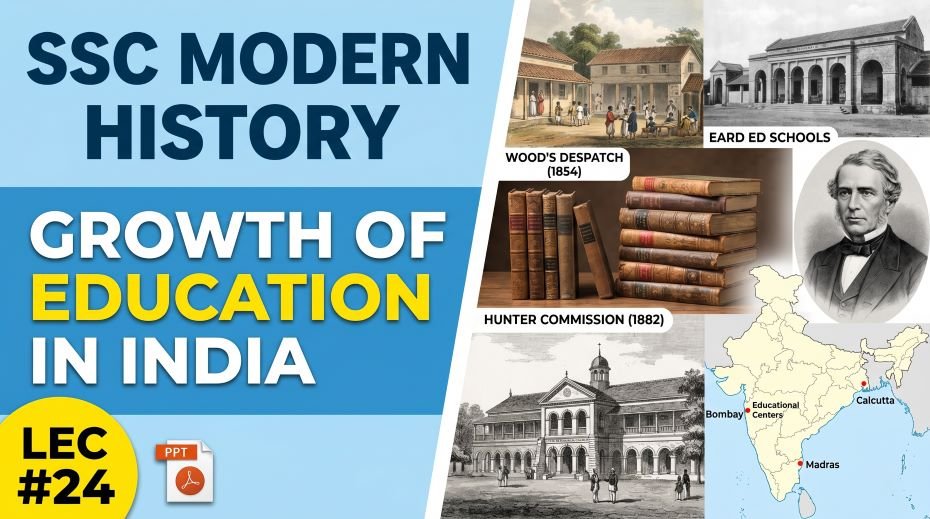
| 1854 | Wood’s Education Despatch | Charles Wood (President of Board of Control); most important education document before independence; called ‘Magna Carta of Indian Education’ |
| 1857 | First Three Universities | Calcutta, Bombay, Madras Universities established; all affiliating universities (no teaching; only examination); direct result of Wood’s Despatch |
| 1858 | Punjab University College | Lahore; became Punjab University 1882 |
| 1870s | Downward Filtration Theory failure acknowledged | British educated only upper class; knowledge did not ‘filter down’ to masses; Hunter Commission set up |
| 1882 | Hunter Commission | W.W. Hunter as Chairman; reviewed education since Wood’s Despatch (1854); recommended: hand over primary/secondary education to local bodies; expand higher education; education for women |
| 1886 | Aligarh Muslim University roots | Sir Syed Ahmad Khan founds Muhammadan Anglo-Oriental College (1875) → became AMU 1920 |
| 1898 | Indian Universities Act context | Curzon worried about ‘seditious’ educated Indians; Lord Curzon ordered review |
| 1901 | Shimla Education Conference | Lord Curzon convened; criticized quality of Indian education; set stage for 1904 Act |
| 1904 | Indian Universities Act | Lord Curzon; increased government control over universities; reduced elected members; stricter affiliation rules; aimed to control ‘seditious’ nationalism in colleges |
| 1905 | Swadeshi & National Education Movement | Bengal Partition triggers demand for national education free from British control; National Council of Education formed |
| 1906 | National Council of Education | Bengal; Satish Chandra Mukherjee; alternative nationalist education system; later became Jadavpur University |
| 1911 | Gokhale’s Free & Compulsory Education Bill | G.K. Gokhale introduced bill for free and compulsory primary education; defeated in Imperial Legislative Council by British |
| 1916 | Benaras Hindu University | Madan Mohan Malaviya founds BHU; nationalist higher education; Hindu culture + modern science |
| 1916 | Aligarh Muslim University (as college) | Sir Syed Ahmad Khan’s MAO College evolves; becomes university 1920 |
| 1917–19 | Sadler Commission | Michael Sadler; appointed to reform Calcutta University; recommendations: 3-year degree, 12-year school, intermediate colleges; most recommendations adopted widely |
| 1920 | Non-Cooperation Movement – National schools | Gandhi calls for boycott of government schools/colleges; national schools and colleges set up; Jamia Millia Islamia (1920) founded |
| 1920 | Jamia Millia Islamia founded | During Non-Cooperation Movement; Ali Brothers + Gandhi + Hakim Ajmal Khan; nationalist Muslim university |
| 1929 | Hartog Committee | Sir Philip Hartog; reviewed elementary education; found primary education severely neglected; wastage and stagnation at primary level |
| 1937 | Wardha Scheme / Basic Education | Gandhi proposes; craft-based education in mother tongue; free and compulsory 7-year education; self-supporting schools; Dr. Zakir Hussain Committee formulates it |
| 1944 | Sargent Plan | John Sargent (Education Adviser); 40-year plan for universal free compulsory education; became basis for post-independence education planning |
| 1948 | Radhakrishnan Commission | Post-independence; Dr. S. Radhakrishnan; university education reform; 3-year degree recommended; intermediate course abolished |
| 1952 | Mudaliar Commission | Secondary education reform post-independence; Dr. A.L. Mudaliar |
| 1964–66 | Kothari Commission | Most comprehensive post-independence education review; ‘Education and National Development’; 6% of GDP for education recommended |
Section 3: Pre-British Education System
Understanding the traditional system helps answer ‘what was education like before the British’ type questions, and explains WHY British education policy was so revolutionary (and controversial).
Traditional Education Before British Rule
- Gurukuls: Hindu residential schools; teacher (guru) + students (shishyas) lived together; Sanskrit medium; subjects: Vedas, philosophy, astronomy, mathematics, grammar; free education; guru was supported by community donations
- Madrasas: Muslim schools attached to mosques; Arabic and Persian medium; Islamic theology, law (fiqh), literature, astronomy; Quranic education primary focus
- Pathshalas: Elementary village schools; mother tongue medium; reading, writing, arithmetic; practical skills for daily life
- Limitation: No system for girls; no mass literacy goal; knowledge was caste-restricted; no scientific or technical education
Charter Act 1813 – The First Government Commitment
- For the first time, the British government committed Rs 1 lakh per year for ‘revival and improvement of literature and encouragement of learned natives of India’
- The amount was tiny but the principle was important – government accepted responsibility for Indian education
- This money sat largely unspent for decades because of the Orientalist vs Anglicist controversy about HOW to spend it
Section 4: The Orientalist vs Anglicist Debate
This is a standard SSC topic – know the two sides, their leaders, and which side won.
Orientalists – Support Traditional Indian Education
- Leaders: H.H. Wilson, James Prinsep, Warren Hastings (earlier era)
- Argument: India has a rich intellectual tradition; teach in Sanskrit, Arabic, Persian; translate European science into Indian languages; respect Indian knowledge
- Practical motivation: Many British scholars genuinely valued Indian classical learning; also easier to govern through existing educated elites
Anglicists – Push English-Medium Education
- Leaders: Thomas Macaulay, Charles Trevelyan
- Argument: English is the language of all modern knowledge – science, law, commerce; Indian classical texts are inferior and contain errors; only English education can modernize India
- Macaulay’s infamous statement: ‘A single shelf of a good European library is worth the whole native literature of India and Arabia’
Result: Macaulay’s Minute (1835) settled the debate – Anglicists won. Lord Bentinck accepted Macaulay’s recommendation. English became the medium of higher education. This decision shaped Indian education, government, and intellectual life for the next 150+ years.
Section 5: Education Commissions & Policies – Complete Reference Table
The single most important table in this chapter. Every commission, its year, chairman, and key recommendations. Know this table cold before your SSC exam.
| Commission / Policy | Year | By Whom | Also Known As | Key Recommendations | SSC Exam Significance |
| Wood’s Education Despatch | 1854 | Charles Wood (Pres., Board of Control) | ‘Magna Carta of Indian Education’ | 1. English as medium of higher education 2. Vernacular languages for school education 3. Grant-in-Aid system introduced 4. Departments of Education in each province 5. Universities in Calcutta, Bombay, Madras 6. Teacher training schools 7. Women’s education encouraged | Most important pre-independence education document; directly ask: ‘Which despatch led to 3 universities in 1857?’ → Wood’s Despatch 1854 |
| Hunter Commission | 1882 | W.W. Hunter (Chairman) | Education Commission / Indian Education Commission | 1. Primary & secondary education handed to local bodies / district boards 2. Private enterprise encouraged in higher education 3. Two tracks: literary (university) and vocational 4. Women’s education recommended 5. Muslim education needs attention | First thorough review of Wood’s Despatch; ‘Downward Filtration Theory failed’ – primary education neglected; recommendation: local body control of primary education |
| Indian Universities Act | 1904 | Lord Curzon | Universities Act / Curzon’s Education Policy | 1. Reduced number of elected Fellows in universities 2. Increased government nominees 3. Stricter affiliation rules for colleges 4. Government more control over curriculum 5. Residences and conditions for students specified | Most controversial education act; critics said it was to suppress nationalism in colleges; Gokhale called it an attack on Indian education autonomy |
| Sadler Commission | 1917–19 | Michael Sadler (Vice-Chancellor, Leeds) | Calcutta University Commission | 1. School education to be 12 years (not 10) 2. Intermediate stage between school and degree 3. Degree course to be 3 years 4. Universities should be more teaching (not just affiliating) 5. Women’s education should expand 6. More autonomy to universities | Most reform-oriented British commission; recommendations widely adopted across India; 12-year school + 3-year degree still largely the Indian model |
| Hartog Committee | 1929 | Sir Philip Hartog | Auxiliary Committee of the Simon Commission | 1. Primary education severely neglected 2. Huge ‘wastage’ (dropout) and ‘stagnation’ (repeating years) at primary level 3. Consolidation needed before expansion 4. Quality over quantity 5. Women’s education far behind | Focus on PRIMARY education problems; terms ‘wastage’ and ‘stagnation’ are directly asked in SSC MCQs as Hartog Committee findings |
| Wardha Scheme | 1937 | Mahatma Gandhi (Dr. Zakir Hussain Committee) | Basic Education / Nai Talim | 1. Free & compulsory 7-year education 2. Mother tongue as medium of instruction 3. Craft-centred curriculum (learning through doing) 4. Schools to be self-supporting through craft production 5. Holistic development – body, mind, spirit | Also called ‘Nai Talim’ (New Education); Gandhi’s vision of education linked to Indian values and self-reliance; Dr. Zakir Hussain (later President of India) formulated the scheme; Wardha = city in Maharashtra where scheme proposed |
| Sargent Plan | 1944 | Sir John Sargent (Education Adviser, GoI) | Post-War Educational Development in India | 1. Universal free compulsory education 6–14 years 2. Two tracks: academic and vocational (at secondary level) 3. Nursery schools for under-6 4. Teacher training expansion 5. 40-year implementation timeline | 40-year plan never fully implemented due to independence (1947); became basis for planning in independent India; directly asked: ‘Which plan was 40 years?’ → Sargent Plan 1944 |
Section 6: Key Personalities in Indian Education
| Person | Nationality | Key Work / Policy | Contribution & SSC Significance |
| Lord Macaulay | British | Minute on Education (1835) | Advocated English-medium education; ‘Downward Filtration Theory’; goal: create class ‘Indian in blood, English in tastes’; defeated Orientalists in the debate |
| Charles Wood | British | Wood’s Education Despatch (1854) | President of Board of Control; issued the ‘Magna Carta of Indian Education’; directly led to 3 universities in 1857 |
| Raja Ram Mohan Roy | Indian | Hindu College (co-founder, 1817) | Supported English education as path to modernity; opposed traditional-only education; ‘Father of Modern India’ |
| Lord Bentinck | British | Accepted Macaulay’s Minute (1835) | Made English official language; implemented Macaulay’s recommendations; ended Persian as court language |
| W.W. Hunter | British | Hunter Commission (1882) | Reviewed education since 1854; found primary education neglected; recommended local body control |
| Lord Curzon | British | Indian Universities Act (1904) | Increased government control over universities; critics said it was anti-nationalist; Shimla Conference (1901) |
| Michael Sadler | British | Sadler Commission (1917–19) | Reformed university structure; 12-year school + 3-year degree; universities to be teaching institutions |
| Philip Hartog | British | Hartog Committee (1929) | Identified ‘wastage’ and ‘stagnation’ in primary education; consolidated approach recommended |
| Mahatma Gandhi | Indian | Wardha Scheme / Nai Talim (1937) | Craft-based education in mother tongue; self-supporting schools; holistic development |
| Dr. Zakir Hussain | Indian | Formulated Wardha Scheme (1937) | Gandhi’s educational vision turned into policy; later became President of India (1967) |
| John Sargent | British | Sargent Plan (1944) | 40-year education plan; universal free compulsory education 6–14 years; basis for post-independence planning |
| Sir Syed Ahmad Khan | Indian | MAO College, Aligarh (1875) | English + Islamic education for Muslims; later became Aligarh Muslim University (1920); believed Muslims needed English education to survive in modern India |
| Madan Mohan Malaviya | Indian | BHU founded (1916) | Benaras Hindu University – Hindu culture + modern science; nationalist higher education institution |
| G.K. Gokhale | Indian | Free & Compulsory Education Bill (1911) | Introduced bill in Legislative Council; defeated by British; championed mass primary education |
Section 7: Important Universities – Founding Years & Facts
University founding years are directly asked in SSC MCQs. The 1857 trio (Calcutta, Bombay, Madras) and first-type universities are highest frequency.
| University | Founded | Key Facts & SSC Significance |
| Calcutta University | 1857 | First university; affiliating; direct result of Wood’s Despatch 1854; first Vice-Chancellor: William Hay Macnaghten |
| Bombay University | 1857 | Affiliating university; Wood’s Despatch recommendation; modeled on London University |
| Madras University | 1857 | Affiliating university; Wood’s Despatch; all three 1857 universities were examinating bodies, not teaching |
| Punjab University | 1882 | Lahore; established after Hunter Commission; first university in north-west India |
| Allahabad University | 1887 | Fourth affiliating university; founded during Lord Dufferin; ‘Oxford of the East’ |
| MAO College / AMU | 1875/1920 | Sir Syed Ahmad Khan; Muhammadan Anglo-Oriental College 1875 → Aligarh Muslim University 1920 |
| Benaras Hindu University | 1916 | Madan Mohan Malaviya; Hindu culture + modern knowledge; nationalist institution |
| Mysore University | 1916 | First university in princely state; established by Krishnaraja Wadiyar IV |
| Patna University | 1917 | Bihar; post-Sadler period |
| Jamia Millia Islamia | 1920 | Delhi; Non-Cooperation Movement; nationalist Muslim university; Ali Brothers + Gandhi + Hakim Ajmal Khan |
| Osmania University | 1918 | Hyderabad; first Indian university with Indian language (Urdu) as medium of instruction |
| Nagpur University | 1923 | Central Provinces; affiliating |
| Andhra University | 1926 | Waltair (Visakhapatnam); teaching + affiliating |
| Delhi University | 1922 | Consolidating existing Delhi colleges; teaching university |
Section 8: Podcast Q&A – Most Frequently Confused Topics
| # | Question | Expert Answer – Exam-Focused |
| Q1 | What is Wood’s Education Despatch and why is it called the ‘Magna Carta of Indian Education’? | Wood’s Education Despatch (1854) was issued by Charles Wood, President of the Board of Control, and is the most important education policy document in pre-independence Indian history. It is called ‘Magna Carta of Indian Education’ because it laid down the complete framework for modern Indian education for the first time. Key provisions: (1) English as medium of higher education; (2) Vernacular languages for school education; (3) Grant-in-Aid system to support private schools; (4) Education Departments in each province; (5) Universities in Calcutta, Bombay, and Madras – all three established in 1857 directly as a result; (6) Teacher training schools; (7) Women’s education explicitly encouraged. SSC direct MCQ: ‘Which education document led to founding of first three Indian universities?’ → Wood’s Education Despatch 1854. |
| Q2 | What was Macaulay’s Minute (1835) and what is the ‘Downward Filtration Theory’? | Macaulay’s Minute was a policy recommendation submitted by Thomas Babington Macaulay (Law Member of the Governor-General’s Council) in 1835 to settle the Orientalist vs Anglicist debate. Macaulay argued strongly for English-medium education. His most quoted line: the goal was to create ‘a class of persons Indian in blood and colour, but English in tastes, opinions, morals and intellect.’ Lord Bentinck accepted the Minute and English became the medium of instruction. The Downward Filtration Theory was the idea behind this policy: educate the upper class in English → they would transmit (filter down) Western knowledge to the masses below. In practice, this theory FAILED – knowledge never filtered down; only the upper class benefited. The Hunter Commission (1882) formally acknowledged this failure. |
| Q3 | What were the two sides in the Orientalist vs Anglicist debate? | This was a crucial debate in the 1820s–30s about what kind of education the British should provide in India. Orientalists (supported by H.H. Wilson, James Prinsep, Warren Hastings earlier) argued: teach Indians in their own classical languages (Sanskrit, Arabic, Persian); respect Indian knowledge systems; European science should be translated into Indian languages. Anglicists (supported by Macaulay, Charles Trevelyan) argued: English is the key to all modern knowledge; Indian classical literature is inferior; only English education can modernize India. Macaulay’s Minute (1835) settled the debate in favour of the Anglicists. Lord Bentinck accepted it. This is why ‘Macaulay is controversial’ – he dismissed Indian classical knowledge while pushing English education. |
| Q4 | What is the Wardha Scheme and who formulated it? Why is it different from British education? | The Wardha Scheme (1937), also called ‘Nai Talim’ (Basic Education), was Gandhi’s vision of Indian education. Gandhi proposed it at a National Education Conference at Wardha (Maharashtra) in 1937. Key features: (1) Free and compulsory 7-year education; (2) Mother tongue as the medium of instruction (not English); (3) Craft-centred learning – students learn through doing productive work (spinning, weaving, farming, carpentry); (4) Schools should be self-supporting – the craft products students make should pay for school running costs; (5) Holistic development of body, mind, and character. Dr. Zakir Hussain (later President of India) headed the committee that gave it formal shape. Why it was different: it rejected the Macaulay model of English + bookish learning; it was rooted in Indian village life and economic self-reliance. |
| Q5 | What is the difference between the Hunter Commission (1882) and the Sadler Commission (1917-19)? | Hunter Commission (1882): Focused on primary and secondary education. Key finding: Downward Filtration Theory had failed – primary education was severely neglected because all attention went to English higher education. Key recommendation: Hand over primary and secondary education to local bodies (district boards); the central government should focus on higher education. Sadler Commission (1917-19): Focused on university (higher) education, specifically Calcutta University. Key recommendations: School should be 12 years (not 10); intermediate stage between school and degree; degree to be 3 years; universities should be teaching institutions (not just examination bodies); more autonomy for universities. Memory hook: Hunter = PRIMARY education problems; Sadler = UNIVERSITY structure reform. |
| Q6 | What was the Sargent Plan (1944) and how did it relate to post-independence education? | The Sargent Plan was prepared in 1944 by Sir John Sargent, Educational Adviser to the Government of India. It was titled ‘Post-War Educational Development in India.’ Key features: (1) Universal free compulsory education for all children aged 6 to 14; (2) Pre-primary nursery schools for under-6; (3) Two tracks at secondary level – academic and vocational/technical; (4) Teacher training expansion; (5) Higher education reform; (6) Implementation timeline: 40 YEARS (to be completed by 1984). The plan was never fully implemented because India became independent in 1947. However, it became the blueprint for education planning in independent India. The 40-year timeline is the most-asked fact: ‘Which education plan had a 40-year timeline?’ → Sargent Plan (1944). |
Section 9: 30 High-Frequency MCQs with Answers
Cover the answer column and self-test. Target: 28+ correct.
| # | Question | Answer |
| 01 | Which Act first allocated money (Rs 1 lakh) for Indian education? | Charter Act of 1813 |
| 02 | Who founded the first modern college for Indians in Calcutta (1817)? | David Hare and Raja Ram Mohan Roy (Hindu College, later Presidency College) |
| 03 | Wood’s Education Despatch (1854) is also called? | Magna Carta of Indian Education |
| 04 | Who issued Wood’s Education Despatch? | Charles Wood, President of the Board of Control |
| 05 | Which three universities were founded in 1857 as a result of Wood’s Despatch? | Calcutta, Bombay, and Madras Universities |
| 06 | What was the nature of 1857 universities (teaching or affiliating)? | Affiliating (examination bodies only, not teaching universities) |
| 07 | Macaulay’s Minute (1835) was accepted by which Governor-General? | Lord William Bentinck |
| 08 | What was the goal of Macaulay’s education policy (in his own words)? | Create ‘a class of persons Indian in blood but English in tastes, opinions, morals and intellect’ |
| 09 | What is the ‘Downward Filtration Theory’? | Educate upper class in English → knowledge filters down to masses. It FAILED in practice. |
| 10 | Who acknowledged the failure of Downward Filtration Theory? | Hunter Commission (1882) |
| 11 | Hunter Commission (1882) was chaired by? | W.W. Hunter |
| 12 | Hunter Commission’s key recommendation about primary education? | Hand over primary and secondary education to local bodies / district boards |
| 13 | Indian Universities Act (1904) was passed by? | Lord Curzon |
| 14 | What did the 1904 Universities Act do? | Increased government control over universities; reduced elected Fellows; stricter affiliation rules |
| 15 | Sadler Commission (1917-19) was appointed to review which university? | Calcutta University |
| 16 | What school duration did Sadler Commission recommend? | 12 years (school) + 3 years (degree) |
| 17 | Hartog Committee (1929) terms for primary education problems? | ‘Wastage’ (dropouts) and ‘Stagnation’ (repeating classes) |
| 18 | Wardha Scheme (1937) is also known as? | Nai Talim / Basic Education |
| 19 | Who proposed the Wardha Scheme? | Mahatma Gandhi (1937, at Wardha, Maharashtra) |
| 20 | Who formulated / gave shape to the Wardha Scheme? | Dr. Zakir Hussain Committee |
| 21 | Medium of instruction in Wardha Scheme? | Mother tongue (NOT English) |
| 22 | Sargent Plan (1944) had what implementation timeline? | 40 years (to be completed by 1984) |
| 23 | Sargent Plan aimed at compulsory education for which age group? | 6 to 14 years |
| 24 | English replaced which language as the official/court language in 1835? | Persian |
| 25 | MAO College (1875) was founded by? | Sir Syed Ahmad Khan – later became Aligarh Muslim University (1920) |
| 26 | Benaras Hindu University (BHU) was founded by? | Madan Mohan Malaviya (1916) |
| 27 | Jamia Millia Islamia was founded in which year and context? | 1920 – during Non-Cooperation Movement |
| 28 | Who introduced a Free and Compulsory Primary Education Bill (1911)? | G.K. Gokhale – defeated in Legislative Council |
| 29 | First university in a princely state was? | Mysore University (1916) – by Krishnaraja Wadiyar IV |
| 30 | Which university was called the ‘Oxford of the East’? | Allahabad University (1887) |
also read: SSC Modern History Journalism in India PPT Slides (LEC #23)
Section 10: Rapid Revision – Last-Day Cheat Sheet
Must-Remember Pairs (Commission → Person → Year)
- Charter Act Rs 1 lakh → 1813
- Hindu College Calcutta → David Hare + Raja Ram Mohan Roy → 1817
- Macaulay’s Minute (English medium) → Lord Bentinck accepts → 1835
- Wood’s Despatch (Magna Carta) → Charles Wood → 1854
- 3 Universities (Cal + Bom + Mad) → 1857 → result of Wood’s Despatch
- Hunter Commission → W.W. Hunter → 1882 → primary education to local bodies
- Indian Universities Act → Lord Curzon → 1904 → more govt control
- Sadler Commission → Michael Sadler → 1917-19 → 12-yr school + 3-yr degree
- Hartog Committee → Philip Hartog → 1929 → wastage + stagnation
- Wardha Scheme / Nai Talim → Gandhi + Zakir Hussain → 1937 → mother tongue + craft
- Sargent Plan → John Sargent → 1944 → 40-year plan → 6-14 years compulsory
3 Most-Tested One-Liners
- Wood’s Despatch 1854 = Magna Carta of Indian Education = led to 3 universities in 1857
- Macaulay’s Minute 1835 = English medium = ‘Indian in blood, English in taste’ = Downward Filtration Theory
- Sargent Plan 1944 = 40-year plan = compulsory education 6–14 years
First Universities – Memory Order
- 1857 = Calcutta + Bombay + Madras (all three same year – affiliating only)
- 1882 = Punjab University (Lahore)
- 1887 = Allahabad (Oxford of the East)
- 1916 = BHU (Malaviya) + Mysore University (first in princely state)
- 1920 = AMU (Aligarh) + Jamia Millia Islamia (Non-Cooperation context)
Conclusion:
Growth of Education in India (LEC #24) is one of the easiest and most rewarding chapters for SSC preparation – the questions are direct, the facts are clear, and the commissions follow a logical chronological progression. Master the commissions table, the university founding years, and the 30 MCQs in this guide – and this chapter will never lose you a mark.