SSC Geography Mineral Resources of India PPT (LEC #26)

SSC Geography Mineral Resources of India PPT (LEC #26)

This article accompanies the SSC Geography Mineral Resources of India PPT (LEC #26) – Serial #104 of the Complete Foundation Batch for All SSC Exams PPT Series on slideshareppt.net. With 120 slides in bilingual Hindi + English format, this PPT covers Indian mineral resources – ferrous, non-ferrous, non-metallic, and energy minerals – in complete depth, aligned to the SSC exam pattern.

India’s mineral wealth is one of its greatest economic assets – and Mineral Resources of India is one of the most consistently tested topics in SSC CGL, SSC CHSL, SSC MTS, SSC GD Constable, and RRB Group D General Awareness sections. Questions on which mineral is found where, which state leads production, and which basin or belt has which mineral appear in virtually every paper.

Contents hide

PPT Resource Overview

DetailInformation
Lecture NumberLEC #26 (Geography Series)
Serial Number in Complete Batch#104
SubjectGeography – Mineral Resources of India (भारत के खनिज संसाधन)
Series NameComplete Foundation Batch for All SSC Exams (PPT Series)
Total Slides120 PPT Slides
File Size23 MB
LanguageHindi + English (Bilingual)
Format AvailableGoogle Slides & Google Drive (PDF also available)
Websitewww.slideshareppt.net
Target ExamsSSC CGL, SSC CHSL, SSC MTS, SSC GD Constable, RRB Group D
Suitable ForStudents (self-study & marathon revision) and Teachers (classroom use)

SSC Geography Mineral Resources of India PPT (LEC #26)

Note: Above is PPT in GOOGLE SLIDES (HTML AND IFRAME COMBINATION) and if you wish to download the Complete SSC series (PPT slides), visit this Link – REDIRECT PAGE.

Mineral Resources – Overview and Classification

A mineral is a naturally occurring, inorganic, solid substance with a definite chemical composition and crystalline structure. India is one of the most mineral-rich countries in the world, with the Chota Nagpur Plateau region – often called the Ruhr of India – being the single richest mineral belt. Minerals are classified into: Metallic (Ferrous – iron-based; Non-Ferrous – other metals), Non-Metallic (limestone, mica, gypsum), and Energy minerals (coal, petroleum, natural gas, uranium). India ranks among the top global producers of mica, barite, coal, iron ore, and manganese.

Classification of Minerals – Master Overview

CategoryTypeKey MineralsMain States in India
Metallic – FerrousIron-based metalsIron Ore, Manganese, Chromite, Tungsten, NickelJharkhand, Odisha, Karnataka, Chhattisgarh, Goa
Metallic – Non-FerrousNon-iron metalsCopper, Bauxite (Aluminium), Lead, Zinc, Gold, Silver, TinRajasthan, MP, Jharkhand, Odisha, Karnataka, AP
Non-MetallicMinerals without metalMica, Limestone, Gypsum, Rock Salt, Silica, Asbestos, DolomiteRajasthan, AP, Bihar, Jharkhand, Uttarakhand
Energy MineralsFuel mineralsCoal, Petroleum, Natural Gas, Uranium, Thorium, LigniteJharkhand, WB, Odisha, MP (coal); Assam, Gujarat, Mumbai Offshore (petroleum)

Iron Ore – Most Important Ferrous Mineral

ParameterDetail
ImportanceIron ore is the foundation of the steel industry; India is the 4th largest producer of steel in the world
Types of Iron OreHaematite (Fe₂O₃ – red ore; 60–70% iron; best quality); Magnetite (Fe₃O₄ – 72% iron; magnetic; highest grade); Limonite (Fe₂O₃.nH₂O; 40–60%); Siderite (45% iron; lowest grade)
Best QualityMagnetite has highest iron content (72%); Haematite is most commercially used
Total ReservesIndia has ~33 billion tonnes of iron ore reserves
World Rank4th largest reserves; 2nd–4th largest producer (varies by year)
Major Iron Ore BeltsOdisha-Jharkhand Belt; Durg-Bastar-Chandrapur Belt (CG and MH); Ballari-Chitradurga-Chikkamagaluru-Tumakuru Belt (Karnataka); Maharashtra-Goa Belt
State-wise Largest ReservesOdisha (largest reserves); Jharkhand (2nd); Karnataka (3rd)
Odisha MinesMayurbhanj, Keonjhar, Sundargarh – key iron ore districts
Jharkhand MinesSinghbhum district – major iron ore region; also Noamundi, Gua
Karnataka MinesBallari (Bellary) and Sandur – major iron ore mines; some closure due to Supreme Court orders on illegal mining
Goa MinesLow-grade iron ore exported mainly to China; Goa iron ore mining controversy
Steel Plants linked to iron oreTata Steel (Jamshedpur) – uses Singhbhum ore; SAIL plants at Bokaro, Bhilai, Rourkela, Durgapur, Burnpur
SSC Key FactsHaematite most commonly mined; Magnetite highest grade; Odisha has largest reserves; Singhbhum (JH) and Mayurbhanj (OD) are key districts

Coal – Most Important Energy Mineral

ParameterDetail
ImportanceCoal provides ~55% of India’s energy needs; most important energy mineral
Types of Coal (Quality Order)Anthracite (best; 90%+ carbon; hard; rare in India) > Bituminous (70–90% carbon; most common; used for steel) > Sub-bituminous > Lignite (Brown coal; 30–40% carbon; lowest grade)
World Rank4th largest coal reserves; 2nd largest coal producer; 2nd largest consumer
Total Reserves~319 billion tonnes of estimated coal reserves
Major Coalfields (Gondwana coalfields)Jharia (Jharkhand) – largest coalfield in India; Bokaro, Giridih, Karanpura, Ranigunj (WB), Talcher (Odisha), Korba (CG), Singrauli (MP/UP), Wardha Valley (MH)
Jharia CoalfieldLargest coalfield in India; Dhanbad district, Jharkhand; best coking coal (for steel); has been on fire underground for 100+ years
Raniganj CoalfieldOldest coalfield in India; West Bengal; on Damodar River banks
Gondwana Coal~98% of India’s coal reserves are Gondwana coal (250–300 million years old); found in river valleys of central and eastern India
Tertiary Coal (Non-Gondwana)Found in Assam (Makum, Ledo, Nambor), Meghalaya, Arunachal Pradesh, J&K – younger coal, different geological origin
LigniteFound in Tamil Nadu (Neyveli – largest lignite mine in India); also Rajasthan and Gujarat
Neyveli Lignite MinesTamil Nadu – India’s largest lignite deposit; operated by NLC India Ltd (formerly Neyveli Lignite Corporation)
SSC Key FactsJharia = largest coalfield; Raniganj = oldest; Neyveli = largest lignite; Gondwana coal = 98% of reserves; Jharkhand produces most coal

Petroleum (Crude Oil) – Most Valuable Energy Mineral

ParameterDetail
ImportancePetroleum provides fuel (petrol, diesel, LPG, aviation fuel, kerosene) and raw materials for petrochemicals
Regulatory BodyDirectorate General of Hydrocarbons (DGH); ONGC (Oil and Natural Gas Corporation) is main PSU
Major OilfieldsMumbai High (Bombay High) – largest offshore oilfield; Assam (Digboi, Naharkatiya, Moran-Hugrijan); Ankleshwar (Gujarat); Krishna-Godavari (KG) Basin (AP); Rajasthan (Barmer-Sanchore Basin – Cairn/Vedanta fields)
Mumbai High (Bombay High)Largest oilfield in India; offshore in Arabian Sea; operated by ONGC; produces majority of India’s crude oil
Digboi (Assam)India’s oldest oil refinery (1901) and oldest oil well; Digboi Refinery – first refinery in India and Asia
Ankleshwar (Gujarat)Major onshore oilfield; Gujarat’s main producing field
KG BasinKrishna-Godavari Basin – Andhra Pradesh; also significant natural gas producer; Reliance Industries KG-D6 block
Rajasthan FieldsBarmer district – major recent discovery; operated by Cairn India (now Vedanta)
Natural GasIndia produces natural gas from the same fields; KG Basin, Mumbai High, Assam, Gujarat; GAIL manages pipelines
Major RefineriesJamnagar (Gujarat) – Reliance; Koyali (Vadodara, Gujarat) – HPCL; Barauni (Bihar) – HPCL; Visakhapatnam – HPCL; Digboi – IOC; Mangaluru – MRPL; Panipat – IOC; Haldia – IOC
Jamnagar RefineryWorld’s largest oil refinery complex (Reliance); in Gujarat; biggest private refinery
SSC Key FactsMumbai High = largest oilfield; Digboi = first oil well and refinery; KG Basin = gas+oil; Jamnagar = world’s largest refinery complex

Manganese – Important for Steel Industry

ParameterDetail
ImportanceUsed in manufacturing steel (ferro-manganese alloys); also used in dry batteries, glass, paints
World RankIndia has 5th or 6th largest manganese reserves globally
Major StatesOdisha (largest reserves and producer), Madhya Pradesh, Karnataka, Maharashtra, Goa, Andhra Pradesh
Odisha DistrictsSundergarh, Kalahandi, Koraput – major manganese districts
MP DistrictsBalaghat district – major manganese producing area
SSC Key FactsOdisha is largest producer; used in steel and battery industry; India is among top producers globally

Copper – Most Important Non-Ferrous Mineral

ParameterDetail
ImportanceExcellent electrical conductor; used in electrical wiring, electronics, plumbing, coins
Major StatesRajasthan (Khetri – major copper mine; ‘Copper City’), Jharkhand (Singhbhum – Rakha, Mosaboni mines), Madhya Pradesh (Malanjkhand – largest copper deposit in India)
Khetri (Rajasthan)Famous copper mining town; Khetri Copper Complex; Rajasthan Copper Project
Malanjkhand (MP)Largest copper deposit in India; Balaghat district; operated by HCL (Hindustan Copper Ltd)
Hindustan Copper Ltd (HCL)Only company in India engaged in mining, beneficiation, and smelting of copper; PSU under Ministry of Mines
SSC Key FactsRajasthan (Khetri) and Jharkhand (Singhbhum) most important; Malanjkhand (MP) has largest deposit; HCL is the key PSU

Bauxite (Aluminium Ore) – Key Non-Ferrous Mineral

ParameterDetail
ImportanceBauxite is the ore of aluminium; aluminium is the most widely used non-ferrous metal (aircraft, packaging, electrical)
World RankIndia has 5th–7th largest bauxite reserves globally
Major StatesOdisha (largest; Kalahandi, Koraput, Rayagada districts), Jharkhand, Gujarat, Maharashtra, Chhattisgarh, Madhya Pradesh
Odisha SignificanceNiyamgiri Hills in Odisha (Kalahandi-Rayagada) – major bauxite reserve; became famous due to Vedanta mining controversy and tribal rights protest (Dongria Kondh tribal community)
Major Aluminium PlantsNALCO (National Aluminium Company) at Damanjodi (Odisha); BALCO at Korba (Chhattisgarh); HINDALCO at Renukoot (UP), Belgaum (Karnataka)
SSC Key FactsOdisha is largest producer; Niyamgiri Hills famous for tribal-mining controversy; NALCO is major PSU

Gold – Precious Metal

ParameterDetail
Major MinesKolar Gold Fields (KGF) – Karnataka (Kolar district); Hutti Gold Mines – Karnataka (Raichur district); Ramgiri – Andhra Pradesh
Kolar Gold Fields (KGF)Once one of the deepest and richest gold mines in the world; mines closed in 2001 due to high costs; made famous by Bollywood film KGF; now partially under exploration for revival
Hutti Gold MinesKarnataka; operated by Hutti Gold Mines Ltd; currently India’s only operating significant gold mine
India as Gold ConsumerIndia is world’s 2nd largest gold consumer (after China); but a net importer – domestic production very low compared to demand
SSC Key FactsKGF (Karnataka) = most famous gold mine; Hutti = currently operational; India imports most of its gold

Mica – Most Important Non-Metallic Mineral

ParameterDetail
ImportanceExcellent electrical insulator; heat resistant; used in electrical industry, paints, cosmetics, rubber industry
World RankIndia is the world’s leading producer of mica (especially high-quality sheet mica)
TypesMuscovite (white/silver mica – best quality), Biotite (dark/black mica), Phlogopite (brown)
Major StatesJharkhand (Koderma district – largest mica belt in India; called ‘Mica Capital of the World’), Rajasthan, Andhra Pradesh, Tamil Nadu
KodermaKoderma district, Jharkhand – most important mica-producing district in India; nicknamed ‘Mica City’
RajasthanBhilwara, Ajmer, Jaipur districts – major mica production
Andhra PradeshNellore – major mica belt in South India
Child Labour IssueMica mining in Jharkhand and Rajasthan has faced criticism for widespread child labour – a frequently referenced environmental/social issue
SSC Key FactsIndia is world’s top mica producer; Koderma (Jharkhand) = mica capital; used in electrical insulation and cosmetics

Lead and Zinc – Important Non-Ferrous Minerals

ParameterDetail
ImportanceLead: used in batteries, radiation shielding, ammunition. Zinc: galvanising steel, die casting, pharmaceuticals
World RankIndia has world’s largest zinc reserves; 3rd largest zinc producer
Major MinesZawar Mines – Udaipur, Rajasthan (largest lead-zinc mines in India); Rampura-Agucha – Bhilwara, Rajasthan (world’s largest zinc-lead mine)
PSUHindustan Zinc Ltd (HZL) – formerly government-owned PSU; now majority owned by Vedanta Resources
Rajasthan’s dominanceRajasthan alone accounts for ~90% of India’s zinc-lead production
SSC Key FactsRajasthan = dominant; Rampura-Agucha = world’s largest zinc-lead mine; Zawar Mines = important; HZL (Hindustan Zinc) is key company

Uranium and Thorium – Nuclear Energy Minerals

MineralReserves / ProductionLocationKey SSC Fact
UraniumIndia has modest uranium reserves but is a nuclear powerJadugora (Jharkhand) – first and oldest uranium mine in India; also Tummalapalle (AP – one of the largest uranium deposits in Asia)Jadugora mine operated by Uranium Corporation of India Ltd (UCIL); Tummalapalle in Kadapa district, AP
ThoriumIndia has world’s largest thorium reserves (~25–30% of global total)Kerala (beach sands of Kollam, Alappuzha – monazite sand); Tamil Nadu (Manavalakurichi), AP (Bheemunipatnam)Monazite sand is the main source; Kerala beaches (placer deposits); India plans to use thorium in 3-stage nuclear programme

Limestone – Key Non-Metallic Mineral

ParameterDetail
ImportancePrimary raw material for cement industry; also used in iron and steel production (flux), chemicals, glass
Major StatesMadhya Pradesh (largest reserves), Rajasthan, Andhra Pradesh, Karnataka, Gujarat, Chhattisgarh
MP SignificanceSatna district – major cement belt; several large cement plants
RajasthanJaisalmer, Jodhpur, Chittorgarh – major limestone areas
SSC Key FactsMP has largest limestone reserves; limestone = main raw material for cement; also used as flux in steel making
SSC Geography Mineral Resources of India PPT (LEC #26)

Major Mineral Belts of India

Belt / RegionStatesKey Minerals
Chota Nagpur Plateau BeltJharkhand, West Bengal, Odisha, ChhattisgarhCoal (Jharia, Raniganj, Bokaro), Iron ore (Singhbhum), Mica (Koderma), Copper (Singhbhum), Manganese, Bauxite – richest mineral belt in India
Odisha-Jharkhand Iron Ore BeltOdisha, JharkhandIron ore (Mayurbhanj, Keonjhar, Sundargarh, Singhbhum), Manganese, Bauxite
Deccan Plateau Central BeltMadhya Pradesh, ChhattisgarhCoal (Singrauli, Korba), Iron ore (Bailadila), Manganese (Balaghat), Copper (Malanjkhand), Limestone (Satna), Diamond (Panna)
Karnataka Mineral BeltKarnatakaIron ore (Ballari/Bellary, Sandur), Gold (Kolar – KGF, Hutti), Manganese, Chromite
Rajasthan Mineral BeltRajasthanZinc-Lead (Zawar, Rampura-Agucha), Copper (Khetri), Gypsum, Rock Salt (Sambhar), Marble, Mica
Andhra Pradesh / Telangana BeltAndhra Pradesh, TelanganaCoal (Singareni), Mica (Nellore), Barite (largest barytes producer globally – Andhra), Limestone, Uranium (Tummalapalle)
Assam-NE Petroleum BeltAssam, Tripura, NagalandPetroleum (Digboi, Naharkatiya), Natural Gas, Tertiary Coal (Makum, Ledo)
Mumbai Offshore BasinMaharashtra (offshore)Petroleum (Mumbai High/Bombay High) – largest oilfield in India
Gujarat Petroleum BeltGujaratPetroleum (Ankleshwar, Mehsana, Kalol), Natural Gas, Lignite
Kerala Thorium BeltKerala, Tamil NaduThorium (monazite sand – beach placer deposits), Ilmenite, Rutile, Zircon

Diamond – India’s Precious Stone

ParameterDetail
Only Diamond Mine in IndiaPanna, Madhya Pradesh – the only significant diamond mine currently operational in India
Operated byNational Mineral Development Corporation (NMDC)
Historical significanceGolconda (now in Telangana) was historically the world’s most famous diamond trading centre; Koh-i-Noor, Hope Diamond originated from here
Golconda todayNo longer active for mining; historical sultanate fort near Hyderabad
SSC Key FactsPanna (MP) = only operating diamond mine in India; Golconda = historical diamond centre; NMDC operates Panna

Quick Fact Table – Mineral Resources of India for SSC

Question / FactAnswer
Richest mineral belt in IndiaChota Nagpur Plateau (Jharkhand, Odisha, WB, CG)
Largest coalfield in IndiaJharia Coalfield – Dhanbad, Jharkhand
Oldest coalfield in IndiaRaniganj Coalfield – West Bengal (on Damodar River)
India’s oldest oil well and refineryDigboi, Assam – first oil well (1889); Digboi Refinery (1901)
Largest oilfield in IndiaMumbai High (Bombay High) – offshore Arabian Sea
World’s largest zinc-lead mineRampura-Agucha – Bhilwara, Rajasthan
World’s largest oil refinery complexJamnagar Refinery (Reliance) – Gujarat
Most important gold mine in India (operational)Hutti Gold Mines – Karnataka (Raichur district)
Famous but closed gold mineKolar Gold Fields (KGF) – Karnataka; closed 2001
India’s rank in mica production globally1st – world’s leading producer of sheet mica
Mica capital of IndiaKoderma district – Jharkhand
World’s largest thorium reservesIndia – ~25-30% of global thorium; mainly in Kerala beach sands
First and oldest uranium mine in IndiaJadugora – Jharkhand; operated by UCIL
Largest bauxite producer stateOdisha
Niyamgiri Hills (bauxite controversy)Odisha – Vedanta mining vs Dongria Kondh tribal rights
State with largest limestone reservesMadhya Pradesh
Largest manganese producerOdisha
Only operating diamond mine in IndiaPanna – Madhya Pradesh; operated by NMDC
Historical diamond centre of IndiaGolconda – near Hyderabad, Telangana
PSU for copper miningHindustan Copper Ltd (HCL)
PSU for aluminiumNALCO (National Aluminium Company) – Odisha
Largest zinc-lead mining companyHindustan Zinc Ltd (HZL) – owned by Vedanta
India’s rank in coal production globally2nd largest producer
Lignite found mainly inNeyveli – Tamil Nadu (largest lignite deposit)
Tertiary coal found inAssam, Meghalaya, Arunachal Pradesh (NE India)
Gondwana coal constitutes~98% of India’s total coal reserves
Andhra Pradesh known for globally dominant mineralBarite (barytes) – AP is world’s largest producer
State dominant in zinc-leadRajasthan (~90% of India’s zinc-lead production)
NMDC stands forNational Mineral Development Corporation – PSU for iron ore mining
Iron ore district in KarnatakaBallari (Bellary) and Sandur – famous but controversy-hit mining zone

ALSO READ: SSC Geography Transport PPT Slides (LEC #25)

PYQ:

Q1: Why is the Chota Nagpur Plateau called the Ruhr of India?

The Chota Nagpur Plateau, covering parts of Jharkhand, West Bengal, Odisha, and Chhattisgarh, is nicknamed the Ruhr of India after the Ruhr Valley in Germany – Europe’s most important industrial and mining region. This comparison is apt because Chota Nagpur has the most concentrated and diverse mineral wealth in India: it contains the country’s largest coalfields (Jharia, Raniganj, Bokaro), major iron ore deposits (Singhbhum), the largest mica belt (Koderma), copper deposits (Singhbhum), and significant reserves of bauxite, manganese, and uranium. The concentration of coal and iron ore in the same region naturally attracted India’s heavy industries – Tata Steel at Jamshedpur, Bokaro Steel Plant, and multiple thermal power stations – making this the heartland of Indian industrialisation.

Q2: What makes Jharia coalfield uniquely important?

Jharia coalfield in Dhanbad district of Jharkhand is the largest coalfield in India and is particularly important because it contains India’s best coking coal – the high-grade bituminous coal required for steel manufacturing (where coal is used in blast furnaces as coke). Almost all of India’s domestic coking coal supply comes from Jharia, making it irreplaceable for the steel industry. However, Jharia is also famous for an ongoing environmental disaster – underground coal fires that have been burning for over 100 years, with estimates suggesting millions of tonnes of coal lost to these fires. The fires have forced the relocation of hundreds of thousands of people living over the burning seams and represent one of India’s most severe industrial-environmental crises.

Q3: What is the significance of Digboi in Indian petroleum history?

Digboi in Assam holds the distinction of being the site of India’s first oil well, drilled in 1889, and India’s oldest operational oil refinery, established in 1901 – making it one of the oldest continuously operating refineries in Asia. The discovery of oil at Digboi, during the construction of the Assam Railway, predated the formation of ONGC by decades and established Assam as India’s first petroleum-producing state. While Assam’s petroleum production has declined significantly relative to the Mumbai High and newer fields, Digboi remains symbolically and historically the birthplace of India’s oil industry.

Q4: What is India’s nuclear energy mineral profile – uranium and thorium?

India has a unique nuclear mineral profile: it has relatively modest uranium reserves but extraordinarily large thorium reserves – among the world’s largest, estimated at 25–30% of global thorium deposits. India’s thorium is found primarily in monazite sand deposits along the Kerala coast (Kollam, Alappuzha districts) and Tamil Nadu (Manavalakurichi). India’s three-stage nuclear power programme, designed by Dr. Homi Bhabha, is built to leverage this thorium abundance in the long term – first using uranium in conventional reactors, then plutonium in fast breeder reactors, and finally thorium in advanced reactors. The only uranium mine in India is Jadugora in Jharkhand, operated by UCIL (Uranium Corporation of India Limited), while Tummalapalle in Kadapa district, Andhra Pradesh, is a more recent large uranium discovery.

Q5: Why does India import gold despite having mines?

India is the world’s second-largest consumer of gold – with demand driven by jewellery (particularly for weddings and religious festivals), investment, and cultural traditions. However, India’s domestic gold production is extremely limited. The Kolar Gold Fields in Karnataka, once one of the world’s most productive gold mines, was shut down in 2001 because the ore veins had been nearly exhausted at increasingly deep and costly depths. The Hutti Gold Mine in Karnataka remains India’s only significant operational gold mine but produces a tiny fraction of demand. As a result, India imports the vast majority of its gold – primarily from Switzerland, UAE, South Africa, and Australia – making gold one of India’s largest import items and a significant contributor to the current account deficit.

Q6: Why is Rajasthan dominant in zinc-lead and copper minerals?

Rajasthan’s mineral dominance in zinc-lead and copper stems from the ancient Precambrian geological formations that underlie much of the state – particularly the Aravalli Range and associated rock systems that are rich in polymetallic sulphide deposits. The Zawar mines near Udaipur are historically among the oldest known zinc-smelting sites in the world, with evidence of zinc production dating back to the 9th century CE. Modern extraction through Hindustan Zinc Ltd’s Rampura-Agucha mine has made Rajasthan the source of approximately 90% of India’s zinc production. The Khetri Copper Complex in Sikar-Jhunjhunu district similarly sits on ancient copper-bearing formations that have been mined since antiquity, with the modern mine operated by Hindustan Copper Ltd.

Q7: What is barite and why is Andhra Pradesh globally significant for it?

Barite (barium sulphate) is a non-metallic mineral primarily used as a weighting agent in oil and gas well drilling fluids – it makes the drilling fluid heavy enough to prevent blowouts. India, specifically Andhra Pradesh, is the world’s largest producer of barytes (as barite is commercially called), with the major deposits in Cuddapah (YSR Kadapa) and Kurnool districts. India accounts for approximately 25–30% of global barite production, making it one of the few minerals where India holds a dominant global position. This connection to the petroleum industry gives barite a direct link to the oil exploration boom globally and makes it particularly relevant in SSC questions that touch on industrial minerals or India’s global mineral standing.

Rapid Revision Cheat Sheet – Mineral Resources of India

TopicKey Point
Richest mineral beltChota Nagpur Plateau – coal, iron, mica, copper, bauxite, uranium
Largest coalfieldJharia – Dhanbad, Jharkhand – best coking coal
Oldest coalfieldRaniganj – West Bengal
Lignite (brown coal)Neyveli – Tamil Nadu (largest lignite deposit)
Gondwana coal~98% of India’s coal reserves
Largest oilfieldMumbai High (Bombay High) – offshore Arabian Sea
First oil well and refineryDigboi – Assam (1889 and 1901)
Largest refinery complex (world)Jamnagar (Reliance) – Gujarat
Iron ore – largest reservesOdisha (largest) > Jharkhand > Karnataka
Best iron ore typeMagnetite (72% iron); Haematite most commonly mined
Manganese largest producerOdisha
Copper – KhetriRajasthan – Khetri Copper Complex (HCL)
Copper – largest depositMalanjkhand – Balaghat, MP (HCL)
Bauxite largest producerOdisha; NALCO at Damanjodi
Gold mines (operational)Hutti – Karnataka (Raichur); KGF closed in 2001
Mica – world rank1st – India is leading producer
Mica capital of IndiaKoderma district – Jharkhand
Zinc-lead – dominant stateRajasthan (~90% of India’s production); Rampura-Agucha
World’s largest zinc-lead mineRampura-Agucha – Bhilwara, Rajasthan (HZL)
Uranium mineJadugora – Jharkhand (UCIL); Tummalapalle – AP
World’s largest thorium reservesIndia – Kerala beach sands (monazite)
Only diamond minePanna – Madhya Pradesh (NMDC)
Historical diamond centreGolconda – near Hyderabad, Telangana
Limestone largest reservesMadhya Pradesh
Barite (barytes)Andhra Pradesh – world’s largest producer
NMDCNational Mineral Development Corporation – iron ore mining PSU
UCILUranium Corporation of India Ltd – uranium mining PSU
NALCONational Aluminium Company – bauxite and aluminium PSU
HCLHindustan Copper Ltd – copper mining PSU
Serial number of this PPT#104 in the Complete Foundation Batch

Conclusion

Mineral Resources of India is a topic that delivers direct marks through specific, testable facts: which mineral in which state, which coalfield is the largest, which oilfield is most productive, and which PSU manages which mineral. The Chota Nagpur Plateau as the Ruhr of India, Jharia as the largest coalfield, Mumbai High as the largest oilfield, Digboi as the first oil well, Koderma as the mica capital, and Panna as the only diamond mine – these are anchor facts that appear repeatedly across SSC and RRB papers.

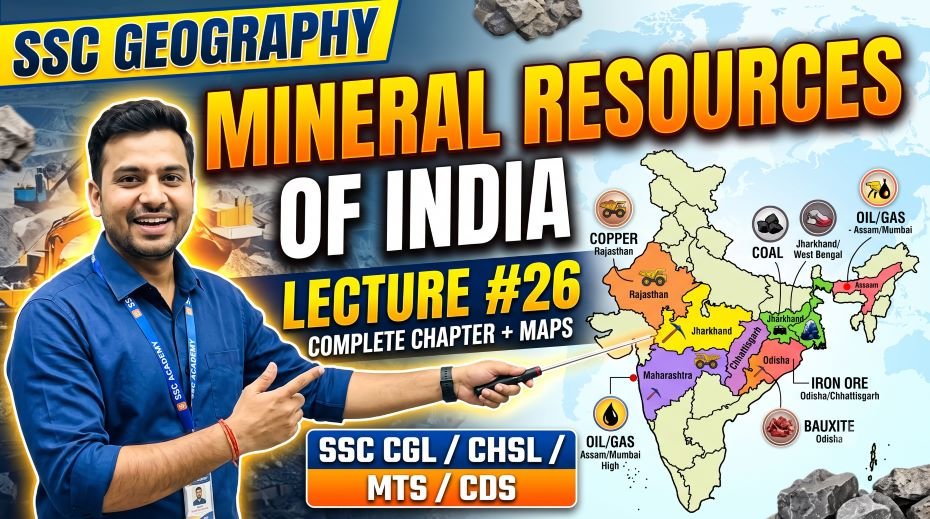
The SSC Geography Mineral Resources of India PPT (LEC #26), Serial #104, available at slideshareppt.net in bilingual Hindi + English format across 120 slides, gives you the complete visual framework. Study the mineral belt table, memorise the state-mineral associations, and use the Rapid Revision Cheat Sheet in your final week. This topic reliably delivers 3–5 marks per paper.

Leave a Comment

Your email address will not be published. Required fields are marked *

Scroll to Top