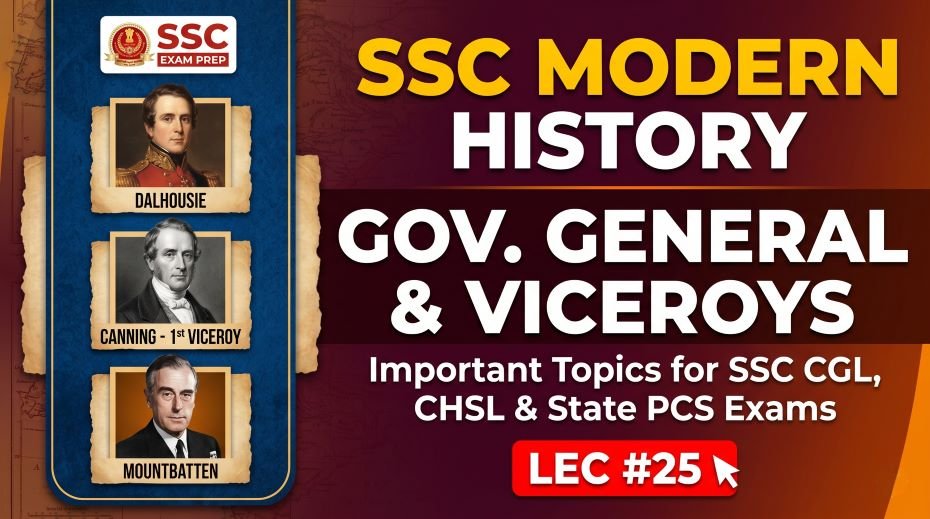
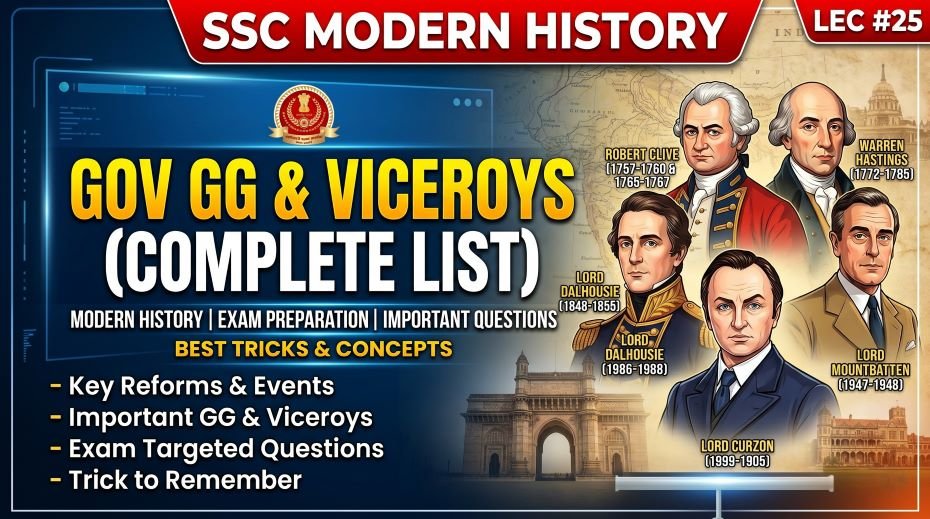
Welcome to Lecture 25 (SSC Modern History Gov GG and Viceroy PPT Slides (LEC #25) of the Complete Foundation Batch for All SSC Exams – PPT Series by SlidesharePPT. This is the biggest lecture in the entire History series – covering Modern Indian History: Governors, Governor-Generals and Viceroys of India (गवर्नर, गवर्नर-जनरल और वायसराय) across 190 years of British Indian administration (1757 to 1947).
In this article, you will find a complete study guide built around the massive 156-slide PPT – including all Governors of Bengal, Governor-Generals of Bengal, Governor-Generals of India, and all 20 Viceroys with their key acts and policies, a full Constitutional Acts reference table, Podcast-style Q&A on the most confusing topics, and 30 practice MCQs with answers. This is one of the highest-scoring chapters in SSC CGL, SSC CHSL, SSC MTS, SSC GD Constable, and RRB Group D – with 10 to 15 direct MCQs appearing in almost every SSC exam.
The PPT slides are embedded below – self-made, regularly updated, and fully ready for online and offline classroom use. Whether you are a teacher running a regular batch or a full marathon revision session, or a student doing last-minute exam preparation, you can use all 156 slides directly on any device,
Section 1: PPT Resource Overview
| PPT RESOURCE OVERVIEW – LEC #25 | |
| Complete Foundation Batch for All SSC Exams | History PPT Series | Gov. GG and Viceroy of India | |
| Lecture Title | Governors, Governor-Generals and Viceroys of India (गवर्नर, गवर्नर-जनरल और वायसराय) |
| Lecture Number | Lecture 25 (LEC #25) |
| Serial Number | #50 in the Complete Foundation Batch PPT Series |
| Total Slides | 156 High-Quality PPT Slides – Largest lecture in the History series |
| File Size | 27 MB |
| Subject | Modern Indian History |
| Series Name | Complete Foundation Batch for All SSC and Other Competitive Exams (PPT SERIES) |
| Target Exams | SSC CGL | SSC CHSL | SSC MTS | SSC GD Constable | RRB Group D | UPSC Prelims | State PSC |
| Topics Covered | Governors of Bengal → Governor-Generals of Bengal → Governor-Generals of India → Viceroys of India → All Key Acts, Reforms & Policies under each ruler |
| Era Covered | 1757 (Robert Clive) to 1947 (Lord Mountbatten) – 190 years of British Indian administration |
| Key Names | Clive, Warren Hastings, Cornwallis, Wellesley, Bentinck, Dalhousie, Canning, Lytton, Ripon, Curzon, Hardinge, Chelmsford, Irwin, Linlithgow, Wavell, Mountbatten |
| Difficulty Level | Moderate – large volume but highly pattern-based; same questions repeat every year |
| Recommended Study | 3 to 4 days (first read) | 1 day (revision using tables) |
| PPT Source | slideshareppt.net |
| Best Combined With | LEC #21 (British Expansion) – both chapters together cover all of British Indian history |
| Highest-Yield Chapter: 10–15 direct MCQs from G-G & Viceroy appear in every SSC exam | |
SSC Modern History Gov GG and Viceroy PPT Slides (LEC #25) – (iframe and html combination)
Note: If you wish to download the entire SSC series (PPT slides), simply visit this redirect page. –REDIRECT PAGE
Section 2: Three Eras – Quick Orientation
British Indian administration went through three distinct phases. Understanding which title applied to which era avoids the most common confusion in SSC exams.
Era 1: Governors of Bengal (1757–1773)
- Head of Bengal Presidency only; Madras and Bombay had their own Governors with equal rank
- Robert Clive (most important), Vansittart, Warren Hastings (as Governor before becoming G-G)
- Dual Government era – EIC collected revenue, Nawab maintained civil admin; disastrously failed
- Ended by Regulating Act 1773 – created the superior post of Governor-General
Era 2: Governor-Generals (1773–1858) – Two sub-phases
- Governor-General of BENGAL (1773–1833): Superior authority over all presidencies in foreign/military matters; Warren Hastings to Lord William Bentinck (first 8 years)
- Governor-General of INDIA (1833–1858): Full authority over ALL presidencies for ALL matters; created by Charter Act 1833; Lord William Bentinck was first; Lord Canning was last
- This is a frequently confused distinction – Charter Act 1833 is the dividing line
Era 3: Viceroys of India (1858–1947)
- Created by Government of India Act 1858 after 1857 Revolt – EIC abolished, Crown takes direct control
- Viceroy = representative of the British Crown (monarch) in India
- Lord Canning = first Viceroy; Lord Mountbatten = last Viceroy
- 20 Viceroys in total over 89 years
Section 3: Governors of Bengal (1757–1773)
| Governor of Bengal | Tenure | Key Events | SSC Significance |
| Robert Clive | 1757–1760 | First Governor of Bengal; after Battle of Plassey; installed Mir Jafar; introduced Dual Government system; personal corruption scandals | Battle of Plassey (1757); Dual Government – EIC collects revenue, Nawab maintains civil admin; Called ‘Founder of British India’ |
| Henry Vansittart | 1760–1764 | Replaced Mir Jafar with Mir Qasim; Mir Qasim proved too independent – Battle of Buxar followed | Transition between Plassey and Buxar; weak administration |
| Robert Clive (2nd term) | 1765–1767 | Returned after Buxar; negotiated Diwani Rights (Treaty of Allahabad 1765); introduced Dual Government formally | Diwani Rights = greatest achievement; Bengal, Bihar, Orissa revenue to EIC; Clive’s second and final term |
| John Cartier | 1769–1772 | Bengal Famine of 1770 – worst in history; approximately 10 million died; one-third of Bengal’s population; complete administrative failure | Bengal Famine 1770 = direct result of exploitative Dual Government revenue system; EIC continued collecting revenue during famine |
| Warren Hastings | 1772–1773 | As Governor (before becoming G-G): abolished Dual Government; took direct control of revenue collection; reformed district administration | Dual Government ended; direct British administration begins; transition from Governor to Governor-General era |
Section 4: Governor-Generals of Bengal (1773–1833)
10 Governor-Generals governed Bengal with authority over all three presidencies. Warren Hastings to Lord William Bentinck (first 8 years as G-G of Bengal).
| Governor-General of Bengal | Tenure | Key Acts, Wars & Policies | SSC Significance |
| Warren Hastings | 1773–1785 | Regulating Act 1773 (created GG post + Supreme Court); Pitt’s India Act 1784; abolished Dual Government; First Rohilla War (1774); First Maratha War; Impeached by Parliament (acquitted after 7-year trial) | FIRST Governor-General of Bengal; Regulating Act 1773 = created his own post; Pitt’s India Act 1784 = dual control; his impeachment trial is famous |
| Lord Cornwallis | 1786–1793 | Permanent Settlement of Bengal (1793) – zamindari; Cornwallis Code (separated revenue + judicial powers); Third Anglo-Mysore War (Treaty of Seringapatam 1792); Police reforms | Permanent Settlement 1793 = most important; ‘Father of Indian Civil Service’; Indians barred from senior posts; came back for brief 2nd term (died in office, 1805) |
| Sir John Shore | 1793–1798 | Non-Intervention policy; Charter Act 1793 renewed EIC monopoly; Subsidiary Alliance NOT introduced (left that to Wellesley) | Weak administration; notable mainly for what he did NOT do – refused to interfere in Indian state affairs |
| Lord Wellesley | 1798–1805 | Subsidiary Alliance (1798); Fourth Anglo-Mysore War – Tipu Sultan killed (1799); Second Anglo-Maratha War; Fort William College (1800); vast territorial expansion | Subsidiary Alliance = most important policy; Hyderabad FIRST to sign (1798); called himself ‘Bengal Tiger’; most aggressive expansionist before Dalhousie |
| Lord Cornwallis (2nd) | 1805 | Second very brief term; died at Ghazipur within months; no significant policy | Only notable as ‘died in office’ – occasionally asked |
| Sir George Barlow | 1805–1807 | Acting G-G after Cornwallis died; Vellore Mutiny (1806) – first major Indian military mutiny before 1857 | Vellore Mutiny 1806: soldiers objected to new dress regulations (turban, moustache); British suppressed brutally; forerunner of 1857 |
| Lord Minto I | 1807–1813 | Charter Act 1813 (ended EIC trade monopoly; Rs 1 lakh for education); Treaty of Amritsar (1809) with Ranjit Singh – Sutlej as boundary | Charter Act 1813 = education provision + trade monopoly ends; Treaty of Amritsar with Ranjit Singh = Sutlej boundary |
| Lord Hastings | 1813–1823 | Third Anglo-Maratha War + Pindari War (1817–18) – Maratha Confederacy destroyed; Anglo-Nepal War (Treaty of Sugauli 1816); British Paramountcy established | Maratha power ENDED under him; British paramountcy over all India except Punjab; Treaty of Sugauli with Nepal |
| Lord Amherst | 1823–1828 | First Anglo-Burmese War (1824–26) – Treaty of Yandabo; Assam, Arakan, Tenasserim ceded; Bharatpur siege (1826) | Treaty of Yandabo 1826 = Burma gives territory; Assam comes to British; Bharatpur (Jat fort) finally captured |
| Lord William Bentinck | 1828–1833 | Abolished Sati (1829); suppressed Thuggee (Colonel Sleeman); English as official language (1835 – Macaulay’s Minute accepted); financial reforms; reduced European officers’ pay | ‘Greatest social reformer’ G-G; Sati abolished 1829 (supported by Raja Ram Mohan Roy); first G-G of INDIA (not just Bengal) after Charter Act 1833 |
Section 5: Governor-Generals of India (1833–1858)
7 Governor-Generals with full authority over all of India after Charter Act 1833. Lord William Bentinck (continuing) to Lord Canning.
| Governor-General of India | Tenure | Key Acts, Wars & Policies | SSC Significance |
| Lord William Bentinck | 1833–1835 | Charter Act 1833 made him first G-G of INDIA; Macaulay’s Minute on Education (1835); English as medium of instruction; English as official court language (replacing Persian) | FIRST Governor-General of India (not just Bengal) – Charter Act 1833; Macaulay accepted under him |
| Sir Charles Metcalfe | 1835–1836 | Repealed all press restrictions → ‘Liberator of the Indian Press’; short tenure – only acting G-G | Press freedom given 1835 – his most lasting legacy; ‘Liberator of Indian Press’ |
| Lord Auckland | 1836–1842 | First Anglo-Afghan War (1838–42) – disastrous; Tripartite Treaty (British + Ranjit Singh + Shah Shuja against Afghans); army of 16,000 reduced to 1 survivor at Kabul retreat | Afghan War = greatest British military disaster in India; Kabul retreat 1842; Auckland recalled in disgrace |
| Lord Ellenborough | 1842–1844 | Ended Afghan War; annexed Sind (1843) – Charles Napier ‘Peccavi’; Gwalior War (1843) | Sind annexation = ‘Peccavi’ (I have sinned) by Napier – famous quote directly asked in SSC |
| Lord Hardinge I | 1844–1848 | First Anglo-Sikh War (1845–46); Treaty of Lahore; Kashmir sold to Gulab Singh (Treaty of Amritsar 1846) | First Sikh War; Kashmir sold for Rs 7.5 million; British Resident placed at Lahore |
| Lord Dalhousie | 1848–1856 | Second Anglo-Sikh War – Punjab annexed (1849); Doctrine of Lapse (Satara→Jhansi→Nagpur); Awadh annexed 1856; First Railway (1853); Electric Telegraph (1851); Postal reforms; Wood’s Education Despatch (1854); Universities (1857 planned); Public Works Department | GREATEST expansionist G-G; most SSC questions; Railways 1853 = Bombay-Thane; Doctrine of Lapse = 6 states; Awadh = ‘misgovernance’ |
| Lord Canning | 1856–1858 | 1857 Revolt – suppressed; Government of India Act 1858 – EIC dissolved; Crown rule begins; Queen Victoria’s Proclamation (Nov 1, 1858); last G-G of India + FIRST Viceroy of India | LAST Governor-General AND FIRST Viceroy; 1857 Revolt suppressed; called ‘Clemency Canning’ for merciful post-revolt policy |
Section 6: Viceroys of India (1858–1947)
20 Viceroys from Lord Canning (1858) to Lord Mountbatten (1947) – 89 years of Crown rule. This table is the highest MCQ source in the entire chapter.
| Viceroy of India | Tenure | Key Acts, Events & Policies | SSC Significance |
| Lord Canning | 1858–1862 | First Viceroy; Queen Victoria’s Proclamation (Nov 1, 1858); Indian Councils Act 1861; Penal Code 1860; High Courts Act 1861 | First Viceroy; Indian Councils Act 1861 = decentralisation begins; IPC 1860 still in use; Clemency Canning |
| Lord Elgin I | 1862–1863 | Wahabi movement suppressed; died in office at Dharamsala | Short tenure; died in office – occasionally asked |
| Lord Lawrence | 1864–1869 | Policy of ‘masterly inactivity’ in Afghanistan; canal construction in Punjab; high court established | Masterly Inactivity = non-interference in Afghanistan; canal irrigation expanded |
| Lord Mayo | 1869–1872 | Financial decentralisation; Provincial governments given more financial power; census conducted (1872); assassinated by a Pathan convict in Andaman Islands – only Viceroy to be assassinated | Only Viceroy assassinated in office (1872, Andaman Islands); financial decentralisation; first census 1872 |
| Lord Northbrook | 1872–1876 | Kuka Movement (Punjab Sikh movement); famine in Bengal and Bihar; first Baroda controversy | Kuka Movement suppressed; famine relief inadequate |
| Lord Lytton | 1876–1880 | Vernacular Press Act 1878 – ‘Gagging Act’; Arms Act 1878 (Indians cannot carry arms without licence); Second Anglo-Afghan War (1878–80); Delhi Durbar 1877 – Queen Victoria proclaimed Empress of India; worst famine in Indian history (1876–78) – Lytton Ball controversy | Vernacular Press Act 1878 = most controversial press law; Queen Victoria = Empress of India 1877; Second Afghan War; Arms Act 1878 |
| Lord Ripon | 1880–1884 | Repealed Vernacular Press Act (1882); Local Self-Government Act 1882 – Ilbert Bill controversy; Hunter Commission on Education (1882); First Factory Act 1881 | ‘Most popular Viceroy among Indians’; Local Self-Government = ‘Magna Carta of local democracy’; Ilbert Bill: Indian judges to try Europeans – white protest forced amendment |
| Lord Dufferin | 1884–1888 | Third Anglo-Burmese War (1885) – Burma fully annexed; Indian National Congress founded (1885) – A.O. Hume; Durand Line (1893 – actually Lansdowne’s era) | INC founded 1885 under Dufferin’s tenure; Burma fully annexed; Dufferin secretly encouraged INC as ‘safety valve’ |
| Lord Lansdowne | 1888–1894 | Factories Act 1891; Durand Line (1893) – boundary between British India and Afghanistan; Indian Councils Act 1892 | Durand Line 1893 = border with Afghanistan still disputed today; Indian Councils Act 1892 = more Indian members in councils |
| Lord Elgin II | 1894–1899 | Chitral expedition; Plague epidemic in Bombay (1896); Bal Gangadhar Tilak arrested for first time (1897) | Plague of 1896-97; Tilak’s first arrest for Kesari articles during this period |
| Lord Curzon | 1899–1905 | Partition of Bengal (1905) – biggest political mistake; Indian Universities Act 1904; Ancient Monuments Act 1904; Police Commission; Delhi Durbar 1903; established Archaeological Survey of India under John Marshall; established North-West Frontier Province (NWFP) | Partition of Bengal 1905 = MOST important political event of his tenure; triggered Swadeshi Movement; Universities Act 1904 = more govt control; Archaeological Survey reorganized |
| Lord Minto II | 1905–1910 | Morley-Minto Reforms / Indian Councils Act 1909 – separate electorates for Muslims (first time); Swadeshi Movement crackdown; Bomb thrown at Viceroy’s elephant procession (missed) | Morley-Minto Reforms 1909 = MOST important; separate Muslim electorates = seed of partition; Minto = Viceroy, Morley = Secretary of State |
| Lord Hardinge II | 1910–1916 | Partition of Bengal ANNULLED (1911); Delhi Durbar 1911 – King George V visits; Capital shifted from Calcutta to Delhi (1911); Delhi bomb throwing at Hardinge (1912) – survived; Ghadar Movement | Capital shifted Calcutta → Delhi 1911 = most important; Partition of Bengal reversed 1911; Delhi Durbar with King George V – only reigning British monarch to visit India |
| Lord Chelmsford | 1916–1921 | Montague-Chelmsford Reforms / Government of India Act 1919 – dyarchy in provinces; Rowlatt Act (1919); Jallianwala Bagh massacre (April 13, 1919); Non-Cooperation Movement begins (1920); Khilafat Movement | Rowlatt Act + Jallianwala Bagh 1919 = under his watch; Montagu-Chelmsford Reforms (dyarchy); Non-Cooperation 1920 starts |
| Lord Reading | 1921–1926 | Non-Cooperation Movement withdrawn (Feb 1922) after Chauri Chaura; Prince of Wales visit (boycotted); Kohat riots; suppressed revolutionary terrorism | Chauri Chaura incident Feb 1922 → Gandhi withdraws NCM; this is a direct SSC question |
| Lord Irwin | 1926–1931 | Civil Disobedience Movement (1930); Dandi March (March 12, 1930); First Round Table Conference (1930); Gandhi-Irwin Pact (March 5, 1931) | Gandhi-Irwin Pact 1931 = CDM temporarily suspended; Dandi March = Salt Satyagraha; First RTC without Congress |
| Lord Willingdon | 1931–1936 | Second and Third Round Table Conferences; Communal Award (1932) – Ramsay MacDonald; Poona Pact (Sept 1932) Gandhi + Ambedkar; Government of India Act 1935 | Government of India Act 1935 = most comprehensive act; Poona Pact 1932 = Gandhi fasts vs separate Dalit electorates; Communal Award |
| Lord Linlithgow | 1936–1944 | Government of India Act 1935 implemented; Provincial elections (1937) – Congress wins in 8 provinces; Cripps Mission (1942); Quit India Movement (Aug 8–9, 1942); August Offer (1940); Bengal Famine 1943 | LONGEST serving Viceroy (8 years); Quit India Movement 1942; Bengal Famine 1943 killed 2–3 million; Cripps Mission fails |
| Lord Wavell | 1944–1947 | Simla Conference (1945); Cabinet Mission (1946); Interim Government (Nehru, Sept 1946); Direct Action Day (Aug 16, 1946); Communal riots | Cabinet Mission 1946 = last attempt to keep India united; failed; Interim Government set up; replaced by Mountbatten |
| Lord Mountbatten | 1947 | Mountbatten Plan (June 3, 1947) – partition of India; Indian Independence Act 1947; India and Pakistan become independent (Aug 14–15, 1947); First Governor-General of independent India (briefly) | LAST Viceroy of British India; Mountbatten Plan = partition plan; independence Aug 15 1947; stayed as first GG of India till June 1948 |
Section 7: Key Constitutional Acts – Complete Reference
Every major Act from Regulating Act 1773 to Independence Act 1947 – with year, context, and SSC significance.
| Act / Reform | Year | Under Whom | Key Provisions | SSC Significance |
| Regulating Act | 1773 | Warren Hastings | Created post of Governor-General of Bengal; Supreme Court in Calcutta; Board of Directors oversight | FIRST Parliamentary control over EIC; Warren Hastings = first G-G |
| Pitt’s India Act | 1784 | Warren Hastings era | Dual control: Board of Control (government) + EIC Court of Directors; more effective government oversight | Distinction: Regulating Act = weak control; Pitt’s Act = real control |
| Charter Act | 1793 | Cornwallis era | Renewed EIC monopoly for 20 years; G-G’s power over other presidencies increased | EIC monopoly continues |
| Charter Act | 1813 | Lord Minto I | Ended EIC trade monopoly (except China tea); Rs 1 lakh for education; Christian missionaries allowed | Trade monopoly ends; education gets first govt funding |
| Charter Act | 1833 | Lord Bentinck | EIC loses all trading functions; G-G of Bengal becomes G-G of INDIA; all laws to be made centrally; Macaulay joins as Law Member | FIRST G-G of India; EIC becomes purely administrative |
| Charter Act | 1853 | Lord Dalhousie era | No time limit set for EIC rule; legislative and executive functions separated; competitive exam for civil service introduced | ICS competitive exam begins; legislative council expanded |
| Government of India Act | 1858 | Lord Canning | EIC abolished; Crown takes direct control; Secretary of State for India + India Council; Viceroy replaces G-G; Queen’s Proclamation (Nov 1, 1858) | EIC ends; Crown rule (British Raj) formally begins; G-G becomes Viceroy |
| Indian Councils Act | 1861 | Lord Canning | Legislative councils expanded; non-official Indians nominated (advisory); portfolio system introduced; Ordinance power to Viceroy | First steps toward Indian participation in legislation |
| Indian Councils Act | 1892 | Lord Lansdowne | More Indians in councils; indirect elections (not direct); power to discuss budget; right to ask questions | Limited but growing Indian representation |
| Indian Councils Act (Morley-Minto Reforms) | 1909 | Lord Minto II | Separate Muslim electorates (communal representation) – most controversial; Indians in Executive Council (Satyendra Prasad Sinha – first Indian) | Separate electorates = seed of partition; S.P. Sinha = first Indian in Executive Council |
| Government of India Act (Montagu-Chelmsford) | 1919 | Lord Chelmsford | Dyarchy in provinces (some subjects to Indian ministers, some reserved for British); bicameral legislature at centre; direct elections; franchise extended | Dyarchy = dual government in provinces; partial responsible government |
| Government of India Act | 1935 | Lord Willingdon | Federal structure (never implemented); Provincial Autonomy (implemented 1937); Dyarchy at centre (never implemented); RBI; Federal Court; Burma separated | Most detailed act; 321 sections; Provincial Autonomy actually implemented; RBI established 1935 |
| Indian Independence Act | 1947 | Lord Mountbatten | India and Pakistan become independent dominions; Viceroy becomes Governor-General; princely states can join either dominion | LAST British act on India; Independence Aug 14–15, 1947 |
Section 8: Podcast Q&A – Most Frequently Confused Topics
| # | Question | Expert Answer – Exam-Focused |
| Q1 | What is the difference between a Governor, Governor-General of Bengal, Governor-General of India, and Viceroy? | These are four distinct titles reflecting the evolution of British rule: (1) Governor of Bengal (1757–1773): Head of Bengal Presidency only; no authority over Madras or Bombay; Robert Clive was the most important. (2) Governor-General of Bengal (1773–1833): Created by Regulating Act 1773; authority over all three presidencies (Bengal, Madras, Bombay) on military/foreign matters but not civil; Warren Hastings was first. (3) Governor-General of India (1833–1858): Created by Charter Act 1833; full authority over ALL presidencies for ALL matters; Lord William Bentinck was first. (4) Viceroy of India (1858–1947): Created after 1857 revolt; same powers as G-G but now representing the British Crown directly (not EIC); Lord Canning was last G-G and first Viceroy simultaneously. |
| Q2 | Which Governor-General/Viceroy is associated with the most SSC questions – and what are the must-know facts? | Lord Dalhousie (1848–1856) generates the most SSC questions: (1) Doctrine of Lapse – Satara (1848), Jhansi (1853), Nagpur (1854); (2) Awadh annexed 1856 for ‘misgovernance’ – NOT Doctrine of Lapse; (3) First Railway – Bombay to Thane, April 16, 1853; (4) Electric Telegraph – 1851, Calcutta to Agra; (5) Postal reforms – uniform postage system; (6) Second Anglo-Sikh War – Punjab annexed 1849; (7) Wood’s Education Despatch – 1854; (8) Public Works Department established. Close second: Lord Curzon (1899–1905): Partition of Bengal 1905, Universities Act 1904, Archaeological Survey, NWFP created. Third: Lord Canning – 1857 Revolt, Crown rule begins, last G-G + first Viceroy. |
| Q3 | What were the Morley-Minto Reforms (1909) and why are they so controversial? | The Morley-Minto Reforms, formally the Indian Councils Act 1909, were introduced by Secretary of State John Morley (in London) and Viceroy Lord Minto II (in India). Key provisions: (1) Separate Muslim electorates – for the first time, Muslim voters would elect their own representatives to legislative councils; (2) Indians allowed in Executive Council – S.P. Sinha became first Indian member of Viceroy’s Executive Council; (3) More Indians in legislative councils (but still majority British). Why controversial: The separate electorates gave official recognition to the idea that Hindus and Muslims were two separate political communities. This is widely seen as laying the foundation for the eventual partition of India in 1947. SSC MCQ pattern: ‘Separate electorates were introduced by?’ → Morley-Minto Reforms / Indian Councils Act 1909. |
| Q4 | What is Dyarchy (Diarchy)? When was it introduced and where did it apply? | Dyarchy (dual government) was introduced by the Montagu-Chelmsford Reforms / Government of India Act 1919 under Viceroy Lord Chelmsford. It applied at the PROVINCIAL level (not central). Under Dyarchy, provincial subjects were divided into two categories: (1) Reserved Subjects – kept under the British Governor’s control: law and order, finance, irrigation, land revenue – the important ones; (2) Transferred Subjects – given to Indian ministers responsible to elected legislature: education, health, agriculture, local self-government – the less critical ones. Why it failed: Indian ministers had responsibility without power – they controlled unimportant departments and had no money. Critics called it ‘dyarchy without the di.’ It was abolished by the Government of India Act 1935, which gave full Provincial Autonomy. SSC tip: Dyarchy introduced 1919 (Chelmsford) – at provincial level – abolished 1935. |
| Q5 | What happened under Lord Curzon’s Partition of Bengal (1905)? | Lord Curzon announced the Partition of Bengal on July 19, 1905 (effective October 16, 1905). Bengal was divided into: (1) Eastern Bengal and Assam – Muslim majority – capital Dhaka; (2) Bengal (West) + Bihar + Orissa – Hindu majority – capital Calcutta. Official reason: Administrative convenience (Bengal was too large). Real reason (as Indians saw it): Divide Hindu and Muslim communities; weaken the nationalist movement centred in Bengal. Response: Swadeshi Movement – boycott of British goods; use of Indian goods; partition of Bengal = birth of organized mass nationalism; INC split into Extremists (Tilak) and Moderates (Gokhale) over response strategy; the partition was ANNULLED in 1911 under Lord Hardinge II, when Delhi Durbar with King George V provided the occasion. SSC key: Partition of Bengal 1905 = Curzon; Annulled 1911 = Hardinge II. |
| Q6 | What is the significance of the Government of India Act 1935? | The Government of India Act 1935 was the most comprehensive constitutional act of British India – 321 sections and 10 schedules. Key features: (1) Federal structure proposed – All-India Federation of provinces + princely states; NEVER implemented because princes refused to join; (2) Provincial Autonomy – IMPLEMENTED from 1937; provinces got full responsible government under elected ministers; (3) Dyarchy at the Centre – proposed but never implemented; (4) Reserve Bank of India established (1935); (5) Federal Court established (1937 – became Supreme Court in 1950); (6) Burma separated from India; (7) Direct elections with expanded franchise; (8) Separate electorates retained and extended to more communities. Why important for SSC: The Indian Constitution (1950) borrowed heavily from the 1935 Act – federal structure, emergency provisions, distribution of powers. It is often called the ‘parent of the Indian Constitution.’ |
Section 9: 30 High-Frequency MCQs with Answers
Based on previous SSC CGL, CHSL, MTS, and GD Constable papers. Cover the answer column and self-test. Target: 27+ correct.
| # | Question | Answer |
| 01 | Who was the FIRST Governor-General of Bengal? | Warren Hastings (1773, created by Regulating Act 1773) |
| 02 | Who was the FIRST Governor-General of India? | Lord William Bentinck (1833, created by Charter Act 1833) |
| 03 | Who was the LAST Governor-General of India AND FIRST Viceroy? | Lord Canning (1858) |
| 04 | Who was the LAST Viceroy of British India? | Lord Mountbatten (1947) |
| 05 | Regulating Act 1773 was passed during whose tenure? | Warren Hastings – created the G-G post and Supreme Court |
| 06 | Permanent Settlement (Zamindari) was introduced by? | Lord Cornwallis (1793) |
| 07 | Who is called ‘Father of Indian Civil Service’? | Lord Cornwallis |
| 08 | Subsidiary Alliance was introduced by? | Lord Wellesley (1798) – Hyderabad was first to accept |
| 09 | Sati was abolished in which year and by whom? | 1829 – Lord William Bentinck (supported by Raja Ram Mohan Roy) |
| 10 | First Railway in India (1853) was under which G-G? | Lord Dalhousie (Bombay to Thane, April 16, 1853) |
| 11 | Doctrine of Lapse was used by? | Lord Dalhousie (1848–1856) |
| 12 | Awadh was annexed in 1856 on what grounds? | Misgovernance – NOT Doctrine of Lapse |
| 13 | Who was called ‘Clemency Canning’? | Lord Canning – for his lenient policy after 1857 revolt |
| 14 | Queen Victoria was proclaimed Empress of India in? | 1877 – Delhi Durbar under Viceroy Lord Lytton |
| 15 | Vernacular Press Act (1878) was passed by? | Lord Lytton – called ‘Gagging Act’ |
| 16 | Who repealed the Vernacular Press Act? | Lord Ripon (1882) |
| 17 | Local Self-Government Act 1882 is associated with? | Lord Ripon – called ‘Magna Carta of local self-government’ |
| 18 | Indian National Congress was founded in 1885 during whose Viceroyalty? | Lord Dufferin – A.O. Hume founded INC |
| 19 | Partition of Bengal (1905) was done by? | Lord Curzon |
| 20 | Partition of Bengal was annulled in which year and by whom? | 1911 – Lord Hardinge II (at Delhi Durbar with King George V) |
| 21 | Capital of India shifted from Calcutta to Delhi in? | 1911 – under Lord Hardinge II |
| 22 | Morley-Minto Reforms (Indian Councils Act 1909) introduced? | Separate electorates for Muslims – first time |
| 23 | Dyarchy in provinces was introduced by? | Montagu-Chelmsford Reforms / Government of India Act 1919 – Lord Chelmsford |
| 24 | Jallianwala Bagh massacre (April 13, 1919) occurred under? | Lord Chelmsford – Brigadier General Dyer ordered firing |
| 25 | Gandhi-Irwin Pact (1931) was signed with? | Lord Irwin – Civil Disobedience Movement temporarily suspended |
| 26 | Dandi March (Salt Satyagraha) was during whose Viceroyalty? | Lord Irwin (March 12, 1930) |
| 27 | Government of India Act 1935 was passed under? | Lord Willingdon – implemented from 1937 under Lord Linlithgow |
| 28 | Quit India Movement (1942) was during? | Lord Linlithgow – August 8–9, 1942 |
| 29 | Cabinet Mission (1946) was during? | Lord Wavell – last attempt to keep India united |
| 30 | Only Viceroy to be assassinated in office was? | Lord Mayo (1872) – at Port Blair, Andaman Islands |
also read: SSC Modern History Growth of Education in India PPT (LEC 24)
Section 10: Rapid Revision – Last-Day Cheat Sheet
Title → First Person
- First Governor of Bengal → Robert Clive (1757)
- First Governor-General of Bengal → Warren Hastings (1773)
- First Governor-General of India → Lord William Bentinck (1833)
- Last G-G of India AND First Viceroy → Lord Canning (1858)
- Last Viceroy → Lord Mountbatten (1947)
- Only Viceroy assassinated → Lord Mayo (1872, Andaman Islands)
Most-Tested Governor-Generals – Signature Policy
- Warren Hastings → Regulating Act 1773 + Pitt’s India Act 1784
- Cornwallis → Permanent Settlement 1793 + Father of ICS
- Wellesley → Subsidiary Alliance 1798 + Fort William College 1800
- Bentinck → Sati abolished 1829 + English medium 1835 + First G-G of India
- Dalhousie → Doctrine of Lapse + Railways 1853 + Awadh 1856 (misgovernance)
- Canning → 1857 Revolt + Clemency Canning + First Viceroy
Most-Tested Viceroys – Signature Event
- Lytton → Vernacular Press Act 1878 + Queen Victoria = Empress 1877
- Ripon → Repealed VPA 1882 + Local Self-Government + Most popular Viceroy
- Dufferin → INC founded 1885
- Curzon → Partition of Bengal 1905 + Universities Act 1904
- Minto II → Morley-Minto Reforms 1909 = Separate Muslim electorates
- Hardinge II → Partition of Bengal annulled 1911 + Capital shifted to Delhi 1911
- Chelmsford → Dyarchy 1919 + Jallianwala Bagh 1919
- Irwin → Gandhi-Irwin Pact 1931 + Dandi March 1930
- Willingdon → Government of India Act 1935 + Poona Pact 1932
- Linlithgow → Quit India 1942 + Bengal Famine 1943 + Longest Viceroy
- Wavell → Cabinet Mission 1946
- Mountbatten → Independence Aug 15, 1947 + Partition
Key Acts – 1-Line Memory
- 1773 Regulating Act → First Parliamentary control; GG post created
- 1784 Pitt’s India Act → Dual control (Board of Control + EIC)
- 1813 Charter Act → Trade monopoly ends; Rs 1 lakh education
- 1833 Charter Act → First G-G of India; EIC = administrative only
- 1858 GoI Act → EIC abolished; Crown rule; Viceroy
- 1909 Indian Councils Act → Separate Muslim electorates
- 1919 GoI Act → Dyarchy in provinces
- 1935 GoI Act → Provincial autonomy; RBI; Federal Court; parent of Constitution
- 1947 Independence Act → India + Pakistan independent
Conclusion
Governors, Governor-Generals, and Viceroys (LEC #25) is the single largest and most rewarding chapter in SSC Modern Indian History. With 156 slides in the PPT and 190 years of history to cover, it requires systematic table-based revision. Use the 5 tables in this guide – study one table per day – and by Day 5, you will have command over one of the most asked chapters in all of SSC history.