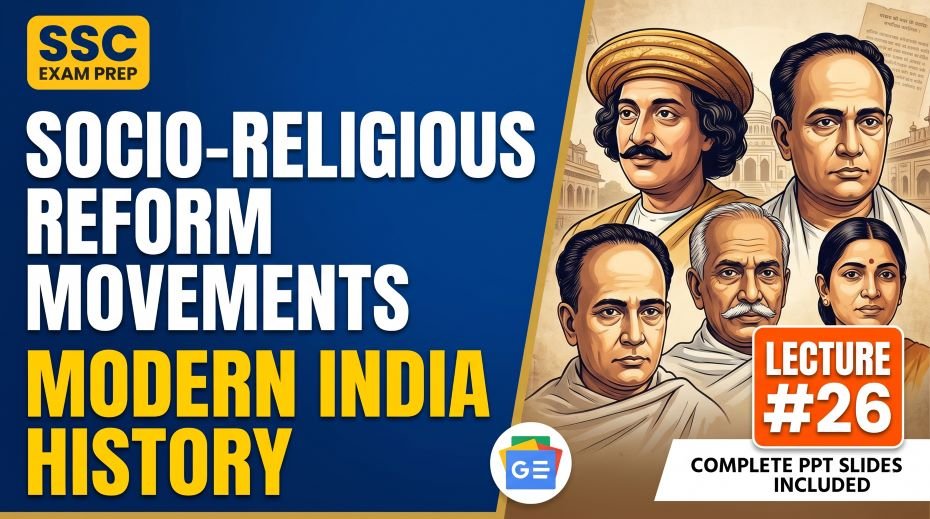
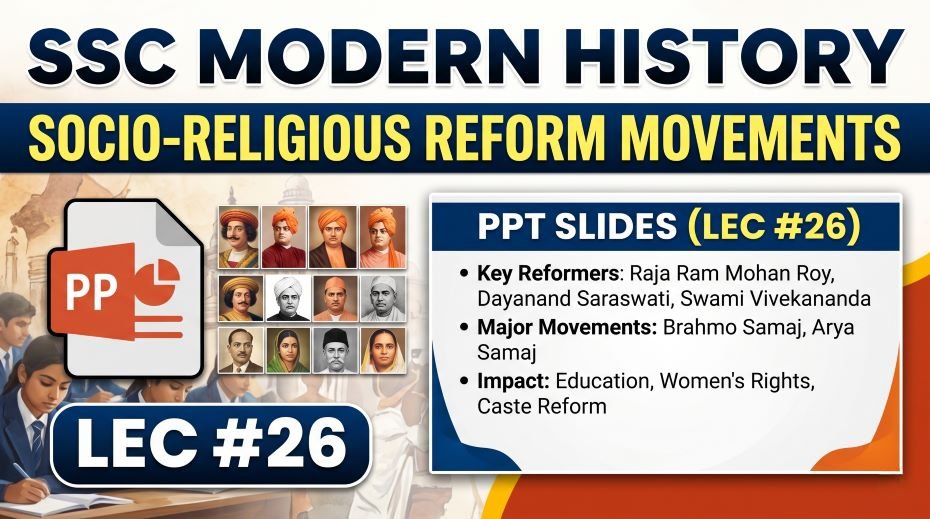
Welcome to the new Lecture 26 (SSC Modern History Socio Religious Reform PPT (LEC #26) of the Complete Foundation Batch for All SSC Exams – PPT Series by SlidesharePPT. This lecture covers Modern Indian History: Socio-Religious Reform Movements in India (सामाजिक-धार्मिक सुधार) – one of the most consistently asked chapters in SSC CGL, SSC CHSL, SSC MTS, SSC GD Constable, and RRB Group D exams, with 8 to 12 direct MCQs appearing in almost every paper.
In this article, you will find a complete study guide built around the 124-slide PPT – including a full reform era timeline, all major Hindu reform movements, all major Muslim reform movements, a complete reformers quick-reference table, special topics on Brahmo Samaj splits and women’s reform legislation, a Podcast-style Q&A on the most confused topics, and 30 practice MCQs with answers.
The PPT slides are embedded below – self-made, regularly updated, and fully ready for online and offline classroom use. Whether you are a teacher taking a regular batch or running a full marathon revision session before exams, or a student doing last-minute preparation, you can view and use all 124 slides directly on any device – no download needed.
Section 1: PPT Resource Overview
| PPT RESOURCE OVERVIEW – LEC #26 | |
| Complete Foundation Batch for All SSC Exams | History PPT Series | Socio-Religious Reform Movements | |
| Lecture Title | Socio-Religious Reform Movements in India (सामाजिक-धार्मिक सुधार) |
| Lecture Number | Lecture 26 (LEC #26) |
| Serial Number | #51 in the Complete Foundation Batch PPT Series |
| Total Slides | 124 High-Quality PPT Slides |
| File Size | 21 MB |
| Subject | Modern Indian History |
| Series Name | Complete Foundation Batch for All SSC and Other Competitive Exams (PPT SERIES) |
| Target Exams | SSC CGL | SSC CHSL | SSC MTS | SSC GD Constable | RRB Group D | UPSC Prelims | State PSC |
| Topics Covered | Brahmo Samaj → Arya Samaj → Ramakrishna Mission → Theosophical Society → Prarthana Samaj → Young Bengal → Aligarh Movement → Deoband → Wahabi → Faraizi → Satyashodhak Samaj → Self-Respect Movement → SNDP → and more |
| Key Personalities | Raja Ram Mohan Roy, Swami Dayananda Saraswati, Swami Vivekananda, Sir Syed Ahmad Khan, Annie Besant, Jyotirao Phule, E.V. Ramasamy Periyar, Sri Narayana Guru, Ishwar Chandra Vidyasagar |
| Difficulty Level | Moderate – large number of movements but very pattern-based; same MCQs repeat |
| Recommended Study | 2 to 3 days (first read) | 1 day (revision using tables) |
| PPT Source | slideshareppt.net |
| Best Combined With | LEC #24 (Education) + LEC #25 (G-G & Viceroy) – all three together cover the social reform era completely |
| Exam Tip: 8–12 direct MCQs from Reform Movements appear in every SSC CGL & CHSL exam | |
SSC Modern History Socio Religious Reform PPT (LEC #26) – (iframe and html combination)
Note: If you wish to download the entire SSC series (PPT slides), simply visit this redirect page. –REDIRECT PAGE
Section 2: Master Timeline – Socio-Religious Reform Era (1806–1936)
Every key reform movement and milestone in chronological order with SSC significance.
| Year | Movement / Event | SSC Significance |
| 1806 | Vellore Mutiny – reform context | First military mutiny; soldiers protested changes to dress codes; shows existing tensions before reform era |
| 1815 | Atmiya Sabha – Raja Ram Mohan Roy | Roy’s first reform organization in Calcutta; opposed idol worship, caste, Sati; predecessor to Brahmo Samaj |
| 1817 | Hindu College, Calcutta | David Hare + Roy; English education; modern rational thinking enters Bengal; Young Bengal movement seeds planted |
| 1820 | Raja Ram Mohan Roy – The Precepts of Jesus | Roy’s analysis of Christianity; showed respect for Jesus’s ethics; caused controversy with missionaries |
| 1828 | Brahmo Samaj founded – Raja Ram Mohan Roy | First major Hindu reform organization; opposed Sati, child marriage, idol worship, caste; monotheism; English education; ‘Father of Modern India’ |
| 1829 | Sati abolished – Lord Bentinck | Roy’s campaign directly led to official abolition; Roy used press (Sambad Kaumudi) and petitions |
| 1830 | Roy visits England | First Indian intellectual to visit England; died in Bristol (1833); showed reformers’ global vision |
| 1833 | Death of Raja Ram Mohan Roy | Died in Bristol, England; left Brahmo Samaj to successors |
| 1839 | Debendranath Tagore joins Brahmo Samaj | Rabindranath Tagore’s father; gave Brahmo Samaj new spiritual direction; founded Tattvabodhini Sabha |
| 1843 | Henry Louis Vivian Derozio – Young Bengal legacy | Derozio (1809–1831) had already died young; his rationalist, anti-tradition students called ‘Derozians’ or Young Bengal – challenged Hindu orthodoxy |
| 1851 | Paramahansa Mandali – Maharashtra | Secret reform society; Maharashtra; opposed caste and idol worship; precursor to Prarthana Samaj |
| 1856 | Widow Remarriage Act | Ishwar Chandra Vidyasagar’s campaign succeeds; Lord Dalhousie signs the act; major reform for Hindu widows |
| 1863 | Swami Vivekananda born | Narendranath Datta; disciple of Ramakrishna; founded Ramakrishna Mission (1897); Chicago speech (1893) |
| 1863 | Deoband Movement context | Darul Uloom Deoband founded 1867 by Mohammad Qasim Nanautavi + Rashid Ahmad Gangohi; Islamic conservatism + anti-British |
| 1865 | Keshab Chandra Sen – Brahmo Samaj of India | Split from Debendranath’s Adi Brahmo Samaj; more radical reforms; Keshab pushed inter-caste marriage, women’s education |
| 1867 | Darul Uloom Deoband founded | Saharanpur, UP; Islamic education in traditional style; later produced ulema who opposed both British and INC |
| 1867 | Prarthana Samaj founded – Bombay | M.G. Ranade, R.G. Bhandarkar, K.T. Telang; Maharashtra’s answer to Brahmo Samaj; opposed caste, child marriage, promoted widow remarriage |
| 1869 | Mahatma Gandhi born | Context: reform era produces India’s greatest leader |
| 1871 | Keshab Chandra Sen – Brahmo Marriage Act | Inter-caste and inter-religious marriages legalized through his advocacy |
| 1872 | Satyashodhak Samaj – Jyotirao Phule | Pune; first major Dalit/OBC reform movement; opposed Brahmin domination; ‘Truth-Seeking Society’; education for lower castes and women |
| 1875 | Arya Samaj – Swami Dayananda Saraswati | Bombay (then shifted to north India); ‘Back to the Vedas’; opposed idol worship, caste by birth, child marriage; Shuddhi (reconversion) movement; Hindi promotion; ‘Most radical Hindu reform’ |
| 1875 | Theosophical Society founded – USA | Madame H.P. Blavatsky + Colonel H.S. Olcott; later HQ shifted to Adyar, Madras (1886); promoted Hindu/Buddhist philosophy to the West |
| 1875 | Muhammadan Anglo-Oriental College, Aligarh | Sir Syed Ahmad Khan; Aligarh Movement; English + Islamic education for Muslims; ‘Two-Nation Theory’ seeds |
| 1878 | Arya Samaj – Lahore branch | Most active branch; Dayananda Anglo-Vedic (DAV) schools network; Lala Lajpat Rai, Lala Hansraj associated |
| 1881 | Ramakrishna Paramahamsa’s influence peaks | Mystic saint of Dakshineswar, Calcutta; Kali devotee; taught unity of all religions; Vivekananda his main disciple |
| 1882 | Anjuman-i-Islam – Bombay | Islamic reform organization; Badruddin Tyabji associated; moderate Islamic modernism |
| 1886 | Theosophical Society HQ – Adyar, Madras | Annie Besant later becomes president (1907); promotes Indian culture + nationalism |
| 1893 | Swami Vivekananda – Chicago Parliament of Religions | September 11, 1893; ‘Sisters and Brothers of America’ opening; Vedanta philosophy to the world; India’s soft power moment |
| 1897 | Ramakrishna Mission founded – Vivekananda | Belur Math, Howrah; combines spiritual practice with social service; education, hospitals, disaster relief |
| 1900 | Ahmadiyya Movement – Mirza Ghulam Ahmad | Qadian, Punjab; claimed prophethood; controversial in mainstream Islam; British-friendly; declared non-Muslim in Pakistan 1974 |
| 1905 | Annie Besant – active in India | Joins INC; Theosophical Society; Home Rule League (1916); first woman INC President (1917) |
| 1906 | Muslim League founded | All India Muslim League; Dhaka; Nawab Salimullah; Aga Khan; separate Muslim political identity – outcome of Aligarh Movement’s separatist strand |
| 1917 | Annie Besant – first woman INC President | Peak of her Indian political influence |
| 1920 | Non-Brahmin Movement – Maharashtra/Tamil Nadu | Periyar (E.V. Ramasamy) + B.R. Ambedkar challenge caste; Satya Shodhak / Self-Respect movements grow |
| 1925 | Self-Respect Movement – E.V. Ramasamy Periyar | Tamil Nadu; rejected Hindu religious texts as tools of Brahmin domination; promoted rationalism; marriages without priests (‘Self-Respect marriages’) |
| 1927 | Dr. Ambedkar – Mahad Satyagraha | Mahad, Maharashtra; Dalits assert right to use public water tank; first organized Dalit civil rights action |
| 1932 | Poona Pact – Gandhi and Ambedkar | Separate Dalit electorates (Communal Award) vs. Gandhi’s fast; compromise: reserved seats in joint electorates |
| 1936 | SNDP – Sri Narayana Guru’s legacy | Sree Narayana Dharma Paripalana Yogam; Kerala; Ezhava community; ‘One Caste, One Religion, One God for Man’ |
Section 3: Why Reform Movements Happened – Context
Understanding WHY the reform era occurred helps answer ’cause’ type SSC questions and gives context for every movement.
Root Causes of the Reform Era
- British rule exposed Indians to Western Enlightenment ideas – rationalism, equality, individual rights, scientific thinking
- English education produced a new generation of Indians who questioned traditional practices through a rational lens
- Social evils like Sati, child marriage, untouchability, purdah, and caste discrimination were deeply entrenched and harmful
- Christian missionaries criticized Hindu practices – reformers felt pressure to clean house from within
- Economic changes under British rule disrupted traditional social structures – new middle class emerged with different values
- Printing press + newspapers allowed reformers to reach large audiences for the first time – Roy used Sambad Kaumudi; Tilak used Kesari
Two Types of Reform Responses
- Reform from within (Brahmo Samaj, Prarthana Samaj): Modernize Hinduism/Islam by removing its ‘corruptions’; keep core faith, discard harmful practices
- Revival of classical roots (Arya Samaj, Deoband): Return to pure original texts – Vedas or early Islam – and reject all later ‘corruptions’ including idol worship, saint veneration
Section 4: Hindu Reform Movements – Complete Table
All major Hindu reform and revival movements with founder, base, principles, and SSC significance.
| Movement | Year | Founder | Base | Key Principles | SSC Key Facts |
| Brahmo Samaj | 1828 | Raja Ram Mohan Roy | Calcutta, Bengal | Monotheism; opposed Sati, idol worship, caste, child marriage; English education; social equality; widow remarriage | ‘Father of Modern India’; ‘Father of Indian Renaissance’; Roy used press (Sambad Kaumudi) to fight Sati; First major Hindu reform org |
| Adi Brahmo Samaj | 1843 (reorganized) | Debendranath Tagore | Calcutta | Spiritual reform; Tattvabodhini Sabha; opposed Christian missionaries; Upanishads focus | Rabindranath Tagore’s father; gave Brahmo Samaj strong spiritual foundation after Roy’s death |
| Brahmo Samaj of India | 1866 | Keshab Chandra Sen | Calcutta | More radical social reforms; inter-caste marriage advocacy; women’s education; Brahmo Marriage Act (1872) | Split from Debendranath; Keshab’s reforms were more socially aggressive; later founded ‘New Dispensation’ (1880) |
| Young Bengal Movement | 1820s–30s | Henry Louis Vivian Derozio | Calcutta (Hindu College) | Rationalism; anti-tradition; free thought; challenged Hindu orthodoxy; inspired by French Revolution ideas | Derozio died at 22 (1831); his students called ‘Derozians’; questioned everything including religion – ‘Young Bengal’ |
| Arya Samaj | 1875 | Swami Dayananda Saraswati | Bombay → north India | ‘Back to the Vedas’; opposed idol worship, caste by birth, child marriage, Sati; Shuddhi (reconversion); Hindi medium; DAV schools | Most radical Hindu reform; slogan ‘India for Indians’; Shuddhi = bringing Muslims/Christians back to Hinduism; DAV school network across north India |
| Ramakrishna Mission | 1897 | Swami Vivekananda | Belur Math, Howrah | Vedanta philosophy + social service; education, hospitals, disaster relief; unity of all religions | Chicago Parliament 1893 = most famous speech; ‘Arise, awake, stop not till the goal is reached’; combines spirituality + nationalism |
| Prarthana Samaj | 1867 | M.G. Ranade, R.G. Bhandarkar | Bombay, Maharashtra | Maharashtra’s Brahmo Samaj; opposed caste, child marriage; widow remarriage; women’s education; monotheism | M.G. Ranade = ‘Mahadev Govind Ranade’; also an economic nationalist (Drain of Wealth theory supporter) |
| Theosophical Society | 1875 (USA); 1886 India HQ | H.P. Blavatsky + H.S. Olcott; Annie Besant later | Adyar, Madras (India HQ) | Universal Brotherhood; Hindu and Buddhist philosophy promotion; no caste or race distinction | Annie Besant became president 1907; first woman INC president 1917; HQ at Adyar, Chennai still active |
| Satyashodhak Samaj | 1873 | Jyotirao Phule (Mahatma Phule) | Pune, Maharashtra | Truth-Seeking Society; opposed Brahmin domination; education for Dalits + women; rejected Brahmin priests; rational social reform | First school for girls in Pune – by Phule and wife Savitribai Phule; called ‘Mahatma’; wife Savitribai = first female teacher in modern India |
| Self-Respect Movement | 1925 | E.V. Ramasamy Periyar | Tamil Nadu | Rejected Hindu religious texts as Brahmin tools of oppression; rationalism; self-respect marriages (without priests); anti-caste | Called ‘Periyar’ (Great Man); DK (Dravidar Kazhagam) party; strong influence on Tamil politics; opposed Hindi imposition |
| SNDP Yogam | 1903 | Sri Narayana Guru | Kerala | Ezhava community reform; ‘One Caste, One Religion, One God for Man’; temples open to all; education; opposed untouchability | Sri Narayana Guru’s famous quote = one of SSC’s most asked; built temples accessible to all castes; Kerala’s greatest social reformer |
| Veerasalingam Movement | 1878 | Kandukuri Veerasalingam Pantulu | Andhra Pradesh (Rajahmundry) | Widow remarriage; women’s education; opposed child marriage; first widow remarriage in Andhra (1881) | ‘Father of Telugu Renaissance’; Andhra’s social reform equivalent of Roy; organized first widow remarriage in Andhra |
Section 5: Muslim Reform Movements – Complete Table
All major Islamic reform movements in India – from Wahabi to Aligarh to Deoband – with key distinctions for SSC.
| Movement | Year | Founder | Base | Key Principles | SSC Key Facts |
| Wahabi Movement | 1820s | Syed Ahmad Barelvi (Rai Bareilly) | Rae Bareli, UP → northwest India | Return to pure Islam (as in Prophet’s time); opposed un-Islamic practices (saint worship, shrines); Pan-Islamic; anti-British; jihad against Sikh rule in Punjab + later British | Syed Ahmad Barelvi killed in Battle of Balakot (1831) fighting Sikhs; Wahabi = ‘puritan’ Islam; strongly anti-British – contrasts with Aligarh movement |
| Faraizi Movement | 1838 | Haji Shariatullah | Bengal (East Bengal / Bangladesh) | ‘Faraiz’ = obligatory Islamic duties; opposed Hindu landlords (zamindars) and British; no Friday prayers (as Bengal under non-Muslim rule); agrarian reform for Muslim peasants | Strongly anti-British; supported by Muslim peasantry of Bengal; his son Dudu Mian continued movement; distinct from Wahabi but similar in Islamic purification goal |
| Aligarh Movement | 1875 | Sir Syed Ahmad Khan | Aligarh, UP | English + modern education for Muslims; cooperation with British; MAO College 1875 → AMU 1920; ‘Two-Nation Theory’ seeds; opposed INC | Pro-British; believed Muslims must get English education to compete in new India; Scientific Society (1863) translated Western works; most influential Muslim reform for SSC |
| Deoband Movement | 1867 | Mohammad Qasim Nanautavi + Rashid Ahmad Gangohi | Darul Uloom Deoband, Saharanpur | Traditional Islamic education (Arabic, Hadith, Fiqh); anti-British in culture (no English); opposed Western influence; later produced ulema divided on independence | Most important Islamic seminary in South Asia; still active; graduates called ‘Deobandis’; some ulema later supported Indian nationalism (Maulana Hussain Ahmad Madani, Maulana Azad) |
| Ahmadiyya Movement | 1889 | Mirza Ghulam Ahmad | Qadian, Punjab | Claimed to be promised Messiah and prophet; British-friendly; opposed jihad against British; emphasized peace | Controversial – mainstream Islam rejects his claim of prophethood; declared non-Muslim in Pakistan (1974); legally persecuted in Pakistan today; SSC asks about founder + location |
| Anjuman-i-Islam | 1876 | Badruddin Tyabji + others | Bombay | Moderate Islamic modernism; English education + Islamic values; supported INC (unlike Aligarh) | Badruddin Tyabji = first Muslim President of INC (1887); represents the Congress-Muslim cooperation strand |
| Mohammedan Literary Society | 1863 | Nawab Abdul Latif | Calcutta | English education for Bengali Muslims; moderate modernism; precursor to later Muslim intellectual movements | Earlier than Aligarh; focused on Bengali Muslims; Nawab Abdul Latif = pioneer of Muslim modernism in Bengal |
Section 6: Key Reformers – Complete Quick Reference
Every major reformer with their titles, works, and the SSC-critical facts linked to their name.
| Reformer | Lived | Region | Associated With | Key Contribution & SSC Titles/Facts |
| Raja Ram Mohan Roy | 1772–1833 | Bengal | Brahmo Samaj (1828) | ‘Father of Modern India’ + ‘Father of Indian Renaissance’ + ‘Father of Indian Nationalism (sometimes)’; campaigned against Sati (abolished 1829); Sambad Kaumudi + Mirat-ul-Akhbar; first Indian to visit England |
| Ishwar Chandra Vidyasagar | 1820–1891 | Bengal | – | ‘Father of Bengali Prose’; Widow Remarriage Act 1856; campaigned against child marriage; simplified Bengali script; organized first widow remarriage in Bengal |
| Swami Dayananda Saraswati | 1824–1883 | Gujarat → all-India | Arya Samaj (1875) | Real name Mool Shankar; ‘Back to the Vedas’; Satyarth Prakash (his book); Shuddhi movement; opposed idol worship, caste by birth, child marriage |
| Swami Vivekananda | 1863–1902 | Bengal | Ramakrishna Mission (1897) | Real name Narendranath Datta; Chicago Parliament 1893; Belur Math; blended Vedanta + social service; ‘Arise, awake’ quote; disciple of Ramakrishna |
| Ramakrishna Paramahamsa | 1836–1886 | Bengal | – | Mystic of Dakshineswar; Kali devotee; ‘All paths lead to God’ philosophy; Vivekananda’s guru; his followers founded the Mission |
| Jyotirao (Mahatma) Phule | 1827–1890 | Maharashtra | Satyashodhak Samaj (1873) | First girls’ school in Pune (with wife Savitribai); opposed Brahmin dominance; title ‘Mahatma’ given by his followers; Gulamgiri (book) |
| Savitribai Phule | 1831–1897 | Maharashtra | – | First female teacher in modern India; wife of Jyotirao Phule; ran schools for girls and Dalits; pelted with stones for going to school; poet |
| Sir Syed Ahmad Khan | 1817–1898 | UP | Aligarh Movement; MAO College (1875) | ‘Father of Muslim Modernism’; Scientific Society 1863; believed Muslims must cooperate with British; warned against INC; seeds of Two-Nation Theory |
| Keshab Chandra Sen | 1838–1884 | Bengal | Brahmo Samaj of India (1866) | Split Brahmo Samaj from Debendranath; radical social reforms; New Dispensation (1880) – blended Hindu, Christian, Islamic ideas; advocated inter-caste marriage |
| M.G. Ranade | 1842–1901 | Maharashtra | Prarthana Samaj (1867) | ‘Mahadev Govind Ranade’; judge + reformer; widow remarriage advocate; economic nationalist (criticized Drain of Wealth); mentor of Gokhale |
| E.V. Ramasamy Periyar | 1879–1973 | Tamil Nadu | Self-Respect Movement (1925) | ‘Periyar’ (Great Man); DK party; opposed Hindu caste texts; rationalist; anti-Brahmin; self-respect marriages; opposed Hindi imposition; lived to 94 |
| Sri Narayana Guru | 1856–1928 | Kerala | SNDP Yogam | Famous quote: ‘One Caste, One Religion, One God for Man’; built temples open to all castes; Ezhava community uplift; opposed untouchability; met Vivekananda |
| Annie Besant | 1847–1933 | Ireland/UK → India | Theosophical Society; INC | Irish; came to India 1893; Theosophical Society president 1907; New India newspaper; Home Rule League 1916; first woman INC President 1917; arrested briefly |
| Henry Derozio | 1809–1831 | Calcutta | Young Bengal Movement | Eurasian teacher at Hindu College; rationalist; anti-tradition; died at 22; his students (Derozians) carried on; radical free thinkers of Bengal |
| Debendranath Tagore | 1817–1905 | Bengal | Adi Brahmo Samaj | Rabindranath’s father; spiritual reformer; Tattvabodhini Sabha (1839); gave Brahmo Samaj strong philosophical foundation; called ‘Maharshi’ |
| Kandukuri Veerasalingam | 1848–1919 | Andhra | – | ‘Father of Telugu Renaissance’; widow remarriage; first widow remarriage in Andhra (1881); women’s education; Rajamahendravaram (Rajahmundry) base |
Section 7: Special Topics – Highest-Frequency SSC Areas
Brahmo Samaj – Three Splits (Important for SSC)
- Original Brahmo Samaj (1828): Raja Ram Mohan Roy – monotheistic reform; Sati campaign
- Adi Brahmo Samaj (1865): Debendranath Tagore – spiritual direction; Upanishads; separated from Keshab
- Brahmo Samaj of India (1866): Keshab Chandra Sen – radical social reform; inter-caste marriage; later ‘New Dispensation’ (1880)
- SSC asks: ‘Who split Brahmo Samaj?’ → Keshab Chandra Sen (1866)
Ramakrishna–Vivekananda Connection
- Ramakrishna Paramahamsa: Mystic saint, Dakshineswar (Calcutta); Kali devotee; taught all religions lead to same God; barely literate but supremely wise
- Vivekananda: His brightest disciple; took Ramakrishna’s spiritual message to the world; founded Ramakrishna Mission (1897) to combine spirituality with social service
- Chicago Speech (Sept 11, 1893): ‘Sisters and Brothers of America’ – audience of 7,000 gave a standing ovation; introduced Vedanta philosophy globally
- Famous Vivekananda quotes asked in SSC: ‘Arise, awake, stop not till the goal is reached’ and ‘Each soul is potentially divine’
Social Reforms for Women – Legislative Milestones
- 1829: Sati abolished – Bengal (Roy’s campaign + Lord Bentinck)
- 1856: Widow Remarriage Act – Vidyasagar’s campaign; Lord Dalhousie signs
- 1861: Female Infanticide Prevention Act
- 1872: Brahmo Marriage Act (Keshab Chandra Sen) – inter-caste marriage legalized
- 1891: Age of Consent Act – minimum age of consent for girls raised to 12 (was 10)
- 1929: Child Marriage Restraint Act (Sarda Act) – minimum age: girls 14, boys 18
Section 8: Podcast Q&A – Most Frequently Confused Topics
| # | Question | Expert Answer – Exam-Focused |
| Q1 | What are the key differences between Arya Samaj and Brahmo Samaj? SSC often asks to distinguish them. | Both opposed idol worship and caste but had fundamental differences: Brahmo Samaj (Roy, 1828): monotheistic but not specifically Vedic; Roy accepted value in all religions including Christianity; moderate tone; based in Bengal; English education strongly supported; did not advocate reconversion. Arya Samaj (Dayananda, 1875): strictly Vedic – ‘Back to the Vedas’; rejected all religious texts except the Vedas (including Puranas, which Roy respected); advocated Shuddhi (reconversion of Muslims and Christians back to Hinduism); strongly pro-Hindi; more militant in opposing caste and idol worship; spread mainly in Punjab and UP; founded DAV schools. SSC tip: Roy = gentle reformer, accepts multiple traditions. Dayananda = radical, only Vedas are valid, Shuddhi reconversion. |
| Q2 | Who were the founders of the Theosophical Society and what was their connection to India? | The Theosophical Society was founded in New York, USA in 1875 by Madame Helena Petrovna Blavatsky (Russian-American) and Colonel Henry Steel Olcott (American). Its India HQ was established at Adyar, Madras (Chennai) in 1882. The Society promoted Hindu and Buddhist philosophy to Western audiences and respected Indian spiritual traditions. Annie Besant (Irish) became its President in 1907 and made it a base for Indian nationalism – she founded the Home Rule League (1916) and became the first woman President of the Indian National Congress (1917). SSC MCQ patterns: ‘Theosophical Society founded by?’ → Blavatsky + Olcott. ‘India HQ?’ → Adyar, Madras. ‘First woman INC president?’ → Annie Besant. |
| Q3 | What was the Aligarh Movement and how is it different from the Deoband Movement? | Aligarh Movement (Sir Syed Ahmad Khan, 1875): Pro-British; believed Muslims must get English + modern education to succeed in British India; founded MAO College at Aligarh (1875) which became AMU in 1920; warned Muslims against joining INC; emphasized Hindu-Muslim differences; laid seeds of Two-Nation Theory. Deoband Movement (1867): Anti-British culturally; traditional Islamic education in Arabic; Darul Uloom Deoband seminary at Saharanpur; no English; produced Islamic scholars (ulema); some Deobandi ulema later supported Indian nationalism (Maulana Hussain Ahmad Madani led Jamiat Ulema-i-Hind, which opposed partition). Key SSC distinction: Aligarh = English + cooperate with British. Deoband = Arabic traditional + anti-Western culture. |
| Q4 | What made Raja Ram Mohan Roy the ‘Father of Modern India’? What were his actual achievements? | Raja Ram Mohan Roy earned this title through concrete actions, not just ideas: (1) Sati campaign: Used his newspapers (Sambad Kaumudi in Bengali, Mirat-ul-Akhbar in Persian) to write against Sati; submitted petitions to the Governor-General; result: Sati abolished by Lord Bentinck in 1829; (2) English education: Supported English education as a path to modernity; co-founded Hindu College (1817); opposed the Orientalists in the 1823 controversy; (3) Press freedom: Founded Indian-owned newspapers; protested the 1823 Licensing Act by shutting his own paper; (4) Religious reform: Founded Brahmo Samaj (1828) – monotheistic, rational; opposed idol worship; (5) Social reform: Opposed child marriage, caste discrimination, purdah; (6) International exposure: Visited England in 1830 – first major Indian intellectual to do so. Roy demonstrated that tradition could be challenged through rational argument, not violent revolution. |
| Q5 | What is the Shuddhi movement of Arya Samaj and why was it controversial? | Shuddhi (purification) was a program initiated by Arya Samaj under Swami Dayananda Saraswati to reconvert Muslims and Christians (who were originally Hindus or whose ancestors were converted) back to Hinduism through a purification ceremony. Why controversial: (1) Traditional Hindu orthodoxy did not accept reconversion – once a person left Hinduism, they could not re-enter; Arya Samaj rejected this exclusivity; (2) Muslim community was deeply offended; Hindu-Muslim tensions increased; (3) Critics said it was communally provocative; (4) However, Arya Samaj defended it as restoring social equality – those converted by force or coercion deserved a path back. The Shuddhi movement peaked in the 1920s under Swami Shraddhanand and was linked to growing communal tensions of that era. |
| Q6 | How did the Socio-Religious Reform movements contribute to Indian nationalism? | The reform movements were the intellectual and organizational nursery of Indian nationalism in four ways: (1) Rationalism: Movements like Young Bengal and Brahmo Samaj taught Indians to question authority – the same questioning that was later applied to British rule; (2) Pride in Indian civilization: Arya Samaj, Ramakrishna Mission, and Theosophical Society (paradoxically, a Western organization) revived pride in Indian philosophy and culture – essential for anti-colonial nationalism; (3) Social solidarity: By fighting caste, untouchability, and gender discrimination, reformers tried to create a unified Indian society capable of collective political action; (4) Organizational skills: Societies like Brahmo Samaj, Arya Samaj, and Satyashodhak Samaj taught Indians how to organize meetings, publish newspapers, petition governments, and build national networks – the same skills used by INC from 1885 onwards. Swami Vivekananda’s nationalism was explicitly spiritual: ‘Serve man as God’ became ‘Serve India as Mother.’ |
Section 9: 30 High-Frequency MCQs with Answers
Based on previous SSC CGL, CHSL, MTS, and GD Constable papers. Target: 27+ correct.
| # | Question | Answer |
| 01 | Who founded the Brahmo Samaj and in which year? | Raja Ram Mohan Roy (1828, Calcutta) |
| 02 | What titles is Raja Ram Mohan Roy known by? | Father of Modern India, Father of Indian Renaissance, Father of Bengal Renaissance |
| 03 | Sati was abolished in 1829 due to whose campaign? | Raja Ram Mohan Roy – Lord Bentinck signed the act |
| 04 | Who founded Arya Samaj and in which year? | Swami Dayananda Saraswati (1875, Bombay) |
| 05 | What is the slogan of Arya Samaj? | ‘Back to the Vedas’ (Vedas are the only authority) |
| 06 | What is Shuddhi movement? | Reconversion of Muslims/Christians back to Hinduism – Arya Samaj initiative |
| 07 | Who founded the Ramakrishna Mission? | Swami Vivekananda (1897, Belur Math, Howrah) |
| 08 | Swami Vivekananda’s famous speech was at? | Parliament of World Religions, Chicago – September 11, 1893 |
| 09 | Real name of Swami Vivekananda? | Narendranath Datta |
| 10 | Who was Vivekananda’s spiritual guru? | Ramakrishna Paramahamsa (Dakshineswar, Calcutta) |
| 11 | Theosophical Society was founded by? | Madame H.P. Blavatsky and Colonel H.S. Olcott (1875, New York) |
| 12 | India HQ of Theosophical Society is at? | Adyar, Madras (Chennai) – established 1882 |
| 13 | First woman President of Indian National Congress? | Annie Besant (1917) – also head of Theosophical Society |
| 14 | Prarthana Samaj was founded by? | M.G. Ranade and R.G. Bhandarkar (1867, Bombay) |
| 15 | Young Bengal Movement was associated with? | Henry Louis Vivian Derozio – Hindu College, Calcutta |
| 16 | Widow Remarriage Act (1856) was campaigned for by? | Ishwar Chandra Vidyasagar |
| 17 | ‘Father of Bengali Prose’ is? | Ishwar Chandra Vidyasagar |
| 18 | Satyashodhak Samaj was founded by? | Jyotirao (Mahatma) Phule (1873, Pune) |
| 19 | First girls’ school in Pune was started by? | Jyotirao Phule and Savitribai Phule |
| 20 | Self-Respect Movement was started by? | E.V. Ramasamy Periyar (1925, Tamil Nadu) |
| 21 | Famous quote of Sri Narayana Guru? | ‘One Caste, One Religion, One God for Man’ |
| 22 | SNDP Yogam is associated with which community and reformer? | Ezhava community, Kerala – Sri Narayana Guru |
| 23 | Aligarh Movement was started by? | Sir Syed Ahmad Khan – MAO College 1875 → AMU 1920 |
| 24 | Deoband Movement / Darul Uloom Deoband was founded in which year? | 1867 – Mohammad Qasim Nanautavi + Rashid Ahmad Gangohi, Saharanpur |
| 25 | Wahabi Movement in India was led by? | Syed Ahmad Barelvi – killed at Battle of Balakot (1831) |
| 26 | Faraizi Movement was founded by? | Haji Shariatullah (Bengal) – agrarian + Islamic reform |
| 27 | Ahmadiyya Movement was founded by? | Mirza Ghulam Ahmad (1889, Qadian, Punjab) |
| 28 | First Muslim President of INC (1887)? | Badruddin Tyabji – associated with Anjuman-i-Islam, Bombay |
| 29 | ‘Father of Telugu Renaissance’? | Kandukuri Veerasalingam Pantulu – first widow remarriage in Andhra (1881) |
| 30 | Savitribai Phule’s significance? | First female teacher in modern India; wife of Jyotirao Phule; ran schools for girls and Dalits |
also read: SSC Modern History Gov GG and Viceroy PPT Slides (LEC #25)
Section 10: Rapid Revision – Last-Day Cheat Sheet
Movement → Founder → Year → Base
- Brahmo Samaj → Raja Ram Mohan Roy → 1828 → Calcutta
- Arya Samaj → Swami Dayananda Saraswati → 1875 → Bombay (Punjab stronghold)
- Ramakrishna Mission → Swami Vivekananda → 1897 → Belur Math, Howrah
- Theosophical Society → Blavatsky + Olcott → 1875 USA; Adyar HQ 1882
- Prarthana Samaj → M.G. Ranade → 1867 → Bombay
- Young Bengal → Henry Derozio → 1820s → Calcutta (Hindu College)
- Satyashodhak Samaj → Jyotirao Phule → 1873 → Pune
- Self-Respect Movement → E.V. Ramasamy Periyar → 1925 → Tamil Nadu
- SNDP Yogam → Sri Narayana Guru → 1903 → Kerala
- Aligarh Movement → Sir Syed Ahmad Khan → 1875 → Aligarh
- Deoband → Nanautavi + Gangohi → 1867 → Saharanpur
- Wahabi Movement → Syed Ahmad Barelvi → 1820s → Rae Bareli
- Faraizi Movement → Haji Shariatullah → 1838 → Bengal
- Ahmadiyya → Mirza Ghulam Ahmad → 1889 → Qadian, Punjab
Famous Titles – SSC Direct Questions
- Father of Modern India = Raja Ram Mohan Roy
- Father of Bengali Prose = Ishwar Chandra Vidyasagar
- Father of Muslim Modernism = Sir Syed Ahmad Khan
- Father of Telugu Renaissance = Kandukuri Veerasalingam
- Periyar (Great Man) = E.V. Ramasamy (Tamil Nadu)
- Maharshi = Debendranath Tagore
- First female teacher in modern India = Savitribai Phule
- First woman INC President = Annie Besant (1917)
- First Muslim INC President = Badruddin Tyabji (1887)
Conclusion
Socio-Religious Reform Movements (LEC #26) is one of the richest and most rewarding chapters in SSC Modern Indian History. The 124-slide PPT gives a comprehensive visual foundation; this guide organizes all movements into clear, exam-ready tables. Master the Hindu reforms table, Muslim reforms table, reformers reference, and the 30 MCQs – and this chapter will consistently deliver marks in every SSC exam.