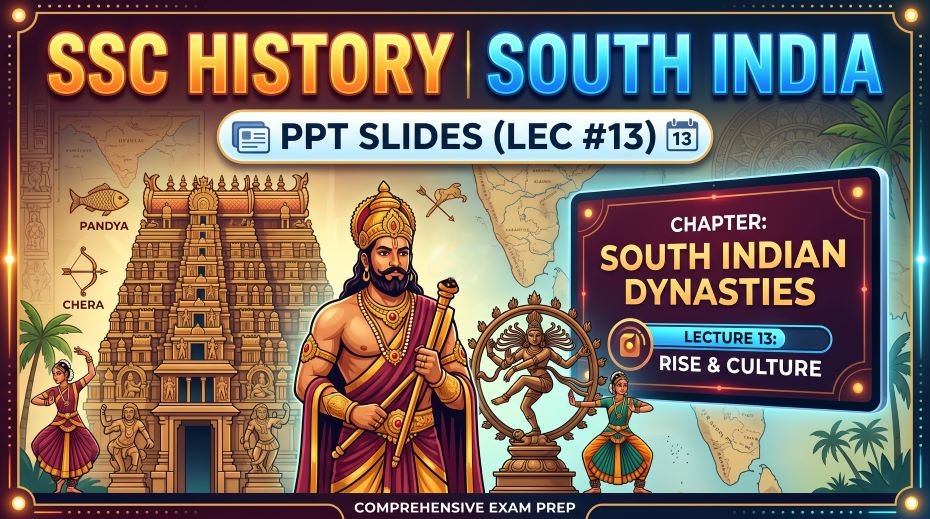
We have shared SSC History of South India PPT Slides (LEC #13) so, Master the History of South India with this complete SSC study guide based on History LECTURE #13 PPT Slides. 116 slides | 49 MB | Serial #38. Covers Sangam Age, Satavahanas, Pallavas, Chalukyas, Rashtrakutas, Chola Empire, Pandyas, Hoysalas, Kakatiyas, South Indian art and architecture, and 35+ high-frequency MCQs for SSC CGL, CHSL, MTS, CPO, Railways NTPC, and UPSC Prelims.
The History of South India is one of the most distinctive and independently developed chapters in the entire spectrum of Indian history. While the north was governed by the Mauryas and Guptas, the south had its own parallel universe of dynasties, literatures, temple architectures, naval powers, and trade networks – equally rich, equally complex, and equally important for SSC exams.
This article is built around the SSC History of South India PPT Slides – Lecture #13 – from the Complete Foundation Batch PPT Series (Serial Number #38) at slideshareppt.net. The PPT contains 116 slides covering the complete arc of South Indian history – from the Sangam Age (300 BC) to the medieval Chola, Pandya, Hoysala, and Kakatiya kingdoms.
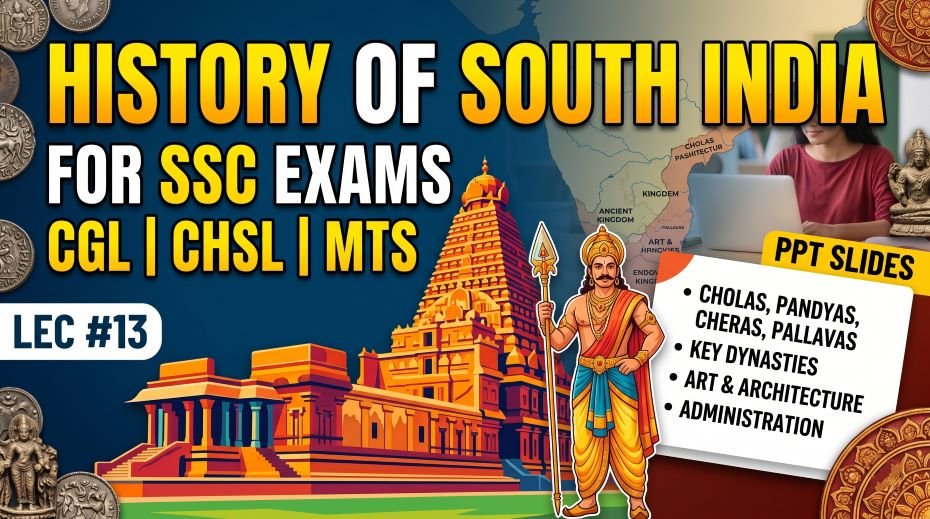
For SSC CGL, SSC CHSL, SSC MTS, SSC CPO, Railways NTPC, and UPSC Prelims aspirants, South Indian history delivers 2–5 reliable marks per exam from temple architecture, dynasty facts, rulers, art styles, and literature. This guide covers every testable fact in a single structured resource.
About the PPT Slides
| Detail | Information |
| Series Name | Complete Foundation Batch for All SSC and Other Exams (PPT Series) |
| Subject | History – History of South India (दक्षिण भारत का इतिहास) |
| Lecture Number | Lecture #13 |
| Total PPT Slides | 116 PPT Slides |
| File Size | 49 MB |
| Serial Number | #38 |
| Period Covered | ~300 BC (Sangam Age) to ~14th Century AD (Vijayanagara era transition) |
| Best For | SSC CGL, CHSL, MTS, CPO, GD, Railways NTPC, UPSC Prelims, State PSCs (especially South Indian states) |
| Source Website | slideshareppt.net |
SSC History of South India PPT Slides (LEC #13) Download
Note: If you wish to download the entire SSC series (PPT slides), simply visit this redirect page. –REDIRECT PAGE
Complete Timeline Table: History of South India – All Key Dates
This master timeline covers the full arc of South Indian history from the Sangam Age to the medieval period. Study each row – every date and ruler here has generated SSC MCQs.
| Period / Year | Dynasty / Event | Key Ruler / Person | Key SSC Fact |
| ~300 BC–300 AD | Sangam Age – Three Tamil Kingdoms | Cheras (Kerala), Cholas (TN coast), Pandyas (Madurai) | Primary source: Sangam literature (Tamil poetry); Thirukkural by Thiruvalluvar; trade with Rome |
| ~60 BC–220 AD | Satavahana Dynasty | Simuka (founder); Gautamiputra Satakarni (greatest) | First great post-Maurya dynasty in Deccan; Prakrit language; Amaravati art; capital Pratishthana |
| ~1st–2nd C. AD | Gautamiputra Satakarni – greatest Satavahana ruler | Gautamiputra Satakarni | Defeated Shakas, Pahlavas, Yavanas (Greeks); called Ekabrahmana; Nashik inscription |
| ~275–897 AD | Pallava Dynasty | Simhavishnu (founder of imperial Pallavas); Mahendravarman I; Narasimhavarman I (Mahamalla); Rajasimha | Capital Kanchipuram; built Mahabalipuram shore temples and rathas; Dravidian temple style |
| ~630–668 AD | Narasimhavarman I (Mahamalla) – greatest Pallava ruler | Narasimhavarman I Pallava | Defeated Chalukya king Pulakesi II; built Mahabalipuram (Mamallapuram) monuments; title Mahamalla (great wrestler) |
| ~543–757 AD | Chalukyas of Badami (Vatapi) | Pulakesi I (founder); Pulakesi II (greatest); Vikramaditya I | Capital Vatapi (Badami); Pulakesi II defeated Harsha; Aihole, Badami, Pattadakal temples |
| ~609–642 AD | Pulakesi II – greatest Chalukya of Badami ruler | Pulakesi II | Defeated Emperor Harshavardhana on the Narmada River (c. 637 AD); received Chinese pilgrim Hieun Tsang; killed by Pallava Narasimhavarman I |
| ~753–982 AD | Rashtrakuta Dynasty | Dantidurga (founder); Krishna I; Amoghavarsha I | Capital Manyakheta (Malkhed, Karnataka); Krishna I built Kailasa Temple at Ellora; Amoghavarsha = great scholar |
| ~757–793 AD | Krishna I – most famous Rashtrakuta builder | Krishna I Rashtrakuta | Built the magnificent Kailasa Temple (Cave 16) at Ellora – largest monolithic rock-cut temple in world |
| ~814–878 AD | Amoghavarsha I – scholar-king | Amoghavarsha I Rashtrakuta | Reigned for 64 years; wrote Kavirajamarga (first literary work in Kannada language); devoted Jain |
| ~848–1279 AD | Imperial Chola Dynasty | Vijayalaya (founder); Rajaraja I; Rajendra I; Kulottunga I | Greatest South Indian medieval empire; naval power; Brihadeeshwara Temple; naval expeditions to Southeast Asia |
| ~985–1014 AD | Rajaraja I – greatest builder among Cholas | Rajaraja I (Chola) | Built the magnificent Brihadeeshwara Temple at Thanjavur (UNESCO); title Rajakesari; conquered Sri Lanka, Maldives |
| ~1014–1044 AD | Rajendra I – greatest Chola military ruler | Rajendra I (Gangaikondachola) | Led naval expedition to Southeast Asia (Srivijaya); took title Gangaikondachola; built Gangaikondacholapuram |
| ~900–1310 AD | Pandya Kingdom (revival) | Maravarman Sundara Pandya; Jatavarman Sundara Pandya | Major power in southern Tamil Nadu; defeated Cholas; Marco Polo visited during Pandya rule |
| ~1000–1346 AD | Hoysala Dynasty | Vishnuvardhana (greatest); Veera Ballala II | Capital Dwarasamudra (Halebid); Hoysaleswara Temple Halebid; Chennakesava Temple Belur; Karnataka |
| ~1083–1323 AD | Kakatiya Dynasty | Rudradeva (founder); Prataparudra II (last ruler) | Capital Warangal (Telangana); Warangal Fort; Ramappa Temple (UNESCO 2021); defeated by Delhi Sultanate (Malik Kafur) |
| ~1336–1646 AD | Vijayanagara Empire | Harihara I and Bukka I (founders); Krishnadeva Raya (greatest) | Greatest Hindu medieval empire; capital Hampi; Battle of Talikota 1565 (LEC 7 coverage) |
Part I: The Sangam Age (~300 BC to 300 AD) – The Classical Tamil Civilisation
The Sangam Age represents the earliest period of Tamil civilisation that is documented through a remarkable body of ancient Tamil poetry – the Sangam literature. This was a period of prosperous trade, vibrant culture, and three competing kingdoms in South India.
The Three Tamil Kingdoms of the Sangam Age
| Kingdom | Dynasty Name | Capital | Location (Modern) | Key Facts / SSC Relevance |
| Chera | Chera Dynasty | Vanji (Karur or Kodungallur) | Kerala + parts of Tamil Nadu | Controlled the western coast (Malabar); major centre of Roman trade; famous for spices and cotton textiles; Poetic works: Pathirruppattu praises Chera kings |
| Chola | Chola Dynasty | Uraiyur (initial); Kaveripattinam (port city) | Northern and central Tamil Nadu; Kaveri delta region | Controlled the fertile Kaveri delta; great maritime traders; Poetic works: Purananuru mentions Chola kings; later became the Imperial Chola Empire |
| Pandya | Pandya Dynasty | Madurai | Southern Tamil Nadu and parts of Kerala | Oldest of the three kingdoms; capital Madurai was a great literary centre; trade with Greeks and Romans; Poetic works: Madurai Kanchi; Marco Polo visited later Pandya kingdom |
Sangam Literature – The Ancient Tamil Literary Corpus
The Sangam literature is one of the oldest and richest bodies of literature in any Indian language – predating much of classical Sanskrit literature in terms of secular, realistic content. It is a collection of approximately 2,381 poems in Tamil, composed by over 473 poets (including women poets).
| Text / Collection | Category | Contents / Significance | SSC Relevance |
| Thirukkural | Didactic text (Kural literature) | Written by Thiruvalluvar; 1,330 couplets (kurals) in 133 chapters covering 3 themes: Aram (virtue/ethics), Porul (wealth/statecraft), Inbam (love); called the ‘Bible of Tamil Land’; translated into more than 80 languages | Most tested Sangam text: Thirukkural = Thiruvalluvar; covers ethics, statecraft, love |
| Tolkappiyam | Grammar text | Written by Tolkappiyar; earliest known grammar of the Tamil language; covers phonology, grammar, and poetics; the most ancient Tamil text | Tolkappiyam = Tolkappiyar = earliest Tamil grammar – frequently asked |
| Ettuthokai (Eight Anthologies) | Poetry anthologies | Eight collections of Sangam poetry: Akananuru, Purananuru, Ainkurunuru, Narrinai, Kuruntokai, Kalittokai, Paripatal, Patirruppattu | Eight anthologies of Sangam poetry – numbers and names tested occasionally |
| Pattuppattu (Ten Idylls) | Poetry | Ten longer poems including Cilappatikaram’s predecessor texts | Ten idylls – sometimes tested |
| Cilappatikaram | Epic poem | By Ilango Adigal (a Chera prince turned monk); considered the greatest Tamil epic; story of Kovalan and Kannagi; the goddess Kannagi destroys Madurai after her husband is unjustly executed; also called ‘The Lay of the Anklet’ | Cilappatikaram = Ilango Adigal = greatest Tamil epic = story of Kannagi and Kovalan |
| Manimekalai | Epic poem | By Sattanar; sequel to Cilappatikaram; Buddhist in ideology | Manimekalai = Sattanar = sequel to Cilappatikaram = Buddhist theme |
| Silappadikaram + Manimekalai | Two Tamil Epics | Called the twin epics of Tamil literature | Two Tamil epics together are frequently asked as a pair |
SSC Exam Tip: Thirukkural = Thiruvalluvar = 1,330 couplets = 3 themes (virtue, wealth, love) = called ‘Bible of Tamil Land’ = translated into 80+ languages. Tolkappiyam = Tolkappiyar = oldest Tamil grammar. Cilappatikaram = Ilango Adigal = greatest Tamil epic. All three are regularly tested.
Sangam Age Economy and Trade with Rome
- The Sangam Age was characterised by extensive maritime trade – particularly with the Roman Empire.
- Yavanas (Greeks and Romans) are frequently mentioned in Sangam poetry – they came in ships bearing wine and gold and left with spices and cotton textiles.
- The main Roman trade ports on India’s south and west coasts included: Muziri (Kodungallur, Kerala – Chera territory), Kaveripattinam (Chola territory), and Korkai (Pandya territory).
- A massive hoard of Roman gold coins (aurei) discovered at various South Indian sites proves the scale of Roman-South Indian trade during the Sangam Age.
- The Roman Emperor Augustus reportedly received embassies from South Indian kings – the earliest documented South Indian diplomatic contact with Europe.
- Main exports from South India to Rome: pepper, ginger, cinnamon, cardamom, cotton textiles, precious stones, ivory, and peacocks.
- Main imports from Rome: gold coins (aurei), wine, glassware, silver vessels, and amphoras.
SSC Exam Tip: Yavanas (Romans/Greeks) traded with South India during Sangam Age. Roman gold coins found in South India. Muziri (Kerala) and Kaveripattinam (Tamil Nadu) were main trade ports. These facts are tested in Trade/Economy questions in SSC papers.
Part II: Satavahana Dynasty (~60 BC to 220 AD) – The First Great Deccan Power
The Satavahana dynasty was the first great indigenous dynasty to fill the power vacuum left in the Deccan after the decline of the Maurya Empire. They ruled a vast territory covering the Deccan Plateau (modern Maharashtra, Andhra Pradesh, and Telangana) and were major patrons of art, trade, and the Prakrit language.
Key Facts About the Satavahanas
| Aspect | Detail |
| Founder | Simuka (also written as Sindhuka or Sisuka); established the dynasty ~60 BC |
| Capital | Pratishthana (modern Paithan on the Godavari River, Maharashtra) |
| Language | Prakrit – they used Prakrit (not Sanskrit) as their court language; their coins have Prakrit inscriptions |
| Script | Brahmi script |
| Religion | Mixed – Brahmanical Hinduism for rituals, but also patronised Buddhism; many Buddhist stupas built with Satavahana support |
| Territory | At their peak: covered Maharashtra, Andhra Pradesh, Telangana, Karnataka, and parts of Madhya Pradesh |
| Titles | Kings used matronymic titles – they named themselves after their mothers (e.g., Gautamiputra = ‘son of Gautami’) |
| Trade | Major trade with Rome; controlled the Deccan trade routes connecting the west coast ports to the eastern ports |
| Art | Major patrons of Amaravati art – the limestone sculptures of the Amaravati Stupa (Andhra Pradesh) are masterpieces of Satavahana art |
| Coins | Their coins are among the earliest bilingual coins in India – with both Prakrit and Tamil inscriptions in some cases |
Gautamiputra Satakarni – The Greatest Satavahana Ruler
- Gautamiputra Satakarni (~106–130 AD) is the most important Satavahana ruler for SSC exams – the dynasty’s peak ruler who restored Satavahana power after a period of decline.
- His name itself contains a matronymic element – Gautamiputra means ‘son of Gautami’ – his mother’s name.
- He defeated three major foreign powers that had encroached on Satavahana territory: the Shakas (Western Kshatrapas), the Pahlavas (Parthians), and the Yavanas (Indo-Greeks).
- He took the proud title Ekabrahmana – ‘the unique Brahmin’ or ‘the foremost Brahmin’ – emphasising his role as a protector of Brahmanical social order.
- The Nashik Inscription (a prasasti composed by his mother Gautami Balashri after his death) is the primary source for his achievements – it lavishly praises his military and administrative accomplishments.
- He was also known as Shakayana – the one who put an end to the Shakas (Scythians).
SSC Exam Tip: Gautamiputra Satakarni = greatest Satavahana king = defeated Shakas + Pahlavas + Yavanas = title Ekabrahmana = Nashik Inscription (by mother Gautami Balashri). All five facts are individually testable.
Amaravati Art – The Satavahana Artistic Legacy
| Aspect | Detail |
| Location | Amaravati (on the Krishna River, Andhra Pradesh) |
| Type | Buddhist stupa and its decorative panels |
| Material | White marble and limestone – distinctive among Indian Buddhist art |
| Period | ~2nd century BC to 3rd century AD – primarily under Satavahana patronage |
| Style | South Indian Buddhist style – very different from Gandhara (northwest) or Mathura (north) |
| Key Features | Extremely intricate narrative panels; figures densely packed; elaborate floral borders; dynamic movement; shows Buddha’s life and Jataka tales in relief panels |
| Buddha Representation | Initially used aniconic symbols (footprints, throne, Bodhi tree); later showed the Buddha in human form |
| Current Status | Many of the finest Amaravati panels are in the British Museum (London) and the Government Museum, Chennai (Madras) |
| SSC Relevance | ‘Amaravati school of art’ = South India = white marble/limestone = Satavahana patronage = Krishna River, Andhra Pradesh |
Part III: Pallava Dynasty (~275–897 AD) – Architects of Dravidian Temple Style
The Pallava dynasty is one of the most important dynasties in South Indian history – not because of the size of their empire, but because of their extraordinary contribution to temple architecture. The Dravidian (South Indian) style of temple architecture was developed and perfected by the Pallavas, and it influenced temple building across South and Southeast Asia.
Key Pallava Rulers
| Ruler | Period (AD) | Key Achievement / SSC Fact |
| Simhavishnu | ~575–600 | Founded the imperial Pallava dynasty; defeated the Kalabhras who had disrupted Tamil kingdoms |
| Mahendravarman I | ~600–630 | Great builder and artist; converted from Jainism to Shaivism under influence of saint Appar (Tirunavukkarasar); built early Pallava rock-cut temples (Mandagapattu inscription says he built a temple without using bricks, wood, mortar, or metal); also wrote the Sanskrit comedy Mattavilasaprahasana |
| Narasimhavarman I (Mahamalla) | ~630–668 | Greatest Pallava military ruler; title Mahamalla (great wrestler); defeated and killed Chalukya king Pulakesi II; sent naval expedition to Sri Lanka; built the shore temples and rock-cut rathas at Mahabalipuram (Mamallapuram); Chinese pilgrim Hieun Tsang visited South India during this period |
| Mahendravarman II | ~668–670 | Short reign |
| Paramesvaravarman I | ~670–695 | Continued Pallava-Chalukya conflicts |
| Narasimhavarman II (Rajasimha) | ~695–722 | Built the famous Shore Temple at Mahabalipuram (oldest structural stone temple in South India); also built the Kailasanatha Temple at Kanchipuram – the finest Pallava temple |
| Nandivarman II | ~731–796 | Maintained Pallava power; built the Vaikuntaperumal Temple at Kanchipuram |
| Aparajita | ~879–897 | Last Pallava ruler; defeated by the Cholas under Aditya I; Pallava dynasty ends |
Pallava Architecture – The Birth of Dravidian Style
Pallava architecture evolved through four distinct stages – from simple rock-cut excavations to fully structural stone temples with towers (vimanas). This evolution represents the development of what became the Dravidian or Southern style of Indian temple architecture.
| Phase / Type | Period | Examples | Key Features |
| Mahendra Style (Rock-cut Mandapas) | ~600–625 AD | Mandagapattu, Mahendravadi, Trichy mandapas | Simple rock-cut cave temples (mandapas) with pillars; no freestanding structures; monolithic; no sculptures on exterior; plain and austere style |
| Mamalla Style (Monolithic Rathas + Shore Temples) | ~625–675 AD | Mahabalipuram (Mamallapuram) – Seven Pagodas (Pancha Pandava Rathas + 2 more); Arjuna’s Penance (world’s largest bas-relief) | Monolithic rock-cut rathas (chariots) carved out of single boulders; each ratha is a different temple form; Arjuna’s Penance/Descent of Ganga = world’s largest bas-relief sculpture |
| Rajasimha Style (Structural Temples) | ~675–750 AD | Shore Temple (Mahabalipuram); Kailasanatha Temple (Kanchipuram) | First structural (built from cut stones, not rock-cut) Pallava temples; Shore Temple = oldest structural stone temple in South India; Kailasanatha = finest and most ornate Pallava temple |
| Nandivarman Style | ~750–900 AD | Vaikuntaperumal Temple, Kanchipuram; Mukteswara Temple | Later Pallava structural temples; more elaborate; transition toward full Dravidian style that the Cholas would perfect |
SSC Exam Tip: Mahabalipuram (Mamallapuram) = Pallava dynasty = Narasimhavarman I (Mahamalla) built the rathas = UNESCO World Heritage Site. Shore Temple = Narasimhavarman II (Rajasimha) = oldest structural stone temple in South India. Kailasanatha Temple = Kanchipuram = finest Pallava temple. Arjuna’s Penance = world’s largest bas-relief. All testable.
Mahabalipuram (Mamallapuram) – Complete Reference
| Monument | Type | Key Details |
| Pancha Pandava Rathas (Five Rathas) | Monolithic rock-cut temples (rathas) | Five separate temples carved from single granite boulders; each named after a Pandava (Dharmaraja Ratha, Bhima Ratha, Arjuna Ratha, Nakula-Sahadeva Ratha, Draupadi Ratha); each shows a different temple form; built during Narasimhavarman I’s reign |
| Arjuna’s Penance (Descent of Ganga) | World’s largest bas-relief | A massive open-air rock panel approximately 29m x 13m; shows the story of the descent of the Ganga from heaven (or Arjuna’s penance); hundreds of figures of gods, humans, and animals carved with extraordinary detail |
| Shore Temple | Structural stone temple | Built by Narasimhavarman II (Rajasimha); located on the beach facing the Bay of Bengal; dedicated to both Shiva (two shrines) and Vishnu (one shrine); oldest surviving structural stone temple in South India; UNESCO World Heritage Site |
| Mahishasuramardini Mandapa | Rock-cut cave temple | Famous for the relief of Durga slaying Mahishasura (the buffalo demon); also shows Vishnu in cosmic sleep (Anantashayana); masterpiece of Pallava sculpture |
| Varaha Cave Temple | Rock-cut cave temple | Shows four incarnations of Vishnu including the famous Varaha (boar lifting the earth goddess) relief |
SSC Exam Tip: Mahabalipuram monuments are UNESCO World Heritage Sites. The most tested individual monuments are: Pancha Pandava Rathas (five rathas named after Pandavas) and the Shore Temple (oldest structural temple in South India). Both frequently appear in SSC architectural heritage questions.
Part IV: Chalukyas of Badami (Vatapi) (~543–757 AD)
The Chalukyas of Badami were the dominant power in the western Deccan from the 6th to 8th centuries AD. Their greatest ruler, Pulakesi II, achieved the remarkable feat of stopping the northward expansion of Emperor Harshavardhana – the last great North Indian emperor.
Key Chalukya of Badami Rulers
| Ruler | Period (AD) | Key Achievement / SSC Fact |
| Pulakesi I | ~543–566 | Founder of the Chalukya dynasty of Badami; established capital at Vatapi (modern Badami, Karnataka); title Satyashraya |
| Kirtivarman I | ~566–597 | Expanded the kingdom; built some of the earliest Badami cave temples |
| Mangalesha | ~597–609 | Regent; killed by Pulakesi II in a succession conflict |
| Pulakesi II | ~609–642 | Greatest Chalukya of Badami ruler; defeated Harshavardhana on the Narmada; received Hieun Tsang’s visit; sent a diplomatic mission to Persian king Khusrau II; killed in battle by Pallava king Narasimhavarman I |
| Vikramaditya I | ~655–681 | Recovered Badami from Pallavas after Pulakesi II’s defeat; rebuilt Chalukya power; patronised Aihole temples |
| Vikramaditya II | ~733–744 | Defeated the Arabs at Navsari (Gujarat) – stopped the Arab advance into India; great temple builder at Pattadakal |
| Kirtivarman II | ~744–757 | Last Chalukya of Badami ruler; overthrown by Dantidurga (Rashtrakuta founder) |
Pulakesi II – The Ruler Who Stopped Harsha
- Pulakesi II (~609–642 AD) is the most famous Chalukya ruler and one of the most important rulers in medieval South Indian history.
- His greatest achievement was defeating Emperor Harshavardhana of Kannauj on the banks of the Narmada River around 637 AD – stopping Harsha’s southward expansion and establishing the Narmada as the boundary between north and south India.
- The Chinese pilgrim Hieun Tsang visited South India during Pulakesi II’s reign and described him as a powerful and popular ruler.
- The Aihole Inscription (Aihole Prashasti) – composed by his court poet Ravikirti – is the primary source for Pulakesi II’s reign and his defeat of Harsha.
- He sent a diplomatic mission to the Persian Sassanid king Khusrau II – this diplomatic contact is depicted in the famous Ajanta cave painting showing Persian ambassadors at an Indian court (Cave 1).
- He was eventually killed in battle by the Pallava king Narasimhavarman I (Mahamalla) around 642 AD, who sacked and captured the Chalukya capital Vatapi (Badami).
SSC Exam Tip: Pulakesi II = stopped Harsha on Narmada River = Aihole Inscription by Ravikirti = Hieun Tsang visited = Persian ambassadors in Ajanta painting = killed by Pallava Narasimhavarman I. Five different testable facts from one ruler.
Chalukya Architecture – Badami, Aihole, Pattadakal
| Site | Location | Key Monuments / Features | SSC Significance |
| Badami (Vatapi) | Bagalkot, Karnataka | Four rock-cut cave temples (~6th century AD); Cave 1 = Shiva; Cave 2 = Vishnu (Trivikrama); Cave 3 = Vishnu (most elaborate, has a date 578 AD); Cave 4 = Jain (Mahavira); also Bhutanatha Temple on the lake | Earliest Chalukya temples; four caves for three religions shows religious tolerance; Badami Cave 3 has the earliest dated Chalukya inscription |
| Aihole | Bagalkot, Karnataka | Over 100 temples of various styles; called ‘Cradle of Indian temple architecture’; Durga Temple (semi-circular apse, Buddhist-influenced); Lad Khan Temple (earliest Hindu temple with flat roof); Meguti Jain Temple (only dated temple, 634 AD, Aihole Inscription found here) | Aihole = Cradle of Indian architecture = experimental ground for Hindu temple styles; Durga Temple is most famous; Aihole Inscription about Pulakesi II |
| Pattadakal | Bagalkot, Karnataka | Ten temples; four in Rekhanagara (North Indian / Nagara) style and six in Vesara (mixed) style; Virupaksha Temple (best example, built by Vikramaditya II’s queen Lokamahadevi to celebrate victory over Pallavas, c. 740 AD); UNESCO World Heritage Site | Pattadakal = UNESCO = Virupaksha Temple = Chalukya; mix of North and South Indian temple styles |
SSC Exam Tip: Aihole = Cradle of Indian temple architecture = over 100 temples = Chalukya. Pattadakal = UNESCO World Heritage Site = Virupaksha Temple = Chalukya = mix of Nagara and Dravidian styles. Both are frequently tested heritage questions.
Part V: Rashtrakuta Dynasty (~753–982 AD) – The Kailasa Temple Builders
The Rashtrakutas were one of the most powerful empires of medieval India – their influence extended from the Deccan to the Gangetic plains in the north and to Sri Lanka in the south. They are particularly famous for the Kailasa Temple at Ellora – the most ambitious rock-cut monument in world history.
Key Rashtrakuta Rulers
| Ruler | Period (AD) | Key Achievement / SSC Fact |
| Dantidurga | ~735–756 | Founder of the Rashtrakuta dynasty; overthrew the last Chalukya of Badami (Kirtivarman II); performed Hiranyagarbha ceremony at Ujjain |
| Krishna I | ~756–773 | Son of Dantidurga; built the magnificent Kailasa Temple (Cave 16) at Ellora – the single greatest achievement in Indian rock-cut architecture |
| Dhruva Dharavarsha | ~780–793 | Defeated Pratiharas and Palas; established Rashtrakuta as the paramount power in the Deccan |
| Govinda III | ~793–814 | Greatest Rashtrakuta military ruler; defeated the Gurjara-Pratiharas, Palas of Bengal, and almost every major power in India; nearly achieved pan-Indian domination |
| Amoghavarsha I | ~814–878 | Reigned for 64 years; most scholarly Rashtrakuta king; wrote Kavirajamarga (first major literary work in Kannada prose); also wrote Ratnamalika (in Sanskrit); was a devoted Jain; gave up a finger to the Jain saint Jinasena; the Arab merchant Sulaiman described his kingdom as one of the four great empires of the world |
| Krishna III | ~939–967 | Greatest Rashtrakuta military ruler of later period; defeated Chola king Parantaka I; extended empire to Tamil Nadu; the last great Rashtrakuta expansionist |
| Indra IV | ~982 | Last Rashtrakuta ruler; dynasty overthrown by the later Western Chalukyas (Chalukyas of Kalyani) |
The Kailasa Temple at Ellora – The Greatest Rock-Cut Monument
| Aspect | Detail |
| Location | Ellora, Aurangabad district, Maharashtra – Cave 16 in the Ellora complex |
| Built By | Krishna I of the Rashtrakuta dynasty (~756–773 AD) |
| Type | Rock-cut monolithic temple – carved downward into the basalt rock of the Deccan plateau |
| Dedication | Dedicated to Shiva – replicates the mythological Mount Kailash (Shiva’s celestial abode) |
| Scale | Approximately 164 feet long, 109 feet wide, and 100 feet tall; carved from a single rock; about twice the size of the Parthenon in Athens, Greece |
| Method | Carved top-to-bottom – workers first cut the top, then worked downward; required removing approximately 200,000 tonnes of rock |
| Features | Massive gateway, courtyard, mandapa (hall), garbhagriha (sanctum), lingam inside; elaborate sculptural panels including the famous Ravana Shaking Kailash (Ravananugraha) scene |
| Comparison | Considered the largest monolithic structure in the world carved from a single rock; the sheer scale of the engineering makes it one of the greatest human achievements in construction |
| UNESCO Status | Part of the Ellora Caves – UNESCO World Heritage Site since 1983 |
| SSC Relevance | ‘Who built the Kailasa Temple at Ellora?’ = Krishna I (Rashtrakuta). ‘The largest monolithic rock-cut temple?’ = Kailasa Temple, Ellora. Both are very frequently tested |
SSC Exam Tip: Kailasa Temple = Ellora = Cave 16 = Krishna I (Rashtrakuta) = dedicated to Shiva = largest monolithic rock-cut structure in world = carved top-to-bottom. All six facts generate separate SSC questions.
Amoghavarsha I – The Scholar Emperor of the Rashtrakutas
- Amoghavarsha I ruled for approximately 64 years (~814–878 AD) – one of the longest reigns in Indian history.
- He was a deeply cultured ruler and a devoted Jain – he reportedly cut off his finger as an offering to the Jain saint Jinasena to avert a calamity.
- He wrote Kavirajamarga (~850 AD) – considered the first major literary work in the Kannada language; a treatise on Kannada poetics.
- He also wrote Ratnamalika in Sanskrit – a work on devotional poetry.
- The Arab merchant-traveller Sulaiman (~851 AD) visited his kingdom and described it as one of the four great empires of the world (along with the Abbasid Caliphate, China, and the Byzantine Empire).
SSC Exam Tip: Amoghavarsha I = Kavirajamarga = first major Kannada literature = Rashtrakuta = Jain devotee. The question ‘who wrote Kavirajamarga?’ = Amoghavarsha I is a standard SSC question.
Part VI: Imperial Chola Dynasty (~848–1279 AD) – South India’s Greatest Empire
The Imperial Chola dynasty is the greatest dynasty in the history of South India and one of the most significant in all of Indian history. At their peak, the Chola Empire controlled not just South India but also parts of Sri Lanka, the Maldives, and launched naval expeditions all the way to Southeast Asia – establishing the world’s first recorded naval empire in medieval times.
Key Imperial Chola Rulers
| Ruler | Period (AD) | Key Achievement / SSC Fact |
| Vijayalaya | ~848–871 | Founded the Imperial Chola dynasty by capturing Thanjavur from the Muttaraiyar chiefs; minor ruler but historically pivotal as the founder |
| Aditya I | ~871–907 | Expanded Chola power; defeated and killed the last Pallava ruler Aparajita (~897 AD); ended the Pallava dynasty |
| Parantaka I | ~907–955 | Conquered most of Sri Lanka; later defeated by the Rashtrakuta king Krishna III |
| Rajaraja I (Rajaraja the Great) | ~985–1014 | Greatest builder among Cholas; built the Brihadeeshwara Temple (Rajarajeshwara Temple) at Thanjavur – the greatest Chola architectural achievement; conquered Sri Lanka, Maldives, and parts of Malaya/Southeast Asia; introduced a revenue settlement (land survey and assessment) |
| Rajendra I (Gangaikondachola) | ~1014–1044 | Greatest military ruler of the Cholas; led the famous naval expedition to Southeast Asia (Srivijaya – modern Malaysia/Indonesia) ~1025 AD; marched an army to the Ganges river and took Gangetic water back to the south (hence the title Gangaikondachola = ‘Chola who took the Ganga’); built new capital Gangaikondacholapuram |
| Kulottunga I | ~1070–1120 | United the Eastern Chalukya line with the Chola line; one of the longest-reigning Chola rulers; wrote the famous Tamil poem Kalingattuparani (about his Kalinga conquest) |
| Kulottunga III | ~1178–1218 | Last great Chola ruler; maintained empire but with declining power |
| Rajendra III | ~1246–1279 | Last Chola ruler; Pandyas became dominant; Chola empire ends |
Rajaraja I – The Temple Builder Emperor
- Rajaraja I (~985–1014 AD) is considered the greatest ruler of the Imperial Chola dynasty and one of the greatest temple builders in Indian history.
- His greatest achievement was building the Brihadeeshwara Temple (also called Rajarajeshwara Temple) at Thanjavur (Tanjore) in Tamil Nadu – completed in 1010 AD.
- The Brihadeeshwara Temple is dedicated to Shiva; its vimana (tower) is 66 metres (216 feet) tall – one of the tallest temple towers in India at the time of construction.
- The capstone (shikhara/stupi) on the top of the vimana weighs approximately 80 tonnes – it was reportedly placed using a ramp 6 km long.
- The temple has a massive Nandi (Shiva’s bull) carved from a single block of granite – weighing ~25 tonnes.
- The Brihadeeshwara Temple, along with the Gangaikondacholapuram Temple and the Airavatesvara Temple, form the Great Living Chola Temples – a UNESCO World Heritage Site since 1987.
- Rajaraja I also conducted a systematic land survey and revenue assessment of his kingdom – an administrative innovation.
- He conquered Sri Lanka (keeping the northern part as a Chola province) and the Maldive Islands.
SSC Exam Tip: Rajaraja I = Brihadeeshwara Temple Thanjavur = 66 metres tall tower = 1010 AD = UNESCO Great Living Chola Temples. These four facts generate the most SSC questions about Rajaraja I.
- Rajendra I (~1014–1044 AD) is the greatest military ruler of the Chola dynasty and one of the most remarkable rulers in Indian history for his naval exploits.
- He inherited a large empire from his father Rajaraja I and expanded it dramatically in all directions.
- His most celebrated achievement: the naval expedition to Southeast Asia around 1025 AD – the Chola fleet attacked and captured territories of the Srivijaya Empire (modern Malaysia, Indonesia, and Thailand), defeating the Srivijaya king Sangrama Vijayottungavarman and taking several cities.
- This is considered the largest and most successful naval military campaign in pre-modern Indian history.
- He marched his army to the River Ganga in northern India, defeated the rulers of Bengal and Odisha, and symbolically carried Ganga water back to South India – earning the title Gangaikondachola (the Chola who took the Ganga).
- He built a new capital called Gangaikondacholapuram (‘the city of the Chola who took the Ganga’) in Tamil Nadu.
- He also built the Gangaikondacholapuram Temple – rivalling the Brihadeeshwara Temple in grandeur.
SSC Exam Tip: Rajendra I = Gangaikondachola = naval expedition to Southeast Asia (Srivijaya, ~1025 AD) = marched to Ganga = built Gangaikondacholapuram. All four facts are repeatedly tested. The question ‘which Indian king led a naval expedition to Southeast Asia?’ = Rajendra I.
Great Living Chola Temples – UNESCO World Heritage
| Temple | Built By | Location | Period (AD) | Key Features / SSC Facts |
| Brihadeeshwara Temple (Rajarajeshwara Temple) | Rajaraja I | Thanjavur, Tamil Nadu | 1003–1010 AD | 66m tall vimana; dedicated to Shiva; 80-tonne capstone; massive granite Nandi; inscriptions recording donations; UNESCO World Heritage |
| Gangaikondacholapuram Temple | Rajendra I | Gangaikondacholapuram, Tamil Nadu | ~1035 AD | Built to commemorate Rajendra’s march to the Ganga; slightly shorter vimana but more ornate; superb Chola sculptures; UNESCO World Heritage |
| Airavatesvara Temple | Rajaraja II | Darasuram (near Kumbakonam), Tamil Nadu | ~12th century AD | Most decorative of the three; chariot-shaped mandapa with wheels; named for Airavata (Indra’s elephant) which worshipped the Shiva here; UNESCO World Heritage |
SSC Exam Tip: The three Great Living Chola Temples form a UNESCO World Heritage Site group (inscribed 1987, extended 2004). The most tested are: Brihadeeshwara (Rajaraja I, Thanjavur) and Gangaikondacholapuram (Rajendra I). ‘Great Living Chola Temples’ = all three together.
Chola Administration – A Model of Ancient Governance
The Chola Empire had one of the most sophisticated and decentralised administrative systems in ancient and medieval India – particularly at the local level, where village assemblies had remarkable autonomy.
| Administrative Unit | Name | Description |
| Province | Mandalam | Largest administrative unit; several mandalams in the empire; each governed by a viceroy (usually a prince) |
| District | Kottam or Nadu | Sub-division of Mandalam; Nadu = a group of villages with shared economic and social ties |
| Sub-district | Kurram | A cluster of villages below Nadu level |
| Village | Ur | The basic unit of administration; had its own assembly |
| Brahmin Village Assembly | Sabha (Mahasabha) | A village assembly in Brahmin-dominated villages (called Brahmadeya villages); had elected committees (Variyams) for specific functions (garden management, water management, justice) |
| Non-Brahmin Village Assembly | Ur Assembly | Assembly of all adult men in a non-Brahmin village; collective decision-making |
| Military Division | Padai / Senapati | Military units under a Senapati; Cholas maintained a large standing army and naval force |
SSC Exam Tip: Chola village administration is a favourite SSC topic – particularly the distinction between Sabha (Brahmin village assembly) and Ur (non-Brahmin village assembly). The question ‘what is the Sabha in Chola administration?’ is tested in competitive exams.
Part VII: Other South Indian Dynasties
Hoysala Dynasty (~1000–1346 AD)
| Aspect | Detail |
| Origin | Local dynasty that rose in Karnataka after the decline of the Chalukyas and Rashtrakutas |
| Founder | Sala (legendary) or Nripa Kama II (historically verifiable) |
| Greatest Ruler | Vishnuvardhana (~1108–1152 AD) – converted from Jainism to Vaishnavism under the influence of the philosopher-saint Ramanujacharya; built the Chennakesava Temple at Belur to celebrate his conversion and military victory over the Cholas |
| Capital | Dwarasamudra (modern Halebid, Karnataka) |
| Distinctive Architecture | Hoysala temples have a unique star-shaped (stellate) plan – the base and walls follow a complex zig-zag pattern creating many projections; built on a raised star-shaped platform (jagati); extremely elaborate sculptural decoration covering every surface |
| Key Temples | Hoysaleswara Temple at Halebid (Dwarasamudra) – dedicated to Shiva; Chennakesava Temple at Belur – dedicated to Vishnu; Kesava Temple at Somanathapura – most perfectly preserved |
| Material | Built of chloritic schite (soapstone) – a soft stone that could be carved very intricately and hardened over time |
| End | Defeated and absorbed by the Vijayanagara Empire in the 14th century; last ruler Veera Ballala III killed fighting against the Madurai Sultanate |
| UNESCO Status | Hoysala temples nominated for UNESCO World Heritage status; inscribed in 2023 |
SSC Exam Tip: Hoysala = Karnataka = Halebid + Belur = star-shaped plan = soapstone = Vishnuvardhana converted by Ramanujacharya. Hoysaleswara Temple (Halebid) and Chennakesava Temple (Belur) are most tested.
Kakatiya Dynasty (~1083–1323 AD)
| Aspect | Detail |
| Location | Warangal, Telangana (modern) |
| Founder | Betaraja I or Prola I; consolidated by Rudradeva (Prataparudra I) |
| Greatest Ruler | Rudramadevi (~1262–1289 AD) – one of the very few women rulers in medieval Indian history; she disguised herself as a male ruler to gain acceptance; Marco Polo mentioned her during his visit to South India |
| Last Ruler | Prataparudra II (~1289–1323 AD) – defeated by Malik Kafur (general of Alauddin Khilji) in 1310 AD; finally overthrown by Muhammad Bin Tughlaq’s forces in 1323 AD |
| Capital | Warangal (Orugallu), Telangana |
| Architecture | Warangal Fort (its gateway – the Kakatiya Kala Thoranam – became the symbol of Telangana state); Thousand Pillar Temple at Hanamkonda; Ramappa Temple (Rudresvara Temple) at Palampet |
| UNESCO Status | Ramappa Temple (Kakatiya Rudresvara Temple) at Palampet inscribed as UNESCO World Heritage Site in 2021 |
| Significance | Major Telugu-speaking power of medieval India; their downfall was the final political liberation of the Deccan sultanates and led to the founding of the Vijayanagara Empire |
SSC Exam Tip: Kakatiya = Warangal = Telangana = Rudramadevi (woman ruler, mentioned by Marco Polo) = Ramappa Temple (UNESCO 2021) = Prataparudra II defeated by Malik Kafur. All five facts are tested. Ramappa Temple’s 2021 UNESCO inscription has made it a current affairs + history crossover question.
Pandya Kingdom – Ancient and Medieval
- The Pandyas are one of the oldest Tamil dynasties – mentioned even in the Greek and Roman records (4th century BC).
- Their capital was Madurai – one of the oldest continuously inhabited cities in India and a great centre of Tamil culture and literature.
- The Pandya kings are associated with the patronage of the Tamil Sangam (literary academy) at Madurai – the great gatherings of Tamil poets that produced the Sangam literature.
- During the medieval period, the Pandyas revived as a major power after the decline of the Cholas.
- Maravarman Sundara Pandya and Jatavarman Sundara Pandya (~13th century AD) were the greatest medieval Pandya rulers – they defeated the Cholas and extended Pandya power across Tamil Nadu and into Sri Lanka.
- Marco Polo visited the Pandya kingdom on his way back from China (~1288–1293 AD) and described its prosperity and the pearl fisheries off the Pandya coast.
- The Pandya kingdom was eventually conquered by the Madurai Sultanate (a branch of the Delhi Sultanate) in the early 14th century.
SSC Exam Tip: Pandyas = Madurai capital = oldest Tamil dynasty = Sangam literary academy = Marco Polo visited = pearl fisheries. These facts are tested in Tamil Nadu state exams and occasionally in SSC papers.
Part VIII: South Indian Art and Architecture – Quick Summary
| Dynasty | Architectural Style | Key Monuments | Key SSC Facts |
| Pallava | Dravidian (early development) | Mahabalipuram (Rathas, Shore Temple, Arjuna’s Penance), Kailasanatha Temple Kanchipuram | Shore Temple = oldest structural stone temple in South India; Rathas = monolithic; Arjuna’s Penance = world’s largest bas-relief |
| Chalukya of Badami | Vesara (hybrid North-South style) | Badami Caves, Aihole temples, Pattadakal temples | Aihole = Cradle of Indian architecture; Pattadakal = UNESCO; Virupaksha Temple |
| Rashtrakuta | Deccan rock-cut | Kailasa Temple Ellora (Cave 16) | Kailasa Temple = largest monolithic rock-cut structure = Krishna I = dedicated to Shiva |
| Chola | Dravidian (mature, perfected) | Brihadeeshwara Temple Thanjavur, Gangaikondacholapuram Temple | Great Living Chola Temples = UNESCO; Brihadeeshwara = Rajaraja I = 66m tower |
| Hoysala | Vesara (star-shaped plan) | Hoysaleswara Temple Halebid, Chennakesava Temple Belur, Kesava Temple Somanathapura | Star-shaped plan; soapstone; Halebid and Belur; UNESCO nomination 2023 |
| Kakatiya | Kakati / Chalukyan style | Ramappa Temple (Rudresvara Temple) Palampet, Thousand Pillar Temple Hanamkonda | Ramappa Temple = UNESCO 2021; floating bricks technology |
| Vijayanagara | Dravidian (grand scale) | Virupaksha Temple Hampi, Vittala Temple Hampi (stone chariot) | Hampi = UNESCO; Krishnadeva Raya; Battle of Talikota 1565; Stone Chariot = famous |
High-Frequency SSC MCQs: History of South India
These 35 questions represent the most consistently repeated MCQs from this chapter across SSC CGL, CHSL, MTS, CPO, GD, and Railways NTPC previous year papers.
| Question | Correct Answer | SSC Exam Reference |
| Who wrote the Thirukkural? | Thiruvalluvar – Tamil poet; 1,330 couplets covering virtue, wealth, and love | SSC CGL 2016, 2019, 2022 |
| What are the three themes of the Thirukkural? | Aram (virtue/ethics), Porul (wealth/statecraft), Inbam (love) | SSC CHSL 2019, SSC MTS 2021 |
| Who wrote the Tolkappiyam? | Tolkappiyar – earliest known Tamil grammar | SSC CHSL 2020, SSC GD 2022 |
| Who wrote Cilappatikaram – the greatest Tamil epic? | Ilango Adigal (a Chera prince who became a monk) | SSC CGL 2018, SSC CHSL 2021 |
| What is the Satavahana dynasty’s capital? | Pratishthana (Paithan, Maharashtra, on the Godavari River) | SSC CGL 2017, SSC CHSL 2020 |
| Who is the greatest Satavahana ruler? | Gautamiputra Satakarni | SSC CGL 2019, SSC CHSL 2021 |
| What title did Gautamiputra Satakarni take? | Ekabrahmana (the foremost/unique Brahmin) | SSC CHSL 2020, SSC MTS 2022 |
| The Nashik Inscription is associated with which ruler? | Gautamiputra Satakarni (composed by his mother Gautami Balashri) | SSC CGL 2019, SSC CPO 2022 |
| Amaravati School of art is associated with which dynasty? | Satavahana dynasty – white marble/limestone, Andhra Pradesh | SSC CGL 2016, 2019, SSC CHSL 2020 |
| What was the capital of the Pallava dynasty? | Kanchipuram (Kanchi), Tamil Nadu | SSC CGL 2017, SSC CHSL 2019 |
| Who built Mahabalipuram (Mamallapuram)? | Narasimhavarman I (Mahamalla) – Pallava king | SSC CGL 2018, 2021, SSC CHSL 2020 |
| What is the Shore Temple and who built it? | The oldest surviving structural stone temple in South India; built by Narasimhavarman II (Rajasimha) at Mahabalipuram | SSC CGL 2019, SSC CHSL 2021 |
| What is Arjuna’s Penance at Mahabalipuram? | World’s largest open-air bas-relief sculpture – showing the descent of the Ganga or Arjuna’s penance; Pallava period | SSC CGL 2020, SSC CPO 2022 |
| Who defeated Harshavardhana and stopped his southward expansion? | Pulakesi II (Chalukya of Badami) on the Narmada River (~637 AD) | SSC CGL 2015–2022 (repeated every exam) |
| What is the Aihole Inscription about? | It praises Pulakesi II’s victory over Harsha; composed by his court poet Ravikirti | SSC CGL 2018, SSC CHSL 2020 |
| Aihole is called by which special name in Indian architecture? | Cradle of Indian temple architecture | SSC CGL 2017, 2020, SSC CHSL 2021 |
| Pattadakal temples are a UNESCO World Heritage Site associated with which dynasty? | Chalukyas of Badami (Vatapi); the Virupaksha Temple is the most famous | SSC CGL 2018, SSC CPO 2021 |
| Who built the Kailasa Temple at Ellora? | Krishna I of the Rashtrakuta dynasty (~756–773 AD) | SSC CGL 2015–2022 (extremely frequently asked) |
| The Kailasa Temple at Ellora is Cave number? | Cave 16 in the Ellora complex | SSC CGL 2019, SSC CHSL 2021 |
| Who wrote Kavirajamarga – the first major Kannada literary work? | Amoghavarsha I (Rashtrakuta ruler) | SSC CGL 2018, 2021, SSC CHSL 2020 |
| Who founded the Imperial Chola dynasty? | Vijayalaya (~848 AD) | SSC CHSL 2019, SSC MTS 2021 |
| Who built the Brihadeeshwara Temple at Thanjavur? | Rajaraja I (Rajaraja the Great) – completed 1010 AD | SSC CGL 2015–2022 (repeated every exam) |
| How tall is the vimana (tower) of the Brihadeeshwara Temple? | 66 metres (216 feet) | SSC CGL 2018, SSC CHSL 2020 |
| The Great Living Chola Temples are a UNESCO World Heritage Site. Name them. | Brihadeeshwara Temple (Thanjavur), Gangaikondacholapuram Temple, Airavatesvara Temple (Darasuram) | SSC CGL 2017, 2020, SSC CHSL 2021 |
| Who is called Gangaikondachola and why? | Rajendra I – because he marched his army to the Ganga River and brought back Gangetic water; also led naval expedition to Southeast Asia (Srivijaya) | SSC CGL 2016, 2019, 2022 |
| Rajendra I launched a naval expedition to which region (~1025 AD)? | Southeast Asia – specifically the Srivijaya Empire (modern Malaysia/Indonesia/Thailand) | SSC CGL 2018, SSC CPO 2021 |
| What is the Chola administrative unit equivalent to a province? | Mandalam | SSC CHSL 2020, SSC GD 2022 |
| What is a Sabha in Chola administration? | The assembly of Brahmin villages (Brahmadeya villages) – had elected committees (Variyams) for governance | SSC CGL 2019, SSC CHSL 2021 |
| Hoysaleswara Temple is located in which city? | Halebid (Dwarasamudra), Karnataka | SSC CHSL 2019, SSC MTS 2021 |
| Chennakesava Temple (Belur) was built by which Hoysala ruler? | Vishnuvardhana – to celebrate his conversion to Vaishnavism and victory over Cholas | SSC CHSL 2020, SSC GD 2022 |
| The Ramappa Temple (Kakatiya Rudresvara Temple) received UNESCO status in which year? | 2021 | SSC CGL 2022, SSC CHSL 2022 (current affairs + history) |
| Who was Rudramadevi? | Kakatiya queen (~1262–1289 AD) – one of the very few medieval Indian women rulers; mentioned by Marco Polo | SSC CHSL 2021, SSC GD 2022 |
| Marco Polo visited which Indian kingdom? | Pandya kingdom (Tamil Nadu) and Kakatiya kingdom during his return from China (~1288–1293 AD) | SSC CGL 2019, SSC CHSL 2022 |
| The Satavahana kings used which language for their inscriptions? | Prakrit (not Sanskrit) | SSC CHSL 2019, SSC CPO 2021 |
| Which dynasty destroyed the last Pallava ruler and ended the Pallava dynasty? | Chola dynasty – Aditya I defeated the last Pallava ruler Aparajita (~897 AD) | SSC CHSL 2020, SSC MTS 2021 |
Podcast Interview: Expert Q&A – History of South India Deep Dive
A 9-round expert dialogue covering South Indian history from multiple angles – conceptual understanding, examination strategy, memory techniques, and historical significance.
| Speaker | Question / Statement | Answer / Explanation |
| Aspirant | South Indian history seems very complex with so many dynasties. How should I approach this chapter for SSC? | Educator: Organise it chronologically in four waves. Wave 1 (ancient, 300 BC–300 AD): Sangam Age with three Tamil kingdoms (Chera, Chola, Pandya) + Satavahanas in the Deccan. Wave 2 (early medieval, 275–750 AD): Pallavas (Kanchipuram) + Chalukyas of Badami. Wave 3 (medieval, 750–1000 AD): Rashtrakutas. Wave 4 (later medieval, 850–1350 AD): Imperial Cholas + Pandyas + Hoysalas + Kakatiyas. For each dynasty, know four things: capital, famous ruler, key monument, and one unique SSC fact. This framework organises the chapter perfectly. |
| Aspirant | Pulakesi II defeating Harsha appears in almost every SSC exam. What are all the facts I need? | Educator: Five facts. One: Pulakesi II was the greatest Chalukya of Badami ruler. Two: He defeated Emperor Harshavardhana on the Narmada River around 637 AD – stopping Harsha’s southward ambition. Three: The primary source is the Aihole Inscription (Aihole Prashasti) by his court poet Ravikirti. Four: The Chinese pilgrim Hieun Tsang visited South India during Pulakesi II’s reign. Five: Pulakesi II was eventually killed by the Pallava king Narasimhavarman I (Mahamalla) who captured Vatapi (Badami). All five facts are individually tested in SSC papers. |
| Aspirant | How do I distinguish between the Brihadeeshwara Temple and the Gangaikondacholapuram Temple? | Educator: They are sister temples – both Chola, both dedicated to Shiva, both enormous. The distinction: Brihadeeshwara = built by Rajaraja I = at Thanjavur = completed 1010 AD = 66 metres tall vimana. Gangaikondacholapuram = built by Rajendra I = in Gangaikondacholapuram = ~1035 AD = slightly shorter but more ornately carved. SSC questions will give you the builder or the location and ask you to identify the correct answer. If you see ‘Rajaraja I’ + ‘temple’ = Thanjavur. If you see ‘Rajendra I’ + ‘temple’ = Gangaikondacholapuram. Never confuse them. |
| Aspirant | Who was Amoghavarsha I and why does he keep appearing in SSC papers? | Educator: Amoghavarsha I is the most intellectually distinguished ruler of the Rashtrakuta dynasty. He appears in SSC papers for three specific reasons. One: He wrote Kavirajamarga – which is the first major literary work in the Kannada language. Kannada language history = Amoghavarsha. Two: He was a devoted Jain who reigned for 64 years – one of India’s longest reigning kings. Three: The Arab traveller Sulaiman described his kingdom as one of the four great empires of the world (alongside the Abbasid Caliphate, China, and Byzantium). Any SSC question about early Kannada literature or about a long-reigning Rashtrakuta king has one answer: Amoghavarsha I. |
| Aspirant | What exactly is the Sangam literature and why is Thirukkural the most important text? | Educator: Sangam literature is a body of ancient Tamil poetry composed approximately 300 BC to 300 AD by hundreds of poets. ‘Sangam’ refers to a literary academy (sangham = assembly) that met at Madurai under the patronage of Pandya kings. This literature gives us our best picture of ancient South Indian society, trade, warfare, and love. Thirukkural is the most tested because it is the most universal – its 1,330 couplets on virtue, governance, and love are timeless, and it has been translated into over 80 languages. The UNESCO compared it to the Sermon on the Mount. For SSC: Thirukkural = Thiruvalluvar = 1,330 couplets = three themes (Aram, Porul, Inbam) = Bible of Tamil Land. |
| Aspirant | Why was the Chola naval expedition to Southeast Asia such a big deal? | Educator: Because it is the largest and most successful naval military expedition in pre-modern Indian history. Around 1025 AD, the Chola navy sailed thousands of kilometres across the Bay of Bengal and the Andaman Sea to attack the Srivijaya Empire in modern Malaysia and Indonesia. They captured major Srivijaya cities and trade ports. This was not a raid – it was a strategic military operation to control the maritime trade routes of Southeast Asia, which the Srivijaya had been monopolising. It demonstrates that medieval India had highly capable naval technology and strategic vision. For SSC: ‘First major Indian naval expedition to Southeast Asia?’ = Rajendra I (Gangaikondachola), Chola dynasty, ~1025 AD. |
| Aspirant | How is the Hoysala architecture different from all other South Indian styles? | Educator: Three things make Hoysala architecture immediately recognisable. One: Star-shaped plan – the base and walls of the temple follow a complex zig-zag stellate pattern (like a many-pointed star), creating dozens of projections and recesses. No other Indian style does this. Two: Built on a raised star-shaped platform (jagati). Three: Density of decoration – the stone surface is completely covered with horizontal bands of sculpture – elephants, lions, horses, scrolling vines, episodes from the epics, and figures of devas and apsaras – all carved in extraordinary detail because soapstone is soft to carve. When you see a photo of a temple completely covered in intricate sculpture on a star-shaped base – it is Hoysala. |
| Aspirant | The Ramappa Temple was inscribed as a UNESCO site in 2021. Why is it special? | Educator: The Ramappa Temple (officially Kakatiya Rudresvara Temple) at Palampet in Telangana was built by the Kakatiya dynasty in the 13th century AD. It is famous for three specific features. One: It is named after the architect Ramappa – one of the very few ancient Indian temples named after its architect rather than its deity or patron king. Two: The bricks used in the temple’s shikhara (tower) are uniquely ‘floating bricks’ – hollow, lightweight bricks made with a special mixture that makes them less dense than water, which protected the tower from earthquake damage. Three: Its sculptures – particularly the bracket figures (Madanika figures) of female forms on the outer walls – are considered masterpieces of Kakatiya sculpture. The 2021 UNESCO inscription has made it a combined current affairs and history MCQ question. |
| Aspirant | Where can I find the complete 116-slide PPT for this chapter? | Educator: The SSC History of South India PPT Slides – Lecture #13 – Serial #38 – is available free at slideshareppt.net. At 116 slides and 49 MB, it covers all the dynasties, monuments, literature, and art forms of South Indian history in a visual, exam-structured format. The slides use colour-coded dynasty timelines, architectural photographs, and comparative tables that make the chapter much easier to visualise and remember. After reading this article thoroughly, spend 50–60 minutes with the slides for the complete preparation package. |
How to Study This Chapter for Maximum SSC Marks
Step 1 – Timeline and Dynasties Framework (Day 1)
- Read the Master Timeline Table. Group dynasties into four waves: Sangam (300 BC–300 AD) → Pallavas + Chalukyas (275–750 AD) → Rashtrakutas (750–982 AD) → Imperial Cholas + Pandyas + Hoysalas + Kakatiyas (850–1350 AD).
- For each dynasty, note: capital, most famous ruler, and most famous monument.
Step 2 – Sangam Age and Satavahanas (Day 2)
- Master: Thirukkural (Thiruvalluvar, 1330 couplets, 3 themes), Tolkappiyam (Tolkappiyar, oldest Tamil grammar), Cilappatikaram (Ilango Adigal, greatest Tamil epic).
- Satavahanas: capital Pratishthana, Gautamiputra Satakarni (greatest, Ekabrahmana, Nashik Inscription), Amaravati art (white marble, Andhra Pradesh).
Step 3 – Pallavas, Chalukyas, Rashtrakutas (Day 3)
- Pallavas: Mahabalipuram (Narasimhavarman I), Shore Temple (Narasimhavarman II), Kailasanatha (Rajasimha), Kanchipuram capital.
- Chalukyas of Badami: Pulakesi II stopped Harsha (Narmada, Aihole Inscription/Ravikirti), Badami caves, Aihole (Cradle), Pattadakal (UNESCO).
- Rashtrakutas: Krishna I built Kailasa Temple (Ellora Cave 16), Amoghavarsha I (Kavirajamarga = first Kannada literature).
Step 4 – Imperial Cholas and Other Dynasties (Day 4)
- Cholas: Vijayalaya (founder), Rajaraja I (Brihadeeshwara Temple, Thanjavur, 66m, 1010 AD), Rajendra I (Gangaikondachola, naval expedition to Srivijaya 1025 AD, Gangaikondacholapuram).
- Great Living Chola Temples = UNESCO = three temples.
- Hoysalas: Halebid + Belur, star-shaped plan, soapstone, Vishnuvardhana.
- Kakatiyas: Warangal, Rudramadevi (woman ruler, Marco Polo), Ramappa Temple (UNESCO 2021).
Step 5 – MCQ Sprint (Day 5–6)
- Solve all 35 MCQs from the table. Aim for 90%+ accuracy.
- Review the Art and Architecture Summary Table for any gaps.
also read: SSC History Gupta Period PPT Slides (LEC #12) Download
FAQs:
Q1: Which South Indian dynasty is most frequently tested in SSC exams?
The Imperial Chola dynasty generates the most SSC questions from South Indian history – because of the combination of famous monuments (Brihadeeshwara Temple, Gangaikondacholapuram), unique events (naval expedition to Southeast Asia), administrative innovations (Mandalam-Nadu-Kurram system, Sabha village assembly), and famous rulers with distinctive titles (Gangaikondachola). After the Cholas, the Chalukyas of Badami (Pulakesi II vs Harsha) and the Rashtrakutas (Kailasa Temple) are the next most frequently tested.
Q2: What makes the Brihadeeshwara Temple unique?
The Brihadeeshwara Temple at Thanjavur was built by Rajaraja I and completed in 1010 AD. It is unique for several reasons: its vimana (tower) is 66 metres tall – the tallest in India at the time of construction; the capstone weighs 80 tonnes and was reportedly placed using a 6-km ramp; the granite Nandi (bull) in the courtyard weighs 25 tonnes and is carved from a single block; the temple walls are covered with inscriptions recording all donations made to the temple – an extraordinary historical document; and it was part of the first group of Great Living Chola Temples inscribed as UNESCO World Heritage in 1987.
Q3: Why is Mahabalipuram (Mamallapuram) historically significant?
Mahabalipuram (official modern name: Mamallapuram) is historically significant for three reasons. First, it is the site of some of the earliest surviving rock-cut and structural stone temples in South India – built by the Pallava dynasty in the 7th century AD. Second, the monuments (Pancha Pandava Rathas, Shore Temple, Arjuna’s Penance) represent a critical transitional phase in Indian temple architecture – moving from wood-and-brick to permanent stone. Third, the site is a UNESCO World Heritage Site with extraordinary artistic achievements including Arjuna’s Penance – the world’s largest open-air bas-relief.
Q4: What is the difference between the Sangam Age and the Sangam literature?
The Sangam Age refers to a historical period in South India (approximately 300 BC to 300 AD) during which three Tamil kingdoms (Chera, Chola, Pandya) flourished and had prosperous trade with Rome. The Sangam literature refers to the body of ancient Tamil poetry composed during this period – approximately 2,381 poems by 473 poets, collected in anthologies (Ettuthokai) and idylls (Pattuppattu). The word ‘Sangam’ refers to a legendary literary academy (assembly of poets) said to have met at Madurai under Pandya royal patronage. So: the Sangam Age is the historical period; the Sangam literature is the literary output of that period.
Q5: Why is the Kailasa Temple at Ellora considered the greatest architectural achievement of ancient India?
The Kailasa Temple (Cave 16) at Ellora, built by Krishna I of the Rashtrakuta dynasty (~756–773 AD), is considered the greatest architectural achievement because of the sheer ambition and scale of its conception. It was carved entirely from the top downward out of a single basalt rock – workers removed approximately 200,000 tonnes of rock to reveal the temple. The final structure is larger than the Parthenon in Athens. It contains a gateway, courtyard, mandapa, sanctum, subsidiary shrines, and elephant-sized sculptures – all carved from the native rock. No other structure in the ancient world required this scale of subtractive rock-carving. It is both a feat of architecture and of monumental sculpture.
Rajendra I’s naval expedition (~1025 AD) to the Srivijaya Empire in Southeast Asia is significant for SSC exams primarily because it is the largest and most successful pre-modern Indian naval military expedition. The Chola fleet sailed to modern-day Malaysia, Indonesia, and Thailand, attacking and capturing major ports of the Srivijaya Empire. The motivation was to control the maritime trade routes that the Srivijaya had been monopolising, cutting into Indian merchants’ trade with China and Southeast Asia. Rajendra I earned the title Gangaikondachola for this and his other exploits. For SSC, the key question is: ‘Which Indian ruler led a naval expedition to Southeast Asia?’ = Rajendra I (Chola dynasty).
Conclusion – Your Complete Revision Package for History of South India
The SSC History of South India PPT Slides – Lecture #13 – with its 116 slides and 49 MB is a comprehensive resource for one of the most architecturally and culturally rich chapters in the SSC History syllabus. This article has matched that depth with a complete written guide.
Your ultimate 10-point exam-day checklist:
- Sangam Age (300 BC–300 AD): Three kingdoms (Chera-Kerala, Chola-TN, Pandya-Madurai); Thirukkural=Thiruvalluvar=1330 couplets; Tolkappiyam=oldest Tamil grammar; Cilappatikaram=Ilango Adigal=greatest Tamil epic
- Satavahanas: Capital Pratishthana; Gautamiputra Satakarni = greatest = Ekabrahmana = Nashik Inscription; Amaravati art = white marble = Satavahana patronage
- Pallavas: Capital Kanchipuram; Narasimhavarman I (Mahamalla) = Mahabalipuram; Shore Temple = Narasimhavarman II = oldest structural stone temple in South India; Kailasanatha = finest Pallava temple
- Chalukyas of Badami: Pulakesi II = stopped Harsha (Narmada) = Aihole Inscription (Ravikirti); Aihole = Cradle of Indian architecture; Pattadakal = UNESCO
- Rashtrakutas: Dantidurga (founder); Krishna I = Kailasa Temple Ellora Cave 16 = Shiva = largest monolithic; Amoghavarsha I = Kavirajamarga = first Kannada literature
- Imperial Cholas: Vijayalaya (founder); Rajaraja I = Brihadeeshwara Temple Thanjavur = 66m tower = 1010 AD; Rajendra I = Gangaikondachola = naval expedition Srivijaya 1025 AD = Gangaikondacholapuram; Great Living Chola Temples = UNESCO
- Chola Administration: Mandalam → Nadu → Kurram → Ur/Sabha (village assemblies)
- Hoysalas: Halebid (Hoysaleswara Temple) + Belur (Chennakesava Temple); star-shaped plan; soapstone; Vishnuvardhana
- Kakatiyas: Warangal; Rudramadevi (woman ruler, Marco Polo); Ramappa Temple = UNESCO 2021 = floating bricks
- Art Summary: Pallava = Dravidian (early); Chalukya = Vesara; Rashtrakuta = Kailasa; Chola = Dravidian (mature); Hoysala = star-shaped; Kakatiya = floating bricks + Ramappa