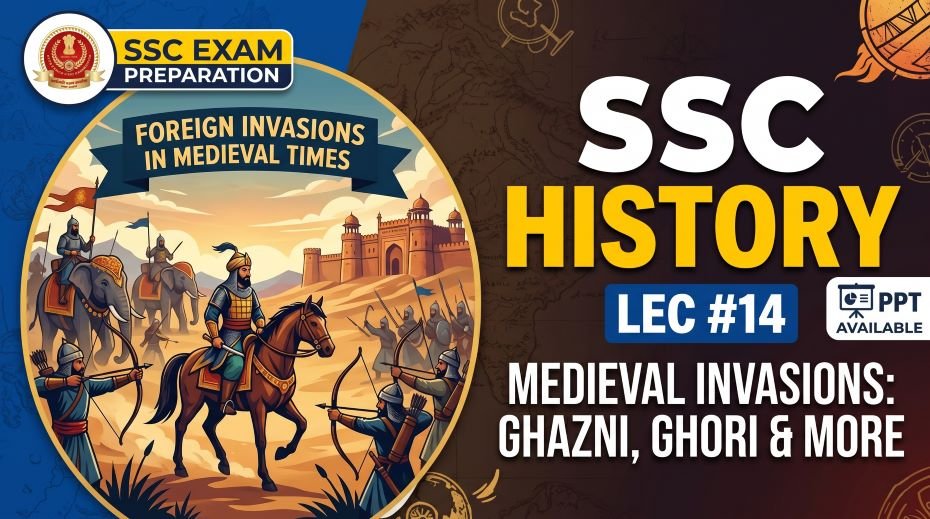
We have shared SSC History Foreign Invasions in Medieval Times PPT (LEC 14) so, Master all Medieval Foreign Invasions with this complete SSC guide based on History LECTURE #14 PPT Slides. 103 slides | 26 MB | Serial #39. Covers Arab Invasion of Sind (Muhammad bin Qasim), Mahmud of Ghazni (17 raids, Somnath), Muhammad Ghori (Battles of Tarain), and their impact on India – with 35+ high-frequency MCQs for SSC CGL, CHSL, MTS, CPO, Railways NTPC, and UPSC Prelims.
The medieval foreign invasions of India mark the beginning of one of the most transformative eras in Indian history. Beginning with Muhammad bin Qasim’s conquest of Sind in 712 AD, continuing with Mahmud of Ghazni’s 17 devastating raids between 1000 and 1027 AD, and culminating with Muhammad Ghori’s establishment of permanent Muslim rule through the Battles of Tarain (1191 and 1192 AD) – these events set in motion forces that would reshape India’s political, cultural, and religious landscape for the next six centuries.
This article is built around the SSC Foreign Invasions in Medieval Times PPT Slides – Lecture #14 – from the Complete Foundation Batch PPT Series (Serial Number #39) at slideshareppt.net. The PPT contains 103 slides covering all three major waves of medieval foreign invasion in exam-focused detail.
For SSC CGL, SSC CHSL, SSC MTS, SSC CPO, Railways NTPC, and UPSC Prelims aspirants, this chapter delivers 3–5 guaranteed marks per exam from battles, rulers, dates, scholars, and impacts. This guide covers every testable fact.
About the PPT Slides
| Detail | Information |
| Series Name | Complete Foundation Batch for All SSC and Other Exams (PPT Series) |
| Subject | Medieval Indian History – Foreign Invasions in Medieval Times (मध्यकाल में विदेशी आक्रमण) |
| Lecture Number | Lecture #14 |
| Total PPT Slides | 103 PPT Slides |
| File Size | 26 MB |
| Serial Number | #39 |
| Period Covered | 712 AD (Arab invasion of Sind) to 1206 AD (Muhammad Ghori’s death) |
| Best For | SSC CGL, CHSL, MTS, CPO, GD, Railways NTPC, UPSC Prelims |
| Source Website | slideshareppt.net |
SSC History Foreign Invasions in Medieval Times PPT (LEC 14)
Note: If you wish to download the entire SSC series (PPT slides), simply visit this redirect page. –REDIRECT PAGE
Complete Timeline Table: Medieval Foreign Invasions of India – All Key Dates
This timeline is the backbone of this chapter. Every date and event in this table has generated SSC MCQs. Memorise the sequence, the rulers, and the specific outcomes.
| Year (AD) | Event | Key Person | Significance / SSC Fact |
| 636–643 | Arab conquest of Persia – Sassanid Empire falls to Arab Muslims | Arab Caliphate (Umar ibn al-Khattab) | Arabs become neighbours of India after taking Persia; first Arab contact with Sind begins |
| 664 | First Arab raids on Makran (Balochistan coast) | Arab forces | Earliest probing raids toward India’s northwest coast; not permanent |
| 711–712 | Arab conquest of Sind – Muhammad bin Qasim’s campaign | Muhammad bin Qasim (Umayyad general); sent by Hajjaj bin Yusuf (governor of Iraq) | First permanent Muslim conquest of Indian territory; conquered Sind and southern Punjab |
| 712 | Battle of Aror (Rawar) – defeat of Raja Dahir | Muhammad bin Qasim vs Raja Dahir (ruler of Sind) | Raja Dahir was killed; Sind brought under Umayyad Caliphate; first Muslim rule in India |
| 715 | Muhammad bin Qasim recalled and executed | Umayyad Caliph (new caliph’s order) | Arab rule in Sind continued but without further expansion; Rajput resistance prevented Arab advance into mainland India |
| 962 | Alptigin founds the Ghaznavid dynasty at Ghazni (Afghanistan) | Alptigin (Turkish slave general) | Foundation of the Ghaznavid dynasty; precursor to Mahmud of Ghazni |
| 977–997 | Subuktigin rules Ghazni; makes raids into Punjab | Subuktigin (father of Mahmud of Ghazni) | Brought the Kabul valley region under Ghazni control; set the stage for Mahmud’s raids |
| 997 | Mahmud of Ghazni becomes ruler of Ghazni | Mahmud of Ghazni | Begins the most famous series of raids on India in history |
| 1000 | First raid of Mahmud of Ghazni into India | Mahmud of Ghazni | Begins 27-year campaign of repeated raids on India |
| 1001 | Battle of Peshawar – Mahmud defeats Jaipal (Shahi king of Punjab) | Mahmud vs Jaipal | First major Indian ruler defeated by Mahmud; Jaipal later committed suicide in shame |
| 1004–1006 | Mahmud raids Bhera and Multan | Mahmud of Ghazni | Brings Multan (Pakistan) permanently under Ghazni control |
| 1008 | Battle of Waihind – Mahmud defeats Anandpala (son of Jaipal) | Mahmud vs Anandpala (Hindu Shahi king) | Despite a large coalition of Indian kings supporting Anandpala, Mahmud won; Punjab lost to Ghazni |
| 1013 | Mahmud defeats Trilochanapala (Hindu Shahi) – ends Hindu Shahi power | Mahmud of Ghazni | Hindu Shahi dynasty of Punjab completely eliminated |
| 1018 | Mahmud raids Mathura and Kanauj | Mahmud of Ghazni | Looted the extremely wealthy temples of Mathura; advanced into the Gangetic plains |
| 1021 | Mahmud raids Kalinjar (Chandela kingdom) | Mahmud vs Chandela king Ganda | Chandela king paid tribute to end siege |
| 1025 | Mahmud raids and destroys the Somnath Temple (Gujarat) | Mahmud of Ghazni vs Bhimadeva I (Solanki ruler of Gujarat) | The most famous of all Mahmud’s raids; Somnath temple destroyed and looted; immense wealth taken; becomes a symbol of medieval Hindu-Muslim conflict in Indian historiography |
| 1027 | Mahmud’s 17th and last raid – attacks the Jats of Sind | Mahmud of Ghazni | Final raid; punished the Jats who had harassed his retreat from the Somnath raid |
| 1030 | Death of Mahmud of Ghazni | Mahmud of Ghazni (dies at Ghazni) | End of the great raider; Ghaznavid power begins to decline; Ghorid dynasty rises |
| 1173 | Muhammad Ghori (Muizzuddin Muhammad bin Sam) becomes ruler of Ghor | Muhammad Ghori | Begins the Ghorid expansion that will permanently conquer India |
| 1175 | Muhammad Ghori’s first raid into India – attacks Multan and Uch | Muhammad Ghori | Initial probing raids; Multan and Uch captured |
| 1178 | Muhammad Ghori invades Gujarat – defeated at Battle of Kayadara | Muhammad Ghori vs Mularaja II (Solanki ruler of Gujarat) | Ghori’s only major military defeat in India; withdrew after this setback; learned to avoid Gujarat |
| 1179–1190 | Muhammad Ghori captures Peshawar, Lahore – Punjab falls | Muhammad Ghori | Systematic conquest of Punjab; Lahore becomes his Indian base |
| 1191 | First Battle of Tarain – Ghori defeated by Prithviraj Chauhan | Muhammad Ghori vs Prithviraj Chauhan III (Rajput ruler of Ajmer and Delhi) | Ghori was seriously wounded and narrowly escaped; Prithviraj showed mercy and did not pursue – a decision he would regret |
| 1192 | Second Battle of Tarain – Ghori defeats and kills Prithviraj Chauhan | Muhammad Ghori vs Prithviraj Chauhan III | The most consequential battle in medieval Indian history; permanent Muslim rule established in North India; Prithviraj captured and executed |
| 1194 | Battle of Chandawar – Ghori defeats Jaichand (Gahadavala ruler of Kanauj) | Muhammad Ghori vs Jaichand | Kanauj and Varanasi (Benares) region brought under Muslim control; huge temple plunder including Kashi Vishwanath |
| 1202–1203 | Bakhtiyar Khilji conquers Bihar and Bengal; destroys Nalanda University | Mohammad bin Bakhtiyar Khilji (Ghori’s general) | Bihar and Bengal permanently brought under Muslim rule; Nalanda University burned (~1193 AD) |
| 1206 | Muhammad Ghori assassinated near the Indus River | Assassinated (possibly by Khokar tribe or Ismaili sect) | Ghori dies without a direct heir; his generals divide his empire; Qutbuddin Aibak founds the Delhi Sultanate |
Part I: Arab Invasion of Sind (712 AD) – The First Muslim Conquest of India
The Arab conquest of Sind in 712 AD under Muhammad bin Qasim is the first permanent Muslim conquest of Indian territory. It preceded the Ghaznavid raids by nearly three centuries and established the earliest Muslim presence on the Indian subcontinent.
Background: Why Did Arabs Invade Sind?
- After the death of Prophet Muhammad (632 AD), the Arab Islamic Caliphate expanded rapidly – conquering Persia (636–643 AD), Egypt, Syria, and Central Asia within decades.
- Sind (modern Pakistan) was a wealthy region at the mouth of the Indus River – rich in agriculture, sea trade, and positioned on the maritime trade routes between the Persian Gulf and India.
- The immediate trigger for the Arab invasion of Sind was the piracy of Arab ships near the port of Debal (near modern Karachi) by pirates said to be operating under the patronage of Raja Dahir (the Hindu ruler of Sind).
- Hajjaj bin Yusuf – the powerful governor of Iraq – demanded compensation from Raja Dahir. When Dahir refused, Hajjaj organised a military expedition.
- Two earlier Arab expeditions to Sind (in 708 and 710 AD) had failed. Hajjaj then sent his 17-year-old nephew and son-in-law Muhammad bin Qasim with a large, well-equipped army in 711 AD.
SSC Exam Tip: Hajjaj bin Yusuf = governor of Iraq = sent Muhammad bin Qasim to Sind. The trigger = Arab ships pirated near Debal. These facts establish the context for ‘why did Arabs invade Sind’ questions.
Muhammad bin Qasim – The Arab Conqueror of Sind
| Aspect | Detail |
| Full Name | Muhammad bin Qasim al-Thaqafi |
| Age During Campaign | 17 years old when he invaded Sind – one of the youngest conquerors in history |
| Sent By | Hajjaj bin Yusuf (governor of Iraq, under the Umayyad Caliphate) |
| Campaign Year | 711–712 AD |
| Key Battle | Battle of Aror (also called Battle of Rawar) – 712 AD; fought on the banks of the Indus River |
| Opponent | Raja Dahir – the Hindu (Brahmin) ruler of Sind |
| Outcome | Raja Dahir was killed in battle; his widow and daughters were captured; Sind and southern Punjab fell to the Arabs |
| Territories Conquered | Debal (port city, near modern Karachi), Nirun, Sehwan, Aror (capital of Sind), Multan |
| Policy Toward Hindus and Buddhists | Adopted a relatively tolerant policy – allowed Hindus and Buddhists to practice their religions and maintain their temples in exchange for paying jizya (tax on non-Muslims); local administrators retained |
| End of Rule | Recalled to Iraq in 715 AD and executed on orders of the new Umayyad Caliph (Sulaiman ibn Abd al-Malik) who had a personal grudge against Hajjaj bin Yusuf’s appointees |
| Impact | First permanent Muslim rule on Indian soil; Arab rule in Sind continued for about 200 years; no further Arab expansion beyond Sind into mainland India |
SSC Exam Tip: Muhammad bin Qasim = 17 years old = defeated Raja Dahir = Battle of Aror 712 AD = conquered Sind = sent by Hajjaj bin Yusuf. All five facts are individually tested.
Why Did Arab Expansion Stop at Sind?
- The Arab advance into mainland India was stopped by strong Rajput resistance – particularly by Bappa Rawal (Guhilot ruler of Mewar/Rajasthan) and Nagabhata I (Gurjara-Pratihara ruler) in the early 8th century.
- The Battle of Rajasthan (738 AD) – sometimes called the Arab-Gurjara war – saw the Gurjara-Pratihara ruler Nagabhata I decisively defeat Arab forces attempting to advance into Rajasthan and the Gangetic plains.
- Internal political problems within the Arab Caliphate (the Umayyad-to-Abbasid transition in 750 AD) also diverted Arab attention from Indian expansion.
- The geography of the Thar Desert and the Aravalli mountains also provided a natural barrier protecting mainland India.
- As a result, Arab rule remained confined to Sind and southern Punjab for over two centuries – never penetrating deeper into India.
SSC Exam Tip: Nagabhata I (Gurjara-Pratihara) stopped the Arab advance into mainland India. Bappa Rawal (Mewar) was another key defender. The fact that Arabs were stopped despite conquering Sind is an important conceptual question.
Part II: Mahmud of Ghazni (997–1030 AD) – The Great Raider
Mahmud of Ghazni is one of the most controversial and significant figures in medieval Indian history. He conducted 17 raids into India between 1000 and 1027 AD – each time looting enormous wealth and returning to his capital at Ghazni in Afghanistan. He never attempted to permanently rule India beyond the Punjab.
Who Was Mahmud of Ghazni?
| Aspect | Detail |
| Full Name | Yamin-ud-Dawla Mahmud of Ghazni |
| Dynasty | Ghaznavid dynasty (of Turkish slave origin) |
| Capital | Ghazni (modern Afghanistan) |
| Period of Reign | 997–1030 AD |
| Religion | Sunni Muslim; extreme iconoclast (destroyer of idols) |
| Title Given by Caliph | The Caliph of Baghdad gave him the title ‘Sultan’ – Mahmud was the first ruler in the Islamic world to formally use this title |
| Number of Indian Raids | 17 raids between 1000 AD and 1027 AD |
| Purpose of Raids | Primarily to loot the immense wealth of Indian temples and cities; also to spread Islam (iconoclasm); NOT to permanently conquer India beyond Punjab |
| Territory Permanently Held | Punjab and Sindh – these he incorporated into the Ghaznavid Empire |
| Court Scholars | Al-Biruni (scholar who wrote Kitab-ul-Hind); Firdausi (poet who wrote Shah Namah/Shahnama); Utbi (who wrote Kitab-ul-Yamini); Farrukhi (poet) |
| Death | 1030 AD at Ghazni |
SSC Exam Tip: Mahmud of Ghazni = 17 raids = first to use title Sultan = capital Ghazni = Al-Biruni and Firdausi in his court. The title ‘first Sultan’ and ’17 raids’ are most commonly tested facts.
The 17 Raids of Mahmud of Ghazni – Key Raids for SSC
| Raid No. | Year (AD) | Target / Region | Key Opponent | Key Outcome / SSC Fact |
| 1st Raid | 1000 | Frontier regions of India (Khyber Pass area) | – | First testing raid; minor skirmishes |
| 2nd Raid | 1001 | Peshawar – Battle of Peshawar | Jaipal (Hindu Shahi king of Punjab) | Jaipal defeated and captured; released after ransom; later committed suicide in shame by entering a funeral pyre |
| 3rd Raid | 1004 | Bhera (Punjab) | Bajra (local ruler) | Bhera looted and captured |
| 4th Raid | 1005 | Multan | Fateh Daud (ruler of Multan) | Multan brought under Ghazni control |
| 6th Raid | 1008 | Waihind (Battle of Waihind) | Anandpala (son of Jaipal; Hindu Shahi king) | A large coalition of Indian kings (Ujjain, Gwalior, Kalinjar, Kannauj, Delhi, Ajmer) supported Anandpala; Mahmud still won decisively; Hindu Shahi power fatally weakened |
| 9th Raid | 1014 | Thanesar | – | Looted the sacred Chakraswami Temple at Thanesar; massive wealth taken |
| 12th Raid | 1018 | Mathura and Kanauj | Rajyapala (Gurjara-Pratihara king of Kanauj) | Mathura and its immensely wealthy temples completely looted; Krishna birthplace temple destroyed; gold and jewels taken; Kanauj also looted |
| 15th Raid | 1021 | Kalinjar (Chandela kingdom) | Ganda (Chandela king) | Chandela king paid tribute after siege |
| 16th Raid | 1025 | Somnath (Gujarat) | Bhimadeva I (Solanki ruler of Gujarat) | The most famous raid; Somnath Temple destroyed and its Shivalingam broken; enormous wealth (reportedly 20 million dinars) looted; this raid made Mahmud the most infamous invader in Indian cultural memory |
| 17th Raid | 1027 | Jats of Sind | Jat tribes | Punished Jats who had harassed his army’s retreat from the Somnath raid; last raid |
The Somnath Temple Raid (1025 AD) – The Most Famous Raid
| Aspect | Detail |
| Year | 1025 AD – the 16th raid of Mahmud of Ghazni |
| Target | The Somnath Temple (Shiva temple) at Prabhas Patan, Saurashtra, Gujarat – one of the 12 Jyotirlingas (sacred Shiva shrines) |
| Opponent | Bhimadeva I (Solanki/Chaulukya ruler of Gujarat) |
| Route | Mahmud marched across the Thar Desert – a daring route that gave him the element of surprise |
| Battle | Bhimadeva I fled; 50,000 Hindu soldiers allegedly died defending the temple |
| Destruction | The Shivalingam was broken by Mahmud personally; the temple was completely looted and destroyed |
| Wealth Looted | Ancient sources claim the loot included gold, silver, precious stones, and valuables worth approximately 20 million dinars – one of the largest single lootings in medieval history |
| Return Journey | Harassed by the Jat tribes during the return journey through Sind – which prompted the 17th (final) raid to punish the Jats |
| Historical Significance | The Somnath raid became the defining symbol of medieval Islamic iconoclasm toward Indian Hindu temples in Indian historiography; the temple was rebuilt multiple times and stands today |
| Scholarly Controversy | Modern historians debate the extent of the temple’s destruction and the role of religious motivation vs pure wealth-seeking; many argue Mahmud’s primary motivation was loot, not religion |
SSC Exam Tip: Somnath Temple raid = 1025 AD = Mahmud of Ghazni = Gujarat = Bhimadeva I fled = 16th raid. This raid generates more SSC questions than any other Mahmud event. Know the year (1025), the ruler of Gujarat (Bhimadeva I), and the temple’s location (Saurashtra/Gujarat).
Scholars in Mahmud’s Court – Al-Biruni, Firdausi, and Others
| Scholar | Works | Subject / Significance | SSC Relevance |
| Al-Biruni (Abu Rayhan Biruni) | Kitab-ul-Hind (Tahqiq-i-Hind) – written ~1030 AD | A comprehensive study of India – its science, philosophy, religion, astronomy, mathematics, geography, and customs; the most detailed and objective account of medieval India written by a foreign scholar; written in Arabic | Most tested: ‘Who wrote Kitab-ul-Hind?’ = Al-Biruni. ‘Which scholar accompanied Mahmud and wrote about India?’ = Al-Biruni |
| Firdausi (Abul Qasim Mansur) | Shahnama (Shah Namah / Book of Kings) – an epic poem of ~60,000 couplets | A Persian epic poem telling the legendary and historical history of Persia from creation to the Islamic conquest; one of the world’s greatest literary works; Firdausi was not fully rewarded by Mahmud and wrote a bitter satire about him before leaving | Most tested: ‘Who wrote Shahnama (Shah Namah)?’ = Firdausi. The story of Mahmud’s unfair treatment of Firdausi is a famous anecdote |
| Utbi (Muhammad ibn Abd al-Jabbar al-Utbi) | Kitab-ul-Yamini (Tarikh-ul-Yamini) | A biography and chronicle of Mahmud’s reign; primary court history of Mahmud of Ghazni; written in ornate Arabic prose | ‘Who wrote Kitab-ul-Yamini?’ = Utbi. Primary historical source for Mahmud’s reign |
| Farrukhi | Court poetry in Persian | A major Persian poet in Mahmud’s court; wrote panegyric poetry praising Mahmud | Occasionally asked as one of the scholars in Mahmud’s court |
SSC Exam Tip: Al-Biruni = Kitab-ul-Hind = most objective medieval account of India = Arabic. Firdausi = Shahnama = Persian epic = 60,000 couplets. Both authors are extremely frequently tested in SSC History papers. Kitab-ul-Hind is also called Tahqiq-i-Hind.
Assessment of Mahmud of Ghazni’s Invasions
| Aspect | Assessment |
| Military Achievement | Brilliant military commander; won every battle in India; innovative cavalry tactics; never lost a major engagement on Indian soil |
| Motivation | Historians debate: primarily loot (to finance his campaigns in Central Asia and his magnificent court at Ghazni) with religious iconoclasm as a secondary justification OR genuine religious zeal with loot as a benefit; most modern historians lean toward the former |
| Cultural Achievement | Under Mahmud, Ghazni became one of the most magnificent cities in the Islamic world; he was a great patron of Persian literature, architecture, and scholarship – the paradox of the ‘destroyer’ who was also a great builder |
| Impact on India | Severely weakened the Hindu kingdoms of Punjab; created the pathway for later Muslim conquest; the repeated looting of temple wealth weakened the economic and military resources of Indian kingdoms; created lasting bitterness in Hindu-Muslim relations in Indian history |
| What He Did NOT Do | He never tried to permanently conquer the Gangetic plains or South India; his empire was always centred at Ghazni; India was always a source of revenue for his Central Asian empire |
| Legacy | His raids weakened Indian kingdoms enough that 150 years later, Muhammad Ghori was able to permanently conquer much of North India with relatively little resistance from a fragmented political landscape |
Part III: Muhammad Ghori (1173–1206 AD) – The Conqueror Who Stayed
If Mahmud of Ghazni was the great raider who came and went, Muhammad Ghori was the strategic conqueror who came to stay. Where Mahmud looted India and returned to Ghazni, Ghori systematically conquered the major kingdoms of North India and established permanent Muslim rule – the foundation of the Delhi Sultanate.
Who Was Muhammad Ghori?
| Aspect | Detail |
| Full Name | Muizzuddin Muhammad bin Sam; also known as Shahab-ud-Din Muhammad Ghori or Muhammad of Ghor |
| Dynasty | Ghurid (Ghorid) dynasty – from the Ghor region of Afghanistan |
| Capital | Ghazni (Afghanistan) – same capital as the Ghaznavids; the Ghurids replaced the Ghaznavids |
| Brother | Ghiyasuddin Muhammad bin Sam – the senior Ghorid ruler; Muhammad Ghori acted as his deputy for eastern conquests |
| Period of Indian Campaigns | 1175–1206 AD |
| Approach | Unlike Mahmud who raided and returned, Ghori’s goal was PERMANENT CONQUEST – establishing Muslim political rule over all of North India |
| Key Difference from Mahmud | Mahmud: raid and loot (17 raids, always returned to Ghazni). Ghori: systematic conquest and permanent governance. Mahmud’s impact was economic. Ghori’s impact was political and civilizational |
| Successors / Generals | Left the governance of conquered India to his trusted generals: Qutbuddin Aibak (India), Taj-ud-din Yildiz (Ghazni), Nasir-ud-din Qabacha (Sind/Punjab), Bakhtiyar Khilji (Bengal/Bihar) |
| Death | Assassinated in 1206 AD near the Indus River (while returning from a campaign against the Khokar tribe in Punjab); possibly by the Khokar tribe or by Ismaili assassins |
| Legacy | By his death, the entire North Indian plains from the Indus to Bengal were under Muslim control; the stage was set for the Delhi Sultanate |
Muhammad Ghori’s Campaigns – Chronological
| Year | Campaign | Key Details |
| 1175 | First Indian campaign – attacks Multan and Uch | Captures Multan and Uch (both in modern Pakistan); establishes a forward base in the subcontinent |
| 1178 | Invades Gujarat – Battle of Kayadara | Attempts to advance into Gujarat; defeated by Mularaja II (Solanki/Chaulukya ruler of Gujarat); Ghori’s army retreats – this is his ONLY major defeat in India; he never again attacked Gujarat |
| 1179–1186 | Systematic conquest of Punjab | Captures Peshawar (1179), Lahore (1186 – from the last Ghaznavid ruler Khusrau Malik); establishes Lahore as his Indian base |
| 1190–1191 | Advances toward Delhi – comes into conflict with Prithviraj Chauhan III | Prithviraj Chauhan III rules Delhi and Ajmer – the most powerful Rajput king of his time |
| 1191 | First Battle of Tarain | First major confrontation between Ghori and Prithviraj; Ghori defeated and wounded; retreated; Prithviraj showed mercy and did not pursue |
| 1192 | Second Battle of Tarain | Ghori returns with a reorganised army and different tactics; Prithviraj defeated and captured; executed shortly after; Delhi and Ajmer fall to Ghori – the most consequential battle in medieval Indian history |
| 1194 | Battle of Chandawar | Ghori defeats Jaichand (Gahadavala ruler of Kanauj and Varanasi); Kanauj, Varanasi, and the entire Gangetic plains fall; Nalanda and other Buddhist institutions attacked |
| 1197–1203 | Bakhtiyar Khilji conquers Bihar and Bengal | Ghori’s general Mohammad bin Bakhtiyar Khilji: captures Nalanda (burns the university ~1193), conquers Bihar (1197), conquers Bengal (1203) |
| 1205–1206 | Final campaign – against Khokar tribes | Khokars (a tribe in Punjab) revolt; Ghori crushes them; assassinated on return journey near Indus River (1206 AD) |
The Two Battles of Tarain – The Most Important Medieval Battles
The two Battles of Tarain (1191 and 1192 AD) are the most important battles in medieval Indian history – they determined whether North India would fall permanently under Muslim rule. These battles generate more SSC questions than any other medieval military event.
| Aspect | First Battle of Tarain (1191 AD) | Second Battle of Tarain (1192 AD) |
| Date | 1191 AD | 1192 AD |
| Location | Tarain (also called Taraori) near Thanesar, Haryana | Same location – Tarain/Taraori, near Thanesar, Haryana |
| Indian Side | Prithviraj Chauhan III – Chahamana (Chauhan) Rajput ruler of Ajmer and Delhi | Prithviraj Chauhan III – same ruler |
| Invader Side | Muhammad Ghori (Muizzuddin Muhammad bin Sam) | Muhammad Ghori |
| Outcome | PRITHVIRAJ WON – Muhammad Ghori was seriously wounded; rescued by a young Afghan soldier; Ghori’s army retreated | GHORI WON – Prithviraj’s forces were decisively defeated; Prithviraj was captured |
| Why Prithviraj Won (1st Battle) | Superior Rajput cavalry and elephant corps; Rajput bravery; Ghori was caught in a frontal battle he wasn’t prepared for | N/A |
| Why Ghori Won (2nd Battle) | Ghori reorganised his army; changed tactics – used fast-moving cavalry archers to harass and tire the Rajput heavy infantry before a final charge; reportedly also used dawn attack when Rajput forces were unprepared; Prithviraj’s Rajput allies were absent or insufficient | |
| Fate of Prithviraj | Showed mercy to Ghori after 1st Battle – did not pursue; this decision allowed Ghori to return stronger | Captured after the battle; accounts differ – one account (from Prithviraj Raso by Chand Bardai, a later and somewhat legendary text) says Prithviraj killed Ghori with an arrow while blindfolded before his own execution; historical consensus is he was executed shortly after capture |
| Historical Significance | Showed Indian military strength but also strategic weakness (failure to pursue a defeated enemy) | The single most consequential battle in medieval Indian history; permanent Muslim rule established in North India; Delhi became a Muslim capital for the next ~350 years |
| SSC Importance | Year (1191) + outcome (Prithviraj won) + Prithviraj showed mercy = Very frequently tested | Year (1192) + outcome (Ghori won) + Prithviraj defeated and executed = MOST FREQUENTLY tested medieval battle |
SSC Exam Tip – The Most Tested Facts About Tarain: First Battle of Tarain = 1191 AD = Prithviraj Chauhan won. Second Battle of Tarain = 1192 AD = Muhammad Ghori won = Prithviraj captured/executed. The YEAR distinction (1191 vs 1192) is the single most common SSC ‘trick’ question in this chapter.
Battle of Chandawar (1194 AD)
| Aspect | Detail |
| Year | 1194 AD |
| Location | Chandawar (near Etawah on the Yamuna River, Uttar Pradesh) |
| Indian Side | Jaichand – Gahadavala king of Kanauj and Varanasi (Benaras) |
| Invader | Muhammad Ghori |
| Outcome | Muhammad Ghori won; Jaichand was killed in battle |
| Territories Lost | Kanauj, Varanasi (Benares), and the entire eastern Gangetic plains fell to Ghori |
| Significance | Completed Muslim conquest of the Gangetic plains from Delhi to the east; the Kashi Vishwanath temple and other Varanasi temples looted |
| Jaichand Context | Jaichand was the father of Sanyogita – the famous Rajput princess who married Prithviraj Chauhan by an elopement (Swayamvara incident); Jaichand’s rivalry with Prithviraj is said to have prevented proper Rajput unity against Ghori – a factor in Prithviraj’s defeat at the Second Battle of Tarain |
| SSC Relevance | ‘Battle of Chandawar (1194)’ + ‘Jaichand defeated’ = frequently tested; also tested as ‘who defeated Jaichand?’ = Muhammad Ghori |
SSC Exam Tip: Battle of Chandawar = 1194 AD = Muhammad Ghori vs Jaichand (Gahadavala of Kanauj) = Jaichand killed = eastern Gangetic plains fell to Ghori.
Muhammad Ghori’s Generals – Who Did What After Ghori
| General | Region Governed | What They Became / Did |
| Qutbuddin Aibak | India (Delhi, Lahore, Ajmer, central territory) | Became the first Sultan of Delhi after Ghori’s death (1206 AD); founder of the Mamluk (Slave) dynasty; built the Qutub Minar and Quwwat-ul-Islam mosque in Delhi |
| Mohammad Bin Bakhtiyar Khilji | Bengal and Bihar | Conquered Bihar (~1197 AD) and Bengal (~1203 AD); burned Nalanda University (~1193 AD); died on an expedition to Bhutan/Tibet |
| Taj-ud-din Yildiz | Ghazni (Afghanistan) | Took control of Ghazni after Ghori’s death; briefly claimed authority over India but Qutbuddin Aibak resisted |
| Nasir-ud-din Qabacha | Sind, Multan, Uch | Governed Sind and Punjab; eventually brought under Iltutmish’s control |
| Ikhtiyar-ud-din Muhammad Khalji | Eastern Bihar and Bengal | Extended Muslim rule into eastern India; first Muslim ruler to reach Bengal |
SSC Exam Tip: Qutbuddin Aibak = Ghori’s general = became first Delhi Sultan 1206 = founded Mamluk dynasty = built Qutub Minar. Bakhtiyar Khilji = Ghori’s general = conquered Bengal + Bihar = burned Nalanda. Both facts are crucial connecting links between this chapter and the Delhi Sultanate chapter.
Prithviraj Chauhan III – The Last Great Hindu Emperor of Delhi
| Aspect | Detail |
| Dynasty | Chahamana (Chauhan) Rajput dynasty |
| Full Name | Prithviraj Chauhan III (also called Rai Pithora) |
| Capital | Ajmer (primary capital); Delhi (Indraprastha/Qila Rai Pithora – he had a fort there) |
| Kingdom | Ruled Ajmer and Delhi; his territory extended across Rajasthan, Haryana, and Delhi |
| Period | ~1178–1192 AD |
| Military Strength | Had one of the most powerful Rajput armies of his era; defeated Ghori in the First Battle of Tarain (1191) |
| Critical Mistake | After defeating Ghori in 1191, Prithviraj released him and allowed his army to retreat – either as an act of Rajput chivalry or out of strategic miscalculation; this allowed Ghori to return the following year |
| Legendary Story (Prithviraj Raso) | The epic poem Prithviraj Raso by Chand Bardai (a later, partly legendary text) describes Prithviraj’s love story with Sanyogita (daughter of Jaichand of Kanauj), his capture by Ghori, and his alleged assassination of Ghori while blindfolded |
| Historical Fate | Captured after Second Battle of Tarain (1192); exact fate unclear – most likely executed by Ghori shortly after capture |
| Significance | The last powerful Hindu ruler to control Delhi before the establishment of the Delhi Sultanate; his defeat in 1192 marks the practical end of Hindu political dominance in North India |
Part IV: Comparison – Mahmud of Ghazni vs Muhammad Ghori
This comparison is one of the most frequently asked conceptual questions in SSC medieval history. Know the distinctions clearly.
| Feature | Mahmud of Ghazni | Muhammad Ghori |
| Period | 997–1030 AD | ~1173–1206 AD |
| Dynasty | Ghaznavid (Turkish slave origin) | Ghurid (from Ghor, Afghanistan) |
| Capital | Ghazni, Afghanistan | Ghor (Afghanistan); also Ghazni |
| Number of Indian Raids | 17 raids | Multiple campaigns; aimed at permanent conquest |
| Primary Goal | Loot wealth from Indian temples and cities; return to Ghazni | Permanent conquest and establishment of Muslim political rule in India |
| Permanent Rule in India | Only Punjab and Sindh | Entire North India from Sindh to Bengal |
| Most Famous Event | Destruction of Somnath Temple (1025 AD) | Second Battle of Tarain (1192 AD) – defeat of Prithviraj Chauhan |
| Title | First ruler to formally use the title ‘Sultan’ | No special title; used Muizzuddin |
| Court Scholars | Al-Biruni (Kitab-ul-Hind), Firdausi (Shahnama), Utbi | No significant literary patronage mentioned |
| Fate / Death | Died of natural illness at Ghazni (1030 AD) | Assassinated near the Indus River (1206 AD) |
| Legacy | Weakened Indian kingdoms; made later conquest easier; Ghazni became a cultural capital | Founded the basis for the Delhi Sultanate; permanent Muslim rule in India begins |
| Indian Opponent | Jaipal, Anandpala (Hindu Shahi); Bhimadeva I (Gujarat/Somnath) | Prithviraj Chauhan III, Jaichand (Gahadavala) |
Part V: Impact of Medieval Foreign Invasions on India
The medieval foreign invasions had profound and multidimensional impacts on Indian society, culture, religion, politics, and economy.
Political Impact
- The Arab conquest of Sind (712 AD) established the first Muslim political presence on Indian soil, demonstrating that Indian kingdoms could be conquered by organised Islamic military power.
- Mahmud of Ghazni’s 17 raids severely weakened the major Hindu kingdoms of Punjab (Hindu Shahi dynasty completely destroyed), the Gurjara-Pratiharas of Kanauj, the Chandelas, and others – leaving a fragmented political landscape.
- Muhammad Ghori’s permanent conquest through the Battles of Tarain (1192 AD) and Chandawar (1194 AD) established the political foundation for the Delhi Sultanate (1206–1526 AD) – 320 years of Muslim rule in North India.
- The Indian kingdoms’ failure to unite against the common threat – exemplified by Jaichand’s rivalry with Prithviraj that prevented Rajput unity – became a lesson in Indian political fragmentation.
Cultural and Religious Impact
- The arrival of Islam in India through these invasions initiated the long process of Hindu-Muslim cultural synthesis that produced Indo-Islamic architecture, Urdu language, Mughal art, Sufi music, and other hybrid cultural forms.
- Temple destruction (Somnath, Mathura, Kashi) and the replacement of Hindu temples with mosques was a traumatic cultural disruption that left lasting religious sensitivities in Indian society.
- The Sufi movement (Islamic mysticism) came to India in the wake of these conquests and eventually became one of the most powerful forces for cultural and religious synthesis.
- The Persian language was introduced to India through the Ghaznavid and Ghorid courts – eventually becoming the language of the Delhi Sultanate and Mughal administration.
Economic Impact
- Mahmud of Ghazni’s raids drained enormous wealth from India – the repeated looting of temples (which functioned as both religious and banking institutions, storing community wealth) significantly impoverished the affected regions.
- The destruction of the Nalanda University by Bakhtiyar Khilji destroyed priceless manuscripts and a great centre of learning – an incalculable intellectual and economic loss.
- On the positive side, Arab and Central Asian trade connections eventually brought new trade routes and commercial connections to India, particularly the land routes through Afghanistan and Central Asia.
Architectural and Artistic Impact
- The introduction of the arch, dome, minaret, and calligraphic decoration through Islamic architecture led to the development of the Indo-Islamic architectural style – one of India’s most distinctive art forms.
- The Qutub Minar (begun by Qutbuddin Aibak after the conquest) represents the first great monument of this new Indo-Islamic style.
- The mosque – with its distinctive prayer hall, minaret, and courtyard – became a new architectural type added to India’s built environment.
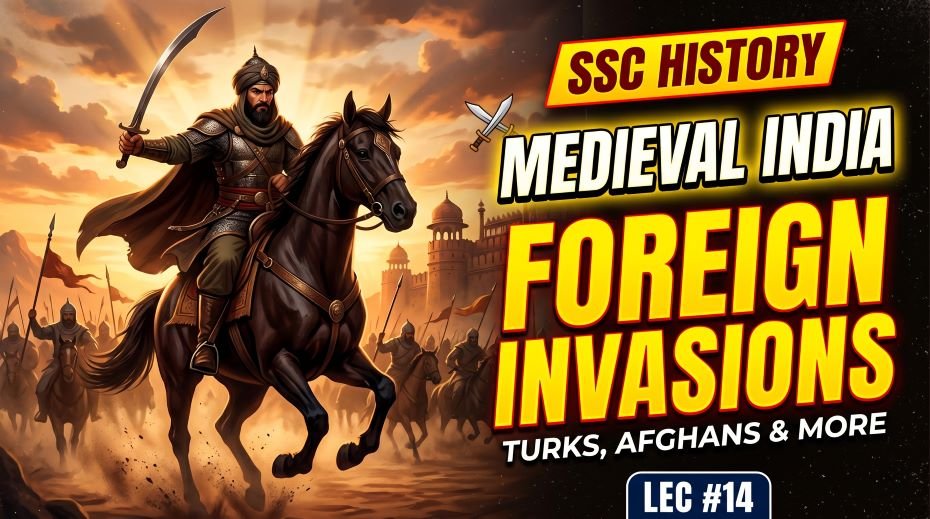
High-Frequency SSC MCQs: Medieval Foreign Invasions Chapter
These 35 questions represent the most consistently repeated MCQs from this chapter across all SSC exams.
| Question | Correct Answer | SSC Exam Reference |
| Who was the first Muslim to conquer Indian territory? | Muhammad bin Qasim (712 AD – conquered Sind) | SSC CGL 2015, 2018, 2021 |
| Muhammad bin Qasim was sent to India by whom? | Hajjaj bin Yusuf – governor of Iraq (Umayyad Caliphate) | SSC CHSL 2019, SSC MTS 2021 |
| How old was Muhammad bin Qasim when he invaded India? | 17 years old | SSC CHSL 2020, SSC GD 2022 |
| The Battle of Aror (712 AD) was fought between whom? | Muhammad bin Qasim vs Raja Dahir (ruler of Sind) | SSC CGL 2017, SSC CHSL 2020 |
| Who was the Hindu ruler of Sind defeated by Muhammad bin Qasim? | Raja Dahir | SSC CGL 2016, 2019, SSC CHSL 2021 |
| Which Indian ruler stopped Arab expansion into mainland India? | Nagabhata I (Gurjara-Pratihara ruler) – Battle of Rajasthan 738 AD | SSC CHSL 2020, SSC GD 2022 |
| How many raids did Mahmud of Ghazni conduct on India? | 17 raids (1000–1027 AD) | SSC CGL 2015–2022 (repeated every exam) |
| What was the capital of Mahmud of Ghazni? | Ghazni (in modern Afghanistan) | SSC CGL 2017, SSC CHSL 2019 |
| Mahmud of Ghazni was the first ruler to use which title? | Sultan – first ruler in the Islamic world to formally use this title | SSC CGL 2018, SSC CHSL 2021 |
| Who wrote Kitab-ul-Hind (Tahqiq-i-Hind)? | Al-Biruni – in Mahmud of Ghazni’s court (~1030 AD) | SSC CGL 2015–2022 (appears every exam) |
| Who wrote the Shahnama (Shah Namah)? | Firdausi – in Mahmud of Ghazni’s court | SSC CGL 2016, 2019, 2022 |
| Who wrote Kitab-ul-Yamini? | Utbi – court historian of Mahmud of Ghazni | SSC CHSL 2020, SSC CPO 2022 |
| In which year did Mahmud of Ghazni destroy the Somnath Temple? | 1025 AD | SSC CGL 2014–2023 (most repeated medieval date) |
| The Somnath Temple (1025 AD raid) was in which region? | Saurashtra/Gujarat (Prabhas Patan on the Gujarat coast) | SSC CGL 2017, 2020, SSC CHSL 2021 |
| Which Gujarat ruler tried to defend against Mahmud’s Somnath raid? | Bhimadeva I (Solanki/Chaulukya ruler of Gujarat) | SSC CHSL 2019, SSC MTS 2021 |
| Mahmud of Ghazni defeated which Hindu Shahi king in the Battle of Peshawar (1001 AD)? | Jaipal (Hindu Shahi king of Punjab) | SSC CGL 2018, SSC CHSL 2020 |
| What did Jaipal do after being defeated by Mahmud? | Committed suicide by entering a funeral pyre (suicide in shame after capture and humiliation) | SSC CHSL 2021, SSC GD 2022 |
| Which battle (1008 AD) saw a coalition of Indian kings defeated by Mahmud? | Battle of Waihind – Anandpala and coalition vs Mahmud | SSC CGL 2019, SSC CHSL 2021 |
| First Battle of Tarain (1191 AD) – who won? | Prithviraj Chauhan III won; Muhammad Ghori was defeated and wounded | SSC CGL 2015–2022 (repeated every exam) |
| Second Battle of Tarain (1192 AD) – who won? | Muhammad Ghori won; Prithviraj Chauhan III was defeated and captured | SSC CGL 2014–2023 (most tested medieval battle result) |
| What was the location of the Battles of Tarain? | Tarain (Taraori), near Thanesar, Haryana | SSC CGL 2018, SSC CHSL 2020 |
| Who was Prithviraj Chauhan III? | Chahamana (Chauhan) Rajput ruler of Ajmer and Delhi; defeated Muhammad Ghori in 1191 but lost in 1192 | SSC CGL 2016, 2019, 2022 |
| What mistake did Prithviraj Chauhan make after the First Battle of Tarain? | He released Muhammad Ghori and did not pursue his retreating army – allowing Ghori to return stronger | SSC CGL 2017, SSC CHSL 2021 |
| Battle of Chandawar (1194 AD) was fought between whom? | Muhammad Ghori vs Jaichand (Gahadavala ruler of Kanauj and Varanasi) | SSC CGL 2018, SSC CHSL 2020 |
| Who was Jaichand? | Gahadavala ruler of Kanauj; defeated and killed by Muhammad Ghori at Battle of Chandawar 1194 AD; father of Sanyogita | SSC CHSL 2019, SSC GD 2022 |
| When and how did Muhammad Ghori die? | 1206 AD; assassinated near the Indus River (by Khokar tribe or Ismaili assassins) | SSC CGL 2017, SSC CHSL 2020 |
| Who was Qutbuddin Aibak? | Muhammad Ghori’s most trusted Indian general; became first Sultan of Delhi after Ghori’s death; founded Mamluk (Slave) dynasty; built Qutub Minar | SSC CGL 2015–2022 (very frequently asked) |
| Mohammad bin Bakhtiyar Khilji is known for which two events? | Conquering Bihar and Bengal; burning Nalanda University (~1193 AD) | SSC CGL 2016, 2019, 2022 |
| What is the key difference between Mahmud of Ghazni and Muhammad Ghori? | Mahmud raided and returned (17 raids, no permanent conquest beyond Punjab); Ghori permanently conquered North India (foundation of Delhi Sultanate) | SSC CGL 2017, 2020, SSC CHSL 2021 |
| Muhammad Ghori’s ONLY defeat in India was at which battle? | Battle of Kayadara (1178 AD) – defeated by Mularaja II (Solanki ruler of Gujarat) | SSC CHSL 2020, SSC CPO 2022 |
| The Arab conquest of Sind (712 AD) is described in which primary text? | Chachnama (Fathnama-i-Sind) – an Arabic text translated into Persian by Muhammad Ali Kufi; narrates the Arab conquest of Sind | SSC CGL 2020, SSC CHSL 2022 |
| What language did Al-Biruni use to write Kitab-ul-Hind? | Arabic | SSC CHSL 2019, SSC MTS 2021 |
| The Prithviraj Raso is about which ruler and was written by whom? | About Prithviraj Chauhan III; written by Chand Bardai (his court poet) | SSC CGL 2018, SSC CHSL 2021 |
| Which Ghaznavid ruler preceded Mahmud of Ghazni and first raided Punjab? | Subuktigin (Mahmud’s father) – made raids into the Kabul valley and Punjab ~977–997 AD | SSC CHSL 2020, SSC GD 2022 |
| What is the Chachnama? | A primary source text describing the Arab conquest of Sind by Muhammad bin Qasim; originally written in Arabic, later translated into Persian | SSC CGL 2021, SSC CHSL 2022 |
Podcast Interview: Expert Q&A – Medieval Foreign Invasions Deep Dive
A 9-round expert dialogue on the chapter from multiple perspectives – strategic, historical, exam-focused, and conceptual.
| Speaker | Question / Statement | Answer / Explanation |
| Aspirant | Which single event from this chapter appears most in SSC papers? | Educator: The Second Battle of Tarain (1192 AD) and the Somnath Temple raid (1025 AD) are neck and neck for the most tested events. Second Battle of Tarain = Muhammad Ghori defeated Prithviraj Chauhan = permanent Muslim rule in North India = 1192 AD. Somnath raid = Mahmud of Ghazni = 1025 AD = Gujarat = Bhimadeva I. Both appear in virtually every SSC exam cycle. If I had to pick one: the Second Battle of Tarain, because it connects to so many other facts – the year, the combatants, the outcome, Prithviraj’s capture, and the founding of the Delhi Sultanate that followed. |
| Aspirant | How do I keep Al-Biruni and Firdausi straight? I always confuse their works. | Educator: Use this memory bridge. Al-Biruni = Al-Biruni studied India = Kitab-ul-HIND (Hind = India). The word ‘Hind’ in the title gives it away – Al-Biruni wrote about India. Firdausi = Firdausi wrote about PERSIA = Shahnama = Shah means king, Nama means book = ‘Book of Kings’ of Persia. Al-Biruni wrote about India. Firdausi wrote about Persia. Two different countries, two different books. Also remember: Firdausi was mistreated by Mahmud over his reward, so he wrote a bitter satirical poem about Mahmud before leaving – a famous anecdote that occasionally appears as an SSC question. |
| Aspirant | Why did Prithviraj Chauhan release Mahmud Ghori after defeating him in 1191? Was it really just chivalry? | Educator: This is one of the great ‘what if’ questions of Indian history. Different sources give different reasons. Some say it was Rajput chivalry – the code that you do not pursue and kill a defeated enemy who is fleeing. Some say Prithviraj genuinely thought Ghori would not return after such a decisive defeat. Some later sources (including Ghori’s own court historians) suggest that the Rajput confederacy that supported Prithviraj dissolved after the victory, leaving him weaker for the following year. Whatever the reason, the consequence was catastrophic – Ghori regrouped, retrained, and returned with better tactics in 1192 and won decisively. |
| Aspirant | What specifically changed between Ghori’s defeat in 1191 and his victory in 1192? | Educator: The tactical change was crucial. In 1191, Ghori fought in the conventional way – infantry-heavy engagement that suited the Rajput style. In 1192, he adopted a different strategy based on the strengths of his Central Asian cavalry. He used five divisions of fast-moving horse archers (10,000 each) to harass the Rajput army from all sides, raining arrows and retreating before the heavy Rajput cavalry and elephants could close with them. When the Rajput army was exhausted and disordered, Ghori sent in his reserve cavalry for the decisive charge. This combination of attrition through archery followed by a concentrated charge was the Central Asian cavalry tactic that Indian armies, trained for direct confrontations, could not easily counter. |
| Aspirant | Why is Al-Biruni’s Kitab-ul-Hind considered so important historically? | Educator: Because Al-Biruni was the first non-Indian scholar to seriously, systematically, and objectively study Indian civilisation. He learned Sanskrit (extraordinarily rare for a foreign Muslim scholar of his era). He studied Indian mathematics, astronomy, philosophy, religion, geography, and social customs. He was honest about what he admired and what he criticised. He compared Indian knowledge with Greek knowledge. He acknowledged Indian mathematical and astronomical achievements with genuine appreciation. His Kitab-ul-Hind is one of the most important primary sources for our understanding of medieval India – written by an outsider who actually took the trouble to understand it from within. No other medieval foreign scholar matched his intellectual engagement with India. |
| Aspirant | Was Muhammad bin Qasim’s conquest of Sind really the ‘first Muslim invasion of India’? What about earlier Arab raids? | Educator: Technically correct. There were Arab raids on Sind as early as 636, 644, 660, 664, and 692 AD – probing raids that were all repelled or failed to establish permanent control. Muhammad bin Qasim’s 712 AD conquest was the first to establish PERMANENT Muslim political rule on Indian soil. That is why it is called the first Muslim conquest – not because earlier raids didn’t happen, but because his was the first that stuck. The distinction ‘first permanent Muslim rule’ is what makes 712 AD and Muhammad bin Qasim uniquely significant in Indian history. |
| Aspirant | What is the Chachnama and why is it important for SSC? | Educator: The Chachnama (also called Fathnama-i-Sind) is the primary textual source for the Arab conquest of Sind. It was originally written in Arabic and later translated into Persian by Muhammad Ali Kufi in the early 13th century. It describes the political history of Sind before the Arab conquest (under Raja Dahir’s family, the Chach dynasty – hence ‘Chachnama’), and then gives a detailed account of Muhammad bin Qasim’s campaign. For SSC, know: Chachnama = primary source for Arab conquest of Sind = originally Arabic, translated to Persian by Muhammad Ali Kufi. ‘Who wrote Chachnama?’ is a recurring question. |
| Aspirant | How did Mahmud of Ghazni’s raids help Muhammad Ghori 150 years later? | Educator: Excellent strategic question. Mahmud’s raids did four things that made Ghori’s conquest easier. One: He destroyed the Hindu Shahi dynasty of Punjab completely – removing the buffer state that had protected the Gangetic plains from northwest invaders. Two: His repeated raids weakened the economic and military resources of the Gurjara-Pratiharas, Chandelas, and other major North Indian kingdoms. Three: His looting of temple wealth (which served as community banking institutions) reduced the financial capacity of these kingdoms to maintain large armies. Four: He incorporated Punjab into the Ghaznavid/Ghorid sphere of control – giving Ghori a staging base inside India. So when Ghori arrived, he was not facing the organised resistance that had stopped Alexander 1,500 years earlier – he was facing a fragmented, economically weakened, politically divided India. |
| Aspirant | Where can I find the complete 103-slide PPT for this chapter? | Educator: The SSC Foreign Invasions in Medieval Times PPT Slides – Lecture #14 – Serial #39 – is available free at slideshareppt.net. At 103 slides and 26 MB, it covers all three waves of medieval invasion (Arabs, Ghaznavids, Ghurids) in a structured, visual, exam-focused format with timeline charts, battle diagrams, and comparative tables. After reading this article and working through the 35 MCQs, spend 45 minutes with the slides to reinforce visual memory of the key facts. |
How to Study This Chapter for Maximum SSC Marks
Step 1 – Master the Timeline (Day 1)
- Read the complete Timeline Table. Note the three waves: Arab (712 AD) → Ghaznavid (1000–1027 AD) → Ghorid (1175–1206 AD).
- Key dates to memorise first: 712 AD (Muhammad bin Qasim, Sind), 1025 AD (Somnath), 1191 AD (First Tarain), 1192 AD (Second Tarain), 1194 AD (Chandawar), 1206 AD (Ghori dies = Delhi Sultanate begins).
Step 2 – Arab Invasion and Mahmud of Ghazni Deep Study (Day 2)
- Arab: Muhammad bin Qasim (17 years old, sent by Hajjaj bin Yusuf, defeated Raja Dahir, Battle of Aror 712 AD). Nagabhata I stopped further Arab advance.
- Mahmud: 17 raids, first Sultan title, capital Ghazni, court scholars (Al-Biruni/Kitab-ul-Hind; Firdausi/Shahnama; Utbi/Kitab-ul-Yamini).
- 17 Raids: key raids to know – Battle of Peshawar 1001 (Jaipal), Battle of Waihind 1008 (Anandpala), Mathura 1018, Somnath 1025 (Bhimadeva I).
Step 3 – Muhammad Ghori and Battles Deep Study (Day 3)
- Ghori vs Mahmud comparison table – know all key differences.
- Two Battles of Tarain complete table: 1191 (Prithviraj won, showed mercy) vs 1192 (Ghori won, tactical change, Prithviraj captured).
- Battle of Chandawar 1194 AD: Ghori vs Jaichand = Jaichand killed = eastern Gangetic plains lost.
- Ghori’s generals: Qutbuddin Aibak (Delhi Sultanate), Bakhtiyar Khilji (Bengal/Bihar/Nalanda).
Step 4 – MCQ Sprint and Impact Study (Day 4–5)
- Solve all 35 MCQs from the table. Aim for 90%+ accuracy.
- Study the Impact section: political (Delhi Sultanate foundation), cultural (Indo-Islamic synthesis), economic (temple wealth looted), architectural (arch, dome, minaret introduced).
ALSO READ: SSC History of South India PPT Slides (LEC #13) Download
(FAQs):
Q1: Why is the Second Battle of Tarain (1192 AD) called the most consequential medieval battle?
Because it directly established permanent Muslim political rule in North India for the first time. Before 1192, every foreign invasion – including Mahmud of Ghazni’s 17 raids – had failed to permanently establish Muslim political authority in the Gangetic plains. After 1192, Ghori’s generals (primarily Qutbuddin Aibak) rapidly consolidated control over Delhi, Ajmer, and the surrounding regions. When Ghori died in 1206, Qutbuddin Aibak declared himself the first Sultan of Delhi – founding a political system that would rule North India for over 300 years. The Second Battle of Tarain is the hinge point between ancient/classical Indian history and the medieval period.
Q2: What did Al-Biruni write about India?
Al-Biruni (Abu Rayhan Biruni) came to India with Mahmud of Ghazni and spent years studying Indian civilisation. His Kitab-ul-Hind (also called Tahqiq-i-Hind, meaning ‘Inquiry into India’) covers: Indian mathematics and astronomy (he praised Aryabhata’s achievements); Indian philosophy and religion (Hinduism, Buddhism, Jainism); Indian geography; social customs and caste system; Indian medicine; and the Indian calendar and time-keeping systems. He wrote in Arabic in a remarkably objective, scholarly tone – comparing Indian knowledge with Greek knowledge and acknowledging Indian superiority in several areas. He is considered the father of Indology – the scholarly study of India by non-Indians.
Q3: What was the Chachnama?
The Chachnama (also called Fathnama-i-Sind) is the primary textual source for the Arab conquest of Sind. The ‘Chach’ in the title refers to the Chach dynasty – the dynasty of Raja Dahir’s family that had ruled Sind before the Arab conquest. The text describes the political history of pre-Arab Sind and then gives a detailed account of Muhammad bin Qasim’s campaign. Originally written in Arabic, it was translated into Persian by Muhammad Ali Kufi in ~1216 AD under the orders of the Muslim governor of Sindh. It is the main historical source for understanding what actually happened in the 712 AD Arab conquest of Sind.
Q4: What is the significance of Prithviraj Raso for SSC?
Prithviraj Raso is a heroic epic poem in Old Hindi (Brajbhasha) composed by Chand Bardai – the court poet of Prithviraj Chauhan III. It describes Prithviraj’s military exploits, his famous love story with Sanyogita (daughter of Jaichand), and his conflict with Muhammad Ghori. The most dramatic episode describes Prithviraj killing Ghori with an arrow while blindfolded in captivity (using his skill of shooting by sound alone). Historians consider the Prithviraj Raso a primarily literary rather than strictly historical text – written partly as legend. For SSC, know: Prithviraj Raso = Chand Bardai = about Prithviraj Chauhan = Old Hindi/Brajbhasha.
Q5: Why did India fail to stop the medieval foreign invasions despite being much larger?
India’s failure to repel the medieval Muslim invasions had multiple causes working together: political fragmentation (dozens of rival kingdoms with no unified command), the absence of a central pan-Indian military authority after the Gupta Empire collapsed, the ‘Rajput chivalry’ code that discouraged decisive follow-through (as seen in Prithviraj releasing Ghori in 1191), the superior Central Asian cavalry tactics that the Indian infantry-and-elephant armies were not trained to counter, the economic weakening caused by Mahmud’s raids, and the failure of the main Indian kingdoms to form lasting coalitions against the common threat (Jaichand’s rivalry with Prithviraj being the most cited example).
Q6: What came after Muhammad Ghori’s death in 1206 AD?
After Muhammad Ghori’s assassination in 1206 AD, his most powerful Indian general Qutbuddin Aibak declared himself the first Sultan of Delhi – founding the Delhi Sultanate and the Mamluk (Slave) dynasty. This marks the beginning of the 320-year-long Delhi Sultanate period (1206–1526 AD). The Sultanate was ruled by five successive dynasties: Mamluk/Slave (1206–1290), Khilji (1290–1320), Tughlaq (1320–1414), Sayyid (1414–1451), and Lodi (1451–1526). The Delhi Sultanate ended when Babur defeated Ibrahim Lodi at the First Battle of Panipat (1526 AD), founding the Mughal Empire.
Conclusion – Your Complete Revision Package for Medieval Foreign Invasions
The SSC Foreign Invasions in Medieval Times PPT Slides – Lecture #14 – with its 103 slides is a comprehensive resource for this pivotal chapter that bridges ancient and medieval Indian history. This article has provided the complete study guide to match.
Your ultimate exam-day checklist:
- 712 AD: Muhammad bin Qasim (17 years old, sent by Hajjaj bin Yusuf) = defeated Raja Dahir = Battle of Aror = Sind conquered = first Muslim rule in India
- Nagabhata I (Gurjara-Pratihara) stopped Arab advance into mainland India – 738 AD
- Mahmud of Ghazni: 997–1030 AD = 17 raids = first Sultan = capital Ghazni = Al-Biruni (Kitab-ul-Hind) + Firdausi (Shahnama) + Utbi (Kitab-ul-Yamini) in court
- Key Mahmud raids: Battle of Peshawar 1001 (Jaipal), Battle of Waihind 1008 (Anandpala), Mathura 1018, Somnath 1025 (Bhimadeva I) = 16th raid
- Muhammad Ghori: 1173–1206 AD = permanent conquest = only defeat at Kayadara 1178 (vs Mularaja II of Gujarat)
- First Battle of Tarain 1191 AD = Prithviraj Chauhan WON = Ghori wounded = Prithviraj released Ghori
- Second Battle of Tarain 1192 AD = Ghori WON = Prithviraj captured/executed = permanent Muslim rule in North India
- Battle of Chandawar 1194 AD = Ghori vs Jaichand (Gahadavala) = Jaichand killed = Kanauj+Varanasi fell
- Ghori’s generals: Qutbuddin Aibak (Delhi Sultanate founder), Bakhtiyar Khilji (Bengal/Bihar + burned Nalanda)
- 1206 AD: Ghori assassinated = Qutbuddin Aibak = first Sultan of Delhi = Mamluk dynasty begins
Download the 103-slide PPT from slideshareppt.net, use this article for deep study, and practise all 35 MCQs daily in your final revision week. This chapter will become one of your most reliable scoring areas in any SSC examination.