This article accompanies the SSC Geography Rotation of Earth PPT Slides (LEC #16) – Serial #95 of the Complete Foundation Batch for All SSC Exams PPT Series on slideshareppt.net. With 116 slides in bilingual Hindi + English format, this lecture covers the rotation of the Earth and all its consequences in complete depth, aligned to the SSC exam pattern.
Earth’s rotation is the fundamental mechanism behind day and night, time zones, the Coriolis effect, and the deflection of winds and ocean currents – making it one of the most conceptually interconnected topics in SSC CGL, SSC CHSL, SSC MTS, SSC GD Constable, and RRB Group D Geography sections. Understanding how rotation differs from revolution, how it drives the Coriolis effect, how it links to IST and time zones, and how it causes eclipses and tides gives students a connected understanding that generates marks across multiple sub-topics.
PPT Overview
| Detail | Information |
| Lecture Number | LEC #16 (Geography Series) |
| Serial Number in Complete Batch | #95 |
| Subject | Geography – Rotation of Earth (पृथ्वी का घूमना) |
| Series Name | Complete Foundation Batch for All SSC Exams (PPT Series) |
| Total Slides | 116 PPT Slides |
| File Size | 32 MB |
| Language | Hindi + English (Bilingual) |
| Format Available | Google Slides & Google Drive (PDF also available) |
| Website | www.slideshareppt.net |
| Target Exams | SSC CGL, SSC CHSL, SSC MTS, SSC GD Constable, RRB Group D |
| Suitable For | Students (self-study & marathon revision) and Teachers (classroom use) |
SSC Geography Rotation of Earth PPT Slides (LEC #16)
Note: Above is PPT in GOOGLE SLIDES (HTML AND IFRAME COMBINATION) and if you wish to download the Complete SSC series (PPT slides), visit this Link – REDIRECT PAGE.
Master Timeline: Understanding Earth’s Rotation
| Period / Year | Development / Milestone | SSC Relevance |
| ~400 BCE | Ancient Greek astronomers debate geocentric vs heliocentric models; Aristarchus proposes Earth orbits the Sun | Early understanding of Earth’s motion |
| ~240 BCE | Eratosthenes calculates Earth’s circumference using shadow angles – implies Earth’s spherical shape and rotation | Scientific basis for Earth’s shape |
| 1543 | Copernicus formally proposes heliocentric model – Earth rotates on its axis and orbits the Sun | Heliocentric model – Earth’s rotation confirmed theoretically |
| 1609 | Galileo uses telescope to observe Jupiter’s moons – further evidence for heliocentric model | Observational astronomy supporting Earth’s motion |
| 1687 | Newton’s Law of Universal Gravitation explains why Earth’s rotation causes an equatorial bulge | Oblate spheroid shape from rotation |
| 1851 | Léon Foucault demonstrates Earth’s rotation using a pendulum (Foucault Pendulum) in Paris | First direct physical proof of Earth’s rotation – very frequently asked |
| 1884 | International Meridian Conference in Washington DC – Greenwich adopted as Prime Meridian; world’s 24 time zones formalised | IST and time zone origin |
| 1947 | India adopts IST (GMT + 5:30) at 82.5°E standard meridian after independence | IST adoption – SSC direct question |
| 1960s–70s | Atomic clocks introduced – Earth’s rotation measured with extreme precision; leap seconds added periodically | Precise rotation measurement |
| Present Day | Earth’s rotation is gradually slowing (~1.4 milliseconds per century); tidal friction from the Moon is the main cause | Rotation slowing – interesting fact for SSC Science-GK |
Rotation of the Earth – Overview and Key Parameters
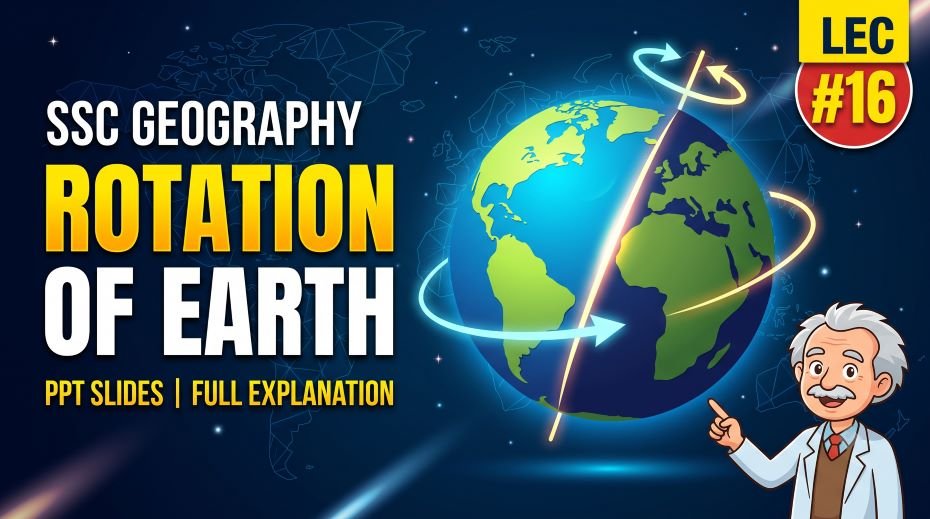
Earth’s rotation is the spinning of the Earth on its own imaginary axis – an invisible line passing through the North Pole and South Pole. Earth rotates from west to east (counterclockwise when viewed from above the North Pole), completing one full rotation in approximately 23 hours 56 minutes 4 seconds – called a sidereal day. The calendar day of 24 hours (solar day) is slightly longer because Earth must rotate a little extra to bring the Sun back to the same position in the sky, due to Earth’s simultaneous revolution around the Sun. The Coriolis effect – the deflection of moving objects (air, water) due to Earth’s rotation – is one of the most important consequences for understanding global wind patterns and ocean currents.
Rotation vs Revolution – Complete Comparison Table
| Feature | Rotation | Revolution |
| Definition | Earth spinning on its own axis | Earth orbiting around the Sun |
| Duration (one complete cycle) | 23 hours 56 minutes 4 seconds (Sidereal Day); 24 hours (Solar Day) | 365 days 5 hours 48 minutes 46 seconds (Sidereal Year); 365.25 days (Civil Year) |
| Direction | West to East (counterclockwise from above North Pole) | West to East (counterclockwise from above North Pole) |
| Axis | Earth’s own axis (tilted 23.5° from the perpendicular to its orbital plane) | Around the Sun along an elliptical orbit |
| Primary Effect | Day and Night | Seasons, Solstices, Equinoxes |
| Secondary Effects | Coriolis Effect, deflection of winds and ocean currents, flattening at poles, tides, IST/time zones | Variation in day length, midnight sun, polar night |
| Speed at Equator | ~1,670 km/h (fastest at equator; zero at poles) | ~29.8 km/h (Earth’s orbital velocity around Sun) |
| SSC Question Type | ‘Rotation causes…’ or ‘How long does rotation take?’ | ‘Revolution causes…’ or ‘Duration of revolution?’ |
Effects of Earth’s Rotation – Detailed Explanation
1. Day and Night
The most direct and obvious effect of Earth’s rotation is the cycle of day and night. As Earth spins on its axis, different parts of its surface face toward the Sun (daytime) and away from the Sun (nighttime). The circle of illumination divides Earth into the lit and unlit halves. Because Earth rotates from west to east, the Sun appears to rise in the east and set in the west.
| Term | Definition |
| Circle of Illumination | The boundary between the sunlit (day) and dark (night) halves of Earth |
| Solar Day | The 24-hour cycle from noon to noon; includes the extra rotation needed to realign with the Sun |
| Sidereal Day | 23 hours 56 minutes 4 seconds – one complete 360° rotation relative to distant stars |
| Why Solar Day > Sidereal Day | Earth also moves along its orbit, so it must rotate slightly more than 360° to bring the Sun back to the same position |
2. The Coriolis Effect
The Coriolis Effect is the apparent deflection of moving objects (wind, ocean currents, projectiles) due to Earth’s rotation. Because Earth rotates, any freely moving object appears to curve relative to the rotating surface beneath it.
| Feature | Northern Hemisphere | Southern Hemisphere |
| Deflection direction | To the RIGHT of the direction of motion | To the LEFT of the direction of motion |
| Wind direction | Cyclones rotate counter-clockwise; Anticyclones rotate clockwise | Cyclones rotate clockwise; Anticyclones rotate counter-clockwise |
| Ocean currents | Deflected to the right – creates clockwise gyres | Deflected to the left – creates counter-clockwise gyres |
| Named after | Gustave Gaspard Coriolis (French scientist, 1835) | Same phenomenon, same discoverer |
| SSC importance | Very high – direction of cyclone rotation by hemisphere is frequently asked | Very high |
3. Time Zones and International Standard Time
Because Earth rotates 360° in 24 hours, it rotates 15° per hour (360 ÷ 24 = 15). This means every 15° of longitude represents exactly 1 hour of time difference. The world is divided into 24 standard time zones of 15° each, based on the Prime Meridian (0°) at Greenwich, England.
| Parameter | Detail |
| Earth rotation per hour | 15° of longitude = 1 hour time difference |
| Earth rotation per minute | 0.25° = 4 minutes per 1° of longitude |
| Number of standard time zones | 24 (one per hour of the day) |
| Prime Meridian basis | GMT (Greenwich Mean Time) / UTC (Coordinated Universal Time) at 0° |
| India Standard Time (IST) | 82.5°E longitude – Mirzapur, UP – IST = GMT + 5 hours 30 minutes |
| Why India has one time zone | Administrative convenience despite ~28.5° east-west span (nearly 2 hours natural difference) |
| Country with most time zones | Russia – 11 time zones |
| International Date Line | Approximately 180° longitude – crossing adds or removes one calendar day |
| Time east of Prime Meridian | Ahead of GMT (add hours) |
| Time west of Prime Meridian | Behind GMT (subtract hours) |
4. Flattening of Earth at Poles (Oblate Spheroid)
Earth’s rotation generates centrifugal force, which is greatest at the equator and zero at the poles. This force pushes the equatorial regions outward, causing Earth to bulge slightly at the equator and flatten at the poles. This is why Earth is described as an oblate spheroid rather than a perfect sphere.
| Parameter | Value |
| Equatorial radius | 6,378 km (larger – bulge due to rotation) |
| Polar radius | 6,357 km (smaller – flattened) |
| Difference | ~21 km – Earth is ~21 km wider at equator than pole-to-pole |
| Point farthest from Earth’s centre | A point on the equatorial bulge – Mount Chimborazo in Ecuador (even though Everest is higher above sea level) |
5. Tides
Earth’s rotation, combined with the gravitational pull of the Moon and Sun, creates tides. The tidal bulges created by the Moon’s gravity stay roughly aligned with the Moon, while Earth rotates beneath them – causing most coastlines to experience two high tides and two low tides every ~24 hours 50 minutes.
6. Deflection of Ocean Currents
The Coriolis Effect from Earth’s rotation deflects ocean currents – to the right in the Northern Hemisphere and to the left in the Southern Hemisphere. This creates large circular current systems called ocean gyres – clockwise in the Northern Hemisphere and counter-clockwise in the Southern Hemisphere.
Solstices and Equinoxes – Complete Reference Table
While solstices and equinoxes are technically caused by Earth’s revolution (orbit) combined with its axial tilt of 23.5°, they are closely linked to rotation topics and are essential for understanding seasons and day length – both frequently tested in SSC Geography.
| Event | Date | Condition | Northern Hemisphere | Southern Hemisphere | SSC Key Fact |
| Summer Solstice (June Solstice) | ~21 June | Sun directly overhead at Tropic of Cancer (23.5°N) | Longest day; shortest night of the year | Shortest day; longest night of the year | Northern Hemisphere summer begins; Arctic regions have 24-hour daylight; Antarctic has 24-hour darkness |
| Winter Solstice (December Solstice) | ~22 December | Sun directly overhead at Tropic of Capricorn (23.5°S) | Shortest day; longest night of the year | Longest day; shortest night of the year | Northern Hemisphere winter begins; Antarctic regions have 24-hour daylight |
| Vernal Equinox (March Equinox) | ~21 March | Sun directly overhead at Equator (0°) | Day and night equal (12 hours each) everywhere on Earth; spring begins in Northern Hemisphere | Day and night equal; autumn begins | Equal days and nights globally; everywhere on Earth has exactly 12 hours day and 12 hours night |
| Autumnal Equinox (September Equinox) | ~23 September | Sun directly overhead at Equator (0°) | Day and night equal; autumn begins in Northern Hemisphere | Day and night equal; spring begins | Equal days and nights globally |
also read: SSC Geography Solar System PPT Slides Download (LEC #15)
Day Length at Different Latitudes – Seasonal Variation
| Latitude | At Summer Solstice (June 21) | At Winter Solstice (Dec 22) | At Equinoxes (March/Sept) |
| Equator (0°) | 12 hours day | 12 hours day | 12 hours day (always) |
| Tropic of Cancer (23.5°N) | ~13.5 hours day | ~10.5 hours day | 12 hours day |
| 30°N | ~14 hours day | ~10 hours day | 12 hours day |
| 45°N | ~15.5 hours day | ~8.5 hours day | 12 hours day |
| 60°N | ~18.5 hours day (sub-polar) | ~5.5 hours day | 12 hours day |
| Arctic Circle (66.5°N) | 24 hours day (Midnight Sun begins) | 0 hours day (Polar Night begins) | 12 hours day |
| North Pole (90°N) | 6 months continuous day | 6 months continuous night | Day transitions |
Eclipses – Solar and Lunar
| Feature | Solar Eclipse | Lunar Eclipse |
| Definition | Moon passes between Earth and Sun, blocking sunlight from reaching Earth | Earth passes between the Sun and Moon, casting Earth’s shadow on the Moon |
| When it occurs | New Moon (Amavasya) – Moon is in line between Earth and Sun | Full Moon (Purnima) – Earth is in line between Sun and Moon |
| Visibility | Visible only from a narrow path on Earth’s surface (umbra zone) | Visible from the entire night side of Earth where the Moon is visible |
| Duration | Maximum ~7.5 minutes for total solar eclipse | Can last up to ~3.5 hours for total lunar eclipse |
| Types | Total, Partial, Annular (ring of fire) solar eclipse | Total, Partial, Penumbral lunar eclipse |
| Annular Eclipse | Moon is farther from Earth (at apogee) – Moon appears smaller, leaving a ring of sunlight visible | Not applicable for lunar eclipse |
| Why not every month? | Moon’s orbit is tilted ~5° from Earth’s orbital plane – alignment is not perfect every month | Same reason – orbital plane tilt prevents eclipse every full moon |
| Shadow types | Umbra (complete shadow), Penumbra (partial shadow) | Umbra (total shadow), Penumbra (partial shadow) |
| SSC key fact | Solar eclipses are caused by the Moon; occur during New Moon; path of totality is narrow | Lunar eclipses occur during Full Moon; visible from wider area; Moon often turns red (‘Blood Moon’) |
Earth’s Axial Tilt – Key Facts
| Parameter | Detail |
| Axial Tilt | 23.5° from the perpendicular to the orbital plane (ecliptic) |
| Also Called | Obliquity of the ecliptic |
| Significance | Responsible for the four seasons; causes variation in day length; defines the Tropics and Arctic/Antarctic Circles |
| Tropic of Cancer (23.5°N) | Northern boundary where Sun is directly overhead at Summer Solstice (June 21) |
| Tropic of Capricorn (23.5°S) | Southern boundary where Sun is directly overhead at Winter Solstice (December 22) |
| Arctic Circle (66.5°N) | Northernmost latitude with 24-hour daylight on Summer Solstice; Polar Night on Winter Solstice |
| Antarctic Circle (66.5°S) | Southernmost equivalent latitude in Southern Hemisphere |
| Polaris (North Star) | Because of axial tilt direction, Polaris (the North Star) appears nearly stationary above the North Pole |
| Precession | Earth’s axis wobbles like a top over a ~26,000-year cycle – changes which star is ‘North Star’ over millennia |
Foucault Pendulum – First Proof of Earth’s Rotation
| Parameter | Detail |
| Inventor | Léon Foucault – French physicist |
| Year of Demonstration | 1851 |
| Location of First Demonstration | Panthéon, Paris, France |
| How It Works | A heavy pendulum swings freely; since it is not attached to Earth’s rotating surface, it maintains its plane of swing in space while Earth rotates beneath it – the apparent rotation of the pendulum’s swing proves Earth is rotating |
| Time to Complete One Rotation | At the poles: 24 hours; at other latitudes: 24/sin(latitude) hours; at the equator: infinite (never completes rotation) |
| SSC Importance | The Foucault Pendulum is described as the first direct physical proof of Earth’s rotation – frequently asked in SSC Science-Geography questions |
| Pendulums in India | There is a Foucault Pendulum at the Birla Planetarium, Kolkata, and at some science centres |
Speed of Earth’s Rotation – Key Data
| Parameter | Detail |
| Speed at Equator | ~1,670 km/h (fastest – greatest distance from axis) |
| Speed at 30° latitude | ~1,447 km/h |
| Speed at 45° latitude | ~1,180 km/h |
| Speed at 60° latitude | ~835 km/h |
| Speed at Poles (90°) | 0 km/h (poles are the axis of rotation – they do not move) |
| Angular velocity | Constant everywhere – 15° per hour at all latitudes |
| Why equator is faster | The equator traces a larger circle than any other latitude – must cover more distance in the same time |
| Effect on rocket launches | Rockets are launched eastward from near-equatorial locations to benefit from the extra rotational speed of Earth |
| ISRO launch site latitude | Satish Dhawan Space Centre – Sriharikota, Andhra Pradesh – ~13.7°N – chosen for near-equatorial advantage |
Quick Fact Table – Rotation of Earth for SSC Exams
| Question / Fact | Answer |
| Direction of Earth’s rotation | West to East (counterclockwise when viewed from above North Pole) |
| Duration of one full rotation (Sidereal Day) | 23 hours 56 minutes 4 seconds |
| Duration of Solar Day | 24 hours |
| Why solar day is longer than sidereal day | Earth must rotate extra to realign Sun due to orbital movement |
| Speed of rotation at Equator | ~1,670 km/h |
| Speed of rotation at Poles | 0 km/h (poles are the axis) |
| Primary effect of rotation | Day and Night |
| Earth’s rotation rate per hour | 15° of longitude per hour |
| Time difference per 1° of longitude | 4 minutes |
| India’s Standard Meridian | 82.5°E – Mirzapur, Uttar Pradesh |
| IST offset from GMT | GMT + 5 hours 30 minutes |
| Country with most time zones | Russia – 11 time zones |
| Coriolis Effect – Northern Hemisphere | Moving objects deflect to the RIGHT |
| Coriolis Effect – Southern Hemisphere | Moving objects deflect to the LEFT |
| Cyclone rotation in Northern Hemisphere | Counter-clockwise (anticlockwise) |
| Cyclone rotation in Southern Hemisphere | Clockwise |
| First direct proof of Earth’s rotation | Foucault Pendulum – demonstrated by Léon Foucault in 1851, Paris |
| Earth’s axial tilt | 23.5° from perpendicular to orbital plane |
| Summer Solstice date | ~21 June – Sun overhead at Tropic of Cancer |
| Winter Solstice date | ~22 December – Sun overhead at Tropic of Capricorn |
| Vernal Equinox date | ~21 March – equal day and night everywhere |
| Autumnal Equinox date | ~23 September – equal day and night everywhere |
| Solar Eclipse occurs during | New Moon (Amavasya) |
| Lunar Eclipse occurs during | Full Moon (Purnima) |
| Annular Eclipse | Moon at apogee (farthest from Earth) – ring of fire visible |
| Earth’s equatorial radius vs polar radius | Equatorial: 6,378 km; Polar: 6,357 km (flattened at poles due to rotation) |
| Point farthest from Earth’s centre | Mount Chimborazo, Ecuador – equatorial bulge |
| Midnight Sun phenomenon occurs at | Arctic Circle and beyond (66.5°N) during summer |
| Polar Night occurs at | Arctic/Antarctic Circle and beyond – in respective winter |
| ISRO’s launch site advantage from rotation | Sriharikota (Andhra Pradesh, ~13.7°N) benefits from Earth’s eastward rotational speed |
Q&A:
Q1: Why is the solar day 24 hours when Earth completes one full rotation in only 23 hours 56 minutes?
Earth completes one full 360° rotation on its axis in 23 hours 56 minutes 4 seconds – this is called the sidereal day. However, during that same period, Earth has also moved slightly along its orbit around the Sun. This means that to bring the Sun back to the same apparent position in the sky, Earth must rotate an additional ~1° beyond the full 360°. That extra rotation takes about 4 minutes, making the solar day – the time from noon to noon – approximately 24 hours. The sidereal day is measured relative to distant stars (which are so far away that Earth’s orbital movement makes no difference to their apparent position), while the solar day is measured relative to the Sun. SSC questions on ‘how long does Earth’s rotation take’ should typically be answered with 24 hours for the solar day context.
Q2: What exactly is the Coriolis Effect and how does it affect winds in India?
The Coriolis Effect is the apparent deflection of freely moving objects – including air masses and ocean currents – caused by Earth’s rotation. In the Northern Hemisphere, moving air is deflected to the right of its direction of motion; in the Southern Hemisphere, it deflects to the left. For India, which lies entirely in the Northern Hemisphere, the Coriolis Effect causes the southwest monsoon winds to curve to the right as they cross the equator from the Southern Hemisphere – they arrive in India from the southwest, and the Coriolis Effect helps sustain their curved path. It also causes cyclones in the Bay of Bengal and Arabian Sea to rotate counter-clockwise (anticlockwise) – a frequently tested SSC fact.
Q3: How does Earth’s axial tilt of 23.5° create seasons?
Earth’s axis is tilted 23.5° from the perpendicular to its orbital plane. As Earth revolves around the Sun, this tilt means that for part of the year the Northern Hemisphere leans toward the Sun (receiving more direct sunlight and longer days – summer), and for the opposite part of the year it leans away (shorter days and indirect sunlight – winter). The Southern Hemisphere experiences the opposite seasons simultaneously. On June 21, the Northern Hemisphere is maximally tilted toward the Sun – the Summer Solstice, with the longest day of the year. On December 22, it is maximally tilted away – the Winter Solstice, with the shortest day. Without this axial tilt, Earth would have no seasons – every latitude would receive the same amount of sunlight year-round.
Q4: What is the difference between a Solar Eclipse and a Lunar Eclipse?
A solar eclipse occurs when the Moon passes directly between the Earth and the Sun during a New Moon, blocking the Sun’s light from reaching Earth. It is only visible from a narrow path on Earth’s surface. In a total solar eclipse, the Moon completely blocks the Sun; in an annular eclipse, the Moon is at apogee (its farthest point from Earth) and appears smaller than the Sun, leaving a visible ring of sunlight around the dark Moon. A lunar eclipse occurs when Earth passes between the Sun and the Moon during a Full Moon, casting Earth’s shadow onto the Moon. Unlike a solar eclipse, a lunar eclipse is visible from anywhere on Earth’s night side where the Moon is above the horizon. During a total lunar eclipse, the Moon often appears reddish – called a ‘Blood Moon’ – because Earth’s atmosphere refracts red light onto the Moon.
Q5: Why does the Foucault Pendulum prove Earth’s rotation?
A Foucault Pendulum is a tall, heavy pendulum that swings freely without any twisting force on its cable. Because of its inertia, once set in motion, it continues to swing in the same plane in space – it does not ‘follow’ the rotating Earth beneath it. If you watch a Foucault Pendulum for several hours, the plane of its swing appears to slowly rotate – but it is actually Earth rotating beneath the pendulum. At the North Pole, the pendulum’s swing completes one full apparent rotation in 24 hours. At other latitudes, the rotation period is longer. At the equator, the pendulum’s swing never appears to rotate at all. This makes the Foucault Pendulum the first direct, observable, physical proof that Earth is rotating – demonstrated by Léon Foucault in Paris in 1851.
Q6: How are time zones determined and why does India have only one time zone?
Time zones are based on longitude – since Earth rotates 360° in 24 hours, every 15° of longitude corresponds to one hour of time difference. The world is divided into 24 standard time zones, each theoretically 15° wide, based on the Prime Meridian at Greenwich (0°). India spans approximately 68.7°E to 97.25°E – a width of about 28.5°, which theoretically represents nearly 2 hours of natural time difference between its westernmost and easternmost points. Despite this, India uses a single national time zone (IST = GMT + 5:30) based on the 82.5°E meridian passing through Mirzapur, UP. This is largely for administrative simplicity and national unity, though it means that in northeastern states (Arunachal Pradesh, Assam) the sun rises very early relative to the clock, while in the west (Gujarat, Rajasthan) sunrise is comparatively late.
Q7: What is Midnight Sun and Polar Night, and which regions experience them?
Midnight Sun is the phenomenon where the Sun remains above the horizon for a full 24 hours – it never sets – occurring during summer at latitudes above the Arctic Circle (66.5°N) and below the Antarctic Circle (66.5°S). It happens because Earth’s axial tilt means that in summer, the polar regions are tilted toward the Sun so much that even at midnight the Sun is still above the horizon. The opposite phenomenon is Polar Night – when the Sun remains below the horizon for a full 24 hours – occurring in polar regions during winter. The North Pole experiences approximately 6 months of continuous daylight (April–September) and 6 months of continuous darkness (October–March). Countries like Norway, Sweden, Finland, Iceland, Canada, and Russia experience Midnight Sun. This topic frequently appears in SSC Geography questions about the Arctic and Antarctic Circles.
Rapid Revision Cheat Sheet – Rotation of Earth
| Topic | Key Point |
| Direction of rotation | West to East (anticlockwise from above North Pole) |
| Sidereal Day | 23 hours 56 minutes 4 seconds – relative to distant stars |
| Solar Day | 24 hours – relative to the Sun |
| Why solar day > sidereal day | Earth must rotate extra ~4 minutes to realign Sun due to orbital movement |
| Speed at Equator | ~1,670 km/h (fastest) |
| Speed at Poles | 0 km/h (poles are the axis) |
| Rotation per hour | 15° of longitude |
| Time per 1° longitude | 4 minutes |
| IST standard meridian | 82.5°E – Mirzapur, UP – GMT + 5:30 |
| Primary effect of rotation | Day and Night |
| Coriolis Effect – North | Deflects to RIGHT; cyclones rotate anticlockwise |
| Coriolis Effect – South | Deflects to LEFT; cyclones rotate clockwise |
| Foucault Pendulum | First direct proof of Earth’s rotation; 1851; Léon Foucault; Paris |
| Earth’s axial tilt | 23.5° – causes seasons |
| Summer Solstice | ~21 June – Sun overhead Tropic of Cancer – longest day (N. Hemisphere) |
| Winter Solstice | ~22 December – Sun overhead Tropic of Capricorn – shortest day (N. Hemisphere) |
| Vernal Equinox | ~21 March – equal day and night everywhere |
| Autumnal Equinox | ~23 September – equal day and night everywhere |
| Solar Eclipse | New Moon – Moon between Earth and Sun |
| Lunar Eclipse | Full Moon – Earth between Sun and Moon |
| Annular Eclipse | Moon at apogee – ring of fire (Sun’s ring visible around Moon) |
| Equatorial radius vs Polar | 6,378 km vs 6,357 km – equatorial bulge from rotation |
| Oblate spheroid shape | Caused by centrifugal force from rotation – flattened at poles |
| Midnight Sun | 24-hour daylight at Arctic/Antarctic Circle during respective summer |
| Polar Night | 24-hour darkness at polar regions during respective winter |
| ISRO launch site | Sriharikota (~13.7°N) – near-equatorial; benefits from Earth’s rotational speed |
| Serial number of this PPT | #95 in the Complete Foundation Batch |
Conclusion
Rotation of the Earth is a foundational chapter that underpins many other Geography topics – from tides and ocean currents to time zones, winds, eclipses, and the shape of the Earth itself. Understanding the cause-and-effect chain from rotation to the Coriolis Effect to cyclone direction to monsoon patterns gives SSC aspirants a connected, integrated understanding that helps answer multiple question types with confidence.
The SSC Geography Rotation of Earth PPT Slides (LEC #16), Serial #95, available at slideshareppt.net in bilingual Hindi + English format across 116 slides, provides the complete visual framework for this topic. Ensure you are clear on Foucault’s Pendulum as the first proof of rotation, the Coriolis Effect’s directional rules by hemisphere, the four key dates (solstices and equinoxes), and the IST-longitude connection. These five anchor points make this entire chapter manageable and consistently mark-generating.