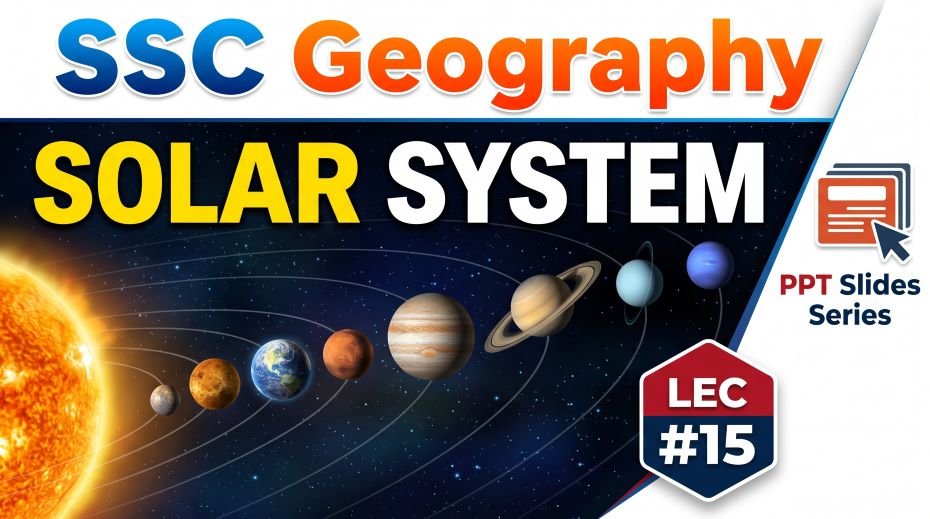
This article accompanies the SSC Geography Solar System PPT Slides Series (LEC #15) – Serial #94 of the Complete Foundation Batch for All SSC Exams PPT Series on slideshareppt.net. With 135 slides in bilingual Hindi + English format, this is one of the most expansive lectures in the entire series. This article covers the complete Solar System – from the Sun and all eight planets through moons, dwarf planets, comets, asteroids, and space exploration milestones – all structured for maximum SSC exam output.
The Solar System is one of the most consistent and high-yield topics in SSC CGL, SSC CHSL, SSC MTS, SSC GD Constable, and RRB Group D General Science and Geography sections. From the eight planets and their order, moons, and characteristics to the Sun’s structure, comets, asteroids, and India’s space missions, this topic demands thorough preparation.
PPT Overview
| Detail | Information |
| Lecture Number | LEC #15 (Geography Series) |
| Serial Number in Complete Batch | #94 |
| Subject | Geography – Solar System (सौर मंडल) |
| Series Name | Complete Foundation Batch for All SSC Exams (PPT Series) |
| Total Slides | 135 PPT Slides |
| File Size | 42 MB |
| Language | Hindi + English (Bilingual) |
| Format Available | Google Slides & Google Drive (PDF also available) |
| Website | www.slideshareppt.net |
| Target Exams | SSC CGL, SSC CHSL, SSC MTS, SSC GD Constable, RRB Group D |
| Suitable For | Students (self-study & marathon revision) and Teachers (classroom use) |
SSC Geography Solar System PPT Slides Download (LEC #15)
Note: Above is PPT in GOOGLE SLIDES (HTML AND IFRAME COMBINATION) and if you wish to download the Complete SSC series (PPT slides), visit this Link – REDIRECT PAGE.
Master Timeline: Solar System – Discovery and Space Exploration
| Period / Year | Event / Milestone | SSC Relevance |
| ~400 BCE | Ancient Greek astronomers propose a geocentric model – Earth at the centre of the universe | Geocentric vs heliocentric – classic science history |
| 1543 | Nicolaus Copernicus publishes heliocentric model – Sun at the centre of the Solar System | Heliocentric theory origin – very frequently asked |
| 1609–1619 | Johannes Kepler formulates the three Laws of Planetary Motion | Kepler’s laws – basis of planetary orbit science |
| 1610 | Galileo Galilei uses a telescope to observe Jupiter’s four largest moons (Galilean moons) and the phases of Venus | Galileo’s observations – support for heliocentric model |
| 1687 | Isaac Newton publishes Principia Mathematica – Law of Universal Gravitation explains planetary orbits | Newton’s law of gravitation |
| 1781 | Uranus discovered by William Herschel – first planet discovered with a telescope | Discovery of Uranus |
| 1846 | Neptune discovered by mathematical prediction (Adams and Le Verrier) | Discovery of Neptune |
| 1930 | Pluto discovered by Clyde Tombaugh | Pluto discovery |
| 4 October 1957 | USSR launches Sputnik 1 – world’s first artificial satellite | First satellite launch – very frequently asked |
| 3 November 1957 | Laika (dog) becomes the first animal in space aboard Sputnik 2 (USSR) | First animal in space |
| 12 April 1961 | Yuri Gagarin (USSR) becomes the first human in space aboard Vostok 1 | First human in space – most asked space fact |
| 16 June 1963 | Valentina Tereshkova (USSR) becomes the first woman in space | First woman in space |
| 20 July 1969 | Neil Armstrong and Buzz Aldrin (USA, Apollo 11) become first humans to land on the Moon | First Moon landing – extremely frequently asked |
| 19 April 1975 | India launches Aryabhata – India’s first satellite | India’s first satellite |
| 2006 | Pluto reclassified as a ‘dwarf planet’ by the International Astronomical Union (IAU) | Pluto demotion – very frequently asked |
| 2008 | ISRO launches Chandrayaan-1 – discovers water molecules on the Moon | India’s first Moon mission |
| 2013–2014 | India’s Mars Orbiter Mission (MOM / Mangalyaan) – India becomes the first Asian nation to reach Mars orbit, and first in the world to succeed on the first attempt | Mangalyaan – most asked Indian space fact |
| 2019 | Chandrayaan-2 launched; Vikram lander fails soft landing attempt; Orbiter remains functional | Chandrayaan-2 – partial success |
| 23 August 2023 | Chandrayaan-3 lands successfully near the Moon’s south pole – India becomes only the 4th country to land on the Moon and first to land near the south pole | Chandrayaan-3 – most current and important India space fact |
The Solar System – Overview
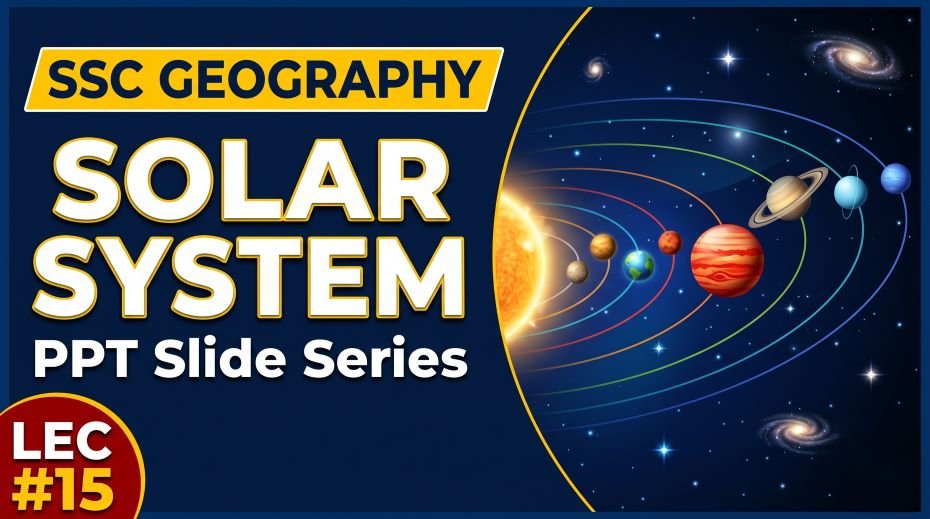
The Solar System consists of the Sun and everything bound to it by gravity – eight planets, their moons, dwarf planets, asteroids, comets, and interplanetary dust. It formed approximately 4.6 billion years ago from a giant molecular cloud of gas and dust. The Sun contains about 99.86% of the total mass of the Solar System. The eight planets, in order from the Sun, are: Mercury, Venus, Earth, Mars, Jupiter, Saturn, Uranus, and Neptune. A helpful mnemonic to remember them is: My Very Educated Mother Just Served Us Nachos (Mercury, Venus, Earth, Mars, Jupiter, Saturn, Uranus, Neptune).
The Sun – Complete Facts Table
| Parameter | Detail |
| Type | G-type main-sequence star (Yellow Dwarf) |
| Age | ~4.6 billion years old |
| Distance from Earth | ~149.6 million km (1 Astronomical Unit / 1 AU) |
| Light travel time (Sun to Earth) | ~8 minutes 20 seconds |
| Diameter | ~1,392,700 km (about 109 times Earth’s diameter) |
| Mass | ~1.989 × 10³⁰ kg – about 333,000 times Earth’s mass |
| Composition | ~73% Hydrogen (H), ~25% Helium (He), ~2% heavier elements |
| Energy Source | Nuclear fusion – Hydrogen nuclei fuse to form Helium, releasing enormous energy |
| Surface Temperature | ~5,500°C (photosphere) |
| Core Temperature | ~15 million °C |
| Rotation Period (at equator) | ~25 days (differential rotation – poles rotate slower) |
| Layers (outer to inner) | Corona → Chromosphere → Photosphere → Convection Zone → Radiation Zone → Core |
| Solar Wind | Stream of charged particles (mainly protons and electrons) flowing from the Sun’s corona into space |
| Sunspots | Dark, cooler regions on the Sun’s photosphere; associated with intense magnetic activity; follow an 11-year solar cycle |
| Solar Flares | Sudden, intense bursts of energy from the Sun’s surface; can disrupt radio communications and power grids on Earth |
| Coronal Mass Ejections (CME) | Large expulsions of plasma and magnetic field from the corona; can trigger geomagnetic storms on Earth |
The Eight Planets – Complete Master Comparison Table
| Planet | Order from Sun | Type | Diameter (km) | Distance from Sun (AU) | Revolution Period (year) | Rotation Period (day) | No. of Moons | Key SSC Facts |
| Mercury | 1st | Terrestrial (Rocky) | 4,879 | 0.39 AU | 88 Earth days | 59 Earth days | 0 | Closest to Sun; smallest planet; no atmosphere; greatest temperature variation (−180°C to +430°C); no moons |
| Venus | 2nd | Terrestrial (Rocky) | 12,104 | 0.72 AU | 225 Earth days | 243 Earth days (retrograde) | 0 | Hottest planet (462°C avg) – dense CO₂ atmosphere creates extreme greenhouse effect; rotates retrograde (east to west); brightest planet in sky; ‘Evening Star’ and ‘Morning Star’ |
| Earth | 3rd | Terrestrial (Rocky) | 12,742 | 1.00 AU | 365.25 days | 23h 56m 4s | 1 (Moon) | Only planet known to support life; 71% surface covered by water; one natural satellite (Moon) |
| Mars | 4th | Terrestrial (Rocky) | 6,779 | 1.52 AU | 687 Earth days | 24h 37m | 2 (Phobos, Deimos) | Called ‘Red Planet’ due to iron oxide (rust) on surface; has Olympus Mons – largest volcano and tallest mountain in Solar System; Valles Marineris – largest canyon in Solar System |
| Jupiter | 5th | Gas Giant | 139,820 | 5.20 AU | 11.9 Earth years | 9h 56m (fastest rotation) | 95+ moons | Largest planet; fastest rotation; Great Red Spot (a storm larger than Earth, ongoing for 350+ years); has rings (faint); Ganymede = largest moon in Solar System |
| Saturn | 6th | Gas Giant | 116,460 | 9.58 AU | 29.5 Earth years | 10h 33m | 146+ moons (most moons) | Famous for its prominent rings (made of ice and rock); least dense planet (would float on water); Titan is its largest moon – has a thick atmosphere |
| Uranus | 7th | Ice Giant | 50,724 | 19.2 AU | 84 Earth years | 17h 14m (retrograde) | 27 moons | Rotates on its side (axial tilt of 98°) – effectively rolls around the Sun; coldest planetary atmosphere (−224°C); ice giant; discovered by William Herschel (1781) |
| Neptune | 8th | Ice Giant | 49,244 | 30.1 AU | 165 Earth years | 16h 6m | 16 moons | Farthest planet from Sun; strongest winds in Solar System (up to 2,100 km/h); Great Dark Spot (large storm); Triton = largest moon; discovered by mathematical prediction (1846) |
Planet Superlatives – Most Asked SSC Facts
| Superlative | Planet | Detail |
| Largest planet | Jupiter | Diameter ~139,820 km; ~1,300 Earths could fit inside Jupiter |
| Smallest planet | Mercury | Diameter ~4,879 km; smaller than some moons |
| Hottest planet | Venus | Average surface temperature ~462°C; hottest despite not being closest to Sun |
| Coldest planet (atmosphere) | Uranus | Coldest planetary atmosphere at −224°C |
| Fastest rotation | Jupiter | One day on Jupiter = ~9 hours 56 minutes |
| Slowest rotation | Venus | One day on Venus = 243 Earth days; longer than its year (225 days) |
| Most moons | Saturn | 146+ confirmed moons (more than any other planet) |
| Least dense planet | Saturn | Less dense than water – would float if placed in a large enough ocean |
| Planet with strongest winds | Neptune | Winds up to 2,100 km/h – strongest in the Solar System |
| Planet rotating on its side | Uranus | Axial tilt of ~98° – essentially rolls around the Sun on its side |
| Planet rotating retrograde | Venus (and Uranus) | Venus rotates east to west (opposite to most planets); Uranus also effectively retrograde due to tilt |
| Closest planet to Earth (average) | Venus | Mercury can be closer at some points, but Venus on average |
| Brightest object in the night sky (after Moon) | Venus | ‘Morning Star’ or ‘Evening Star’ – visible to naked eye |
| Planet with largest volcano in Solar System | Mars | Olympus Mons – height ~21.9 km (nearly 3× Everest) |
| Planet with largest canyon in Solar System | Mars | Valles Marineris – ~4,000 km long, ~7 km deep |
| Planet with Great Red Spot | Jupiter | Ongoing storm larger than Earth; persisting 350+ years |
| Farthest planet from Sun | Neptune | ~30.1 AU from Sun |
The Moon – Earth’s Natural Satellite
| Parameter | Detail |
| Full Name | Natural satellite of Earth; also called Luna |
| Distance from Earth | Average ~384,400 km |
| Diameter | ~3,474 km – about 1/4 of Earth’s diameter |
| Revolution Period around Earth | ~27.3 days (Sidereal month); ~29.5 days (Synodic month – new moon to new moon) |
| Rotation Period | ~27.3 days (same as revolution – tidally locked) |
| Tidally Locked | Yes – always shows the same face to Earth; the far side (dark side) is never visible from Earth |
| Gravity | ~1/6th of Earth’s gravity |
| Atmosphere | Virtually no atmosphere; extreme temperature variations (−173°C to +127°C) |
| Surface Feature | Craters, highlands, maria (dark plains formed by ancient lava); no active volcanoes |
| Largest Crater | South Pole-Aitken Basin (~2,500 km diameter) |
| First Human Landing | 20 July 1969 – Apollo 11 – Neil Armstrong and Buzz Aldrin (USA) |
| India’s Moon Missions | Chandrayaan-1 (2008 – discovered water ice); Chandrayaan-2 (2019 – failed landing); Chandrayaan-3 (23 Aug 2023 – successful south pole landing) |
| Phases of the Moon | New Moon → Waxing Crescent → First Quarter → Waxing Gibbous → Full Moon → Waning Gibbous → Third Quarter → Waning Crescent → New Moon |
| Tidal Effect | Moon’s gravity causes tides on Earth; Full Moon and New Moon cause Spring Tides |
| Eclipse Connection | Solar Eclipse – Moon passes between Earth and Sun; Lunar Eclipse – Earth’s shadow falls on Moon |
Dwarf Planets – Reference Table
| Dwarf Planet | Location | Discovery | Key Facts for SSC |
| Pluto | Kuiper Belt (beyond Neptune) | 1930 by Clyde Tombaugh | Reclassified from 9th planet to dwarf planet by IAU in 2006; has 5 moons; Charon is its largest moon (nearly half Pluto’s size); visited by NASA’s New Horizons in 2015 |
| Eris | Scattered Disc (beyond Kuiper Belt) | 2005 | Slightly smaller than Pluto but similar mass; discovery triggered the debate that led to Pluto’s reclassification |
| Ceres | Asteroid Belt (between Mars and Jupiter) | 1801 by Giuseppe Piazzi | Largest object in the Asteroid Belt; only dwarf planet in the inner Solar System; visited by NASA’s Dawn spacecraft |
| Makemake | Kuiper Belt | 2005 | Named after Rapa Nui creation deity; no known atmosphere |
| Haumea | Kuiper Belt | 2004 | Unusual elongated shape; fastest spinning large object in Solar System; has two moons |
Famous Moons of the Solar System – SSC Reference
| Moon | Parent Planet | Key SSC Fact |
| Ganymede | Jupiter | Largest moon in the Solar System; larger than the planet Mercury; has its own magnetic field |
| Titan | Saturn | Largest moon of Saturn; only moon in Solar System with a dense atmosphere (mainly nitrogen); has lakes of liquid methane |
| Europa | Jupiter | Has a global ocean of liquid water under its icy surface; considered one of the most likely places for extraterrestrial life |
| Io | Jupiter | Most volcanically active body in the Solar System; hundreds of active volcanoes |
| Callisto | Jupiter | 4th Galilean moon; most heavily cratered object in the Solar System |
| Moon (Luna) | Earth | Only natural satellite of Earth; only extraterrestrial body visited by humans |
| Phobos | Mars | Larger of Mars’s two moons; slowly spiralling inward and will eventually crash into Mars or break apart |
| Deimos | Mars | Smaller of Mars’s two moons; tiny irregular shaped body |
| Charon | Pluto (dwarf planet) | Largest moon relative to its parent body; nearly half Pluto’s size; together they form a double dwarf planet system |
| Triton | Neptune | Largest moon of Neptune; orbits retrograde (opposite to Neptune’s rotation); geologically active; may be a captured Kuiper Belt object |
also read: SSC Geography Volcano PPT Slides Series (LEC #14)
Asteroids, Comets, and Meteors – Key Distinctions
| Object | Definition | Location | Key SSC Facts |
| Asteroid | Rocky/metallic bodies orbiting the Sun; too small to be classified as planets | Mainly in the Asteroid Belt between Mars and Jupiter | Also called Minor Planets; Ceres is largest asteroid (also a dwarf planet); Apophis is a near-Earth asteroid watched closely for potential impact |
| Comet | Icy body that develops a visible coma (tail) of gas and dust when near the Sun | Originate from the Kuiper Belt and Oort Cloud beyond Neptune | Tail always points away from the Sun (pushed by solar wind); Halley’s Comet – most famous; period ~75–76 years; last seen 1986; next expected ~2061 |
| Meteor | A meteoroid (space rock fragment) that enters Earth’s atmosphere and burns up | Anywhere in space; become meteors when entering atmosphere | Also called ‘shooting star’; most burn up completely |
| Meteorite | A meteoroid that survives the atmosphere and lands on Earth’s surface | Space origin; land on Earth’s surface | Provide valuable data on Solar System’s origin; iron and stony meteorites most common |
| Meteoroid | Small particle of rock or metal in outer space | Orbiting the Sun | Smaller than asteroids; larger than molecules |
India’s Space Missions – ISRO Key Milestones
| Mission / Satellite | Year | Key Achievement / Details |
| Aryabhata | 1975 | India’s first satellite; launched by USSR from Kapustin Yar; named after ancient Indian mathematician Aryabhata |
| Bhaskara-I | 1979 | First Indian experimental remote sensing satellite |
| APPLE (Ariane Passenger Payload Experiment) | 1981 | India’s first geostationary communication satellite; launched by Ariane rocket (France) |
| INSAT-1A | 1982 | First satellite of the Indian National Satellite System; communication and meteorology |
| IRS-1A (Indian Remote Sensing Satellite) | 1988 | India’s first operational remote sensing satellite |
| SLV-3 (Satellite Launch Vehicle) | 1980 | India’s first indigenously developed satellite launch vehicle; launched Rohini satellite |
| PSLV (Polar Satellite Launch Vehicle) | First successful 1994 | ISRO’s most reliable launch vehicle; used for most Indian satellite launches including Chandrayaan-1 and Mangalyaan |
| Chandrayaan-1 | 2008 | India’s first lunar mission; orbited Moon; detected water ice on the Moon – major scientific discovery |
| Chandrayaan-2 | 2019 | India’s 2nd lunar mission; Vikram lander failed soft landing; Orbiter successfully operating; Pragyan rover never deployed |
| Mars Orbiter Mission (MOM) / Mangalyaan | 2013–2014 | India’s first interplanetary mission; India became first Asian nation to reach Mars orbit; first country in the world to succeed on its first Mars attempt; very cost-effective (~₹450 crore) |
| ASTROSAT | 2015 | India’s first dedicated astronomy satellite; studies celestial objects in UV and X-ray wavelengths |
| GSLV Mk III / LVM3 | 2014 (test), 2022 operational | India’s heaviest rocket; used for Chandrayaan-3; capable of launching heavier payloads to GTO |
| Chandrayaan-3 | 2023 | India’s 3rd lunar mission; successfully landed Vikram lander and deployed Pragyan rover on 23 August 2023 near Moon’s south pole; India became 4th country to soft-land on Moon (after USA, USSR, China) and 1st at south pole |
| Aditya-L1 | 2023 | India’s first solar observatory; positioned at Lagrange Point L1 between Earth and Sun; studies the Sun’s outer layers |
| Gaganyaan (planned) | ~2025 | India’s first crewed spaceflight mission; will send Indian astronauts (Gagannauts) to low Earth orbit and return them safely |
Space Exploration Firsts – Most Asked SSC Facts
| First / Milestone | Achievement | Country / Person | Year |
| First artificial satellite | Sputnik 1 launched into orbit | USSR | 4 October 1957 |
| First animal in space | Laika (dog) aboard Sputnik 2 | USSR | 3 November 1957 |
| First human in space | Yuri Gagarin – Vostok 1; one full orbit of Earth | USSR | 12 April 1961 |
| First American in space | Alan Shepard – suborbital flight; Freedom 7 | USA | 5 May 1961 |
| First woman in space | Valentina Tereshkova – Vostok 6 | USSR | 16 June 1963 |
| First spacewalk (EVA) | Alexei Leonov – outside Voskhod 2 for 12 minutes | USSR | 18 March 1965 |
| First Moon landing | Neil Armstrong and Buzz Aldrin – Apollo 11 | USA | 20 July 1969 |
| First words on Moon | Neil Armstrong: ‘That’s one small step for man, one giant leap for mankind’ | USA | 20 July 1969 |
| First space station | Salyut 1 (USSR) | USSR | 1971 |
| First Indian in space | Rakesh Sharma – Salyut 7 (Soyuz T-11); said ‘Saare Jahan Se Achha’ when asked about India from space | India (USSR rocket) | 3 April 1984 |
| First Indian woman in space | Kalpana Chawla (US citizen of Indian origin) – Space Shuttle Columbia | USA (Indian origin) | 1997 |
| First Indian satellite | Aryabhata – launched by USSR | India | 19 April 1975 |
| First Asian nation to reach Mars | Mangalyaan (MOM) – first try success | India (ISRO) | 2014 |
| First nation to land near Moon’s south pole | Chandrayaan-3 – Vikram lander | India (ISRO) | 23 August 2023 |
| First Mars rover (USA) | Sojourner – Mars Pathfinder mission | USA (NASA) | 1997 |
| Hubble Space Telescope launched | First large optical telescope in Earth orbit | USA (NASA + ESA) | 1990 |
| International Space Station (ISS) permanent crew | Continuous human habitation in low Earth orbit | USA + Russia + Partners | November 2000 |
Quick Fact Table – Solar System for SSC Exams
| Question / Fact | Answer |
| How many planets in the Solar System? | 8 – Mercury, Venus, Earth, Mars, Jupiter, Saturn, Uranus, Neptune |
| Largest planet | Jupiter |
| Smallest planet | Mercury |
| Hottest planet | Venus (~462°C average) |
| Coldest planetary atmosphere | Uranus (−224°C) |
| Planet with most moons | Saturn (146+ moons) |
| Planet with fastest rotation | Jupiter (~9h 56m per day) |
| Planet with slowest rotation | Venus (243 Earth days per day) |
| Planet rotating on its side | Uranus (axial tilt ~98°) |
| Planet known as ‘Red Planet’ | Mars – iron oxide surface |
| Planet known as ‘Evening Star’ / ‘Morning Star’ | Venus – brightest planet visible from Earth |
| Largest volcano in Solar System | Olympus Mons on Mars – ~21.9 km height |
| Largest canyon in Solar System | Valles Marineris on Mars – ~4,000 km long |
| Largest moon in Solar System | Ganymede (moon of Jupiter) |
| Only moon with a dense atmosphere | Titan (moon of Saturn) |
| Moon most likely to harbour life | Europa (moon of Jupiter – liquid water ocean under ice) |
| Most volcanically active body in Solar System | Io (moon of Jupiter) |
| When was Pluto reclassified as a dwarf planet? | 2006 – by the International Astronomical Union (IAU) |
| Famous comet with ~75-year period | Halley’s Comet – last seen 1986; next ~2061 |
| First satellite launched into space | Sputnik 1 – USSR – 4 October 1957 |
| First human in space | Yuri Gagarin – USSR – 12 April 1961 |
| First woman in space | Valentina Tereshkova – USSR – 16 June 1963 |
| First humans on the Moon | Neil Armstrong and Buzz Aldrin – USA – 20 July 1969 |
| First Indian in space | Rakesh Sharma – 1984 (Soyuz T-11, USSR rocket) |
| India’s first satellite | Aryabhata – 1975 |
| India’s first Moon mission | Chandrayaan-1 – 2008 – discovered water ice on Moon |
| India’s Mars mission name | Mangalyaan / MOM – 2013–14 – first Asian nation to reach Mars |
| Chandrayaan-3 significance | Successfully landed near Moon’s south pole on 23 August 2023 – India 4th to soft-land on Moon, 1st at south pole |
| India’s first solar observatory | Aditya-L1 – 2023 – positioned at L1 Lagrange point |
| Distance of Sun from Earth | ~149.6 million km / 1 Astronomical Unit (AU) |
Podcast-Style Q&A – Solar System
Q1: Why is Venus the hottest planet even though Mercury is closer to the Sun?
Mercury is the closest planet to the Sun, yet Venus is significantly hotter. Mercury has virtually no atmosphere to trap heat – temperatures swing wildly from +430°C on its sun-facing side to −180°C at night. Venus, by contrast, has an extremely thick atmosphere composed almost entirely of carbon dioxide with clouds of sulphuric acid, creating an extreme greenhouse effect that traps heat so effectively that the surface temperature is a near-constant 462°C – hot enough to melt lead. This dramatic difference demonstrates that proximity to the Sun is not the only factor determining a planet’s temperature – atmospheric composition and the greenhouse effect play equally important roles.
Q2: Why was Pluto removed from the list of planets in 2006?
In 2006, the International Astronomical Union (IAU) formally defined what a ‘planet’ must be: it must orbit the Sun, have sufficient mass to assume a roughly spherical shape, and have ‘cleared the neighbourhood’ around its orbit of other debris. Pluto meets the first two criteria but fails the third – it shares its orbital zone in the Kuiper Belt with many other similar icy bodies, including Eris (which is actually slightly more massive than Pluto). Rather than expand the planet list to include dozens of Kuiper Belt objects, the IAU created the new category of ‘dwarf planet’ for Pluto and similar bodies. This decision reduced the planet count from nine to eight and is one of the most frequently tested modern astronomy facts in SSC exams.
Q3: What is Chandrayaan-3’s significance and why is it important for India?
Chandrayaan-3 successfully landed its Vikram lander and deployed the Pragyan rover on 23 August 2023, touching down near the Moon’s south pole – a feat no other country had achieved before. This made India the fourth country in history to successfully soft-land on the Moon (after the USA, USSR, and China) and the first nation to land near the lunar south pole, a region of great scientific interest because it contains permanently shadowed craters that may preserve ancient water ice useful for future human exploration. Chandrayaan-3’s success came after the Chandrayaan-2 lander Vikram failed a soft landing in 2019, making the 2023 achievement especially significant for ISRO and for India’s growing reputation in space technology.
Q4: What made India’s Mangalyaan mission historically significant?
India’s Mars Orbiter Mission (MOM), also called Mangalyaan, was launched on 5 November 2013 and successfully entered Mars orbit on 24 September 2014. Its significance lies in multiple records: India became the first Asian nation to successfully reach Mars orbit (previous attempts by Japan and China had failed), the first country in the world to succeed in its Mars mission on the very first attempt, and did so at an extraordinarily low cost of approximately ₹450 crore (about USD 74 million) – cheaper than the production budget of the Hollywood film ‘Gravity’ released the same year. Mangalyaan is considered one of the greatest achievements in India’s space program history.
Q5: What is the difference between a meteor, meteoroid, meteorite, and asteroid?
These four terms describe different stages or sizes of the same type of rocky space material. An asteroid is a relatively large rocky or metallic body orbiting the Sun, mostly found in the Asteroid Belt between Mars and Jupiter. A meteoroid is a smaller chunk of rock or metal in space, often broken off from an asteroid or comet. When a meteoroid enters Earth’s atmosphere and heats up due to friction, the resulting streak of light in the sky is called a meteor – commonly known as a ‘shooting star.’ If the meteoroid is large enough to survive the journey through the atmosphere and land on Earth’s surface, the remaining piece of rock is called a meteorite.
Q6: What are Lagrange Points and why is Aditya-L1 positioned there?
Lagrange Points are five specific positions in space where the gravitational forces of two large bodies (such as the Earth and Sun) and the orbital motion of a smaller object balance each other perfectly, allowing the smaller object to maintain a stable position relative to the two larger bodies with minimal fuel expenditure. India’s Aditya-L1 solar observatory is positioned at the L1 Lagrange Point between the Earth and Sun – approximately 1.5 million km from Earth – because from this position it has an unobstructed view of the Sun at all times without being eclipsed by Earth or the Moon. L1 is also used by other solar observatories including NASA’s SOHO and DSCOVR.
Q7: Why is Europa (moon of Jupiter) considered a candidate for extraterrestrial life?
Europa is one of Jupiter’s four large Galilean moons, covered by a thick layer of ice. Beneath this ice crust, scientists believe there exists a vast liquid water ocean kept warm by tidal heating – the gravitational squeezing caused by Jupiter’s immense gravitational field as Europa orbits. The combination of liquid water, energy (tidal heat), and the presence of chemical compounds makes Europa potentially habitable for microbial life by similar conditions that support life in Earth’s deep ocean vents. NASA’s Europa Clipper mission (launched 2024) is specifically designed to study Europa’s potential habitability in detail, making this topic relevant to both space science and current affairs in SSC exams.
Rapid Revision Cheat Sheet – Solar System
| Topic | Key Point |
| Planets in order from Sun | Mercury, Venus, Earth, Mars, Jupiter, Saturn, Uranus, Neptune |
| Mnemonic | My Very Educated Mother Just Served Us Nachos |
| Largest planet | Jupiter |
| Smallest planet | Mercury |
| Hottest planet | Venus (~462°C) – not Mercury |
| Closest to Sun | Mercury |
| Red Planet | Mars – iron oxide surface |
| Evening/Morning Star | Venus – brightest in sky after Moon |
| Planet with most moons | Saturn – 146+ moons |
| Planet rotating on its side | Uranus – axial tilt ~98° |
| Fastest rotation | Jupiter – 9h 56m |
| Slowest rotation | Venus – 243 Earth days |
| Largest volcano in Solar System | Olympus Mons (Mars) – 21.9 km |
| Largest canyon in Solar System | Valles Marineris (Mars) – 4,000 km |
| Largest moon in Solar System | Ganymede (moon of Jupiter) |
| Moon with dense atmosphere | Titan (Saturn’s moon) – nitrogen atmosphere |
| Moon with liquid water ocean | Europa (Jupiter’s moon) – candidate for life |
| Most volcanically active body | Io (Jupiter’s moon) |
| Pluto reclassified | 2006 – IAU – dwarf planet |
| Famous comet | Halley’s Comet – period ~75–76 years – next ~2061 |
| First satellite | Sputnik 1 – USSR – 4 Oct 1957 |
| First human in space | Yuri Gagarin – USSR – 12 Apr 1961 |
| First woman in space | Valentina Tereshkova – USSR – 16 Jun 1963 |
| First Moon landing | Neil Armstrong & Buzz Aldrin – USA – 20 Jul 1969 |
| First Indian in space | Rakesh Sharma – 1984 |
| India’s first satellite | Aryabhata – 1975 |
| Chandrayaan-1 (2008) | Discovered water ice on Moon |
| Mangalyaan (2013–14) | First Asian nation to Mars orbit; first country to succeed on 1st attempt |
| Chandrayaan-3 (23 Aug 2023) | India 4th to soft-land on Moon; 1st near south pole |
| Aditya-L1 (2023) | India’s first solar observatory; positioned at L1 Lagrange point |
| Serial number of this PPT | #94 in the Complete Foundation Batch |
Conclusion
Solar System Geography is one of the most fact-dense and consistently high-scoring topics in SSC and RRB exams, combining pure science with current affairs through India’s rapidly advancing space program. From memorising planetary order and superlatives to knowing the significance of Chandrayaan-3, Mangalyaan, and Rakesh Sharma – this topic rewards thorough systematic preparation.
The SSC Geography Solar System PPT Slides (LEC #15), Serial #94, available at slideshareppt.net in bilingual Hindi + English format across 135 slides, is the most comprehensive single lecture on Solar System in the Foundation Batch. Study the planet comparison table and superlatives table carefully, memorise the space exploration firsts in chronological order, and keep the Rapid Revision Cheat Sheet accessible in the week before your exam. This topic reliably delivers 3–5 marks per SSC or RRB paper for well-prepared students.