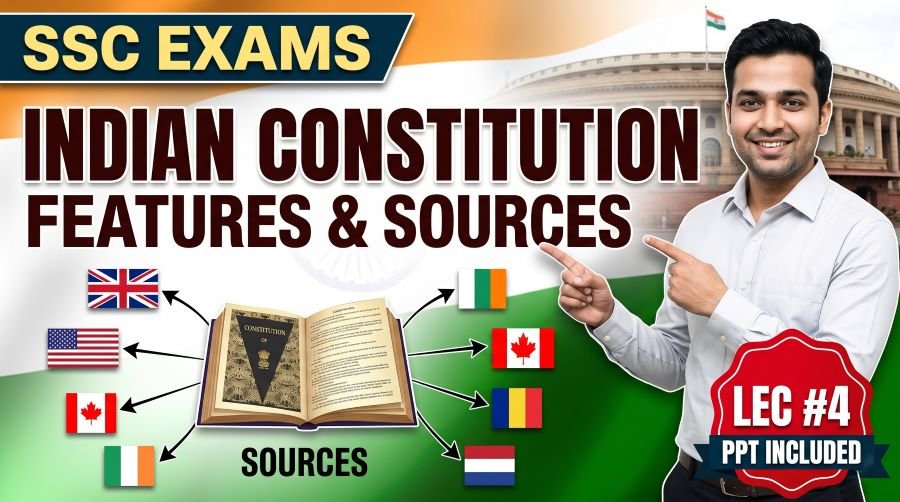
This article covers SSC Features and Sources of Indian Constitution PPT (LEC #4) (भारतीय संविधान की विशेषताएं और स्रोत), including Sources, Parts, and Schedules (स्रोत, भाग और अनुसूची). This lecture is one of the most exam-relevant in the entire PPT series. Questions on sources of the Constitution, all 12 Schedules, Parts of the Constitution, and key features appear in virtually every SSC CGL, CHSL, CPO, and MTS exam. This article covers every detail from the 122-slide PPT with complete tables for quick revision.
SSC Features and Sources of Indian Constitution PPT (LEC #4)
Note: Above is PPT in GOOGLE SLIDES (HTML AND IFRAME COMBINATION) and if you wish to download the Complete SSC series (PPT slides), Simply visit this redirect page – REDIRECT PAGE.
1. Nature of the Indian Constitution
The Indian Constitution is the supreme law of India – all other laws must conform to it
It is the longest written constitution in the world
Called a ‘bag of borrowings’ because it drew heavily from constitutions of many countries
Neither purely federal nor purely unitary – described as ‘quasi-federal’ or federal with unitary bias
Both rigid (for major changes) and flexible (for some provisions)
It is a living document – has been amended 106 times since 1950
2. Sources of the Indian Constitution – Complete Table
This is one of the most frequently asked topics in SSC Polity. At least 1–2 questions on sources appear in every exam. Memorise the country–provision mapping thoroughly.
Country / Source
Provision Borrowed
Key Word to Remember
Government of India Act 1935
Federal structure, Emergency provisions, Public Service Commissions, Judiciary, Governor’s office, Three lists
LARGEST source
United Kingdom (UK)
Parliamentary system, Cabinet system, PM as head of govt, Rule of Law, Single citizenship, Bicameral Parliament, Speaker of Lok Sabha
Parliamentary model
United States of America (USA)
Fundamental Rights, Judicial Review, independence of judiciary, Preamble inspiration, impeachment of President, removal of SC judges
Bill of Rights
Ireland
Directive Principles of State Policy (DPSP), nomination of members to Rajya Sabha, method of election of President
DPSP
Canada
Federal system with strong Centre, residuary powers with Centre, advisory jurisdiction of Supreme Court
Strong Centre
Australia
Concurrent List, joint sitting of both Houses of Parliament, freedom of trade and commerce
Concurrent List
Weimar Republic (Germany)
Suspension of Fundamental Rights during Emergency, provisions of Emergency
Emergency
South Africa
Amendment procedure for certain provisions (by 2/3 majority), election of Rajya Sabha members
Amendment
Soviet Union (USSR)
Fundamental Duties, ideals of justice (social, economic, political) in Preamble
Fundamental Duties
Japan
Procedure established by law (Article 21 – right to life)
Article 21
France
Republic, Liberty, Equality, Fraternity in Preamble
Preamble ideals
Most Important Sources to Remember
GoI Act 1935 – LARGEST source; federal structure, emergency, judiciary, three lists, governor
UK – Parliamentary system, Cabinet, PM, Rule of Law, single citizenship, Speaker
USA – Fundamental Rights, Judicial Review, Preamble inspiration, impeachment
Ireland – DPSP (Directive Principles of State Policy), Rajya Sabha nominations
Canada – Strong Centre, residuary powers with Union
Australia – Concurrent List, joint sitting of Parliament
Germany – Emergency: suspension of Fundamental Rights
USSR – Fundamental Duties, socio-economic justice in Preamble
Japan – Procedure established by law (Article 21)
South Africa – Amendment of Constitution (2/3 majority)
3. Key Features of the Indian Constitution
Feature
Description
Lengthiest Written Constitution
Originally 395 Articles, 8 Schedules, 22 Parts; now 470+ Articles, 12 Schedules, 25 Parts
Drawn from Many Sources
Called a ‘bag of borrowings’ – drew from constitutions of many countries
Partly Rigid, Partly Flexible
Some articles amended by simple majority; others need 2/3 majority + ratification by states
Federal System with Unitary Bias
Distribution of powers between Centre and States; but Centre is stronger
Parliamentary Form of Government
Executive responsible to legislature; PM is head of government
Integrated and Independent Judiciary
Single unified judiciary; Supreme Court at apex; power of Judicial Review
Fundamental Rights
Justiciable rights guaranteed to all citizens (Part III, Articles 12–35)
Directive Principles
Non-justiciable guidelines for State policy (Part IV, Articles 36–51)
Fundamental Duties
11 duties for citizens (Part IV-A, Article 51A)
Secular State
No state religion; state treats all religions equally
Universal Adult Franchise
Every citizen above 18 can vote regardless of caste, religion, sex
Single Citizenship
All Indians are citizens of India only; no separate state citizenship
Independent Constitutional Bodies
Election Commission, CAG, UPSC, Finance Commission, etc.
Emergency Provisions
Three types: National (Art 352), President’s Rule (Art 356), Financial (Art 360)
Three-tier Government
Central Government, State Governments, Local Bodies (Panchayati Raj & Municipalities)
4. Federal Features of the Indian Constitution
Written and supreme Constitution
Rigid Constitution for certain provisions
Division of powers between Centre and States (7th Schedule – three lists)
Independent and integrated judiciary
Bicameral legislature at the Centre (Lok Sabha + Rajya Sabha)
Dual government – Central and State governments
Financial independence of units
5. Unitary Features of the Indian Constitution (Unitary Bias)
Strong Centre – Union List has more and more important subjects than State List
Residuary powers with the Centre (unlike USA where residuary powers are with states)
Single Constitution for both Centre and States (except J&K earlier)
Single citizenship – no separate state citizenship
Integrated judiciary – one Supreme Court for the whole country
All-India Services (IAS, IPS, IFoS) controlled by Centre
Emergency provisions give Centre sweeping powers over states
Parliament can change boundaries of states without state consent
Governor appointed by President – Centre’s representative in states
The Constitution itself uses the word ‘Union’ not ‘Federation’
6. Parts of the Indian Constitution – Complete Table
The Constitution is divided into Parts (भाग). Originally 22 Parts; currently 25 Parts. Every SSC exam asks at least one question on which Part deals with which subject.
Part
Articles
Subject
Part I
1–4
The Union and its Territory
Part II
5–11
Citizenship
Part III
12–35
Fundamental Rights
Part IV
36–51
Directive Principles of State Policy (DPSP)
Part IV-A
51A
Fundamental Duties (added by 42nd Amendment 1976)
Part V
52–151
The Union Government (President, Parliament, PM, Courts)
Part VI
152–237
The State Governments
Part VII
[Deleted]
States in Part B (deleted by 7th Amendment 1956)
Part VIII
239–242
Union Territories
Part IX
243–243O
Panchayats (added by 73rd Amendment 1992)
Part IX-A
243P–243ZG
Municipalities (added by 74th Amendment 1992)
Part IX-B
243ZH–243ZT
Co-operative Societies (added by 97th Amendment 2011)
Part X
244–244A
Scheduled and Tribal Areas
Part XI
245–263
Relations between Union and States
Part XII
264–300A
Finance, Property, Contracts, Suits
Part XIII
301–307
Trade, Commerce, Intercourse within India
Part XIV
308–323
Services under Union and States
Part XIV-A
323A–323B
Tribunals (added by 42nd Amendment 1976)
Part XV
324–329A
Elections
Part XVI
330–342
Special Provisions for SC, ST, OBC, Anglo-Indians
Part XVII
343–351
Official Language
Part XVIII
352–360
Emergency Provisions
Part XIX
361–367
Miscellaneous
Part XX
368
Amendment of Constitution
Part XXI
369–392
Temporary, Transitional, Special Provisions
Part XXII
393–395
Short Title, Commencement, Repeal
Most Important Parts to Remember
Part III (Articles 12–35) – Fundamental Rights – most tested
Part IV (Articles 36–51) – DPSP
Part IV-A (Article 51A) – Fundamental Duties
Part V (Articles 52–151) – Union Government (President, Parliament, PM, SC)
Part VI (Articles 152–237) – State Governments
Part XI (Articles 245–263) – Union-State Relations
Part XVIII (Articles 352–360) – Emergency Provisions
Part XX (Article 368) – Amendment of Constitution
7. Schedules of the Indian Constitution – Complete Table
Originally 8 Schedules; currently 12 Schedules. Questions on Schedules are extremely common in SSC CGL and CHSL. Know the content of every Schedule.
Schedule
Subject
Key Content / Example
First Schedule
Names of States and Union Territories
List of 28 States and 8 UTs
Second Schedule
Salaries and emoluments of constitutional post holders
12th Schedule – Municipal subjects (18 subjects, 74th Amendment 1992)
SSC Features and Sources of Indian Constitution PPT (LEC #4)
8. Seventh Schedule – Three Lists (Most Important)
The Seventh Schedule divides legislative powers between the Union and States into three lists. This is the single most important schedule for SSC exams.
Total: 22 official languages currently in the 8th Schedule
Hindi is the official language of the Union (Article 343); English also used for official purposes
There is no ‘national language’ declared in the Constitution
10. Amendment of the Constitution – Article 368
The Indian Constitution provides three methods of amendment (partly rigid, partly flexible):
Method
How Amended
Examples
By Simple Majority (not Article 368)
By Parliament by simple majority – ordinary legislative process
Admission of new states, creation of UTs, citizenship, 5th & 6th Schedules
By Special Majority (Article 368)
2/3 majority of members present and voting + majority of total membership of each House
Fundamental Rights, DPSP, any other constitutional provision
By Special Majority + State Ratification (Article 368)
2/3 special majority + ratification by at least half of State Legislatures
Election of President, extent of executive power of Union/States, 7th Schedule, representation of states in Parliament, Art 368 itself
Basic Structure Doctrine – Kesavananda Bharati Case (1973): Parliament cannot amend the ‘basic structure’ of the Constitution
Basic structure includes: supremacy of Constitution, republican & democratic form, secular character, separation of powers, federalism, judicial review, Fundamental Rights
11. Preamble – Features and Keywords
Word in Preamble
Meaning / Significance
Sovereign
India is free from external control; supreme authority within its territory
Socialist
Social and economic equality; added by 42nd Amendment 1976
Secular
No state religion; equal respect for all religions; added by 42nd Amendment 1976
Democratic
Government by the people (through elected representatives)
Republic
Elected head of state (President); not a hereditary monarchy
Justice
Social, economic, and political justice for all citizens
Liberty
Liberty of thought, expression, belief, faith, and worship
Equality
Equality of status and opportunity
Fraternity
Brotherhood among all citizens; dignity of the individual; unity and integrity of the nation