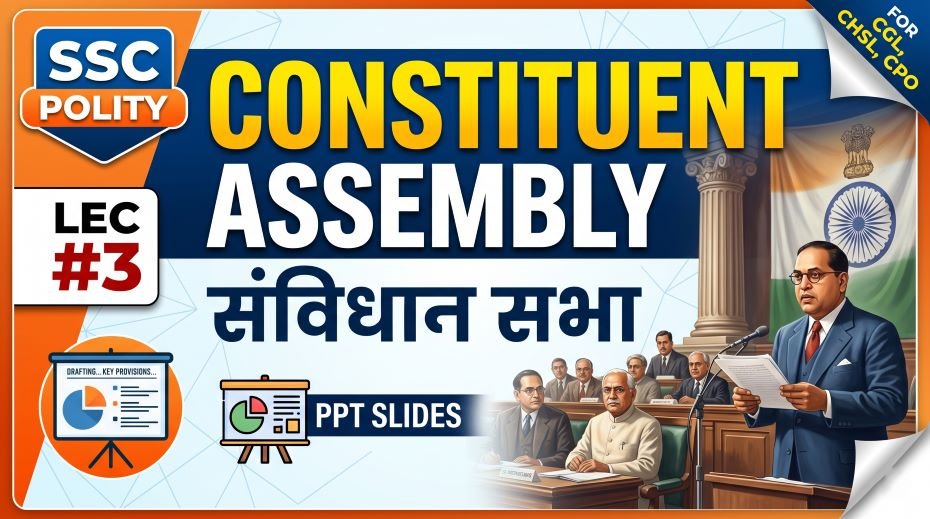
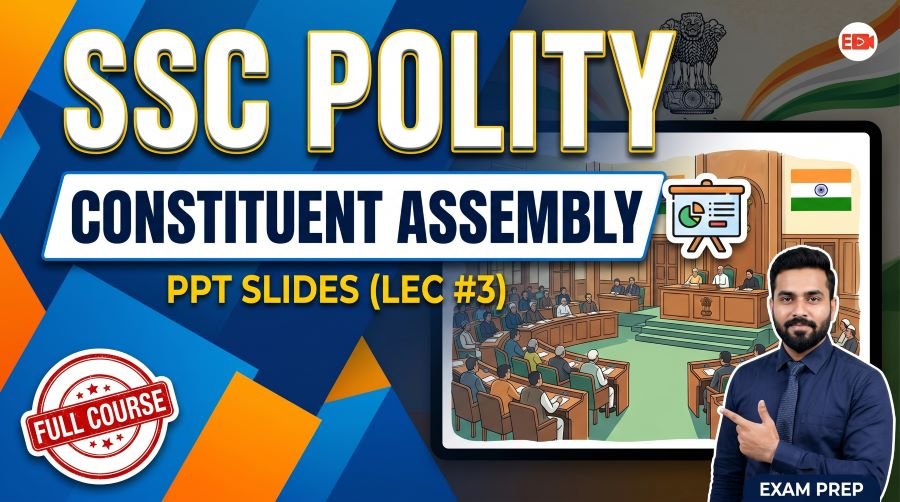
This article covers SSC Polity Constituent Assembly PPT Slides (LEC #3) (संविधान सभा), part of the Complete Foundation Batch PPT Series at slideshareppt.net. With 140 slides, this lecture is dedicated entirely to the formation, composition, committees, sessions, and proceedings of the Constituent Assembly. It is a consistently high-scoring topic in SSC CGL, CHSL, CPO, and MTS exams – questions on committee chairmen, key dates, members, and the Drafting Committee appear in nearly every shift.
PPT Details
| Field | Details |
| PPT Title | SSC Polity Constituent Assembly PPT Slides (LEC #3) |
| Subject | Polity – Constituent Assembly (संविधान सभा) |
| Series | Complete Foundation Batch for All SSC and Other Exams (PPT Series) |
| Total Slides | 140 PPT Slides |
| File Size | 46 MB |
| Serial Number | #59 |
| Lecture | LEC #3 |
| Format | PowerPoint (.pptx) + PDF |
| Target Exams | SSC CGL, SSC CHSL, SSC MTS, SSC CPO, SSC GD, SSC Steno |
| Website | slideshareppt.net |
SSC Polity Constituent Assembly PPT Slides (LEC #3)
Note: Above is PPT in GOOGLE SLIDES (HTML AND IFRAME COMBINATION) and if you wish to download the Complete SSC series (PPT slides), Simply visit this redirect page – REDIRECT PAGE.
Complete Timeline – Constituent Assembly of India (Most Important for SSC Exams)
| Date / Year | Event | Key Significance |
| 1934 | M.N. Roy first proposed idea of a Constituent Assembly | First demand for a constituent assembly for India |
| 1935 | Indian National Congress officially demanded Constituent Assembly | Congress made it a formal political demand |
| 1940 | August Offer by Viceroy Linlithgow | British acknowledged idea but did not concede |
| 1942 | Cripps Mission | Proposed Constituent Assembly after WWII; rejected by Congress |
| Mar 1946 | Cabinet Mission arrived in India | Proposed structure and composition of Constituent Assembly |
| Jul–Aug 1946 | Elections to Constituent Assembly held | 296 seats filled; Congress won 208, Muslim League won 73 |
| 9 Dec 1946 | First sitting of Constituent Assembly | Dr. Sachchidananda Sinha – Temporary/Provisional President |
| 11 Dec 1946 | Dr. Rajendra Prasad elected President | Permanent President of Constituent Assembly |
| 11 Dec 1946 | H.C. Mukherjee elected Vice-President | Also chaired Committee on Minorities |
| 13 Dec 1946 | Objective Resolution moved by Nehru | Philosophical basis of the Constitution; basis of Preamble |
| 22 Jan 1947 | Objective Resolution adopted unanimously | Foundation of the Constitution formally accepted |
| Jul 1947 | Indian Independence Act 1947 passed | Constituent Assembly became fully sovereign |
| 14 Aug 1947 | Pakistan’s Constituent Assembly separated | Membership of Indian CA reduced to 299 |
| 29 Aug 1947 | Drafting Committee constituted | Dr. B.R. Ambedkar elected Chairman |
| 4 Nov 1948 | First Reading of Draft Constitution began | Draft presented by Drafting Committee |
| Nov 1948 – Oct 1949 | Second Reading (clause-by-clause discussion) | Longest phase; detailed debate on every article |
| 17 Oct 1949 | Third Reading began | Final reading and voting on the Constitution |
| 26 Nov 1949 | Constitution adopted | Signed by 284 members; Constitution Day (Samvidhan Diwas) |
| 24 Jan 1950 | Last sitting of Constituent Assembly | Members signed the Constitution; National Anthem adopted |
| 26 Jan 1950 | Constitution came into force | India became a Sovereign Democratic Republic |
1. What is the Constituent Assembly?
A Constituent Assembly is a body of elected representatives given the special task of drafting a constitution for a country. India’s Constituent Assembly was set up under the Cabinet Mission Plan of 1946. It was not directly elected by the people but by the members of the provincial legislative assemblies. After independence on 15 August 1947, it also functioned as the provisional Parliament of India until the first general elections in 1952.
2. Demand for a Constituent Assembly – Historical Background
- 1934 – M.N. Roy (Marxist leader) first put forward the idea of a Constituent Assembly for India
- 1935 – Indian National Congress officially demanded a Constituent Assembly to frame India’s Constitution
- 1938 – Jawaharlal Nehru declared that the Constitution of India must be framed by a Constituent Assembly elected on the basis of adult franchise
- 1940 – August Offer by Viceroy Linlithgow acknowledged the demand but did not concede it
- 1942 – Cripps Mission proposed a Constituent Assembly after World War II; rejected by Congress as it gave provinces and princely states the right to stay out
- 1946 – Cabinet Mission Plan finally provided for the formation of the Constituent Assembly
3. Cabinet Mission Plan 1946 – Formation of Constituent Assembly
- Cabinet Mission arrived in India in March 1946; members: Lord Pethick-Lawrence, Sir Stafford Cripps, A.V. Alexander
- Proposed a Constituent Assembly of 389 members in total
- 292 members – elected by provincial legislative assemblies (11 provinces)
- 4 members – from Chief Commissioner’s provinces (Delhi, Ajmer-Merwara, Coorg, British Baluchistan)
- 93 members – nominated by Princely States
- Seats in each province allocated proportionally: 1 seat per 10 lakh population
- Seats divided among three communities: General, Muslims, Sikhs
- Elections held in July–August 1946; Congress won 208 seats, Muslim League won 73 seats
- Muslim League initially boycotted the Constituent Assembly
4. Composition of the Constituent Assembly
| Category | Seats | Remarks |
| British Indian Provinces (elected) | 296 | Elected by provincial legislative assemblies |
| Chief Commissioner’s Provinces | 4 | Nominated members |
| Princely States | 93 | Nominated by rulers of princely states |
| Total (original) | 389 | Before partition of India |
| After partition (Aug 1947) | 299 | Pakistan’s members separated; Muslim League members left |
| Members who signed Constitution | 284 | 26 November 1949 |
5. Key Personalities of the Constituent Assembly
Dr. Rajendra Prasad – President of Constituent Assembly
- Elected permanent President on 11 December 1946
- Presided over all sessions of the Constituent Assembly
- Later became the first President of India on 26 January 1950
Dr. B.R. Ambedkar – Chairman, Drafting Committee
- Called the ‘Father of the Indian Constitution’
- Played the most crucial role in drafting the Constitution
- Called Article 32 (Right to Constitutional Remedies) the ‘Heart and Soul’ of the Constitution
- Resigned as Law Minister in 1951 over disagreements on the Hindu Code Bill
Jawaharlal Nehru – Key Leader
- Moved the Objective Resolution on 13 December 1946
- Chaired: Union Powers Committee, Union Constitution Committee, States Committee
- Became first Prime Minister of independent India
Sardar Vallabhbhai Patel – Key Leader
- Chaired: Provincial Constitution Committee and Advisory Committee on Fundamental Rights
- Responsible for integration of princely states into India
- Called the ‘Iron Man of India’
Sir B.N. Rau – Constitutional Advisor
- Served as the Constitutional Adviser to the Constituent Assembly
- Prepared the initial draft of the Constitution
- Travelled to USA, Canada, Ireland, UK to study constitutions
Dr. Sachchidananda Sinha – Temporary President
- The oldest member of the Constituent Assembly
- Served as Temporary/Provisional President at the first sitting on 9 December 1946
6. Committees of the Constituent Assembly
The Constituent Assembly worked through a large number of committees. The most important ones for SSC exams are:
| Committee | Chairman | Key Function |
| Drafting Committee | Dr. B.R. Ambedkar | Draft the Constitution; most important committee |
| Union Powers Committee | Jawaharlal Nehru | Powers of the Union Government |
| Union Constitution Committee | Jawaharlal Nehru | Structure of Union Government |
| Provincial Constitution Committee | Sardar Vallabhbhai Patel | Structure of Provincial Governments |
| Advisory Committee on Fundamental Rights | Sardar Vallabhbhai Patel | Fundamental Rights and Minorities |
| Steering Committee | Dr. Rajendra Prasad | Conduct of business of Constituent Assembly |
| Rules of Procedure Committee | Dr. Rajendra Prasad | Rules for functioning of the Assembly |
| States Committee | Jawaharlal Nehru | Relations between Union and States |
| Committee on Minorities | H.C. Mukherjee | Protection of minorities |
| House Committee | B. Pattabhi Sitaramayya | Accommodation for members |
| Credentials Committee | Alladi Krishnaswami Ayyar | Verification of member credentials |
| Finance and Staff Committee | Dr. Rajendra Prasad | Financial matters of the Assembly |
7. Drafting Committee – Most Important for SSC Exams
The Drafting Committee was the most important committee of the Constituent Assembly. It was constituted on 29 August 1947 with Dr. B.R. Ambedkar as Chairman. It had 7 members originally.
| Member | Remarks |
| Dr. B.R. Ambedkar | Chairman; Father of the Indian Constitution |
| N. Gopalaswami Ayyangar | Former PM of Jammu & Kashmir; key contributor |
| Alladi Krishnaswami Ayyar | Eminent jurist |
| Dr. K.M. Munshi | Writer and jurist; Munshi-Ayyangar formula for language |
| Syed Mohammad Saadulla | Former PM of Assam |
| N. Madhava Rau | Replaced B.L. Mitter (resigned due to ill-health) |
| T.T. Krishnamachari | Replaced D.P. Khaitan (died in 1948) |
- The Drafting Committee prepared the Draft Constitution and presented it to the Assembly on 4 November 1948
- The Draft Constitution had 315 articles and 8 schedules when first presented
- After discussions and amendments: 395 articles, 8 schedules, 22 parts in the final Constitution
8. Objective Resolution – Basis of the Preamble
The Objective Resolution was moved by Jawaharlal Nehru on 13 December 1946 and adopted on 22 January 1947. It declared the aims and objectives of the Constituent Assembly and became the philosophical foundation of the Indian Constitution.
Key Declarations of the Objective Resolution
- India shall be an Independent Sovereign Republic
- All power and authority derived from the people
- All citizens guaranteed justice, equality, freedom of thought, expression, belief, faith, worship, vocation, association, and action
- Adequate safeguards for minorities, backward and tribal areas, and depressed and other backward classes
- Territorial integrity of the Republic shall be maintained
- India shall make full and willing contribution to world peace and welfare of mankind
The Objective Resolution was later incorporated almost verbatim into the Preamble of the Constitution.
9. Sessions and Readings of the Constituent Assembly
| Phase | Period | Details |
| First sitting | 9 December 1946 | Temporary President: Dr. Sachchidananda Sinha; Muslim League boycotted |
| Objective Resolution | 13 Dec 1946 – 22 Jan 1947 | Moved by Nehru; adopted unanimously |
| Post-Independence | After 15 Aug 1947 | CA became sovereign; also acted as provisional Parliament |
| Drafting Committee formed | 29 August 1947 | Dr. Ambedkar as Chairman; 7 members |
| First Reading | 4 Nov 1948 – 9 Feb 1949 | General discussion on Draft Constitution |
| Second Reading | 15 Nov 1948 – 17 Oct 1949 | Clause-by-clause discussion; most detailed phase |
| Third Reading | 17 Oct 1949 – 26 Nov 1949 | Final reading; passed with amendments |
| Constitution adopted | 26 November 1949 | Signed by 284 members; 395 articles finalised |
| Last sitting | 24 January 1950 | National Anthem & National Song adopted; members signed Constitution |
| Constitution enforced | 26 January 1950 | India became a Republic; Republic Day |
10. Criticisms of the Constituent Assembly
- Not directly elected by the people on the basis of universal adult franchise
- Dominated by Congress party – not truly representative
- Granville Austin called it a ‘one-party body in an essentially one-party country’
- Muslim League initially boycotted proceedings
- Princely states’ representatives were nominated, not elected
- Time-consuming – took nearly 3 years to draft the Constitution
- However: it was the most representative body possible under the circumstances of 1946
11. Features of the Constituent Assembly as a Body
- Sovereign body after 15 August 1947 – not subject to any external authority
- Also functioned as provisional Parliament from 1947 to 1952
- Sat for 166 days spread over 11 sessions in 2 years, 11 months, 18 days
- Debates were open to the public and press
- Decisions taken by consensus rather than voting in most cases
- Committees did detailed groundwork; Assembly debated and approved
- Calligrapher: Prem Behari Narain Raizada wrote the Constitution by hand in italic style
- Constitution signed on 24 January 1950 at its last sitting
12. The Preamble – Born from the Constituent Assembly
- Based directly on the Objective Resolution moved by Nehru
- Declares India to be: Sovereign, Democratic, Republic (originally)
- ‘Socialist’ and ‘Secular’ added by 42nd Amendment 1976
- Objectives: Justice (social, economic, political), Liberty, Equality, Fraternity
- Supreme Court in Berubari Case (1960) – Preamble is not part of the Constitution
- Supreme Court in Kesavananda Bharati Case (1973) – Preamble IS part of the Constitution
- Preamble can be amended under Article 368 but basic structure cannot be changed
13. Quick Revision Fact Table – Constituent Assembly
| Fact | Detail |
| Who first proposed the Constituent Assembly? | M.N. Roy – 1934 |
| Temporary President (first sitting) | Dr. Sachchidananda Sinha |
| Permanent President | Dr. Rajendra Prasad |
| Vice-President of Constituent Assembly | H.C. Mukherjee |
| Constitutional Advisor | Sir B.N. Rau (Sir Benegal Narsing Rau) |
| Chairman of Drafting Committee | Dr. B.R. Ambedkar |
| Total members of Constituent Assembly | 389 originally; reduced to 299 after partition |
| Total sessions of Constituent Assembly | 11 sessions |
| Total days the Assembly sat | 166 days (in 2 years, 11 months, 18 days) |
| Objective Resolution moved by | Jawaharlal Nehru – 13 December 1946 |
| Objective Resolution adopted on | 22 January 1947 |
| Constitution adopted on | 26 November 1949 (Constitution Day / Samvidhan Diwas) |
| Members who signed the Constitution | 284 out of 299 |
| Constitution enforced on | 26 January 1950 (Republic Day) |
| Total articles in original Constitution | 395 Articles, 8 Schedules, 22 Parts |
| National Anthem adopted on | 24 January 1950 (last sitting of Constituent Assembly) |
| National Song adopted on | 24 January 1950 |
| Calligrapher of the Constitution | Prem Behari Narain Raizada (in Hindi); also done in English |
READ ALSO: SSC Polity Constitutional Development of India PPT (LEC #2)
14. Key Takeaways for SSC Exams
- M.N. Roy first proposed Constituent Assembly in 1934
- Cabinet Mission Plan 1946 – set up the Constituent Assembly
- First sitting: 9 December 1946 | Temporary President: Dr. Sachchidananda Sinha
- Permanent President: Dr. Rajendra Prasad (elected 11 December 1946)
- Objective Resolution moved by Nehru on 13 Dec 1946; adopted 22 Jan 1947
- Drafting Committee: 7 members | Chairman: Dr. B.R. Ambedkar | Formed: 29 Aug 1947
- Constitutional Advisor: Sir B.N. Rau
- Constitution adopted: 26 November 1949 | 284 members signed
- Constitution enforced: 26 January 1950 – Republic Day
- Total: 395 Articles, 8 Schedules, 22 Parts | 11 sessions | 166 days | 299 members
- National Anthem and National Song adopted: 24 January 1950.