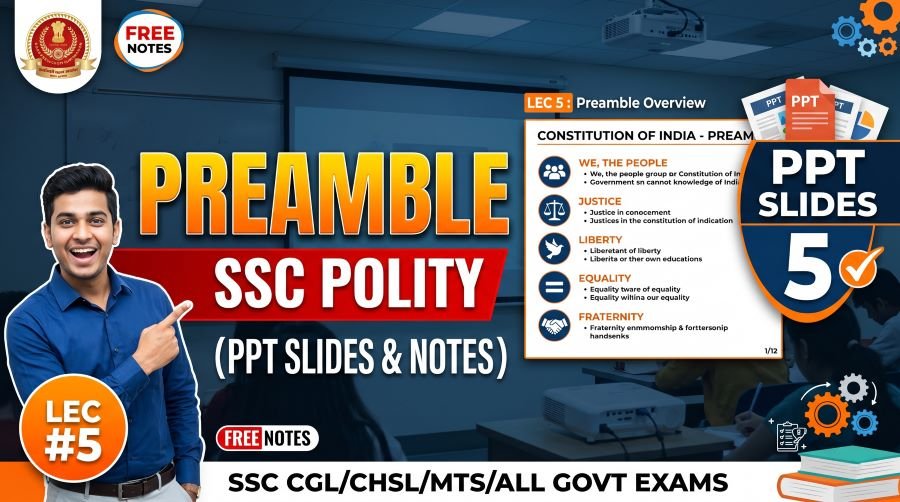
This article covers SSC Polity Preamble PPT Slides (LEC #5) (प्रस्तावना), part of the Complete Foundation Batch PPT Series at slideshareppt.net. The Preamble is one of the highest-scoring single topics in SSC CGL, CHSL, CPO, and MTS exams. Questions are asked on every aspect – keywords, meanings, Supreme Court cases, the 42nd Amendment, comparisons, and the Objective Resolution. This article covers the full 68-slide PPT with complete tables for revision.
PPT Details
| Field | Details |
| PPT Title | SSC Polity Preamble PPT Slides (LEC #5) |
| Subject | Polity – Preamble of the Indian Constitution (प्रस्तावना) |
| Series | Complete Foundation Batch for All SSC and Other Exams (PPT Series) |
| Total Slides | 68 PPT Slides |
| File Size | 20 MB |
| Serial Number | #61 |
| Lecture | LEC #5 |
| Format | PowerPoint (.pptx) + PDF |
| Target Exams | SSC CGL, SSC CHSL, SSC MTS, SSC CPO, SSC GD, SSC Steno |
| Website | slideshareppt.net |
SSC Polity Preamble PPT Slides (LEC #5)
Note: Above is PPT in GOOGLE SLIDES (HTML AND IFRAME COMBINATION) and if you wish to download the Complete SSC series (PPT slides), Simply visit this redirect page – REDIRECT PAGE.
1. What is the Preamble?
The Preamble is the introductory statement of the Indian Constitution. It declares the source of authority of the Constitution, the nature of the Indian State, and the objectives the Constitution seeks to achieve. It acts as a key to understanding the spirit and intention of the framers of the Constitution.
Famous Descriptions of the Preamble
- Ernest Barker (political scientist) – described Preamble as the ‘key to the Constitution’
- K.M. Munshi – called the Preamble the ‘horoscope of our sovereign democratic republic’
- N.A. Palkhivala – called the Preamble the ‘identity card of the Constitution’
- Thakurdas Bhargava – called it the ‘soul of the Constitution’
- Jawaharlal Nehru – Objective Resolution, which became the Preamble, declared India’s destiny
2. Full Text of the Preamble of India
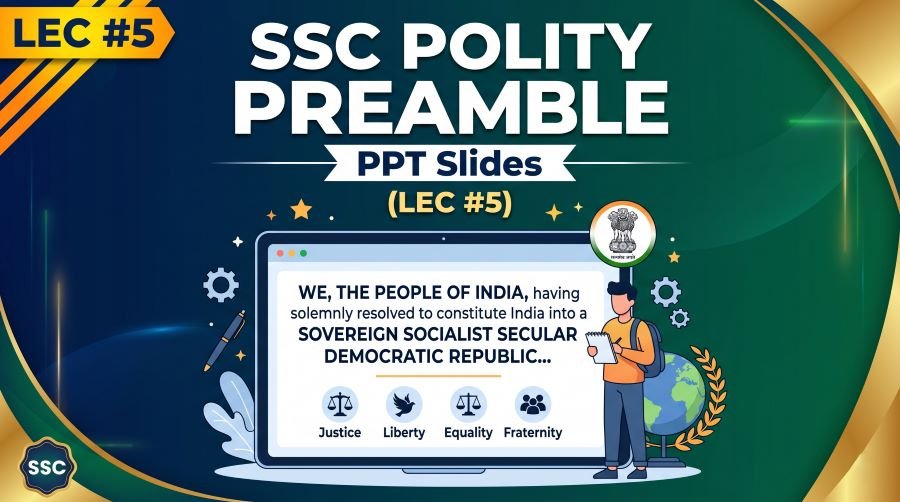
WE, THE PEOPLE OF INDIA, having solemnly resolved to constitute India into a SOVEREIGN SOCIALIST SECULAR DEMOCRATIC REPUBLIC and to secure to all its citizens:
- JUSTICE, social, economic and political;
- LIBERTY of thought, expression, belief, faith and worship;
- EQUALITY of status and of opportunity;
- and to promote among them all
- FRATERNITY assuring the dignity of the individual and the unity and integrity of the Nation;
IN OUR CONSTITUENT ASSEMBLY this twenty-sixth day of November, 1949, do HEREBY ADOPT, ENACT AND GIVE TO OURSELVES THIS CONSTITUTION.
3. Preamble Keywords – Complete Explanation Table (Most Important for SSC)
Every keyword in the Preamble is exam-relevant. Questions are asked on meanings, which words were added by the 42nd Amendment, and which country inspired each ideal.
| Keyword in Preamble | Meaning | Added / Original | Source Country |
| Sovereign | India is independent; not under control of any external power; supreme authority within its borders | Original (1950) | — |
| Socialist | Economic and social equality; state controls key resources; reduce gap between rich and poor | Added by 42nd Amendment 1976 | USSR (Soviet Union) |
| Secular | No state religion; state treats all religions equally; no discrimination on basis of religion | Added by 42nd Amendment 1976 | — |
| Democratic | Government elected by the people; people exercise power through elected representatives | Original (1950) | UK / USA |
| Republic | Head of state (President) is elected, not hereditary; office is not inherited | Original (1950) | France |
| Justice – Social | No discrimination on basis of caste, sex, religion; equal access to social life | Original (1950) | — |
| Justice – Economic | Equal pay for equal work; no exploitation; equitable distribution of resources | Original (1950) | USSR |
| Justice – Political | Equal political rights; one person one vote; equal access to political office | Original (1950) | — |
| Liberty of Thought | Freedom to think, form opinions without interference | Original (1950) | France / USA |
| Liberty of Expression | Freedom of speech (Article 19) | Original (1950) | USA |
| Liberty of Belief | Freedom to hold any belief or faith | Original (1950) | — |
| Liberty of Faith | Freedom to follow any religion | Original (1950) | — |
| Liberty of Worship | Freedom to practise and propagate religion (Article 25) | Original (1950) | — |
| Equality of Status | All citizens equal before law regardless of birth, position, wealth | Original (1950) | USA / France |
| Equality of Opportunity | Equal opportunity in public employment (Article 16) | Original (1950) | — |
| Fraternity | Brotherhood among citizens; sense of common belonging | Original (1950) | France |
| Dignity of the Individual | Every person deserves respect and dignity regardless of background | Original (1950) | — |
| Unity and Integrity of Nation | Maintain oneness of the nation; ‘Integrity’ added by 42nd Amendment 1976 | ‘Integrity’ added 1976 | — |
4. The Four Key Objectives – JELF (Justice, Equality, Liberty, Fraternity)
Justice – Three Dimensions
- Social Justice – eliminating discrimination based on caste, creed, sex, religion; equal access to public places and social life; related to Fundamental Rights (Part III)
- Economic Justice – equitable distribution of wealth; no exploitation; equal pay for equal work; related to DPSP (Part IV) and Fundamental Duties
- Political Justice – one person one vote; equal right to contest elections; equal access to political office regardless of birth or wealth
Justice in the Preamble is inspired by the ideals of the Russian/French Revolution and the socialist tradition.
Liberty – Five Freedoms in the Preamble
- Liberty of Thought – freedom to think independently
- Liberty of Expression – freedom of speech and press (Article 19(1)(a))
- Liberty of Belief – freedom to hold personal convictions
- Liberty of Faith – freedom to follow any religion
- Liberty of Worship – freedom to practise religious rituals (Article 25)
Liberty in the Preamble does not mean absolute freedom. It is subject to reasonable restrictions under Articles 19(2) to 19(6).
Equality – Two Dimensions
- Equality of Status – all citizens equal before the law regardless of caste, creed, sex, religion (Articles 14, 15)
- Equality of Opportunity – equal opportunity in matters of public employment (Article 16)
Equality in the Preamble is inspired by the French Revolution (‘Liberté, Égalité, Fraternité’).
Fraternity – Two Aspects
- Dignity of the Individual – every person deserves respect and equal treatment
- Unity and Integrity of the Nation – oneness of India; ‘Integrity’ added by 42nd Amendment 1976
Fraternity is borrowed from the French Revolution. It ensures that the rights of liberty and equality have real meaning for every citizen.
5. Five Characteristics of the Indian State in the Preamble
Sovereign
- India is not subject to any external authority
- The Legislature has power to make any law (subject to the Constitution)
- India can acquire foreign territory or cede Indian territory
- India can conduct its own foreign policy
- Sovereignty is both internal (supreme within territory) and external (independent of other states)
Socialist
- Added by 42nd Amendment 1976 during the Emergency period under Indira Gandhi
- Means a mixed economy – neither purely capitalist nor purely communist
- State controls key resources; aims to reduce inequality of income and status
- India follows ‘democratic socialism’ not ‘communist socialism’
- Supreme Court clarified: ‘socialism’ in India means commitment to mixed economy and welfare state
Secular
- Added by 42nd Amendment 1976
- India has no official state religion
- State treats all religions with equal respect and does not favour or discriminate against any religion
- Individuals are free to profess, practise, and propagate any religion (Article 25)
- Secularism in India is ‘positive secularism’ – state supports all religions equally (unlike ‘negative secularism’ of USA/France where state is strictly separate from religion)
- S.R. Bommai Case (1994) – Secularism declared a basic feature of the Constitution
Democratic
- Government of the people, by the people, for the people
- Citizens exercise power through elected representatives
- Universal Adult Franchise – every citizen above 18 years can vote (Article 326)
- Regular free and fair elections conducted by the Election Commission (Article 324)
- India is a representative / indirect democracy
- Direct democracy is not practised at the national level
Republic
- The head of state (President of India) is elected, not hereditary
- Unlike a monarchy (UK), no position in India is inherited by birth
- The President is elected for a fixed term of 5 years (Article 56)
- Every citizen of India is eligible to become President (subject to qualifications)
- India became a Republic on 26 January 1950
6. Objective Resolution – Foundation of the Preamble
- Moved by Jawaharlal Nehru on 13 December 1946 in the Constituent Assembly
- Adopted unanimously on 22 January 1947
- Declared India would be an Independent Sovereign Republic
- All power derived from the people
- Guaranteed justice, equality, freedom for all citizens
- Adequate safeguards for minorities, backward classes, tribal areas
- Pledged full contribution to world peace and welfare of mankind
- The Objective Resolution was incorporated almost verbatim into the Preamble of the Constitution
7. Amendment of the Preamble – 42nd Amendment 1976
| Amendment | Year | Change Made to Preamble |
| 42nd Constitutional Amendment | 1976 | Added ‘Socialist’ and ‘Secular’ before ‘Democratic’; changed ‘Unity of the Nation’ to ‘Unity and Integrity of the Nation’ |
| No other amendment | — | The Preamble has been amended only once in 75+ years of the Constitution |
- The Preamble has been amended only ONCE in the history of India
- 42nd Amendment (1976) was passed during the Emergency under Prime Minister Indira Gandhi
- Changes: ‘Sovereign Democratic Republic’ became ‘Sovereign Socialist Secular Democratic Republic’
- ‘Unity of the Nation’ became ‘Unity and Integrity of the Nation’
- The Preamble can be amended under Article 368 but its basic structure cannot be destroyed (Kesavananda Bharati Case 1973)
8. Important Supreme Court Cases on the Preamble
| Case / Judgment | Year | Court’s Decision on Preamble |
| Berubari Union Case | 1960 | Preamble is NOT a part of the Constitution; cannot be used to interpret constitutional provisions |
| Kesavananda Bharati Case | 1973 | Preamble IS a part of the Constitution; can be amended but basic structure cannot be destroyed |
| LIC of India Case | 1995 | Reaffirmed that Preamble is part of the Constitution; upheld Kesavananda Bharati ruling |
| S.R. Bommai Case | 1994 | Secularism is a basic feature of the Constitution; cannot be amended away |
Kesavananda Bharati Case 1973 – Most Important
- Full name: Kesavananda Bharati Sripadagalvaru v. State of Kerala
- 13-judge Constitutional Bench – largest bench in Supreme Court history
- Held: Preamble is a part of the Constitution
- Held: Parliament can amend the Constitution under Article 368 BUT cannot destroy its ‘basic structure’
- Basic structure includes: supremacy of Constitution, republican and democratic form, secular character, separation of powers, federalism, unity and integrity, judicial review, free and fair elections
- This judgment limited Parliament’s power to amend the Constitution
9. Preamble of India vs Other Countries – Comparison
| Feature | India | USA | France |
| Preamble begins with | ‘We, the People of India’ | ‘We the People of the United States’ | ‘The French People proclaim’ |
| Type of State | Sovereign Socialist Secular Democratic Republic | Federal Constitutional Republic | Secular Republic |
| Key ideals | Justice, Liberty, Equality, Fraternity | Justice, domestic tranquillity, general welfare | Liberty, Equality, Fraternity |
| Head of State | Elected President (Republic) | Elected President (Republic) | Elected President (Republic) |
| Preamble enforceability | Not directly justiciable | Not directly enforceable | Part of constitutional bloc |
- India’s Preamble begins with ‘We, the People of India’ – inspired by the US Preamble (‘We the People of the United States’)
- The concept of Republic is inspired by France
- Liberty, Equality, Fraternity – borrowed from the French Revolution (1789)
- Justice (social, economic, political) – influenced by socialist ideals and Russian Revolution
10. Is the Preamble Justiciable?
- The Preamble is NOT directly enforceable in a court of law
- A citizen cannot file a petition in court if the ideals of the Preamble are not met
- However, the Preamble is used as a guide for interpreting the provisions of the Constitution
- Courts refer to the Preamble to understand the intention of the framers
- Fundamental Rights (Part III) are justiciable – courts can enforce them
- DPSP (Part IV) are not justiciable – cannot be enforced by courts
- Fundamental Duties (Article 51A) are not justiciable
11. Preamble and the Basic Structure Doctrine
The Basic Structure Doctrine established in Kesavananda Bharati Case (1973) protects the core of the Preamble from being amended away. The following elements from the Preamble are part of the basic structure:
- Sovereignty of India
- Democratic character of the polity
- Unity and integrity of the Nation
- Secular character of the Constitution
- Republican form of government
- Federal character of the Constitution
- Rule of Law
Even if Parliament passes a constitutional amendment with the required majority, it cannot remove these elements. The Supreme Court will strike down any such amendment.
also read: SSC Features and Sources of Indian Constitution PPT (LEC #4)
12. Quick Revision Fact Table – Preamble
| Fact | Detail |
| What is the Preamble? | Introduction / preface to the Indian Constitution; declares its ideals and objectives |
| Preamble inspired by | US Constitution’s Preamble (‘We, the People’) |
| Objective Resolution moved by | Jawaharlal Nehru on 13 December 1946 |
| Objective Resolution adopted on | 22 January 1947 |
| Preamble adopted on | 26 November 1949 (along with the Constitution) |
| Words in original Preamble (1950) | Sovereign, Democratic, Republic |
| Words added by 42nd Amendment 1976 | Socialist, Secular; ‘Integrity’ added to ‘Unity of the Nation’ |
| Preamble amended how many times? | Only once – by the 42nd Constitutional Amendment in 1976 |
| Who described Preamble as ‘key to the Constitution’? | Earnest Barker (political scientist) |
| Who called it the ‘horoscope of our sovereign democratic republic’? | K.M. Munshi |
| Who called it the ‘identity card of the Constitution’? | N.A. Palkhivala |
| Berubari Case (1960) | Preamble is NOT part of the Constitution |
| Kesavananda Bharati Case (1973) | Preamble IS part of the Constitution; basic structure cannot be amended |
| LIC of India Case (1995) | Reaffirmed that Preamble is part of the Constitution |
| Is Preamble justiciable? | No – cannot be enforced in a court of law |
| Can Preamble be amended? | Yes – under Article 368; but basic structure cannot be destroyed |
| Fraternity borrowed from | French Revolution (Liberty, Equality, Fraternity) |
| JUSTICE (social, economic, political) inspired by | Russian Revolution / USSR ideals |
| India is a Republic because | Head of State (President) is elected, not hereditary |
| India is Secular because | No state religion; state does not favour any religion |
13. Key Takeaways for SSC Exams
- Preamble = Introduction to the Constitution; declares ideals and objectives
- ‘We, the People of India’ – inspired by US Preamble
- Five characteristics: Sovereign, Socialist, Secular, Democratic, Republic
- ‘Socialist’ and ‘Secular’ added by 42nd Amendment 1976 (only amendment to the Preamble)
- ‘Integrity’ added to ‘Unity of the Nation’ also by 42nd Amendment 1976
- Four objectives: Justice (social, economic, political), Liberty, Equality, Fraternity
- Fraternity – borrowed from French Revolution; ensures dignity + unity
- Berubari Case 1960 – Preamble NOT part of the Constitution
- Kesavananda Bharati Case 1973 – Preamble IS part of the Constitution
- Basic Structure cannot be destroyed even by Parliament (Article 368)
- Preamble is NOT justiciable – cannot be enforced in court
- S.R. Bommai Case 1994 – Secularism is a basic feature; cannot be removed
- Famous quote: K.M. Munshi called it ‘horoscope of our sovereign democratic republic’
- India is a POSITIVE secular state – state supports all religions equally.