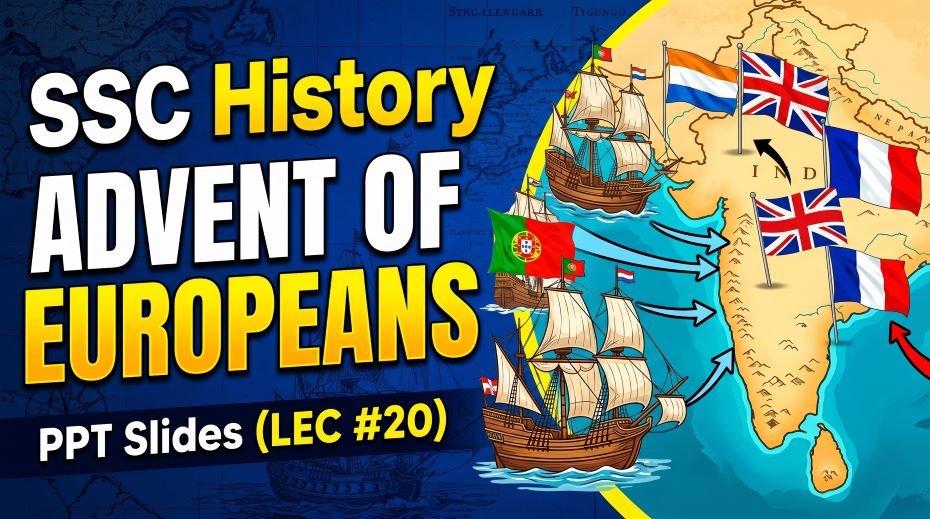
We are going to share SSC History Advent of Europeans PPT Slides (LEC #20) with you so, The Advent of Europeans in India marks one of the most consequential chapters in world history. Five European nations – Portugal, the Netherlands, England, France, and Denmark – arrived on India’s shores between 1498 and 1700 AD, drawn by the immense wealth of the spice trade. What began as commercial ventures gradually evolved into political domination – culminating in 200 years of British colonial rule that transformed India permanently.
This article is built around the SSC History Advent of Europeans PPT Slides – Lecture #20 – from the Complete Foundation Batch PPT Series (Serial Number #45) at slideshareppt.net. The PPT contains 169 slides covering all European powers in India, their trading companies, their key battles against each other and against Indian rulers, and the rise of British supremacy.
For SSC CGL, SSC CHSL, SSC MTS, SSC CPO, Railways NTPC, and UPSC Prelims aspirants, this chapter delivers 3–5 reliable marks per exam on sea routes, trading companies, key battles, and important individuals. This guide covers every testable fact.
About – PPT Slides
| Detail | Information |
| Series Name | Complete Foundation Batch for All SSC and Other Exams (PPT Series) |
| Subject | Modern Indian History – Advent of Europeans (यूरोपियों का आगमन / यूरोपीय लोगों का आगमन) |
| Lecture Number | Lecture #20 |
| Total PPT Slides | 169 PPT Slides |
| File Size | 45 MB |
| Serial Number | #45 |
| Period Covered | 1498 AD (Vasco da Gama’s arrival) to ~1818 AD (French and Dutch power eliminated) |
| Best For | SSC CGL, CHSL, MTS, CPO, GD, Railways NTPC, UPSC Prelims, State PSCs |
| Source Website | slideshareppt.net |
SSC History Advent of Europeans PPT Slides (LEC #20)
Note: If you wish to download the entire SSC series (PPT slides), simply visit this redirect page. –REDIRECT PAGE
Complete Timeline Table: Advent of Europeans in India – All Key Dates
This master timeline is the backbone of this chapter. Every date, person, and event here has generated SSC MCQs. Study it carefully.
| Year (AD) | Event | Key Person / Country | Key SSC Fact |
| 1453 | Ottoman Turks capture Constantinople – overland trade route from Europe to Asia blocked | Ottoman Turks (Mehmed II) | This forced European nations to find a sea route to India; the search for an alternative route to India’s spices began |
| 1487–1488 | Bartholomew Dias rounds the Cape of Good Hope | Bartholomew Dias (Portuguese) | First European to sail around the southern tip of Africa; proved a sea route to India was possible; named it Cape of Good Hope |
| 1492 | Columbus reaches the Americas thinking it is India | Christopher Columbus (Spanish) | Columbus’s error – he called the inhabitants ‘Indians’ because he thought he had reached India; discovered the Americas instead |
| 1498 | Vasco da Gama arrives at Calicut (Kozhikode) – first European to reach India by sea | Vasco da Gama (Portuguese) | The most important date in this chapter: 17 May 1498; arrived at Calicut; met Zamorin (ruler of Calicut); opened the sea route from Europe to India |
| 1500 | Pedro Álvares Cabral’s Portuguese fleet arrives in India | Pedro Álvares Cabral (Portuguese) | Second Portuguese fleet to India; accidentally discovered Brazil on the way; traded at Calicut and Cochin |
| 1502–1503 | Vasco da Gama’s second voyage to India | Vasco da Gama (Portuguese) | Established Portuguese trading presence more firmly; attacked Calicut which was hostile |
| 1503 | First Portuguese fort in India built at Cochin (Kochi) | Portuguese | First permanent European fortification in India |
| 1505 | Francisco de Almeida becomes first Viceroy of Portuguese India | Francisco de Almeida (Portuguese) | First Portuguese Viceroy (Governor) of India; developed the ‘Blue Water Policy’ – control of the Indian Ocean through naval supremacy |
| 1509 | Battle of Diu (at sea) – Portuguese defeat combined Arab-Egyptian-Indian fleet | Francisco de Almeida vs Arab-Egyptian-Gujarati fleet | Portuguese naval supremacy over the Indian Ocean established; confirmed European dominance of the sea routes |
| 1510 | Alfonso de Albuquerque captures Goa from Bijapur Sultanate | Alfonso de Albuquerque (Portuguese) | Goa became the capital of Portuguese India (Estado da India); the most important Portuguese base in Asia; Albuquerque = greatest Portuguese figure in India |
| 1511 | Portuguese capture Malacca (Malaysia) | Alfonso de Albuquerque | Controlled the Strait of Malacca – the key chokepoint for spice trade with Southeast Asia |
| 1498–1600 | Portuguese monopoly of sea trade with India | Portuguese (Estado da India) | For 100 years, Portugal dominated the sea trade; Cartaz system – all ships in the Indian Ocean had to carry Portuguese passes (cartaz) or be attacked |
| 1600 | British East India Company (EIC) founded | Queen Elizabeth I granted charter | 31 December 1600; Queen Elizabeth I granted charter to the EIC; began as a trading company; eventually conquered India |
| 1602 | Dutch East India Company (VOC – Vereenigde Oost-Indische Compagnie) founded | Netherlands | VOC became the world’s first joint-stock company; one of the largest trading companies in history |
| 1605 | Dutch establish first factory in India at Masulipatnam (Andhra Pradesh) | Dutch (Netherlands) | Dutch East India Company (VOC) begins Indian trade operations |
| 1608 | Captain William Hawkins arrives at Jahangir’s court at Agra | Captain William Hawkins (English) | First English representative at a Mughal court; stayed 1608–1611; Jahangir was friendly but could not give him trading rights due to Portuguese pressure |
| 1609 | Dutch establish factory at Pulicat (Tamil Nadu) | Dutch (VOC) | Pulicat (near Chennai) became the Dutch headquarters in South India |
| 1612 | Battle of Swally (Suvali/Suwali) – English defeat Portuguese | Captain Thomas Best (English) vs Portuguese fleet | Off the coast of Surat, Gujarat; first major English military victory in India; established English naval presence; Jahangir then gave the English trading rights |
| 1613 | English factory established at Surat (first permanent English factory in India) | English EIC | After the Battle of Swally, Jahangir allowed the English to establish a factory at Surat; Surat = first permanent English commercial base in India |
| 1615–1619 | Thomas Roe visits Jahangir’s court – first British ambassador | Thomas Roe (English), sent by King James I | Negotiated trading rights for the English East India Company; secured firman (royal order) allowing EIC factories across the Mughal Empire |
| 1623 | Amboyna Massacre – Dutch kill English traders in Southeast Asia | Dutch (VOC) at Amboyna, Indonesia | English EIC traders and Japanese soldiers killed by Dutch; English effectively driven out of Southeast Asian spice trade; EIC refocused on India |
| 1639 | English establish Fort St. George at Madraspatnam (Chennai) | Francis Day (English EIC) | Foundation of the city of Madras (modern Chennai); Fort St. George became the first English fort in South India; centre of Madras Presidency |
| 1651 | English establish first factory in Bengal at Hugli | English EIC | Beginning of English commercial presence in Bengal; foundation for later conquest of Bengal |
| 1664 | French East India Company (Compagnie des Indes Orientales) founded | Jean-Baptiste Colbert (French Finance Minister) | Last of the major European trading companies; France entered the Indian trade arena |
| 1668 | English EIC acquires Bombay from Portuguese | English EIC | Bombay (Mumbai) was part of Catherine of Braganza’s dowry when she married King Charles II; Charles II gave it to the EIC for £10 per year rent; became the most important English port in western India |
| 1672–1674 | French establish Pondicherry (Puducherry) | French EIC | Pondicherry became the French headquarters in India; remained French territory until 1954 |
| 1690 | Job Charnock founds Calcutta (Kolkata) | Job Charnock (English EIC) | Established the trading post at Sutanuti (near modern Calcutta); Fort William (Calcutta) later built here; Calcutta became the English capital in Bengal |
| 1717 | English EIC receives firman from Mughal Emperor Farrukhsiyar | Farrukhsiyar + English EIC (Dr William Hamilton treated Farrukhsiyar) | The famous ‘Magna Carta of the EIC’ – the Farrukhsiyar Firman gave EIC trading rights across Bengal, Bombay and Madras without custom duties; EIC’s commercial position immensely strengthened |
| 1741 | Battle of Colachel – Dutch defeated by Travancore | Dutch (VOC) vs King Marthanda Varma of Travancore (Kerala) | Dutch forces completely defeated by the army of Travancore; Dutch naval power in India ended; Travancore captain Eustachius De Lannoy (a Dutch prisoner) then helped train the Travancore army |
| 1746 | French capture Madras (during First Carnatic War) | Dupleix (French) vs English | Dupleix’s forces briefly captured Madras during the First Carnatic War; showed French military capability |
| 1751 | Battle of Arcot and Robert Clive’s raid | Robert Clive (English) | Clive’s daring capture of Arcot (Madras region) with a small force against a much larger French-backed army; turned the tide in favour of the English in the Carnatic |
| 1757 | Battle of Plassey – English defeat Nawab of Bengal | Robert Clive (English) vs Siraj-ud-Daulah (Nawab of Bengal) | 23 June 1757; decisive English victory; beginning of British territorial rule in India; Mir Jafar’s betrayal helped the English win |
| 1759 | Battle of Bedara (Biderra/Chinsurah) – English defeat Dutch | English EIC vs Dutch (VOC) at Chinsurah, Bengal | Dutch completely defeated; ended Dutch presence as a military power in India; English supremacy in Bengal confirmed |
| 1760 | Battle of Wandiwash – English defeat French | Eyre Coote (English) vs Lally (French) in Tamil Nadu | January 1760; decisive English victory; French power in India effectively ended; Lally was captured |
| 1761 | French surrender Pondicherry to English | French EIC – Pondicherry surrendered | Pondicherry, the French capital in India, surrendered; French presence reduced to a few towns (returned later under treaty) |
| 1764 | Battle of Buxar – English defeat Mughal-Nawab coalition | English EIC vs Mir Qasim + Nawab of Awadh + Mughal Emperor Shah Alam II | More significant than Plassey in military terms; confirmed English military supremacy over all of North India |
| 1765 | Treaty of Allahabad – English receive Diwani of Bengal | Robert Clive + Mughal Emperor Shah Alam II | EIC received the Diwani (right to collect revenue) of Bengal, Bihar, and Orissa; transformed EIC from a trading company into a territorial power |
Overview: All Five European Powers in India
| European Power | Trading Company | Year Company Founded | First Arrival in India | Headquarters in India | Key Figures | When Power Ended in India |
| Portugal | Estado da India (Crown control, not a company) | – | 1498 (Vasco da Gama at Calicut) | Goa | Vasco da Gama, Pedro Cabral, Francisco de Almeida, Alfonso de Albuquerque | 1961 (Goa liberated by India); commercial monopoly ended earlier by English |
| Netherlands (Dutch) | VOC (Vereenigde Oost-Indische Compagnie) – Dutch East India Company | 1602 | 1596 (first voyage to Asia); 1605 (first Indian factory at Masulipatnam) | Pulicat (South India), Chinsurah (Bengal) | Jan Pieterszoon Coen (Asia), Pieter Both (India) | 1759 (Battle of Bedara/Chinsurah, defeated by English) |
| England (British) | East India Company (EIC) | 1600 (Elizabeth I charter) | 1608 (Hawkins at Jahangir’s court); 1613 (Surat factory) | Surat → Madras → Bombay → Calcutta | Hawkins, Thomas Roe, Thomas Best, Robert Clive, Warren Hastings | Never ended – transformed into British Raj; handed power to Crown 1858 |
| France | Compagnie des Indes Orientales (French East India Company) | 1664 | 1668 (Surat); 1672–1674 (Pondicherry founded) | Pondicherry (Puducherry) | Dupleix, Lally (Count de Lally) | 1760 (Battle of Wandiwash); Pondicherry returned 1954 |
| Denmark | Danish East India Company | 1616 | 1620 (Tranquebar, Tamil Nadu) | Tranquebar (Tamil Nadu), Serampore (Bengal) | Ove Gjedde (first voyage) | 1845 (Danish settlements sold to British EIC) |
Part I: The Portuguese in India – First and Foundational
The Portuguese were the first Europeans to establish a permanent presence in India and the first to dominate the sea trade between Europe and Asia. For over a century (1498–1612), they controlled the Indian Ocean and the spice trade – a commercial supremacy that made Portugal, a small nation, briefly one of the wealthiest countries in Europe.
Why Did the Portuguese Come to India?
- The primary motivation was the enormously profitable spice trade. In the 15th century, spices (pepper, cinnamon, cardamom, cloves, nutmeg) from India and Southeast Asia were worth more than gold in European markets – used for food preservation, medicine, and as luxury items.
- The overland spice trade route from Asia to Europe passed through the Ottoman Empire, which charged very high taxes and duties – making the spices extremely expensive by the time they reached European consumers.
- The Ottoman conquest of Constantinople (1453 AD) made the overland route even more difficult and expensive.
- Portugal’s King John II and later King Manuel I sponsored voyages to find a direct sea route to India – bypassing the Ottoman middlemen entirely.
- The Portuguese also had a religious motivation – spreading Christianity (the Crusading spirit) combined with commercial ambition.
Key Portuguese Figures in India
| Person | Role | Period | Key Achievement / SSC Fact |
| Bartholomew Dias | Explorer | 1487–1488 | Rounded the Cape of Good Hope (southern tip of Africa) – first European to do so; proved a sea route to India was possible |
| Vasco da Gama | Explorer / Navigator | 1st voyage: 1497–1499; 2nd voyage: 1502–1503; 3rd voyage: 1524 | Arrived at Calicut (Kozhikode, Kerala) on 17 May 1498 – first European to reach India by sea; opened the sea route from Lisbon to Calicut; met the Zamorin (Hindu ruler) of Calicut; died in India on his 3rd voyage (1524) |
| Pedro Álvares Cabral | Explorer | 1500 | Led the second Portuguese fleet to India; accidentally discovered Brazil on the way (blown off course); established more regular trade relations; was granted permission to trade at Cochin (Calicut was hostile) |
| Francisco de Almeida | 1st Viceroy of Portuguese India | 1505–1509 | First Governor/Viceroy of Portuguese India; developed the ‘Blue Water Policy’ (Cartaz system) – all ships in the Indian Ocean must carry Portuguese passes (cartazes) or face attack; won the Battle of Diu (1509) establishing Portuguese naval supremacy |
| Alfonso de Albuquerque | 2nd Governor/Viceroy; greatest Portuguese figure in Asia | 1509–1515 | Captured Goa (1510) from the Bijapur Sultanate – made it the permanent capital of Portuguese India; captured Malacca (1511) and Hormuz (1515); laid the foundation of the Portuguese empire in Asia; personally brave and strategically brilliant |
| Nuno da Cunha | Governor | 1529–1538 | Captured Daman (1531) and Bassein (1534); extended Portuguese control on the western Indian coast |
| Francisco Xavier | Jesuit missionary | 1542–1552 | St. Francis Xavier; came to India on a Portuguese ship; worked extensively in Goa, South India, and Japan; his body is preserved at the Basilica of Bom Jesus in Goa; became a Catholic saint |
Alfonso de Albuquerque – The Greatest Portuguese Figure in India
| Aspect | Detail |
| Title | Second Governor/Viceroy of Portuguese India |
| Period | 1509–1515 AD |
| Capture of Goa (1510) | In November 1510, Albuquerque captured Goa from Yusuf Adil Shah of Bijapur (Bijapur Sultanate); made Goa the capital of all Portuguese possessions in Asia – Estado da India |
| Why Goa? | Goa had an excellent natural harbour, abundant food supply, shipbuilding timber, and a strategic location on the western coast of India – perfect for controlling the spice trade route |
| Malacca (1511) | Captured the Strait of Malacca (modern Malaysia) – the key chokepoint between the Indian Ocean and the Pacific spice islands; gave Portugal control over the entire East-West maritime trade |
| Hormuz (1515) | Captured Hormuz (modern Iran/Oman) at the entrance to the Persian Gulf; gave Portugal control over the third key trade chokepoint |
| Policy toward Hindus | Was generally friendly toward Hindus in Goa; encouraged intermarriage between Portuguese soldiers and Hindu/Muslim women to create a loyal mixed community |
| Legacy | Called ‘Caesar of the East’ by contemporaries; his strategic vision made Portugal the dominant power in the Indian Ocean for a century |
SSC Exam Tip: Alfonso de Albuquerque = captured Goa 1510 = made it capital of Portuguese India = also captured Malacca 1511 = greatest Portuguese figure in India. His capture of Goa and the year 1510 are the most tested Portuguese facts in SSC papers.
Portuguese Institutions in India
| Institution | Description | SSC Relevance |
| Estado da India | The Portuguese maritime empire in Asia; the formal administrative structure for all Portuguese territories east of the Cape of Good Hope; governed from Goa | Estado da India = Portuguese empire in Asia = capital Goa |
| Cartaz System | A licensing system where all ships (Indian, Arab, or other) sailing in the Indian Ocean had to purchase a Portuguese ‘cartaz’ (pass/license) or face seizure or destruction; gave Portuguese control over all maritime trade | Cartaz = Portuguese licensing system for Indian Ocean ships |
| Viceroy System | Portuguese territories in India were governed by a Viceroy (Viceroi); first Viceroy was Francisco de Almeida (1505); second and most famous was Alfonso de Albuquerque (1509) | First Viceroy = Francisco de Almeida; greatest = Alfonso de Albuquerque |
| Inquisition in Goa | From 1560 onwards, the Portuguese Catholic Inquisition operated in Goa – forcing conversion to Christianity, persecuting Hindus and Muslims; one of the darkest chapters of Portuguese rule | Goa Inquisition = 1560 onwards = forced conversion = Portuguese |
| Padroado System | Portugal’s claim to appoint Catholic bishops in Asia (including India) based on treaties with the Pope; Portuguese Crown sponsored Catholic missions | Portuguese religious patronage system in Asia |
Part II: The Dutch in India – Powerful but Temporary
The Dutch East India Company (VOC) was one of the most powerful trading enterprises in world history – at its peak (1600s), it had more ships, employees, and capital than any other commercial organisation in the world. In India, however, the Dutch were more interested in Southeast Asia (the true spice islands) and were eventually displaced by the English.
Key Dutch Facts for SSC
| Aspect | Detail |
| Company Name | VOC – Vereenigde Oost-Indische Compagnie (Dutch East India Company) |
| Founded | 1602 AD – the world’s first joint-stock company to issue shares publicly; became the world’s most valuable company at its peak |
| First Arrival in India | 1596 (first Dutch fleet to Asia); 1605 (first Dutch factory at Masulipatnam, Andhra Pradesh) |
| Key Indian Settlements | Masulipatnam (1605, Andhra Pradesh); Pulicat (1609, Tamil Nadu – Dutch headquarters in South India); Surat (Gujarat); Chinsurah / Chinsura (Bengal); Nagapattinam (Tamil Nadu) |
| Primary Interest | Southeast Asia (Moluccas/Spice Islands, Java, Sumatra); India was a secondary market |
| Amboyna Massacre (1623) | Dutch killed English EIC traders and Japanese soldiers at Amboyna (Indonesia); ended English-Dutch competition in Southeast Asia; English EIC concentrated on India instead – unintentionally benefiting the English |
| Battle of Colachel (1741) | Dutch attacked Travancore (Kerala); completely defeated by King Marthanda Varma’s army; Eustachius De Lannoy (a captured Dutch naval commander) was forced to train the Travancore army – a remarkable historical irony |
| Battle of Bedara/Chinsurah (1759) | Dutch sent a fleet to contest English control of Bengal; defeated by English EIC forces under Colonel Forde at Biderra near Chinsurah; effectively ended Dutch military and commercial power in India |
| End of Dutch Power | After the Battle of Bedara (1759), the Dutch never recovered military credibility in India; their commercial presence declined; Dutch territories eventually sold to the British |
SSC Exam Tip: Dutch = VOC (1602) = world’s first joint-stock company = first factory Masulipatnam 1605 = Battle of Colachel 1741 (defeated by Travancore) = Battle of Bedara/Chinsurah 1759 (defeated by English). The Battle of Colachel (Dutch defeated by an Indian king!) is a very distinctive SSC fact.
Part III: The English East India Company – From Traders to Rulers
The English East India Company (EIC), founded on 31 December 1600 by Queen Elizabeth I’s charter, began as a small group of merchants seeking a share of the spice trade. Within 250 years, it had conquered and governed the entire Indian subcontinent – one of the most extraordinary transformations in world history.
Foundation and Early English Presence in India
| Year | Event | Key Person | Significance |
| 1600 | English East India Company founded | Queen Elizabeth I (charter) | 31 December 1600; EIC had monopoly of English trade east of the Cape of Good Hope |
| 1608 | Captain William Hawkins at Jahangir’s court | Captain William Hawkins | First English representative at a Mughal court; stayed 1608–1611; Jahangir was personally friendly but could not give trading rights due to Portuguese pressure |
| 1611 | English factory at Masulipatnam (Andhra Pradesh) | English EIC | First English factory in South India |
| 1612 | Battle of Swally (Suvali) – English defeat Portuguese | Captain Thomas Best | English naval victory over Portuguese off Surat coast; proved English naval capability; Jahangir then gave English trading rights at Surat |
| 1613 | English factory at Surat | English EIC | First permanent English factory in India; Surat = England’s first commercial base in India |
| 1615–1619 | Thomas Roe at Jahangir’s court | Thomas Roe – ambassador sent by King James I | First official British ambassador; secured firman (royal order) allowing EIC factories throughout the Mughal Empire |
| 1623 | Amboyna Massacre | Dutch kill English traders in Indonesia | English EIC concentrated on India after losing in Southeast Asia – turned misfortune into advantage |
| 1639 | Fort St. George founded at Madraspatnam | Francis Day (EIC agent) | Foundation of the city of Madras (modern Chennai); first English fort in South India |
| 1668 | EIC receives Bombay | King Charles II transferred Bombay to EIC for £10 annual rent | Bombay was part of the Portuguese princess Catherine of Braganza’s dowry to King Charles II; became the most important English port in western India |
| 1690 | Fort William founded at Calcutta | Job Charnock | Established Calcutta (Kolkata) as the English base in Bengal; Fort William = English fort protecting the Calcutta factory |
| 1717 | Farrukhsiyar Firman | English EIC (Dr William Hamilton treated Emperor Farrukhsiyar for a painful disease) | The ‘Magna Carta of the EIC’ – firman gave EIC free trade in Bengal, Bombay, Madras without custom duties; a key stepping stone to EIC’s commercial dominance |
The Three Presidency Towns – English India’s Foundation
| Presidency | Town / City | Founded / Key Date | Key Person | Key Fort / Building |
| Madras Presidency | Madras (Chennai), Tamil Nadu | 1639–1640 AD | Francis Day (acquired land from the Raja of Chandragiri) | Fort St. George – first English fort in India; Madras is the oldest English settlement to survive as a major city |
| Bombay Presidency | Bombay (Mumbai), Maharashtra | 1668 AD (acquired from Portuguese via Crown) | Gerald Aungier (first significant EIC Governor of Bombay) | Bombay Castle; later became the most important English commercial port |
| Bengal / Calcutta Presidency | Calcutta (Kolkata), West Bengal | 1690 AD (Job Charnock establishes trading post) | Job Charnock (founder of Calcutta) | Fort William (original fort); Black Hole of Calcutta (1756) at the old Fort William site |
Battle of Swally (Suvali/Suwali) – 1612
| Aspect | Detail |
| Date | 1612 AD |
| Location | Off the coast of Swally (Suvali/Suwali), near Surat, Gujarat |
| English Side | English EIC – Captain Thomas Best commanding the fleet |
| Opponent | Portuguese fleet |
| Outcome | English victory; Portuguese fleet defeated and driven off |
| Significance | (1) Established English naval credibility in the Indian Ocean for the first time; (2) Jahangir (Mughal Emperor) was so impressed that he granted the English permission to establish a factory at Surat; (3) Began the gradual decline of Portuguese commercial dominance in India |
| SSC Relevance | ‘Battle of Swally (1612)’ = English vs Portuguese = English won = English got Surat factory. Captain Thomas Best = key English figure. Very frequently tested |
Battle of Plassey – 23 June 1757
| Aspect | Detail |
| Date | 23 June 1757 |
| Location | Palashi (Plassey), near Murshidabad, West Bengal |
| English Side | English EIC – Robert Clive commanding; approximately 800 British + 2,200 Indian sepoys |
| Indian Side | Siraj-ud-Daulah – Nawab of Bengal; approximately 50,000 soldiers + French artillery support |
| Key Betrayal | Mir Jafar (Siraj-ud-Daulah’s commander-in-chief) had secretly agreed with Clive before the battle not to fight; took no action during the battle; this treachery was decisive |
| Outcome | English EIC victory; Siraj-ud-Daulah fled and was killed; Mir Jafar became the new (puppet) Nawab of Bengal |
| Significance | (1) Beginning of British territorial rule in India – the first time EIC controlled a major Indian territory; (2) Bengal’s treasury was looted; (3) It was not really a battle – it was a diplomatic coup backed by a minor military confrontation; (4) Robert Clive received massive personal payments from Mir Jafar |
| Robert Clive | Called ‘Clive of India’; later became Governor of Bengal; his wealth from Plassey was enormous; he was later investigated by the British Parliament for corruption |
SSC Exam Tip: Battle of Plassey = 23 June 1757 = Robert Clive vs Siraj-ud-Daulah = Mir Jafar’s betrayal = English won = beginning of British territorial rule in India. These five facts are among the most tested in all of SSC Modern History. The year 1757 is one of the most important dates in Indian history.
Battle of Buxar – 22 October 1764
| Aspect | Detail |
| Date | 22 October 1764 |
| Location | Buxar (Baksar), Bihar |
| English Side | English EIC – Major Hector Munro commanding |
| Indian Side | Triple Alliance: Mir Qasim (Nawab of Bengal) + Shuja-ud-Daulah (Nawab of Awadh) + Mughal Emperor Shah Alam II |
| Outcome | English EIC decisive victory; all three Indian rulers defeated |
| Significance | (1) More militarily significant than Plassey – the English defeated three major Indian rulers simultaneously; (2) Mughal Emperor Shah Alam II was forced to sign the Treaty of Allahabad (1765) giving EIC the Diwani (revenue rights) of Bengal, Bihar, Orissa |
| Treaty of Allahabad (1765) | Robert Clive (who returned as Governor) negotiated; EIC received Diwani of Bengal + Bihar + Orissa = right to collect revenue = EIC became a territorial power, not just a trading company; this is sometimes called the beginning of ‘Company Raj’ |
| Why More Important Than Plassey | Plassey was essentially a coup; Buxar was a real military battle against a combined coalition; the Treaty of Allahabad that followed gave legal basis for British territorial rule |
SSC Exam Tip: Battle of Buxar = 1764 = Major Hector Munro = Triple Alliance (Mir Qasim + Shuja-ud-Daulah + Shah Alam II) = English won = Treaty of Allahabad 1765 = EIC gets Diwani of Bengal. ‘Which battle was more significant – Plassey or Buxar?’ = Buxar, because it was a real military victory against multiple opponents and led to the Diwani rights.
Part IV: The French in India – Brilliant but Defeated
The French East India Company (Compagnie des Indes Orientales) arrived in India more than 60 years after the English, but for a period in the 1740s–1750s, under the brilliant governor Dupleix, the French came closer to dominating India than any other European power except the English. Their ultimate defeat at the Battle of Wandiwash (1760) ended French imperial ambitions in India.
French East India Company – Key Facts
| Aspect | Detail |
| Company Name | Compagnie des Indes Orientales (French East India Company) |
| Founded | 1664 AD by Jean-Baptiste Colbert (French Finance Minister under King Louis XIV) |
| First Arrival | 1668 (Surat factory); 1672–1674 (Pondicherry founded – main French base) |
| Headquarters | Pondicherry (Puducherry, Tamil Nadu) – French capital in India |
| Other Settlements | Chandernagore (Bengal); Mahe (Kerala); Karikal (Tamil Nadu); Yanam (Andhra Pradesh) |
| Key Figures | Joseph François Dupleix (greatest French figure in India); Count de Lally (General at Wandiwash) |
| Dupleix | Governor-General of French India (1742–1754); recognised that Europeans could use Indian princes against each other; created the idea of Europeans providing military support to one Indian prince against another in exchange for territorial and commercial concessions – a concept the English then adopted and perfected |
| Carnatic Wars | Three wars between French and English in South India for influence over the Carnatic region (Tamil Nadu-Andhra area): 1st Carnatic War (1746–1748), 2nd Carnatic War (1749–1754), 3rd Carnatic War (1758–1763) |
| Battle of Wandiwash (1760) | January 1760; English forces under Eyre Coote decisively defeated French forces under Count de Lally at Wandiwash (Vandavasi), Tamil Nadu; Lally was captured; French power in India effectively ended |
| End of French Power | After Wandiwash, French surrendered Pondicherry (1761); it was returned to France under the Treaty of Paris (1763); French retained small trading posts but never recovered military or political power in India |
| Legacy | The French experience under Dupleix taught the English exactly how to use Indian political divisions to their advantage; without the French challenge, the English might have developed the strategy of political interference much more slowly |
SSC Exam Tip: French EIC = founded 1664 by Colbert = Pondicherry = Dupleix = Carnatic Wars = Battle of Wandiwash 1760 (English general Eyre Coote defeated French general Lally) = French power ended. The question ‘who defeated the French at Wandiwash?’ = Eyre Coote is very frequently tested.
Dupleix – The Visionary French Governor
| Aspect | Detail |
| Full Name | Joseph François Dupleix |
| Period in India | 1742–1754 as Governor-General of French India |
| Headquarters | Pondicherry |
| Revolutionary Concept | First European to recognise that a small European force with discipline and firearms could decide battles among Indian princes; offered French military support to Indian claimants to thrones in exchange for territorial concessions – turning Indian succession disputes into European commercial and political opportunities |
| Key Achievements | Captured Madras during the First Carnatic War (1746); used Indian politics brilliantly; at his peak controlled a vast network of alliances across South India |
| Why He Failed | His own government in France did not support his military adventures; recalled in 1754 against his will; his successor could not maintain his alliances; the English (especially Clive) adopted his methods and used them more successfully |
| Legacy | His strategy of interfering in Indian politics and using trained Indian soldiers (sepoys) became the template for English expansion in India; without Dupleix’s innovation, the British conquest of India might not have followed the same path |
The Three Carnatic Wars – Summary Table
| War | Period | Main Combatants | Outcome / Key Event |
| First Carnatic War | 1746–1748 | French (Dupleix) vs English; linked to War of Austrian Succession in Europe | French captured Madras (1746); returned under Treaty of Aix-la-Chapelle (1748) – European peace treaty; no decisive Indian outcome |
| Second Carnatic War | 1749–1754 | French (Dupleix) vs English; competing for influence over Hyderabad and Carnatic throne claimants | Robert Clive’s famous siege of Arcot (1751) – captured the Carnatic capital with a tiny force; English influence grew; Dupleix recalled to France 1754; French advantage lost |
| Third Carnatic War | 1758–1763 | French (Count de Lally) vs English (Eyre Coote); part of Seven Years’ War in Europe | Battle of Wandiwash (1760) – English victory; Pondicherry surrendered (1761); Treaty of Paris (1763) – French kept trading posts but lost all political power; English supremacy in India established |
SSC Exam Tip: The Second Carnatic War is famous for Robert Clive’s siege of Arcot (1751). The Third Carnatic War ended with Battle of Wandiwash (1760) = Eyre Coote vs Lally = English won. The year of Wandiwash and the participants are the most tested facts about the Carnatic Wars.
Part V: The Danish in India
| Aspect | Detail |
| Company Name | Danish East India Company (Ostindisk Kompagni) |
| Founded | 1616 AD |
| First Settlement | Tranquebar (also called Tharangambadi, Tamil Nadu) – 1620 AD; established by Ove Gjedde |
| Bengal Settlement | Serampore (Srirampur, West Bengal) – 1755 AD; became an important centre of Protestant missionary activity (Serampore Mission) |
| Serampore Mission | William Carey (an English Baptist missionary) and associates worked from Serampore (Danish territory) because the English EIC initially banned missionaries; from here they translated the Bible into many Indian languages |
| End | 1845 AD – Danish sold all their Indian settlements to the British East India Company for a modest sum; Denmark’s Indian chapter ended peacefully |
| SSC Relevance | Danish = Tranquebar (Tamil Nadu) = Serampore (Bengal) = 1845 sold to British. Occasionally asked as ‘Which European nation established Tranquebar?’ = Denmark/Danish |
Part VI: Inter-European Battles in India – Key Summary
| Battle | Year | Countries / Combatants | Winner | Significance / SSC Fact |
| Battle of Diu (Sea Battle) | 1509 | Portuguese vs Arab-Egyptian-Gujarati fleet | Portuguese | Established Portuguese naval supremacy in the Indian Ocean; first great naval battle off India’s coast |
| Battle of Swally (Suvali) | 1612 | English EIC (Thomas Best) vs Portuguese | English | First English naval victory in India; led to English factory at Surat; Jahangir gave English trading rights |
| Battle of Colachel | 1741 | Dutch (VOC) vs Travancore (Marthanda Varma) | Travancore (Indian) | Dutch defeated by an Indian kingdom; ended Dutch military power in South India; Eustachius De Lannoy trained Travancore army after defeat |
| Battle of Bedara / Chinsurah | 1759 | English EIC (Colonel Forde) vs Dutch (VOC) in Bengal | English | Dutch fleet defeated near Chinsurah, Bengal; ended Dutch commercial and military presence in India |
| Battle of Wandiwash | 1760 | English EIC (Eyre Coote) vs French (Count de Lally) | English | French power in India ended; Lally captured; Pondicherry surrendered 1761 |
| Battle of Plassey | 1757 | English EIC (Robert Clive) vs Siraj-ud-Daulah + French | English | Beginning of British territorial rule in India; Mir Jafar’s betrayal; most famous battle in Indian colonial history |
| Battle of Buxar | 1764 | English EIC (Major Hector Munro) vs Mir Qasim + Shuja-ud-Daulah + Shah Alam II | English | English military supremacy confirmed over entire North India; Treaty of Allahabad = Diwani of Bengal |
Part VII: European Trading Companies – Quick Comparison
| Feature | Portuguese | Dutch (VOC) | English (EIC) | French |
| Founded | Crown-controlled (no company as such) | 1602 AD | 1600 AD | 1664 AD |
| First Indian Factory | Cochin (1503 fort) | Masulipatnam (1605) | Surat (1613) | Surat (1668) |
| Indian Capital | Goa | Pulicat (South), Chinsurah (Bengal) | Surat → Madras → Bombay → Calcutta | Pondicherry |
| Key Military Victory | Battle of Diu 1509 (vs Arabs) | Battle of Colachel 1741 (won by Indian Travancore against Dutch) | Battle of Plassey 1757 (vs Nawab of Bengal) | First Carnatic War – captured Madras 1746 |
| Key Military Defeat | Battle of Swally 1612 (vs English) | Battle of Bedara 1759 (vs English) | – | Battle of Wandiwash 1760 (vs English) |
| Peak Period | 1498–1612 (Indian Ocean monopoly) | 1602–1750 (Southeast Asia focus) | 1757 onwards (conquering India) | 1746–1754 (Dupleix era) |
| When Ended in India | 1961 (Goa liberated) | 1759 (Battle of Bedara) | Never (became British Raj) | 1960 (Pondicherry merged with India) |
Part VIII: Why Did the British Win?
The single most important question in this chapter is: why did the English prevail over all other European powers AND over all Indian rulers? This is a frequently asked analytical question in SSC exams.
| Factor | Explanation |
| Geographical Advantage | After losing Southeast Asia (Amboyna 1623), England focused entirely on India while Dutch and Portuguese were spread thin across multiple regions and colonies |
| Private Enterprise vs State Control | The English EIC was a private company funded by shareholders who expected profit – this gave it flexibility and entrepreneurial drive. The French EIC was heavily state-controlled, dependent on government subsidies, and could not act independently. The Portuguese Estado da India was a Crown monopoly with bureaucratic inefficiency |
| Naval Superiority | After the Battle of Swally (1612), the English had the best naval forces in the Indian Ocean. Naval power allowed control of trade and reinforcement of armies |
| Learning from French | The English adopted Dupleix’s brilliant strategy of interfering in Indian political succession disputes – but had more resources, better organisation, and longer-term commitment than the French |
| Indian Political Fragmentation | The collapse of the Mughal Empire left dozens of competing Indian powers who could be played against each other; the English mastered this diplomatic game better than any other European power |
| Superior Diplomacy | The English combined military force with diplomatic skill – winning over key Indian allies (Mir Jafar at Plassey; Carnatic princes against the French; various Maratha chiefs) at crucial moments |
| Financial Resources | The wealth of Bengal (after Plassey and Buxar) gave the English EIC almost unlimited financial resources to fund further expansion – creating a self-reinforcing cycle of conquest |
| Home Government Support | Britain as a rising global power in the 18th century gave the EIC diplomatic and ultimately military backing. France was distracted by European wars (Seven Years’ War 1756–1763); Portugal was in decline; Netherlands was fighting Britain in Europe |
High-Frequency SSC MCQs: Advent of Europeans Chapter
These 35 questions represent the most consistently repeated MCQs from this chapter across all SSC exams.
| Question | Correct Answer | SSC Exam Reference |
| Who discovered the sea route from Europe to India? | Vasco da Gama (Portuguese) – arrived at Calicut on 17 May 1498 | SSC CGL 2014–2023 (every exam) |
| Where did Vasco da Gama land in India on his first voyage? | Calicut (Kozhikode), Kerala – 17 May 1498 | SSC CGL 2016, 2019, 2022 |
| Who was the ruler of Calicut (Zamorin) when Vasco da Gama arrived? | The Zamorin (Samoothiri – the hereditary Hindu ruler of Calicut) | SSC CHSL 2019, SSC MTS 2021 |
| Who rounded the Cape of Good Hope (southern tip of Africa)? | Bartholomew Dias (Portuguese) – 1487–1488 AD | SSC CGL 2017, SSC CHSL 2020 |
| Who was the first Portuguese Viceroy (Governor) of India? | Francisco de Almeida (1505–1509) | SSC CGL 2018, SSC CHSL 2021 |
| Who captured Goa for Portugal and in which year? | Alfonso de Albuquerque – 1510 AD (captured from Bijapur Sultanate) | SSC CGL 2015–2022 (repeated every exam) |
| Goa was captured from which Indian kingdom by the Portuguese? | Bijapur Sultanate (Adil Shahi) – Yusuf Adil Shah was the ruler | SSC CGL 2018, SSC CHSL 2021 |
| Who was the greatest Portuguese figure in India? | Alfonso de Albuquerque – also called ‘Caesar of the East’ | SSC CGL 2017, 2020, SSC CHSL 2021 |
| When was the English East India Company founded? | 31 December 1600 AD – by a charter from Queen Elizabeth I | SSC CGL 2015–2022 (repeated every exam) |
| When was the Dutch East India Company (VOC) founded? | 1602 AD – the world’s first joint-stock company | SSC CGL 2018, SSC CHSL 2020 |
| When was the French East India Company founded? | 1664 AD (by Jean-Baptiste Colbert, Finance Minister) | SSC CGL 2017, SSC CHSL 2019 |
| Captain William Hawkins visited which Mughal Emperor’s court? | Jahangir (1608–1611 AD) | SSC CGL 2016, 2019, SSC CHSL 2021 |
| Battle of Swally (1612) was between whom and who won? | English EIC (Thomas Best) vs Portuguese fleet; English won | SSC CGL 2017, SSC CHSL 2020 |
| What was the result of the Battle of Swally for the English? | Jahangir granted English permission to establish a factory at Surat; English got their first permanent Indian trading base | SSC CHSL 2019, SSC MTS 2021 |
| Which was the first permanent English factory in India? | Surat (1613 AD) – after the Battle of Swally | SSC CGL 2016, 2019, 2022 |
| Fort St. George (Madras/Chennai) was founded by whom? | Francis Day (English EIC agent) – 1639–1640 AD | SSC CGL 2017, SSC CHSL 2020 |
| Job Charnock is associated with founding which city? | Calcutta (Kolkata) – 1690 AD | SSC CGL 2018, SSC CHSL 2021 |
| What was the ‘Farrukhsiyar Firman’ (1717)? | A royal order giving EIC free trade rights in Bengal without custom duties; called ‘Magna Carta of the EIC’ | SSC CGL 2019, SSC CHSL 2022 |
| Battle of Colachel (1741) was fought between whom? | Dutch (VOC) vs King Marthanda Varma of Travancore; Dutch were defeated by Travancore | SSC CGL 2018, SSC CHSL 2021 |
| Who was Eustachius De Lannoy? | Dutch naval commander captured at Colachel; later trained the Travancore army for King Marthanda Varma | SSC CHSL 2020, SSC CPO 2022 |
| Battle of Bedara / Chinsurah (1759) – who defeated whom? | English EIC (Colonel Forde) defeated the Dutch (VOC) in Bengal near Chinsurah | SSC CHSL 2019, SSC MTS 2021 |
| Who was Dupleix? | French Governor-General of French India (1742–1754); greatest French figure in India; used Indian political divisions to expand French influence | SSC CGL 2017, 2020, SSC CHSL 2021 |
| Battle of Wandiwash (1760) – who fought and who won? | English EIC (Eyre Coote) vs French (Count de Lally); English won decisively | SSC CGL 2015–2022 (repeated every exam) |
| Which city was the French headquarters in India? | Pondicherry (Puducherry, Tamil Nadu) | SSC CGL 2016, 2019, 2022 |
| Battle of Plassey (1757) – date, combatants, and significance? | 23 June 1757; Robert Clive (English) vs Siraj-ud-Daulah (Nawab of Bengal); English won due to Mir Jafar’s betrayal; beginning of British territorial rule in India | SSC CGL 2014–2023 (every exam) |
| Who betrayed Siraj-ud-Daulah at the Battle of Plassey? | Mir Jafar (Siraj-ud-Daulah’s commander-in-chief) | SSC CGL 2016, 2019, 2022 |
| Battle of Buxar (1764) – who fought? | English EIC (Major Hector Munro) vs Triple Alliance: Mir Qasim + Shuja-ud-Daulah + Mughal Emperor Shah Alam II | SSC CGL 2017, 2020, SSC CHSL 2021 |
| Treaty of Allahabad (1765) gave what to the English EIC? | The Diwani (right to collect revenue) of Bengal, Bihar, and Orissa; signed by Robert Clive and Mughal Emperor Shah Alam II | SSC CGL 2018, SSC CHSL 2021 |
| Which was the Danish settlement in Tamil Nadu? | Tranquebar (Tharangambadi, Tamil Nadu) – founded 1620 AD | SSC CHSL 2019, SSC GD 2022 |
| The Cartaz system was introduced by which European power? | Portuguese – a licensing system for ships in the Indian Ocean | SSC CGL 2018, SSC CHSL 2021 |
| The Blue Water Policy was developed by which Portuguese official? | Francisco de Almeida (first Portuguese Viceroy of India) | SSC CHSL 2020, SSC CPO 2022 |
| Pondicherry was established by the French in which year? | 1672–1674 AD | SSC CHSL 2019, SSC MTS 2021 |
| What was the VOC and who founded it? | VOC = Vereenigde Oost-Indische Compagnie (Dutch East India Company); founded 1602 AD; world’s first joint-stock company | SSC CGL 2018, SSC CHSL 2021 |
| The first Dutch factory in India was at which place? | Masulipatnam (Machilipatnam, Andhra Pradesh) – 1605 AD | SSC CHSL 2020, SSC GD 2022 |
| Which European power arrived first in India? | Portuguese (Vasco da Gama, 1498 AD) – the first Europeans to arrive in India by sea | SSC CGL 2015–2022 (repeated) |
Podcast Interview: Expert Q&A – Advent of Europeans Deep Dive
A 9-round expert dialogue covering the chapter from multiple perspectives.
| Speaker | Question / Statement | Answer / Explanation |
| Aspirant | Which European in this chapter appears most in SSC papers? | Educator: Vasco da Gama generates the most questions – because he represents the single most important moment in the chapter (1498, sea route discovery, Calicut arrival). After him, Alfonso de Albuquerque (captured Goa 1510) and Robert Clive (Battle of Plassey 1757) are the most tested. For battles, the Battle of Plassey (1757) and Battle of Wandiwash (1760) are the two most frequently tested. And for companies, the EIC founding date (1600), the VOC founding date (1602), and the French EIC founding date (1664) are all commonly asked. If you know Vasco da Gama/1498, Albuquerque/Goa/1510, and Plassey/1757/Clive/Mir Jafar as solid facts, you can answer 4–5 SSC questions from this chapter alone. |
| Aspirant | Why is the Battle of Plassey called the beginning of British rule in India if it was just a bribed victory? | Educator: You’ve identified something historians debate – but for SSC purposes, Plassey (1757) is universally taught as the start of British territorial rule, and here’s why it qualifies despite the treachery. Before Plassey, the EIC was a trading company that rented land from Indian rulers and could be expelled at any time – as Siraj-ud-Daulah proved when he expelled the English from Calcutta in 1756 (the ‘Black Hole of Calcutta’). After Plassey, the EIC was the real power in Bengal – they chose who became Nawab (Mir Jafar and later Mir Qasim); they controlled Bengal’s enormous revenue; and no Indian ruler in Bengal could challenge them. The Battle of Buxar (1764) and Treaty of Allahabad (1765) formalised this by giving EIC the Diwani rights. But the political turning point was Plassey. |
| Aspirant | What exactly is the Blue Water Policy and why was it revolutionary? | Educator: Francisco de Almeida (first Portuguese Viceroy of India, 1505–1509) developed the Blue Water Policy – the idea that Portugal should dominate the Indian Ocean through naval supremacy rather than controlling large territories on land. The key mechanism was the Cartaz system: any ship sailing in the Indian Ocean – Arab, Indian, or any other nationality – had to purchase a Portuguese pass (cartaz) or face seizure and destruction. This meant Portugal controlled all the sea trade without having to conquer much land. It was revolutionary because: (1) it was the first time a European power used naval technology to control Asian trade; (2) it terrorised centuries-old Arab and Indian trading networks; (3) it created enormous wealth for a tiny nation. The Portuguese could not maintain it indefinitely – the English and Dutch had stronger navies by the 1600s – but for over a century, it worked. |
| Aspirant | Why did the French ultimately fail to control India despite Dupleix’s genius? | Educator: Four reasons. First, France’s government didn’t fully support Dupleix’s expensive Indian adventures. When Dupleix was at his most powerful (1750–1754), he was spending more than his government was willing to fund – and was recalled against his will in 1754. Second, France was distracted by the Seven Years’ War in Europe (1756–1763) – fighting Britain and Prussia on multiple fronts simultaneously; India was a secondary theatre. Third, the English EIC had more sustained private investment – it didn’t depend on government support the way the French EIC did. Fourth, after Dupleix left, no French leader of comparable ability emerged in India – while the English produced Clive, Wellesley, and others in succession. The Battle of Wandiwash (1760) simply confirmed what political and financial realities had already decided. |
| Aspirant | What is the Black Hole of Calcutta and why is it important? | Educator: The ‘Black Hole of Calcutta’ incident (20 June 1756) was when Nawab Siraj-ud-Daulah of Bengal captured Calcutta from the English EIC and reportedly imprisoned 146 English prisoners overnight in a small room (‘Black Hole’). The British account claimed 123 of them died of heat and suffocation. The accuracy of these numbers is disputed by modern historians, but the incident became the British justification for Robert Clive’s retaliatory campaign that led to the Battle of Plassey (1757). For SSC: Black Hole of Calcutta = 1756 = Siraj-ud-Daulah = before Battle of Plassey = used as British justification for the battle. The incident’s year (1756) and the context (precedes Plassey 1757) are the testable facts. |
| Aspirant | What is the significance of the Farrukhsiyar Firman of 1717? | Educator: The Farrukhsiyar Firman of 1717 is sometimes called the ‘Magna Carta of the English East India Company’ – and the analogy is apt. The background: Mughal Emperor Farrukhsiyar suffered from a painful ailment (some sources say an STD); the EIC sent their doctor William Hamilton who successfully treated him. As a reward, the grateful Emperor gave the EIC an extraordinary imperial order (firman) granting: free trade in Bengal without any customs duties; the right to issue passes for goods and ships in Bengal, Bombay, and Madras; the right to rent more land around Calcutta. This dramatically strengthened the EIC’s commercial position – they could trade across the Mughal Empire without paying any taxes that Indian merchants had to pay. It gave EIC a massive competitive advantage that accelerated their commercial dominance before military dominance followed. |
| Aspirant | How should I remember the order in which European powers arrived and declined in India? | Educator: Use the mnemonic PDEFD and the rough dates. Portuguese arrived 1498 (Vasco da Gama) → Dutch 1605 (Masulipatnam) → English 1608/1613 (Hawkins/Surat factory) → French 1668/1674 (Pondicherry) → Danish 1620 (Tranquebar). For departure/defeat order: Portuguese commercial monopoly broken by English at Battle of Swally 1612 → Dutch military power ended at Battle of Bedara 1759 → French power ended at Battle of Wandiwash 1760 → English supremacy established. Chronological order of arrival (Portuguese-Dutch-English-French) and defeat order (Portuguese → Dutch → French, all by English) make the pattern clear. |
| Aspirant | What made Goa so important to the Portuguese? | Educator: Goa was the perfect base for Portuguese power in Asia for four reasons. One: Geography – the natural harbour at Goa (Panaji) could shelter large fleets; the surrounding terrain of rivers and hills provided natural defence. Two: Location – midway on the western Indian coast, ideal for controlling trade routes both north and south; close to the major spice-producing regions of the Malabar Coast. Three: Resources – abundant food and timber for shipbuilding in the surrounding forests. Four: Isolation – until Alfonso de Albuquerque captured it in 1510, Goa was not well-defended; it was a prize waiting to be taken. Once Portuguese, Goa became the nerve centre of the Estado da India – the capital from which all Portuguese operations in Asia (India, Malacca, East Africa, China) were coordinated. It remained Portuguese for 451 years – until India’s military operation liberated it in December 1961. |
| Aspirant | Where can I find the 169-slide PPT for this chapter? | Educator: The SSC History Advent of Europeans PPT Slides – Lecture #20 – Serial #45 – is available free at slideshareppt.net. At 169 slides and 45 MB, it covers all five European powers in India, the sea routes, the major battles, the trading companies, and the rise of British supremacy in a structured, visual, exam-focused format. It also includes comparative charts showing the sequence of European arrivals and departures – very useful for understanding the overall pattern. After reading this article and working through the 35 MCQs, spend 55–60 minutes with the PPT slides for complete preparation. |
also read: SSC History Sikh Empire PPT Slides Download (LEC #19)
How to Study This Chapter for Maximum SSC Marks
Step 1 – Arrival Sequence and Companies (Day 1)
- Memorise arrival order: Portuguese (1498) → Danish (1620, Tranquebar) → Dutch/English (1600/1602 companies; 1605/1613 first factories) → French (1664 company, 1674 Pondicherry).
- Company founding dates: English EIC = 1600 (Queen Elizabeth I), Dutch VOC = 1602 (world’s first joint-stock company), French EIC = 1664 (Colbert).
- Portuguese had no company – Crown-controlled Estado da India.
Step 2 – Portuguese and Dutch Deep Study (Day 2)
- Portuguese: Vasco da Gama (1498, Calicut), Bartholomew Dias (Cape of Good Hope), Francisco de Almeida (1st Viceroy, Blue Water Policy, Cartaz), Albuquerque (Goa 1510, greatest Portuguese).
- Dutch: VOC 1602 = world’s first joint-stock company; first factory Masulipatnam 1605; Battle of Colachel 1741 (Dutch defeated by Travancore); Battle of Bedara 1759 (English defeated Dutch = Dutch power ends).
Step 3 – English EIC and Key Battles (Day 3)
- EIC: 1600 (Elizabeth I), Hawkins (1608, Jahangir), Thomas Best (Battle of Swally 1612 = first English factory at Surat 1613), Thomas Roe (ambassador 1615–1619), Fort St. George 1639 (Francis Day), Job Charnock/Calcutta 1690, Farrukhsiyar Firman 1717.
- Battle of Plassey 1757: Robert Clive vs Siraj-ud-Daulah = Mir Jafar betrayal = British territorial rule begins.
- Battle of Buxar 1764: Major Hector Munro vs Triple Alliance = Treaty of Allahabad 1765 = Diwani of Bengal.
Step 4 – French and MCQ Sprint (Day 4–5)
- French: EIC 1664, Pondicherry 1674, Dupleix (greatest French, recalled 1754), Three Carnatic Wars, Battle of Wandiwash 1760 (Eyre Coote vs Lally = English won = French power ends).
- Solve all 35 MCQs. Target 90%+.
Frequently Asked Questions (FAQs)
Q1: In what order did European powers arrive in India and what were their first settlements?
The order of arrival: (1) Portuguese – 1498 (Vasco da Gama at Calicut); first fort at Cochin 1503; Goa capital from 1510. (2) Dutch – first factory at Masulipatnam 1605; Pulicat was their South India headquarters. (3) English – Captain Hawkins at Jahangir’s court 1608; first permanent factory at Surat 1613. (4) Danish – Tranquebar in Tamil Nadu 1620. (5) French – Surat factory 1668; Pondicherry founded 1672–1674. The Portuguese arrived nearly 100 years before the others because they had a head start in Atlantic exploration under Henry the Navigator’s programme.
Q2: What was the Battle of Plassey and why is it called the turning point of Indian history?
The Battle of Plassey (23 June 1757) was fought at Palashi in West Bengal between Robert Clive’s English EIC forces and Siraj-ud-Daulah (Nawab of Bengal). It was largely won by Mir Jafar’s betrayal – he had secretly agreed with Clive to defect during the battle. The battle itself lasted only a few hours. It is called a turning point because: it was the first time the EIC won a major political-military confrontation against an Indian ruler; it gave the English control of Bengal (India’s richest province); the looting of Bengal’s treasury provided funds for further conquest; Mir Jafar became a puppet Nawab; and the pattern of using Indian collaborators to defeat Indian rulers became the EIC’s standard template.
Q3: Why was the Battle of Buxar more important than Plassey?
The Battle of Buxar (22 October 1764) was more militarily significant than Plassey for several reasons: (1) It was a genuine military battle, not primarily a diplomatic coup – the EIC’s Indian sepoy army defeated the combined forces of three major Indian powers (Mir Qasim, Shuja-ud-Daulah, and Mughal Emperor Shah Alam II). (2) The Treaty of Allahabad (1765) that followed gave the EIC the Diwani (revenue collection rights) of Bengal, Bihar, and Orissa – transforming it from a trading company into a territorial power. (3) It proved that no Indian power, even acting in coalition, could match EIC military force. However, Plassey remains more famous because it was the first major victory and started the chain of events.
Q4: What was the Cartaz system and who used it?
The Cartaz (also spelled Cartaze or Cartaza) system was a sea-pass licensing system introduced by the Portuguese under their ‘Blue Water Policy’. Any ship (Indian, Arab, or other nationality) sailing in the Indian Ocean had to purchase a Cartaz from the Portuguese authorities. Ships carrying the Cartaz were allowed to sail unmolested; ships without one could be seized, attacked, or sunk by Portuguese warships. The system gave Portugal effective control over Indian Ocean trade without having to conquer large territories – they simply taxed or attacked anyone who wanted to use ‘their’ ocean. It was a form of maritime extortion that generated enormous revenue for Portugal. The system worked for about a century until English and Dutch naval power challenged Portuguese dominance.
Q5: What is the significance of the VOC being the world’s first joint-stock company?
The Dutch East India Company (VOC, founded 1602) was the first company in history to issue shares to the general public and create a formal stock exchange. Previously, trading voyages to Asia required merchants to raise all capital themselves or through private partnerships. The VOC allowed ordinary Dutch citizens to buy shares – contributing small amounts that were pooled into a massive capital base; investors received dividends from the profits. This innovation allowed the VOC to raise far more capital than any previous trading venture, fund a much larger fleet and army, and spread risk across thousands of shareholders. The Amsterdam Stock Exchange was created specifically to trade VOC shares. The modern concept of publicly traded companies, stock markets, and shareholder capitalism all trace their origin to the VOC’s 1602 innovation.
Q6: Why did Portugal’s Indian Ocean monopoly eventually collapse?
Portugal’s Indian Ocean monopoly (approximately 1498–1612) collapsed for several interconnected reasons: (1) Portugal was simply too small – a country of only 1.5 million people trying to police the entire Indian Ocean and simultaneously maintain a global empire in Brazil, Africa, and Asia. (2) The English and Dutch had superior naval technology and tactics by the early 1600s. (3) Portuguese corruption: the Cartaz system was extensively evaded and corrupted – Portuguese officials routinely sold passes to the ‘wrong’ people. (4) The Spanish-Portuguese Union (1580–1640) distracted Portuguese resources and made Portugal a target of Spain’s enemies (the English and Dutch). (5) The Battle of Swally (1612) – the English EIC’s first naval victory – proved Portugal could be defeated at sea in Indian waters. After Swally, Portuguese commercial dominance never recovered.
Conclusion – Your Complete Revision Package for Advent of Europeans
The SSC History Advent of Europeans PPT Slides – Lecture #20 – with its 169 slides and 45 MB is a thorough resource for one of the most commercially and politically consequential chapters in Indian history. This article has provided the complete written guide to match.
Your ultimate 12-point exam-day checklist:
- Portuguese first: Vasco da Gama = 1498 = Calicut = first European sea route to India. Bartholomew Dias = Cape of Good Hope 1488. Albuquerque = Goa 1510 = greatest Portuguese.
- Portuguese institutions: Francisco de Almeida = first Viceroy = Blue Water Policy = Cartaz system. Estado da India = Portuguese empire in Asia = capital Goa.
- English EIC = 1600 (Queen Elizabeth I charter). Dutch VOC = 1602 (world’s first joint-stock company). French EIC = 1664 (Colbert).
- English milestones: Hawkins (1608, Jahangir), Battle of Swally 1612 (Thomas Best vs Portuguese = English won = first factory Surat 1613), Thomas Roe (1615–1619 ambassador), Fort St. George Madras 1639 (Francis Day), Calcutta 1690 (Job Charnock), Farrukhsiyar Firman 1717.
- Dutch: First factory Masulipatnam 1605. Battle of Colachel 1741 = Dutch defeated by Travancore (Marthanda Varma). Battle of Bedara/Chinsurah 1759 = Dutch defeated by English = Dutch power ends.
- French: Pondicherry 1674. Dupleix = greatest French figure = recalled 1754. Three Carnatic Wars. Battle of Wandiwash 1760 = Eyre Coote (English) defeated Lally (French) = French power ends.
- Battle of Plassey = 23 June 1757 = Robert Clive vs Siraj-ud-Daulah = Mir Jafar betrayal = English won = British territorial rule begins in India.
- Battle of Buxar = 22 October 1764 = Major Hector Munro = Triple Alliance defeated = Treaty of Allahabad 1765 = EIC gets Diwani of Bengal, Bihar, Orissa.
- Danish: Tranquebar (Tamil Nadu) 1620. Serampore (Bengal) 1755. Sold to British 1845.
- Battle of Diu 1509: Portuguese naval supremacy established. Battle of Swally 1612: English established. Wandiwash 1760: French eliminated.
- Why English won: private enterprise flexibility, naval superiority, Dupleix’s strategy adopted, Indian political fragmentation exploited, Bengal wealth as financial base.
- Vasco da Gama died on his 3rd voyage to India in 1524. Albuquerque died in India in 1515 at Goa.