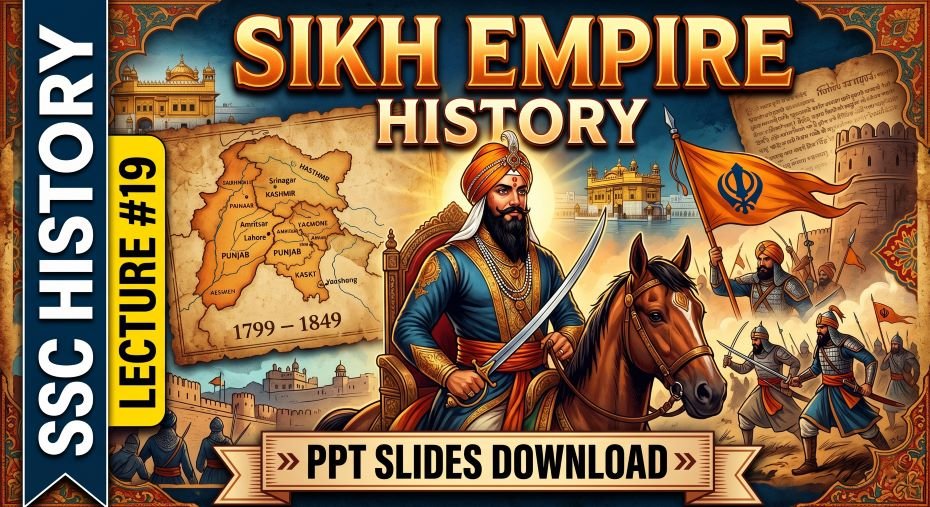
We are going to share SSC History Sikh Empire PPT Slides Download (LEC #19) so, The Sikh Empire (Sikh Raj or Sarkar-e-Khalsa) was the last great indigenous empire in India before the British achieved complete dominance over the subcontinent. Born from the spiritual teachings of Guru Nanak Dev Ji in the early 16th century, evolving through the sacrifices of ten Gurus, and reaching its political zenith under the Lion of the Punjab – Maharaja Ranjit Singh – the Sikh story is one of the most remarkable in Indian history.
This article is built around the SSC History Sikh Empire PPT Slides – Lecture #19 – from the Complete Foundation Batch PPT Series (Serial Number #44) at slideshareppt.net. The PPT contains 153 slides covering the Ten Sikh Gurus, the founding of the Khalsa, the Sikh misls, Maharaja Ranjit Singh’s empire, and the Anglo-Sikh Wars.
For SSC CGL, SSC CHSL, SSC MTS, SSC CPO, Railways NTPC, and UPSC Prelims aspirants, Sikh history delivers 3–5 reliable marks per exam. This guide covers every testable fact.
About: PPT Slides
| Detail | Information |
| Series Name | Complete Foundation Batch for All SSC and Other Exams (PPT Series) |
| Subject | Medieval Indian History – Sikh Empire (सिख साम्राज्य) |
| Lecture Number | Lecture #19 |
| Total PPT Slides | 153 PPT Slides |
| File Size | 40 MB |
| Serial Number | #44 |
| Period Covered | 1469 AD (Guru Nanak’s birth) to 1849 AD (Punjab annexed by British) |
| Best For | SSC CGL, CHSL, MTS, CPO, GD, Railways NTPC, UPSC Prelims, State PSCs |
| Source Website | slideshareppt.net |
SSC History Sikh Empire PPT Slides Download (LEC #19)
Note: If you wish to download the entire SSC series (PPT slides), simply visit this redirect page. –REDIRECT PAGE
Complete Timeline Table: Sikh History – All Key Dates
This master timeline covers the full Sikh story from Guru Nanak to the end of the Sikh Empire. Every date here has generated SSC MCQs.
| Year (AD) | Event | Key Person | Key SSC Fact |
| 1469 | Birth of Guru Nanak Dev Ji at Talwandi (Nankana Sahib, now Pakistan) | Guru Nanak Dev Ji | Founded Sikhism; born 15 April 1469 at Talwandi (Rai Bhoi di Talwandi); his birth anniversary (Gurpurab) is celebrated as Guru Nanak Jayanti |
| 1499 | Guru Nanak receives divine revelation at the Bein River | Guru Nanak Dev Ji | He disappeared into the river and experienced divine vision; emerged saying ‘There is no Hindu, there is no Muslim’ – the founding moment of Sikhism |
| 1539 | Death of Guru Nanak Dev Ji; Guru Angad Dev Ji becomes 2nd Guru | Guru Angad Dev Ji | Guru Nanak died at Kartarpur (Pakistan); Guru Angad Dev standardised the Gurmukhi script |
| 1552 | Guru Amar Das Ji becomes 3rd Guru | Guru Amar Das Ji | Introduced the Langar system (community kitchen); abolished purdah for Sikh women; introduced the Manji system of administration |
| 1574 | Guru Ram Das Ji becomes 4th Guru | Guru Ram Das Ji | Founded the city of Amritsar (originally called Ramdaspur / Chak Ramdas); excavated the sacred pool (Amrit Sarovar) |
| 1577 | Foundation of Amritsar city by Guru Ram Das Ji | Guru Ram Das Ji | Amritsar = ‘Pool of Nectar’; became the holiest city in Sikhism; the Golden Temple was later built here |
| 1581 | Guru Arjan Dev Ji becomes 5th Guru | Guru Arjan Dev Ji | Compiled the first version of the Adi Granth (holy scripture); built the Harmandir Sahib (Golden Temple); first Sikh martyr – executed by Mughal Emperor Jahangir in 1606 |
| 1604 | Compilation of Adi Granth (original Guru Granth Sahib) | Guru Arjan Dev Ji | Compiled the Adi Granth and installed it in the Harmandir Sahib at Amritsar; contains compositions of first 5 Gurus and various saints (Kabir, Farid, Namdev, Ravidas) |
| 1606 | Guru Arjan Dev Ji executed by Jahangir – first Sikh martyr | Jahangir ordered execution; Guru Arjan Dev Ji | Executed by Mughal Emperor Jahangir (reasons: supported Prince Khusrau’s rebellion; growing Sikh influence; included non-Hindu saints in Adi Granth); first Sikh Guru to be martyred |
| 1606 | Guru Hargobind Ji becomes 6th Guru | Guru Hargobind Ji | Introduced the concept of Miri-Piri (two swords: temporal power + spiritual power); built Akal Takht at Amritsar; militarised the Sikh community in response to Arjan Dev’s martyrdom |
| 1644 | Guru Har Rai Ji becomes 7th Guru | Guru Har Rai Ji | Maintained large cavalry force; provided refuge to Prince Dara Shikoh (Shah Jahan’s son) |
| 1661 | Guru Har Krishan Ji becomes 8th Guru | Guru Har Krishan Ji | Became Guru at age 5 – youngest Sikh Guru; died of smallpox at age 7-8 in Delhi after caring for smallpox patients |
| 1665 | Guru Tegh Bahadur Ji becomes 9th Guru | Guru Tegh Bahadur Ji | Called ‘Hind di Chadar’ (Shield of India) for protecting Kashmiri Hindus’ right to practice their faith; executed by Aurangzeb in 1675 |
| 1675 | Guru Tegh Bahadur Ji executed by Aurangzeb – second Sikh martyr | Aurangzeb ordered execution; Guru Tegh Bahadur Ji | Refused to convert to Islam; executed publicly at Chandni Chowk, Delhi; his son Guru Gobind Singh became the 10th Guru |
| 1675 | Guru Gobind Singh Ji becomes 10th (last human) Guru | Guru Gobind Singh Ji | Founded the Khalsa (1699); created the Panj Pyarey and Five Kakars; compiled the final Guru Granth Sahib; declared it the eternal Guru after his death |
| 1699 | Founding of the Khalsa by Guru Gobind Singh Ji on Baisakhi | Guru Gobind Singh Ji – at Anandpur Sahib | 30 March 1699 (Baisakhi); created Panj Pyarey (Five Beloved) from five volunteers; instituted the Amrit Sanchar (baptism) ceremony; gave Sikhs the Five Kakars (K’s) |
| 1704 | Battle of Chamkaur – Guru Gobind Singh’s sons killed | Guru Gobind Singh Ji + two elder sons | Sahibzadas (elder sons) Ajit Singh and Jujhar Singh died fighting at Chamkaur; younger sons Zorawar Singh and Fateh Singh were bricked alive by Nawab of Sirhind |
| 1708 | Death of Guru Gobind Singh Ji at Nanded (Maharashtra) | Guru Gobind Singh Ji | Stabbed by an assassin; died at Nanded (Maharashtra) – where Hazur Sahib Gurudwara now stands; declared Guru Granth Sahib as the eternal (11th) Guru |
| 1708 | Banda Singh Bahadur begins Sikh uprising | Banda Singh Bahadur (Banda Bahadur) | Sent by Guru Gobind Singh to avenge the Sahibzadas’ murder; led Sikh peasant uprising in Punjab; captured Sirhind (1710); defeated the Nawab who killed the Guru’s sons |
| 1710 | Banda Singh Bahadur captures Sirhind | Banda Singh Bahadur | Defeated and killed Wazir Khan (Nawab of Sirhind) who had executed Guru Gobind Singh’s younger sons; avenged the Sahibzadas |
| 1716 | Banda Singh Bahadur captured and executed by Mughals | Farrukh Siyar (Mughal Emperor) ordered execution | Banda Bahadur captured near Gurdaspur; brought to Delhi; refused to convert to Islam; executed along with hundreds of his followers on 9 June 1716 |
| 1716–1799 | Era of the Sikh Misls (12 misls) | Various Sikh misl leaders | 12 independent Sikh military brotherhoods (misls) divided Punjab among themselves; operated under the Dal Khalsa (collective Sikh army); key misls: Sukerchakia (Ranjit Singh’s), Bhangi, Ahluwalia, Ramgarhia, Kanhaiya, Phulkian |
| 1780 | Birth of Ranjit Singh at Gujranwala (Pakistan) | Ranjit Singh | Born 13 November 1780; son of Mahan Singh (chief of Sukerchakia misl); lost sight in one eye due to smallpox in childhood |
| 1799 | Ranjit Singh captures Lahore | Ranjit Singh | At age 19, captured Lahore from the Bhangi misl; made it his capital; began the consolidation of the Sikh Empire |
| 1801 | Ranjit Singh crowned Maharaja of the Punjab | Ranjit Singh | Proclaimed Maharaja (great king) of Punjab on Baisakhi (12 April 1801); formalised the Sikh Empire |
| 1802 | Ranjit Singh captures Amritsar | Ranjit Singh | Took control of the holiest Sikh city from the Bhangi misl |
| 1809 | Treaty of Amritsar between Ranjit Singh and British East India Company | Ranjit Singh + British (Metcalfe) | Ranjit Singh agreed not to expand east of the Sutlej River; British agreed not to interfere in his territories west of Sutlej; defined spheres of influence |
| 1818 | Ranjit Singh captures Multan | Ranjit Singh | Extended Sikh Empire over the entire Punjab region |
| 1819 | Ranjit Singh captures Kashmir | Ranjit Singh | Added Kashmir to the Sikh Empire |
| 1834 | Ranjit Singh captures Peshawar | Ranjit Singh | Extended Sikh Empire to the Afghan border; at its greatest extent |
| 1839 | Death of Maharaja Ranjit Singh | Ranjit Singh | Died 27 June 1839 at Lahore; without a strong successor, the empire rapidly weakened |
| 1845–1846 | First Anglo-Sikh War | British East India Company vs Sikh Empire | Battle of Mudki, Battle of Aliwal, Battle of Sobraon; Treaty of Lahore (1846): Punjab reduced; Koh-i-Noor diamond given to British |
| 1846 | Treaty of Lahore – after First Anglo-Sikh War | British + Sikh Durbar | Sikh Empire reduced; Jammu and Kashmir sold to Gulab Singh for 7.5 million Nanakshahis; British gained territory east of Beas; Koh-i-Noor transferred to British |
| 1848–1849 | Second Anglo-Sikh War | British (Lord Dalhousie) vs Sikh Empire | Battle of Chillianwala, Battle of Gujrat; complete British victory |
| 1849 | Punjab annexed by British; Sikh Empire ends | Lord Dalhousie (Governor-General) | Punjab formally annexed; Duleep Singh (last Sikh ruler, a child) deposed and sent to England; Koh-i-Noor diamond transferred to Queen Victoria |
Part I: The Ten Sikh Gurus – Complete Reference
The Sikh religion was founded and developed by ten human Gurus over a period of approximately 239 years (1469–1708 AD). Each Guru contributed uniquely to the development of Sikhism as a religion and community. Knowledge of the Gurus – particularly their names, key contributions, and associations – is essential for SSC exams.
| Guru | Name | Period | Birthplace | Key Contribution / SSC Fact |
| 1st | Guru Nanak Dev Ji | 1469–1539 | Talwandi (Nankana Sahib, now Pakistan) | Founded Sikhism; taught oneness of God (Ik Onkar), equality of all humans, rejection of caste; composed the Japji Sahib; travelled widely (Udasis) to spread his message; died at Kartarpur |
| 2nd | Guru Angad Dev Ji | 1539–1552 | Ferozepur, Punjab | Standardised and promoted the Gurmukhi script (which became the script for the Punjabi language as used in Gurbani); compiled and organised Guru Nanak’s hymns; popularised Langar |
| 3rd | Guru Amar Das Ji | 1552–1574 | Basarke, Amritsar district | Abolished purdah for Sikh women; made sitting in Langar (pangat) compulsory before meeting the Guru (even Emperor Akbar had to sit in Langar); introduced the Manji system (22 administrative regions for Sikh community); promoted equality among Sikhs |
| 4th | Guru Ram Das Ji | 1574–1581 | Lahore (now Pakistan) | Founded the city of Amritsar (originally Ramdaspur/Chak Ramdas); excavated the sacred tank (Amrit Sarovar – Pool of Nectar); composed the Laavan (wedding hymn used in Sikh wedding ceremony to this day) |
| 5th | Guru Arjan Dev Ji | 1581–1606 | Goindval, Punjab | Compiled the Adi Granth (1604) – the first holy scripture of Sikhism, including compositions of first 5 Gurus and various Hindu and Muslim saints; built the Harmandir Sahib (Golden Temple); became the FIRST SIKH MARTYR – executed by Mughal Emperor Jahangir in 1606 |
| 6th | Guru Hargobind Ji | 1606–1644 | Vadali, Amritsar district | Introduced the concept of Miri-Piri (two swords = temporal/political power + spiritual/religious power); built the Akal Takht (throne of the immortal – the highest seat of temporal Sikh authority) opposite the Harmandir Sahib; first Guru to maintain an army |
| 7th | Guru Har Rai Ji | 1644–1661 | Kiratpur Sahib, Punjab | Maintained a cavalry force of 2,200 soldiers; provided shelter to Dara Shikoh (Mughal prince, Shah Jahan’s son); gentle and compassionate ruler; expanded Sikh medical service |
| 8th | Guru Har Krishan Ji | 1661–1664 | Kiratpur Sahib, Punjab | Became Guru at age 5 – the youngest of all Gurus; died at age 7-8 in Delhi after caring for smallpox patients (showing compassion); called ‘Bala Pritam’ (beloved child); his last words ‘Baba Bakale’ pointed to the next Guru being at Bakala (Punjab) |
| 9th | Guru Tegh Bahadur Ji | 1665–1675 | Amritsar, Punjab | Called ‘Hind di Chadar’ (Shield/Protector of India) for standing up for Kashmiri Hindus’ right to practice Hinduism against Aurangzeb’s forced conversion; the SECOND SIKH MARTYR – executed by Aurangzeb at Chandni Chowk, Delhi on 24 November 1675 |
| 10th | Guru Gobind Singh Ji | 1675–1708 | Patna, Bihar | Founded the Khalsa (1699); created the Panj Pyarey; gave Sikhs the Five Kakars; added his father’s compositions to create the final Guru Granth Sahib; declared Guru Granth Sahib the eternal (living) Guru after him; born at Patna Sahib (Bihar) |
SSC Exam Tip – The Most Tested Gurus: (1) Guru Nanak Dev Ji = founded Sikhism = born Talwandi = Gurmukhi script associated with him (more with Guru Angad). (2) Guru Ram Das Ji = founded Amritsar. (3) Guru Arjan Dev Ji = compiled Adi Granth = built Golden Temple = first Sikh martyr = executed by Jahangir. (4) Guru Tegh Bahadur Ji = ‘Hind di Chadar’ = second martyr = executed by Aurangzeb. (5) Guru Gobind Singh Ji = founded Khalsa 1699 = born Patna Bihar. All five generate multiple SSC questions.
Part II: Guru Nanak Dev Ji – The Founder of Sikhism
| Aspect | Detail |
| Full Name | Guru Nanak Dev Ji |
| Birth | 15 April 1469 at Rai Bhoi di Talwandi (modern Nankana Sahib, Pakistan) |
| Parents | Father: Mehta Kalu (a village official/accountant); Mother: Mata Tripta |
| Wife and Children | Married Mata Sulakhani; two sons: Sri Chand (founder of Udasi sect) and Lakhmi Das |
| Divine Revelation | At approximately age 30, Guru Nanak disappeared into the Bein River at Sultanpur Lodhi for three days; emerged with divine realisation; proclaimed: ‘There is no Hindu, there is no Muslim’ – the founding philosophical statement of Sikhism |
| Core Teachings | Ik Onkar (One God – the fundamental Sikh belief); Naam Japna (meditating on God’s name); Kirat Karna (honest livelihood); Vand Chakna (sharing with others); rejection of caste distinctions; equality of all humans; rejection of idol worship and empty rituals |
| Udasis (Travels) | Made four major journeys (Udasis) covering most of South Asia and also Arabia and parts of Central Asia; spread his teachings widely; visited Mecca (Saudi Arabia), Baghdad (Iraq), Assam, Sri Lanka, and other places |
| Kartarpur | Settled at Kartarpur (now in Pakistan) in his final years; established the first Sikh community (sangat) here; died at Kartarpur in 1539 AD |
| Compositions | Composed many hymns (shabads) that form part of the Guru Granth Sahib; the Japji Sahib (opening composition of the Guru Granth Sahib) is his most celebrated work |
| Contemporary Rulers | Was a contemporary of Mughal Emperor Babur; witnessed and wrote about Babur’s invasion of India (1526); his compositions mention the suffering of ordinary people during Babur’s invasion |
| Successor | Chose Guru Angad Dev Ji as his successor – breaking the tradition by not choosing his own son |
| Death | 22 September 1539 at Kartarpur |
| Legacy | Sikhism – the world’s 5th largest religion with approximately 30 million followers worldwide; the Sikh diaspora is one of the most successful communities in the world |
SSC Exam Tip: Guru Nanak born at Talwandi (Nankana Sahib, Pakistan) = 1469 = Ik Onkar (One God) = Bein River divine revelation = Kartarpur (first Sikh community) = contemporary of Babur. Five testable facts from this table.
Part III: Key Events in Sikh Guru Period
Guru Arjan Dev Ji – First Sikh Martyr
| Aspect | Detail |
| 5th Guru | 1581–1606 AD |
| Greatest Contribution | Compiled the Adi Granth (original Guru Granth Sahib) in 1604 AD – the holy scripture of Sikhism; includes compositions of first 5 Gurus and saints like Kabir, Farid, Namdev, Ravidas – showing Sikhism’s inclusive approach |
| Harmandir Sahib | Built the Harmandir Sahib (Golden Temple) at Amritsar; the foundation stone was laid by Mian Mir (a Muslim Sufi saint) – showing interfaith harmony |
| Mian Mir | A Muslim Sufi saint who laid the foundation stone of the Harmandir Sahib (Golden Temple) – one of the most distinctive facts about the temple’s founding |
| 4 Doors | Designed the Harmandir Sahib with four doors (open on all four sides) – symbolising that it is open to people from all four directions and all four castes |
| Execution | Arrested by Mughal Emperor Jahangir in 1606 on charges of: (1) blessing Prince Khusrau (Jahangir’s rebel son) with a tilak; (2) ‘distorting’ Hindu and Muslim religious texts in the Adi Granth (Jahangir’s accusation); (3) growing Sikh political and religious influence |
| Martyrdom | Tortured and executed at Lahore in May/June 1606; became the first Sikh Guru to be martyred; Sikhs call him Shaheedan de Sartaj (Crown of Martyrs) |
| Significance | His martyrdom transformed the Sikh community; his son Guru Hargobind Ji took up the sword (Miri-Piri) in response; marked the beginning of the Sikh political-military identity |
Guru Hargobind Ji – The Warrior Guru
- Guru Hargobind Ji (6th Guru, 1606–1644) was the first Guru to fundamentally change the nature of Sikh leadership – from purely spiritual to a combination of spiritual and temporal (political-military) power.
- He introduced the concept of Miri-Piri – wearing two swords simultaneously: one representing Miri (temporal/worldly power) and one representing Piri (spiritual power). This concept became fundamental to Sikh theology.
- He built the Akal Takht (Throne of the Immortal) directly opposite the Harmandir Sahib at Amritsar – the highest seat of Sikh temporal authority. It symbolised that Sikhs had both religious and political sovereignty.
- He maintained a standing army and trained Sikhs in military arts – a radical departure from previous Gurus.
- He fought four battles against the Mughal forces of Jahangir and Shah Jahan – winning all four, which greatly enhanced Sikh military prestige.
SSC Exam Tip: Guru Hargobind Ji = 6th Guru = Miri-Piri (two swords = temporal + spiritual) = built Akal Takht at Amritsar = first Guru with army. Miri-Piri is a very frequently tested concept.
Guru Tegh Bahadur Ji – ‘Hind di Chadar’
| Aspect | Detail |
| 9th Guru | 1665–1675 AD |
| Name Meaning | Tegh Bahadur = Brave of the Sword; earned this title for his bravery |
| Title ‘Hind di Chadar’ | Called ‘Hind di Chadar’ (Shield/Protector of India) for standing up for the right of Kashmiri Hindus to practice their own religion |
| Context | Aurangzeb was forcing large-scale conversion to Islam in Kashmir; Kashmiri Pandits (Hindus) came to Guru Tegh Bahadur asking for protection |
| Decision | Guru Tegh Bahadur went to Delhi to protest to Aurangzeb on behalf of the Kashmiri Hindus – offering himself as the ransom: ‘If you can convert me, I promise the Hindus will also convert; if you cannot, you must stop the forced conversions’ |
| Execution | Aurangzeb had him arrested; three of his companions (Bhai Mati Das, Bhai Sati Das, Bhai Dyala) were tortured to death before him to break his resolve; Guru Tegh Bahadur remained steadfast; publicly beheaded at Chandni Chowk, Delhi on 24 November 1675 |
| Gurdwara Sis Ganj Sahib | Built at the site of his execution in Chandni Chowk, Delhi; one of the most important Sikh shrines in Delhi |
| Gurdwara Rakab Ganj Sahib | Built at the site where his body was cremated; also in Delhi |
| Effect | His martyrdom inspired his son Guru Gobind Singh Ji to found the Khalsa and give Sikhs a permanent martial identity |
SSC Exam Tip: Guru Tegh Bahadur Ji = 9th Guru = ‘Hind di Chadar’ = executed by Aurangzeb at Chandni Chowk Delhi 1675 = second Sikh martyr = his son became Guru Gobind Singh Ji. All five elements are testable. The ‘Hind di Chadar’ title is especially distinctive and frequently tested.
Part IV: Guru Gobind Singh Ji – The Tenth and Last Human Guru
| Aspect | Detail |
| Full Name | Guru Gobind Singh Ji (born Gobind Rai) |
| Birth | 22 December 1666 at Patna, Bihar (now Patna Sahib Gurudwara marks this spot) |
| Became Guru | At age 9, after his father Guru Tegh Bahadur Ji was executed by Aurangzeb |
| Key Residence | Anandpur Sahib (Punjab) – the centre of Sikh community and military training during his long Guruship |
| Founding of Khalsa (1699) | On Baisakhi (30 March 1699) at Anandpur Sahib, Guru Gobind Singh Ji created the Khalsa Panth (Community of the Pure); asked for five volunteers willing to give their lives – one by one they entered a tent with the Guru; people feared they were being killed; the five who volunteered are called Panj Pyarey (Five Beloved Ones) |
| Panj Pyarey (Five Beloved Ones) | The five men who volunteered at Baisakhi 1699: Daya Ram (Bhai Daya Singh) – Lahore; Dharam Das (Bhai Dharam Singh) – Delhi; Himmat Rai (Bhai Himmat Singh) – Jagannath Puri; Mohkam Chand (Bhai Mohkam Singh) – Dwarka; Sahib Chand (Bhai Sahib Singh) – Bidar. They came from different castes and regions – symbolising Khalsa’s unity across caste and region |
| Amrit Sanchar | The initiation ceremony for joining the Khalsa; involves drinking Amrit (holy water stirred with a khanda/double-edged sword) while reciting prayers; makes a Sikh a ‘Khalsa’ (pure one) |
| Five Kakars (5 Ks) | Mandatory symbols for Khalsa Sikhs: Kesh (uncut hair), Kangha (wooden comb), Kara (steel bracelet), Kachera (undergarment/shorts), Kirpan (steel sword). Together called Panj Kakar or Panj K |
| New Names | Guru gave all Khalsa men the surname ‘Singh’ (lion) and all Khalsa women the surname ‘Kaur’ (princess/lioness) |
| Four Sahibzadas (Sons) | His four sons all died in the conflicts with the Mughals: Ajit Singh (eldest) and Jujhar Singh died fighting at Battle of Chamkaur (1704); Zorawar Singh and Fateh Singh (younger, aged 7 and 9) were captured and bricked alive on orders of Wazir Khan (Nawab of Sirhind) |
| Zafarnama | A letter written in Persian by Guru Gobind Singh Ji to Aurangzeb – a masterpiece of confident, dignified prose; challenged Aurangzeb’s moral authority despite Aurangzeb’s greater military power |
| Composition | Wrote the Dasam Granth (Second Scripture); also added his father Guru Tegh Bahadur Ji’s compositions to the Adi Granth |
| Eternal Guru | Before his death, declared the Guru Granth Sahib as the eternal living Guru of the Sikhs – no more human Gurus after him; ‘Waheguru Ji ka Khalsa, Waheguru Ji ki Fateh’ |
| Death | 7 October 1708 at Nanded, Maharashtra; stabbed by a Pathan assassin; died shortly after; Hazur Sahib Gurudwara marks this site in Nanded |
SSC Exam Tip – Six Must-Know Guru Gobind Singh Facts: (1) Born at Patna, Bihar. (2) Founded Khalsa on Baisakhi 1699 at Anandpur Sahib. (3) Panj Pyarey = Five Beloved Ones who volunteered. (4) Five Kakars: Kesh, Kangha, Kara, Kachera, Kirpan. (5) All four sons (Sahibzadas) died. (6) Declared Guru Granth Sahib as eternal Guru. All six generate separate SSC questions.
The Five Kakars (Five K’s) – Essential Knowledge
| Kakar (K) | Punjabi Name | Meaning / Significance |
| 1. Kesh | Kesh (ਕੇਸ਼) | Uncut hair – symbolises acceptance of God’s will; natural form; turban covers and protects the Kesh |
| 2. Kangha | Kangha (ਕੰਘਾ) | Wooden comb – symbolises cleanliness and order; worn in the hair |
| 3. Kara | Kara (ਕੜਾ) | Steel/iron bracelet worn on the wrist – symbolises restraint, God’s infinity (no beginning or end), unity with God and the Guru |
| 4. Kachera | Kachera (ਕਛਹਿਰਾ) | Cotton undergarment/shorts – symbolises sexual continence and readiness for action |
| 5. Kirpan | Kirpan (ਕਿਰਪਾਨ) | Steel sword – symbolises defence of righteousness, protection of the weak; every Khalsa Sikh carries a kirpan |
SSC Exam Tip: The Five Kakars (Five K’s) = Kesh + Kangha + Kara + Kachera + Kirpan = Panj Kakar = given by Guru Gobind Singh at Baisakhi 1699. Questions often ask: ‘Which of the following is NOT one of the Five K’s?’ or ‘How many Kakars are there?’ = 5. Know all five names.
Part V: Banda Singh Bahadur – The First Sikh Political Leader
| Aspect | Detail |
| Original Name | Lachman Das; later Madho Das Bairagi (a Hindu ascetic); renamed Banda Singh Bahadur by Guru Gobind Singh Ji |
| Meeting with Guru Gobind Singh | Met Guru Gobind Singh at Nanded (Maharashtra) ~1708, shortly before the Guru’s death; the Guru sent him to Punjab to avenge the murders of his Sahibzadas (sons) and lead the Sikh community |
| Punjab Campaign | Arrived in Punjab ~1708 and immediately began organising the Sikh peasantry for rebellion against Mughal rule |
| Capture of Sirhind (1710) | His greatest military achievement: defeated and killed Wazir Khan (Nawab of Sirhind) – the man responsible for executing the two younger Sahibzadas; captured and destroyed Sirhind |
| Social Revolutionary Measures | Abolished the zamindari system in areas he controlled; redistributed land to the peasants (tillers); issued coins and seals in the name of Guru Nanak and Guru Gobind Singh – the first attempt at an independent Sikh state |
| Defeat and Capture | Mughal Emperor Farrukh Siyar launched a massive campaign against him; Banda and his followers were besieged at Gurdas Nangal (1715); starved out after months of siege; captured |
| Execution | Brought to Delhi; offered life if he converted to Islam; refused; executed on 9 June 1716 along with hundreds of his followers; his young son was killed before his eyes to break him, but he remained steadfast |
| Legacy | First attempt to establish a Sikh political state; his social reforms (redistribution of land) made him a hero among Punjabi peasants; paved the way for the Sikh misls |
SSC Exam Tip: Banda Singh Bahadur = sent by Guru Gobind Singh = captured Sirhind 1710 (killed Wazir Khan) = avenged the Sahibzadas = executed by Mughals 1716 = refused to convert to Islam. All five facts are testable.
Part VI: The Sikh Misls (~1716–1799 AD)
After Banda Singh Bahadur’s execution in 1716, the Sikh community reorganised under the concept of misls – independent military confederacies. The word ‘misl’ means ‘equal’ or ‘similar’ in Arabic – reflecting the equality of all members. There were 12 Sikh misls that collectively controlled Punjab under the umbrella of the Dal Khalsa (collective Sikh army).
| Misl Name | Region / Territory | Notable Leader | Key SSC Fact |
| Sukerchakia | Central Punjab (Gujranwala area) | Mahan Singh; Ranjit Singh | The misl that Maharaja Ranjit Singh led to unify all other misls and create the Sikh Empire |
| Bhangi | Western Punjab (Lahore area) | Hari Singh Bhangi | Controlled Lahore before Ranjit Singh captured it in 1799; known for having the Zam Zama cannon (famous gun in Kipling’s Kim) |
| Ahluwalia | Kapurthala area | Jassa Singh Ahluwalia | One of the most respected misl leaders; played a key role in the defeat of Ahmad Shah Abdali’s invasions |
| Ramgarhia | North-central Punjab (Batala-Gurdaspur area) | Jassa Singh Ramgarhia | Famous for their building skills; many Sikh forts and buildings built by Ramgarhia artisans |
| Kanhaiya | Gurdaspur-Batala area | Jai Singh Kanhaiya | Important misl; Sada Kaur (Jai Singh’s daughter-in-law) supported Ranjit Singh and gave him her misl’s support |
| Phulkian | Patiala, Nabha, Jind area | Ala Singh (Patiala) | Their descendants still rule Patiala; the Phulkian misl sided with the British against Ranjit Singh |
| Nishanwalia | Ambala area | – | Small but important misl |
| Dallewalia | Firozpur area | – | – |
| Shaheedan | – | – | ‘Martyrs’ misl; dedicated to protecting the holy shrines |
| Karorasinghia | – | – | – |
| Nakkai | Kasur area | – | – |
| Faizullapuria | Faizullapur area | – | – |
SSC Exam Tip: The Sikh Misls = 12 military brotherhoods = controlled Punjab 1716–1799. The most important misl for SSC is the Sukerchakia misl – because Maharaja Ranjit Singh belonged to it and used it to unify Punjab. Also know: Bhangi misl had Lahore before Ranjit Singh. Jassa Singh Ahluwalia = important leader.
Part VII: Maharaja Ranjit Singh (1780–1839 AD) – The Lion of Punjab
Maharaja Ranjit Singh is the greatest political and military figure in Sikh history and one of the most remarkable rulers of 19th century India. In 40 years, he transformed a loose collection of competing misls into a powerful, centralised, modern empire that was the last independent kingdom in India before the British achieved complete dominance.
Maharaja Ranjit Singh – Complete Profile
| Aspect | Detail |
| Full Name | Ranjit Singh Sukerchakia; took title Maharaja (Great King) |
| Birth | 13 November 1780 at Gujranwala (now Pakistan) |
| Childhood Handicap | Lost sight in his left eye due to smallpox at age 6; this and the pockmarks from smallpox gave him a distinctive appearance |
| Title | Sher-e-Punjab (Lion of Punjab) – his most famous title |
| Misl | Was chief of the Sukerchakia misl – one of the twelve Sikh misls |
| Capture of Lahore (1799) | At age 19 (1799), captured Lahore from the Bhangi misl; made it his capital; remarkable achievement for such a young ruler |
| Proclamation as Maharaja | Proclaimed Maharaja on Baisakhi (12 April 1801); Sahib Singh Bedi (a descendant of Guru Nanak) performed the ceremony |
| Capture of Amritsar (1802) | Took control of the holiest Sikh city; completed control of eastern Punjab |
| Treaty of Amritsar (1809) | Signed with the British East India Company (negotiated by Charles Metcalfe); Ranjit Singh agreed not to expand east of the Sutlej River; British guaranteed his territories west of the Sutlej; defined mutual spheres of influence for 40 years |
| Military Modernisation | Hired European officers to train his army: Jean-Baptiste Ventura and Jean-François Allard (French), Paolo Avitabile (Italian), John Holmes, Claude August Court; created the Fauj-i-Ain (regular disciplined infantry) modelled on European lines |
| Kohinoor Diamond | Acquired the Kohinoor diamond from Shah Shuja (Afghan ruler) in 1813 in exchange for Sikh military support; the Kohinoor had been taken from the Mughals by Nadir Shah (1739) |
| Territorial Expansion | Captured: Lahore (1799), Amritsar (1802), Ludhiana area (1806), Multan (1818), Kashmir (1819), Attock (1813), Peshawar (1834) – creating the largest Sikh state in history |
| Religious Policy | Was personally devout Sikh but completely secular in governance; had Hindu, Muslim, Sikh, and European officers at all levels; did not discriminate based on religion |
| Fakir Azizuddin | His famous Foreign Minister – a Muslim physician who served him loyally; shows Ranjit Singh’s secular approach |
| Architecture | Renovated the Golden Temple (Harmandir Sahib) and gave it its distinctive golden covering (gilded copper plates) – hence the name ‘Golden Temple’ |
| Court | His court was famous for its magnificence; described by European visitors as one of the most brilliant courts in Asia |
| Death | 27 June 1839 at Lahore; died of illness; aged 58; after his death, the empire rapidly disintegrated due to succession disputes and court intrigues |
SSC Exam Tip – Seven Must-Know Ranjit Singh Facts: (1) Title = Sher-e-Punjab (Lion of Punjab). (2) Captured Lahore 1799 at age 19. (3) Treaty of Amritsar 1809 with British = Sutlej boundary. (4) Kohinoor diamond acquired from Shah Shuja 1813. (5) Hired French and Italian military officers. (6) Gave Golden Temple its golden covering. (7) Captured Kashmir (1819) and Peshawar (1834). All seven generate separate SSC questions.
Ranjit Singh’s Military and Administrative System
| Feature | Detail |
| Army Name | Khalsa Sikh Army; regular army called Fauj-i-Ain (disciplined army) |
| European Officers | Jean-Baptiste Ventura (French), Jean-François Allard (French), Paolo Avitabile (Italian), Claude August Court (French), John Holmes (British) – all trained his infantry and artillery |
| Cavalry | The famous Sikh cavalry; included Akalis (a fierce group of warrior-Sikhs) and regular cavalry |
| Artillery | Zamzama (or Zam Zama) – a famous bronze cannon captured from the Bhangi misl; later became famous through Kipling’s Kim (‘Kim’s Gun’) |
| Revenue System | Maintained much of the previous Mughal revenue system; also used Jagir assignments to pay military officers |
| Administrative Divisions | Divided empire into 4 provinces: Lahore, Multan, Kashmir, Peshawar; each governed by a governor (nazim) |
| Capital | Lahore (present-day Pakistan) |
| Religion in Governance | Completely secular; no discrimination; Hindu, Muslim, Sikh officers at all levels |
Part VIII: The Golden Temple (Harmandir Sahib) – Complete Reference
| Aspect | Detail |
| Official Name | Harmandir Sahib (House of God) or Darbar Sahib (Court of the Lord) |
| Common Name | Golden Temple |
| Location | Amritsar, Punjab, India |
| Who Initiated | Guru Ram Das Ji (4th Guru) excavated the sacred tank (Amrit Sarovar) |
| Who Built the Temple | Guru Arjan Dev Ji (5th Guru) – the original temple was built by him ~1588–1604 AD |
| Foundation Stone | Laid by Mian Mir – a Muslim Sufi saint from Lahore; shows the interfaith spirit of Sikhism |
| Four Doors | The Harmandir Sahib has four doors, open on all sides – symbolising it is open to all people from all castes and directions |
| The Tank | The temple sits in the centre of the Amrit Sarovar (Pool of Nectar) – a man-made tank; devotees bathe here |
| Golden Covering | The golden covering (gilded copper plates) was donated by Maharaja Ranjit Singh (~1830 AD) – which is why the temple is popularly called the ‘Golden Temple’ |
| Guru Granth Sahib | The Guru Granth Sahib is continuously read (Akhand Path) inside the Harmandir Sahib, 24 hours a day |
| Akal Takht | Opposite the Harmandir Sahib across the sacred tank stands the Akal Takht (Throne of the Timeless) – built by Guru Hargobind Ji; the highest seat of temporal Sikh authority |
| UNESCO Status | Not a UNESCO World Heritage Site (as of 2025); frequently confused with UNESCO sites in questions |
| 1984 Operation | Operation Blue Star (June 1984) – Indian Army stormed the Golden Temple complex to remove militants who had fortified it; a major political and religious controversy |
| SSC Relevance | Who built the Golden Temple? = Guru Arjan Dev Ji (original structure). Who gave it the golden covering? = Maharaja Ranjit Singh. Who laid the foundation stone? = Mian Mir (Muslim Sufi saint). The Mian Mir connection is a very distinctive and frequently tested SSC fact |
Part IX: Guru Granth Sahib – The Living Guru
| Aspect | Detail |
| Original Name | Adi Granth (Original Scripture) |
| Modern Name | Guru Granth Sahib (when it became the eternal Guru) |
| Who Compiled | Guru Arjan Dev Ji (5th Guru) compiled the original Adi Granth in 1604 AD |
| Installation | Installed in the Harmandir Sahib at Amritsar in 1604 AD; Baba Buddha Ji was appointed the first Granthi (reader/caretaker) |
| Content | Contains: hymns (Gurbani) composed by the first 5 Gurus; also includes compositions of Bhakti saints: Kabir, Ramananda, Ravidas (Raidas), Sheikh Farid, Namdev, Trilochan, Sain, Pipa, Sadhna, Dhanna – Hindus and Muslims both included |
| Final Form | Guru Gobind Singh Ji added the hymns of his father Guru Tegh Bahadur Ji (9th Guru) to create the final form of Guru Granth Sahib; Guru Gobind Singh himself chose not to add his own compositions |
| Language | Written in Gurmukhi script; the compositions are in various languages: Punjabi, Hindi, Sanskrit, Braj, Persian, and local dialects |
| Eternal Guru | At the time of his death (1708), Guru Gobind Singh Ji declared the Guru Granth Sahib to be the living, eternal Guru for all Sikhs – ending the line of human Gurus |
| Number of Pages | The standard printed version has 1,430 pages (Angs) |
| Significance | The only living Guru of the Sikhs; treated with the same reverence as a living person – placed on a throne (takht), carried in procession with a flywhisk (chaur), and read continuously 24/7 in the Golden Temple |
| SSC Relevance | Who compiled the Adi Granth? = Guru Arjan Dev Ji (1604 AD). Who declared it the eternal Guru? = Guru Gobind Singh Ji (1708). What is the Guru Granth Sahib? = the eternal living scripture/Guru of Sikhism. Three different SSC questions from this one text |
Part X: Anglo-Sikh Wars – End of the Sikh Empire
Background to the Anglo-Sikh Wars
- After Maharaja Ranjit Singh’s death in 1839, the Sikh Empire was torn by succession disputes – five Maharajas in six years (1839–1845), many killed in court intrigues.
- The Sikh army (Khalsa), unpaid and unsatisfied, became the real power in Punjab – they demanded their generals lead them to war against the British.
- The British, under Governor-General Hardinge (First Anglo-Sikh War) and Lord Dalhousie (Second Anglo-Sikh War), were waiting for an opportunity to annex Punjab.
- Punjab was the last unconquered territory in India – the British were determined to complete their control of the subcontinent.
Anglo-Sikh Wars – Comparative Table
| Feature | First Anglo-Sikh War (1845–1846) | Second Anglo-Sikh War (1848–1849) |
| Period | 1845–1846 AD | 1848–1849 AD |
| Governor-General | Lord Hardinge | Lord Dalhousie |
| Sikh Ruler | Maharaja Duleep Singh (child, under regency) | Maharaja Duleep Singh (still a child) |
| Key Battles | Battle of Mudki, Battle of Ferozeshah, Battle of Aliwal, Battle of Sobraon | Battle of Ramnagar, Battle of Chillianwala, Battle of Gujrat |
| Outcome | British won; Sikh Empire survived but severely weakened | Complete British victory; Sikh Empire dissolved |
| Treaty | Treaty of Lahore (1846) – Sikh army reduced; territory ceded; British Resident at Lahore; Kashmir sold to Gulab Singh | No separate treaty – Punjab directly annexed |
| Kashmir Fate | Sold to Gulab Singh (Dogra chief of Jammu) for 75 lakh rupees (7.5 million nanakshahis) by the Treaty of Amritsar (1846) | – |
| Kohinoor | Kohinoor diamond transferred from Sikh treasury to British Crown (Lord Dalhousie took it as personal acquisition by the Governor-General) | – |
| Duleep Singh | Child Maharaja kept under British protection | Deposed; sent to England; became a ward of the British Crown; became Christian; later reconverted to Sikhism; Queen Victoria’s ‘favourite son’ |
| End Result | Sikh Empire still nominally existed | Punjab formally annexed to British India on 29 March 1849 |
SSC Exam Tip: First Anglo-Sikh War (1845–1846) = Treaty of Lahore = Kashmir sold to Gulab Singh = Kohinoor transferred. Second Anglo-Sikh War (1848–1849) = Lord Dalhousie = Punjab annexed = Duleep Singh deposed. These specific facts are regularly tested in SSC papers.
Lord Dalhousie and the Annexation of Punjab
- Lord Dalhousie (Governor-General of India 1848–1856) was the British official who formally annexed Punjab in 1849 after the Second Anglo-Sikh War.
- He famously took personal possession of the Kohinoor diamond as a ‘spoil of war’ – arranging for it to be transferred to Queen Victoria, who had it set in a brooch.
- The annexation of Punjab under Dalhousie was part of his aggressive policy of territorial expansion, also called the Doctrine of Lapse – although Punjab was annexed by conquest, not lapse.
- After annexation, Punjab was administered as a directly ruled British territory; the Lawrence Brothers (John and Henry Lawrence) were the first administrators.
SSC Exam Tip: Lord Dalhousie = annexed Punjab 1849 = Second Anglo-Sikh War = Kohinoor taken to Queen Victoria. ‘Who annexed Punjab?’ = Lord Dalhousie. This is one of the most commonly tested facts about the end of the Sikh Empire.
Part XI: Important Sikh Religious Concepts
| Concept | Explanation | SSC Relevance |
| Ik Onkar | ‘One God’ – the fundamental Sikh belief; the opening symbol of the Guru Granth Sahib; declares that there is only one God and He is truth | Ik Onkar = One God = Guru Nanak’s core teaching = symbol in Guru Granth Sahib |
| Waheguru | ‘Wonderful Lord’ – the Sikh name for God; the central devotional term | Waheguru = Sikh name for God |
| Langar | Community kitchen where all people (regardless of caste, religion, gender, or wealth) sit together and eat the same free food; introduced by Guru Amar Das Ji (3rd Guru); an institution challenging the caste system | Langar = community kitchen = Guru Amar Das Ji introduced it; Emperor Akbar had to sit in Langar before meeting Guru Amar Das Ji – famous anecdote |
| Sangat | The holy congregation; Sikh community gathered for prayer and worship | Sangat = Sikh congregation |
| Pangat | Sitting in a row for Langar – literally ‘row/line’; symbolises equality – no one is above anyone else during the meal | Pangat = sitting in row for Langar = equality symbol |
| Simran | Meditation on God’s name; one of the three pillars of Sikhism (along with Kirat Karna and Vand Chakna) | Three pillars of Sikhism: Naam Japna (Simran), Kirat Karna (honest work), Vand Chakna (sharing) |
| Miri-Piri | Temporal power + Spiritual power; introduced by Guru Hargobind Ji; symbolised by two swords | Miri-Piri = 6th Guru Hargobind Ji = temporal + spiritual |
| Akal Takht | Throne of the Timeless; built by Guru Hargobind Ji at Amritsar; highest seat of Sikh temporal authority; issues hukamnamas (edicts) to the entire Sikh community | Akal Takht = Guru Hargobind Ji = opposite the Golden Temple = highest temporal authority |
| Khalsa | ‘Pure Ones’; founded by Guru Gobind Singh Ji on Baisakhi 1699; all initiated Khalsa wear the Five Kakars; are warrior-saints dedicated to righteousness | Khalsa = Guru Gobind Singh = 1699 Baisakhi = Five Kakars |
| Gurdwara | ‘Guru’s Door/House’; a Sikh place of worship; any place where the Guru Granth Sahib is kept with reverence and Gurbani (sacred music/reading) is performed | Gurdwara = Sikh temple/place of worship |
| Hukamnama | An edict or order issued from the Akal Takht to the entire Sikh community | Hukamnama = Sikh edict from Akal Takht |
| Gurmukhi Script | The script used to write the Punjabi language as used in Gurbani; standardised by Guru Angad Dev Ji (2nd Guru) | Gurmukhi = Guru Angad Dev Ji = script of Punjabi sacred texts |
High-Frequency SSC MCQs: Sikh Empire Chapter
These 35 questions represent the most consistently repeated MCQs from this chapter across SSC CGL, CHSL, MTS, CPO, GD, and Railways NTPC previous year papers.
| Question | Correct Answer | SSC Exam Reference |
| Where was Guru Nanak Dev Ji born? | Talwandi (Nankana Sahib, now Pakistan) – 15 April 1469 | SSC CGL 2016, 2019, 2022 |
| Who founded Sikhism? | Guru Nanak Dev Ji (1st Sikh Guru) | SSC CGL 2015–2022 (repeated) |
| What is Ik Onkar? | ‘One God’ – the fundamental Sikh belief; opening symbol of the Guru Granth Sahib | SSC CHSL 2019, SSC MTS 2021 |
| Who standardised the Gurmukhi script? | Guru Angad Dev Ji (2nd Sikh Guru) | SSC CGL 2017, SSC CHSL 2020 |
| Who founded the city of Amritsar? | Guru Ram Das Ji (4th Sikh Guru); originally called Ramdaspur/Chak Ramdas | SSC CGL 2016, 2019, 2022 |
| Who compiled the Adi Granth (original Guru Granth Sahib)? | Guru Arjan Dev Ji (5th Sikh Guru) – in 1604 AD | SSC CGL 2015–2022 (repeated every exam) |
| Who built the Harmandir Sahib (Golden Temple)? | Guru Arjan Dev Ji (5th Sikh Guru) – original structure ~1588–1604 AD | SSC CGL 2016, 2019, SSC CHSL 2021 |
| Who laid the foundation stone of the Golden Temple? | Mian Mir – a Muslim Sufi saint from Lahore | SSC CGL 2018, SSC CHSL 2021 |
| Who gave the Golden Temple its golden covering? | Maharaja Ranjit Singh (~1830 AD) | SSC CGL 2017, 2020, SSC CHSL 2021 |
| Who was the first Sikh martyr and who executed him? | Guru Arjan Dev Ji (5th Guru); executed by Mughal Emperor Jahangir in 1606 | SSC CGL 2016, 2019, 2022 |
| What was the concept of Miri-Piri? | Two swords representing temporal power (Miri) and spiritual power (Piri); introduced by Guru Hargobind Ji (6th Guru) | SSC CGL 2017, SSC CHSL 2020 |
| Who built the Akal Takht at Amritsar? | Guru Hargobind Ji (6th Sikh Guru) | SSC CHSL 2019, SSC MTS 2021 |
| Who was the second Sikh martyr? | Guru Tegh Bahadur Ji (9th Guru); executed by Aurangzeb at Chandni Chowk, Delhi in 1675 | SSC CGL 2015–2022 (repeated) |
| What is the title ‘Hind di Chadar’ associated with? | Guru Tegh Bahadur Ji (9th Guru) – ‘Shield/Protector of India’ for defending Kashmiri Hindus’ right to their faith | SSC CGL 2017, 2020, SSC CHSL 2021 |
| Where was Guru Gobind Singh Ji born? | Patna, Bihar (Patna Sahib Gurudwara marks this site) | SSC CGL 2018, SSC CHSL 2020 |
| When and where was the Khalsa founded? | Baisakhi 1699 (30 March 1699) at Anandpur Sahib, Punjab; by Guru Gobind Singh Ji | SSC CGL 2015–2022 (repeated every exam) |
| Who were the Panj Pyarey? | The Five Beloved Ones who volunteered at Baisakhi 1699 to join the Khalsa | SSC CGL 2018, SSC CHSL 2021 |
| What are the Five Kakars (Five K’s)? | Kesh (uncut hair), Kangha (comb), Kara (bracelet), Kachera (shorts), Kirpan (sword) | SSC CGL 2016, 2019, 2022 |
| Guru Gobind Singh Ji declared which as the eternal Guru? | Guru Granth Sahib (the holy scripture) – declared eternal Guru in 1708 AD | SSC CGL 2017, SSC CHSL 2020 |
| Where did Guru Gobind Singh Ji die? | Nanded, Maharashtra (Hazur Sahib Gurudwara marks this site) – 1708 AD | SSC CHSL 2019, SSC MTS 2021 |
| Who was Banda Singh Bahadur? | Disciple sent by Guru Gobind Singh to Punjab; captured Sirhind (1710); killed Wazir Khan; executed by Mughals 1716 | SSC CGL 2018, SSC CHSL 2021 |
| What is the title of Maharaja Ranjit Singh? | Sher-e-Punjab (Lion of Punjab) | SSC CGL 2015–2022 (repeated) |
| Maharaja Ranjit Singh captured Lahore in which year? | 1799 AD (at age 19) | SSC CGL 2017, SSC CHSL 2020 |
| Treaty of Amritsar (1809) was signed between whom? | Maharaja Ranjit Singh and the British East India Company (Metcalfe); agreed to Sutlej River as boundary | SSC CGL 2018, SSC CHSL 2021 |
| When did Ranjit Singh capture Kashmir? | 1819 AD | SSC CGL 2019, SSC MTS 2021 |
| When did Ranjit Singh capture Peshawar? | 1834 AD | SSC CHSL 2020, SSC GD 2022 |
| The Kohinoor diamond was acquired by Ranjit Singh from whom? | Shah Shuja (Afghan ruler) in 1813 AD | SSC CGL 2018, SSC CHSL 2021 |
| Which Guru introduced the Langar system? | Guru Amar Das Ji (3rd Guru) institutionalised the Langar system | SSC CHSL 2019, SSC MTS 2021 |
| Emperor Akbar had to sit in the Langar before meeting which Sikh Guru? | Guru Amar Das Ji (3rd Guru) – who insisted everyone sit in Pangat (rows) before meeting him | SSC CGL 2018, SSC CHSL 2020 |
| First Anglo-Sikh War ended with which treaty? | Treaty of Lahore (1846); also Treaty of Amritsar (1846) – Kashmir sold to Gulab Singh | SSC CGL 2017, 2020, SSC CHSL 2021 |
| Kashmir was sold to whom after the First Anglo-Sikh War? | Gulab Singh (Dogra chief/Maharaja of Jammu) for 75 lakh rupees (Treaty of Amritsar 1846) | SSC CGL 2018, SSC CHSL 2021 |
| Who annexed Punjab after the Second Anglo-Sikh War? | Lord Dalhousie (Governor-General of India) in 1849 AD | SSC CGL 2016, 2019, 2022 |
| Who was the last Sikh Maharaja? | Duleep Singh (Maharaja Duleep Singh) – deposed 1849; sent to England | SSC CHSL 2020, SSC GD 2022 |
| What is the Guru Granth Sahib? | The eternal living scripture and Guru of Sikhism; compiled by Guru Arjan Dev Ji (1604); final form by Guru Gobind Singh Ji (1708); declared eternal Guru | SSC CGL 2016–2022 (repeated) |
| How many Sikh Misls were there? | 12 Sikh misls that controlled Punjab after Banda Singh Bahadur and before Ranjit Singh | SSC CHSL 2019, SSC MTS 2021 |
Podcast Interview: Expert Q&A – Sikh Empire Deep Dive
A 9-round expert dialogue covering Sikh history from multiple perspectives.
| Speaker | Question / Statement | Answer / Explanation |
| Aspirant | Which Sikh Gurus are most important for SSC exams? | Educator: Five stand out for the most SSC questions. First: Guru Nanak Dev Ji – founder of Sikhism, born at Talwandi, Ik Onkar, Kartarpur. Second: Guru Ram Das Ji – founded Amritsar (4th Guru). Third: Guru Arjan Dev Ji – compiled Adi Granth 1604, built Golden Temple (Harmandir Sahib), foundation stone by Mian Mir (Muslim saint), first Sikh martyr executed by Jahangir. Fourth: Guru Tegh Bahadur Ji – ‘Hind di Chadar’, executed by Aurangzeb 1675. Fifth: Guru Gobind Singh Ji – founded Khalsa on Baisakhi 1699, Five Kakars, Panj Pyarey, born at Patna Bihar, died at Nanded Maharashtra. If you master these five Gurus with all their associated facts, you can answer at least 4 SSC questions from the Guru section alone. |
| Aspirant | What exactly is the Khalsa and why was it created? | Educator: The Khalsa (‘Pure Ones’) is the Sikh community of the baptised, initiated by Guru Gobind Singh Ji on Baisakhi (30 March 1699) at Anandpur Sahib. The immediate reason for creating the Khalsa was the severe persecution of Sikhs by the Mughal Empire under Aurangzeb – his father Guru Tegh Bahadur had been executed; the Sahibzadas (his sons) would soon die. Guru Gobind Singh needed to give the Sikh community a permanent warrior identity that could stand up against overwhelming odds. He created a community of ‘Soldier-Saints’ bound by shared symbols (the Five Kakars), shared surname (Singh for men, Kaur for women), and a shared commitment to righteousness and courage. The Khalsa was also a radical social statement – the Five Beloved Ones came from different castes; in the Khalsa, caste was irrelevant. |
| Aspirant | The foundation stone of the Golden Temple was laid by a Muslim saint. Is that really true? | Educator: Yes, it is historically documented. Mian Mir was a revered Sufi saint from Lahore – a deeply devout Muslim mystic. Guru Arjan Dev Ji and Mian Mir were close friends and had tremendous mutual respect. Guru Arjan Dev Ji invited Mian Mir to lay the foundation stone of the Harmandir Sahib (~1588 AD) as a statement of interfaith harmony – that God’s house is open to all. This fact is one of the most distinctive and frequently tested in SSC History papers because it’s so unexpected and memorable. It also illustrates how Guru Arjan Dev Ji included compositions of Hindu and Muslim saints in the Adi Granth – the Sikh holy scripture contains hymns by Kabir, Sheikh Farid, Namdev, Ravidas and others, not just Sikhs. |
| Aspirant | What is the difference between the Adi Granth and the Guru Granth Sahib? | Educator: Technically, the Adi Granth is the original scripture compiled by Guru Arjan Dev Ji in 1604 AD at Amritsar. It contained the hymns of the first five Gurus and various Bhakti and Sufi saints. The Guru Granth Sahib is the final, complete version – compiled by Guru Gobind Singh Ji who added the hymns of Guru Tegh Bahadur Ji (9th Guru); and then, at his death in 1708, declared this complete version to be the eternal living Guru of the Sikhs. So: Adi Granth (1604) + Guru Tegh Bahadur’s hymns = Guru Granth Sahib (1708) + declaration as eternal Guru = Guru Granth Sahib. For SSC: both names are used; ‘who compiled’ the Adi Granth = Guru Arjan Dev Ji; ‘who declared it the eternal Guru’ = Guru Gobind Singh Ji. |
| Aspirant | Why is Maharaja Ranjit Singh called the ‘Lion of Punjab’? | Educator: Because he embodied everything that the word ‘lion’ connotes in South Asian martial tradition: courage, strength, ferocity in battle, nobility, and dominance over his domain. At age 19 he captured Lahore – the greatest city in Punjab. By age 40 he had unified all of Punjab’s warring misls into a single empire. He fought and won against Afghans, Pashtuns, and Nepalese Gurkhas. He reorganised his army using European military science while maintaining Sikh warrior traditions. He held the British at bay through the Treaty of Amritsar (1809) – the only Indian ruler in this period who successfully negotiated with the British from a position of strength. In 40 years of rule, he never lost a battle. He also had the Golden Temple covered in gold – an act of supreme royal devotion. The Lion title was earned. |
| Aspirant | What happened to the Kohinoor diamond and where is it now? | Educator: The Kohinoor has had an extraordinary journey. It was originally a famous diamond from the Golconda mines of Andhra Pradesh. It passed through the Kakatiya, Vijayanagara, and Mughal emperors (Babur mentioned it). Nadir Shah took it from the Mughals in 1739 along with the Peacock Throne. It passed to Ahmad Shah Abdali (Afghanistan), then back to various Afghan princes. Maharaja Ranjit Singh acquired it from Shah Shuja (Afghan ruler) in 1813 in exchange for Sikh military support. After the First Anglo-Sikh War (1846), Lord Dalhousie arranged for it to be transferred to Queen Victoria. It was cut and placed in the British Crown Jewels – now part of Queen Mother’s Crown in the Tower of London. India, Pakistan, and Afghanistan have all at various times claimed its return. As of 2025, it remains in the UK. |
| Aspirant | What was the Treaty of Amritsar (1809) between Ranjit Singh and the British? | Educator: The Treaty of Amritsar (25 April 1809) was negotiated by Charles Metcalfe (British representative) and Maharaja Ranjit Singh. Its key terms: Ranjit Singh agreed not to expand east of the Sutlej River – the Sikh chiefs in the Cis-Sutlej area (east of Sutlej) came under British protection. The British agreed not to interfere in Ranjit Singh’s territories west of the Sutlej. This defined two spheres of influence. For Ranjit Singh, it was a pragmatic decision – he calculated that fighting the British would be costly, while the treaty gave him a free hand to expand north and west (capturing Multan, Kashmir, Peshawar) without British interference. The treaty held successfully for 40 years – until his death in 1839 and the subsequent disintegration of Sikh court politics. |
| Aspirant | Why did the Sikh Empire collapse so quickly after Ranjit Singh’s death? | Educator: Ranjit Singh’s empire was held together entirely by his personal authority, military genius, and political skill. He left no strong institutional arrangements for succession. After his death in 1839, five different rulers sat on the Lahore throne in six years – all killed in court intrigues involving the Sikh army (Khalsa), ambitious sardars (nobles), and the Dogra ministers (Dhian Singh, Gulab Singh). The Khalsa army – unpaid and unsatisfied with weak civilian rulers – became a destabilising force demanding to be led to war. The British, under Hardinge and then Dalhousie, were waiting and ready. The First Anglo-Sikh War (1845–1846) weakened the empire; the Second (1848–1849) finished it. The fundamental cause was the failure to create strong institutions or a designated successor – Ranjit Singh was so dominant that the empire was essentially him. |
| Aspirant | Where can I find the 153-slide PPT for this chapter? | Educator: The SSC History Sikh Empire PPT Slides – Lecture #19 – Serial #44 – is available free at slideshareppt.net. At 153 slides and 40 MB, it covers all Ten Sikh Gurus in detail, the Khalsa founding, Banda Singh Bahadur, the Sikh misls, Maharaja Ranjit Singh’s complete career, the Golden Temple, and both Anglo-Sikh Wars – in structured, visual, exam-focused format. After reading this article and working through all 35 MCQs, spending 60 minutes with the PPT will give you complete preparation for this high-scoring chapter. |
How to Study This Chapter for Maximum SSC Marks
Step 1 – Ten Gurus Framework (Day 1)
- Memorise all Ten Gurus with their numbers and ONE key fact each: Nanak (founded Sikhism, Talwandi), Angad (Gurmukhi script), Amar Das (Langar institutionalised), Ram Das (founded Amritsar), Arjan Dev (Adi Granth 1604, Golden Temple, first martyr/Jahangir), Hargobind (Miri-Piri, Akal Takht), Har Rai (cavalry), Har Krishan (youngest, died young Delhi), Tegh Bahadur (Hind di Chadar, second martyr/Aurangzeb, Chandni Chowk 1675), Gobind Singh (Khalsa 1699, Five Kakars, born Patna, died Nanded).
Step 2 – Key Events Deep Study (Day 2)
- Khalsa founding: Baisakhi 30 March 1699, Anandpur Sahib, Panj Pyarey, Five Kakars (Kesh+Kangha+Kara+Kachera+Kirpan), surnames Singh/Kaur.
- Golden Temple: Guru Ram Das (tank), Guru Arjan Dev (built temple), Mian Mir (foundation stone – Muslim Sufi!), Ranjit Singh (golden covering).
- Guru Granth Sahib: Guru Arjan Dev Ji compiled 1604, Guru Gobind Singh declared eternal Guru 1708.
- Banda Singh Bahadur: sent by Guru Gobind Singh, captured Sirhind 1710, killed Wazir Khan, executed 1716.
Step 3 – Ranjit Singh and Anglo-Sikh Wars (Day 3)
- Ranjit Singh: Sher-e-Punjab, born Gujranwala 1780, Sukerchakia misl, captured Lahore 1799 (age 19), Maharaja from Baisakhi 1801, Treaty of Amritsar 1809 (Sutlej boundary), Kohinoor from Shah Shuja 1813, Kashmir 1819, Peshawar 1834, died 1839.
- 1st Anglo-Sikh War (1845–1846): Treaty of Lahore + Kashmir sold to Gulab Singh. 2nd Anglo-Sikh War (1848–1849): Lord Dalhousie, Punjab annexed, Duleep Singh deposed, Kohinoor to Queen Victoria.
Step 4 – MCQ Sprint (Day 4–5)
- Solve all 35 MCQs from the table. Target 90%+ accuracy.
- Review any Guru or concept where accuracy falls below 80%.
(FAQs):
Q1: How many Sikh Gurus were there and who was the last human Guru?
There were ten human Sikh Gurus, starting with Guru Nanak Dev Ji (1469–1539) and ending with Guru Gobind Singh Ji (1675–1708). Guru Gobind Singh Ji declared the Guru Granth Sahib (the holy scripture) to be the eternal, living Guru after his death – making it the 11th and eternal Guru of the Sikhs. There have been no human Gurus after Guru Gobind Singh Ji. The Guru Granth Sahib is treated as a living presence in all Sikh Gurdwaras.
Q2: What is the significance of Baisakhi in Sikh history?
Baisakhi (also spelled Vaisakhi) is the harvest festival of Punjab, celebrated on 13 or 14 April every year. In Sikh history, it has two major associations: (1) Guru Gobind Singh Ji founded the Khalsa on Baisakhi 1699 (30 March 1699 by the old calendar) at Anandpur Sahib – making it one of the most important dates in Sikh history. (2) Maharaja Ranjit Singh was proclaimed Maharaja of Punjab on Baisakhi (12 April 1801). In modern history, the Jallianwala Bagh massacre (13 April 1919) occurred on Baisakhi day – when a large crowd had gathered in Amritsar to celebrate. Baisakhi is also celebrated as the Sikh New Year.
Q3: What is the Akal Takht and what is its significance?
The Akal Takht (Throne of the Timeless/Immortal) is a building located directly opposite the Harmandir Sahib (Golden Temple) across the sacred tank in Amritsar. It was built by the 6th Sikh Guru, Guru Hargobind Ji, in 1606 AD. It is the highest seat of temporal (political) authority in Sikhism – while the Harmandir Sahib represents spiritual authority, the Akal Takht represents temporal authority. The Akal Takht issues Hukamnamas (edicts) to the entire Sikh community on matters of religious and temporal concern. It is one of five Takhts (seats of authority) in Sikhism.
Q4: Why was Guru Tegh Bahadur Ji called ‘Hind di Chadar’?
Guru Tegh Bahadur Ji was called ‘Hind di Chadar’ (Shield/Protector of India) because he sacrificed his life to protect the religious rights of Kashmiri Hindus – not Sikhs. Aurangzeb was forcing mass conversion to Islam in Kashmir. A delegation of Kashmiri Pandits came to Guru Tegh Bahadur Ji and asked for his help. The Guru decided to go to Delhi and confront Aurangzeb directly – offering himself as a test case: if Aurangzeb could convert the Guru, the Hindus would follow; if not, conversions must stop. Aurangzeb had the Guru arrested and executed (24 November 1675) at Chandni Chowk, Delhi. The ‘Hind di Chadar’ title reflects that he gave his life not just for Sikhs but for the principle of religious freedom for all Indians.
Q5: How did Maharaja Ranjit Singh acquire the Kohinoor?
The Kohinoor diamond had an extraordinary journey before reaching Ranjit Singh. After being with the Mughals, it was taken to Persia by Nadir Shah (1739) and then passed to the Afghan Durrani rulers. Shah Shuja (a Durrani prince) had it when he was deposed and in need of military support to regain his throne. In 1813, Shah Shuja took refuge with Maharaja Ranjit Singh, who provided military assistance. In exchange, Shah Shuja gave the Kohinoor to Ranjit Singh. The diamond thus came to Lahore, where Ranjit Singh wore it as an armlet on state occasions. After the First Anglo-Sikh War (1846), it was transferred to the British East India Company and then to Queen Victoria, who had it recut. It is currently set in the Crown of Queen Mother Elizabeth in the Tower of London.
Q6: What was the impact of the Anglo-Sikh Wars on Indian history?
The Anglo-Sikh Wars (1845–1849) had enormous consequences for Indian history. First, they ended the last major independent Indian kingdom – with Punjab’s annexation in 1849, the British achieved complete political dominance over the entire Indian subcontinent. Second, the Kohinoor diamond passed to the British Crown. Third, Kashmir was sold to Gulab Singh (Treaty of Amritsar 1846) – creating the Dogra dynasty of Jammu and Kashmir whose legacy is still debated. Fourth, the Sikh soldiers (who fought valiantly on both sides) were later recruited massively into the British Indian Army – becoming one of its most valued components. Fifth, young Maharaja Duleep Singh was deported to England where he became a favourite of Queen Victoria – a poignant symbol of what India had lost.
also read: SSC History Maratha Empire PPT Slides Download (LEC #18)
Conclusion – Your Complete Revision Package for the Sikh Empire
The SSC History Sikh Empire PPT Slides – Lecture #19 – with its 153 slides and 40 MB is a thorough resource for one of the most spiritually rich and historically dramatic chapters in Indian history. This article has provided the complete written guide to match.
Your ultimate 12-point exam-day checklist:
- Guru Nanak born Talwandi 1469 = founded Sikhism = Ik Onkar = Bein River revelation = Kartarpur community
- Guru Angad (2nd) = Gurmukhi script; Guru Amar Das (3rd) = Langar institutionalised, Akbar sat in Pangat; Guru Ram Das (4th) = founded Amritsar
- Guru Arjan Dev (5th) = Adi Granth 1604 + Golden Temple (Harmandir Sahib) + foundation stone by Mian Mir (Muslim Sufi) + first Sikh martyr = executed by Jahangir 1606
- Guru Hargobind (6th) = Miri-Piri (two swords = temporal + spiritual) = built Akal Takht at Amritsar
- Guru Tegh Bahadur (9th) = ‘Hind di Chadar’ = second Sikh martyr = executed by Aurangzeb at Chandni Chowk Delhi 1675
- Guru Gobind Singh (10th) = born Patna Bihar = founded Khalsa at Baisakhi 1699 Anandpur Sahib = Panj Pyarey = Five Kakars (Kesh+Kangha+Kara+Kachera+Kirpan) = declared Guru Granth Sahib eternal Guru = died Nanded Maharashtra 1708
- Banda Singh Bahadur = sent by Guru Gobind Singh = captured Sirhind 1710 (killed Wazir Khan) = executed by Mughals 1716 = refused to convert to Islam
- Maharaja Ranjit Singh = Sher-e-Punjab = Sukerchakia misl = captured Lahore 1799 (age 19) = Maharaja from Baisakhi 1801 = Treaty of Amritsar 1809 (Sutlej boundary) = Kohinoor from Shah Shuja 1813 = Kashmir 1819 = Peshawar 1834 = gave Golden Temple golden covering = died 1839
- 1st Anglo-Sikh War (1845–1846): Treaty of Lahore = Kashmir sold to Gulab Singh (Rs 75 lakh). 2nd Anglo-Sikh War (1848–1849): Lord Dalhousie = Punjab annexed 1849 = Duleep Singh deposed = Kohinoor to Queen Victoria
- Golden Temple = Guru Ram Das (tank) + Guru Arjan Dev (temple) + Mian Mir (foundation stone) + Ranjit Singh (golden covering)
- Guru Granth Sahib = Guru Arjan Dev Ji compiled Adi Granth 1604 = Guru Gobind Singh Ji added Guru Tegh Bahadur’s hymns = declared eternal Guru 1708
- Five Kakars: Kesh (hair) + Kangha (comb) + Kara (bracelet) + Kachera (shorts) + Kirpan (sword).