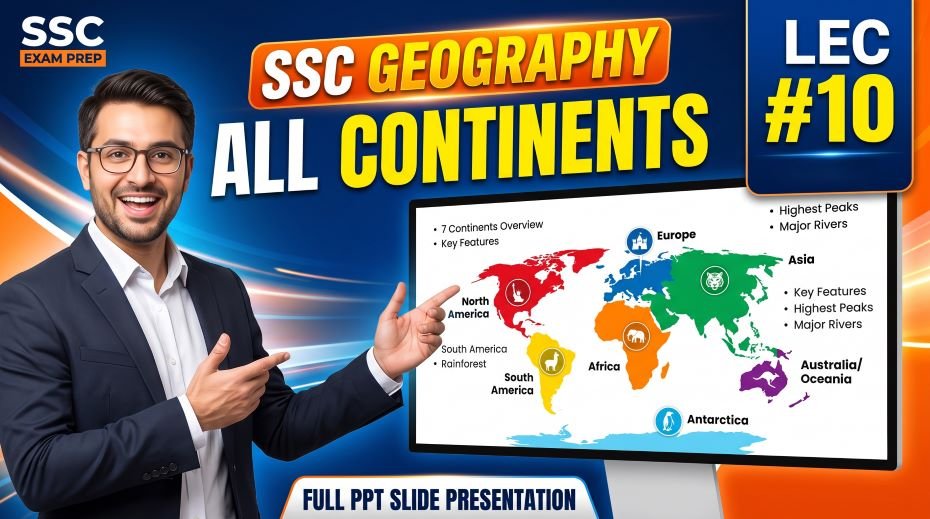
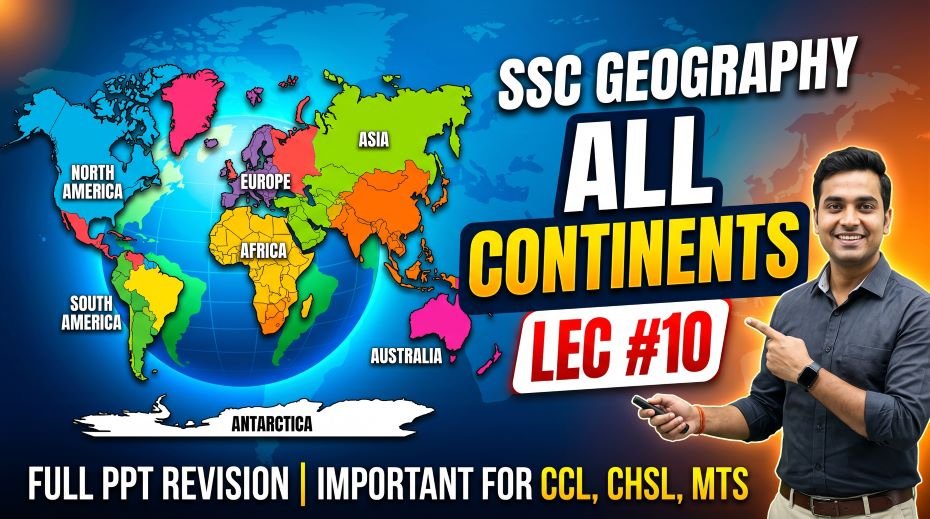
This article accompanies the SSC Geography All Continents PPT Slides (LEC #10) – Serial #89 of the Complete Foundation Batch for All SSC Exams PPT Series on slideshareppt.net. With 87 slides in bilingual Hindi + English format, this is the definitive consolidation lecture on world geography. This article gives you the complete master comparison tables, continent-by-continent superlatives, cross-continent fact tables, 30 MCQs, and a rapid revision cheat sheet – all structured for maximum SSC exam output.
A strong command over all seven continents is one of the fastest ways to secure guaranteed marks in SSC CGL, SSC CHSL, SSC MTS, SSC GD Constable, and RRB Group D General Awareness sections. LEC #10 of the Complete Foundation Batch brings all continents together into one powerful revision lecture – covering comparative data, superlatives, physical features, and the most asked cross-continent facts.
PPT Resource Overview
| Detail | Information |
| Lecture Number | LEC #10 (Geography Series) |
| Serial Number in Complete Batch | #89 |
| Subject | Geography – All Continents (सभी महाद्वीप) |
| Series Name | Complete Foundation Batch for All SSC Exams (PPT Series) |
| Total Slides | 87 PPT Slides |
| File Size | 19 MB |
| Language | Hindi + English (Bilingual) |
| Format Available | Google Slides & Google Drive (PDF also available) |
| Website | www.slideshareppt.net |
| Target Exams | SSC CGL, SSC CHSL, SSC MTS, SSC GD Constable, RRB Group D |
| Suitable For | Students (marathon revision, last-week prep) and Teachers (classroom consolidation) |
SSC Geography All Continents PPT Slides (LEC #10)
Note: Above is PPT in GOOGLE SLIDES (HTML AND IFRAME COMBINATION) and if you wish to download the Complete SSC series (PPT slides), visit this Link – REDIRECT PAGE.
Master Comparison Table – All 7 Continents
| Continent | Area (sq km) | Area Rank | Population | Pop. Rank | Countries | Highest Peak | Lowest Point |
| Asia | 44.6 million | 1st | ~4.7 billion | 1st | ~48–50 | Mt. Everest (8,848.86 m) | Dead Sea (−430 m) |
| Africa | 30.4 million | 2nd | ~1.4 billion | 2nd | 54 | Mt. Kilimanjaro (5,895 m) | Lake Assal, Djibouti (−155 m) |
| North America | 24.7 million | 3rd | ~600 million | 4th | 23 | Denali (6,194 m) | Death Valley (−86 m) |
| South America | 17.8 million | 4th | ~436 million | 5th | 12+1 territory | Aconcagua (6,961 m) | Laguna del Carbón (−105 m) |
| Antarctica | 14.2 million | 5th | ~1,000 (researchers) | 7th | 0 sovereign | Vinson Massif (4,892 m) | Bentley Subglacial Trench (−2,555 m) |
| Europe | 10.5 million | 6th | ~746 million | 3rd | 44 | Mount Elbrus (5,642 m) | Caspian Sea (−28 m) |
| Australia | 7.7 million | 7th | ~26 million | 6th | 1 (country-continent) | Mt. Kosciuszko (2,228 m) | Lake Eyre (−15 m) |
World Geography Superlatives – Most Asked SSC Facts
| Category | Superlative | Name / Place | Location |
| CONTINENTS | |||
| Continent | Largest by area | Asia | 44.6 million sq km |
| Continent | Smallest by area | Australia | 7.7 million sq km |
| Continent | Most populous | Asia | ~4.7 billion |
| Continent | Least populous (permanent) | Australia | ~26 million |
| Continent | Most countries | Africa | 54 sovereign nations |
| Continent | Coldest | Antarctica | Average −60°C interior |
| Continent | Driest (non-polar) | Australia | Driest inhabited continent |
| Continent | Highest average elevation | Antarctica | 2,300 m (ice sheet included) |
| Continent | Only country-continent | Australia | Commonwealth of Australia |
| MOUNTAINS & PEAKS | |||
| Mountain | Highest on Earth | Mount Everest | 8,848.86 m – Nepal-China border |
| Mountain | 2nd highest | K2 | 8,611 m – Pakistan-China border |
| Mountain | 3rd highest | Kangchenjunga | 8,586 m – India-Nepal border |
| Mountain | Highest in Americas | Aconcagua | 6,961 m – Argentina |
| Mountain | Highest in North America | Denali | 6,194 m – Alaska, USA |
| Mountain | Highest in Africa | Mt. Kilimanjaro | 5,895 m – Tanzania |
| Mountain | Highest in Europe (incl. Caucasus) | Mount Elbrus | 5,642 m – Russia |
| Mountain | Highest in Europe (Alps only) | Mont Blanc | 4,808 m – France-Italy border |
| Mountain | Highest in Antarctica | Vinson Massif | 4,892 m |
| Mountain | Highest in Australia | Mt. Kosciuszko | 2,228 m – NSW, Australia |
| Mountain range | Longest continental range | The Andes | ~7,000 km – South America |
| Mountain range | Youngest and highest | The Himalayas | Asia – contains all 14 eight-thousanders |
| RIVERS | |||
| River | Longest in the world | Nile River | ~6,650 km – Africa |
| River | Largest by discharge volume | Amazon River | South America |
| River | Longest in Asia | Yangtze River | ~6,300 km – China |
| River | Longest in Europe (entirely) | Volga River | ~3,530 km – Russia |
| River | Flows through most countries | Danube River | 10 countries – Europe |
| River | Deepest in the world | Congo River | Over 220 m – Africa |
| River | Longest in Australia | Murray River | 2,508 km |
| River | Longest in North America (system) | Mississippi-Missouri | ~6,275 km – USA |
| DESERTS | |||
| Desert | Largest hot desert | Sahara Desert | ~9.2 million sq km – North Africa |
| Desert | Largest cold desert | Antarctic Polar Desert | Antarctica |
| Desert | Driest non-polar desert | Atacama Desert | Chile – South America |
| Desert | Largest in Asia | Gobi Desert | Mongolia-China |
| Desert | Largest in Australia | Great Victoria Desert | ~424,400 sq km – WA & SA |
| Desert | Largest in South Asia | Thar Desert | India-Pakistan border |
| LAKES & WATER BODIES | |||
| Lake | Largest freshwater by surface area | Lake Superior | USA-Canada border – Great Lakes |
| Lake | Deepest in the world | Lake Baikal | 1,642 m – Russia (Siberia) |
| Lake | Largest inland body of water | Caspian Sea | Borders Russia, Kazakhstan, Iran, Turkmenistan, Azerbaijan |
| Lake | Highest large navigable lake | Lake Titicaca | 3,812 m – Peru-Bolivia border |
| Lake | Largest in Africa | Lake Victoria | Uganda-Kenya-Tanzania |
| Lake | Largest in Australia | Lake Eyre (Kati Thanda) | South Australia |
| OCEANS & EXTREME POINTS | |||
| Ocean | Largest | Pacific Ocean | ~165 million sq km |
| Ocean | Smallest | Arctic Ocean | ~14 million sq km |
| Ocean trench | Deepest in the world | Mariana Trench | ~11,034 m – Pacific Ocean |
| Land point | Highest on Earth | Mount Everest summit | 8,848.86 m – Asia |
| Land point | Lowest on Earth | Dead Sea shore | ~430 m below sea level – Asia |
| WATERFALLS | |||
| Waterfall | Highest in the world | Angel Falls | 979 m – Venezuela, South America |
| Waterfall | Widest / Largest by volume | Iguazu Falls | Brazil-Argentina border |
| Waterfall | 7 Natural Wonders | Victoria Falls | Zambia-Zimbabwe – Africa |
| COUNTRIES | |||
| Country | Largest by area | Russia | 17.1 million sq km |
| Country | 2nd largest by area | Canada | 9.98 million sq km |
| Country | 3rd largest by area | USA | 9.83 million sq km |
| Country | Largest in Africa | Algeria | 2.38 million sq km |
| Country | Largest in South America | Brazil | 8.5 million sq km |
| Country | Largest in Australia continent | Australia | 7.69 million sq km |
| Country | Smallest in the world | Vatican City | ~0.49 sq km – Europe |
| Country | Most populous | India | ~1.45 billion (since 2023) |
| Country | 2nd most populous | China | ~1.41 billion |
| Country | Only country-continent | Australia | Commonwealth of Australia |
Continent-wise Summary – Key Facts for SSC Revision
| Continent | Largest Country | Capital of Largest Country | Longest River | Major Desert | Key Fact |
| Asia | China (fully Asian) | Beijing | Yangtze (~6,300 km) | Gobi Desert | Largest & most populous; home to Everest and Dead Sea |
| Africa | Algeria | Algiers | Nile (~6,650 km) | Sahara (~9.2 mn sq km) | 54 countries – most of any continent; Mansa Musa’s Mali Empire |
| North America | Canada | Ottawa | Mississippi-Missouri (~6,275 km) | Chihuahuan / Sonoran Desert | 3rd largest; Great Lakes; Denali; US Independence 1776 |
| South America | Brazil | Brasília | Amazon (~6,400 km) | Atacama Desert (driest) | Andes (longest mountain range); Angel Falls; Inca Empire |
| Antarctica | No countries | N/A | No major rivers | Antarctic Polar Desert | Coldest, driest, windiest; Antarctic Treaty 1959; India has Maitri & Bharati stations |
| Europe | Russia (European part) | Moscow | Volga (~3,530 km) | No major hot desert | EU (27 members); NATO (1949); Berlin Wall fell 1989 |
| Australia | Australia | Canberra | Murray River (2,508 km) | Great Victoria Desert | Smallest continent; only country-continent; kangaroos and platypus |
World’s Five Oceans – Complete Reference Table
The world is divided into five oceans. The Pacific Ocean is the largest, covering more area than all the world’s land combined. Knowing the ranking, location, and key facts of each ocean is essential for SSC General Awareness questions.
| Ocean | Area (approx.) | Rank | Key SSC Facts |
| Pacific Ocean | ~165 million sq km | 1st (Largest) | Largest ocean – bigger than all land combined; contains the Mariana Trench (deepest point on Earth at ~11,034 m); borders Asia, Australia, North and South America |
| Atlantic Ocean | ~106 million sq km | 2nd | 2nd largest; separates Americas from Europe and Africa; contains the Bermuda Triangle (popular GK topic); Titanic sank here (1912) |
| Indian Ocean | ~70 million sq km | 3rd | Surrounds India on three sides; named after India; warmest ocean; major shipping route between Asia, Africa, and Australia |
| Southern Ocean | ~21 million sq km | 4th | Surrounds Antarctica; also called the Antarctic Ocean; recognised as the 5th ocean officially only in 2000 (by IHO) |
| Arctic Ocean | ~14 million sq km | 5th (Smallest) | Smallest and shallowest ocean; covered by sea ice for most of the year; surrounds the North Pole |
Step-by-Step Study Roadmap – All Continents Consolidation
Use this roadmap as your final checklist before any SSC or RRB exam. Each row identifies what you must know from each continent and the type of SSC question it commonly generates.
| Continent (Lecture) | Must-Know Physical Facts | Must-Know Historical/Political Facts | Most Common SSC Question Type |
| Asia (LEC #9, #87) | Everest (8,848.86 m), Dead Sea (lowest land), Yangtze (longest river Asia), Gobi Desert, Caspian Sea, Lake Baikal, Himalayas, Mariana Trench | India-Pakistan 1947, PRC 1949, Mongol Empire, Buddha born in Nepal, Indus Valley Civilisation | Superlatives, peaks, rivers, religious origins, India-Asia geography overlap |
| Africa (LEC #7, #85) | Nile (longest river), Kilimanjaro (5,895 m), Sahara (largest hot desert), Lake Victoria, Victoria Falls, Congo River (deepest) | Berlin Conference 1884, Ghana independence 1957, Year of Africa 1960, Mandela 1994, Mansa Musa | River names, desert sizes, country counts, independence facts |
| North America (LEC #6, #84) | Denali (6,194 m), Death Valley (lowest N. America), Mississippi-Missouri system, Great Lakes, Grand Canyon, Greenland (largest island) | US independence 1776, Canada Confederation 1867, Aztec/Maya civilisations, USMCA | Independence dates, Great Lakes, US-Canada-Mexico geography |
| South America (LEC #5, #83) | Aconcagua (6,961 m), Amazon (largest by volume), Atacama (driest), Angel Falls (979 m, highest), Lake Titicaca (highest navigable lake), Andes (longest range ~7,000 km) | Treaty of Tordesillas 1494, Inca Empire, Simon Bolivar, Bolivia’s two capitals | Waterfall heights, desert types, Amazon vs Nile, Inca history |
| Europe (LEC #8, #86) | Mount Elbrus (5,642 m), Volga (longest fully-European river), Danube (10 countries), Vatican City (smallest country), Alps | EU (Maastricht 1993), NATO (1949), Berlin Wall (fell 1989), Brexit (2020), French Revolution 1789 | EU membership, Brexit, river-country crossings, treaty dates |
| Australia (LEC #3, #81) | Mt. Kosciuszko (2,228 m), Lake Eyre (lowest point), Murray River (longest), Great Victoria Desert (largest), Great Barrier Reef, Uluru | Federation 1901, Canberra as capital (1927), Cook’s voyage 1770 | Capital, federation date, marsupials, unique wildlife, reef |
| Antarctica (LEC #4, #82) | Vinson Massif (4,892 m), Bentley Trench (lowest), Ross Ice Shelf, Transantarctic Mountains, Lake Vostok, Coldest temp (−89.2°C) | Antarctic Treaty 1959, India’s stations (Maitri 1988, Bharati 2012), Amundsen reached South Pole 1911 | Treaty dates, India’s stations, coldest temperature, treaty countries |
Cross-Continent Comparison – Frequently Asked SSC Questions
| Question Type | 1st | 2nd | 3rd |
| Largest continent by area | Asia (44.6 mn sq km) | Africa (30.4 mn sq km) | North America (24.7 mn sq km) |
| Smallest continent by area | Australia (7.7 mn sq km) | Europe (10.5 mn sq km) | Antarctica (14.2 mn sq km) |
| Most populous continent | Asia (~4.7 billion) | Africa (~1.4 billion) | Europe (~746 million) |
| Highest peak on each continent | Everest (Asia) | Aconcagua (S. America) | Denali (N. America) |
| Longest river on each continent | Nile (Africa) | Amazon (S. America) | Yangtze (Asia) |
| Largest desert on each continent | Sahara (Africa, ~9.2 mn sq km) | Arabian (W. Asia) | Gobi (Asia, Mongolia-China) |
| Largest lake on each continent | Caspian Sea (Asia/Europe border) | Lake Superior (N. America) | Lake Victoria (Africa) |
| Deepest lake globally | Lake Baikal (Asia, 1,642 m) | Lake Tanganyika (Africa) | Crater Lake (N. America) |
| Highest navigable lake | Lake Titicaca (S. America, 3,812 m) | Lake Maracaibo (S. America) | Not applicable |
| Highest waterfall globally | Angel Falls (S. America, 979 m) | Tugela Falls (Africa, 948 m) | Tres Hermanas (S. America) |
| Continent with most countries | Africa (54) | Asia (~48–50) | Europe (44) |
| Continent with fewest countries | Antarctica (0) | Australia (1) | South America (12 + 1 territory) |
| Only country-continent | Australia | N/A | N/A |
| Continent with no permanent population | Antarctica | N/A | N/A |
| Coldest continent | Antarctica (−89.2°C record) | Asia (Siberia, −67.8°C recorded) | North America (Yukon, −63°C) |
| Driest continent | Antarctica (polar desert) | Australia (driest inhabited) | Asia (Atacama is in S. America) |
| Continent through which Equator passes | Africa, Asia, South America | N/A | N/A |
| Continent through which Tropic of Cancer passes | Africa, Asia, North America | N/A | N/A |
| Continent through which Tropic of Capricorn passes | Africa, Australia, South America | N/A | N/A |
Important Straits, Canals, and Gulfs – World Geography
| Feature | Type | Location / Connects | Key SSC Fact |
| Strait of Gibraltar | Strait | Atlantic Ocean to Mediterranean Sea | Separates Spain (Europe) from Morocco (Africa); only 14 km at narrowest |
| Strait of Malacca | Strait | Indian Ocean to South China Sea (Pacific) | Busiest shipping strait in the world; between Malaysia and Indonesia |
| Palk Strait | Strait | India (Tamil Nadu) to Sri Lanka | Separates India and Sri Lanka; narrow shallow strait |
| Bering Strait | Strait | Pacific Ocean to Arctic Ocean | Separates Asia (Russia) from North America (Alaska, USA) |
| Strait of Hormuz | Strait | Persian Gulf to Gulf of Oman | Controls ~20% of world’s oil supply; critical chokepoint |
| Suez Canal | Canal | Mediterranean Sea to Red Sea (Egypt) | Opened 1869; connects Europe-Asia trade route; eliminates need to go around Africa |
| Panama Canal | Canal | Atlantic Ocean (Caribbean) to Pacific Ocean | Opened 1914; shortens trade route between Americas; controlled by Panama |
| Gulf of Mannar | Gulf | Between India and Sri Lanka | Rich marine biodiversity; between Tamil Nadu and Sri Lanka |
| Gulf of Aden | Gulf | Between Somalia (Africa) and Yemen (Asia) | Connects to the Red Sea; key Indian Ocean shipping lane |
| Drake Passage | Passage | Between South America and Antarctica | Widest and most turbulent ocean passage; between Cape Horn and Antarctic Peninsula |
World’s Important Islands – SSC GK Reference Table
| Island | Location / Ocean | Country | Key SSC Fact |
| Greenland | Arctic/Atlantic Ocean | Denmark (autonomous territory) | Largest island in the world (~2.17 million sq km); mostly ice-covered |
| New Guinea | Pacific Ocean | Papua New Guinea and Indonesia | 2nd largest island in the world |
| Borneo | Pacific Ocean | Indonesia, Malaysia, Brunei | 3rd largest island; shared by 3 countries |
| Madagascar | Indian Ocean | Madagascar | 4th largest island; world’s 2nd most biodiverse country after Brazil |
| Sri Lanka | Indian Ocean | Sri Lanka | Separated from India by Palk Strait |
| Andaman & Nicobar Islands | Bay of Bengal | India | India’s easternmost territory; Indira Point (southernmost tip of India) here |
| Lakshadweep | Arabian Sea | India | India’s smallest Union Territory; coral islands |
| Galápagos Islands | Pacific Ocean | Ecuador | Inspired Darwin’s theory of evolution; UNESCO World Heritage Site |
| Maldives | Indian Ocean | Maldives | Lowest-lying nation on Earth; highly vulnerable to sea-level rise |
| Iceland | North Atlantic | Iceland | Most volcanically active island in the world; home to geysers |
Quick Fact Table – All Continents Master Revision
| Question / Fact | Answer |
| Largest continent by area | Asia (44.6 million sq km) |
| Smallest continent by area | Australia (7.7 million sq km) |
| Most populous continent | Asia (~4.7 billion) |
| Continent with most countries | Africa (54) |
| Only country-continent | Australia |
| Continent with no permanent population | Antarctica |
| Highest mountain on Earth | Mount Everest (8,848.86 m) – Asia |
| Highest mountain in Americas | Aconcagua (6,961 m) – South America |
| Longest river in the world | Nile River (~6,650 km) – Africa |
| Largest river by discharge volume | Amazon River – South America |
| River flowing through most countries | Danube (10 countries) – Europe |
| Deepest river in the world | Congo River – Africa |
| Largest hot desert | Sahara Desert – Africa (~9.2 million sq km) |
| Driest non-polar desert | Atacama Desert – South America (Chile) |
| Deepest lake in the world | Lake Baikal – Asia (~1,642 m) |
| Largest freshwater lake by surface area | Lake Superior – North America |
| Largest inland body of water in the world | Caspian Sea – Asia/Europe border |
| Highest waterfall in the world | Angel Falls (979 m) – South America (Venezuela) |
| Widest waterfall system | Iguazu Falls – South America (Brazil-Argentina border) |
| Smallest country in the world | Vatican City – Europe |
| Largest country in the world by area | Russia |
| Most populous country in the world | India (since 2023) |
| Largest island in the world | Greenland |
| Largest ocean | Pacific Ocean |
| Deepest ocean point | Mariana Trench (~11,034 m) – Pacific Ocean |
| Coldest recorded temperature on Earth | −89.2°C at Vostok Station, Antarctica (1983) |
| Only continent entirely in the Southern Hemisphere (mostly) | Antarctica and Australia |
| Equator passes through how many continents | 3 (Africa, Asia, South America) |
| Continent not claimed by any country | Antarctica |
| Highest navigable lake in the world | Lake Titicaca (3,812 m) – South America |
also read: SSC Geography Asia Continent PPT Slides (LEC #9)
Q&A:
Q1: How do you quickly rank all 7 continents from largest to smallest for the exam?
A reliable memory trick is the phrase: ‘A-A-N-S-A-E-A’ – Asia, Africa, North America, South America, Antarctica, Europe, Australia. You can also remember the rough areas: 44 → 30 → 24 → 17 → 14 → 10 → 7 (in millions of sq km). Another way is to remember that Asia is nearly 6 times the size of Australia, and Africa is about 4 times the size of Australia. Keeping these ratios in mind helps you verify ranking-based MCQ options quickly during the exam.
Q2: Which continent has the highest peak, and how do the Seven Summits compare?
The Seven Summits are the highest peaks on each of the seven continents, frequently referenced in SSC geography questions. In order from tallest to shortest: Everest (Asia, 8,848.86 m), Aconcagua (South America, 6,961 m), Denali (North America, 6,194 m), Kilimanjaro (Africa, 5,895 m), Elbrus (Europe, 5,642 m), Vinson Massif (Antarctica, 4,892 m), and Kosciuszko (Australia, 2,228 m). Note that if Mont Blanc is considered Europe’s highest peak instead of Elbrus, it sits at 4,808 m – lower than Vinson Massif, which would rearrange the last three positions.
Q3: What is the difference between the world’s longest river and largest river by discharge?
The Nile River at approximately 6,650 km is widely considered the world’s longest river by length, flowing northward from East Africa into the Mediterranean Sea. The Amazon River in South America, while slightly shorter by most traditional measurements at around 6,400 km (though some studies argue it may be longer), is unquestionably the world’s largest river by discharge volume – it carries more water than the next seven largest rivers combined, discharging roughly 20% of all freshwater entering the world’s oceans. So when SSC questions ask for ‘longest,’ the answer is the Nile; when they ask for ‘largest by volume or discharge,’ the answer is the Amazon.
Q4: How do the Sahara, Gobi, and Atacama deserts differ from each other?
The Sahara Desert in North Africa (~9.2 million sq km) is the world’s largest hot desert, characterised by extreme heat, sand dunes, and very low rainfall – though it contains significant variation including rocky plateaux and small oases. The Gobi Desert in Mongolia and China is the largest desert in Asia and is classified as a cold desert – temperatures can drop well below freezing in winter, unlike the Sahara. The Atacama Desert in Chile is the driest non-polar desert on Earth, receiving almost no measurable rainfall in its core regions, and is classified as a coastal desert influenced by the cold Humboldt Current and rain shadows from the Andes.
Q5: Why do SSC exams frequently test Antarctica despite it having no permanent population?
Antarctica consistently generates SSC exam questions because it holds multiple world records – coldest temperature (−89.2°C), highest average elevation of all continents, largest ice sheet outside of Greenland, largest polar desert – and because India’s active Antarctic research program (Maitri since 1988, Bharati since 2012) creates a direct India-current affairs linkage. The Antarctic Treaty of 1959 (signed by 12 countries, entered into force 1961), Roald Amundsen reaching the South Pole in 1911, and the 1991 Madrid Protocol banning mining are specific treaty facts that appear regularly in SSC General Awareness questions.
Q6: How should students approach the Strait of Malacca, Suez Canal, and Panama Canal in the exam?
These three strategic waterways are among the most tested geography facts in SSC exams because of their immense global trade importance. The Strait of Malacca between Malaysia and Indonesia is the busiest shipping strait in the world, connecting the Indian Ocean to the South China Sea. The Suez Canal in Egypt (opened 1869) connects the Mediterranean Sea to the Red Sea, shortening the Europe-to-Asia shipping route by thousands of kilometres. The Panama Canal (opened 1914) connects the Atlantic and Pacific Oceans through Central America. A useful comparison: both canals are artificial, while the Strait of Malacca is natural, and both canals are among the most strategically important engineering projects in history.
Q7: What are the top 5 must-memorise facts for each continent for SSC exam success?
Asia: Everest (8,848.86 m), Yangtze (longest river), Gobi Desert, Dead Sea (lowest land), 4.7 billion population. Africa: Nile (longest river), Sahara (largest hot desert), Kilimanjaro, 54 countries, Victoria Falls. North America: Denali, Great Lakes (Superior is largest freshwater lake), Mississippi-Missouri system, Greenland (largest island), US independence 1776. South America: Aconcagua, Amazon (largest discharge), Atacama (driest), Angel Falls (highest), Lake Titicaca (highest navigable). Europe: Elbrus or Mont Blanc (highest peak), Volga (longest European river), Danube (10 countries), Vatican City (smallest country), EU (Maastricht 1993). Australia: Kosciuszko, Murray River, Great Victoria Desert, Canberra capital, Federation 1901. Antarctica: Vinson Massif, −89.2°C record, Antarctic Treaty 1959, India’s Maitri (1988) and Bharati (2012) stations.
30 MCQ Practice Questions – All Continents
All questions follow SSC CGL, CHSL, MTS, and GD Constable exam patterns. Answers follow at the end.
- Which is the largest continent by area?
A) Africa B) North America C) Asia D) Europe
- Which is the smallest continent by area?
A) Europe B) Antarctica C) Australia D) South America
- Which continent has the most countries (54)?
A) Asia B) Africa C) Europe D) North America
- What is the highest mountain on Earth?
A) K2 B) Aconcagua C) Mount Everest D) Denali
- What is the highest peak in South America?
A) Chimborazo B) Aconcagua C) Ojos del Salado D) Cotopaxi
- The longest river in the world is:
A) Amazon B) Yangtze C) Nile D) Mississippi
- The largest river by discharge volume in the world is:
A) Nile B) Amazon C) Congo D) Yangtze
- The river flowing through the most countries (10) is:
A) Rhine B) Danube C) Volga D) Mekong
- The world’s largest hot desert is:
A) Gobi B) Thar C) Sahara D) Arabian
- The driest non-polar desert on Earth is:
A) Sahara B) Gobi C) Namib D) Atacama
- The deepest lake in the world is:
A) Lake Victoria B) Lake Tanganyika C) Lake Baikal D) Caspian Sea
- The largest freshwater lake by surface area is:
A) Lake Superior B) Lake Baikal C) Lake Victoria D) Lake Huron
- The highest waterfall in the world is:
A) Iguazu Falls B) Victoria Falls C) Niagara Falls D) Angel Falls
- The smallest country in the world is:
A) Monaco B) San Marino C) Vatican City D) Liechtenstein
- The largest country in the world by area is:
A) Canada B) Russia C) USA D) China
- The largest island in the world is:
A) Borneo B) New Guinea C) Greenland D) Madagascar
- The largest ocean in the world is:
A) Atlantic B) Indian C) Pacific D) Arctic
- The deepest ocean point (Mariana Trench) is in the:
A) Atlantic B) Indian C) Pacific D) Arctic
- The Strait of Malacca connects the Indian Ocean to the:
A) Arabian Sea B) South China Sea C) Bay of Bengal D) Persian Gulf
- The Suez Canal connects the Mediterranean Sea to the:
A) Arabian Sea B) Indian Ocean C) Red Sea D) Persian Gulf
- The Panama Canal connects the Atlantic to the:
A) Indian Ocean B) Pacific Ocean C) Arctic Ocean D) Southern Ocean
- The Equator passes through how many continents?
A) 2 B) 3 C) 4 D) 5
- The Tropic of Capricorn passes through which of these continents?
A) Europe B) Antarctica C) Australia D) North America
- Which continent has no permanent human population?
A) Australia B) Antarctica C) Arctic D) Greenland
- The coldest recorded temperature on Earth was at:
A) North Pole B) South Pole C) Vostok Station, Antarctica D) Siberia, Russia
- The lowest point on land on Earth is the:
A) Death Valley B) Dead Sea shore C) Mariana Trench D) Bentley Subglacial Trench
- The only country that is also a continent is:
A) Russia B) India C) Australia D) Canada
- Which is the highest large navigable lake in the world?
A) Lake Titicaca B) Lake Victoria C) Lake Baikal D) Caspian Sea
- Palk Strait separates which two countries?
A) India and Pakistan B) India and Bangladesh C) India and Sri Lanka D) India and Maldives
- The Bering Strait separates which two continents?
A) Europe and Asia B) Asia and North America C) North America and South America D) Asia and Australia
Answer Key
| Q | Ans | Q | Ans | Q | Ans |
| 1 | C | 11 | C | 21 | B |
| 2 | C | 12 | A | 22 | B |
| 3 | B | 13 | D | 23 | C |
| 4 | C | 14 | C | 24 | B |
| 5 | B | 15 | B | 25 | C |
| 6 | C | 16 | C | 26 | B |
| 7 | B | 17 | C | 27 | C |
| 8 | B | 18 | C | 28 | A |
| 9 | C | 19 | B | 29 | C |
| 10 | D | 20 | C | 30 | B |
Rapid Revision Cheat Sheet – All Continents Master Summary
| Superlative / Fact | Answer |
| Largest continent | Asia – 44.6 million sq km |
| Smallest continent | Australia – 7.7 million sq km |
| Most populous continent | Asia – ~4.7 billion |
| Continent with most countries | Africa – 54 |
| Only country-continent | Australia |
| Highest mountain on Earth | Mt. Everest – 8,848.86 m (Asia) |
| Seven Summits (highest peaks per continent) | Everest, Aconcagua, Denali, Kilimanjaro, Elbrus, Vinson Massif, Kosciuszko |
| Longest river in world | Nile – ~6,650 km (Africa) |
| Largest river by discharge | Amazon (South America) |
| River through most countries | Danube – 10 countries (Europe) |
| Deepest river | Congo River (Africa) |
| Largest hot desert | Sahara – ~9.2 million sq km (Africa) |
| Driest non-polar desert | Atacama – Chile (South America) |
| Deepest lake | Lake Baikal – 1,642 m (Asia) |
| Largest freshwater lake (area) | Lake Superior (North America) |
| Largest inland water body | Caspian Sea (Asia-Europe border) |
| Highest waterfall | Angel Falls – 979 m (South America) |
| Smallest country | Vatican City (Europe) |
| Largest country | Russia |
| Most populous country | India (since 2023) |
| Largest island | Greenland |
| Largest ocean | Pacific Ocean |
| Deepest ocean trench | Mariana Trench – ~11,034 m (Pacific) |
| Coldest temp. on Earth | −89.2°C – Vostok Station, Antarctica |
| Lowest land point | Dead Sea shore – ~430 m below sea level (Asia) |
| Equator passes through | Africa, Asia, South America |
| Tropic of Cancer passes through | Africa, Asia, North America |
| Tropic of Capricorn passes through | Africa, Australia, South America |
| Serial number of this PPT | #89 in the Complete Foundation Batch |
Conclusion
SSC Geography All Continents (LEC #10, Serial #89) is the most important revision resource in the entire Geography series, bringing together every key fact across all seven continents into one comprehensive, exam-focused reference. This article, combined with the 87-slide bilingual PPT on slideshareppt.net, gives you the complete toolkit for World Geography – from the master comparison table and superlatives list to the straits and canals reference and the Seven Summits breakdown.
Use the Rapid Revision Cheat Sheet in your final week before any SSC or RRB exam, practise all 30 MCQs to test cross-continent knowledge, and keep the Step-by-Step Roadmap open while revising individual continent lectures to see how they connect. Together, the ten lectures in this Geography series from slideshareppt.net form a complete, structured preparation system from Introduction (LEC #1) to All Continents Consolidation (LEC #10).