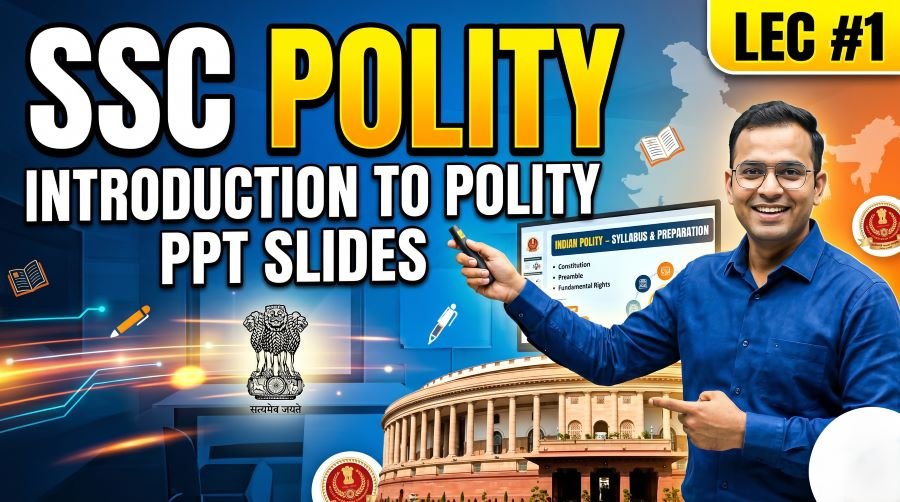
This article covers the SSC Polity Introduction to Polity PPT Slides (LEC #1), part of the Complete Foundation Batch PPT Series available at slideshareppt.net. It is the starting point for mastering Indian Polity for SSC CGL, SSC CHSL, SSC MTS, SSC CPO, SSC GD, and all other competitive exams. The article includes a complete timeline, key constitutional facts, important articles, amendments, and exam-focused content.
SSC Polity Introduction to Polity PPT Slides (LEC #1) – PPT Details
| Field | Details |
| PPT Title | SSC Polity Introduction to Polity PPT Slides (LEC #1) |
| Subject | Modern Indian History – Indian National Movement (भारतीय राष्ट्रीय आंदोलन) |
| Series | Complete Foundation Batch for All SSC and Other Exams (PPT Series) |
| Total Slides | 34 PPT Slides |
| File Size | 6 MB |
| Serial Number | #57 |
| Lecture | LEC #1 |
| Format | PowerPoint (.pptx) + PDF |
| Target Exams | SSC CGL, SSC CHSL, SSC MTS, SSC CPO, SSC GD, SSC Steno |
| Website | slideshareppt.net |
SSC Polity Introduction to Polity PPT Slides (LEC #1)
Note: Above is PPT in GOOGLE SLIDES (HTML AND IFRAME COMBINATION) and if you wish to download the Complete SSC series (PPT slides), Simply visit this redirect page – REDIRECT PAGE.
Important Timeline – Indian Polity & Constitutional History
| Year / Period | Event / Milestone | Significance for Polity |
| 1600 AD | Arrival of East India Company | Start of British influence in India |
| 1757 | Battle of Plassey | British political dominance begins |
| 1858 | Government of India Act 1858 | Crown takes over from East India Company |
| 1861 | Indian Councils Act 1861 | First step toward legislative councils |
| 1885 | Formation of Indian National Congress (INC) | Organised national movement begins |
| 1905 | Partition of Bengal | Swadeshi Movement; mass agitation |
| 1906 | Muslim League Founded | Communal politics enters mainstream |
| 1909 | Morley-Minto Reforms (Indian Councils Act) | Separate electorate introduced |
| 1919 | Montague-Chelmsford Reforms / GoI Act 1919 | Dyarchy introduced; expanded councils |
| 1920 | Non-Cooperation Movement | Mass civil disobedience under Gandhi |
| 1929 | Lahore Congress – Poorna Swaraj declared | Complete independence as the goal |
| 1930 | Civil Disobedience Movement / Dandi March | Salt Satyagraha |
| 1935 | Government of India Act 1935 | Federal structure; provincial autonomy |
| 1942 | Quit India Movement | Final mass struggle for independence |
| 1946 | Cabinet Mission Plan | Proposal for Constituent Assembly |
| 9 Dec 1946 | First meeting of Constituent Assembly | Constitution drafting officially begins |
| 15 Aug 1947 | Independence of India | Transfer of power; Dominion status |
| 26 Nov 1949 | Constitution adopted | Passed by Constituent Assembly |
| 26 Jan 1950 | Constitution comes into force | India becomes a Republic |
1. Introduction to Indian Polity
Polity refers to the system of government and political organisation of a state. For SSC exams, Indian Polity covers the Constitution, Parliament, the Executive, the Judiciary, Fundamental Rights, Directive Principles, and related constitutional provisions. It accounts for 4-5 questions per shift in SSC CGL and CHSL, making it one of the most reliable scoring areas in General Awareness.
2. Historical Background – Colonial Phase
The Indian Constitution was shaped by decades of British administration and the independence movement. The key constitutional landmarks during colonial rule are:
Government of India Act 1858
After the Revolt of 1857, the British Crown took direct control from the East India Company. This Act established the office of the Secretary of State for India and the Viceroy.
Indian Councils Act 1861
Indians were nominated to legislative councils for the first time. It introduced the portfolio system and decentralisation of legislative powers.
Morley-Minto Reforms – Indian Councils Act 1909
Introduced separate electorates for Muslims and expanded legislative councils. First use of the principle of election.
Montague-Chelmsford Reforms – Government of India Act 1919
Introduced Dyarchy in provinces, dividing subjects into central and provincial lists. Expanded legislative councils with direct elections for some seats.
Government of India Act 1935
The most comprehensive constitutional reform under British rule. Provided a federal structure, introduced provincial autonomy, established a Federal Court, and became the single largest source for the Indian Constitution of 1950.
3. Indian National Movement – Key Milestones
- 1885 – Formation of Indian National Congress (INC)
- 1905 – Partition of Bengal; Swadeshi Movement launched
- 1906 – Muslim League founded in Dhaka
- 1909 – Morley-Minto Reforms; separate electorates introduced
- 1919 – Montague-Chelmsford Reforms; Rowlatt Act; Jallianwala Bagh massacre
- 1920 – Non-Cooperation Movement by Gandhi
- 1929 – Lahore Congress; Poorna Swaraj (Complete Independence) declared
- 1930 – Dandi March; Civil Disobedience Movement
- 1935 – Government of India Act 1935 passed
- 1942 – Quit India Movement (‘Do or Die’)
- 1946 – Cabinet Mission Plan; Constituent Assembly formed
- 9 Dec 1946 – First sitting of the Constituent Assembly
- 15 Aug 1947 – Independence of India
- 26 Nov 1949 – Constitution adopted
- 26 Jan 1950 – Constitution comes into force; India becomes a Republic
4. Constituent Assembly of India
- Set up under the Cabinet Mission Plan of 1946
- Total members: 299 (originally 389; reduced after partition)
- President of Constituent Assembly: Dr. Rajendra Prasad
- Chairman of Drafting Committee: Dr. B.R. Ambedkar
- Total sessions: 11 sessions over 2 years, 11 months, 18 days
- Constitution adopted: 26 November 1949 (Constitution Day / Samvidhan Diwas)
- Constitution enforced: 26 January 1950 (Republic Day)
- Original Constitution: 395 Articles, 8 Schedules, 22 Parts
- Current Constitution: 470+ Articles, 12 Schedules, 25 Parts
5. Sources of the Indian Constitution
| Country / Source | Provision Borrowed |
| Government of India Act 1935 | Federal structure, administrative provisions, Emergency provisions |
| United Kingdom (UK) | Parliamentary system, Rule of Law, Cabinet system, Single citizenship |
| United States of America (USA) | Fundamental Rights, Judicial Review, Preamble inspiration |
| Ireland | Directive Principles of State Policy (DPSP) |
| Canada | Federal structure with strong Centre, residuary powers with Centre |
| Australia | Concurrent List, joint sitting of both Houses of Parliament |
| Weimar Constitution (Germany) | Suspension of Fundamental Rights during Emergency |
| South Africa | Amendment procedure for certain provisions |
| Soviet Union (USSR) | Fundamental Duties, socio-economic justice ideals |
| Japan | Procedure established by law (Article 21) |
6. Key Features of the Indian Constitution
- Lengthiest written constitution in the world
- Sovereign, Socialist, Secular, Democratic, Republic – words in the Preamble (‘Socialist’ and ‘Secular’ added by 42nd Amendment 1976)
- Parliamentary form of government (Westminster model from UK)
- Federal system with unitary bias – Centre stronger than states
- Fundamental Rights (Part III, Articles 12-35) – justiciable in courts
- Directive Principles of State Policy (Part IV, Articles 36-51) – non-justiciable guidelines
- Fundamental Duties (Part IV-A, Article 51A) – 11 duties added by 42nd Amendment 1976
- Independent Judiciary with power of Judicial Review
- Universal Adult Franchise – every citizen above 18 years can vote
- Single citizenship for all Indians
- Emergency Provisions – Articles 352, 356, 360
7. Preamble of the Indian Constitution
- Begins with: ‘We, the People of India’ – indicates popular sovereignty
- India declared: Sovereign, Socialist, Secular, Democratic, Republic
- ‘Socialist’ and ‘Secular’ added by 42nd Constitutional Amendment 1976
- Preamble inspired by the US Constitution
- Not directly enforceable in court but is the key to interpreting the Constitution
- Kesavananda Bharati Case (1973) – Supreme Court held the Preamble is part of the Constitution
- Objectives: Justice (social, economic, political), Liberty, Equality, Fraternity
8. Fundamental Rights – Part III (Articles 12-35)
Fundamental Rights are justiciable rights – enforceable through the Supreme Court or High Courts under Articles 32 and 226 respectively. These are the most frequently asked topics in SSC Polity.
| Right | Articles | Key Provision |
| Right to Equality | 14-18 | Equality before law, prohibition of discrimination, abolition of untouchability |
| Right to Freedom | 19-22 | Freedom of speech, expression, movement, profession; protection against arrest |
| Right Against Exploitation | 23-24 | Prohibition of trafficking, forced labour, child labour below 14 years |
| Right to Freedom of Religion | 25-28 | Freedom of conscience, religion, religious education in schools |
| Cultural and Educational Rights | 29-30 | Protection of minorities; right to establish educational institutions |
| Right to Constitutional Remedies | 32 | Heart and Soul of the Constitution (Dr. Ambedkar); move Supreme Court directly |
Important Articles to Remember
- Article 14 – Equality before law and equal protection of laws
- Article 19 – Six freedoms (speech, assembly, association, movement, residence, profession)
- Article 21 – Right to Life and Personal Liberty
- Article 21A – Right to Education for children aged 6-14 years (added by 86th Amendment 2002)
- Article 32 – Right to Constitutional Remedies; called ‘Heart and Soul’ by Dr. Ambedkar
- Article 44 – Uniform Civil Code (Directive Principle)
- Article 51A – Fundamental Duties (42nd Amendment 1976)
- Article 74 – Council of Ministers to aid and advise the President
- Article 368 – Amendment procedure of the Constitution
9. Directive Principles of State Policy (DPSP) – Part IV (Articles 36-51)
DPSPs are non-justiciable guidelines for the State. Borrowed from the Irish Constitution, they aim to establish a welfare state. They are classified into three categories:
- Socialist Principles (Articles 38-39) – adequate livelihood, equal pay for equal work, prevent concentration of wealth
- Gandhian Principles (Articles 40-48) – organise Panchayats, promote cottage industries, ban cow slaughter
- Liberal Principles (Articles 44-51) – Uniform Civil Code, free legal aid, separation of judiciary from executive, protect environment, promote international peace
10. Fundamental Duties – Part IV-A (Article 51A)
Fundamental Duties were added by the 42nd Constitutional Amendment in 1976 on the recommendation of the Swaran Singh Committee. Originally 10 duties; an 11th duty was added by the 86th Amendment 2002.
- Abide by the Constitution and respect its ideals
- Cherish and follow the noble ideals of the freedom struggle
- Uphold and protect the sovereignty, unity and integrity of India
- Defend the country and render national service when required
- Promote harmony and the spirit of common brotherhood
- Value and preserve the rich heritage of the composite culture
- Protect and improve the natural environment
- Develop scientific temper, humanism, and the spirit of inquiry
- Safeguard public property and abjure violence
- Strive towards excellence in all spheres of individual and collective activity
- Provide opportunities for education to children between 6 and 14 years (added by 86th Amendment 2002)
11. Important Constitutional Amendments for SSC Exams
| Amendment | Year | Key Provision |
| 1st Amendment | 1951 | Added Ninth Schedule; restrictions on freedom of speech |
| 7th Amendment | 1956 | Reorganisation of states on linguistic basis |
| 24th Amendment | 1971 | Parliament has power to amend any part of the Constitution |
| 42nd Amendment | 1976 | Added ‘Socialist’, ‘Secular’; Fundamental Duties added; called ‘Mini Constitution’ |
| 44th Amendment | 1978 | Right to Property made a legal right (not Fundamental Right) |
| 52nd Amendment | 1985 | Anti-Defection Law (Tenth Schedule) |
| 61st Amendment | 1988 | Voting age reduced from 21 to 18 years |
| 73rd Amendment | 1992 | Constitutional status to Panchayati Raj Institutions |
| 74th Amendment | 1992 | Constitutional status to Urban Local Bodies |
| 86th Amendment | 2002 | Right to Education – Article 21A; 11th Fundamental Duty |
| 101st Amendment | 2016 | Goods and Services Tax (GST) |
| 103rd Amendment | 2019 | 10% EWS reservation in education and employment |
12. Quick Revision Fact Table
| Fact | Detail |
| Who drafted the Constitution? | Dr. B.R. Ambedkar – Chairman, Drafting Committee |
| Time taken to draft | 2 years, 11 months, 18 days |
| Original articles | 395 Articles, 8 Schedules, 22 Parts |
| Current articles (approx.) | 470+ Articles, 12 Schedules, 25 Parts |
| Lengthiest written constitution | India has the world’s longest written constitution |
| Preamble inspired by | US Constitution’s Preamble |
| Rule of Law borrowed from | United Kingdom (UK) |
| Fundamental Rights (Part III) | Articles 12 to 35 |
| Directive Principles (Part IV) | Articles 36 to 51 |
| Fundamental Duties added | 1976 – 42nd Amendment, Article 51A |
| SSC CGL Polity weightage | 4-5 questions per shift (20-25% of GA section) |
| Most tested topic in SSC | Fundamental Rights, Constitutional Articles, Parliament |
also read: SSC History Indian National Movements PPT (LEC #31)
13. Key Takeaways
- Polity is one of the most scoring sections in SSC CGL, CHSL, MTS, CPO – do not skip it
- The Indian Constitution is the longest written constitution in the world
- Dr. B.R. Ambedkar is the Father of the Indian Constitution
- Constitution adopted: 26 November 1949 | Enforced: 26 January 1950
- Fundamental Rights (Part III), DPSP (Part IV), and Fundamental Duties (Part IV-A) are the most tested topics
- 42nd Amendment 1976 is the most important amendment for SSC exams
- Government of India Act 1935 is the single largest source of the Indian Constitution
- Download the complete PPT Series at slideshareppt.net for all subjects.