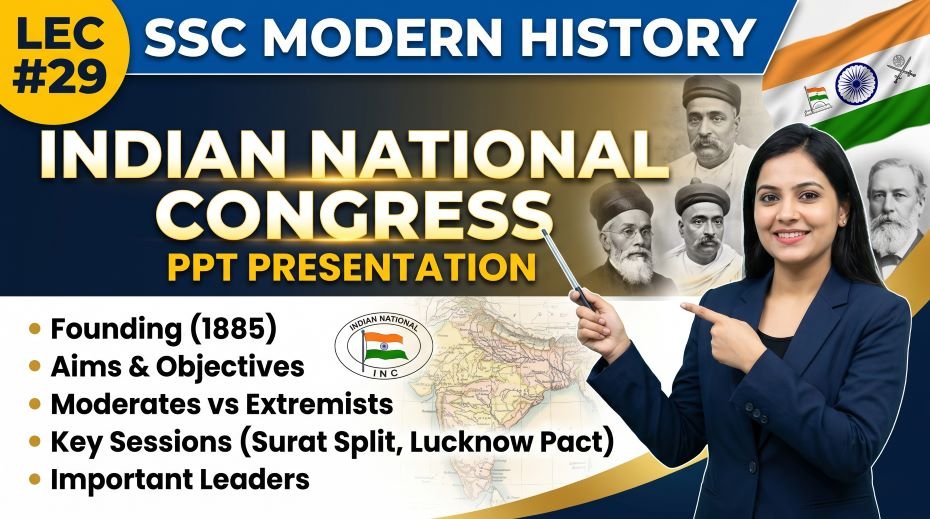
This is Lecture 29 (SSC Modern History Indian National Congress PPT (LEC #29) of the Complete Foundation Batch for All SSC Exams – PPT Series by SlidesharePPT. This lecture covers Modern Indian History: Indian National Congress (भारतीय राष्ट्रीय कांग्रेस) – the complete story of India’s freedom movement from the founding of INC in 1885 to independence in 1947, and one of the highest-scoring chapters in SSC CGL, SSC CHSL, SSC MTS, SSC GD Constable, and RRB Group D with 10 to 15 direct MCQs in almost every paper.
In this article, you will find a complete study guide built around the 97-slide PPT – including a 46-entry master timeline, Moderates vs Extremists comparison table, all landmark INC sessions with presidents and locations, Gandhi’s 8 major movements with causes and outcomes, a complete ‘Firsts in INC’ reference table, Podcast-style Q&A on the most confusing topics, and 30 practice MCQs with answers.
The PPT slides are embedded below – self-made, regularly updated, and fully ready for online and offline classroom use. Whether you are a teacher running a regular batch or a full marathon revision session before exams, or a student doing last-minute SSC preparation, you can view and use all 97 slides directly on any device – no download needed.
Section 1: PPT Resource Overview
| PPT RESOURCE OVERVIEW – LEC #29 | |
| Complete Foundation Batch for All SSC Exams | History PPT Series | Indian National Congress | |
| Lecture Title | Indian National Congress (भारतीय राष्ट्रीय कांग्रेस) |
| Lecture Number | Lecture 29 (LEC #29) |
| Serial Number | #54 in the Complete Foundation Batch PPT Series |
| Total Slides | 97 High-Quality PPT Slides |
| File Size | 20 MB |
| Subject | Modern Indian History |
| Series Name | Complete Foundation Batch for All SSC and Other Competitive Exams (PPT SERIES) |
| Target Exams | SSC CGL | SSC CHSL | SSC MTS | SSC GD Constable | RRB Group D | UPSC Prelims | State PSC |
| Topics Covered | Founding of INC (1885) → Moderate Phase → Extremist Phase → Surat Split → Swadeshi → Lucknow Pact → Home Rule → Gandhi Era → Non-Cooperation → Simon Commission → Civil Disobedience → Round Table Conferences → Quit India → Independence 1947 |
| Key Personalities | A.O. Hume, W.C. Bonnerjee, Dadabhai Naoroji, Gokhale, Tilak, Lal-Bal-Pal, Annie Besant, Gandhi, Nehru, Subhas Chandra Bose, Ambedkar |
| Difficulty Level | Moderate – large volume; INC presidents + session locations + movements tested frequently |
| Recommended Study | 2 to 3 days (first read) | 1 day (revision using tables) |
| PPT Source | slideshareppt.net |
| Best Combined With | LEC #28 (1857 Revolt) – 1857 planted the seeds; INC was the organized political outcome |
| Exam Tip: 10–15 direct MCQs from INC chapter – INC founding, presidents, session locations, and movements are highest frequency | |
SSC Modern History Indian National Congress PPT (LEC #29)
Note: If you wish to download the Complete SSC series (PPT slides), Simply visit this redirect page. –REDIRECT PAGE.
Section 2: Master Timeline – INC History (1883–1947)
Every key INC event, session, and movement in chronological order with SSC significance.
| Year | Event | Details & SSC Significance |
| 1883 | Ilbert Bill controversy | British officials protest Indian judges trying Europeans; shows racial divide; politicizes Indians; creates demand for political organization |
| 1885 | INC founded – Bombay (Dec 28) | A.O. Hume (retired British ICS officer) + 72 delegates; first session at Gokuldas Tejpal Sanskrit College, Bombay; W.C. Bonnerjee = first President; Lord Dufferin’s Viceroyalty |
| 1886 | 2nd INC Session – Calcutta | Dadabhai Naoroji presides; first major demands articulated; Drain of Wealth theory raised |
| 1887 | 3rd INC Session – Madras | Badruddin Tyabji = first Muslim President of INC |
| 1888 | 4th INC Session – Allahabad | George Yule = first English President of INC |
| 1893–1905 | Moderate Phase – key demands | Expansion of councils, civil service reform, reduction of military expenditure, repeal of Arms Act; methods: petitions, speeches, resolutions; believed in British sense of justice |
| 1896 | Bal Gangadhar Tilak introduces Ganesh Chaturthi festival | Used as tool of mass nationalist mobilization in Maharashtra; marks extremist methods beginning |
| 1899 | Gokhale founds Servants of India Society (1905) | G.K. Gokhale; moderate school; trained full-time social and political workers |
| 1905 | Partition of Bengal – Lord Curzon (Oct 16) | Biggest political blunder; divided Bengal on religious lines; triggered Swadeshi Movement and mass INC activity |
| 1905 | Swadeshi Movement begins | Boycott of British goods; use of Indian goods; bonfire of foreign cloth; mass political agitation; INC split on methods |
| 1906 | Muslim League founded – Dhaka | All India Muslim League; Nawab Salimullah + Aga Khan; separate Muslim political organization; British encouraged |
| 1906 | Calcutta INC Session – Dadabhai Naoroji presides | ‘Swaraj’ first officially demanded in an INC session; Naoroji uses the word; historic session |
| 1907 | Surat Split – INC divides | Extremists (Tilak) vs Moderates (Gokhale, Pherozeshah Mehta); fight over next INC President; Congress splits into two factions; Extremists expelled |
| 1909 | Morley-Minto Reforms | Indian Councils Act 1909; separate Muslim electorates; limited legislative power; INC demands not met; Extremists’ anger justified |
| 1911 | Delhi Durbar – Partition of Bengal annulled | King George V visits; partition reversed; capital shifted Delhi; INC moderates feel vindicated |
| 1913 | Gokhale founds Servants of India Society (1905); dies 1915 | Gokhale = mentor of Gandhi; dies February 1915; Gandhi promises to observe India for 1 year before acting politically |
| 1915 | Gandhi returns to India from South Africa | January 9, 1915; spent 1 year observing India as Gokhale advised; Champaran 1917 is first action |
| 1916 | Lucknow Pact | INC + Muslim League agree on joint demands; Tilak + Jinnah negotiate; Extremists and Moderates also reunite within INC at Lucknow session |
| 1916 | Home Rule League – Tilak (April) + Besant (Sept) | Two separate Home Rule Leagues; mass agitation for self-government within British Empire; Annie Besant becomes INC President 1917 |
| 1917 | Montagu Declaration | British promise ‘responsible government’ for India; vague but significant; first official acknowledgment of Indian political aspirations |
| 1919 | Montagu-Chelmsford Reforms / GoI Act 1919 | Dyarchy in provinces; limited franchise; direct elections; INC rejects as inadequate |
| 1919 | Rowlatt Act – March | No jury, no appeal; pressed by British to extend wartime powers into peace; Gandhi calls first nationwide hartal |
| 1919 | Jallianwala Bagh Massacre – April 13 | Brigadier Dyer orders firing at peaceful crowd; 379+ killed (official); 1000+ (nationalist count); turns moderate Indians into nationalists |
| 1920 | Non-Cooperation Movement – Aug 1 | Gandhi launches NCM; boycott of schools, courts, foreign cloth; return of titles; Khilafat Movement linked; INC session at Nagpur adopts Gandhi’s programme |
| 1922 | Chauri Chaura – Feb 4 | Mob burns police station; 22 policemen killed; Gandhi withdraws NCM unilaterally; splits movement |
| 1922 | Swarajist Party formed | C.R. Das + Motilal Nehru; enter legislatures to ‘wreck from within’; INC splits on strategy post-NCM withdrawal |
| 1927 | Simon Commission announced | All-white commission to review GoI Act 1919; INC announces boycott; Lala Lajpat Rai leads protest; hit by police lathi; dies November 17, 1928 |
| 1928 | Nehru Report | Motilal Nehru’s committee; first Indian-drafted constitutional proposals; dominion status demand; Jinnah rejects some clauses |
| 1929 | Lahore INC Session – Jawaharlal Nehru presides | ‘Purna Swaraj’ (Complete Independence) declared as INC goal; December 31, 1929 midnight; January 26, 1930 = first Independence Day |
| 1930 | Civil Disobedience Movement + Dandi March | March 12 – Gandhi starts Dandi March (241 miles, 24 days); April 6 – makes salt at Dandi; CDM launches; mass arrests |
| 1930 | First Round Table Conference – London | British + Indian princes + Muslim League; INC absent (Gandhi in jail); no agreement |
| 1931 | Gandhi-Irwin Pact – March 5 | CDM suspended; Gandhi released; agrees to attend Second RTC; British agree to release political prisoners |
| 1931 | Second Round Table Conference | Gandhi attends; communal deadlock; Gandhi returns empty-handed; CDM resumed |
| 1932 | Communal Award – Ramsay MacDonald | Separate electorates for Dalits; Gandhi fasts in prison; Poona Pact (Gandhi + Ambedkar) – reserved seats instead |
| 1932 | Third Round Table Conference | INC absent; results in Government of India Act 1935 |
| 1935 | Government of India Act | Provincial Autonomy; Federal structure (not implemented); RBI; Federal Court; Burma separated |
| 1937 | Provincial elections – Congress wins 8 provinces | Congress forms governments; Muslim League wins few seats; Jinnah feels Muslims must have separate guarantee |
| 1939 | Congress governments resign – WW2 protest | Viceroy declares India at war without consulting Indian leaders; Gandhi + Nehru outraged; all Congress governments resign |
| 1940 | Pakistan Resolution – Lahore (Muslim League) | March 23, 1940; Muslim League demands separate Muslim homeland; ‘Two-Nation Theory’ formally adopted |
| 1942 | Cripps Mission – fails | British offer: dominion status after war + constituent assembly; INC rejects – ‘a post-dated cheque on a failing bank’ (Gandhi) |
| 1942 | Quit India Movement – Aug 8–9 | Gandhi’s ‘Do or Die’ speech; ‘Quit India’ resolution; Gandhi + Congress leaders arrested immediately; mass leaderless uprising |
| 1944 | Gandhi-Jinnah talks – fail | Gandhi released due to health; meets Jinnah; no agreement on united India formula |
| 1945 | Simla Conference – Wavell | Attempt to form Executive Council with Congress + League; Jinnah demands parity; fails |
| 1946 | Cabinet Mission Plan | Three-tier federation plan; INC accepts with reservations; Jinnah accepts then rejects; last chance to avoid partition |
| 1946 | Direct Action Day – Aug 16 | Muslim League calls; Great Calcutta Killings; massive Hindu-Muslim violence; partition becomes inevitable |
| 1946 | Interim Government – Sept | Nehru heads interim government; Jinnah keeps League out initially; government paralyzed by League non-cooperation |
| 1947 | Mountbatten Plan – June 3 | Partition of India; Indian Independence Act; India + Pakistan independent August 14–15, 1947 |
Section 3: Founding of INC – Key Facts
Why Was INC Founded?
- Growing educated Indian middle class needed a political platform – product of English education policy
- Lessons of 1857 revolt: Indians needed organized political movement, not spontaneous uprisings
- Ilbert Bill controversy (1883): British officials protest against Indian judges – showed racial discrimination in law; galvanized Indian political awareness
- A.O. Hume believed INC would serve as a ‘safety valve’ for political discontent – preventing another 1857
- Dadabhai Naoroji, Pherozeshah Mehta, and other Indian leaders actively supported its formation
First INC Session – Quick Facts
- Date: December 28–30, 1885
- Location: Gokuldas Tejpal Sanskrit College, Bombay (originally planned at Pune – cholera epidemic shifted it)
- Delegates: 72 (from all across India)
- First President: W.C. Bonnerjee (Womesh Chunder Bonnerjee)
- Organized by: A.O. Hume (retired British ICS officer)
- Viceroy at the time: Lord Dufferin
- First demands: Civil service reforms, reduction of military expenditure, Indianization of government services
Section 4: Moderates vs Extremists – Complete Comparison
The two dominant schools of thought within INC. SSC asks both identification questions (‘Who was a Moderate?’) and comparison questions.
| Aspect | Moderates (1885–1905) | Extremists (1905–1920) |
| Period | 1885–1905 | 1905–1920 |
| Leaders | Dadabhai Naoroji, G.K. Gokhale, Pherozeshah Mehta, Surendranath Banerjea | Bal Gangadhar Tilak, Lala Lajpat Rai, Bipin Chandra Pal (Lal-Bal-Pal); Aurobindo Ghosh |
| Goal | Administrative reform within British Empire; Dominion status eventually | Purna Swaraj (complete independence); self-rule now, not gradually |
| Methods | Petitions, speeches, resolutions, press campaigns; believed in British justice | Mass agitation, boycott, swadeshi, passive resistance; did not trust British justice |
| View of British | British rule can be reformed; work through constitutional means | British rule is fundamentally exploitative; must be ended not reformed |
| Famous Quote | Dadabhai Naoroji: ‘Drain of Wealth’; Gokhale: ‘What Bengal thinks today, India thinks tomorrow’ | Tilak: ‘Swaraj is my birthright and I shall have it’; ‘Freedom is not given, it is taken’ |
| Key Achievements | Publicized Indian grievances; built organizational base; got reforms (limited); educated public opinion | Swadeshi Movement (1905); mass politics; connected common people to freedom struggle; INC became truly mass |
| Newspapers | Surendranath Banerjea – The Bengalee; Dadabhai – Rast Goftar | Tilak – Kesari (Marathi) + Mahratta (English); Bipin Pal – New India |
| Critique of each other | Called Extremists ‘anarchists’ and ‘dangerous’ | Called Moderates ‘political mendicants’ who beg Britain for rights |
| End of phase | Surat Split 1907 – Moderates expel Extremists | Lucknow Pact 1916 – Moderates and Extremists reunite; Gandhi era begins |
Lal-Bal-Pal – The Extremist Trio
- LAL: Lala Lajpat Rai – Punjab; deported to Mandalay 1907; died after lathi charge during Simon Commission protest (1928)
- BAL: Bal Gangadhar Tilak – Maharashtra; Kesari + Mahratta newspapers; Ganesh Chaturthi; Shivaji festival; imprisoned 1897 and 1908; ‘Swaraj is my birthright’
- PAL: Bipin Chandra Pal – Bengal; New India newspaper; radical Swadeshi; later became more moderate
Section 5: Key INC Sessions – Complete Reference
Session locations and presidents are directly asked in SSC MCQs. Know the landmark sessions.
| Session | Year | Location | President | Key SSC Significance |
| 1st Session | 1885 | Bombay | W.C. Bonnerjee | FIRST INC session; 72 delegates; Gokuldas Tejpal Sanskrit College; A.O. Hume organized; Lord Dufferin’s era |
| 3rd Session | 1887 | Madras | Badruddin Tyabji | First Muslim President of INC |
| 4th Session | 1888 | Allahabad | George Yule | First English/British President of INC |
| 12th Session | 1896 | Calcutta | Rahimtulla M. Sayani | Vande Mataram sung for first time at INC session – by Rabindranath Tagore |
| 22nd Session | 1906 | Calcutta | Dadabhai Naoroji | ‘Swaraj’ first demanded at INC; Naoroji uses the word officially; historic turning point |
| 23rd Session | 1907 | Surat | – | Surat Split – Extremists vs Moderates fight; INC divides; Tilak’s faction expelled |
| 1916 Session | 1916 | Lucknow | Ambica Charan Mazumdar | Lucknow Pact signed between INC and Muslim League; Tilak + Jinnah; INC reunites Moderates + Extremists |
| 1917 Session | 1917 | Calcutta | Annie Besant | First woman President of INC; Home Rule League leader; also head of Theosophical Society |
| Special Session | 1920 | Calcutta | Lala Lajpat Rai | Special session; Non-Cooperation Movement adopted; then confirmed at Nagpur session |
| 35th Session | 1920 | Nagpur | C. Vijayaraghavachariar | Non-Cooperation Movement formally adopted; INC constitution changed; Gandhi takes over |
| 1924 Session | 1924 | Belgaum | Mahatma Gandhi | Gandhi’s only INC presidential session |
| 1928 Session | 1928 | Calcutta | Motilal Nehru | Nehru Report presented; dominion status vs complete independence debate |
| 1929 Session | 1929 | Lahore | Jawaharlal Nehru | Purna Swaraj declared; Jan 26, 1930 = first Independence Day celebration; most important INC session |
| 1931 Session | 1931 | Karachi | Vallabhbhai Patel | Fundamental Rights and Economic Policy resolution; Gandhi-Irwin Pact ratified; INC’s socialist leanings formalized |
| 1938 Session | 1938 | Haripura | Subhas Chandra Bose | Bose elected INC President; conflict with Gandhi begins |
| 1939 Session | 1939 | Tripuri | Subhas Chandra Bose | Bose re-elected against Gandhi’s candidate (Pattabhi Sitaramayya); Gandhi says Bose’s victory is his defeat; Bose resigns; forms Forward Bloc |
Section 6: Gandhi’s Major Movements – Complete Table
All eight major Gandhi-led movements with cause, outcome, and SSC-critical facts.
| Movement | Year | Place | Cause / Issue | Key Facts & SSC Significance |
| Champaran Satyagraha | 1917 | Bihar | Against tinkathia indigo system; peasant oppression by European planters | Gandhi’s FIRST satyagraha in India; investigated conditions personally; British forced to repeal tinkathia; established Gandhi’s mass appeal |
| Kheda Satyagraha | 1918 | Gujarat | Revenue remission demand after crop failure; British refused legal right | Gandhi + Vallabhbhai Patel; British eventually accepted; Patel’s political debut; Kheda = Kaira district |
| Ahmedabad Mill Strike | 1918 | Gujarat | Mill workers’ demand for 35% wage hike; plague bonus withdrawn | Gandhi’s FIRST hunger strike (fast unto death); mill owner Ambalal Sarabhai; his sister Anasuya Sarabhai supported workers; workers got 35% hike |
| Rowlatt Satyagraha | 1919 | All India | Against Rowlatt Act (no jury, no appeal); Gandhi calls first nationwide hartal (April 6, 1919) | Jallianwala Bagh massacre (April 13) follows; Gandhi suspends movement calling it ‘Himalayan miscalculation’ due to violence |
| Non-Cooperation Movement | 1920–22 | All India | Boycott British schools, courts, foreign cloth; return titles/honours; Khilafat linked | Largest mass movement till then; Chauri Chaura (Feb 4, 1922) – Gandhi withdraws unilaterally; most controversial decision |
| Civil Disobedience Movement | 1930–34 | All India | Break British laws openly; Dandi March (salt); forest laws; revenue non-payment | Dandi March March 12 – April 6, 1930 (241 miles, 24 days); Gandhi-Irwin Pact (1931); CDM resumed; suspended 1934 |
| Individual Satyagraha | 1940–41 | All India | Symbolic individual protest against India being dragged into WW2 without consent | Vinoba Bhave = first satyagrahi; Jawaharlal Nehru = second; deliberate token protest |
| Quit India Movement | 1942 | All India | ‘Do or Die’ – British must quit India immediately during WW2 | August 8–9, 1942; Gandhi arrested immediately; leaderless uprising; Aruna Asaf Ali hoists INC flag at Gowalia Tank, Bombay; underground leaders: JP Narayan, Ram Manohar Lohia |
Section 7: Important ‘Firsts’ in INC – High-Frequency SSC Area
| First / Landmark | Year | Details |
| First INC Session | 1885, Bombay | W.C. Bonnerjee – first President of INC |
| First Muslim President | 1887 | Badruddin Tyabji – 3rd INC session, Madras |
| First English/British President | 1888 | George Yule – 4th INC session, Allahabad |
| First Woman President | 1917 | Annie Besant – Calcutta session; Irish-British Theosophist |
| First Indian Woman President | 1925 | Sarojini Naidu – Kanpur session; ‘Nightingale of India’ |
| Word ‘Swaraj’ first used at INC | 1906 | Dadabhai Naoroji – Calcutta session |
| ‘Purna Swaraj’ (Complete Independence) declared | 1929 | Lahore session – Jawaharlal Nehru presiding |
| Vande Mataram first sung at INC | 1896 | Calcutta session – by Rabindranath Tagore |
| Gandhi’s only presidential session | 1924 | Belgaum session |
| INC founded by | 1885 | A.O. Hume (retired British ICS officer); 72 delegates |
| INC founding venue | 1885 | Gokuldas Tejpal Sanskrit College, Bombay |
| First INC session originally planned at | 1885 | Pune (Poona) – shifted to Bombay due to cholera epidemic |
| Lucknow Pact signatories | 1916 | INC (Tilak side) + Muslim League (Jinnah) – joint constitutional demands |
| Surat Split year | 1907 | INC divides into Moderates and Extremists |
| INC’s goal changed to Purna Swaraj from | 1929 | Earlier goal was ‘Dominion Status’ (self-governance within British Empire) |
Section 8: Podcast Q&A – Most Frequently Confused Topics
| # | Question | Expert Answer – Exam-Focused |
| Q1 | Why was the INC founded? Was it a ‘safety valve’ for British? What is the truth? | The INC was founded in December 1885 by Allan Octavian Hume, a retired British ICS officer, with 72 delegates at Bombay. The ‘Safety Valve Theory’ (proposed by Lala Lajpat Rai and later debated) suggests that Lord Dufferin encouraged Hume to create the INC as a ‘safety valve’ – a controlled outlet for Indian political discontent that would prevent another 1857-style uprising. Evidence for this: Hume himself met with Viceroy Dufferin before founding INC; the early INC was extremely moderate and non-threatening. Evidence against this: INC quickly grew beyond British control; by 1906 it was demanding Swaraj; by 1929 Purna Swaraj; by 1942 Quit India. Modern consensus: INC may have started partly as a safety valve but rapidly became the genuine vehicle of Indian nationalism. SSC MCQ: ‘INC was founded by?’ → A.O. Hume. ‘First INC session was in?’ → Bombay, 1885. ‘First INC President?’ → W.C. Bonnerjee. |
| Q2 | What was the Surat Split (1907) and why did it happen? | The Surat Split was the dramatic division of the Indian National Congress at its 23rd session in Surat (1907) into two factions – Moderates and Extremists. Background: After the 1905 Partition of Bengal, the Extremists (Tilak, Lajpat Rai, Bipin Pal – ‘Lal-Bal-Pal’) wanted to extend the Swadeshi boycott to all of India and adopt more aggressive anti-British methods. The Moderates (Gokhale, Pherozeshah Mehta) wanted to restrict Swadeshi to Bengal and continue constitutional methods. The breaking point: The two sides could not agree on who should preside at the Surat session. Extremists wanted Lajpat Rai; Moderates insisted on Rash Behari Ghose. When the session opened, there was physical chaos – shoes were thrown; the session descended into a brawl. The Extremists were expelled from the Congress. Result: INC became a Moderate-only body from 1907 to 1916 – weaker without mass appeal. The split was repaired at the Lucknow session (1916) via the Lucknow Pact. |
| Q3 | What was the Lucknow Pact (1916) and why was it a turning point? | The Lucknow Pact (1916) was a landmark agreement signed between the Indian National Congress (led by Tilak on the moderate-extremist reunification side) and the All India Muslim League (represented by Muhammad Ali Jinnah). It was negotiated at the INC’s Lucknow session (1916). Key provisions: (1) Congress and League would present joint constitutional demands to the British; (2) Congress accepted the principle of separate electorates for Muslims (a concession to League demands); (3) Muslims got weightage in Hindu-majority provinces; Hindus got representation in Muslim-majority provinces. Why significant: (1) First time Congress and League cooperated – ‘Hindu-Muslim Unity’ moment; (2) INC’s Moderates and Extremists reunited at the same session; (3) Jinnah was at his most nationalist – earned the title ‘Ambassador of Hindu-Muslim Unity’ (given by Sarojini Naidu); (4) Tilak’s return to mainstream INC strengthened the organization. SSC MCQ: ‘Lucknow Pact was between?’ → INC + Muslim League (1916). ‘Who negotiated Lucknow Pact?’ → Tilak (INC side) + Jinnah (League side). |
| Q4 | Why did Gandhi withdraw the Non-Cooperation Movement after Chauri Chaura (1922)? | Gandhi withdrew the Non-Cooperation Movement (launched August 1920) on February 12, 1922, after the Chauri Chaura incident of February 4, 1922. What happened at Chauri Chaura: A mob of protesters in Chauri Chaura village (Gorakhpur, UP) clashed with police who had fired on them; the crowd retaliated by burning the police station; 22 policemen were killed. Gandhi’s reasoning for withdrawal: His movement was based on absolute non-violence (ahimsa); this was a violation of the core principle; if the movement had become violent, continuing it would be wrong regardless of political gains. Why it was controversial: The movement was at its peak – hartals, boycotts, and protests were paralyzing British India; most Congress leaders (including Nehru, who was in jail) were shocked and angry at the withdrawal; C.R. Das and Motilal Nehru formed the Swarajist Party as a result. Significance: Chauri Chaura → NCM withdrawn → Swarajist Party formed → shows the tension between Gandhi’s moral principles and political expediency. SSC MCQ: ‘Chauri Chaura incident was in?’ → February 4, 1922. ‘Gandhi withdrew NCM because of?’ → Chauri Chaura violence. |
| Q5 | What was the Dandi March? Give all SSC-critical details. | The Dandi March (Salt Satyagraha) was Gandhi’s most dramatic act of civil disobedience. Key facts for SSC: (1) Date started: March 12, 1930 from Sabarmati Ashram, Ahmedabad; (2) Destination: Dandi (a coastal village in Navsari, Gujarat); (3) Distance: 241 miles (about 385 km); (4) Duration: 24 days; (5) Companions: 78 selected volunteers marched with Gandhi; (6) Arrival at Dandi: April 6, 1930; (7) The act: Gandhi picked up a lump of salt from the sea – symbolically breaking the British salt law (which gave Britain monopoly over salt production and taxed salt); (8) Impact: Civil Disobedience Movement launched across India; mass arrests; approximately 60,000 people jailed; (9) International coverage: American journalist Webb Miller’s reports brought the march to world attention; (10) Significance: Chose salt because it affected ALL Indians equally – rich and poor, Hindu and Muslim, man and woman; universally understood symbol of British exploitation. SSC tip: ‘How long was Dandi March?’ → 24 days. ‘How far?’ → 241 miles. ‘When did Gandhi reach Dandi?’ → April 6, 1930. |
| Q6 | What were the Round Table Conferences and why did they fail? | Three Round Table Conferences were held in London to discuss India’s constitutional future: First RTC (November 1930 – January 1931): INC absent (Gandhi in jail, CDM ongoing); British + Indian princes + Muslim League + minorities attended; no agreement possible without Congress. Gandhi-Irwin Pact (March 1931) – Gandhi agrees to attend Second RTC in exchange for: release of political prisoners, right to make salt on coast, suspension of CDM. Second RTC (September–December 1931): Gandhi attends as sole INC representative; communal deadlock – Muslims, Sikhs, Dalits, Christians all demanded separate electorates; Gandhi argued for unified nationhood; no agreement; Gandhi returns empty-handed; CDM resumed. Third RTC (November–December 1932): INC absent; inconclusive; led to Government of India Act 1935. Why RTCs failed: (1) INC and British had incompatible positions on pace of self-government; (2) Communal deadlock – every minority demanded separate guarantees; (3) British used minority demands as excuse to delay transfer of power; (4) No goodwill after Jallianwala Bagh, Rowlatt Act, and continued repression. |

Section 9: 30 High-Frequency MCQs with Answers
Based on previous SSC CGL, CHSL, MTS, and GD Constable papers. Target: 27+ correct.
| # | Question | Answer |
| 01 | Indian National Congress was founded in which year and city? | 1885, Bombay (December 28, 1885) |
| 02 | Who founded the Indian National Congress? | A.O. Hume (Allan Octavian Hume) – retired British ICS officer |
| 03 | Who was the first President of INC? | W.C. Bonnerjee (Womesh Chunder Bonnerjee) – 1885 |
| 04 | First INC session was held at? | Gokuldas Tejpal Sanskrit College, Bombay |
| 05 | First Muslim President of INC? | Badruddin Tyabji (1887, Madras session) |
| 06 | First English/British President of INC? | George Yule (1888, Allahabad session) |
| 07 | First Woman President of INC? | Annie Besant (1917, Calcutta session) |
| 08 | First Indian Woman President of INC? | Sarojini Naidu (1925, Kanpur session) |
| 09 | ‘Swaraj’ was first demanded at which INC session? | 1906, Calcutta session – by Dadabhai Naoroji |
| 10 | Vande Mataram was first sung at INC session in? | 1896, Calcutta session – by Rabindranath Tagore |
| 11 | Surat Split (1907) divided INC into? | Moderates (Gokhale) and Extremists (Tilak, Lajpat Rai, Bipin Pal) |
| 12 | Lucknow Pact (1916) was between? | INC (Tilak side) and All India Muslim League (Jinnah) |
| 13 | ‘Purna Swaraj’ was declared at which INC session? | 1929, Lahore session – Jawaharlal Nehru presiding |
| 14 | January 26, 1930 significance? | First Independence Day celebration – after Purna Swaraj declaration (1929 Lahore session) |
| 15 | Gandhi’s only INC presidential session was? | 1924, Belgaum session |
| 16 | Dandi March started on which date from where? | March 12, 1930 – from Sabarmati Ashram, Ahmedabad |
| 17 | Gandhi reached Dandi and broke the salt law on? | April 6, 1930 |
| 18 | Dandi March distance and duration? | 241 miles – 24 days – 78 volunteers accompanied Gandhi |
| 19 | Chauri Chaura incident was on? | February 4, 1922 – 22 policemen killed; Gandhi withdrew NCM |
| 20 | Gandhi withdrew Non-Cooperation Movement because of? | Chauri Chaura violence – February 1922 |
| 21 | Home Rule League was founded by? | Two separate leagues: Tilak (April 1916) and Annie Besant (September 1916) |
| 22 | Quit India Movement was launched on? | August 8–9, 1942 – ‘Do or Die’ speech by Gandhi |
| 23 | Who hoisted INC flag at Gowalia Tank during Quit India? | Aruna Asaf Ali |
| 24 | Gandhi’s FIRST satyagraha in India was? | Champaran Satyagraha (1917, Bihar) – against tinkathia indigo system |
| 25 | Gandhi’s FIRST hunger strike (fast) was during? | Ahmedabad Mill Strike (1918) – workers’ wage demand |
| 26 | Simon Commission was boycotted because? | All-white commission; no Indian members; INC demanded Indian representation |
| 27 | Lala Lajpat Rai was injured during? | Simon Commission protest (Lahore, 1928) – lathi charge; died November 17, 1928 |
| 28 | Nehru Report (1928) was about? | First Indian-drafted constitutional proposals – by Motilal Nehru’s committee |
| 29 | Cripps Mission (1942) was rejected by Gandhi as? | ‘A post-dated cheque on a failing bank’ |
| 30 | INC originally planned its first session at? | Pune (Poona) – shifted to Bombay due to cholera epidemic |
Also read: SSC Modern History The Revolt of 1857 PPT (LEC #28)
Section 10: Rapid Revision – Last-Day Cheat Sheet
INC Founding – Must Know
- Founded: 1885 | By: A.O. Hume | Where: Bombay | First President: W.C. Bonnerjee
- Originally planned: Pune (shifted due to cholera) | Viceroy: Lord Dufferin
Key ‘Firsts’ – One Line Each
- First Muslim President = Badruddin Tyabji (1887) | First British President = George Yule (1888)
- First Woman President = Annie Besant (1917) | First Indian Woman = Sarojini Naidu (1925)
- Swaraj first demanded = 1906 Calcutta (Naoroji) | Purna Swaraj = 1929 Lahore (Nehru presiding)
- Vande Mataram first sung = 1896 Calcutta (Tagore) | Gandhi’s only session = 1924 Belgaum
Key Movements – Year + Trigger + Outcome
- Champaran 1917 → tinkathia indigo → tinkathia abolished (Gandhi’s first satyagraha in India)
- NCM 1920–22 → Rowlatt Act + Khilafat → Chauri Chaura → Gandhi withdraws
- CDM 1930 → Dandi March Mar 12 → salt made Apr 6 → Gandhi-Irwin Pact Mar 1931
- Quit India Aug 8–9, 1942 → ‘Do or Die’ → Gandhi arrested → Aruna Asaf Ali hoists flag
Surat Split + Lucknow Pact
- Surat Split 1907 → Moderates vs Extremists → Extremists expelled → INC weakened
- Lucknow Pact 1916 → INC + Muslim League → Tilak + Jinnah → reunification + joint demands
Conclusion
The Indian National Congress (LEC #29) is the spine of Modern Indian History – the organization through which India achieved independence. From A.O. Hume’s 72 delegates in 1885 to the midnight of August 15, 1947, INC is the story of India’s political awakening. The 97-slide PPT gives the complete visual narrative; this guide organizes every session, movement, and personality into exam-ready tables. Master the Timeline, Sessions Table, Gandhi’s Movements Table, and the 30 MCQs – and this chapter will deliver the highest marks of any single topic in your SSC exam.