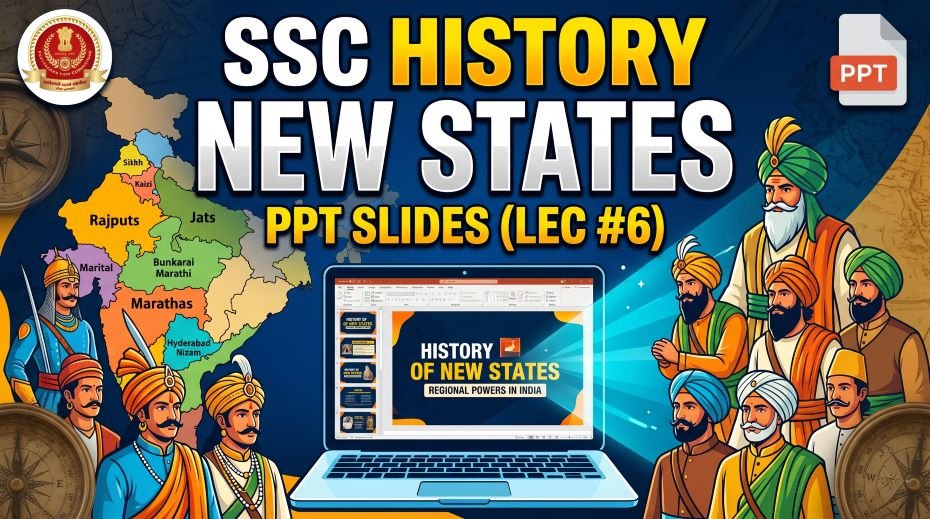
Download and study the SSC History New States PPT Slides (LEC #6) – covering Delhi Sultanate disintegration, Jaunpur, Malwa, Gujarat, Bahmani Kingdom, Kashmir, and Bengal. Best free history notes for SSC CGL, CHSL, MTS, CPO, and SSC GD exams.
If you are preparing for SSC CGL, SSC CHSL, SSC MTS, SSC CPO, or any other Staff Selection Commission exam, Medieval Indian History is one of the most scoring and frequently asked topics. Among all medieval history chapters, the disintegration of the Delhi Sultanate and the emergence of new provincial kingdoms stands out as a goldmine of questions every year.
This article is a complete breakdown of the SSC History New States PPT Slides – Lecture #5 and Lecture #6 – from the Complete Foundation Batch PPT Series available at slideshareppt.net. The PPT compilation contains 104 slides, covers the topic of New States (Naye Rajya / Naveen Rajya), and is Serial Number #31 in the series.
Whether you are a beginner just starting your SSC journey or an experienced aspirant revising before the final exam, this guide will help you understand every important point in a clear, structured, and exam-ready format.
Quick Facts About This PPT Series
| Detail | Information |
| PPT Series Name | Complete Foundation Batch for All SSC and Other Exams (PPT Series) |
| Subject | History – New States (Naye Rajya / Naveen Rajya) |
| Lecture Numbers | Lecture #6 |
| Total PPT Slides | 104 PPT Slides |
| File Size | 36 MB |
| Serial Number in Series | #31 |
| Best For | SSC CGL, SSC CHSL, SSC MTS, SSC CPO, SSC GD, Railways, UPSC Prelims |
| Source Website | slideshareppt.net |
SSC History New States PPT Slides (LEC #6)
Note: If you wish to download the entire SSC series (PPT slides), simply visit this redirect page. –REDIRECT PAGE
Complete Timeline Table: Key Events in Delhi Sultanate Disintegration and New States
This is the most important timeline for SSC exams. Questions on years, rulers, and events are very frequently asked. Memorise this table carefully.
| Year (AD) | Event | Ruler / Person | State / Region |
| 1206 | Establishment of Delhi Sultanate | Qutubuddin Aibak | Delhi |
| 1290 | Khilji Dynasty begins | Jalal ud-Din Khilji | Delhi Sultanate |
| 1297 | Gujarat annexed into Delhi Sultanate | Alauddin Khilji (defeated Raja Karna) | Gujarat |
| 1298 | Malwa first brought under Sultanate influence | Alauddin Khilji | Malwa |
| 1305 | Malwa fully conquered | Alauddin Khilji | Malwa |
| 1310 | Malwa formally annexed into Delhi Sultanate | Alauddin Khilji | Malwa |
| 1203 | Bengal and Bihar added to Sultanate | Mohammad Bin Bakhtiyar Khilji | Bengal / Bihar |
| 1320 | Tughlaq Dynasty begins | Ghiyasuddin Tughlaq | Delhi Sultanate |
| 1325 | Firoz Shah Tughlaq becomes Sultan | Firoz Shah Tughlaq | Delhi Sultanate |
| ~1360 | Jaunpur city founded in memory of Juna Khan | Firoz Shah Tughlaq | Jaunpur (UP) |
| 1394 | Jaunpur Sultanate established as independent state | Malik Sarwar (Malik-us-Sharq) | Jaunpur |
| 1347 | Bahmani Kingdom declared independent | Zafar Khan (took title: Alauddin Hasan Bahman Shah) | Deccan / Bahmani |
| 1368 | Gujarat becomes semi-independent | Zafar Khan Muzaffar I | Gujarat |
| 1407 | Gujarat Sultanate becomes fully independent | Ahmad Shah I | Gujarat |
| 1401 | Malwa Sultanate becomes independent | Dilawar Khan Ghuri | Malwa |
| ~14th C. | Muslim rule established in Kashmir | Shamasuddin Shah (a merchant) | Kashmir |
| 1526 | Delhi Sultanate ends; Mughal Empire begins | Babur defeats Ibrahim Lodi | Delhi |
Why Did the Delhi Sultanate Break Apart? Understanding the Disintegration
The Delhi Sultanate, which ruled a significant part of the Indian subcontinent for over three centuries (1206–1526 AD), did not collapse overnight. Its disintegration was a gradual process driven by several interconnected factors.
1. Weak Successors and Administrative Failures
- After strong sultans like Alauddin Khilji and Muhammad Bin Tughlaq died, their successors lacked administrative vision and military strength.
- Governors of distant provinces took advantage of this weakness and declared independence.
- The highly centralised administrative model collapsed when the centre became weak.
2. Financial Ruin Under Muhammad Bin Tughlaq
- Muhammad Bin Tughlaq’s costly experiments – moving the capital to Daulatabad and introducing token currency – drained the treasury.
- Rebellions became common as soldiers and officials went unpaid.
3. Timur’s Invasion (1398 AD)
- The invasion of Timur (Tamerlane) destroyed Delhi and looted the Sultanate’s wealth.
- After Timur left, the Sultans had little authority beyond Delhi and its immediate surroundings.
- Provincial governors saw this as the perfect opportunity to break away.
4. Rise of Strong Regional Identities
- Regions like Bengal, Gujarat, Kashmir, Malwa, and the Deccan had strong local cultures and identities.
- Local nobles and governors who had lived in these regions for generations preferred local autonomy.
The Six Major New States That Emerged from Delhi Sultanate’s Disintegration
The second image from the PPT (Dilli Saltanat ke Vighatan) shows six hexagonal regions that broke away. Let us study each one in complete detail for SSC exam preparation.
1. Jaunpur (जौनपुर) – The Sharqi Kingdom
Jaunpur is one of the most frequently asked topics in SSC History papers related to medieval India.
- Location: Modern-day eastern Uttar Pradesh, near Varanasi.
- The city of Jaunpur was founded by Firoz Shah Tughlaq in the memory of Juna Khan (Muhammad Bin Tughlaq’s original name was Juna Khan).
- Jaunpur was established as a tribute to Muhammad Bin Tughlaq, who was also known as Juna Khan before becoming Sultan.
- The Jaunpur Sultanate was formally established in 1394 AD by Malik Sarwar, also known as Malik-us-Sharq (King of the East), hence the dynasty is called the Sharqi Dynasty.
- Jaunpur became a major centre of learning and culture and is often called the ‘Shiraz of India’ for its intellectual environment.
- The Jaunpur Sultanate was eventually absorbed into the Delhi Sultanate again by Sikandar Lodi in 1479 AD.
SSC Exam Tip: Remember – Jaunpur was founded by Firoz Shah Tughlaq in memory of Juna Khan. This is a very common SSC MCQ.
2. Malwa (मालवा) – The Central Indian Sultanate
Malwa is a historically rich plateau region in central India, covering modern Madhya Pradesh.
- Malwa was first annexed into the Delhi Sultanate by Alauddin Khilji in 1310 AD.
- The Malwa Sultanate declared independence from Delhi around 1401 AD under Dilawar Khan Ghuri.
- The capital of the Malwa Sultanate was Mandu (also called Shadiabad – the City of Joy).
- The Malwa Sultanate had two main dynasties: the Ghuri dynasty and later the Khalji dynasty of Malwa (different from Delhi’s Khilji).
- The famous ruler Mahmud Khilji of Malwa fought extensively with the Mewar king Rana Kumbha.
- Malwa was eventually annexed by the Mughal Emperor Humayun in 1531 AD and permanently absorbed under Akbar.
SSC Exam Tip: Alauddin Khilji annexed Malwa in 1310 AD – this is the most repeated SSC fact about Malwa.
3. Gujarat (गुजरात) – The Prosperous Western Kingdom
Gujarat, owing to its long coastline and thriving trade ports, was one of the wealthiest provinces of medieval India.
- Alauddin Khilji defeated Raja Karna (the Solanki/Vaghela king of Gujarat) and annexed Gujarat into the Delhi Sultanate in 1297 AD.
- This campaign was led by Alauddin Khilji’s generals Ulugh Khan and Nusrat Khan.
- The famous incident of Malik Kafur’s rise to power is connected to the Gujarat campaign – he was purchased as a slave during this expedition.
- The Gujarat Sultanate broke away from Delhi around 1407 AD and became fully independent under Ahmad Shah I.
- The capital of the Gujarat Sultanate was Ahmedabad, founded by Ahmad Shah I in 1411 AD.
- Gujarat Sultanate was known for its naval power, rich trade, and cultural synthesis.
- Mahmud Begada was the most famous ruler of the Gujarat Sultanate, known for his military campaigns and love for literature.
SSC Exam Tip: Alauddin Khilji defeated Raja Karna and annexed Gujarat in 1297 AD. Malik Kafur was acquired during this same campaign.
4. Bahmani Kingdom (बहमनी राज्य) – The Deccan Sultanate
The Bahmani Kingdom was one of the most powerful and long-lasting of the new states that emerged from the Delhi Sultanate’s weakening grip.
- Zafar Khan, a noble under Muhammad Bin Tughlaq, rebelled against the Sultan in the Deccan.
- In 1347 AD, Zafar Khan assumed the grand title of Alauddin Hasan Bahman Shah and established the Bahmani Sultanate.
- The name ‘Bahmani’ is derived from ‘Bahman Shah’ – the title taken by Zafar Khan.
- The initial capital of the Bahmani Sultanate was Gulbarga (present-day Karnataka), later shifted to Bidar.
- The Bahmani Sultanate was in constant conflict with the Vijayanagara Empire in the south.
- The Bahmani Kingdom later broke into five smaller Deccan Sultanates: Bijapur, Ahmadnagar, Golconda, Bidar, and Berar.
- Mahmud Gawan was the most capable Prime Minister (Wazir) of the Bahmani Sultanate.
SSC Exam Tip: Zafar Khan established the Bahmani Kingdom in 1347 AD by taking the title ‘Alauddin Hasan Bahman Shah’. This year and name are very commonly tested.
5. Kashmir (कश्मीर) – The Valley Kingdom
Kashmir has a unique political and cultural history in the context of medieval India.
- The beginning of Muslim rule in Kashmir is credited to Shamasuddin Shah, who is historically noted as a merchant by profession – a very unusual background for a king.
- Shamasuddin Shah founded the Muslim dynasty of Kashmir in the early 14th century.
- The most illustrious ruler of medieval Kashmir was Sultan Zain-ul-Abidin (1420–1470 AD), often called the ‘Akbar of Kashmir’ for his religious tolerance and promotion of arts.
- Zain-ul-Abidin abolished jizya (tax on non-Muslims), allowed Hindus to hold high offices, and patronised Kashmiri language and literature.
- Kashmir was known for its fine shawls, carpets, and woodcraft during this period.
SSC Exam Tip: Muslim rule in Kashmir was established by Shamasuddin Shah, who was a merchant. Zain-ul-Abidin is called the ‘Akbar of Kashmir’ – both facts are SSC exam favourites.
6. Bengal (बंगाल) – The Eastern Province
Bengal occupies a special place in the history of the Delhi Sultanate as one of the earliest regions to be brought under Muslim rule.
- The credit for including Bengal and Bihar into the Delhi Sultanate goes to Mohammad Bin Bakhtiyar Khilji – a military commander under Qutubuddin Aibak.
- Mohammad Bin Bakhtiyar Khilji is also infamous for destroying the famous Nalanda University in Bihar around 1193 AD.
- Bengal remained under Delhi Sultanate control through several governors but frequently declared independence during periods of weak central rule.
- The Bengal Sultanate declared full independence in the 14th century and lasted until Akbar absorbed it in 1576 AD.
- Ilyas Shah was an important ruler who united Bengal and fought against Firoz Shah Tughlaq.
- The Hussain Shahi dynasty of Bengal (1494–1538 AD) is considered the golden age of the Bengal Sultanate.
SSC Exam Tip: Bengal and Bihar were added to the Sultanate by Mohammad Bin Bakhtiyar Khilji – and he also destroyed Nalanda University. Both facts are very commonly tested together in SSC exams.
Comparative Summary Table: All Six New States at a Glance
This table is ideal for last-minute revision before the exam.
| State | Founded By | Year | Capital | Notable Ruler | Key SSC Fact |
| Jaunpur | Malik Sarwar (Malik-us-Sharq) | 1394 AD | Jaunpur (UP) | Ibrahim Shah Sharqi | City founded by Firoz Tughlaq in memory of Juna Khan |
| Malwa | Dilawar Khan Ghuri | 1401 AD | Mandu (Shadiabad) | Mahmud Khilji | First annexed by Alauddin Khilji in 1310 AD |
| Gujarat | Zafar Khan Muzaffar I | 1407 AD (fully) | Ahmedabad | Mahmud Begada | Annexed by Alauddin Khilji in 1297; Malik Kafur origin |
| Bahmani | Zafar Khan (Alauddin Hasan Bahman Shah) | 1347 AD | Gulbarga → Bidar | Mahmud Gawan | Later split into 5 Deccan Sultanates |
| Kashmir | Shamasuddin Shah (merchant) | Early 14th C. | Srinagar | Zain-ul-Abidin | Zain-ul-Abidin called ‘Akbar of Kashmir’ |
| Bengal | Mohammad Bin Bakhtiyar Khilji (under Sultanate) | 1203 AD (included) | Gaur / Pandua | Ilyas Shah; Hussain Shah | Bakhtiyar Khilji also destroyed Nalanda University |
About the Complete Foundation Batch PPT Series for SSC Exams
The Complete Foundation Batch PPT Series is one of the most popular free study material resources for SSC aspirants in India. Here is a complete breakdown of what makes this series so effective:
What is Included in the PPT Series?
- Subject-wise PPT compilations covering History, Geography, Polity, Economics, Science, and Current Affairs.
- Each lecture PPT contains hand-picked, exam-relevant content sourced from standard books like Spectrum’s Brief History, NCERT History textbooks, and Old NCERT books.
- The History – New States PPT Slides (Lecture #5 and #6) contains 104 slides covering all major new states, timelines, rulers, capitals, and important events.
- The slides are designed in a visually engaging format with colour-coded hexagonal diagrams, tables, and flowcharts to make memorisation easier.
Who Is This PPT Series Best For?
- SSC CGL (Combined Graduate Level) aspirants – Tier I and Tier II General Awareness
- SSC CHSL (Combined Higher Secondary Level) aspirants
- SSC MTS, SSC CPO, SSC GD candidates
- Railway NTPC, Railway Group D candidates
- UPSC Prelims aspirants looking for quick revision material
- Students in Classes 11 and 12 studying Medieval History
High-Frequency SSC MCQs on New States – Previous Year Pattern
Based on the pattern of SSC CGL, CHSL, and MTS papers, here are the most commonly asked questions from this chapter:
| Question | Correct Answer | Exam Appeared In |
| Jaunpur city was founded in memory of which ruler? | Juna Khan (Muhammad Bin Tughlaq) | SSC CGL 2019, SSC CHSL 2020 |
| Who first annexed Malwa into the Delhi Sultanate? | Alauddin Khilji (1310 AD) | SSC CGL 2017, SSC MTS 2021 |
| The Bahmani Kingdom was established in which year? | 1347 AD | SSC CPO 2018, SSC CGL 2022 |
| Who established the Bahmani Sultanate? | Zafar Khan (Alauddin Hasan Bahman Shah) | SSC CHSL 2019, SSC GD 2021 |
| Who is credited with adding Bengal and Bihar to the Sultanate? | Mohammad Bin Bakhtiyar Khilji | SSC CGL 2016, SSC MTS 2020 |
| Alauddin Khilji defeated which ruler to annex Gujarat in 1297? | Raja Karna | SSC CGL 2018, SSC CPO 2020 |
| Muslim rule in Kashmir was first established by whom? | Shamasuddin Shah (a merchant) | SSC CHSL 2021, SSC MTS 2022 |
| Zain-ul-Abidin is known by which title? | Akbar of Kashmir | SSC CGL 2020, SSC CHSL 2023 |
| Who destroyed Nalanda University? | Mohammad Bin Bakhtiyar Khilji | SSC CGL 2015, 2017, 2019 (repeated multiple times) |
| The Sharqi dynasty ruled over which region? | Jaunpur | SSC CPO 2019, SSC GD 2022 |
| What was the capital of the Bahmani Sultanate initially? | Gulbarga | SSC CGL 2021, SSC CHSL 2022 |
| Who was called the ‘Akbar of Kashmir’ for his tolerance? | Zain-ul-Abidin | SSC MTS 2021, SSC CHSL 2022 |
Podcast Interview – Expert Q&A: SSC History New States Chapter Deep Dive
To help you understand this chapter from multiple perspectives, here is a simulated expert interview in a question-and-answer format, just like a podcast discussion between a seasoned SSC educator and a first-time aspirant.
| Speaker | Question / Statement | Answer / Explanation |
| Aspirant (Student) | Sir, why is the chapter ‘New States’ so important for SSC exams specifically? | Educator: Because SSC loves facts about medieval India – years, rulers, capitals, and titles. The New States chapter is packed with such facts. Questions like ‘who founded Jaunpur’ or ‘what year did Bahmani Kingdom start’ come every single year in at least one SSC exam. It is a high-yield, low-effort chapter if studied correctly. |
| Aspirant | Which single year from this chapter is most important to remember? | Educator: Without a doubt, 1347 AD – the founding of the Bahmani Kingdom by Zafar Khan. It appears in almost every SSC CGL paper. After that, 1297 AD (Gujarat annexed by Alauddin) and 1310 AD (Malwa annexed) are also very frequently tested. |
| Aspirant | I always confuse Juna Khan and Firoz Shah Tughlaq when it comes to Jaunpur. Can you clarify? | Educator: Great question! Firoz Shah Tughlaq FOUNDED the city of Jaunpur. But the city was named in MEMORY of Juna Khan, who was Muhammad Bin Tughlaq’s original name before he became Sultan. So remember: builder = Firoz Shah Tughlaq; name inspiration = Juna Khan. |
| Aspirant | What is the trick to remember that Shamasuddin Shah was a merchant? | Educator: Just remember the phrase ‘Kashmir was ruled by a trader turned king’. It is a unique, unusual fact – a merchant becoming a king. Unusual facts are easy to remember. No other major medieval kingdom was founded by a merchant. This uniqueness is your memory hook. |
| Aspirant | Is it important to know about Zain-ul-Abidin for SSC? | Educator: Absolutely. He is called the ‘Akbar of Kashmir’ because just like Akbar promoted religious harmony in the Mughal era, Zain-ul-Abidin abolished jizya, welcomed Hindus into his court, and supported multiple languages and arts. SSC often asks this comparison. Remember: Akbar of Kashmir = Zain-ul-Abidin. |
| Aspirant | Why do I keep seeing Nalanda University connected to the Bengal question? | Educator: Because the same person – Mohammad Bin Bakhtiyar Khilji – is responsible for both. He conquered Bihar and Bengal AND destroyed Nalanda University during those campaigns. SSC examiners love to club these two facts in a single question to test whether you know the full picture. |
| Aspirant | How should I study the Bahmani Kingdom for SSC – it seems very complicated. | Educator: For SSC, just focus on three things: the founder (Zafar Khan / Alauddin Hasan Bahman Shah), the year (1347 AD), and the fact that it later broke into five Deccan Sultanates. If they ask about the Deccan Sultanates, the five names are Bijapur, Ahmadnagar, Golconda, Bidar, and Berar. SSC CGL sometimes asks to identify which one is NOT a Deccan Sultanate. |
| Aspirant | Which PPT resource would you recommend for studying this topic visually? | Educator: The SSC History New States PPT Slides from the Complete Foundation Batch series – Lecture #5 and #6 – are excellent. They have 104 slides with colour-coded diagrams, timeline charts, and hexagonal cluster diagrams that make it very easy to visualise which states broke away from Delhi and when. You can find them at slideshareppt.net. |
| Aspirant | Any final advice for this chapter before the exam? | Educator: Revise the Timeline Table at least three times in the last week before the exam. Focus on years, founders, and any unusual facts like Shamasuddin Shah being a merchant or Juna Khan being the inspiration for Jaunpur. Download the PPT slides, spend 45 minutes on them, and you will be ready for any MCQ this chapter can throw at you. |
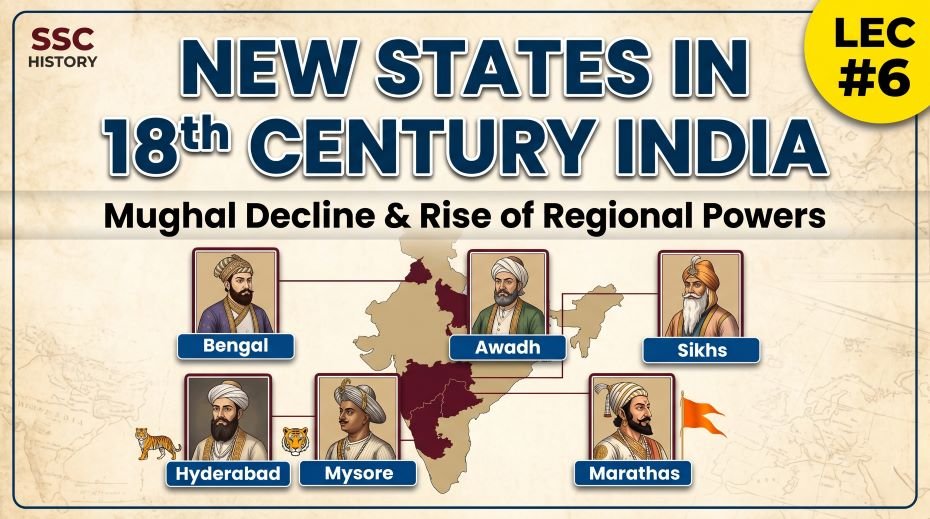
How to Study This Chapter for Maximum Marks in SSC Exams
Step 1: Build the Framework (Day 1)
- Start with the Timeline Table given above. Read through it twice without trying to memorise.
- Understand the broad pattern: Delhi Sultanate weakened → governors broke away → new kingdoms formed.
- Understand which directions each state was in: Gujarat (west), Bengal (east), Kashmir (north), Bahmani (south), Jaunpur and Malwa (central/north India).
Step 2: Study Each State in Detail (Day 2–3)
- Go state by state using this article and the PPT slides.
- For each state, note: founder, year of independence, capital, most famous ruler, and the one unique SSC fact.
- Use the Comparative Summary Table to cross-check your notes.
Step 3: Practice MCQs (Day 4–5)
- Solve the High-Frequency MCQ table from this article first.
- Then attempt previous year SSC papers specifically on the New States and Delhi Sultanate topic.
- Aim for 90% accuracy in this chapter – it is very much achievable with focused preparation.
Step 4: Rapid Revision (Exam Day)
- Review only the Timeline Table and Comparative Summary Table.
- Recall the five Deccan Sultanates: Bijapur, Ahmadnagar, Golconda, Bidar, Berar.
- Remember: Jaunpur (Firoz/Juna Khan), Malwa (1310 Alauddin), Gujarat (1297 Raja Karna), Bahmani (1347 Zafar Khan), Kashmir (Shamasuddin Shah merchant), Bengal (Bakhtiyar Khilji).
Recommended Books and Resources for SSC History Preparation
| Resource | Type | Why Recommended |
| Spectrum’s Brief History of Modern India | Book | Best for Modern History; also covers transition from medieval to modern period |
| NCERT Class 7 – Our Pasts II | Textbook | Covers Delhi Sultanate and New States in simple language; best for beginners |
| NCERT Class 11 – Themes in Indian History I | Textbook | In-depth primary source approach to medieval India |
| Old NCERT – Medieval India by Satish Chandra | Book | Most detailed coverage of Delhi Sultanate, Khilji, Tughlaq, and New States |
| SSC History New States PPT Slides (LEC #6) | PPT Slides | 104 slides; visual diagrams; exam-focused content; free on slideshareppt.net |
| GK Today (gktoday.in) | Website | Free MCQs and quizzes on medieval Indian history for SSC practice |
| Lucent’s General Knowledge | Book | Quick reference for dates, names, and facts – useful for last-minute revision |
Frequently Asked Questions (FAQs) – SSC History New States
Q1: What is the most important topic in the New States chapter for SSC CGL?
The founding of the Bahmani Kingdom (1347 AD by Zafar Khan) and the annexation of Gujarat by Alauddin Khilji (1297 AD) are the most tested topics. The Jaunpur connection to Juna Khan is also very frequently asked.
Q2: How many New States emerged from the Delhi Sultanate?
While many small provincial kingdoms emerged, the six major ones covered in SSC exams are: Jaunpur, Malwa, Gujarat, Bahmani Kingdom, Kashmir, and Bengal. Each of these has its own unique facts that are exam-relevant.
Yes, the Complete Foundation Batch PPT Series available at slideshareppt.net is a free resource designed for SSC aspirants across India.
Q4: What are the five Deccan Sultanates that emerged from the Bahmani Kingdom?
The five Deccan Sultanates that emerged after the Bahmani Kingdom broke apart are: Bijapur, Ahmadnagar, Golconda, Bidar, and Berar. This is a common SSC exam question.
Q5: Which ruler is called the ‘Akbar of Kashmir’?
Sultan Zain-ul-Abidin (1420–1470 AD) is called the ‘Akbar of Kashmir’ because of his policy of religious tolerance, abolition of jizya, and patronage of arts and literature.
Q6: Why is Mohammad Bin Bakhtiyar Khilji important for both Bengal and Bihar history?
Mohammad Bin Bakhtiyar Khilji was the military commander who conquered Bihar and Bengal and added them to the Delhi Sultanate around 1203 AD. He is also the person responsible for burning and destroying Nalanda University, which was the world’s greatest centre of learning at that time.
READ ALSO: SSC History Jainism and Buddhism PPT Slides (LEC #5)
Conclusion – Your Complete Roadmap to Mastering the New States Chapter
The SSC History New States PPT Slides – Lecture #5 and Lecture #6 – offer one of the most comprehensive, visually engaging, and exam-focused summaries of a chapter that can easily give you two to four marks in any SSC exam.
To summarise the key learning points from this article:
- The Delhi Sultanate disintegrated due to weak rulers, Timur’s invasion, and strong regional identities.
- Six major new states emerged: Jaunpur, Malwa, Gujarat, Bahmani Kingdom, Kashmir, and Bengal.
- The most exam-important year is 1347 AD (Bahmani Kingdom), followed by 1297 AD (Gujarat) and 1310 AD (Malwa).
- Zain-ul-Abidin = Akbar of Kashmir; Shamasuddin Shah = merchant who founded Muslim rule in Kashmir.
- Mohammad Bin Bakhtiyar Khilji added Bengal and Bihar AND destroyed Nalanda University.
- Jaunpur city was built by Firoz Shah Tughlaq in memory of Juna Khan (Muhammad Bin Tughlaq).
Download the PPT slides from slideshareppt.net, revise the Timeline Table every day in the final week before your exam, and practice the MCQs provided in this guide. With consistent effort, this chapter will become one of your strongest areas.