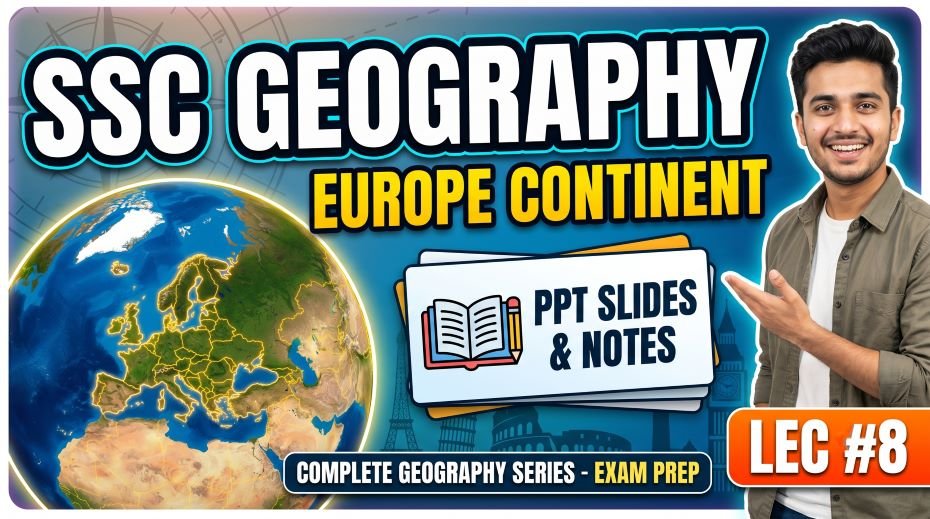
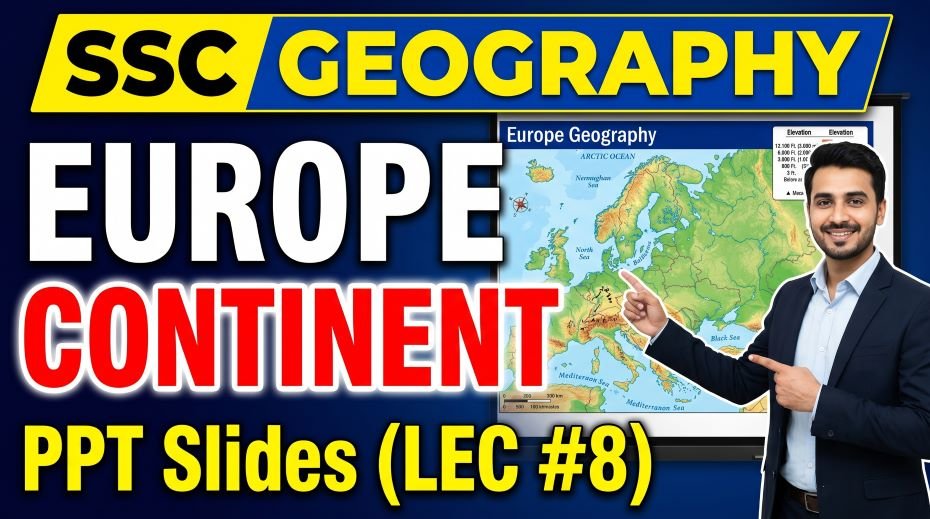
This article accompanies the SSC Geography Europe Continent PPT Slides (LEC #8) – Serial #86 of the Complete Foundation Batch for All SSC Exams PPT Series on slideshareppt.net. With 107 slides in bilingual Hindi + English format, this is one of the most detailed lectures in the series. This article provides the full structured theory, timeline, comparison tables, MCQs, and a rapid revision cheat sheet, all aligned to the SSC exam pattern. Europe is the birthplace of the modern nation-state system, the European Union, and centuries of history that shaped the modern world – making it a consistently important topic in SSC CGL, SSC CHSL, SSC MTS, SSC GD Constable, and RRB Group D General Awareness sections. From the Alps and the Danube River to the fall of the Berlin Wall and the formation of the EU, Europe offers a dense set of high-yield geography and history facts.
PPT Resource Overview
| Detail | Information |
| Lecture Number | LEC #8 (Geography Series) |
| Serial Number in Complete Batch | #86 |
| Subject | Geography – Europe Continent (यूरोप महाद्वीप) |
| Series Name | Complete Foundation Batch for All SSC Exams (PPT Series) |
| Total Slides | 107 PPT Slides |
| File Size | 65 MB |
| Language | Hindi + English (Bilingual) |
| Format Available | Google Slides & Google Drive (PDF also available) |
| Website | www.slideshareppt.net |
| Target Exams | SSC CGL, SSC CHSL, SSC MTS, SSC GD Constable, RRB Group D |
| Suitable For | Students (self-study & marathon revision) and Teachers (classroom use) |
SSC Geography Europe Continent PPT Slides (LEC #8)
Note: Above is PPT in GOOGLE SLIDES (HTML AND IFRAME COMBINATION) and if you wish to download the Complete SSC series (PPT slides), visit this Link – REDIRECT PAGE.
Master Timeline: Europe – Civilisation, Empire, and Modern Union
| Period | Event / Milestone | SSC Exam Relevance |
| ~2700–1450 BCE | Minoan civilisation flourishes on Crete – one of Europe’s earliest advanced civilisations | Earliest European civilisation |
| ~800–146 BCE | Ancient Greek civilisation – rise of city-states like Athens and Sparta; birthplace of democracy | Ancient Greece – democracy origin |
| 27 BCE – 476 CE | Roman Empire dominates Europe; falls in West in 476 CE (Eastern/Byzantine continues to 1453) | Roman Empire – major ancient power |
| 800 CE | Charlemagne crowned Holy Roman Emperor – unifies much of Western Europe | Holy Roman Empire origin |
| 1095–1291 | The Crusades – series of religious wars between European Christians and Muslim powers | Crusades – medieval history fact |
| 1347–1351 | Black Death pandemic kills an estimated one-third of Europe’s population | Black Death – major historical demographic event |
| 1450s | Johannes Gutenberg invents the printing press in Germany – revolutionises information spread | Printing press invention |
| 1492 | Spain completes the Reconquista; Columbus’s voyage launches the Age of Exploration | Age of Exploration begins |
| 1517 | Martin Luther’s 95 Theses sparks the Protestant Reformation | Protestant Reformation origin |
| 1789 | French Revolution begins – overthrows monarchy, reshapes European political thought | French Revolution – major political event |
| 1815 | Congress of Vienna redraws European borders after the Napoleonic Wars | Post-Napoleonic European order |
| 1914–1918 | World War I – fought largely across Europe; reshapes the continent’s borders | WWI – origin and major European event |
| 1939–1945 | World War II – most destructive conflict in European history | WWII – major 20th-century event |
| 1949 | NATO (North Atlantic Treaty Organization) founded for collective European-American defence | NATO founding – frequently asked |
| 1957 | Treaty of Rome establishes the European Economic Community (EEC), precursor to the EU | Origin of European Union |
| 1989 | Fall of the Berlin Wall – symbolic end of Cold War division of Europe | Berlin Wall fall – very frequently asked |
| 1993 | Maastricht Treaty formally establishes the European Union (EU) | European Union formation date |
| 2002 | Euro currency introduced as physical cash across most EU member states | Euro currency introduction |
| 2020 | United Kingdom formally exits the European Union (“Brexit”) | Brexit – major recent current affairs/history event |
Europe – Overview of the Continent
Europe is the sixth-largest continent by area but the third most populous, known for its dense concentration of sovereign nations, advanced economies, and deep historical legacy. It is bordered by the Arctic Ocean to the north, the Atlantic Ocean to the west, the Mediterranean Sea to the south, and is conventionally separated from Asia by the Ural Mountains and the Caspian Sea to the east, together forming the landmass often referred to as Eurasia. Europe hosts the Alps, the Danube River, and dozens of distinct cultures and languages packed into a relatively compact geographic area.
Europe – Complete Key Facts Table
| Parameter | Detail |
| Continent Rank by Area | 6th largest continent (larger only than Australia) |
| Total Area | 10.5 million sq km |
| Population (approx.) | ~746 million – 3rd most populous continent |
| Number of Countries | 44 sovereign countries (commonly cited figure; varies by classification of transcontinental nations) |
| Largest Country by Area | Russia (European part) – Russia overall is world’s largest country; European Russia alone is largest in Europe |
| Smallest Country by Area | Vatican City – smallest sovereign state in the world |
| Most Populous Country | Russia (European part) / Germany is largest fully-European EU member by population |
| Highest Peak | Mount Elbrus – 5,642 m (Russia, Caucasus); some classify Mont Blanc (4,808 m) as highest if Caucasus excluded |
| Longest River | Volga River – ~3,530 km; longest river entirely within Europe |
| Major Mountain Range | The Alps – runs through France, Switzerland, Italy, Austria, and other countries |
| Continental Boundary (East) | Ural Mountains and Caspian Sea – conventional boundary between Europe and Asia |
| Major Economic/Political Body | European Union (EU) – currently 27 member states |
| Common Currency | Euro – used by 20 of 27 EU member states (Eurozone) |
| Major Military Alliance | NATO – North Atlantic Treaty Organization, founded 1949 |
| Religion (majority) | Christianity (various denominations – Catholic, Protestant, Orthodox) |
| Languages | Over 200 languages; major families include Romance, Germanic, Slavic |
Major Countries of Europe – Reference Table
| Country | Capital | Key Geographic / SSC Fact |
| Russia | Moscow | World’s largest country by area; spans both Europe and Asia; European part is largest in Europe |
| Germany | Berlin | Largest economy in Europe; most populous fully-European EU member; reunified in 1990 |
| France | Paris | Largest country in the EU by area; home to the Eiffel Tower and Louvre Museum |
| United Kingdom | London | Formally exited the EU in 2020 (Brexit); comprises England, Scotland, Wales, Northern Ireland |
| Italy | Rome | Centre of the ancient Roman Empire and Renaissance; home to Vatican City |
| Spain | Madrid | Major colonial power historically; shares Iberian Peninsula with Portugal |
| Switzerland | Bern | Not an EU member; known for neutrality, banking, and the Alps |
| Vatican City | Vatican City | Smallest sovereign state in the world by both area and population; seat of the Roman Catholic Church |
| Greece | Athens | Birthplace of democracy and Western philosophy; ancient Greek civilisation |
| Netherlands | Amsterdam | Known for low-lying geography – significant land reclaimed from the sea |
| Norway | Oslo | Not an EU member; major oil and gas producer; extensive fjord coastline |
| Ukraine | Kyiv | Largest country located entirely within Europe by area; major agricultural producer |
Physical Geography of Europe
Mountains of Europe
| Mountain / Peak | Location | Height | Key Facts for SSC |
| Mount Elbrus | Russia (Caucasus) | 5,642 m | Highest peak in Europe (if Caucasus is included in Europe); located near the Europe-Asia boundary |
| Mont Blanc | France-Italy border (Alps) | 4,808 m | Highest peak in the Alps; highest peak in Europe if Caucasus is excluded from Europe |
| The Alps | France, Switzerland, Italy, Austria, Germany, Slovenia | Highest peak: Mont Blanc | Major mountain range of Central Europe; source of several major rivers |
| The Carpathians | Central/Eastern Europe (Romania, Slovakia, Poland) | Highest peak: Gerlachovský štít (2,655 m) | Second major mountain arc of Europe after the Alps |
| Ural Mountains | Russia | Highest peak: Mount Narodnaya (1,895 m) | Conventional boundary between Europe and Asia |
Rivers of Europe
| River | Length | Countries | Key Facts for SSC |
| Volga River | ~3,530 km | Russia (entirely) | Longest river entirely within Europe; flows into the Caspian Sea; vital for Russian trade and culture |
| Danube River | ~2,850 km | Germany, Austria, Hungary, and 6 others | 2nd longest river in Europe; flows through more countries than any other river in the world (10 countries); empties into the Black Sea |
| Ural River | ~2,428 km | Russia, Kazakhstan | Forms part of the conventional Europe-Asia boundary |
| Dnieper River | ~2,201 km | Russia, Belarus, Ukraine | Major river of Eastern Europe; flows through Kyiv |
| Rhine River | ~1,233 km | Switzerland, Germany, Netherlands, and others | Major commercial waterway of Western Europe; flows into the North Sea |
Seas, Peninsulas, and Natural Features
| Feature | Type | Location / Note | Key SSC Facts |
| Iberian Peninsula | Peninsula | Spain and Portugal | Separated from rest of Europe by the Pyrenees mountains |
| Scandinavian Peninsula | Peninsula | Norway, Sweden, parts of Finland | Known for fjords, extensive coastline carved by glaciers |
| Balkan Peninsula | Peninsula | Greece, Albania, Balkan states | Historically called the “powder keg of Europe” due to ethnic and political tensions |
| Mediterranean Sea | Sea | Borders Southern Europe | Connects to Atlantic via Strait of Gibraltar; central to ancient trade and civilisation |
| Black Sea | Sea | Borders Eastern Europe | Connects to Mediterranean via the Bosphorus and Dardanelles straits |
| Baltic Sea | Sea | Borders Northern Europe | Surrounded by Scandinavia, Baltic states, Germany, Poland, Russia |
| Norwegian Fjords | Coastal Landform | Norway | Deep, narrow inlets carved by glaciers; major tourist attraction |
Climate of Europe
| Climate Zone | Region | Key Characteristics |
| Mediterranean | Southern Europe (Spain, Italy, Greece) | Hot dry summers, mild wet winters |
| Temperate Oceanic | Western Europe (UK, France, Germany) | Mild temperatures, rainfall throughout the year |
| Continental | Eastern Europe (Poland, Ukraine, Russia) | Cold winters, warm summers; greater temperature extremes |
| Subarctic / Polar | Northern Scandinavia, parts of Russia | Very cold winters; short cool summers |
| Alpine / Highland | The Alps, Carpathians, Pyrenees | Cold temperatures at elevation; significant snowfall |
The European Union (EU) – Complete Details
| Parameter | Detail |
| Predecessor Organisation | European Economic Community (EEC), established by Treaty of Rome, 1957 |
| EU Formally Established | 1993, via the Maastricht Treaty |
| Current Number of Member States | 27 (after UK’s exit in 2020) |
| Common Currency | Euro – used by 20 of 27 members (the “Eurozone”) |
| Founding Members (1957, EEC) | Belgium, France, West Germany, Italy, Luxembourg, Netherlands (6 countries) |
| Headquarters | Brussels, Belgium (main administrative centre) |
| European Parliament Seat | Strasbourg, France (also meets in Brussels) |
| UK Exit (Brexit) | Referendum in 2016; formal exit completed 31 January 2020 |
| Schengen Area | Border-free travel zone among most EU members (and some non-EU states) |
| Largest Economy in EU | Germany |
| SSC Importance | Very high – EU formation date, member count, Eurozone, Brexit are frequently tested |
Europe Compared to All 7 Continents – Reference Table
| Continent | Area (sq km) | Population | Highest Point | Key Fact |
| Asia | 44.6 million | 4.7 billion | Mt. Everest (8,848 m) | Largest and most populous continent |
| Africa | 30.4 million | ~1.4 billion | Mt. Kilimanjaro (5,895 m) | 2nd largest; 54 countries |
| North America | 24.7 million | ~600 million | Denali (6,194 m) | 3rd largest; Great Lakes |
| South America | 17.8 million | ~436 million | Aconcagua (6,961 m) | 4th largest; Amazon Rainforest |
| Antarctica | 14.2 million | ~1,000 (researchers) | Vinson Massif (4,892 m) | 5th largest; no permanent population |
| Europe | 10.5 million | ~746 million | Mount Elbrus (5,642 m) | 6th largest; EU; birthplace of modern nation-states |
| Australia | 7.7 million | ~26 million | Mt. Kosciuszko (2,228 m) | Smallest continent; only country-continent |
Quick Fact Table – Europe for SSC Exams
| Question / Fact | Answer |
| Europe’s rank by area among continents | 6th largest |
| Europe’s total area | 10.5 million sq km |
| Highest peak in Europe | Mount Elbrus (5,642 m) – Russia |
| Highest peak in the Alps | Mont Blanc (4,808 m) |
| Longest river entirely within Europe | Volga River (~3,530 km) |
| River flowing through the most countries in the world | Danube River (10 countries) |
| Smallest sovereign state in the world | Vatican City |
| Conventional boundary between Europe and Asia | Ural Mountains and Caspian Sea |
| Birthplace of democracy | Ancient Greece (Athens) |
| When did the Roman Empire fall in the West? | 476 CE |
| Who invented the printing press? | Johannes Gutenberg (1450s, Germany) |
| When did the French Revolution begin? | 1789 |
| When was NATO founded? | 1949 |
| When was the Berlin Wall built and when did it fall? | Built 1961; fell 1989 |
| Which treaty formally established the EU? | Maastricht Treaty (1993) |
| How many member states does the EU currently have? | 27 (after UK’s Brexit exit) |
| When did the UK formally exit the EU? | 31 January 2020 (Brexit) |
| What is the common currency used by most EU states? | Euro |
| Where is the EU headquartered? | Brussels, Belgium |
| Which peninsula is shared by Spain and Portugal? | Iberian Peninsula |
| Which sea connects to the Atlantic via Gibraltar? | Mediterranean Sea |
| Largest economy in the EU | Germany |
Podcast-Style Q&A – Europe Continent
Q1: Why is there disagreement about Europe’s highest peak?
The disagreement stems from how the Europe-Asia boundary is drawn through the Caucasus region. If Mount Elbrus in Russia (5,642 m) is considered part of Europe, it is the continent’s highest peak. However, some geographers place the Europe-Asia boundary along the main Caucasus watershed, which would put Elbrus in Asia, making Mont Blanc (4,808 m) on the France-Italy border the highest peak in Europe instead. SSC questions sometimes test both answers depending on the specific geographic convention referenced, so it is worth knowing both options.
Q2: Why does the Danube River flow through more countries than any other river in the world?
The Danube River flows for approximately 2,850 km through Central and Eastern Europe, passing through or bordering ten countries: Germany, Austria, Slovakia, Hungary, Croatia, Serbia, Romania, Bulgaria, Moldova, and Ukraine, before emptying into the Black Sea. This is the highest number of countries touched by any river on Earth, a direct result of Europe’s dense concentration of relatively small nations packed closely together along the river’s winding path through the continent’s geography.
Q3: What was the significance of the Fall of the Berlin Wall in 1989?
The Berlin Wall was constructed in 1961 to physically divide East Berlin (controlled by Communist East Germany) from West Berlin (aligned with Western democracies), becoming the most powerful symbol of the Cold War division of Europe into Eastern and Western blocs. Its fall on 9 November 1989, driven by mass protests and political reform across Eastern Europe, marked the symbolic end of the Cold War and led directly to German reunification in 1990. This event is one of the most frequently referenced 20th-century milestones in SSC history and current affairs questions.
Q4: How did the European Union evolve from the European Economic Community?
The European Union traces its origins to the European Economic Community (EEC), established by the Treaty of Rome in 1957 among six founding countries – Belgium, France, West Germany, Italy, Luxembourg, and the Netherlands – primarily to create a common market and remove trade barriers. Over subsequent decades, the organisation expanded in membership and scope, eventually being formally renamed and restructured as the European Union through the Maastricht Treaty in 1993, which introduced deeper political and economic integration, including the eventual adoption of a common currency, the Euro, in 2002.
Q5: What was Brexit and why is it significant?
Brexit refers to the United Kingdom’s withdrawal from the European Union, following a national referendum held in June 2016 in which 51.9% of voters chose to leave the EU. After years of negotiation over the terms of departure, the UK formally exited the EU on 31 January 2020, becoming the first and only member state to leave the union. Brexit significantly altered UK-EU trade relationships, immigration policy, and Britain’s role in European governance, making it one of the most important recent events in European political geography frequently referenced in Current Affairs sections.
Q6: Why is Vatican City considered the smallest country in the world?
Vatican City, an independent city-state enclosed entirely within Rome, Italy, covers an area of just about 0.49 sq km and has a population of under 1,000 people, making it the smallest sovereign state in the world by both area and population. It serves as the spiritual and administrative centre of the Roman Catholic Church and is governed by the Pope. Despite its tiny size, Vatican City maintains its own postal system, currency arrangements, and diplomatic relations, making this a frequently tested fact in ‘smallest/largest’ category SSC questions.
Q7: What makes Ancient Greece significant to world political history?
Ancient Greece, particularly the city-state of Athens during the 5th century BCE, is widely credited as the birthplace of democracy, having developed a system where free male citizens could directly participate in political decision-making through assemblies and voting. Beyond political theory, Ancient Greek civilisation made foundational contributions to philosophy (Socrates, Plato, Aristotle), mathematics, drama, and the Olympic Games, which originated in Olympia around 776 BCE. This legacy directly shaped Western political and intellectual traditions and remains a frequently tested topic in world history sections of SSC exams.
30 MCQ Practice Questions – Europe Continent
All questions follow SSC CGL, CHSL, MTS, and GD Constable exam patterns. Answers follow at the end.
- Europe is the ___ largest continent by area.
A) 4th B) 5th C) 6th D) 7th
- What is the highest peak in Europe (including Caucasus)?
A) Mont Blanc B) Mount Elbrus C) Matterhorn D) Mount Olympus
- The highest peak in the Alps is:
A) Mount Elbrus B) Mont Blanc C) Matterhorn D) Zugspitze
- Which is the longest river entirely within Europe?
A) Danube B) Rhine C) Volga D) Dnieper
- The Danube River flows through how many countries?
A) 5 B) 7 C) 10 D) 12
- Which is the smallest sovereign state in the world?
A) Monaco B) San Marino C) Vatican City D) Liechtenstein
- The conventional boundary between Europe and Asia is formed by:
A) Alps and Mediterranean B) Ural Mountains and Caspian Sea C) Caucasus and Black Sea D) Pyrenees and Atlantic
- Ancient Greek civilisation is credited as the birthplace of:
A) Writing B) Democracy C) Agriculture D) The wheel
- The Roman Empire fell in the West in:
A) 27 BCE B) 100 CE C) 476 CE D) 800 CE
- Who invented the printing press in the 1450s?
A) Leonardo da Vinci B) Johannes Gutenberg C) Galileo Galilei D) Isaac Newton
- The French Revolution began in:
A) 1776 B) 1789 C) 1815 D) 1848
- NATO was founded in:
A) 1945 B) 1949 C) 1957 D) 1991
- The Berlin Wall fell in:
A) 1985 B) 1989 C) 1991 D) 1993
- The European Union was formally established by which treaty?
A) Treaty of Rome B) Treaty of Versailles C) Maastricht Treaty D) Treaty of Paris
- The Maastricht Treaty was signed in:
A) 1957 B) 1989 C) 1993 D) 2002
- How many member states does the EU currently have (after Brexit)?
A) 25 B) 26 C) 27 D) 28
- The common currency used by most EU member states is:
A) Pound B) Franc C) Euro D) Mark
- The UK formally exited the EU (Brexit) on:
A) 2016 B) 2018 C) 2020 D) 2022
- Where is the European Union headquartered?
A) Paris B) Brussels C) Berlin D) Geneva
- The Iberian Peninsula is shared by which two countries?
A) France-Italy B) Spain-Portugal C) Greece-Albania D) Norway-Sweden
- The Mediterranean Sea connects to the Atlantic Ocean via:
A) Bosphorus Strait B) Strait of Gibraltar C) Dardanelles D) English Channel
- Which peninsula is known as the “powder keg of Europe”?
A) Iberian Peninsula B) Scandinavian Peninsula C) Balkan Peninsula D) Apennine Peninsula
- The Black Death pandemic occurred in which century?
A) 12th B) 14th C) 16th D) 18th
- The founding members of the EEC (1957) numbered:
A) 4 B) 6 C) 9 D) 12
- Norwegian fjords are formed by:
A) River erosion B) Glacial carving C) Volcanic activity D) Wind erosion
- Which mountain range separates the Iberian Peninsula from the rest of Europe?
A) Alps B) Carpathians C) Pyrenees D) Apennines
- The largest economy in the European Union is:
A) France B) Italy C) Germany D) Spain
- Mont Blanc is located on the border of which two countries?
A) France-Switzerland B) France-Italy C) Italy-Switzerland D) Austria-Italy
- The Schengen Area refers to:
A) A common currency zone B) A border-free travel zone C) A military alliance D) A trade tariff system
- Martin Luther’s 95 Theses (1517) sparked which historical movement?
A) French Revolution B) Protestant Reformation C) Renaissance D) Age of Exploration
Answer Key
| Q | Ans | Q | Ans | Q | Ans |
| 1 | C | 11 | B | 21 | B |
| 2 | B | 12 | B | 22 | C |
| 3 | B | 13 | B | 23 | B |
| 4 | C | 14 | C | 24 | B |
| 5 | C | 15 | C | 25 | B |
| 6 | C | 16 | C | 26 | C |
| 7 | B | 17 | C | 27 | C |
| 8 | B | 18 | C | 28 | B |
| 9 | C | 19 | B | 29 | B |
| 10 | B | 20 | B | 30 | B |
Also read: SSC Geography African Continent PPT Slides (LEC #7)
Rapid Revision Cheat Sheet – Europe Continent
| Topic | Key Point |
| Continent rank | 6th largest – 10.5 million sq km |
| Highest peak (incl. Caucasus) | Mount Elbrus – 5,642 m, Russia |
| Highest peak in the Alps | Mont Blanc – 4,808 m, France-Italy border |
| Longest river entirely in Europe | Volga River – ~3,530 km |
| River through most countries (10) | Danube River |
| Smallest country in the world | Vatican City |
| Europe-Asia boundary | Ural Mountains and Caspian Sea |
| Birthplace of democracy | Ancient Greece (Athens) |
| Roman Empire fall (West) | 476 CE |
| Printing press inventor | Johannes Gutenberg (1450s) |
| French Revolution | Began 1789 |
| NATO founded | 1949 |
| Berlin Wall built / fell | Built 1961 / Fell 1989 |
| EEC founded (precursor to EU) | 1957, Treaty of Rome – 6 founding members |
| EU formally established | 1993, Maastricht Treaty |
| Current EU member states | 27 (after Brexit) |
| EU common currency | Euro – used by 20 of 27 members |
| EU headquarters | Brussels, Belgium |
| Brexit completed | 31 January 2020 |
| Iberian Peninsula countries | Spain and Portugal |
| Balkan Peninsula nickname | “Powder keg of Europe” |
| Largest EU economy | Germany |
| Serial number of this PPT | #86 in the Complete Foundation Batch |
Conclusion
Europe Continent blends ancient civilisation (Greece, Rome), major historical turning points (the Reformation, French Revolution, World Wars), and modern political-economic integration (NATO, the European Union) into one of the most layered topics in SSC General Awareness. From Mount Elbrus to the Danube’s ten-country journey, and from the fall of the Berlin Wall to Brexit, Europe’s geography and history are deeply interconnected and consistently tested together.
The SSC Geography Europe Continent PPT Slides (LEC #8), Serial #86, available at slideshareppt.net in bilingual Hindi + English format across 107 slides, gives you a complete visual companion to this article. Study the country and EU tables carefully, memorise key dates (1789, 1949, 1989, 1993, 2020), and complete all 30 MCQs to strengthen your command of this topic.
Whether preparing for SSC CGL, CHSL, MTS, GD Constable, or RRB Group D, a strong grip on Europe’s geography, history, and the European Union ensures consistent marks in this section. Bookmark this article alongside the PPT and revisit the Rapid Revision Cheat Sheet during your final week before the exam.