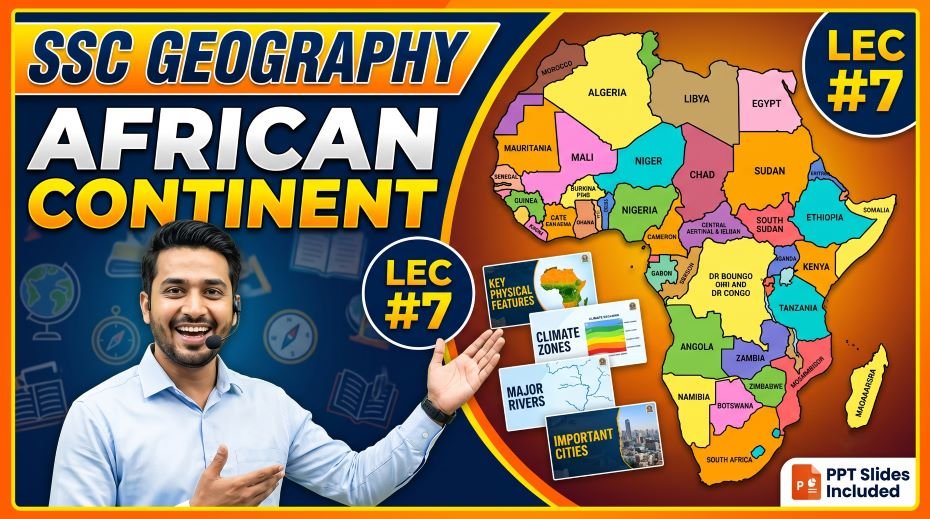
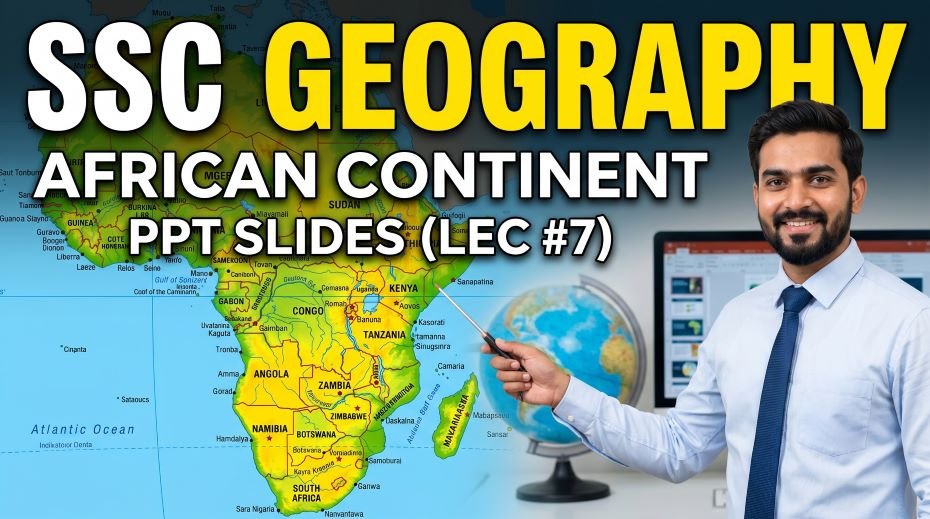
This article presents (SSC Geography African Continent PPT Slides (LEC #7)) the full structured theory, timeline, comparison tables, MCQs, and a rapid revision cheat sheet, built around the Nile and the rest of Africa’s defining features – all aligned to the SSC exam pattern. Africa is the world’s second largest and second-most populous continent, home to the Sahara Desert, the longest river on Earth, and 54 sovereign nations – making it a consistently important topic in SSC CGL, SSC CHSL, SSC MTS, SSC GD Constable, and RRB Group D General Awareness sections. This article accompanies the SSC Geography African Continent PPT Slides (LEC #7) – Serial #85 of the Complete Foundation Batch for All SSC Exams PPT Series on slideshareppt.net. With 81 slides in bilingual Hindi + English format, this PPT covers Africa’s physical and political geography, rivers, deserts, wildlife, and history.
PPT Resource Overview
| Detail | Information |
| Lecture Number | LEC #7 (Geography Series) |
| Serial Number in Complete Batch | #85 |
| Subject | Geography – African Continent (अफ़्रीकी महाद्वीप) |
| Series Name | Complete Foundation Batch for All SSC Exams (PPT Series) |
| Total Slides | 81 PPT Slides |
| File Size | 22 MB |
| Language | Hindi + English (Bilingual) |
| Format Available | Google Slides & Google Drive (PDF also available) |
| Website | www.slideshareppt.net |
| Target Exams | SSC CGL, SSC CHSL, SSC MTS, SSC GD Constable, RRB Group D |
| Suitable For | Students (self-study & marathon revision) and Teachers (classroom use) |
SSC Geography African Continent PPT Slides (LEC #7)
Note: Above is PPT in GOOGLE SLIDES (HTML AND IFRAME COMBINATION) and if you wish to download the Complete SSC series (PPT slides), visit this Link – REDIRECT PAGE.
Master Timeline: Africa – Civilisation, Colonisation, and Independence
| Period | Event / Milestone | SSC Exam Relevance |
| ~3100 BCE | Ancient Egypt unified under the first Pharaoh; rise of Egyptian civilisation along the Nile | Ancient Egypt – origin civilisation fact |
| ~2560 BCE | Great Pyramid of Giza constructed during the Old Kingdom | Pyramid construction date – frequently asked |
| ~1270 BCE | Kingdom of Kush rises in Nubia (modern Sudan), later ruling Egypt as the 25th Dynasty | Ancient African kingdoms beyond Egypt |
| c. 300–1600 CE | Great empires of West Africa rise: Ghana Empire, Mali Empire, Songhai Empire | West African empires – Mansa Musa and Mali Empire |
| 1324 | Mansa Musa of the Mali Empire makes famous pilgrimage to Mecca, displaying immense wealth | Mansa Musa – often cited as richest person in history |
| 1488 | Bartolomeu Dias (Portugal) rounds the Cape of Good Hope, opening sea route around Africa | Cape of Good Hope discovery |
| 1652 | Dutch establish Cape Colony at modern Cape Town – beginning of European settlement in South Africa | Origin of Dutch/Boer presence in South Africa |
| 1884–1885 | Berlin Conference – European powers formally divide Africa into colonial territories | Scramble for Africa – most asked colonial history fact |
| 1869 | Suez Canal opens, connecting the Mediterranean Sea to the Red Sea via Egypt | Suez Canal – major trade route fact |
| 1922 | Egypt gains nominal independence from Britain (full sovereignty later in 1952 revolution) | Egypt’s path to independence |
| 1957 | Ghana becomes the first Sub-Saharan African country to gain independence from colonial rule | Ghana’s independence – most frequently asked |
| 1960 | “Year of Africa” – 17 African nations gain independence in a single year | Year of Africa – major decolonisation milestone |
| 1963 | Organisation of African Unity (OAU) founded – predecessor to the African Union | OAU founding – institutional history |
| 1990 | Namibia becomes the last African colony to gain independence | Namibia’s independence – completion of decolonisation |
| 1994 | Nelson Mandela becomes South Africa’s first Black president, ending apartheid | End of apartheid – very frequently asked |
| 2002 | African Union (AU) formally replaces the OAU | Formation of African Union |
| Present Day | Africa comprises 54 sovereign countries; AfCFTA (African Continental Free Trade Area) drives economic integration | Current African political and economic landscape |
Africa – Overview of the Continent
Africa is the second-largest continent by both area and population, after Asia. It straddles the Equator, the Tropic of Cancer, and the Tropic of Capricorn, giving it a vast range of climates from tropical rainforest to arid desert. The continent is bordered by the Mediterranean Sea to the north, the Indian Ocean to the east, and the Atlantic Ocean to the west, and is connected to Asia via the Sinai Peninsula. Africa is home to the Sahara Desert (the world’s largest hot desert), the Nile River (the world’s longest river), and 54 sovereign nations – more countries than any other continent.
Africa – Complete Key Facts Table
| Parameter | Detail |
| Continent Rank by Area | 2nd largest continent (after Asia) |
| Total Area | 30.4 million sq km |
| Population (approx.) | ~1.4 billion – 2nd most populous continent |
| Number of Countries | 54 sovereign countries – most of any continent |
| Largest Country by Area | Algeria (2.38 million sq km) |
| Smallest Country by Area | Seychelles (island nation) |
| Most Populous Country | Nigeria (~223 million) |
| Highest Peak | Mount Kilimanjaro – 5,895 m (Tanzania); tallest free-standing mountain in the world |
| Longest River | Nile River – ~6,650 km; widely considered the longest river in the world |
| Largest Desert | Sahara Desert – ~9.2 million sq km; world’s largest hot desert |
| Largest Lake | Lake Victoria – largest lake in Africa by area; 2nd largest freshwater lake in the world |
| Deepest Lake | Lake Tanganyika – 2nd deepest lake in the world after Lake Baikal |
| Famous Waterfall | Victoria Falls – on the Zambia-Zimbabwe border; one of the Seven Natural Wonders of the World |
| Major Rift System | Great Rift Valley – runs from the Middle East through East Africa |
| Equator Passes Through | Gabon, Republic of Congo, DR Congo, Uganda, Kenya, Somalia |
| Languages | Over 2,000 languages spoken; Arabic, Swahili, French, English, Hausa, Portuguese widely used |
| Continental Body | African Union (AU) – formed 2002, replaced the OAU (founded 1963) |
| Largest Economy | Nigeria or South Africa (rankings vary by year, both consistently top-2) |
Major Regions and Sample Countries of Africa
| Region | Sample Countries | Capital (Example) | Key Geographic Fact |
| North Africa | Egypt, Libya, Algeria, Morocco, Tunisia | Cairo (Egypt) | Mostly covered by the Sahara Desert; Mediterranean coastline; Arabic-speaking majority |
| West Africa | Nigeria, Ghana, Senegal, Mali, Ivory Coast | Abuja (Nigeria) | Home to historic Ghana, Mali, and Songhai Empires; Niger River basin |
| East Africa | Kenya, Ethiopia, Tanzania, Uganda, Somalia | Nairobi (Kenya) | Great Rift Valley; Mount Kilimanjaro; cradle of early human evolution (Olduvai Gorge) |
| Central Africa | DR Congo, Cameroon, Chad, Gabon | Kinshasa (DR Congo) | Congo Basin – 2nd largest rainforest in the world after the Amazon |
| Southern Africa | South Africa, Zimbabwe, Zambia, Botswana, Namibia | Pretoria/Cape Town/Bloemfontein (South Africa) | Victoria Falls; Kalahari Desert; diamond and gold mining regions |
Physical Geography of Africa
Mountains of Africa
| Mountain / Peak | Location | Height | Key Facts for SSC |
| Mount Kilimanjaro | Tanzania | 5,895 m | Highest peak in Africa; tallest free-standing mountain in the world (not part of a range); has snow-capped summit despite tropical location |
| Mount Kenya | Kenya | 5,199 m | 2nd highest peak in Africa; extinct volcano; UNESCO World Heritage Site |
| Mount Stanley (Margherita Peak) | DR Congo-Uganda border | 5,109 m | 3rd highest peak in Africa; part of the Rwenzori Mountains (“Mountains of the Moon”) |
| Atlas Mountains | Morocco, Algeria, Tunisia | Highest peak: Toubkal (4,167 m) | Major mountain range in North Africa; separates Mediterranean coast from the Sahara |
| Drakensberg Mountains | South Africa, Lesotho | Highest peak: Thabana Ntlenyana (3,482 m) | Major range in Southern Africa; UNESCO World Heritage Site |
Rivers of Africa
| River | Length | Countries | Key Facts for SSC |
| Nile River | ~6,650 km | Egypt, Sudan, Ethiopia, Uganda, and 7 others | Widely considered the longest river in the world; flows northward into the Mediterranean Sea; supported ancient Egyptian civilisation |
| Congo River | ~4,700 km | DR Congo, Republic of Congo | 2nd longest river in Africa; deepest river in the world (over 220 m in places); 2nd largest by discharge after the Amazon |
| Niger River | ~4,180 km | Guinea, Mali, Niger, Nigeria | 3rd longest river in Africa; supported the historic Mali and Songhai Empires |
| Zambezi River | ~2,574 km | Zambia, Zimbabwe, Mozambique | Forms Victoria Falls; 4th longest river in Africa; flows into the Indian Ocean |
| Orange River | ~2,200 km | South Africa, Namibia | Longest river in South Africa; important for irrigation and diamond mining |
Deserts, Lakes, and Natural Wonders
| Feature | Type | Location | Key SSC Facts |
| Sahara Desert | Hot Desert | North Africa (spans 11 countries) | World’s largest hot desert at ~9.2 million sq km; roughly the size of the United States; covers most of North Africa |
| Kalahari Desert | Semi-arid Desert | Botswana, Namibia, South Africa | Large semi-arid sandy savanna in Southern Africa; supports more vegetation than true deserts |
| Lake Victoria | Freshwater Lake | Uganda, Kenya, Tanzania | Largest lake in Africa by area; 2nd largest freshwater lake in the world; source of the White Nile |
| Lake Tanganyika | Freshwater Lake | Tanzania, DR Congo, Burundi, Zambia | 2nd deepest lake in the world; one of the longest freshwater lakes in the world |
| Victoria Falls | Waterfall | Zambia-Zimbabwe border (Zambezi River) | One of the Seven Natural Wonders of the World; known locally as “Mosi-oa-Tunya” (the smoke that thunders) |
| Great Rift Valley | Geological Rift System | Runs through East Africa (Kenya, Ethiopia, Tanzania, etc.) | One of Earth’s most significant geological features; site of major fossil discoveries on human evolution |
| Congo Basin Rainforest | Tropical Rainforest | Central Africa (mainly DR Congo) | 2nd largest tropical rainforest in the world after the Amazon |
Climate of Africa
| Climate Zone | Region | Key Characteristics |
| Tropical Rainforest | Congo Basin, West African coast | Heavy year-round rainfall; high humidity; dense rainforest |
| Tropical Savanna | East and Southern Africa (Serengeti, Sahel) | Wet-dry seasons; grasslands with scattered trees; large wildlife herds |
| Desert / Arid | Sahara (north), Kalahari and Namib (south) | Extremely low rainfall; Sahara is world’s largest hot desert |
| Mediterranean | North African coast (Morocco, Algeria, Tunisia) | Hot dry summers, mild wet winters |
| Highland / Alpine | East African highlands, Mount Kilimanjaro region | Cooler temperatures at elevation; some peaks have permanent snow despite tropical latitude |
Wildlife of Africa – SSC GK Facts
| Category | Key Species | SSC Fact |
| Big Cats | Lion, Leopard, Cheetah | Africa hosts the largest wild lion populations; Cheetah is the fastest land animal on Earth |
| Mega-herbivores | African Elephant, Hippopotamus, Rhinoceros, Giraffe | African Elephant is the largest land animal on Earth; Giraffe is the tallest land animal |
| The Big Five | Lion, Leopard, Elephant, Rhino, Buffalo | Classic safari term for the five most difficult animals to hunt on foot, now a wildlife tourism term |
| Primates | Gorilla, Chimpanzee, Bonobo | Gorilla and Chimpanzee are humanity’s closest living relatives; found mainly in Central Africa |
| Migration | Wildebeest, Zebra (Serengeti-Mara ecosystem) | Great Migration in Serengeti-Maasai Mara is the largest land mammal migration on Earth |
Ancient Civilisations and Empires of Africa
| Civilisation / Empire | Region | Period | Key Facts for SSC |
| Ancient Egypt | Along the Nile River | ~3100 BCE – 30 BCE | Built the Great Pyramids of Giza; developed hieroglyphic writing; one of the world’s earliest civilisations |
| Kingdom of Kush | Nubia (modern Sudan) | ~1070 BCE – 350 CE | Ruled Egypt as the 25th Dynasty; built more pyramids than Egypt itself |
| Ghana Empire | West Africa | ~300 – 1200 CE | Early West African trading empire; controlled trans-Saharan gold and salt trade |
| Mali Empire | West Africa | ~1235 – 1600 CE | Ruled by Mansa Musa, often cited as the wealthiest individual in history; centred at Timbuktu |
| Songhai Empire | West Africa | ~1430 – 1591 CE | Largest empire in West African history; Timbuktu was a major centre of Islamic learning |
| Great Zimbabwe | Southern Africa | ~1100 – 1450 CE | Famous stone-built city; gives modern Zimbabwe its name; major trade centre |
Africa Compared to All 7 Continents – Reference Table
| Continent | Area (sq km) | Population | Highest Point | Key Fact |
| Asia | 44.6 million | 4.7 billion | Mt. Everest (8,848 m) | Largest and most populous continent |
| Africa | 30.4 million | ~1.4 billion | Mt. Kilimanjaro (5,895 m) | 2nd largest; 54 countries; Sahara Desert; Nile River |
| North America | 24.7 million | ~600 million | Denali (6,194 m) | 3rd largest; Great Lakes, Rocky Mountains |
| South America | 17.8 million | ~436 million | Aconcagua (6,961 m) | 4th largest; Amazon Rainforest, Andes |
| Antarctica | 14.2 million | ~1,000 (researchers) | Vinson Massif (4,892 m) | 5th largest; no permanent population |
| Europe | 10.5 million | 746 million | Mont Blanc (4,808 m) | 6th largest; most developed |
| Australia | 7.7 million | ~26 million | Mt. Kosciuszko (2,228 m) | Smallest continent; only country-continent |
Quick Fact Table – Africa for SSC Exams
| Question / Fact | Answer |
| Africa’s rank by area among continents | 2nd largest |
| Africa’s total area | 30.4 million sq km |
| Number of countries in Africa | 54 sovereign countries |
| Largest country in Africa by area | Algeria |
| Most populous country in Africa | Nigeria (~223 million) |
| Highest peak in Africa | Mount Kilimanjaro (5,895 m) – Tanzania |
| Longest river in the world | Nile River (~6,650 km) |
| World’s largest hot desert | Sahara Desert (~9.2 million sq km) |
| Largest lake in Africa | Lake Victoria |
| Deepest river in the world | Congo River (over 220 m in places) |
| One of the Seven Natural Wonders located in Africa | Victoria Falls – Zambia-Zimbabwe border |
| Geological feature running through East Africa | Great Rift Valley |
| Fastest land animal in the world | Cheetah |
| Largest land animal in the world | African Elephant |
| Tallest land animal in the world | Giraffe |
| Famous African ruler called the wealthiest person in history | Mansa Musa (Mali Empire) |
| Conference that divided Africa among colonial powers | Berlin Conference (1884–1885) |
| First Sub-Saharan African country to gain independence | Ghana (1957) |
| Year known as the “Year of Africa” | 1960 (17 nations gained independence) |
| South Africa’s first Black president, ended apartheid | Nelson Mandela (1994) |
| Continental body representing Africa today | African Union (AU), formed 2002 |
| Canal connecting the Mediterranean and Red Seas | Suez Canal – Egypt |
Podcast-Style Q&A – African Continent
Q1: Why is the Nile considered the longest river in the world?
The Nile River flows for approximately 6,650 km from its sources in East Africa (the White Nile from Lake Victoria and the Blue Nile from Ethiopia) northward through Sudan and Egypt before emptying into the Mediterranean Sea. It is widely cited as the world’s longest river, though some recent studies argue the Amazon may be slightly longer depending on measurement methodology, making this a genuinely debated topic. Regardless, the Nile’s unique north-flowing direction and its role in sustaining one of history’s earliest civilisations make it an essential SSC Geography fact.
Q2: Who was Mansa Musa and why is he significant in African history?
Mansa Musa ruled the Mali Empire in West Africa during the 14th century and is frequently cited by historians as possibly the wealthiest individual in recorded history, due to Mali’s control over vast gold and salt trade routes across the Sahara. His famous pilgrimage to Mecca in 1324, during which he distributed so much gold along the way that it reportedly caused inflation in regional economies, made his wealth legendary across Europe, the Middle East, and Africa. His capital, Timbuktu, became a major centre of Islamic scholarship and trade, a fact often tested alongside questions about pre-colonial African empires.
Q3: What was the Berlin Conference and why is it significant?
The Berlin Conference of 1884–1885 was a meeting of major European colonial powers – including Britain, France, Germany, Belgium, and Portugal – who formally divided the African continent into colonial spheres of influence, largely without consulting African leaders or considering existing ethnic and political boundaries. This event, often called the “Scramble for Africa,” led to artificial national borders that still affect many African countries today, including ethnic and political tensions that arose from grouping rival communities within single colonial territories or splitting unified communities across borders.
Q4: Why does Mount Kilimanjaro have snow despite being near the Equator?
Mount Kilimanjaro in Tanzania rises to 5,895 metres, and temperature decreases significantly with altitude regardless of latitude – a phenomenon geographers call the environmental lapse rate. Even though Kilimanjaro sits close to the Equator where surface temperatures are consistently warm, its summit reaches high enough into the atmosphere that temperatures drop below freezing, allowing snow and glacial ice to persist at the peak. This makes Kilimanjaro a classic example in SSC Geography questions about how altitude affects climate independent of latitude.
Q5: What was the significance of the ‘Year of Africa’ in 1960?
1960 is known as the “Year of Africa” because 17 African nations achieved independence from their European colonial rulers within that single year, marking the most rapid phase of decolonisation on the continent. This wave followed Ghana’s pioneering independence in 1957 under Kwame Nkrumah and reflected growing anti-colonial movements across the continent after World War II. By 1990, with Namibia’s independence, the formal colonial era in Africa came to an end, though the long-term effects of colonial-era borders and governance structures remain a significant topic in African political geography.
Q6: What is the Great Rift Valley and why is it important to scientists?
The Great Rift Valley is a massive geological trench system stretching roughly 6,000 km from the Middle East through East Africa, formed by the gradual splitting apart of tectonic plates over millions of years. It passes through countries including Kenya, Ethiopia, and Tanzania, creating dramatic landscapes of valleys, lakes, and volcanic mountains. The Rift Valley is especially significant to paleoanthropologists because many of the most important fossil discoveries related to early human evolution – including famous finds at Olduvai Gorge in Tanzania – have been made in this region, earning East Africa the nickname “Cradle of Humankind.”
Q7: How did apartheid end in South Africa and why is Nelson Mandela significant?
Apartheid was a system of institutionalised racial segregation enforced in South Africa from 1948 to the early 1990s, which systematically discriminated against the country’s Black majority population. Nelson Mandela, a leading anti-apartheid activist, was imprisoned for 27 years before his release in 1990 amid mounting international pressure and internal resistance. Following negotiations to dismantle apartheid laws, Mandela was elected as South Africa’s first Black president in 1994 in the country’s first fully democratic election, an event widely regarded as one of the most significant moments in modern African and world history.
30 MCQ Practice Questions – African Continent
All questions follow SSC CGL, CHSL, MTS, and GD Constable exam patterns. Answers follow at the end.
- Africa is the ___ largest continent by area.
A) 1st B) 2nd C) 3rd D) 4th
- How many sovereign countries are there in Africa?
A) 48 B) 50 C) 52 D) 54
- Which is the largest country in Africa by area?
A) Nigeria B) Algeria C) Egypt D) Sudan
- Which is the most populous country in Africa?
A) Egypt B) South Africa C) Nigeria D) Ethiopia
- What is the highest peak in Africa?
A) Mount Kenya B) Mount Kilimanjaro C) Mount Stanley D) Atlas Peak
- The Nile River flows into which sea?
A) Red Sea B) Mediterranean Sea C) Arabian Sea D) Black Sea
- Which is the world’s largest hot desert?
A) Thar Desert B) Gobi Desert C) Sahara Desert D) Kalahari Desert
- Which is the largest lake in Africa?
A) Lake Tanganyika B) Lake Malawi C) Lake Victoria D) Lake Chad
- Which river is known as the deepest river in the world?
A) Nile B) Niger C) Zambezi D) Congo
- Victoria Falls is located on the border of which two countries?
A) Kenya-Tanzania B) Zambia-Zimbabwe C) Egypt-Sudan D) Nigeria-Niger
- Victoria Falls is formed on which river?
A) Nile B) Congo C) Zambezi D) Niger
- The Great Rift Valley runs primarily through which region?
A) West Africa B) East Africa C) North Africa D) Central Africa
- Which empire was ruled by Mansa Musa?
A) Ghana Empire B) Mali Empire C) Songhai Empire D) Kush Kingdom
- The Berlin Conference, which divided Africa among colonial powers, was held in:
A) 1870 B) 1884–1885 C) 1900 D) 1914
- Which was the first Sub-Saharan African country to gain independence?
A) Nigeria B) Kenya C) Ghana D) South Africa
- 1960 is referred to as:
A) Year of Independence Day B) Year of Africa C) Year of the Republic D) Year of Unity
- Who became South Africa’s first Black president in 1994?
A) Desmond Tutu B) Nelson Mandela C) Jacob Zuma D) Thabo Mbeki
- The Suez Canal connects the Mediterranean Sea with:
A) Arabian Sea B) Red Sea C) Black Sea D) Persian Gulf
- Which African body succeeded the OAU in 2002?
A) ECOWAS B) African Union C) SADC D) AU Commission
- The Great Pyramids of Giza were built during which civilisation?
A) Kingdom of Kush B) Ancient Egypt C) Mali Empire D) Great Zimbabwe
- Which African mountain is the tallest free-standing mountain in the world?
A) Mount Kenya B) Mount Kilimanjaro C) Mount Stanley D) Toubkal
- The Congo Basin contains the world’s:
A) Largest desert B) 2nd largest rainforest C) Largest lake D) Highest mountain
- Which animal is known as the fastest land animal, found in Africa?
A) Lion B) Leopard C) Cheetah D) Gazelle
- The “Big Five” in African wildlife tourism refers to:
A) Five largest countries B) Five major rivers C) Five most difficult animals to hunt on foot D) Five UNESCO sites
- Timbuktu, a major centre of Islamic learning, was part of which empire?
A) Ghana Empire B) Songhai Empire C) Kush Kingdom D) Great Zimbabwe
- Which lake is the second deepest in the world?
A) Lake Victoria B) Lake Chad C) Lake Tanganyika D) Lake Malawi
- Apartheid was a system of:
A) Economic planning B) Racial segregation C) Religious governance D) Trade regulation
- The last African country to gain independence was:
A) Ghana B) Algeria C) Namibia D) Zimbabwe
- The Atlas Mountains are located in which part of Africa?
A) East Africa B) North Africa C) Southern Africa D) Central Africa
- Which two animals are humanity’s closest living primate relatives, found in Africa?
A) Lion and Leopard B) Elephant and Rhino C) Gorilla and Chimpanzee D) Zebra and Giraffe
Answer Key
| Q | Ans | Q | Ans | Q | Ans |
| 1 | B | 11 | C | 21 | B |
| 2 | D | 12 | B | 22 | B |
| 3 | B | 13 | B | 23 | C |
| 4 | C | 14 | B | 24 | C |
| 5 | B | 15 | C | 25 | B |
| 6 | B | 16 | B | 26 | C |
| 7 | C | 17 | B | 27 | B |
| 8 | C | 18 | B | 28 | C |
| 9 | D | 19 | B | 29 | B |
| 10 | B | 20 | B | 30 | C |
Rapid Revision Cheat Sheet – African Continent
| Topic | Key Point |
| Continent rank | 2nd largest – 30.4 million sq km |
| Countries | 54 sovereign countries – most of any continent |
| Largest country | Algeria – 2.38 million sq km |
| Most populous country | Nigeria – ~223 million |
| Highest peak | Mount Kilimanjaro – 5,895 m, Tanzania |
| Longest river in world | Nile River – ~6,650 km |
| Largest hot desert in world | Sahara Desert – ~9.2 million sq km |
| Largest lake in Africa | Lake Victoria |
| Deepest river in world | Congo River |
| Famous waterfall | Victoria Falls – Zambia-Zimbabwe border, Zambezi River |
| Major rift system | Great Rift Valley – East Africa, linked to human evolution fossils |
| Mansa Musa | Mali Empire ruler – cited as history’s wealthiest individual |
| Berlin Conference | 1884–1885 – divided Africa among colonial powers |
| First Sub-Saharan independence | Ghana – 1957 |
| Year of Africa | 1960 – 17 nations gained independence |
| Apartheid ended | 1994 – Nelson Mandela becomes first Black president |
| Last African colony to gain independence | Namibia – 1990 |
| Continental body | African Union (AU) – formed 2002, replaced OAU (1963) |
| Suez Canal | Connects Mediterranean Sea and Red Sea – through Egypt |
| Fastest land animal | Cheetah |
| Largest land animal | African Elephant |
| Tallest land animal | Giraffe |
| Serial number of this PPT | #85 in the Complete Foundation Batch |
Also read: SSC Geography North America Continent PPT Slides (LEC #6)
Conclusion
African Continent brings together ancient civilisation (Egypt, Kush, Mali), colonial history (the Berlin Conference and decolonisation), and extraordinary physical geography (the Nile, Sahara, Kilimanjaro, Victoria Falls) into one of the richest topics in SSC General Awareness. From Mansa Musa’s legendary wealth to Nelson Mandela’s historic presidency, Africa’s geography and history are deeply intertwined and frequently tested together.
The SSC Geography African Continent PPT Slides (LEC #7), Serial #85, available at slideshareppt.net in bilingual Hindi + English format across 81 slides, gives you a complete visual companion to this article. Study the regional and physical geography tables carefully, memorise key dates and superlatives, and complete all 30 MCQs to strengthen your command of this topic.
Whether preparing for SSC CGL, CHSL, MTS, GD Constable, or RRB Group D, a strong grip on Africa’s geography and history ensures consistent marks in this section. Bookmark this article alongside the PPT, and revisit the Rapid Revision Cheat Sheet during your final week before the exam.