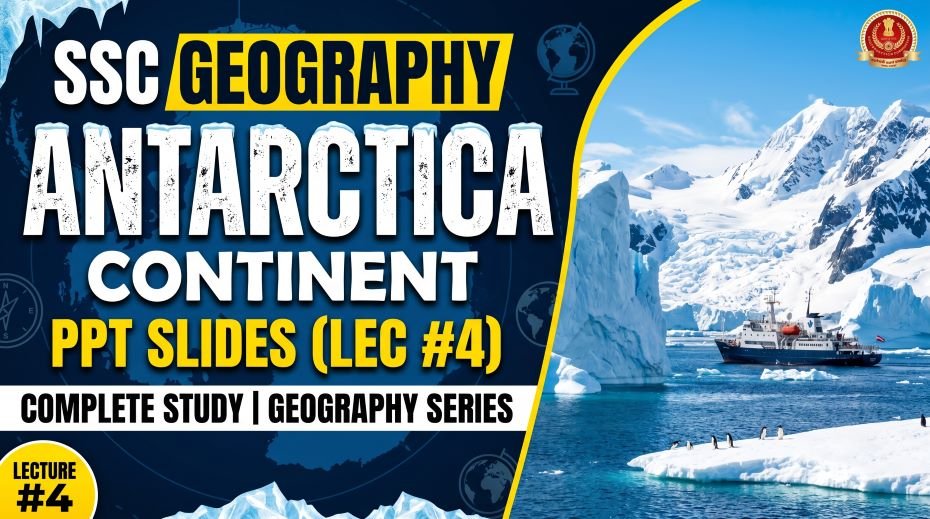
This article accompanies the SSC Geography Antarctica Continent PPT Slides (LEC #4) – Serial #82 of the Complete Foundation Batch for All SSC Exams PPT Series on slideshareppt.net. With 73 slides in bilingual Hindi + English format, this PPT covers the Antarctica Continent in complete depth. Antarctica is the coldest, driest, windiest, and most isolated continent on Earth – and it is also one of the most fascinating and frequently asked topics in SSC CGL, SSC CHSL, SSC MTS, SSC GD Constable, and RRB Group D General Awareness sections. From its record-breaking climate extremes to its unique governance under the Antarctic Treaty, India’s own research stations, and its role in global climate science, Antarctica offers a rich set of exam-ready facts and This article presents the full structured theory, timeline, comparison tables, MCQs, and a rapid revision cheat sheet – all aligned to the SSC exam pattern.
PPT Resource Overview
| Detail | Information |
| Lecture Number | LEC #4 (Geography Series) |
| Serial Number in Complete Batch | #82 |
| Subject | Geography – Antarctica Continent (अंटार्कटिका महाद्वीप) |
| Series Name | Complete Foundation Batch for All SSC Exams (PPT Series) |
| Total Slides | 73 PPT Slides |
| File Size | 13 MB |
| Language | Hindi + English (Bilingual) |
| Format Available | Google Slides & Google Drive (PDF also available) |
| Website | www.slideshareppt.net |
| Target Exams | SSC CGL, SSC CHSL, SSC MTS, SSC GD Constable, RRB Group D |
| Suitable For | Students (self-study & marathon revision) and Teachers (classroom use) |
SSC Geography Antarctica Continent PPT Slides (LEC #4)
Note: Above is PPT in GOOGLE SLIDES (HTML AND IFRAME COMBINATION) and if you wish to download the Complete SSC series (PPT slides), visit this Link – REDIRECT PAGE.
Master Timeline: Antarctica – Discovery, Exploration, and Governance
| Period | Event / Milestone | SSC Exam Relevance |
| 1820 | Antarctica is first sighted – disputed claims by Russian (Bellingshausen), British (Bransfield), and American (Palmer) expeditions | First sighting of Antarctica |
| 1821 | First landing on the Antarctic mainland recorded by American sealer John Davis | First human landing on Antarctica |
| 1895 | First confirmed landing on the Antarctic continent by a Norwegian-led expedition at Cape Adare | Confirmed first landing |
| 1911 (14 December) | Roald Amundsen (Norway) becomes the first person to reach the South Pole | First to reach South Pole – most asked fact |
| 1912 (17 January) | Robert Falcon Scott (Britain) reaches the South Pole a month after Amundsen; his team dies on return journey | Tragic Scott expedition – GK fact |
| 1928–1930 | Richard Byrd (USA) becomes first to fly over the South Pole | Aviation milestone in Antarctica |
| 1957–1958 | International Geophysical Year – major scientific cooperation begins in Antarctica | Origin of international scientific collaboration |
| 1 December 1959 | Antarctic Treaty signed by 12 countries in Washington DC | Antarctic Treaty signing – very frequently asked |
| 23 June 1961 | Antarctic Treaty enters into force – Antarctica designated for peaceful, scientific use only | Treaty enforcement date |
| 1981 | India launches its first Antarctic expedition | India’s Antarctic program begins |
| 1983 | India establishes Dakshin Gangotri – its first research station in Antarctica | India’s first Antarctic station |
| 1988 | Maitri research station established by India (still operational) | India’s main active Antarctic station |
| 1991 | Madrid Protocol (Protocol on Environmental Protection) added to Antarctic Treaty – bans mining | Environmental protection – mining ban |
| 2012 | India commissions Bharati – its third and most advanced Antarctic research station | India’s newest Antarctic station |
| Present Day | 57 countries are parties to the Antarctic Treaty; ~30 countries operate ~70 research stations | Current international presence in Antarctica |
Antarctica – The World’s Southernmost Continent
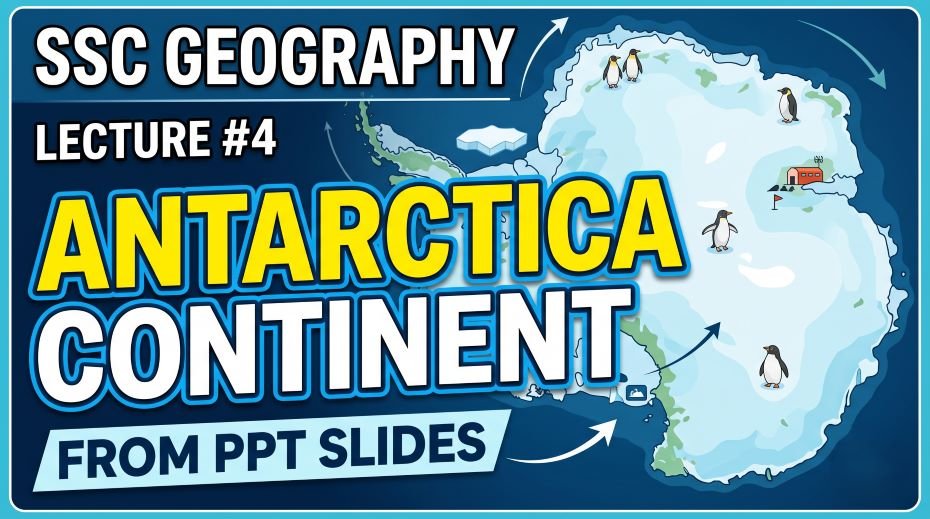
Antarctica is the fifth-largest continent by area and is located almost entirely south of the Antarctic Circle (66.5°S), centred roughly on the South Pole. It is the coldest, driest, and windiest continent on Earth, and it holds the distinction of having no permanent human population, no native government, and no indigenous people. Nearly 98% of Antarctica is covered by ice, which holds approximately 70% of the world’s fresh water.
Antarctica – Complete Key Facts Table
| Parameter | Detail |
| Continent Rank by Area | 5th largest continent (after Asia, Africa, North America, South America) |
| Total Area | 14.2 million sq km (larger than Europe and Australia) |
| Permanent Population | None (no native or permanent residents) |
| Temporary Population | ~1,000 in winter; ~5,000 in summer (scientists and support staff) |
| Ice Coverage | ~98% of the continent covered by ice sheet |
| Average Ice Thickness | ~1.9 km (maximum recorded over 4.7 km) |
| Freshwater Stored | ~70% of the world’s fresh water; ~90% of world’s ice |
| Highest Point | Vinson Massif – 4,892 m (Ellsworth Mountains) |
| Lowest Point | Bentley Subglacial Trench – approximately 2,555 m below sea level |
| Coldest Recorded Temperature | −89.2°C at Vostok Station (1983); satellite readings as low as −93°C in 2010 |
| Average Winter Temperature (interior) | −60°C |
| Average Summer Temperature (coast) | 0°C to 5°C |
| Annual Precipitation | Less than 200 mm (driest continent on Earth – classified as a polar desert) |
| Wind Speeds | Katabatic winds can reach over 320 km/h – windiest continent |
| Daylight Pattern | 6 months continuous daylight (summer) and 6 months continuous darkness (winter) |
| Governing Framework | Antarctic Treaty System (1959) – no single country owns Antarctica |
| Number of Treaty Parties | 57 countries (as of recent count) |
| Number of Research Stations | ~70 stations operated by ~30 countries |
| Time Zones | No official time zone; stations typically use the time zone of their supply country |
| Surrounding Ocean | Southern Ocean (Antarctic Ocean) – surrounds the entire continent |
| Nearest Landmass | South America (via Drake Passage) – closest continent to Antarctica |
Physical Geography of Antarctica
Location and Boundaries
- Antarctica is centred on the South Pole (90°S) and lies almost entirely within the Antarctic Circle (66.5°S)
- Surrounded entirely by the Southern Ocean (also called the Antarctic Ocean)
- Closest landmass is South America, separated by the Drake Passage (~1,000 km wide)
- Divided into East Antarctica and West Antarctica by the Transantarctic Mountains
- The Antarctic Peninsula extends northward toward South America – the warmest and most accessible region
Mountains, Ice Shelves, and Key Landforms
| Feature | Type | Key Facts for SSC |
| Vinson Massif | Mountain | Highest peak in Antarctica at 4,892 m; located in Ellsworth Mountains, West Antarctica |
| Transantarctic Mountains | Mountain Range | Divides East and West Antarctica; one of the longest mountain ranges on Earth (~3,500 km) |
| Ross Ice Shelf | Ice Shelf | Largest ice shelf in Antarctica – roughly the size of France; floats on the Ross Sea |
| Ronne Ice Shelf | Ice Shelf | Second largest ice shelf; located in West Antarctica on the Weddell Sea side |
| Larsen Ice Shelf | Ice Shelf | Located on Antarctic Peninsula; famous for major collapse events (Larsen B in 2002) linked to climate change |
| East Antarctic Ice Sheet | Ice Sheet | Largest ice sheet on Earth; covers most of East Antarctica; relatively more stable |
| West Antarctic Ice Sheet | Ice Sheet | Smaller but more vulnerable to melting; major concern for sea-level rise |
| Lake Vostok | Subglacial Lake | Largest known subglacial lake; lies under ~4 km of ice; site of Vostok Station coldest temperature record |
| Antarctic Peninsula | Peninsula | Warmest and most rapidly warming part of Antarctica; closest to South America |
| Dry Valleys | Polar Desert | One of the driest places on Earth; almost no ice due to katabatic winds; used to simulate Mars conditions |
The Antarctic Treaty System – Complete Details
| Parameter | Detail |
| Signed On | 1 December 1959, in Washington DC, USA |
| Entered Into Force | 23 June 1961 |
| Original Signatory Countries | 12 – Argentina, Australia, Belgium, Chile, France, Japan, New Zealand, Norway, South Africa, USSR (Russia), UK, USA |
| Current Parties (approx.) | 57 countries |
| India’s Status | Acceded to the treaty in 1983; Consultative Party status since 1983 |
| Core Principle | Antarctica shall be used exclusively for peaceful purposes and scientific research |
| Military Activity | Banned – no military bases, weapons testing, or fortifications allowed |
| Territorial Claims | Frozen – existing claims neither recognised nor denied; no new claims permitted |
| Nuclear Activity | Banned – no nuclear explosions or radioactive waste disposal allowed |
| Scientific Cooperation | Free exchange of scientific data and personnel among all member nations required |
| Madrid Protocol (1991) | Added environmental protections; banned mining and mineral resource extraction for at least 50 years |
| Governing Body | Antarctic Treaty Consultative Meeting (ATCM) – annual meeting of treaty parties |
| SSC Importance | Very high – treaty date, signatory count, India’s accession year are frequently tested |
India’s Presence in Antarctica – Complete Table
| Station Name | Established | Status | Key Facts for SSC |
| Dakshin Gangotri | 1983 | Decommissioned (now a supply base) | India’s first Antarctic research station; named after the river Ganga’s origin; submerged in ice by 1990s |
| Maitri | 1988 | Active (operational) | India’s main research station; located in the Schirmacher Oasis, East Antarctica; ongoing scientific research |
| Bharati | 2012 | Active (operational) | India’s third and most modern station; located on Larsemann Hills; built using shipping containers; supports year-round research |
Key Facts About India’s Antarctic Program
- India’s first Antarctic expedition was launched in 1981, under the National Centre for Polar and Ocean Research (NCPOR), Goa
- India acceded to the Antarctic Treaty in 1983 and became a Consultative Party the same year
- India ratified the Madrid Protocol on environmental protection in 1998
- The Indian Antarctic program is managed by the National Centre for Polar and Ocean Research (NCPOR), based in Goa, under the Ministry of Earth Sciences
- India also operates Himadri research station in the Arctic (Svalbard, Norway) – making India one of the few countries with stations in both polar regions
- India passed the Indian Antarctic Act in 2022 to regulate Indian activities in Antarctica and align with international treaty obligations
Climate of Antarctica – Records and Extremes
| Climate Record | Value | Location / Note |
| Coldest temperature ever recorded (surface station) | −89.2°C | Vostok Station, 21 July 1983 |
| Coldest temperature ever recorded (satellite) | −93.2°C | East Antarctic Plateau, 2010 (satellite estimate) |
| Average interior winter temperature | −60°C | Antarctic Plateau (interior highlands) |
| Average coastal summer temperature | 0°C to 5°C | Coastal regions and Antarctic Peninsula |
| Highest recorded temperature | 18.3°C | Antarctic Peninsula (Esperanza Base), February 2020 – used as evidence of warming |
| Annual precipitation (interior) | Less than 50 mm | Polar desert classification – driest place on Earth |
| Annual precipitation (coast) | 200–600 mm | Coastal areas receive more snowfall than interior |
| Strongest recorded wind speed | 327 km/h | Recorded at Dumont d’Urville Station, France |
| Daylight in summer | Up to 24 hours | Continuous daylight at high latitudes (Dec–Feb) |
| Darkness in winter | Up to 24 hours | Continuous darkness at high latitudes (June–Aug) |
Antarctica’s Wildlife – SSC GK Facts
Despite its extreme climate, Antarctica and the surrounding Southern Ocean support a surprising range of specially adapted wildlife, particularly along the coastlines and in the surrounding waters.
| Category | Key Species | SSC Fact |
| Penguins | Emperor Penguin, Adelie Penguin, Chinstrap Penguin, Gentoo Penguin | Emperor Penguin is the largest penguin species and the only one that breeds during the Antarctic winter; cannot fly |
| Seals | Weddell Seal, Leopard Seal, Crabeater Seal, Elephant Seal, Ross Seal | Weddell Seal lives furthest south of any mammal; Leopard Seal is a top predator feeding on penguins |
| Whales | Blue Whale, Humpback Whale, Orca (Killer Whale), Minke Whale | Southern Ocean is a key feeding ground; Blue Whale is the largest animal ever to have existed |
| Birds (non-penguin) | Snow Petrel, Wandering Albatross, Skua, Antarctic Tern | Wandering Albatross has the largest wingspan of any living bird (up to 3.5 m) |
| Marine Life | Krill, Antarctic Toothfish, Icefish | Krill is the foundation of the Antarctic food web; supports penguins, seals, and whales |
| Land Life | No native land mammals; only mosses, lichens, and algae survive on land | Antarctica has no native land mammals, reptiles, or amphibians at all |
Antarctica vs Arctic – Comparison Table
| Feature | Antarctica | Arctic |
| Type | Continent (landmass covered in ice) | Ocean (frozen sea surrounded by land) |
| Location | Southern Hemisphere – around South Pole | Northern Hemisphere – around North Pole |
| Surrounding feature | Surrounded by Southern Ocean | Surrounded by landmasses of Asia, Europe, North America |
| Permanent residents | None – only scientists temporarily | Yes – indigenous peoples like Inuit, Sami live there |
| Governance | Antarctic Treaty System (1959) – no country owns it | Divided among 8 Arctic nations (Russia, Canada, USA, etc.) |
| Average temperature | Colder overall (−60°C interior winter) | Relatively warmer (−40°C average winter) |
| Ice type | Land ice (ice sheets, glaciers) – up to 4.7 km thick | Sea ice – floating ice, much thinner |
| Wildlife | Penguins, seals, whales – no polar bears | Polar bears, Arctic foxes, reindeer – no penguins |
| India’s research station | Maitri and Bharati | Himadri (Svalbard, Norway) |
| SSC trick to remember | Antarctica = Land + Ice + Penguins (South) | Arctic = Ocean + Ice + Polar Bears (North) |
Antarctica Compared to All 7 Continents – Reference Table
| Continent | Area (sq km) | Population | Highest Point | Key Fact |
| Asia | 44.6 million | 4.7 billion | Mt. Everest (8,848 m) | Largest and most populous continent |
| Africa | 30.4 million | 1.4 billion | Mt. Kilimanjaro (5,895 m) | 2nd largest; cradle of humankind |
| North America | 24.7 million | 580 million | Denali (6,194 m) | 3rd largest; includes Greenland |
| South America | 17.8 million | 430 million | Aconcagua (6,961 m) | 4th largest; Amazon rainforest |
| Antarctica | 14.2 million | ~1,000 (researchers only) | Vinson Massif (4,892 m) | 5th largest; no permanent population; coldest, driest, windiest |
| Europe | 10.5 million | 746 million | Mont Blanc (4,808 m) | 6th largest; most developed economically |
| Australia | 7.7 million | ~26 million | Mt. Kosciuszko (2,228 m) | Smallest continent; only country-continent |
Antarctica and Climate Change – Current Affairs Linkage
Antarctica plays a critical role in global climate science and is increasingly linked to Current Affairs sections of SSC exams. Scientific monitoring in Antarctica directly informs global climate policy and sea-level projections.
- Antarctica holds approximately 90% of the world’s ice and 70% of its fresh water – its melting directly affects global sea levels
- If all of Antarctica’s ice melted, global sea levels would rise by approximately 58 metres
- The Larsen B ice shelf collapsed dramatically in 2002, becoming a widely cited example of climate change impact
- West Antarctica is melting faster than East Antarctica due to warmer ocean currents reaching its ice shelves from below
- The ozone hole over Antarctica, discovered in the 1980s, led to the Montreal Protocol (1987) – an important environment-geography crossover topic for SSC
- Scientific ice core samples from Antarctica provide climate records going back over 800,000 years
Quick Fact Table – Antarctica for SSC Exams
| Question / Fact | Answer |
| Antarctica’s continent rank by area | 5th largest |
| Antarctica’s total area | 14.2 million sq km |
| Permanent population of Antarctica | None – no native residents |
| Percentage of Antarctica covered by ice | ~98% |
| Percentage of world’s fresh water in Antarctica | ~70% |
| Highest peak in Antarctica | Vinson Massif – 4,892 m |
| Lowest point in Antarctica | Bentley Subglacial Trench – ~2,555 m below sea level |
| Coldest temperature ever recorded on Earth | −89.2°C at Vostok Station (1983) |
| First person to reach the South Pole | Roald Amundsen (Norway), 14 December 1911 |
| Second to reach South Pole (a month later) | Robert Falcon Scott (Britain), 17 January 1912 |
| Antarctic Treaty signed in | 1 December 1959, Washington DC |
| Antarctic Treaty entered into force | 23 June 1961 |
| Number of original signatory countries | 12 countries |
| India acceded to Antarctic Treaty in | 1983 |
| India’s first Antarctic station | Dakshin Gangotri (1983, now decommissioned) |
| India’s active Antarctic stations | Maitri (1988) and Bharati (2012) |
| India’s Arctic research station | Himadri (Svalbard, Norway) |
| Largest ice shelf in Antarctica | Ross Ice Shelf |
| Largest penguin species | Emperor Penguin |
| Only penguin that breeds in Antarctic winter | Emperor Penguin |
| Largest subglacial lake in Antarctica | Lake Vostok |
| Mountain range dividing East & West Antarctica | Transantarctic Mountains |
| Body managing India’s polar research | National Centre for Polar and Ocean Research (NCPOR), Goa |
| Madrid Protocol added in | 1991 – banned mining in Antarctica |
| If Antarctic ice fully melted, sea level would rise by | ~58 metres |
| Antarctica vs Arctic – basic difference | Antarctica = continent (land); Arctic = frozen ocean |
Podcast-Style Q&A – Antarctica Continent
Q1: Why does Antarctica have no permanent population or government?
Antarctica has no native indigenous population and no permanent residents because its extreme climate – average winter temperatures of −60°C in the interior, near-total ice cover, and months of continuous darkness – makes permanent settlement virtually impossible without external supply. Governance is instead handled collectively through the Antarctic Treaty System, signed in 1959, under which 57 countries agree that Antarctica shall be reserved exclusively for peaceful purposes and scientific research, with no single nation owning or governing it.
Q2: What is the significance of the Antarctic Treaty of 1959?
The Antarctic Treaty, signed by 12 countries in Washington DC on 1 December 1959 and entering into force on 23 June 1961, was a landmark in international cooperation. It froze all territorial claims to Antarctica, banned military activity and nuclear testing, and mandated that the continent be used solely for peaceful scientific research with free exchange of data among nations. The Madrid Protocol added in 1991 further banned mineral and mining exploitation for at least 50 years, making Antarctica one of the most environmentally protected regions on Earth.
Q3: What are India’s research stations in Antarctica and why are they important?
India currently operates two active research stations in Antarctica: Maitri, established in 1988 in the Schirmacher Oasis, and Bharati, commissioned in 2012 on the Larsemann Hills, built using recycled shipping containers. India’s first station, Dakshin Gangotri (1983), is now decommissioned and largely buried under ice. These stations support ongoing research in glaciology, climate science, atmospheric studies, and marine biology, and reflect India’s status as a Consultative Party to the Antarctic Treaty since 1983.
Q4: Who reached the South Pole first and what happened to the runner-up expedition?
Norwegian explorer Roald Amundsen became the first person to reach the South Pole on 14 December 1911, using a well-planned route with sled dogs. British explorer Robert Falcon Scott reached the Pole about a month later, on 17 January 1912, only to discover Amundsen had beaten him. Tragically, Scott and his entire team died during the difficult return journey due to extreme cold, exhaustion, and lack of supplies – a story frequently referenced in exploration history questions.
Q5: Why is Antarctica called a polar desert despite being covered in ice?
Antarctica is classified as a desert because deserts are defined by low precipitation, not temperature. The interior of Antarctica receives less than 50 mm of precipitation annually – far drier than the Sahara Desert. The vast ice sheets that cover the continent have accumulated over hundreds of thousands of years through extremely slow snowfall, not because of heavy precipitation. This makes Antarctica technically the driest continent on Earth, alongside being the coldest.
Q6: What is the key difference between Antarctica and the Arctic?
Antarctica is a continent – solid land covered by a thick ice sheet, surrounded entirely by the Southern Ocean. The Arctic, in contrast, is largely a frozen ocean (the Arctic Ocean) surrounded by the landmasses of northern Asia, Europe, and North America. Antarctica has no permanent population, while the Arctic region is home to indigenous peoples such as the Inuit and Sami. Wildlife also differs sharply: Antarctica has penguins but no polar bears, while the Arctic has polar bears but no penguins.
Q7: Why is Antarctica important for studying climate change?
Antarctica holds roughly 90% of the world’s ice and 70% of its fresh water, making its ice sheets a critical factor in global sea-level rise. Scientists drill ice cores in Antarctica that preserve climate records going back over 800,000 years, helping researchers understand historical atmospheric carbon dioxide levels and predict future climate trends. Events like the collapse of the Larsen B ice shelf in 2002 and the discovery of the ozone hole over Antarctica in the 1980s (which led to the Montreal Protocol) make Antarctica a recurring topic in both Geography and Environment & Current Affairs sections of SSC exams.
also read: SSC Geography Australia Continent PPT Slides (LEC #3)
30 MCQ Practice Questions – Antarctica Continent
All questions follow SSC CGL, CHSL, MTS, and GD Constable exam patterns. Answers follow at the end.
- Antarctica is the ___ largest continent in the world.
A) 3rd B) 4th C) 5th D) 6th
- What is the total area of Antarctica?
A) 10.5 million sq km B) 12 million sq km C) 14.2 million sq km D) 17 million sq km
- Antarctica’s permanent population is:
A) Less than 1,000 B) About 10,000 C) None – no permanent residents D) About 50,000
- Approximately what percentage of Antarctica is covered by ice?
A) 80% B) 90% C) 95% D) 98%
- The highest peak in Antarctica is:
A) Mount Erebus B) Vinson Massif C) Mount Sidley D) Mount Markham
- The coldest temperature ever recorded on Earth’s surface was at:
A) Maitri Station B) Vostok Station C) McMurdo Station D) Amundsen-Scott Station
- Who was the first person to reach the South Pole?
A) Robert Falcon Scott B) Richard Byrd C) Roald Amundsen D) Ernest Shackleton
- Roald Amundsen reached the South Pole in:
A) 1909 B) 1911 C) 1912 D) 1915
- The Antarctic Treaty was signed in:
A) 1957 B) 1959 C) 1961 D) 1965
- The Antarctic Treaty entered into force in:
A) 1959 B) 1960 C) 1961 D) 1963
- How many countries originally signed the Antarctic Treaty?
A) 8 B) 10 C) 12 D) 15
- India acceded to the Antarctic Treaty in:
A) 1981 B) 1983 C) 1988 D) 1991
- India’s first research station in Antarctica was:
A) Maitri B) Bharati C) Dakshin Gangotri D) Himadri
- India’s currently active Antarctic stations are:
A) Dakshin Gangotri and Maitri B) Maitri and Bharati C) Bharati and Himadri D) Himadri and Maitri
- India’s research station in the Arctic is called:
A) Maitri B) Bharati C) Himadri D) Gangotri
- The Madrid Protocol, which banned mining in Antarctica, was added in:
A) 1985 B) 1988 C) 1991 D) 1995
- Antarctica is surrounded by which ocean?
A) Pacific Ocean B) Indian Ocean C) Atlantic Ocean D) Southern Ocean
- The mountain range dividing East and West Antarctica is:
A) Ellsworth Mountains B) Transantarctic Mountains C) Andes D) Rockies
- The largest ice shelf in Antarctica is:
A) Ronne Ice Shelf B) Larsen Ice Shelf C) Ross Ice Shelf D) Amery Ice Shelf
- Which penguin species is the largest and breeds in Antarctic winter?
A) Adelie Penguin B) Chinstrap Penguin C) Emperor Penguin D) Gentoo Penguin
- The largest subglacial lake in Antarctica is:
A) Lake Eyre B) Lake Vostok C) Lake Baikal D) Lake Superior
- If all Antarctic ice melted, sea levels would rise by approximately:
A) 15 m B) 30 m C) 58 m D) 100 m
- The closest continent to Antarctica is:
A) Africa B) Australia C) South America D) Asia
- Antarctica is classified climatically as a:
A) Tropical rainforest B) Polar desert C) Temperate zone D) Savanna
- Which body manages India’s Antarctic research program?
A) ISRO B) NCPOR C) DRDO D) IMD
- The Antarctic ozone hole discovery led to which international agreement?
A) Kyoto Protocol B) Paris Agreement C) Montreal Protocol D) Madrid Protocol
- Antarctica differs from the Arctic mainly because Antarctica is a:
A) Frozen ocean B) Continent (land) C) Group of islands D) Peninsula only
- Robert Falcon Scott reached the South Pole how many days after Amundsen?
A) 10 days B) 20 days C) About a month D) 6 months
- The Antarctic Peninsula is notable for being:
A) The coldest part of Antarctica B) The warmest and most rapidly warming part C) Completely uninhabited by wildlife D) The lowest point in Antarctica
- Which of these animals is NOT found in Antarctica?
A) Emperor Penguin B) Weddell Seal C) Polar Bear D) Orca
Answer Key
| Q | Ans | Q | Ans | Q | Ans |
| 1 | C | 11 | C | 21 | B |
| 2 | C | 12 | B | 22 | C |
| 3 | C | 13 | C | 23 | C |
| 4 | D | 14 | B | 24 | B |
| 5 | B | 15 | C | 25 | B |
| 6 | B | 16 | C | 26 | C |
| 7 | C | 17 | D | 27 | B |
| 8 | B | 18 | B | 28 | C |
| 9 | B | 19 | C | 29 | B |
| 10 | C | 20 | C | 30 | C |
Rapid Revision Cheat Sheet – Antarctica Continent
| Topic | Key Point |
| Continent rank | 5th largest – 14.2 million sq km |
| Population | None permanent – only researchers (1,000 winter / 5,000 summer) |
| Ice coverage | ~98% – holds 70% of world’s fresh water, 90% of world’s ice |
| Highest peak | Vinson Massif – 4,892 m |
| Lowest point | Bentley Subglacial Trench – ~2,555 m below sea level |
| Coldest recorded temp | −89.2°C at Vostok Station, 1983 |
| First to reach South Pole | Roald Amundsen – 14 December 1911 |
| Runner-up to South Pole | Robert Falcon Scott – 17 January 1912 (died on return) |
| Antarctic Treaty signed | 1 December 1959, Washington DC – 12 original signatories |
| Treaty entered into force | 23 June 1961 |
| Madrid Protocol | 1991 – banned mining for 50+ years |
| India’s accession to treaty | 1983 |
| India’s stations | Dakshin Gangotri (1983, decommissioned), Maitri (1988, active), Bharati (2012, active) |
| India’s Arctic station | Himadri – Svalbard, Norway |
| India’s nodal body | NCPOR – National Centre for Polar and Ocean Research, Goa |
| Largest ice shelf | Ross Ice Shelf |
| Mountain range divider | Transantarctic Mountains (East vs West Antarctica) |
| Largest subglacial lake | Lake Vostok |
| Largest penguin | Emperor Penguin – only one breeding in Antarctic winter |
| Antarctica vs Arctic | Antarctica = continent; Arctic = frozen ocean; no polar bears in Antarctica |
| Climate classification | Polar desert – driest continent on Earth |
| Sea level rise if ice melts | ~58 metres |
| Ozone hole link | Led to Montreal Protocol (1987) |
| Serial number of this PPT | #82 in the Complete Foundation Batch |
Conclusion
Antarctica Continent is a high-value, fact-dense topic for SSC and RRB exams, combining pure Geography with elements of Environment, History, and Current Affairs. From record-breaking climate extremes, to the historic race to the South Pole, the unique governance of the Antarctic Treaty System, and India’s growing scientific presence through Maitri and Bharati stations – this topic offers many opportunities to score easy marks if prepared systematically.
The SSC Geography Antarctica Continent PPT Slides (LEC #4), Serial #82, available at slideshareppt.net in bilingual Hindi + English format across 73 slides, gives you a complete visual companion to this article. Go through the comparison tables (Antarctica vs Arctic, Antarctica vs other continents), commit the Antarctic Treaty dates to memory, and practice all 30 MCQs to test your retention.
Whether preparing for SSC CGL, CHSL, MTS, GD Constable, or RRB Group D, mastering Antarctica ensures you never miss marks from this consistently tested topic. Bookmark this article alongside the PPT and revisit the Rapid Revision Cheat Sheet during your final week of preparation.