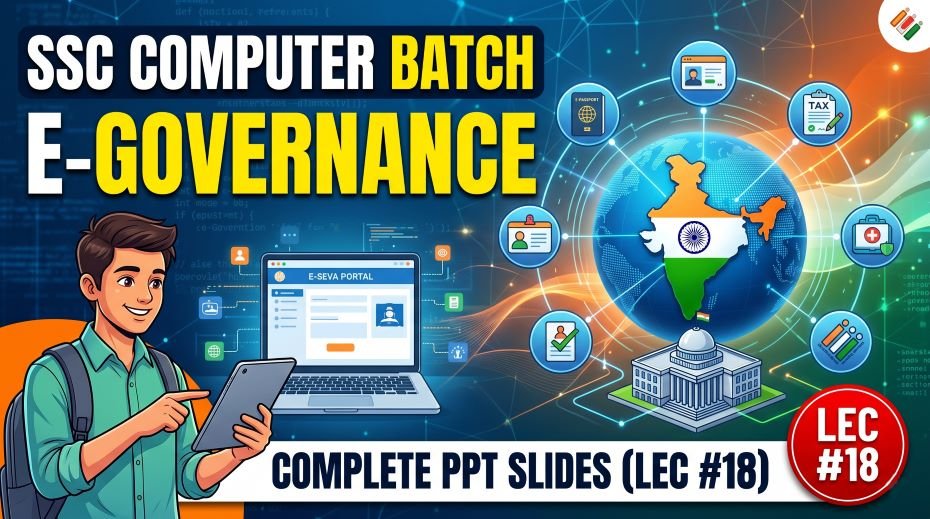
In this article we will share E-Governance Notes for SSC – Digital Government Is the New Reality, SSC Computer Batch E-Governance PPT Slides (LEC #18), Every time a citizen books a train ticket on IRCTC, files an income tax return online, checks their Aadhaar status, or receives a government scholarship directly in their bank account, they are experiencing E-Governance in action. E-Governance is the use of information and communication technologies (ICT) to deliver government services, exchange information, conduct transactions, integrate various services, and transform the way government functions.
Lecture 18 of the Complete Foundation Batch for All SSC and Other Exams PPT Series covers E-Governance (ई-शासन) across 36 focused PPT slides. This is one of the most directly career-relevant topics for SSC aspirants because the positions they are preparing for, whether in central government ministries, tax departments, railways, or defence establishments, are all part of the e-governance ecosystem.
Whether you are searching for e-governance notes for SSC, e-governance kya hai in Hindi, types of e-governance, Digital India programme details, important government portals and apps, CSC Common Service Centres, e-governance benefits, or a free e-governance PDF for competitive exams, this article covers all of it comprehensively. Let us begin.
| Detail | Information |
| Subject | E-Governance (ई-शासन) |
| Lecture Number | LEC 18 |
| Total Slides | 36 PPT Slides |
| File Size | 7 MB |
| Series Name | Complete Foundation Batch for All SSC and Other Exams (PPT Series) |
| Serial Number | #018 |
| Best For | SSC CGL, CHSL, MTS, GD, CPO, JE, Banking, Railways, and all competitive exams |
| Language | English + Hindi (Bilingual) |
| Format | PPT / PDF |
| Website | https://slideshareppt.net/ |
SSC Computer Batch E-Governance PPT Slides (LEC #18)
NOTE: IF YOU WANT TO DOWNLOAD COMPLETE SSC SERIES – JUST VISIT THIS REDIRECT PAGE
E-Governance Kya Hai? What Is E-Governance? Definition and Concept
E-Governance (Electronic Governance) is the application of Information and Communication Technology (ICT) for delivering government services, enabling citizen-government interactions, conducting government transactions, and integrating various government systems to improve transparency, efficiency, accountability, and participation.
The goal of e-governance is to make government services faster, cheaper, more accessible, and less corrupt by moving from paper-based manual processes to digital platforms accessible through computers, smartphones, and the internet. It transforms governance from a bureaucratic, in-person experience into a citizen-centric, anytime-anywhere digital service.
In Hindi, E-Governance is called E-Shaasan (ई-शासन) or Elektronik Shaasan (इलेक्ट्रॉनिक शासन). Both forms appear in SSC bilingual exam papers.
| Aspect | Detail |
| Full Form | E-Governance = Electronic Governance |
| Hindi Name | ई-शासन (E-Shaasan) / इलेक्ट्रॉनिक शासन |
| Definition | Use of ICT to deliver government services and enable digital citizen-government interaction |
| Core Technology | Internet, mobile phones, computers, digital databases, cloud computing |
| Primary Goal | Transparent, efficient, accountable, and citizen-centric governance |
| Introduced in India | Early 2000s; formalized under National E-Governance Plan (NeGP) in 2006 |
| Major Milestone | Digital India Programme launched by PM Narendra Modi on July 1, 2015 |
| Nodal Ministry | Ministry of Electronics and Information Technology (MeitY) |
| Implementing Agency | National Informatics Centre (NIC) under MeitY |
| Related Term | E-Government (focus on internal government operations); E-Governance (broader, includes citizen interaction) |
E-Governance vs E-Government: Important Distinction
Many students confuse E-Governance with E-Government. SSC exams sometimes test this distinction:
| Feature | E-Government | E-Governance |
| Scope | Narrower: focuses on digitizing internal government operations and processes | Broader: includes citizen participation, democratic processes, multi-stakeholder engagement |
| Focus | Government efficiency and internal automation | Citizen-centric service delivery and democratic accountability |
| Perspective | Government’s internal view (how government uses technology) | External and internal view (how citizens interact with technology-enabled government) |
| Examples | Government payroll system, digital file management, inter-department data sharing | IRCTC for citizens, DigiLocker, online RTI filing, e-voting systems |
| Relationship | E-Government is a subset of E-Governance | E-Governance includes E-Government plus citizen participation and transparency |
Types of E-Governance: G2C, G2B, G2G, G2E
E-Governance is classified based on the relationship between the interacting parties. This classification is one of the most frequently tested topics in SSC Computer Awareness and General Awareness:
| Type | Full Form | Definition | Indian Examples |
| G2C | Government to Citizen | Government delivers services and information directly to individual citizens | IRCTC (train booking), DigiLocker (digital documents), Income Tax e-filing, Passport Seva, UMANG app, PAN card online, Voter ID portal, PM-KISAN |
| G2B | Government to Business | Government provides services, information, and regulatory functions to businesses and corporations | GeM (Government e-Marketplace), GSTN (GST portal), MCA21 (company registration), UDYAM (MSME registration), e-Tender portals |
| G2G | Government to Government | Digital exchange of information and services between government departments, agencies, and ministries | NIC inter-departmental data sharing, PFMS (Public Financial Management System), e-Office, State-Centre data integration, AADHAAR-linked DBT |
| G2E | Government to Employee | Government uses ICT to interact with its own employees for HR management, payroll, training, and communication | HRMS (Human Resource Management System), e-Leave management, Sparrow (online ACR), CGHS online portal for health services, salary slip portals |
Digital India Programme: The Flagship E-Governance Initiative
Digital India is the Government of India’s flagship programme that was launched by Prime Minister Narendra Modi on July 1, 2015. It is a comprehensive umbrella programme that encompasses all digital initiatives across government departments and ministries with a vision to transform India into a digitally empowered society and knowledge economy.
| Digital India Detail | Information |
| Launched By | Prime Minister Narendra Modi |
| Launch Date | July 1, 2015 |
| Nodal Ministry | Ministry of Electronics and Information Technology (MeitY) |
| Implementing Agency | Digital India Corporation (DIC); NIC; various state governments |
| Vision | Transform India into a digitally empowered society and knowledge economy |
| Three Key Vision Areas | Digital Infrastructure as a Utility to Every Citizen; Governance and Services on Demand; Digital Empowerment of Citizens |
| Nine Pillars | Broadband Highways; Universal Access to Mobile Connectivity; Public Internet Access Programme; e-Governance; e-Kranti; Information for All; Electronics Manufacturing; IT for Jobs; Early Harvest Programmes |
| Target Areas | Rural areas, BPL citizens, women, students, senior citizens |
| Related App | MyGov.in – citizen engagement platform for Digital India feedback |
Nine Pillars of Digital India: Complete Reference
| Pillar No. | Pillar Name | Key Focus |
| 1 | Broadband Highways | High-speed internet connectivity to all villages through BharatNet; 2.5 lakh Gram Panchayats connected |
| 2 | Universal Access to Mobile Connectivity | Network coverage to all uncovered areas in India; expanding mobile network to rural regions |
| 3 | Public Internet Access Programme | Common Service Centres (CSCs) as service delivery outlets; Wi-Fi hotspots in public places |
| 4 | e-Governance: Reforming Government Through Technology | Digitizing government processes; mobile-first approach; improving government delivery |
| 5 | e-Kranti: Electronic Delivery of Services | Technology for transforming key sectors: health, education, farming, security, financial inclusion, justice |
| 6 | Information for All | Online hosting of government information; Open Data platform; two-way communication |
| 7 | Electronics Manufacturing | Zero Net Import by 2020 target; Make in India for electronics; Fab India initiative |
| 8 | IT for Jobs | Training youth in IT skills; BPO/IT services in north-east and rural areas; NASSCOM partnerships |
| 9 | Early Harvest Programmes | Quick implementation projects: Wi-Fi in universities, national scholarship portal, online messaging for government |
Important E-Governance Portals and Applications: Complete Reference
Knowledge of important e-governance portals and their functions is heavily tested in SSC Computer Awareness and General Awareness. Here is the most comprehensive reference table:
| Portal / App | URL / Platform | Ministry / Department | Purpose / Function |
| IRCTC | irctc.co.in | Ministry of Railways | Online train ticket booking, catering, tourism; most visited Indian govt website |
| DigiLocker | digilocker.gov.in / app | MeitY | Secure cloud-based digital document wallet; stores Aadhaar, PAN, Driving Licence, marksheets digitally |
| UMANG | umang.gov.in / app | MeitY + NIC | Unified Mobile Application for New-age Governance; single app for 1200+ central and state government services |
| MyGov | mygov.in | Prime Minister’s Office | Citizen engagement platform; feedback on government policies; crowdsourcing ideas; polls and discussions |
| GeM | gem.gov.in | Ministry of Commerce | Government e-Marketplace; online procurement of goods and services by all government bodies |
| GSTN | gst.gov.in | Ministry of Finance | GST registration, return filing, tax payment, refund tracking for businesses |
| PFMS | pfms.nic.in | Ministry of Finance | Public Financial Management System; tracks all government fund flows and direct benefit transfers |
| Income Tax e-Filing | incometax.gov.in | CBDT / Finance Ministry | Online ITR filing, tax payment, refund tracking, Form 26AS viewing |
| Passport Seva | passportindia.gov.in | Ministry of External Affairs | Online passport application, appointment booking, status tracking |
| Aadhaar (UIDAI) | uidai.gov.in | UIDAI / MeitY | Aadhaar enrollment, update, verification, e-KYC services |
| eNAM | enam.gov.in | Ministry of Agriculture | National Agriculture Market; online trading of agricultural commodities |
| PM-KISAN | pmkisan.gov.in | Ministry of Agriculture | Direct financial assistance (Rs.6000/year) to farmer families; DBT status check |
| National Career Service | ncs.gov.in | Ministry of Labour | Job matching, employment exchange, career counselling portal |
| RTI Online | rtionline.gov.in | Department of Personnel & Training | Filing Right to Information (RTI) applications online to central government departments |
| COWIN | cowin.gov.in | Ministry of Health | COVID-19 vaccination registration, appointment, and certificate download (now health records) |
| e-Hospital / NIC Hospital | ehospital.nic.in | Ministry of Health | Online OPD appointment booking at government hospitals |
| Scholarship Portal (NSP) | scholarships.gov.in | Ministry of Education | National Scholarship Portal; single platform for all central government scholarships |
| Bhashini | bhashini.gov.in | MeitY | AI-powered translation platform for all 22 Indian official languages |
| DIKSHA | diksha.gov.in | Ministry of Education | Digital Infrastructure for Knowledge Sharing; educational content for teachers and students |
| e-Sanjeevani | esanjeevani.in | Ministry of Health | National Telemedicine Service; online doctor consultation for citizens |
| PM SVANidhi | pmsvanidhi.mohua.gov.in | Ministry of Housing | Street vendor loan scheme; digital credit access for informal sector |
| PM Awas Yojana (PMAY) | pmaymis.gov.in | Ministry of Housing | Housing for all scheme; online beneficiary search and status |
| NREGA MIS | nregs.nic.in | Ministry of Rural Development | MGNREGA work demand, job card, payment tracking for rural wage employment |
Common Service Centres (CSC): E-Governance at the Grassroots
Common Service Centres (CSCs) are one of the most important components of India’s e-governance infrastructure and are frequently tested in SSC exams, especially in the context of digital inclusion for rural India.
| CSC Feature | Detail |
| Full Form | Common Service Centre |
| Programme Name | CSC Scheme (under Digital India) |
| Nodal Ministry | Ministry of Electronics and Information Technology (MeitY) |
| Implementing Agency | CSC e-Governance Services India Limited (CSC SPV) |
| Launched | 2006 under National E-Governance Plan (NeGP); revamped under Digital India 2015 |
| Purpose | Physical access points to deliver government and private sector services in rural and remote areas |
| Location | Village level (at Gram Panchayat level); designed to serve citizens in areas with no internet access |
| Operator | Village Level Entrepreneur (VLE) – a trained local person who runs the CSC |
| Target | At least one CSC per Gram Panchayat across India; over 5 lakh CSCs established |
| Services Offered | Government certificates, Aadhaar services, banking (INDA POST PAYMENTS BANK), insurance, education, health services, agriculture services, digital literacy training |
| Financial Services | Business Correspondent of banks; savings accounts, money transfers, loan applications |
| Significance for SSC | CSCs are the last-mile delivery mechanism for e-governance; serve as IRDAI insurance points, DigiPay agents, and exam registration centers in rural India |
National E-Governance Plan (NeGP): The Foundation of India’s E-Governance
The National E-Governance Plan (NeGP) was approved by the Government of India in May 2006. It is the foundational framework document for e-governance in India that established the vision, approach, strategy, and key components for implementing e-governance across the country.
| NeGP Component | Description |
| Approved | May 2006 by the Government of India |
| Full Form | National e-Governance Plan |
| Nodal Ministry | Department of Electronics and IT (now MeitY) |
| Vision | Make all government services accessible to the common man in his locality through Common Service Delivery Outlets |
| Mission Mode Projects (MMPs) | 31 Mission Mode Projects covering central, state, and integrated services |
| Core Infrastructure | SWAN (State Wide Area Network), SDC (State Data Centres), CSCs (Common Service Centres) |
| Standards | National standards for e-governance interoperability |
| Integrated Services | Aim to deliver integrated services through CSCs at village level |
| Successor | Digital India Programme (2015) built upon NeGP foundation |
Mission Mode Projects (MMPs) Under NeGP
| Category | Examples of Mission Mode Projects |
| Central Government MMPs | Income Tax, Passport, Visa, MCA21 (Company Affairs), Central Excise, Insurance, Pension, Banking, UID (Aadhaar), e-Post |
| State Government MMPs | Agriculture, Land Records, Transport, Municipality, Gram Panchayat, Commercial Taxes, Police, Employment Exchange, e-District, Treasuries |
| Integrated / Common MMPs | CSCs, SWAN, SDC, e-Biz, e-Courts, e-Procurement, India Portal, e-Office, NSDG (National Service Delivery Gateway) |
BharatNet: Rural Internet Connectivity for E-Governance
BharatNet is the world’s largest rural broadband connectivity project, aimed at providing high-speed internet connectivity to all 2.5 lakh Gram Panchayats in India. It is the backbone infrastructure that makes e-governance delivery possible in rural areas.
| BharatNet Feature | Detail |
| Full Name | BharatNet (Bharat Broadband Network Limited – BBNL) |
| Earlier Name | National Optical Fibre Network (NOFN) – renamed to BharatNet |
| Implementing Agency | Bharat Broadband Network Limited (BBNL) |
| Under | Department of Telecommunications (DoT) |
| Objective | Connect all 2,50,000 Gram Panchayats in India with high-speed broadband using optical fibre |
| Technology | Primarily Optical Fibre Cable (OFC); also uses satellite and radio for difficult terrain |
| Speed Target | Minimum 100 Mbps bandwidth at each Gram Panchayat |
| Significance | Foundation for digital service delivery in rural India; enables CSC operations; enables rural telemedicine, e-education |
| Phases | Phase 1 (1 lakh GPs by 2017), Phase 2 (remaining 1.5 lakh GPs) |
Digital India: Key Schemes and Their Benefits
| Scheme / Initiative | Year | Key Benefit / Purpose |
| Digital India Programme | 2015 | Umbrella e-governance initiative; digital infrastructure + services + literacy |
| BharatNet | 2011 (NOFN), renamed 2015 | Optical fibre internet to all Gram Panchayats |
| DigiLocker | 2015 | Eliminates need to carry physical documents; legally valid digital copies |
| UMANG App | 2017 | Single app for 1200+ government services; Android, iOS, web |
| Bhim App | 2016 | UPI-based payment app; promotes cashless transactions |
| e-NAM | 2016 | National Agriculture Market; farmers get better price discovery online |
| Pradhan Mantri Gramin Digital Saksharta Abhiyan (PMGDISHA) | 2017 | Digital literacy for 6 crore rural households |
| SBI YONO | 2017 | State Bank of India’s digital banking app; all financial services in one app |
| PM Jan Dhan Yojana (PMJDY) | 2014 | Financial inclusion; zero-balance bank accounts linked to Aadhaar; DBT beneficiary |
| Aadhaar-Enabled Payment System (AEPS) | 2016 | Banking transactions using only Aadhaar number and fingerprint |
| Jam Trinity (Jan Dhan-Aadhaar-Mobile) | 2014 | Three pillars of DBT (Direct Benefit Transfer); eliminates leakage in welfare delivery |
| National Digital Health Mission (NDHM) | 2020 | Health ID for every Indian; digital health records |
| e-RUPI | 2021 | Cashless, contactless digital voucher for targeted benefit delivery; no bank account needed |
| Digital Rupee (e-Rupee) | 2022 | RBI’s Central Bank Digital Currency (CBDC); digital form of Indian rupee |
Direct Benefit Transfer (DBT): E-Governance Eliminating Corruption
Direct Benefit Transfer (DBT) is one of the most impactful e-governance initiatives in India. It uses Aadhaar-linked bank accounts to transfer government subsidies and benefits directly to the beneficiary’s bank account, eliminating middlemen and preventing leakage of public funds.
| DBT Feature | Detail |
| Full Form | Direct Benefit Transfer |
| Launched | January 1, 2013 |
| Technology Backbone | JAM Trinity: Jan Dhan (bank account) + Aadhaar (identity) + Mobile (OTP/notification) |
| Purpose | Transfer government subsidies, scholarships, wages, and benefits directly to beneficiary’s bank account |
| Benefits | Eliminates middlemen; prevents leakage; reduces corruption; faster delivery; beneficiary empowerment |
| Beneficiary Identification | Aadhaar number linked to bank account for de-duplication and identity verification |
| DBT Schemes Covered | LPG subsidy (PAHAL), PM-KISAN, MGNREGA wages, scholarships, food subsidy, PMAY housing benefit |
| Amount Transferred | Trillions of rupees saved annually by eliminating ghost beneficiaries and middlemen |
| PFMS Role | Public Financial Management System tracks all DBT payments and fund flows |
E-Governance and Digital Payments: India’s Cashless Economy Push
A major component of India’s e-governance initiative is promoting digital payments to reduce cash dependency and enable transparent financial transactions. SSC exams frequently test knowledge of India’s digital payment systems:
| Payment System | Full Form | Launched | Managing Body | Key Feature |
| UPI | Unified Payments Interface | 2016 | NPCI (National Payments Corporation of India) | Instant real-time bank-to-bank transfer via mobile; uses virtual payment addresses (VPA) |
| BHIM | Bharat Interface for Money | 2016 | NPCI | Government’s own UPI app; works with basic smartphones; supports offline transactions via USSD (*99#) |
| RuPay | Rupee Payment | 2012 | NPCI | India’s own domestic card payment network; alternative to Visa and Mastercard; used in PM Jan Dhan Yojana |
| IMPS | Immediate Payment Service | 2010 | NPCI | 24/7 instant interbank money transfer; available 365 days; works even on holidays |
| NEFT | National Electronic Funds Transfer | 2005 | RBI (Reserve Bank of India) | Batch-based funds transfer; settled in hourly batches; available 24/7 since 2019 |
| RTGS | Real Time Gross Settlement | 2004 | RBI | For large-value transactions (above Rs. 2 lakh); real-time settlement; minimum Rs. 2 lakh |
| AEPS | Aadhaar-Enabled Payment System | 2016 | NPCI | Banking transactions using only Aadhaar and fingerprint; no card or smartphone needed; financial inclusion tool |
| e-RUPI | Electronic RUPI | 2021 | NPCI | Cashless digital voucher; no bank account needed; targeted benefit delivery; one-time use |
| Digital Rupee (e-Rupee) | Central Bank Digital Currency | 2022 | RBI | India’s official CBDC; digital form of Indian rupee issued by RBI; pilot launched December 2022 |
Right to Information (RTI) and E-Governance
The Right to Information Act (RTI Act) 2005 is a fundamental pillar of transparent governance in India, and e-governance has significantly enhanced its effectiveness through online filing portals:
| RTI E-Governance Feature | Detail |
| RTI Act Year | 2005 |
| RTI Online Portal | rtionline.gov.in |
| What It Enables | Citizens can file RTI applications online to any central government department; track status; receive responses |
| CIC | Central Information Commission – apex body for RTI at central government level |
| First Appellate Authority | Each ministry/department has a First Appellate Authority for RTI disputes |
| Time Limit | RTI response must be given within 30 days; for life/liberty matters within 48 hours |
| E-Governance Impact | Reduced travel and cost for citizens to file RTI; increased transparency in government |
| CIC Online Filing | CIC also has online systems for second appeals and complaints |
E-Governance Challenges and Solutions
Despite significant progress, e-governance faces several challenges in India. Understanding these challenges and their solutions is important for SSC interview preparation and General Awareness:
| Challenge | Impact | Government Solution / Initiative |
| Digital Divide | Rural and low-income citizens lack internet access and digital literacy | BharatNet for connectivity; PMGDISHA for digital literacy; CSCs for assisted access |
| Language Barrier | Government portals and services often only in English | Bhashini for AI translation; multilingual government portals; local language interfaces |
| Infrastructure Gap | Poor internet connectivity in remote areas; power outages | BharatNet optical fibre; VSAT satellite connectivity; offline-capable apps (BHIM on USSD) |
| Cybersecurity Threats | Government databases targeted by hackers; citizen data breach risks | CERT-In guidelines; MEITY cybersecurity framework; AIRAWAT secure cloud |
| Digital Literacy | Many citizens unable to use digital services independently | PMGDISHA training; CSC assistance; UMANG simple interface |
| Interoperability | Different government departments use incompatible systems | National e-Governance Interoperability Framework (NEGIF); API-based integration |
| Privacy Concerns | Aadhaar data linking raised privacy and surveillance concerns | Personal Data Protection Act; Supreme Court privacy judgement (2017) |
| Trust Deficit | Citizens hesitant to use digital systems due to fear of fraud | Digital literacy campaigns; secure HTTPS portals; OTP verification; awareness ads |
State-Level E-Governance Initiatives: Best Practices
Several Indian states have developed innovative e-governance solutions that have become national models. SSC exams sometimes ask about state-level digital governance achievements:
| State | E-Governance Initiative | Achievement / Impact |
| Andhra Pradesh | e-Seva, Mee Seva | Pioneer in integrated citizen service delivery centres; single-window services for 150+ services |
| Kerala | FRIENDS (Fast Reliable Instant Efficient Network for Disbursement of Services) | One of India’s first integrated service delivery centers; handles 60+ services |
| Gujarat | e-Gram Vishwagram | Connected all villages with VSAT connectivity before BharatNet; digital gram panchayats |
| Karnataka | Bhoomi (Land Records Computerization) | First complete computerization of land records in India; prevents land fraud |
| Tamil Nadu | e-District, ELCOT | Efficient district-level service delivery; integrated government services at Tahsildar level |
| Maharashtra | MahaOnline, Aaple Sarkar | Comprehensive state services portal; online certificates and licences |
| Rajasthan | Raj e-Vault, e-Mitra | Integrated service delivery kiosks across rural Rajasthan |
| Telangana | Mee Seva (inherited from AP), T-App Folio | Mobile-first state services; most services on smartphone app |
| Delhi | Delhi Jal Board online, e-Services | Urban e-governance; online utility services, property tax, water bill |
E-Governance Standards and Policies
| Standard / Policy | Full Form | Purpose |
| NeGP | National e-Governance Plan | 2006 policy framework; foundation of India’s e-governance strategy; 31 Mission Mode Projects |
| NEGIF | National e-Governance Interoperability Framework | Technical standards ensuring different government systems can communicate with each other |
| Open Government Data (OGD) | data.gov.in portal | Publishing government datasets publicly for transparency and innovation |
| GIGW | Guidelines for Indian Government Websites | Standards for government websites: design, accessibility, multilingual content, security |
| Policy on Open Standards | – | Ensures government software uses open, non-proprietary standards for vendor independence |
| IT Act 2000 | Information Technology Act 2000 | Legal framework for digital transactions, electronic records, digital signatures in e-governance |
| e-Sign | Electronic Signature | Aadhaar-based digital signature for citizens; legally valid; used for e-governance documents |
| Digital Signature Certificate (DSC) | – | Used by businesses and government officials for legally signing electronic documents |
| PDP Act / DPDP Act | Digital Personal Data Protection Act 2023 | India’s comprehensive data privacy law; governs how government and companies handle citizen data |
E-Governance Abbreviations: Complete Reference for SSC
| Abbreviation | Full Form | Context |
| E-Gov | E-Governance | Electronic Governance |
| MeitY | Ministry of Electronics and Information Technology | Nodal ministry for e-governance in India |
| NIC | National Informatics Centre | IT implementation agency for Indian government |
| NeGP | National e-Governance Plan | 2006 foundational e-governance framework |
| MMP | Mission Mode Project | Specific e-governance projects under NeGP |
| CSC | Common Service Centre | Village-level e-governance access point |
| VLE | Village Level Entrepreneur | Local person operating a CSC |
| SWAN | State Wide Area Network | State-level network backbone for government connectivity |
| SDC | State Data Centre | Centralized data hosting for state government services |
| SSDG | State Service Delivery Gateway | Technology platform for state service delivery |
| NSDG | National Service Delivery Gateway | Central platform connecting various government services |
| DBT | Direct Benefit Transfer | Transferring benefits directly to Aadhaar-linked bank accounts |
| JAM | Jan Dhan-Aadhaar-Mobile | Three pillars enabling DBT in India |
| UPI | Unified Payments Interface | NPCI’s real-time mobile payment system |
| BHIM | Bharat Interface for Money | Government’s UPI payment app |
| NPCI | National Payments Corporation of India | Manages UPI, IMPS, RuPay, AEPS payment systems |
| AEPS | Aadhaar-Enabled Payment System | Banking via Aadhaar fingerprint; no card needed |
| IMPS | Immediate Payment Service | 24/7 instant interbank money transfer |
| NEFT | National Electronic Funds Transfer | Batch-based electronic money transfer |
| RTGS | Real Time Gross Settlement | Real-time large value (above Rs. 2 lakh) transfer |
| PFMS | Public Financial Management System | Tracks all government fund flows and DBT |
| GSTN | Goods and Services Tax Network | GST registration and compliance portal |
| IRCTC | Indian Railway Catering and Tourism Corporation | Online train ticket booking |
| UIDAI | Unique Identification Authority of India | Manages Aadhaar identity system |
| RTI | Right to Information | Citizens’ legal right to access government information |
| PMGDISHA | Pradhan Mantri Gramin Digital Saksharta Abhiyan | Rural digital literacy programme |
| BBNL | Bharat Broadband Network Limited | Implements BharatNet rural internet connectivity |
| GeM | Government e-Marketplace | Online procurement for government bodies |
| eNAM | Electronic National Agriculture Market | Online agricultural commodity trading portal |
| DIKSHA | Digital Infrastructure for Knowledge Sharing | National digital education platform |
Exam Frequency: E-Governance Topics and Priority for SSC
| Topic | Exam Frequency | Difficulty | Priority |
| E-Governance Definition and Hindi Name (ई-शासन) | Very High | Easy | Must Study First |
| G2C, G2B, G2G, G2E Types with Examples | Very High | Easy-Medium | Must Study First |
| Digital India Launch Date (July 1, 2015) and PM Modi | Very High | Easy | Must Study First |
| Important Portals (IRCTC, DigiLocker, UMANG, GeM) | Very High | Easy | Must Study First |
| UPI Full Form and NPCI | Very High | Easy | Must Study First |
| DBT Full Form and JAM Trinity | High | Easy-Medium | Must Study First |
| BharatNet Purpose (connecting Gram Panchayats) | High | Easy | Important |
| CSC Full Form and Village Level Entrepreneur (VLE) | High | Easy | Important |
| NeGP Year (2006) and Mission Mode Projects | High | Medium | Important |
| BHIM App Full Form (Bharat Interface for Money) | High | Easy | Important |
| RuPay – India’s own card network | High | Easy | Important |
| PMGDISHA – Rural Digital Literacy | Medium-High | Easy | Important |
| IMPS, NEFT, RTGS Differences | Medium-High | Medium | Important |
| RTI Act 2005 and rtionline.gov.in | Medium-High | Easy-Medium | Important |
| State E-Governance Examples (Bhoomi Karnataka, FRIENDS Kerala) | Medium | Medium | Good to Know |
| PFMS Full Form and Purpose | Medium | Easy | Good to Know |
| Digital Rupee (CBDC) by RBI | Medium | Easy | Good to Know |
| DPDP Act 2023 | Low-Medium | Medium | Revision Only |
Top 30 E-Governance Facts to Memorize for SSC
- E-Governance stands for Electronic Governance; in Hindi it is ई-शासन (E-Shaasan)
- E-Governance uses ICT to deliver government services, improve transparency, and enable citizen-government interaction
- Nodal ministry for E-Governance in India is MeitY (Ministry of Electronics and Information Technology)
- NIC (National Informatics Centre) is the implementing IT agency for Indian government
- National E-Governance Plan (NeGP) was approved in May 2006 with 31 Mission Mode Projects
- Digital India Programme was launched by PM Narendra Modi on July 1, 2015
- Digital India has three key vision areas: Digital Infrastructure, Governance & Services on Demand, Digital Empowerment
- Digital India has Nine Pillars including Broadband Highways, CSCs, e-Governance, and e-Kranti
- G2C = Government to Citizen; G2B = Government to Business; G2G = Government to Government; G2E = Government to Employee
- IRCTC (irctc.co.in) is the most visited Indian government website; handles train ticket booking
- DigiLocker stores official digital documents (Aadhaar, PAN, DL); eliminates physical document carry
- UMANG is a single app providing access to 1200+ government services across departments
- GeM (Government e-Marketplace) is the online procurement portal for all government bodies
- CSC = Common Service Centre; village-level e-governance access point operated by VLE (Village Level Entrepreneur)
- BharatNet aims to connect all 2.5 lakh Gram Panchayats with high-speed optical fibre internet
- DBT = Direct Benefit Transfer; uses JAM Trinity (Jan Dhan + Aadhaar + Mobile) to eliminate middlemen
- JAM Trinity: Jan Dhan (bank account) + Aadhaar (identity) + Mobile (OTP) = backbone of DBT
- UPI = Unified Payments Interface; managed by NPCI; enables real-time mobile bank transfers
- BHIM = Bharat Interface for Money; government’s official UPI payment app
- RuPay is India’s domestic card payment network; alternative to Visa and Mastercard; managed by NPCI
- IMPS enables 24/7 instant interbank money transfer; available 365 days including holidays
- NEFT: batch-based transfer; RTGS: real-time for amounts above Rs. 2 lakh
- AEPS = Aadhaar-Enabled Payment System; banking using only Aadhaar and fingerprint
- e-RUPI is a cashless digital voucher for targeted benefit delivery; no bank account needed
- Digital Rupee (e-Rupee) is India’s CBDC (Central Bank Digital Currency) launched by RBI in 2022
- PMGDISHA = Pradhan Mantri Gramin Digital Saksharta Abhiyan; digital literacy for 6 crore rural households
- RTI Act was enacted in 2005; online filing at rtionline.gov.in; response within 30 days
- Bhoomi (Karnataka) was India’s first complete computerization of land records; prevents land fraud
- PFMS = Public Financial Management System; tracks all central government fund flows and DBT payments
- DPDP Act 2023 (Digital Personal Data Protection Act) is India’s comprehensive data privacy law
Study Plan: 3 Days to Master E-Governance for SSC Exams
Day 1: Definitions, Types, and Digital India
- Study E-Governance definition, Hindi name (ई-शासन), nodal ministry (MeitY), and NIC’s role
- Master the four types: G2C, G2B, G2G, G2E with at least 3 examples each
- Study Digital India: launch date (July 1, 2015), PM Modi, three vision areas, Nine Pillars
- Study NeGP (2006) and its 31 Mission Mode Projects and infrastructure (SWAN, SDC, CSC)
Day 2: Portals, Apps, Payments, and DBT
- Memorize all important portals from the table: IRCTC, DigiLocker, UMANG, GeM, GSTN, etc.
- Study CSC: full form, VLE, services, village-level role
- Study BharatNet: purpose (connect 2.5 lakh Gram Panchayats with optical fibre)
- Master digital payments: UPI, BHIM, RuPay, IMPS, NEFT, RTGS, AEPS, e-RUPI
- Study DBT and JAM Trinity (Jan Dhan + Aadhaar + Mobile)
Day 3: Schemes, Challenges, Abbreviations, and Practice
- Study important e-governance schemes: PMGDISHA, eNAM, PM-KISAN, DIKSHA, Bhashini
- Learn state-level initiatives: Bhoomi (Karnataka), FRIENDS (Kerala), e-Seva (AP)
- Revise all E-Governance abbreviations from the table
- Solve 30 to 40 E-Governance questions from SSC previous year papers
READ ALSO: SSC Computer Batch Artificial intelligence PPT Slides LEC 17
(FAQs)
Q1. What is E-Governance and what is its Hindi name?
E-Governance (Electronic Governance) is the use of Information and Communication Technology (ICT) to deliver government services, enable citizen-government interaction, conduct government transactions, and improve transparency and efficiency of governance. In Hindi, it is called ई-शासन (E-Shaasan). The nodal ministry for E-Governance in India is MeitY (Ministry of Electronics and Information Technology).
Q2. What are the types of E-Governance?
E-Governance is classified into four types based on the interacting parties: G2C (Government to Citizen) – delivering services to individual citizens, like IRCTC and DigiLocker. G2B (Government to Business) – services to businesses, like GeM and GSTN. G2G (Government to Government) – digital exchange between government departments. G2E (Government to Employee) – government interacting with its own employees through HRMS and e-Leave systems.
Q3. When was Digital India launched and by whom?
Digital India was launched by Prime Minister Narendra Modi on July 1, 2015. It is a flagship programme of the Government of India with the vision to transform India into a digitally empowered society and knowledge economy. The programme is managed by the Ministry of Electronics and Information Technology (MeitY) and has Nine Pillars covering everything from broadband connectivity to digital literacy.
Q4. What is a Common Service Centre (CSC)?
A Common Service Centre (CSC) is a village-level e-governance access point that provides government and private sector services to citizens in rural and remote areas. Each CSC is run by a Village Level Entrepreneur (VLE), a trained local person. CSCs offer services including Aadhaar enrollment, certificate issuance, banking (as Business Correspondents), insurance, scholarship applications, and digital literacy training. India has established over 5 lakh CSCs to ensure last-mile delivery of e-governance.
Q5. What is the JAM Trinity in the context of DBT?
The JAM Trinity stands for Jan Dhan (J) + Aadhaar (A) + Mobile (M). It represents the three foundational pillars that enable Direct Benefit Transfer (DBT) in India. Jan Dhan provides a bank account for every citizen (including the poorest), Aadhaar provides a unique verified identity eliminating fake and duplicate beneficiaries, and Mobile enables OTP-based authentication and digital payment notifications. Together, these three eliminate middlemen and ensure government benefits reach genuine beneficiaries directly.
Q6. What is the difference between UPI, IMPS, NEFT, and RTGS?
UPI (Unified Payments Interface) is a real-time mobile payment system that works 24/7 through smartphone apps. IMPS (Immediate Payment Service) is a 24/7 instant interbank money transfer available even on holidays. NEFT (National Electronic Funds Transfer) uses batch processing and is available 24/7 since 2019 but settles in hourly batches. RTGS (Real Time Gross Settlement) is for large-value transfers above Rs. 2 lakh and settles immediately in real time during banking hours.
Q7. What is BharatNet?
BharatNet (Bharat Broadband Network Limited) is the world’s largest rural broadband connectivity project aimed at connecting all 2.5 lakh Gram Panchayats in India with high-speed optical fibre internet providing at least 100 Mbps bandwidth. It is implemented by BBNL (Bharat Broadband Network Limited) under the Department of Telecommunications. BharatNet provides the backbone internet infrastructure that enables CSCs and e-governance service delivery in rural India.
Q8. How many slides are in the SSC E-Governance PPT (LEC 18)?
The E-Governance Complete Batch PPT (LEC 18) contains 36 slides. It is Serial Number 018 of the Complete Foundation Batch for All SSC and Other Exams PPT Series. The file size is just 7 MB, making it the smallest-sized module in the series and the quickest to download. Despite its compact size, it covers all the e-governance content tested in SSC Computer Awareness and General Awareness sections.
Conclusion: E-Governance Knowledge Is Both Exam Preparation and Job Preparation
E-Governance (LEC 18) is one of the most immediately relevant topics for SSC aspirants for a very direct reason: the government job they are preparing for is itself part of India’s e-governance ecosystem. Understanding how government services are delivered digitally, what initiatives like Digital India and DBT involve, and how platforms like UMANG, DigiLocker, and UPI work is not just exam preparation but professional preparation for life as a government employee.
The 36-slide LEC 18 module covers the complete e-governance curriculum for SSC: E-Governance definition and types (G2C, G2B, G2G, G2E), Digital India programme (2015) with Nine Pillars, National E-Governance Plan (NeGP 2006) and Mission Mode Projects, Common Service Centres (CSC) and Village Level Entrepreneurs, BharatNet, Direct Benefit Transfer (DBT) and JAM Trinity, important government portals (IRCTC, DigiLocker, GeM, UMANG), digital payment systems (UPI, BHIM, RuPay, IMPS, NEFT, RTGS, AEPS), key schemes (PMGDISHA, eNAM, DIKSHA, Bhashini), RTI online, state-level initiatives, and e-governance challenges.
For SSC exam scoring: know Digital India’s launch date (July 1, 2015) and PM Modi, know all four G2C/G2B/G2G/G2E types, know UPI and BHIM (NPCI), know DBT and JAM Trinity, know CSC and VLE, know BharatNet’s purpose, know IRCTC/DigiLocker/GeM/UMANG/GSTN, and know PMGDISHA. These areas cover the vast majority of e-governance questions in any SSC exam.
Download the free 7 MB PDF from https://slideshareppt.net/, follow the 3-day study plan, memorize the abbreviations table, and practice previous year questions. E-Governance will consistently deliver marks in both Computer Awareness and General Awareness sections of every SSC exam.