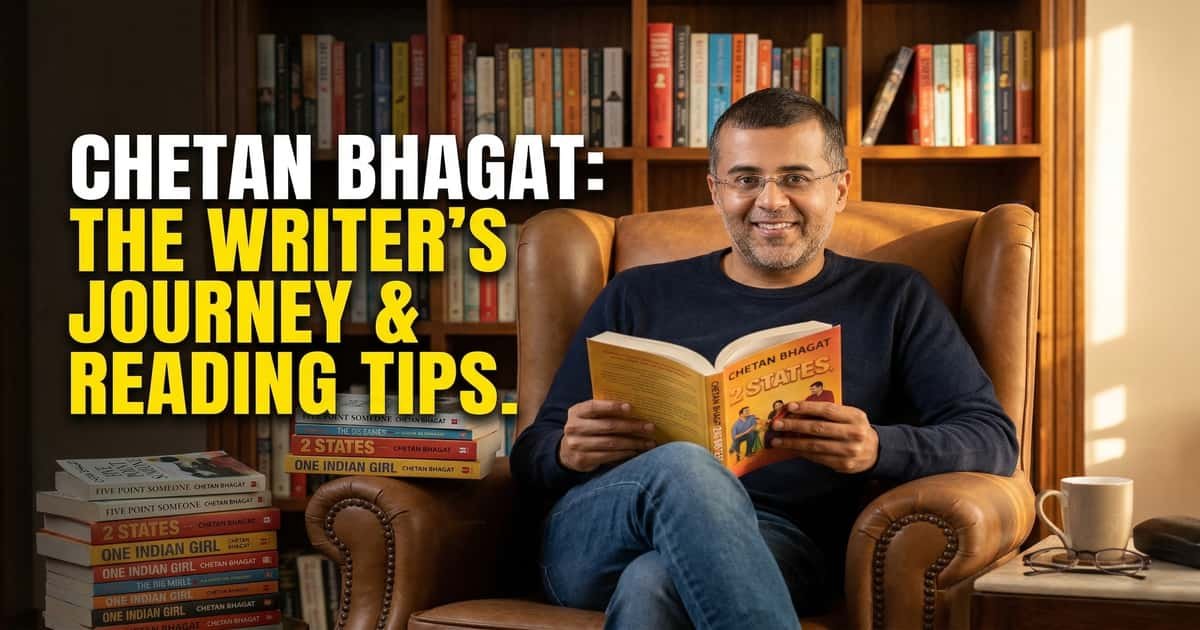
In this article we will discuss everything about Chetan Bhagat Biography PDF and PPT Slides Download – his biography in English and Hindi, all books list in order and year-wise, top 5 books, books one arranged marriage, books 12 years, books story, 11 rules of life, latest book and new book 2025, all movies based on his books, wife, father, age, net worth, which IIT he studied, autobiography, and his complete legacy as India’s most widely read English-language novelist and one of the most influential voices in popular Indian culture.
Chetan Bhagat is a phenomenon. He is not merely a bestselling author – he is the man who changed the relationship between India and the English-language novel. Before Five Point Someone (2004), the English novel in India was largely the preserve of an educated elite; it was reviewed in the literary pages of newspapers, taught in universities, and read by people who had studied English literature. Chetan Bhagat broke all of that wide open. He wrote in a style that was accessible to anyone who could read English at a college level; he wrote about the lives of young, ambitious, middle-class Indians navigating the pressures of engineering college, call centres, relationships, and careers; and he sold millions of copies and created a new reading public for the English-language novel in India.
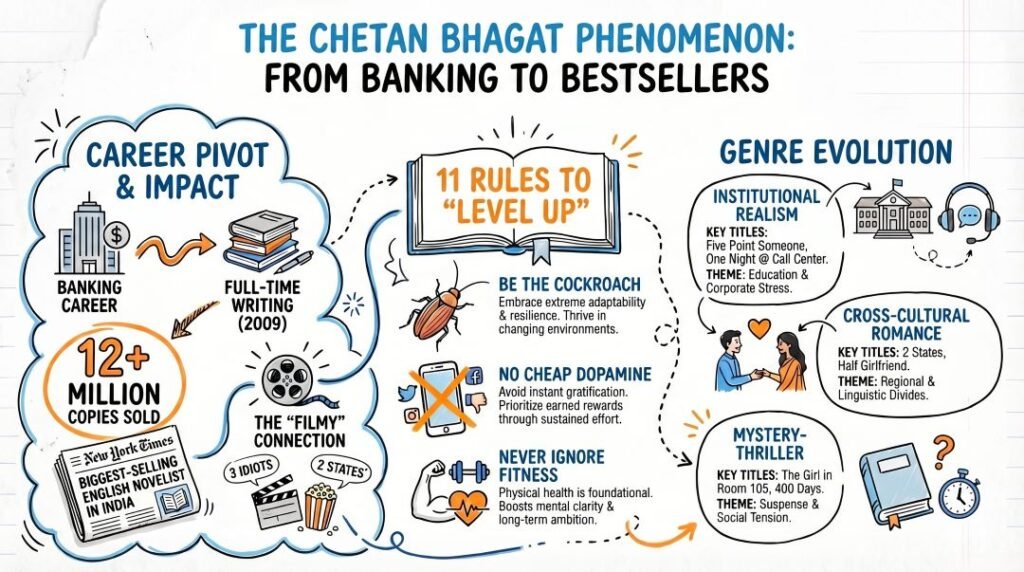
He is the author of eleven novels that have together sold more than 12 million copies. Several of his books have been adapted into major Bollywood films. He is a columnist for major Indian newspapers, a motivational speaker, a television personality, and one of the most visible public intellectuals in India. He is also one of the most debated – celebrated by millions of readers as a voice that speaks to their lives and criticised by literary critics who question the quality of his prose and the depth of his ideas. Whatever position one takes in that debate, the fact of his influence is undeniable.
Chetan Bhagat Biography Table (Biodata / Author Profile)
| Biographical Detail | Information |
| Full Name | Chetan Bhagat |
| Date of Birth / Born | April 22, 1974 |
| Born Place | New Delhi, India – born into a Punjabi middle-class family in Delhi; the Delhi middle-class world – its aspirations, its pressures, its competitiveness, its relationship to the larger project of upwardly mobile India – is the world that shapes all his fiction |
| Age | As of 2025, Chetan Bhagat is 50 years old – born April 22, 1974 |
| Nationality | Indian |
| Father | Lieutenant Colonel (Retired) Rajkumar Bhagat – his father is a retired Indian Army officer; his father’s military background and its influence on his upbringing is reflected in Chetan Bhagat’s own disciplined, achievement-oriented personality and in his understanding of the pressures placed on middle-class Indian children to succeed professionally |
| Mother | Rekha Bhagat – a government employee; his mother’s role in his upbringing was central and has been mentioned in several interviews as a formative influence |
| Wife | Anusha Bhagat (nee Suryakumar) – Chetan Bhagat’s wife, whom he married in 1998; she is a chartered accountant by profession; they met as students at IIM Ahmedabad where they were classmates; their love story – a cross-caste marriage (he is Punjabi, she is South Indian) – was the direct inspiration and source material for his novel 2 States: The Story of My Marriage (2009), one of his most popular and most widely read books |
| Children | Twin sons – Shyam Bhagat and Ishaan Bhagat; born in 2003 |
| Education – Which IIT Did Chetan Bhagat Study? | IIT Delhi (Indian Institute of Technology Delhi) – Chetan Bhagat studied Mechanical Engineering at IIT Delhi, graduating in 1995. This is the answer to the frequently asked question ‘Which IIT did Chetan Bhagat study?’ – he attended IIT Delhi, not IIT Bombay or any other IIT. After IIT Delhi, he went to IIM Ahmedabad (Indian Institute of Management Ahmedabad) – one of the two most prestigious management schools in India – where he completed his MBA. It was at IIM Ahmedabad that he met his wife Anusha. |
| Career Before Writing | After completing his MBA from IIM Ahmedabad, Chetan Bhagat worked as an investment banker – at Goldman Sachs in Hong Kong for several years, and later at Deutsche Bank; he gave up his investment banking career when his writing career took off; he was an investment banker for about a decade before becoming a full-time writer |
| Writing Career | His first novel, Five Point Someone, was published in 2004 and became one of the bestselling Indian English novels of all time; he has since published ten more novels; he is also a popular columnist for The Times of India and Dainik Bhaskar, and has written extensively on topics ranging from politics and economics to relationships and Indian youth culture |
| Which Book Made Chetan Bhagat Famous? | Five Point Someone: What Not to Do at IIT (2004) is the book that made Chetan Bhagat famous – his debut novel about three IIT students navigating college life, friendships, grades, and romance. It became a massive bestseller in India and was later loosely adapted into the Bollywood blockbuster 3 Idiots (2009) |
| What Is the Biggest Hit of Chetan Bhagat? | 2 States: The Story of My Marriage (2009) is often cited as his biggest hit in terms of commercial success – it sold over 5 million copies in India, spent years on bestseller lists, and was adapted into a successful Bollywood film (2014) starring Arjun Kapoor and Alia Bhatt. Five Point Someone (through its 3 Idiots adaptation) also has a strong claim. |
| Is 3 Idiots by Chetan Bhagat? | 3 Idiots (2009) is a Bollywood film directed by Rajkumar Hirani, starring Aamir Khan, Madhavan, and Sharman Joshi. It is based on (or inspired by) Chetan Bhagat’s novel Five Point Someone: What Not to Do at IIT (2004). However, Bhagat was not credited as the primary writer of the film – he received an ‘inspired by’ credit rather than a full adaptation credit, which led to a controversy between him and the filmmakers about the extent of the adaptation. Bhagat expressed dissatisfaction with the credit he received. The film was one of the highest-grossing Bollywood films of all time. |
| Movies Based on His Books | Five Point Someone – inspired 3 Idiots (2009, dir. Rajkumar Hirani, starring Aamir Khan); One Night at the Call Center – adapted as Hello (2008, dir. Atul Agnihotri); The 3 Mistakes of My Life – adapted as Kai Po Che! (2013, dir. Abhishek Kapoor); 2 States – adapted as 2 States (2014, dir. Abhishek Varman, starring Arjun Kapoor and Alia Bhatt); Revolution 2020 – adapted as a web series; Half Girlfriend – adapted as Half Girlfriend (2017, dir. Mohit Suri, starring Arjun Kapoor and Shraddha Kapoor) |
| Net Worth | Chetan Bhagat’s net worth is estimated at approximately 25-30 crore Indian rupees (roughly 3-4 million USD) as of 2024-2025 – derived from book royalties (millions of copies sold), advances for new books, speaking fees, column writing, television appearances, and social media presence. These are estimates; precise figures are not publicly available. |
| Latest Book / New Book 2025 | One Arranged Murder (2020) was his most recent novel as of 2022; 12 Years: My Messed Up Life (2023) is his most recent publication – a memoir/non-fiction book about his personal journey. As of 2025, readers are awaiting his next novel. |
| Autobiography | 12 Years: My Messed Up Life (2023) is the closest Chetan Bhagat has come to writing an autobiography – it is a personal non-fiction book in which he reflects on the twelve years of his life between his marriage and the period of significant personal challenges. It is not a traditional autobiography but a personal, candid account of a difficult period in his life. |
| 11 Rules of Life | What Young India Wants (2012) and Making India Awesome (2015) are his non-fiction books on social, political, and motivational themes; various ’11 rules of life’ attributed to Chetan Bhagat circulate online as motivational content based on his public talks and writings – though no book of his is specifically titled ’11 Rules of Life’, these rules have been compiled from his speeches and columns |
Chetan Bhagat Biography (.PPTX)
Who Is Chetan Bhagat? What Made Him Famous?
Chetan Bhagat is an Indian novelist, columnist, motivational speaker, and public intellectual, born on April 22, 1974, in New Delhi. He is the bestselling English-language fiction author in Indian history – his novels have collectively sold more than 12 million copies, making him the most widely read English-language novelist in a country of 1.4 billion people. He is famous above all as the author of Five Point Someone (2004) – his debut novel about three IIT students – which was later loosely adapted into the Bollywood blockbuster 3 Idiots (2009). He is also famous for 2 States, The 3 Mistakes of My Life, One Night at the Call Center, Half Girlfriend, The Girl in Room 105, and One Indian Girl, each of which has sold millions of copies.
He studied Mechanical Engineering at IIT Delhi and completed his MBA at IIM Ahmedabad – the two most prestigious academic institutions in India for engineering and management – before working as an investment banker at Goldman Sachs in Hong Kong. He gave up investment banking to write full-time, and his career has been one of the most commercially successful in the history of Indian publishing.
What made Chetan Bhagat famous is not just the quality of his writing but the audiences he reached. He wrote in simple, direct, accessible English about the lives of young, ambitious, middle-class Indians – their relationships, their career pressures, their family expectations, their dreams and their disappointments – and he found millions of readers who had never before felt that a novel was written for them. He democratised the English-language novel in India, bringing it to readers who might otherwise never have picked one up.
Chetan Bhagat Biography in English: Early Life, Born Place and Education
Chetan Bhagat was born on April 22, 1974, in New Delhi – into a Punjabi middle-class family shaped by his father’s military career and his mother’s government service. His father, Lieutenant Colonel (Retired) Rajkumar Bhagat, served in the Indian Army – a background that gave the family a disciplined, achievement-oriented culture and that shaped Chetan’s understanding of the pressures placed on middle-class Indian children to succeed professionally and academically.
He attended school in Delhi before securing admission – through the notoriously competitive IIT Joint Entrance Examination (JEE) – to IIT Delhi, where he studied Mechanical Engineering. The answer to the question ‘Which IIT did Chetan Bhagat study?’ is IIT Delhi – not IIT Bombay or any other. He graduated from IIT Delhi in 1995. His experience at IIT – the pressure of the entrance examination, the competitive culture of the campus, the friendships, the relationships, the gap between the rigour of the engineering curriculum and the broader ambitions of the students – is the direct material of his debut novel Five Point Someone.
After IIT Delhi, he went to IIM Ahmedabad – Indian Institute of Management Ahmedabad – for his MBA, graduating in 1997. IIM Ahmedabad is one of the two most prestigious management schools in India (along with IIM Calcutta), and admission is as competitive as IIT. It was at IIM Ahmedabad that he met Anusha Suryakumar – a South Indian woman who would become his wife. Their cross-cultural, cross-caste love story – a Punjabi man and a Tamil woman, each facing family resistance to the match – became the basis of his novel 2 States.
After IIM Ahmedabad, Chetan Bhagat moved to Hong Kong, where he worked as an investment banker at Goldman Sachs. He worked in investment banking for approximately a decade – at Goldman Sachs and later at Deutsche Bank – while writing his novels in his spare time. Five Point Someone was written while he was still an investment banker; it was published in 2004 and became such a success that he eventually left banking to write full-time.
Chetan Bhagat Wife: Anusha Bhagat
Chetan Bhagat’s wife is Anusha Bhagat (nee Suryakumar) – a chartered accountant whom he met when they were both students at IIM Ahmedabad in the mid-1990s. They married in 1998 – the year after graduating from IIM – and have been together for more than twenty-five years. They have twin sons, Shyam and Ishaan, born in 2003.
Their love story – a Punjabi man from Delhi and a South Indian (Tamil) woman, each from different cultural, linguistic, and regional backgrounds, facing family resistance to their marriage from both sides – is the direct inspiration and source material for 2 States: The Story of My Marriage (2009), one of his most popular and most commercially successful novels. In the novel (which is thinly fictionalised autobiography), the protagonist Krish Malhotra (a Punjabi from Delhi) falls in love with Ananya Swaminathan (a Tamil girl from Chennai) at IIM Ahmedabad, and the two must negotiate the cultural and family obstacles to their marriage.
Anusha Bhagat has maintained a relatively private profile, though she is occasionally mentioned in interviews with her husband. The couple live in Mumbai, where Chetan Bhagat has been based since returning from Hong Kong.
Chetan Bhagat All Books: Complete List in Order and Year-Wise
Chetan Bhagat has published eleven novels and two non-fiction books over a career spanning more than two decades. Here is his complete bibliography in chronological order:
| Year | Title | Type / Summary |
| 2004 | Five Point Someone: What Not to Do at IIT | His debut novel and the book that made him famous. The story of three IIT students – Hari, Ryan, and Alok – who have a collective GPA of 5 out of 10 (hence ‘five point someone’) and who navigate college life, friendships, academic pressures, and romance at one of India’s most competitive institutions. The novel is funny, warm, and honest about the gap between IIT’s academic demands and the broader human lives of its students. It became a massive bestseller – the first major commercial success for an Indian-authored English-language novel aimed at a popular audience. Later loosely adapted as 3 Idiots (2009, dir. Rajkumar Hirani). |
| 2005 | One Night @ the Call Center | His second novel – set in a call centre in Gurgaon (now Gurugram), near Delhi; the story of six call centre employees working the night shift, their personal problems, their relationships, and an extraordinary intervention – a phone call from God – that changes everything. The novel captures the world of India’s booming call centre industry in the mid-2000s – the night shifts, the American accents, the disconnect between the work and the workers’ aspirations. Adapted as the Bollywood film Hello (2008). |
| 2008 | The 3 Mistakes of My Life | His third novel – set in Ahmedabad, Gujarat; the story of three friends – Govind, Omi, and Ishan – who start a cricket coaching business and navigate the political violence of the 2002 Gujarat riots and the 2001 Bhuj earthquake. The novel is his most politically engaged – it deals directly with communal violence and its impact on ordinary lives. Adapted as the critically acclaimed Bollywood film Kai Po Che! (2013, dir. Abhishek Kapoor). |
| 2009 | 2 States: The Story of My Marriage | His fourth and most commercially successful novel – the thinly fictionalised story of his own marriage to Anusha; Krish Malhotra (Punjabi) falls in love with Ananya Swaminathan (Tamil) at IIM Ahmedabad, and the two must negotiate the cultural and family obstacles to their marriage across the two very different worlds of north and south India. Funny, warm, and sharply observed about Indian regional cultures and their differences. Spent years on bestseller lists; adapted as the Bollywood film 2 States (2014, dir. Abhishek Varman, starring Arjun Kapoor and Alia Bhatt). |
| 2011 | Revolution 2020: Love, Corruption, Politics | His fifth novel – set in Varanasi (Banaras); the story of a love triangle between Gopal, Raghav, and Aarti against the background of political corruption and the entrance examination coaching industry. The novel engages with themes of corruption, ambition, and the moral compromises demanded by Indian public life. Adapted as a web series. |
| 2013 | What Young India Wants | Non-fiction – a collection of his columns and essays on what India’s young generation wants from the country’s economic, political, and social life; one of his most explicitly political and motivational works; reflecting his role as a public commentator and social critic as well as a novelist. |
| 2014 | Half Girlfriend | His sixth novel – the story of Madhav Jha, a small-town Bihar boy who goes to St. Stephen’s College in Delhi (one of India’s most prestigious liberal arts colleges) on a basketball scholarship, and his complicated relationship with Riya Somani, a Delhi girl of a higher social class. The relationship between them – never fully a girlfriend, but more than a friend – is described as ‘half girlfriend’. The novel is about class, aspiration, language anxiety (Madhav’s English is poor, which makes him feel inferior), and the social distances that exist within Indian society. Adapted as the Bollywood film Half Girlfriend (2017, dir. Mohit Suri). |
| 2015 | Making India Awesome: New Ideas for a New India | Non-fiction – a collection of essays on political and social reform; reflecting his role as a commentator on Indian public life; his most explicitly political non-fiction work. |
| 2016 | One Indian Girl | His seventh novel – his first novel with a female protagonist; Radhika Mehta is a successful investment banker who is about to get married and who reviews, in the days before her wedding, her three relationships and what they have taught her about love, ambition, and what Indian society expects of successful women. Written in a female voice. Explores themes of gender, ambition, and the social expectations placed on Indian women. |
| 2018 | The Girl in Room 105 | His eighth novel – his first thriller/crime novel; Keshav, a jilted engineering graduate, investigates the death of his ex-girlfriend Zara in a mysterious locked-room murder. Subtitled ‘An Unlove Story’; the novel mixes the love story genre with elements of the thriller and the police procedural. Set partly in the context of communal tensions and terrorism. |
| 2019 | One Arranged Murder | His ninth novel – a sequel/companion to The Girl in Room 105; featuring the same detective duo, Keshav and Saurabh, who investigate a murder that occurs just before an arranged marriage. A crime novel about arranged marriage, family expectations, and modern India’s negotiation between traditional and contemporary values. |
| 2020 | 400 Days | His tenth novel – another crime thriller featuring Keshav and Saurabh; a young woman goes missing and the investigation takes the detectives into the dark world of cults and manipulation. Continuing his shift toward genre fiction alongside the social novels of his earlier career. |
| 2023 | 12 Years: My Messed Up Life | Non-fiction memoir – a personal, candid account of a difficult twelve-year period in his life; reflecting on personal challenges, his marriage, his public life, and his journey through a difficult time. His most autobiographical work; closer to a traditional autobiography than any of his previous books. The searches for ‘Chetan Bhagat books 12 years’ refer to this book. |
Five Point Someone: Complete Analysis
Five Point Someone: What Not to Do at IIT (2004) is Chetan Bhagat’s debut novel – the book that made him famous and that transformed the landscape of popular English-language fiction in India. It is the most important single book in the history of Indian popular fiction in English.
| Aspect | Detail |
| Full Title | Five Point Someone: What Not to Do at IIT |
| Author | Chetan Bhagat |
| Published | 2004 (Rupa Publications, India) |
| Setting | IIT Delhi – the Indian Institute of Technology Delhi; one of India’s most prestigious engineering colleges; the story is set in the intensely competitive, pressure-filled world of IIT campus life |
| Central Characters | Hari Kumar (the narrator); Ryan Oberoi (the rebel, the ideas man); Alok Gupta (hardworking, from a difficult family background); the three form the central group of ‘five-pointers’ – students with a collective GPA of 5 out of 10, well below the highly competitive IIT average |
| Five Point Someone Summary | Hari, Ryan, and Alok are three IIT Delhi engineering students who find themselves collectively managing only a 5-point GPA (out of 10) – ‘five point someone’ in the IIT jargon. The novel follows their three years at IIT – the friendships, the academic pressure, the schemes and pranks (including their plan to steal exam papers from a professor’s office), the romances (Hari falls in love with Neha, the daughter of the most demanding professor on campus, Professor Cherian), and the consequences of their decisions. The novel is both a comedy of student life and a gentle critique of the IIT system’s narrow focus on grades at the expense of broader learning and human development. |
| Which Book Made Chetan Bhagat Famous? | Five Point Someone is the book that made Chetan Bhagat famous – the answer to the frequently asked question. It was the first major commercial success for an Indian-authored popular English-language novel, selling hundreds of thousands of copies and creating a new market for popular English fiction in India. |
| Is 3 Idiots Based on Five Point Someone? | Yes – the Bollywood film 3 Idiots (2009), directed by Rajkumar Hirani and starring Aamir Khan, R. Madhavan, and Sharman Joshi, is loosely based on Five Point Someone. The film was one of the highest-grossing Bollywood films of all time. However, there was a significant controversy: Bhagat felt that the film’s producers (Rajkumar Hirani and Vidhu Vinod Chopra) had minimised his credit in the film, giving him only an ‘inspired by’ acknowledgment at the end rather than a full adaptation credit. Bhagat spoke publicly about his dissatisfaction; the filmmakers maintained that the film was an original creative work that drew on elements of the novel. The controversy generated enormous media attention. |
| What IIT Did Chetan Bhagat Study? | IIT Delhi – Chetan Bhagat studied Mechanical Engineering at IIT Delhi; this is the IIT that forms the setting of Five Point Someone |
| Legacy | Five Point Someone is one of the most influential books in the history of Indian publishing – it demonstrated that there was a huge market for English-language popular fiction aimed at the Indian middle class, written in accessible language about relatable Indian experiences; it opened the door for a generation of popular Indian English-language novelists who followed; and it remains one of the bestselling Indian English novels of all time |
2 States: The Story of My Marriage – Analysis
2 States: The Story of My Marriage (2009) is often cited as Chetan Bhagat’s biggest commercial hit and his most beloved novel – the book that most clearly demonstrates his gift for blending personal storytelling with broad social observation and warm, accessible comedy.
| Aspect | Detail |
| Full Title | 2 States: The Story of My Marriage |
| Author | Chetan Bhagat |
| Published | 2009 |
| Is It Autobiographical? | Yes – 2 States is thinly fictionalised autobiography; the protagonist Krish Malhotra is clearly based on Chetan Bhagat himself, and the story of his cross-cultural marriage to a South Indian woman is based directly on his own marriage to Anusha (Suryakumar) Bhagat. The novel is dedicated ‘To Anusha, for everything’. |
| 2 States Summary | Krish Malhotra, a Punjabi boy from Delhi, meets Ananya Swaminathan, a Tamil girl from Chennai, at IIM Ahmedabad. They fall in love. The problem: their families are from completely different cultural worlds – Punjabi north India and Tamil south India – and getting both sets of parents to approve the marriage requires navigating a series of comic, frustrating, and ultimately touching cultural clashes. The novel is structured around Krish’s and Ananya’s efforts to win over each other’s families – with Krish trying to impress the Swaminathans in Chennai and Ananya trying to impress the Malhotras in Delhi. The comedy arises from the specific, lovingly observed cultural differences between the two family worlds. |
| Why It Is the Biggest Hit | 2 States resonates with millions of Indian readers because inter-regional, inter-caste, and inter-cultural marriages are extremely common in contemporary India and because the specific challenges of navigating two very different family cultures are ones that an enormous number of Indian couples have experienced. The novel speaks directly to a genuine and widespread social reality. |
| Film Adaptation | Adapted as 2 States (2014, directed by Abhishek Varman, produced by Karan Johar), starring Arjun Kapoor as Krish and Alia Bhatt as Ananya; the film was a major commercial success |
| One Arranged Marriage (One Arranged Murder) | Searches for ‘Chetan Bhagat books one arranged marriage’ reflect the novel One Arranged Murder (2019), which is sometimes mistakenly referred to by this title; the actual title is One Arranged Murder, not One Arranged Marriage |
The 3 Mistakes of My Life: Analysis
The 3 Mistakes of My Life (2008) is Chetan Bhagat’s third novel – set in Ahmedabad, Gujarat, and structured around three catastrophic mistakes made by the novel’s protagonist, Govind, in the context of his friendship with Omi and Ishan and their cricket coaching business. The three mistakes – which the novel eventually reveals – involve business decisions, relationships, and moral choices that have irreversible consequences.
The novel is set against the background of two of the most traumatic events in recent Gujarati history: the Bhuj earthquake of 2001 and the Gujarat communal riots of 2002. In a departure from the lighter tone of his first two novels, The 3 Mistakes of My Life engages directly with the violence of communal conflict – specifically with the ways in which ordinary friendships and ordinary lives can be destroyed by the flames of religious and political hatred. Omi is a Hindu boy from a family connected to the Vishwa Hindu Parishad, and as communal tensions rise, his loyalties are torn between his friendship with Ali (a Muslim boy whom Ishan is coaching) and the demands of his family’s political commitments.
The novel was adapted into the critically acclaimed Bollywood film Kai Po Che! (2013), directed by Abhishek Kapoor and starring Sushant Singh Rajput in one of his early breakout roles. The film was widely praised for its emotional honesty and its sensitive handling of the communal violence theme.
One Night @ the Call Center: Analysis
One Night @ the Call Center (2005) is Chetan Bhagat’s second novel – a story set in a call centre in Gurgaon that captures the world of India’s booming outsourcing industry in the mid-2000s with both affection and gentle satire.
Six call centre employees – Shyam (the narrator), Priyanka (his ex-girlfriend), Radhika, Esha, Vroom, and Military Uncle – work the night shift at Connexions, a call centre that handles customer queries for American clients. Each of the six is navigating a personal crisis: Shyam is dealing with his failed relationship with Priyanka; Priyanka is about to get married to someone she doesn’t love; Radhika is in an abusive marriage; Esha wants to be a model; Vroom is angry at the system; Military Uncle is struggling with estrangement from his son. Over the course of one extraordinary night, the six share their problems, face a technical crisis, and receive a phone call – literally a call from God – that changes their perspective on their lives.
The novel was adapted as the Bollywood film Hello (2008), directed by Atul Agnihotri. The adaptation was less successful than the 3 Idiots adaptation of Five Point Someone.
Revolution 2020: Analysis
Revolution 2020: Love, Corruption, Politics (2011) is Chetan Bhagat’s fifth novel – set in Varanasi (Banaras/Benares), one of India’s most ancient and most sacred cities, and exploring the intersection of love, political corruption, and the coaching industry for competitive entrance examinations.
Gopal, Raghav, and Aarti grew up together in Varanasi. Raghav is an idealist who wants to fight corruption; Gopal is more pragmatic and is willing to work within a corrupt system to achieve his goals; Aarti loves Raghav but is drawn to Gopal’s stability. The love triangle is set against the background of Varanasi’s coaching industry for engineering entrance examinations – a world of private colleges, corrupt officials, and enormous sums of money – and of Raghav’s attempts to use journalism and media to fight the system.
Revolution 2020 was Bhagat’s most explicitly political novel at the time of its publication – engaging directly with questions of corruption, idealism, and the moral compromises required to survive in a corrupt system. It was adapted as a web series, extending the reach of its story beyond its substantial readership.
Half Girlfriend: Analysis
Half Girlfriend (2014) is Chetan Bhagat’s sixth novel – perhaps his most controversial, at least among critics – but also one of his most commercially successful. The story of Madhav Jha and Riya Somani explores a specifically Indian social dynamic: the class anxiety, the language anxiety, and the social distance that can exist between students from very different backgrounds within the same elite Indian college.
Madhav Jha is a boy from a small town in Bihar – a state associated in the Indian imagination with backwardness, poverty, and social conservatism – who gets a basketball scholarship to St. Stephen’s College in Delhi. At St. Stephen’s, he falls for Riya Somani, a girl from a wealthy Delhi family who is clearly out of his social league. Riya is attracted to Madhav but not ready for a full relationship – hence the ‘half girlfriend’ of the title. The novel follows their complicated relationship across several years and different settings, including the United States, where Riya has gone to study.
Critics attacked the novel’s prose and found the social analysis simplistic; supporters argued that it captured a genuinely real and genuinely important social dynamic in contemporary India. The adaptation as a Bollywood film (2017, dir. Mohit Suri, starring Arjun Kapoor and Shraddha Kapoor) was commercially successful.
One Indian Girl: Analysis
One Indian Girl (2016) is Chetan Bhagat’s seventh novel and his first with a female protagonist – a significant departure from the male-centred perspective of his earlier fiction. Radhika Mehta is a successful investment banker – intelligent, professionally accomplished, financially independent – who is about to get married in a traditional Indian wedding arranged by her family. In the days before the wedding, she reviews her three past relationships and what they have taught her about love, ambition, and the specific social pressures placed on successful Indian women.
The novel is explicitly about gender – about the double standards placed on successful Indian women, the expectation that a woman should be professionally successful but also domestic, attractive but not too sexual, ambitious but not too threatening to a potential husband. Radhika finds that her professional success makes her less attractive as a marriage prospect in the eyes of many Indian men and their families; that the same qualities that are admired in a man are held against a woman.
One Indian Girl received mixed critical responses – some praised its attempt to engage with gender issues from a female perspective; others found the characterisation of Radhika inconsistent and the prose style unchanged from Bhagat’s earlier work. It was nonetheless a commercial success and demonstrated Bhagat’s willingness to expand the range of his fiction.
The Girl in Room 105 and Crime Fiction
The Girl in Room 105 (2018) marked a significant shift in Chetan Bhagat’s fictional career – his first venture into the crime thriller genre. Subtitled ‘An Unlove Story’, the novel follows Keshav, a jilted IIT engineering graduate who discovers his ex-girlfriend Zara murdered in a locked room – Room 105 of her Delhi hostel.
The novel blends the romantic frustration of a failed relationship with the investigation of a murder mystery, and it introduces themes of communal tension (Zara is a Kashmiri Muslim girl, adding a dimension of religious and political complexity to the murder). Keshav investigates the case with his friend Saurabh, and the investigation takes them into territories that are both personally painful and politically dangerous.
One Arranged Murder (2019) and 400 Days (2020) continued this crime fiction strand, establishing Keshav and Saurabh as recurring detective characters and positioning Bhagat as a writer capable of sustaining a genre fiction series. These later novels show him experimenting with different narrative forms while maintaining the accessible, colloquial style that has always been his signature.
Chetan Bhagat Top 5 Books – Best Books to Read
The question of Chetan Bhagat’s top 5 books is one of the most frequently asked by readers new to his work. Here is a guide based on commercial success, critical appreciation, and reader consensus:
| Rank / Book | Why It Makes the Top 5? |
| 1. Five Point Someone (2004) | His debut and the book that made him famous; the most historically significant of all his novels; captures the IIT experience with warmth and honesty; the indirect source of 3 Idiots; essential reading for understanding his achievement and his impact on Indian popular fiction |
| 2. 2 States: The Story of My Marriage (2009) | His biggest commercial hit and most beloved novel; universal appeal across India because of its theme of cross-cultural marriage; based on his own life; warm, funny, and genuinely insightful about Indian regional cultures; the Bollywood adaptation (2014) was a major success |
| 3. The 3 Mistakes of My Life (2008) | His most ambitious and most politically engaged novel of his early career; the adaptation as Kai Po Che! (2013) was one of the finest Bollywood films of its decade; engages with the Gujarat riots with unusual directness for a popular novel |
| 4. One Night @ the Call Center (2005) | A vivid portrait of India’s call centre boom of the 2000s; funny and human; captures a specific historical moment in Indian economic life; the ‘call from God’ plot device is memorable and effective in context |
| 5. Half Girlfriend (2014) / One Indian Girl (2016) | Half Girlfriend for its exploration of class anxiety and language anxiety in elite Indian colleges; One Indian Girl for its pioneering female protagonist and its engagement with gender issues. Either can occupy the fifth spot depending on the reader’s interests. |
Chetan Bhagat Movies: All Film Adaptations
| Book | Film Adaptation | Details |
| Five Point Someone (2004) | 3 Idiots (2009) | Director: Rajkumar Hirani; Stars: Aamir Khan, R. Madhavan, Sharman Joshi; one of the highest-grossing Bollywood films of all time; controversy over Bhagat’s credit; the film significantly diverged from the novel in plot |
| One Night @ the Call Center (2005) | Hello (2008) | Director: Atul Agnihotri; Stars: Salman Khan, Katrina Kaif; less successful than other adaptations |
| The 3 Mistakes of My Life (2008) | Kai Po Che! (2013) | Director: Abhishek Kapoor; Stars: Sushant Singh Rajput, Rajkummar Rao, Amit Sadh; critically acclaimed; one of the best Bollywood adaptations of his work |
| 2 States (2009) | 2 States (2014) | Director: Abhishek Varman; Stars: Arjun Kapoor, Alia Bhatt; commercial success; faithful to the novel’s cross-cultural marriage theme |
| Revolution 2020 (2011) | Web Series | Adapted as a web series rather than a theatrical film |
| Half Girlfriend (2014) | Half Girlfriend (2017) | Director: Mohit Suri; Stars: Arjun Kapoor, Shraddha Kapoor; commercial success; Bhagat himself had a brief appearance in the film |
Chetan Bhagat Net Worth
Chetan Bhagat’s net worth is estimated at approximately 25-30 crore Indian rupees (roughly 3-4 million USD) as of 2024-2025. His income comes from several sources: book royalties (from more than 12 million copies of his novels sold in India and internationally); advance payments for new books; column writing fees (he writes regularly for The Times of India and Dainik Bhaskar); speaking fees (he commands among the highest speaking fees available to any Indian public intellectual); television and media appearances; and social media monetisation.
He is not among the wealthiest Indian celebrities by any measure, but he is comfortably established financially and has built a business around his literary and public profile that goes well beyond book royalties alone. His net worth is not precisely disclosed, and different sources give different estimates; the figures above represent a reasonable midpoint of the available estimates.
Chetan Bhagat’s Writing Style
| Element | Detail |
| Prose Style | Simple, direct, colloquial – Bhagat writes in a style that is deliberately accessible; he avoids complex vocabulary, long sentences, and literary ornamentation; his prose is designed to be read quickly and easily by anyone with a basic command of English; this accessibility is both his greatest commercial strength and the quality most criticised by literary critics |
| Dialogue | His dialogue is one of his strongest qualities – natural, fast-paced, funny, and often very accurately captures the way young urban Indians actually speak; the code-switching between English and Hindi, the slang, the college-campus vocabulary are all rendered with convincing authenticity |
| Humour | One of his most consistent gifts – his novels are genuinely funny; the comedy of Five Point Someone and 2 States in particular has a warmth and a timing that is hard to manufacture; it comes from genuine observation of the social worlds he is writing about |
| Social Observation | His best quality as a writer is his gift for social observation – the ability to capture the specific textures of particular Indian social worlds (the IIT campus, the call centre, the Punjabi family, the Tamil household) with accuracy and affection; this is what gives his fiction its resonance for readers who recognise their own lives in his pages |
| Plotting | His novels are tightly plotted and consistently readable – he is a skilled constructor of narrative momentum, and even his critics acknowledge that his books are hard to put down once started; this narrative skill is essential to his commercial success |
| Criticism | Literary critics consistently attack his prose as simplistic, his characterisation as thin, his female characters as underdeveloped (until One Indian Girl, and even then), and his ideas as shallow; these criticisms are not without merit – he is not a writer in the tradition of Rohinton Mistry or Salman Rushdie; but they miss the point of what he does and why it matters |
Chetan Bhagat as a Public Intellectual and Columnist
Chetan Bhagat’s influence in India extends well beyond his novels. He is one of the most prominent public commentators in the country – a columnist for major newspapers (The Times of India in English; Dainik Bhaskar in Hindi), a motivational speaker, a television personality, and a prolific presence on social media with tens of millions of followers.
His non-fiction books – What Young India Wants (2012) and Making India Awesome (2015) – represent his most explicit engagement with the political, social, and economic questions facing contemporary India. He has written about corruption, about education reform, about gender equality, about Hindu-Muslim relations, about economic development, and about what he calls the need for India to modernise its mindset. These positions have made him controversial – he has been accused of oversimplifying complex questions, of political opportunism, and of inconsistency.
The ’11 rules of life’ attributed to Chetan Bhagat – which circulate widely on social media and in motivational presentations – are drawn from his speeches and columns rather than from a single book. They represent the motivational, life-advice dimension of his public persona, which is as significant as his novelistic career in shaping his public influence.
Chetan Bhagat Life Timeline
| Year | Key Event |
| 1974 | Born on April 22 in New Delhi, India – into a Punjabi middle-class family; father: Lt. Col. (Retd.) Rajkumar Bhagat (Indian Army); mother: Rekha Bhagat (government employee) |
| 1974-1991 | Schooling in Delhi; grows up in the competitive, achievement-oriented culture of middle-class Delhi; prepares for the IIT JEE (Joint Entrance Examination) |
| 1991-1995 | Studies Mechanical Engineering at IIT Delhi (Indian Institute of Technology Delhi) – the answer to ‘Which IIT did Chetan Bhagat study?’; graduates 1995 |
| 1995-1997 | Studies for MBA at IIM Ahmedabad (Indian Institute of Management Ahmedabad); meets his future wife Anusha Suryakumar, a South Indian classmate; their cross-cultural relationship becomes the basis of 2 States |
| 1997-2004 | Works as an investment banker at Goldman Sachs in Hong Kong; later at Deutsche Bank; writes Five Point Someone in his spare time during the Hong Kong years |
| 1998 | Marries Anusha Suryakumar – a cross-cultural marriage (Punjabi man and Tamil woman) that overcomes family resistance from both sides; this story is directly fictionalised in 2 States |
| 2003 | Twin sons Shyam and Ishaan born |
| 2004 | Five Point Someone published by Rupa Publications – immediate bestseller; transforms the market for Indian popular English-language fiction; makes him famous across India |
| 2005 | One Night @ the Call Center published – second consecutive bestseller; confirms his status as India’s most widely read English novelist |
| 2008 | Leaves investment banking to become a full-time writer and public intellectual; The 3 Mistakes of My Life published; moves from Hong Kong back to India (Mumbai) |
| 2008 | Hello (film adaptation of One Night @ the Call Center) released |
| 2009 | 2 States: The Story of My Marriage published – his biggest commercial success; 3 Idiots (loosely based on Five Point Someone) released and becomes one of the highest-grossing Bollywood films of all time; controversy over his credit in the film |
| 2011 | Revolution 2020 published |
| 2012 | What Young India Wants (non-fiction) published; begins writing regular columns for The Times of India and Dainik Bhaskar |
| 2013 | Kai Po Che! (film adaptation of The 3 Mistakes of My Life) released – critically acclaimed |
| 2014 | Half Girlfriend published; 2 States (film adaptation) released, starring Arjun Kapoor and Alia Bhatt |
| 2015 | Making India Awesome (non-fiction) published |
| 2016 | One Indian Girl published – his first novel with a female protagonist |
| 2017 | Half Girlfriend (film adaptation) released, starring Arjun Kapoor and Shraddha Kapoor |
| 2018 | The Girl in Room 105 published – his first crime thriller; signals shift toward genre fiction |
| 2019 | One Arranged Murder published – sequel/companion to The Girl in Room 105 |
| 2020 | 400 Days published – third crime novel featuring Keshav and Saurabh |
| 2023 | 12 Years: My Messed Up Life published – personal memoir/non-fiction; his most autobiographical work |
| 2025 | Active as a novelist, columnist, speaker, and social media presence; 50 years old; continues to be one of India’s most influential popular cultural figures |
10 Lines About Chetan Bhagat for Students
- Chetan Bhagat was born on April 22, 1974, in New Delhi, India, into a Punjabi middle-class family; his father is a retired Indian Army lieutenant colonel.
- He studied Mechanical Engineering at IIT Delhi (which IIT did Chetan Bhagat study? – IIT Delhi) and completed his MBA at IIM Ahmedabad, where he met his wife Anusha Suryakumar.
- His wife is Anusha Bhagat (nee Suryakumar), a chartered accountant; their cross-cultural marriage (Punjabi man, Tamil woman) is the basis of his novel 2 States. They have twin sons, Shyam and Ishaan.
- He worked as an investment banker at Goldman Sachs and Deutsche Bank in Hong Kong before becoming a full-time writer.
- His debut novel, Five Point Someone: What Not to Do at IIT (2004), is the book that made him famous – it became one of India’s bestselling English novels and was later loosely adapted as the Bollywood film 3 Idiots (2009).
- Is 3 Idiots by Chetan Bhagat? – It is loosely based on his novel Five Point Someone; there was a controversy over the credit he received in the film.
- His biggest commercial hit is 2 States: The Story of My Marriage (2009) – based on his own cross-cultural marriage and adapted as a Bollywood film in 2014.
- He has published eleven novels and two non-fiction books; his novels have collectively sold more than 12 million copies, making him the bestselling English-language fiction author in Indian history.
- Several of his novels have been adapted into Bollywood films: 3 Idiots, Hello, Kai Po Che!, 2 States, and Half Girlfriend.
- He is also a prominent public intellectual, newspaper columnist, and motivational speaker – one of the most influential voices in contemporary Indian popular culture.
READ ALSO: Rohinton Mistry Biography PDF and PPT Slides Download
Chetan Bhagat Short Biography (Profile / Biodata)
Chetan Bhagat (born April 22, 1974, New Delhi, India; age 50 as of 2025) is an Indian novelist, columnist, motivational speaker, and public intellectual. Father: Lt. Col. (Retd.) Rajkumar Bhagat (Indian Army). Mother: Rekha Bhagat. Wife: Anusha Bhagat (nee Suryakumar, chartered accountant; IIM Ahmedabad classmate; married 1998). Twin sons: Shyam and Ishaan (born 2003). Education: IIT Delhi (Mechanical Engineering, graduated 1995); IIM Ahmedabad (MBA, 1997). Career before writing: Investment banker, Goldman Sachs (Hong Kong) and Deutsche Bank. Published eleven novels: Five Point Someone (2004); One Night @ the Call Center (2005); The 3 Mistakes of My Life (2008); 2 States (2009); Revolution 2020 (2011); Half Girlfriend (2014); One Indian Girl (2016); The Girl in Room 105 (2018); One Arranged Murder (2019); 400 Days (2020). Non-fiction: What Young India Wants (2012); Making India Awesome (2015); 12 Years: My Messed Up Life (2023). Total copies sold: 12 million+. Films based on his work: 3 Idiots (2009); Hello (2008); Kai Po Che! (2013); 2 States (2014); Half Girlfriend (2017). Net worth: estimated 25-30 crore INR. Lives in Mumbai.
Conclusion: Chetan Bhagat’s Enduring Legacy
Chetan Bhagat’s legacy in Indian literature and culture is genuinely complex – and that complexity is itself a measure of his significance. He is dismissed by literary critics and celebrated by millions of readers, and both responses are, in their own way, accurate assessments of what he has done.
The literary critics are right that his prose is not the prose of a Salman Rushdie or a Rohinton Mistry – that his novels do not engage with the complexities of Indian society at the deepest level, that his characterisation can be thin, and that his ideas, when he ventures beyond storytelling, can be simplistic. None of this is wrong.
But the millions of readers who have made him the bestselling English-language novelist in Indian history are also right about something: that he saw them, when very few other English-language novelists did. He wrote about their lives – the pressures of engineering college, the anxieties of the call centre, the negotiations of cross-cultural marriage, the aspirations and the disappointments of middle-class India’s upward climb – in a language they could read without a dictionary, and he made them feel that their stories were worth telling. That is not a minor achievement. It is, in its way, one of the most important things a writer can do.
Whether you love him or not, Chetan Bhagat changed Indian reading. That legacy is permanent.