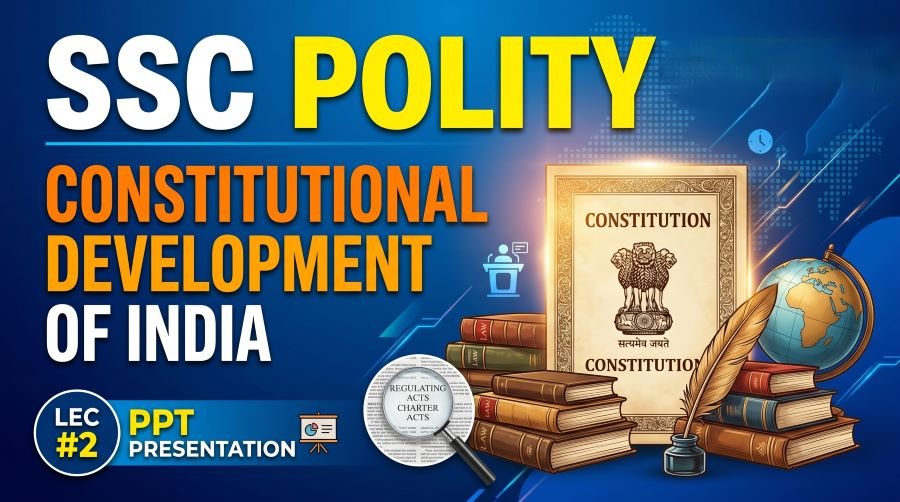
This article covers SSC Polity Constitutional Development of India PPT (LEC #2), (भारत का संवैधानिक विकास), part of the Complete Foundation Batch PPT Series at slideshareppt.net. With 169 slides, this is the most detailed lecture in the series and covers every major constitutional act from 1773 to 1950. This is the highest-weightage topic in SSC CGL, CHSL, and CPO Polity – questions from this topic appear in almost every exam shift.
PPT Details
| Field | Details |
| PPT Title | SSC Polity Constitutional Development of India PPT Slides (LEC #2) |
| Subject | Polity – Constitutional Development of India (भारत का संवैधानिक विकास) |
| Series | Complete Foundation Batch for All SSC and Other Exams (PPT Series) |
| Total Slides | 169 PPT Slides |
| File Size | 51 MB |
| Serial Number | #58 |
| Lecture | LEC #2 |
| Format | PowerPoint (.pptx) + PDF |
| Target Exams | SSC CGL, SSC CHSL, SSC MTS, SSC CPO, SSC GD, SSC Steno |
| Website | slideshareppt.net |
SSC Polity Constitutional Development of India PPT (LEC #2)
Note: Above is PPT in GOOGLE SLIDES (HTML AND IFRAME COMBINATION) and if you wish to download the Complete SSC series (PPT slides), Simply visit this redirect page – REDIRECT PAGE.
Complete Timeline – Constitutional Development of India (Most Important for SSC Exams)
| Year | Act / Event | Key Provision |
| 1600 | Charter Act – East India Company established | EIC given monopoly over trade with India |
| 1726 | Charter Act 1726 | Mayor’s Courts set up in Madras, Bombay, Calcutta |
| 1773 | Regulating Act 1773 | First step by British to control/regulate EIC; Governor-General post created |
| 1784 | Pitt’s India Act 1784 | Dual control: Board of Control (political) + Court of Directors (commercial) |
| 1793 | Charter Act 1793 | Governor-General given overriding powers over Council |
| 1813 | Charter Act 1813 | EIC’s trade monopoly ended (except tea & trade with China) |
| 1833 | Charter Act 1833 | EIC’s commercial activities ended; became purely administrative body; Law Commission set up |
| 1853 | Charter Act 1853 | Last charter act; introduced open competition for civil services |
| 1858 | Government of India Act 1858 | Crown takes over from EIC; Secretary of State for India created; Viceroy appointed |
| 1861 | Indian Councils Act 1861 | Legislative councils expanded; portfolio system introduced; Indians nominated |
| 1892 | Indian Councils Act 1892 | Limited elections introduced; budget discussion allowed |
| 1909 | Morley-Minto Reforms (Indian Councils Act 1909) | Separate electorate for Muslims; legislative councils enlarged |
| 1919 | Montague-Chelmsford Reforms (GoI Act 1919) | Dyarchy in provinces; bicameral legislature at Centre; direct elections |
| 1935 | Government of India Act 1935 | Federal structure; provincial autonomy; Federal Court; largest source of Indian Constitution |
| 1947 | Indian Independence Act 1947 | India and Pakistan as two dominions; Constituent Assembly became sovereign |
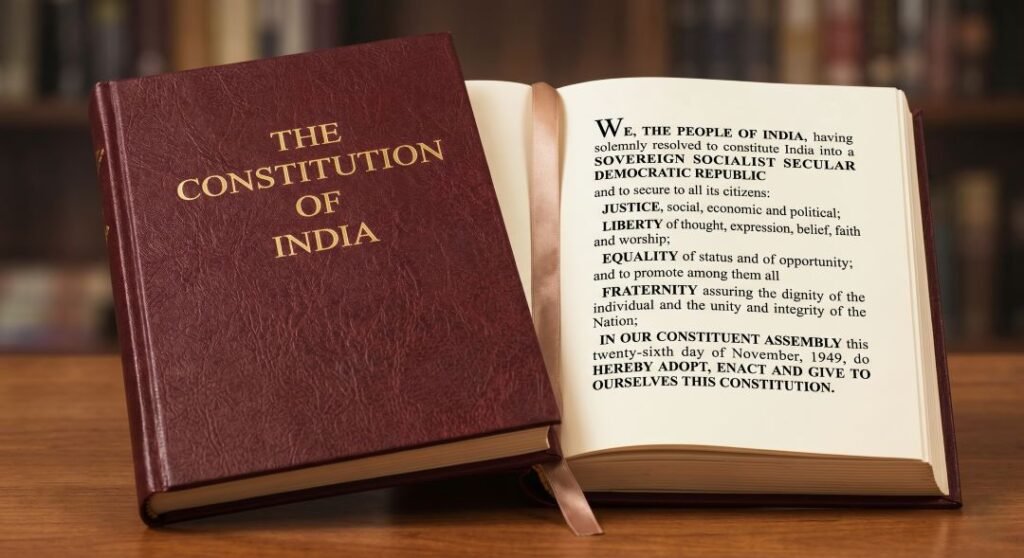
| 26 Nov 1949 | Constitution of India adopted | Constituent Assembly adopted the Constitution |
| 26 Jan 1950 | Constitution of India enforced | India becomes a sovereign democratic republic |
1. Introduction – What is Constitutional Development?
Constitutional Development of India refers to the gradual evolution of India’s legal and political framework from the arrival of the East India Company (1600) to the enforcement of the Indian Constitution (1950). Each major Act introduced new administrative structures, expanded or restricted powers, and slowly moved India toward self-governance. For SSC exams, this is one of the most heavily tested topics – at least 2-3 questions per shift in SSC CGL and CHSL.
2. Early Charters and Regulating Acts (1600-1784)
Charter Act 1600
- East India Company (EIC) given a royal charter by Queen Elizabeth I
- EIC granted monopoly over trade with India and the East
- Originally a trading company – no administrative powers
Charter Act 1726
- Mayor’s Courts established in Calcutta, Bombay, and Madras
- First time British law applied in India
- Governor and Council given law-making powers
Regulating Act 1773 – First Step Toward Central Control
- First attempt by British Parliament to regulate EIC’s affairs in India
- Governor of Bengal elevated to Governor-General of Bengal – Warren Hastings was the first
- Supreme Court established at Calcutta (1774) – first court of record in India
- Governor-General’s Council of 4 members created
- Court of Directors required to report to British government
Pitt’s India Act 1784 – Dual Control System
- Established dual control: Board of Control (political matters) + Court of Directors (commercial matters)
- Board of Control had 6 members; held real power over Indian governance
- Differentiated political and commercial functions of EIC for the first time
- India’s affairs now under effective British government supervision
3. Charter Acts (1793-1853)
Charter Act 1793
- Governor-General given overriding powers over his Council
- Renewed EIC’s charter for 20 years
- Company’s civil, military, and revenue powers continued
Charter Act 1813
- EIC’s trade monopoly abolished – trade with India opened to all British merchants
- Exception: monopoly over tea trade and trade with China retained
- Christian missionaries allowed to come to India
- One lakh rupees allocated annually for education in India
Charter Act 1833 – Most Important Charter Act
- EIC’s commercial activities completely ended – became purely an administrative body
- Governor-General of Bengal became Governor-General of India – Lord William Bentinck was the first
- India’s entire civil, military, and revenue management centralised
- First Law Commission set up – Lord Macaulay as chairman; led to Indian Penal Code
- Civil services opened to all Indians by merit (introduced in principle)
Charter Act 1853 – Last Charter Act
- Last charter act before the Crown took over
- Separated legislative and executive functions of Governor-General’s Council for the first time
- Open competitive examination introduced for recruitment to Indian Civil Services (ICS)
- Local representation introduced in the Legislative Council
- Did not specify the duration of the Company’s charter – left it open
4. Government of India Acts – Crown Rule Phase
Government of India Act 1858 – Crown Takes Over
- Passed after the Revolt of 1857 (Sepoy Mutiny)
- East India Company abolished; Crown took direct control of India
- Secretary of State for India created – a British Cabinet minister; had a 15-member Council of India
- Governor-General of India became Viceroy of India – Lord Canning was the first Viceroy
- India Office (London) set up to manage Indian administration
- Civil services continued; Covenanted and Uncovenanted services established
Indian Councils Act 1861
- Legislative councils expanded and decentralised
- Indians nominated to Governor-General’s Council for the first time
- Portfolio system introduced – ministers assigned specific departments
- Gave legislative powers back to Bombay and Madras presidencies
- Viceroy could issue ordinances in times of emergency
Indian Councils Act 1892
- Introduced limited elections – though the word ‘election’ was not used
- Members could discuss (but not vote on) the budget
- Members could ask questions with prior notice
- Increase in size of legislative councils
Morley-Minto Reforms – Indian Councils Act 1909
- Morley = Secretary of State | Minto = Viceroy of India
- Introduced separate electorates for Muslims – most controversial provision
- Indians appointed to Executive Councils of Viceroy and Governors for the first time
- Satyendra Prasad Sinha – first Indian to join the Viceroy’s Executive Council
- Size of legislative councils significantly increased
- Members could ask supplementary questions and move resolutions on budget
5. Montague-Chelmsford Reforms – Government of India Act 1919
- Montague = Secretary of State | Chelmsford = Viceroy
- Introduced Dyarchy in provinces – subjects divided into Reserved (controlled by Governor) and Transferred (controlled by Indian ministers)
- Reserved subjects: Finance, Police, Land Revenue | Transferred subjects: Education, Health, Agriculture
- Bicameral legislature introduced at the Centre: Council of State (Upper House) + Legislative Assembly (Lower House)
- Introduced direct elections for the first time on a larger scale
- Separate electorates extended to Sikhs, Christians, Anglo-Indians
- Central Public Service Commission set up
- Office of High Commissioner for India created in London
- Provinces given more powers – but Dyarchy was widely criticised as unworkable
6. Government of India Act 1935 – Most Important Act for SSC Exams
This is the single most important constitutional act for SSC Polity. It is also the largest source of the Indian Constitution of 1950. Almost every exam has 1-2 questions directly from this act.
Key Features of GoI Act 1935
- Provided for an All India Federation – Centre + Provinces + Princely States (federation never came into effect)
- Abolished Dyarchy at the provinces – introduced Provincial Autonomy
- Introduced Dyarchy at the Centre – but it never came into operation
- Three Lists introduced: Federal List, Provincial List, Concurrent List
- Established the Federal Court of India at Delhi (1937) – precursor to the Supreme Court
- Abolished the Council of India (set up in 1858)
- Established Reserve Bank of India (RBI)
- Set up Federal Public Service Commission
- Separate electorate retained; extended to women, labour, and other groups
- Burma separated from India under this Act
- Sind separated from Bombay and NWFP made a Governor’s province
What the Indian Constitution Borrowed from GoI Act 1935
- Federal structure with Centre-State distribution of powers
- Emergency provisions
- Public Service Commissions
- Office of Governor
- Judiciary structure
- Three Lists (Union, State, Concurrent in the Constitution)
7. Indian Independence Act 1947
- Passed by the British Parliament on 18 July 1947
- Provided for partition of India into two independent dominions: India and Pakistan
- Effective date: 15 August 1947 (India) and 14 August 1947 (Pakistan)
- Both dominions given full legislative sovereignty
- British Crown’s suzerainty over Princely States ended – states free to accede to either dominion
- Governor-General of each dominion appointed on advice of the respective Cabinet
- Lord Mountbatten – last Viceroy; became first Governor-General of India
- C. Rajagopalachari – first and only Indian Governor-General of India (1948-1950)
- Constituent Assembly of each dominion became the sovereign legislative body
- GoI Act 1935 continued to operate as interim constitution until 26 Jan 1950
8. Constituent Assembly and Making of the Constitution
- Constituent Assembly formed under Cabinet Mission Plan 1946
- First sitting: 9 December 1946 | Temporary President: Dr. Sachchidananda Sinha
- Dr. Rajendra Prasad elected as permanent President of Constituent Assembly
- Dr. B.R. Ambedkar – Chairman of the Drafting Committee
- Other key members: Jawaharlal Nehru, Sardar Patel, Maulana Azad, T.T. Krishnamachari
- Objective Resolution moved by Nehru on 13 December 1946 – basis of the Preamble
- Total members: 299 | 11 sessions held
- Time taken: 2 years, 11 months, 18 days
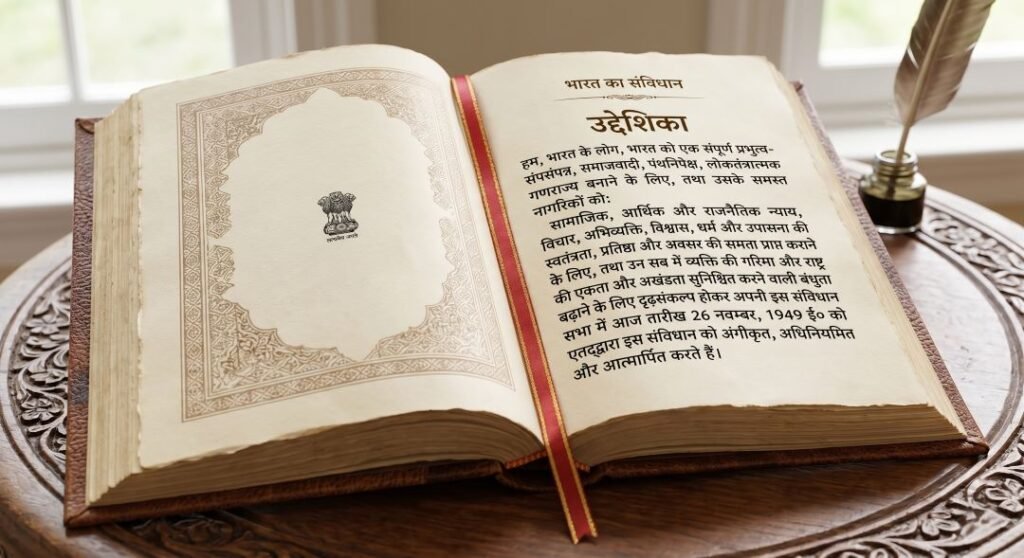
- Constitution adopted: 26 November 1949
- Constitution enforced: 26 January 1950 – India becomes a Republic
9. Governor-General & Viceroy Quick Reference Table
| Act | Governor-General / Viceroy | Important For |
| Regulating Act 1773 | Warren Hastings – first Governor-General of Bengal | First central control over EIC |
| Pitt’s India Act 1784 | Warren Hastings | Dual control system established |
| Charter Act 1833 | Lord William Bentinck – first Governor-General of India | EIC becomes purely administrative |
| GoI Act 1858 | Lord Canning – first Viceroy of India | Crown rule; Secretary of State created |
| GoI Act 1919 | Lord Chelmsford | Dyarchy; bicameral parliament at Centre |
| GoI Act 1935 | Lord Linlithgow | Federal Court; largest source of 1950 Constitution |
| Indian Independence Act 1947 | Lord Mountbatten | Partition; two dominions created |
10. Dyarchy – Detailed Explanation
Dyarchy (dual government) was introduced by the Government of India Act 1919 at the provincial level. It divided provincial subjects into two categories:
| Category | Control | Subjects Included |
| Reserved Subjects | Governor (not responsible to legislature) | Finance, Police, Land Revenue, Justice, Irrigation |
| Transferred Subjects | Indian Ministers (responsible to legislature) | Education, Agriculture, Health, Public Works, Local Self-Government |
- Dyarchy was widely criticised as unworkable and inefficient
- Indian ministers had no control over finances – making governance difficult
- Simon Commission (1927) recommended abolition of Dyarchy
- Dyarchy abolished from provinces by the GoI Act 1935 (Provincial Autonomy given instead)
- Dyarchy was introduced at the Centre by GoI Act 1935 but never came into operation
Also read: SSC Polity Introduction to Polity PPT Slides (LEC #1)
11. Quick Revision Fact Table – Constitutional Development
| Fact | Detail |
| First Governor-General of Bengal | Warren Hastings (Regulating Act 1773) |
| First Governor-General of India | Lord William Bentinck (Charter Act 1833) |
| First Viceroy of India | Lord Canning (Government of India Act 1858) |
| Last Viceroy of India | Lord Mountbatten (1947) |
| Pitt’s India Act year | 1784 – introduced dual control |
| First open competitive exam for ICS | After Charter Act 1853 |
| Dyarchy introduced by | Montague-Chelmsford Reforms / GoI Act 1919 |
| Dyarchy abolished from provinces by | Government of India Act 1935 |
| Federal Court established by | Government of India Act 1935 |
| Separate electorate introduced by | Morley-Minto Reforms 1909 |
| Bicameral legislature at Centre introduced by | GoI Act 1919 – Council of State + Legislative Assembly |
| Largest source of Indian Constitution | Government of India Act 1935 |
| Indian Independence Act passed by | British Parliament on 18 July 1947 |
| Partition into India & Pakistan | 14-15 August 1947 |
12. Key Takeaways for SSC Exams
- Regulating Act 1773 – first attempt to regulate EIC; first Governor-General of Bengal (Warren Hastings)
- Pitt’s India Act 1784 – dual control system; Board of Control + Court of Directors
- Charter Act 1833 – EIC becomes purely administrative; first Governor-General of India (Bentinck)
- Charter Act 1853 – open competitive exam for ICS; last charter act
- GoI Act 1858 – Crown takes over; Secretary of State created; first Viceroy (Lord Canning)
- Morley-Minto Reforms 1909 – separate electorate for Muslims (most controversial)
- GoI Act 1919 – Dyarchy in provinces; bicameral legislature at Centre
- GoI Act 1935 – largest source of Indian Constitution; Federal Court; Provincial Autonomy; RBI
- Indian Independence Act 1947 – partition; two dominions; British suzerainty over princely states ended
- 26 Jan 1950 – Constitution enforced; India becomes a sovereign democratic republic.