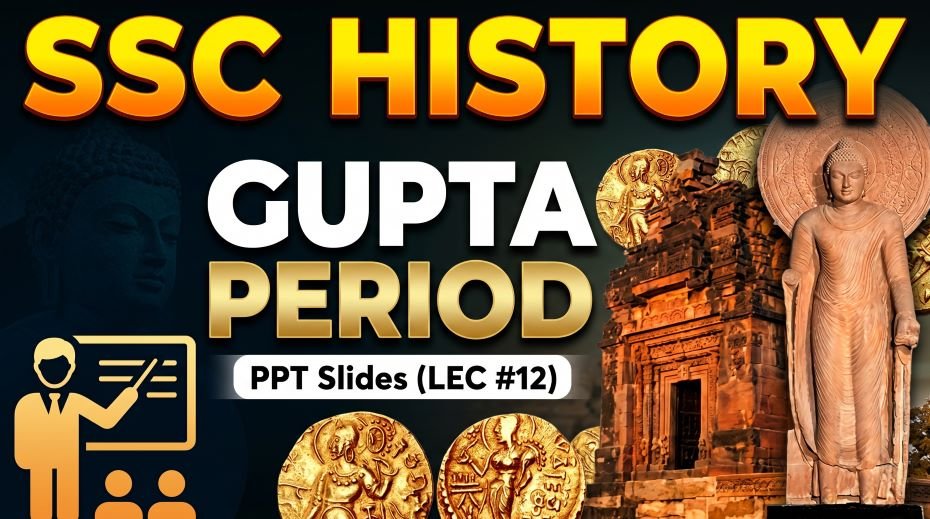
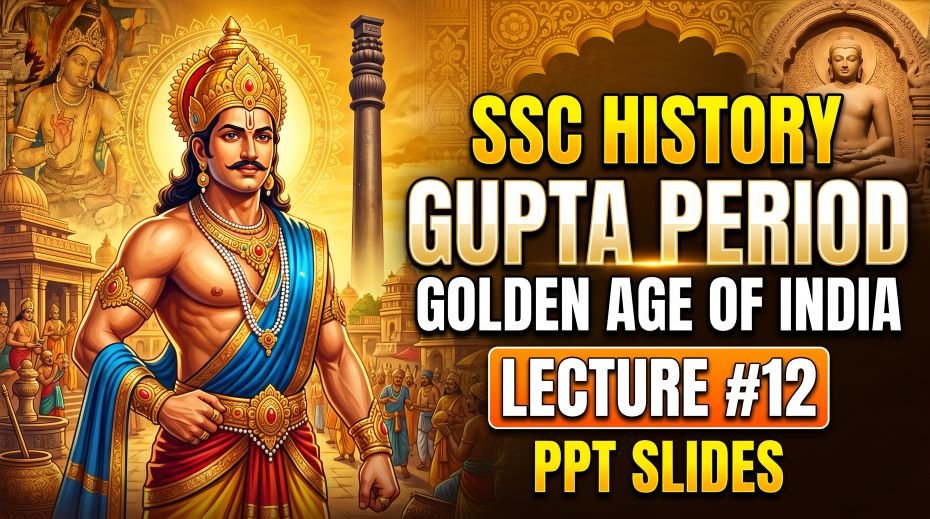
We have shared the SSC History Gupta Period PPT Slides (LEC #12), Master India’s Golden Age with this complete SSC guide on the Gupta Period – based on History LECTURE #12 PPT Slides with 144 slides and 53 MB. Covers all Gupta rulers, Samudragupta (Napoleon of India), Chandragupta II (Vikramaditya), Kalidasa, Aryabhata, Fa-Hien, Nalanda University, Gupta art and architecture, and 38+ high-frequency MCQs for SSC CGL, CHSL, MTS, CPO, Railways NTPC, and UPSC Prelims.
India’s Gupta Period (319–550 AD) is called the Golden Age of India – and for good reason. In a span of roughly 230 years, the Gupta Empire produced achievements in mathematics, astronomy, literature, medicine, philosophy, and art that were unparalleled anywhere in the ancient world. Aryabhata calculated the value of pi and explained that the earth rotates. Kalidasa wrote Sanskrit plays that are still performed today. The Ajanta cave paintings were created. Nalanda University was founded. Gold coins of extraordinary artistry were minted.
This article is built around the SSC History Gupta Period PPT Slides – Lecture #12 – from the Complete Foundation Batch PPT Series (Serial Number #37) at slideshareppt.net. The PPT contains 144 slides covering the complete Gupta Period – from Sri Gupta’s founding of the dynasty to the Huna-driven collapse – in rich, exam-focused detail.
For SSC CGL, SSC CHSL, SSC MTS, SSC CPO, SSC GD, Railways NTPC, and UPSC Prelims aspirants, the Gupta Period is one of the highest-yielding chapters in Ancient History – generating 3–6 questions per exam from rulers, scholars, artworks, and achievements. This guide covers every testable fact.
About the PPT Slides
| Detail | Information |
| Series Name | Complete Foundation Batch for All SSC and Other Exams (PPT Series) |
| Subject | History – Gupta Period (गुप्त काल / गुप्त साम्राज्य) |
| Lecture Number | Lecture #12 |
| Total PPT Slides | 144 PPT Slides |
| File Size | 53 MB |
| Serial Number | #37 |
| Period Covered | ~240 AD (early Gupta) to ~550 AD (Gupta collapse) |
| Best For | SSC CGL, CHSL, MTS, CPO, GD, Railways NTPC, UPSC Prelims, State PSCs |
| Source Website | slideshareppt.net |
SSC History Gupta Period PPT Slides (LEC #12) Download
Note: If you wish to download the entire SSC series (PPT slides), simply visit this redirect page. –REDIRECT PAGE
Complete Timeline Table: Gupta Period – All Key Dates
This timeline table is your most critical revision tool. Memorise every ruler, their dates, and their key achievement. This single table can help you answer 6–8 SSC questions.
| Year (AD) | Event / Ruler | Key Person / Detail | Key Fact / SSC Relevance |
| ~240–280 AD | Sri Gupta – Founder of Gupta dynasty | Sri Gupta (also called Shri Gupta) | Founder; issued early coins; donated a temple to Chinese Buddhist pilgrims near Gaya; title: Maharaja (not Maharajadhiraja yet) |
| ~280–319 AD | Ghatotkacha – son of Sri Gupta | Ghatotkacha | Second ruler; maintained and expanded dynasty; title Maharaja |
| 319–335 AD | Chandragupta I – first great Gupta ruler | Chandragupta I | Started Gupta Era (319–320 AD); took title Maharajadhiraja; married Kumaradevi (Licchavi princess from Nepal); issued Licchavi-type gold coins showing himself and Kumaradevi |
| 335–375 AD | Samudragupta – greatest military ruler | Samudragupta | Called ‘Napoleon of India’ by V.A. Smith; Allahabad Pillar Inscription (by Harishena); defeated 9 N. Indian kings + 12 S. Indian kings; Kaviraja (king of poets); played veena; Ashvamedha Yajna |
| ~350–375 AD | Allahabad Pillar Inscription composed | Harishena (court poet of Samudragupta) | Primary source for Samudragupta’s reign; praises his conquests in flowery Sanskrit verse |
| 375–415 AD | Chandragupta II (Vikramaditya) – Golden Age emperor | Chandragupta II / Vikramaditya | Defeated Western Kshatrapas (Shakas) in Gujarat; empire at greatest extent; Fa-Hien visited; Kalidasa + Navaratna in court; Iron Pillar of Delhi |
| 405–411 AD | Fa-Hien (Faxian) visits India | Fa-Hien – Chinese Buddhist pilgrim | Visited during Chandragupta II’s reign; described India as peaceful and prosperous; wrote ‘Fo Guo Ji’ (Record of Buddhist Kingdoms) |
| 415–455 AD | Kumaragupta I – son of Chandragupta II | Kumaragupta I (Mahendraditya) | Founded Nalanda University (~5th century AD); performed Ashvamedha Yajna; maintained empire; Huna threat begins at end of his reign |
| ~450 AD | First Huna invasions threaten the Gupta Empire | Huna tribes from Central Asia | Begin penetrating the northwest; Skandagupta has to fight them |
| 455–467 AD | Skandagupta – last great Gupta emperor | Skandagupta | Repelled the Huna invasions successfully; known as ‘Vikramaditya’ as well; Junagarh Rock Inscription mentions his victories; after his death empire fragments rapidly |
| 467–550 AD | Rapid decline – multiple weak rulers | Purugupta, Kumaragupta II, Budhagupta, Narasimhagupta, Kumaragupta III, Vishnugupta | Six weak rulers in ~80 years; Huna invasions continue; provinces declare independence |
| ~476 AD | Aryabhata born | Aryabhata | Greatest mathematician-astronomer of the Gupta period; born in Pataliputra (or Kusumapura); wrote Aryabhatiya at age 23 in 499 AD |
| ~499 AD | Aryabhatiya composed | Aryabhata | Groundbreaking work on mathematics and astronomy; calculated pi = 3.1416; earth rotates; explained eclipses scientifically; sine tables |
| ~505 AD | Varahamihira composes Brihat Samhita | Varahamihira | Encyclopaedic work on astronomy, mathematics, weather, plants, perfumes, architecture; also wrote Pancha Siddhantika |
| ~550 AD | Gupta Empire collapses | Repeated Huna invasions + weak rulers + local revolts | Classical age of ancient India ends; fragmentary kingdoms take over |
Part I: Gupta Rulers – Complete Profile of Every Emperor
Sri Gupta (~240–280 AD) – The Founder
- Sri Gupta (also written as Shri Gupta) is the founder of the Gupta dynasty. Very little is known about him from contemporary records.
- His title was Maharaja – a high but not the highest royal title.
- The Chinese Buddhist pilgrim I-Tsing (Yi Jing), who visited India in the 7th century AD (several centuries after Sri Gupta), mentions that Sri Gupta donated a temple to Chinese Buddhist pilgrims near Gaya (modern Bihar) – the Mrigasikhavana temple.
- He is believed to have been a local chieftain or feudatory ruler in the Magadha/Bengal region who began the dynasty.
SSC Exam Tip: Sri Gupta = founder of Gupta dynasty = title Maharaja = donated temple near Gaya for Chinese pilgrims. Occasionally asked in ‘who founded the Gupta dynasty’ questions.
Chandragupta I (319–335 AD) – The Dynasty’s First Great Emperor
| Aspect | Detail |
| Position in Dynasty | Third Gupta ruler; first truly great Gupta emperor |
| Title | Maharajadhiraja – ‘Great King of Great Kings’; first Gupta ruler to use this title; elevated the dynasty from local power to imperial status |
| Gupta Era | Chandragupta I started the Gupta Era (Gupta Samvat) in 319–320 AD to commemorate his coronation; this is one of the historical eras used in ancient Indian dating |
| Marriage Alliance | Married Kumaradevi – a princess of the powerful Licchavi clan of Nepal; a key matrimonial alliance that gave the early Gupta dynasty prestige, territory, and legitimacy |
| Licchavi Coins | Chandragupta I issued unique gold coins showing both himself and Kumaradevi on the obverse – a remarkable numismatic innovation and evidence of the Licchavi alliance |
| Territory | Controlled Magadha, Prayaga (Allahabad), and Saketa (Ayodhya) – the core of the Gangetic heartland |
| Significance | Transformed the Gupta dynasty from a regional power to a nascent empire; set the stage for Samudragupta’s massive conquests |
SSC Exam Tip: Chandragupta I = Maharajadhiraja (first Gupta to use this title) = Gupta Era 319–320 AD = married Kumaradevi (Licchavi) = Licchavi-type coins. All four are commonly tested.
Samudragupta (335–375 AD) – The Napoleon of India
Samudragupta is considered the greatest military ruler in Gupta history and one of the most brilliant military strategists in all of Indian history. The famous historian V.A. Smith gave him the title ‘Napoleon of India’ for his almost unbroken string of military victories.
| Aspect | Detail |
| Title / Epithet | Napoleon of India (given by historian V.A. Smith); also called Kaviraja (King of Poets) |
| Primary Source | Allahabad Pillar Inscription (Prayagraj Prashasti) – composed in flowery Sanskrit by his court poet Harishena; describes all his conquests |
| Northern Conquests | Defeated and annexed 9 kings of North India: Rudradeva, Matila, Nagadatta, Chandravarman, Ganapatinaga, Nagasena, Achyuta, Nandin, Balavarman – uprooted them and incorporated their kingdoms |
| Southern Policy | Defeated 12 kings of South India (Pallava, Chera, Cola, etc.) – but did NOT annex them; instead restored them to power after they submitted – called Dharmavijayi (righteous conqueror) |
| Frontier Kingdoms | Received tribute from 5 frontier kingdoms: Samatata, Davaka, Kamarupa, Nepal, Kartripura |
| Foreign Tribute | Received tribute from foreign powers: Kushanas, Murundas, and the king of Sri Lanka (Meghavarman sent gifts and requested permission to build a monastery at Bodh Gaya) |
| Military Achievement | Conquered the entire Indian subcontinent from east to west; only the deep south was not annexed (restored after submission); unprecedented military domination |
| Cultural Achievement | Was a great musician – played the veena; coins show him playing the veena; composed poetry himself – hence Kaviraja |
| Ashvamedha Yajna | Performed the Ashvamedha Yajna (horse sacrifice) to proclaim his sovereignty over all conquered territories |
| Religion | Was a devotee of Vishnu; promoted Vaishnavism; gave liberal grants to Brahmins |
| Coins | His gold coins show him playing the veena, performing Ashvamedha, and in battle – remarkably varied for ancient coinage |
SSC Exam Tip – Five Must-Know Samudragupta Facts: Napoleon of India (V.A. Smith). Allahabad Pillar Inscription by Harishena. 9 northern kings defeated and annexed. 12 southern kings defeated and RESTORED (Dharmavijayi). Played veena = Kaviraja. All five generate separate SSC questions.
Chandragupta II / Vikramaditya (375–415 AD) – The Golden Age Emperor
Chandragupta II – who took the celebrated title of Vikramaditya (Sun of Valour) – presided over the absolute zenith of Gupta civilisation. His reign represents India’s greatest moment in the ancient world.
| Aspect | Detail |
| Also Known As | Vikramaditya (most famous title); also called Devagupta and Devashri in some inscriptions |
| Title Significance | Vikramaditya was a legendary title associated with a great Indian king; Chandragupta II adopted it after his greatest victories |
| Greatest Military Achievement | Defeated the Western Kshatrapas (Shakas) of western India (Gujarat, Kathiawar, Rajasthan) and incorporated their territories – completing the unification of the subcontinent under Gupta rule |
| How He Defeated Shakas | Married his daughter Prabhavati Gupta to the Vakataka king Rudrasena II – creating a southern alliance; then attacked the Shakas from east while Vakatakas held the south; brilliant strategic encirclement |
| Capital | Maintained Pataliputra as primary capital; Ujjain (Avanti) – the old Shaka capital – became the second capital and a great cultural centre |
| Empire Extent | From the Arabian Sea (west) to the Bay of Bengal (east); from the Himalayas (north) to the Narmada River (south) – the greatest Gupta extent |
| Fa-Hien’s Visit | The Chinese Buddhist pilgrim Fa-Hien (Faxian) visited India 405–411 AD during his reign; described India as peaceful, prosperous, and well-governed; wrote ‘Fo Guo Ji’ |
| Navaratna | His court at Ujjain was famous for the Navaratna (Nine Gems) – nine great scholars; the most famous was Kalidasa |
| Kalidasa | Greatest Sanskrit poet and playwright; wrote Shakuntala, Meghaduta, Kumarasambhava, Raghuvamsha, Malavikagnimitra, Vikramorvasiya |
| Iron Pillar of Delhi | The famous rust-free Iron Pillar in the Qutub Minar complex was erected during the Gupta period – inscribed with a dedication to Vishnu by King Chandra (identified as Chandragupta II) |
| Religious Policy | Was a devout Vaishnava (Vishnu devotee); performed Ashvamedha Yajna; granted lands to Brahmins; but was tolerant of Buddhism and Jainism |
| Coins | His gold coins (Dinars) are the finest in Indian numismatic history – showing him slaying a lion, riding a horse, playing veena, and other scenes |
SSC Exam Tip – Six Must-Know Chandragupta II Facts: Title = Vikramaditya. Defeated Shakas (Western Kshatrapas). Fa-Hien visited (405–411 AD). Kalidasa was in his court (Navaratna). Iron Pillar of Delhi = his era (King Chandra). Capital also at Ujjain. All six are individually tested in SSC papers.
Kumaragupta I (415–455 AD) – Founder of Nalanda University
- Kumaragupta I (also called Mahendraditya) was the son of Chandragupta II and one of the longest-reigning Gupta emperors – ruling for approximately 40 years.
- He is most famous for founding Nalanda University – the greatest university of the ancient world, which attracted students from China, Korea, Japan, Tibet, Mongolia, Sri Lanka, and Southeast Asia.
- Nalanda is located in Bihar (near Rajgir) and operated from the 5th century AD to the 12th century AD when it was destroyed by Mohammad Bin Bakhtiyar Khilji.
- He performed the Ashvamedha Yajna – showing his claim to imperial sovereignty.
- The Huna threat from Central Asia began to manifest seriously toward the end of his reign.
- He issued a wide variety of gold coins – more types than any other Gupta ruler.
SSC Exam Tip: Kumaragupta I = founded Nalanda University. This is the single most tested fact about Kumaragupta. The question ‘who founded Nalanda University?’ has one answer: Kumaragupta I.
Skandagupta (455–467 AD) – The Last Great Gupta Emperor
- Skandagupta was the son of Kumaragupta I and the last truly powerful Gupta emperor.
- His greatest achievement was successfully repelling the ferocious Huna invasions in the 450s AD – saving the empire from immediate collapse.
- The Junagarh Rock Inscription of Skandagupta (in Gujarat) describes his military victories against the Hunas and his rebuilding of the Sudarshana Lake dam (originally built by Chandragupta Maurya’s governor and repaired by Ashoka and then by Rudradaman I).
- He also adopted the title Vikramaditya.
- Despite his military success, the enormous cost of the Huna campaigns drained the Gupta treasury – gold coinage declined in quality during his reign, a sign of economic stress.
- After Skandagupta’s death in ~467 AD, the empire rapidly fragmented. Six weak rulers followed in about 80 years before the empire completely dissolved around 550 AD.
SSC Exam Tip: Skandagupta = last great Gupta = defeated Hunas = Junagarh Rock Inscription. The question ‘which Gupta ruler defeated the Hunas?’ has one answer: Skandagupta.
All Gupta Rulers – Quick Reference Table
| Ruler | Period (AD) | Key Title / Epithet | Single Most Important SSC Fact |
| Sri Gupta | ~240–280 | Maharaja | Founder of Gupta dynasty; donated temple near Gaya for Chinese pilgrims |
| Ghatotkacha | ~280–319 | Maharaja | Second ruler; maintained dynasty |
| Chandragupta I | 319–335 | Maharajadhiraja | Started Gupta Era 319 AD; married Kumaradevi (Licchavi); first to use Maharajadhiraja title |
| Samudragupta | 335–375 | Napoleon of India; Kaviraja | Allahabad Pillar (Harishena); 9 N. Indian kings annexed; 12 S. Indian kings restored (Dharmavijayi); played veena |
| Chandragupta II | 375–415 | Vikramaditya | Defeated Shakas; Fa-Hien visited; Kalidasa in court; Iron Pillar of Delhi; Navaratna |
| Kumaragupta I | 415–455 | Mahendraditya | Founded Nalanda University; Ashvamedha Yajna; gold coins – most varieties |
| Skandagupta | 455–467 | Vikramaditya | Last great Gupta; defeated Hunas; Junagarh Rock Inscription; quality of gold coins declined |
| Purugupta | 467–473 | – | First of the weak post-Skandagupta rulers; empire begins fragmenting |
| Kumaragupta II | 473–476 | – | Short reign; Huna pressure continues |
| Budhagupta | 476–495 | – | Largest empire among post-Skandagupta rulers but still declining |
| Narasimhagupta Baladitya | ~495–530 | Baladitya | Helped defeat Mihirakula (Huna); described as devout Buddhist by Hieun Tsang |
| Vishnugupta | ~540–550 | – | Last Gupta ruler; empire completely collapses ~550 AD |
Part II: Gupta Administration – The Well-Oiled Empire
The Gupta administration was sophisticated, decentralised compared to the Mauryas, and heavily reliant on local power structures. Our primary sources are: the Arthashastra (earlier but relevant), coins, inscriptions, and the accounts of Fa-Hien.
Central Administration
| Post / Department | Title | Function |
| Emperor | Maharajadhiraja / Paramabhattaraka | Supreme ruler; head of state, religion, military, and justice |
| Crown Prince | Yuvaraja | Heir apparent; often viceroy of a major province |
| Prime Minister / Chief Minister | Mahamantri / Sachiva | Headed the council of ministers; chief executive |
| Chief Secretary | Kumaramatya | Senior civil servants who managed various departments |
| Army Commander | Senapati / Mahabaladhikrita | Commanded the military forces |
| Foreign Affairs | Sandhivigrahika | Minister for peace and war – managed diplomatic relations |
| Royal Household | Mahapratihara | Chief of royal palace security and household |
| Finance | Ranabhandagarika | Keeper of the war treasury; managed military finance |
| Revenue | Dhruvadhikarana | Land revenue administration |
| City Administration | Purapala | City governor – managed urban centres |
| Village Administration | Gramika / Gramapati | Village headman; lowest administrative unit |
Provincial and Local Administration
- The Gupta Empire was divided into Bhuktis (provinces) – governed by officers called Uparikas (who were often royal princes or trusted nobles).
- Each Bhukti was divided into Vishayas (districts) – governed by Vishayapatis.
- Vishayas were further divided into Vithi (sub-districts) and Gramas (villages) at the base.
- The Gupta system was more decentralised than the Maurya system – local lords (samants) and feudatories were allowed to maintain their own administrations as long as they paid tribute and provided military service.
- Land grants (called Agrahara grants when given to Brahmins, and Devagrahara when given to temples) were a distinctive feature of Gupta governance – transferring administrative and revenue rights along with the land.
- These land grants weakened central control over time as local grantees built up their own power bases.
SSC Exam Tip: Gupta provincial administration: Bhukti (province) → Vishaya (district) → Vithi (sub-district) → Grama (village). Uparika = provincial governor. Vishayapati = district officer. These administrative terms appear in SSC questions about Gupta governance.
Part III: Gupta Economy – Trade, Coins, and Agriculture
Trade and Commerce
- The Gupta period saw a flourishing of both internal and external trade, making it one of the most commercially prosperous eras in Indian history.
- Internal trade moved along the major river systems (Ganga, Yamuna) and overland routes connecting all major cities.
- External trade was conducted with the Roman Empire (silk, spices, precious stones from India in exchange for gold and silver), Southeast Asia (gold, spices), China (silk, Buddhism), and Arabia/Persia (spices, cotton).
- The main ports of external trade were: Tamralipti (Bengal, on the Bay of Bengal), Broach/Bharuch (Gujarat, on the Arabian Sea), and Kaveripattinam (Tamil Nadu, on the Coromandel Coast).
- Fa-Hien describes India’s prosperity during Chandragupta II’s reign – markets well-stocked, prices reasonable, no arbitrary taxation, people free from fear.
- Trade guilds (Shrenis) were powerful organisations of merchants and artisans that regulated trade, maintained quality standards, provided banking services, and even had their own seals and legal standing.
Gupta Coinage – The Finest Ancient Indian Coins
| Type of Coin | Metal | Called / Name | Description / Key Facts |
| Gold Coin | Gold | Dinar (also Suvarna or Nishka) | Most famous Gupta coins; show rulers in various poses (slaying lion, playing veena, on horseback, Ashvamedha horse); finest artistry in ancient Indian coinage; declined in gold purity under later Gupta rulers – sign of economic decline |
| Silver Coin | Silver | Rupaka | Less common than gold; Gupta silver coins found mainly in western India (former Shaka territories absorbed by Chandragupta II) |
| Copper Coin | Copper | Not specifically named | Used for everyday transactions; less artistic than gold coins |
| Licchavi-type Coins | Gold | Licchavi coins | Issued specifically by Chandragupta I showing himself and his Licchavi wife Kumaradevi – unique dynastic marriage commemorative coins |
SSC Exam Tip: Gupta gold coins = Dinar or Suvarna. Samudragupta’s coins show him playing veena. Chandragupta I’s Licchavi coins show him with Kumaradevi. The decline in gold purity of later Gupta coins = economic decline indicator. All these are testable SSC facts.
Part IV: Gupta Literature – The Sanskrit Renaissance
The Gupta Period is called the Classical Age of Sanskrit literature. Under royal patronage, Sanskrit became the medium for the greatest outpouring of literary creativity in Indian history. The court of Chandragupta II (Vikramaditya) at Ujjain became the centre of this literary universe.
Kalidasa – The Greatest Sanskrit Poet
Kalidasa is universally regarded as the greatest poet and playwright in the Sanskrit language – often called the Shakespeare of India or the Virgil of India. He was one of the Navaratna (Nine Gems) of Chandragupta II’s court.
| Work | Type | Key Content / Significance |
| Abhijnanasakuntalam (Shakuntala) | Nataka (Play – 7 acts) | Story of King Dushyanta and Shakuntala (daughter of sage Vishvamitra and apsara Menaka); considered his greatest work; translated into German by Goethe who praised it extravagantly; first Indian work to gain wide recognition in Europe |
| Meghaduta (Cloud Messenger) | Khandakavya (Lyric poem) | A yaksha (spirit) separated from his beloved sends a message through a cloud; some of the most beautiful descriptive poetry in Sanskrit; describes the geography of India |
| Kumarasambhava | Mahakavya (Epic poem) | Describes the birth of Kumara (Kartikeya); the courtship of Shiva and Parvati; considered technically perfect Sanskrit poetry |
| Raghuvamsha | Mahakavya (Epic poem) | Describes the dynasty of Raghu (ancestors of Rama); covers the entire Ramayana story; 19 cantos |
| Malavikagnimitra | Nataka (Play – 5 acts) | Story of King Agnimitra (Shunga) falling in love with Malavika; has historical value as it describes Shunga period |
| Vikramorvasiya | Nataka (Play – 5 acts) | Story of King Pururavas and the apsara Urvashi; based on a story from the Rigveda |
| Ritusamhara | Khandakavya | Description of the six seasons in Sanskrit poetry |
SSC Exam Tip: Kalidasa’s most tested works: Shakuntala (play), Meghaduta (cloud messenger poem), Kumarasambhava, Raghuvamsha. Shakuntala is the most frequently asked. ‘Which work was praised by Goethe?’ = Shakuntala. ‘Who wrote Meghaduta?’ = Kalidasa.
| Scholar | Field | Key Work / Contribution |
| Kalidasa | Literature / Poetry / Drama | Shakuntala, Meghaduta, Kumarasambhava, Raghuvamsha |
| Aryabhata | Mathematics / Astronomy | Aryabhatiya (499 AD); calculated pi; earth rotates; explained eclipses |
| Varahamihira | Astronomy / Mathematics / Encyclopaedia | Brihat Samhita; Pancha Siddhantika; Brihat Jataka |
| Vararuchi (Katyayana) | Grammar | Grammatical commentary; associated with Panini’s tradition |
| Amarasimha | Lexicography (Dictionary) | Amarakosha – the first Sanskrit dictionary/thesaurus; still used today |
| Dhanvantari | Medicine / Ayurveda | Considered a great physician; associated with Ayurvedic tradition |
| Shanku | Architecture / Engineering | Details not well-preserved but considered a great architect |
| Kshapanaka | Astrology / Jyotish | Associated with astrological calculations |
| Vetala Bhatta | Tantra / Magic | Scholar of tantric texts |
SSC Exam Tip: The Navaratna is in the court of Chandragupta II (Vikramaditya). The most tested individual members are Kalidasa (literature), Aryabhata (mathematics), Varahamihira (astronomy), and Amarasimha (Amarakosha dictionary). Questions often ask: ‘Who wrote the Amarakosha?’ = Amarasimha.
Other Important Gupta Period Authors and Works
| Author | Work | Field / Type | Key Content / SSC Fact |
| Vishakhadatta | Mudrarakshasa | Sanskrit drama (play) | Describes how Chandragupta Maurya defeated the last Nanda king with Chanakya’s help; political intrigue drama; historically valuable |
| Vishakhadatta | Devichandraguptam | Sanskrit drama | Deals with the Gupta dynasty’s early history |
| Shudraka | Mricchakatika (The Little Clay Cart) | Sanskrit drama (10 acts) | Most realistic ancient Sanskrit play; story of a poor Brahmin falling in love with a courtesan; vivid depiction of everyday life; considered a masterpiece of social realism |
| Vishnu Sharma | Panchatantra | Animal fable collection | Famous collection of stories with animals as characters teaching wisdom and statecraft; originally written in Sanskrit; translated into Persian, Arabic, and eventually into almost every world language; the Panchatantra is the most widely translated non-religious book in history after the Bible |
| Amarasimha | Amarakosha | Sanskrit dictionary (thesaurus) | First major Sanskrit dictionary; organised by subject (nouns by category); still used in Sanskrit scholarship today |
| Vatsyayana | Kamasutra | Sanskrit treatise | Comprehensive text on human relationships; much more than commonly understood – covers social customs, psychology, and relationships broadly |
| Vishvanatha | Sahityadarpana | Literary criticism | Treatise on Sanskrit poetics and literary theory |
| Harishena | Allahabad Pillar Inscription (Prayagraj Prashasti) | Sanskrit prose/poetry inscription | Court poet of Samudragupta; primary source for Samudragupta’s reign |
Part V: Gupta Science and Mathematics – India’s Scientific Golden Age
The Gupta Period produced some of the most brilliant scientists and mathematicians in world history. Their discoveries in mathematics, astronomy, and medicine were centuries ahead of the rest of the world.
Aryabhata (476–550 AD) – The Greatest Ancient Indian Scientist
| Achievement | Detail / SSC Relevance |
| Birth and Background | Born 476 AD in Kusumapura (Pataliputra/Patna) or Ashmaka (Deccan); wrote Aryabhatiya in 499 AD at age 23 |
| Primary Work | Aryabhatiya – written in Sanskrit verse; covers mathematics and astronomy in 118 verses; considered one of the greatest scientific works of the ancient world |
| Value of Pi | Calculated pi (π) as 3.1416 – accurate to four decimal places; 1,000 years before European mathematicians achieved similar precision |
| Earth Rotates | Correctly stated that the earth rotates on its own axis – causing day and night; this was 1,000 years before Copernicus and Galileo rediscovered this in Europe |
| Solar and Lunar Eclipses | Correctly explained that lunar eclipses are caused by the shadow of the earth falling on the moon; solar eclipses by the shadow of the moon falling on the earth; debunked the mythological explanation of eclipses (Rahu and Ketu swallowing the sun/moon) |
| Sine Tables | Developed the earliest known tables of sine values in trigonometry |
| Quadratic Equations | Worked on solving quadratic and indeterminate equations |
| Place Value System | Used and described the place-value numeral system (which eventually became our modern numerals through Arabic transmission) |
| Sidereal Periods | Calculated the sidereal periods of planets with remarkable accuracy |
| Length of the Year | Calculated the length of the sidereal year as 365 days, 6 hours, 12 minutes, and 30 seconds – only about 3 minutes off from the modern calculated value |
| Legacy | His work Aryabhatiya was translated into Arabic in the 8th century and Latin in the 12th century – transmitting Indian mathematics to the Islamic world and then to Europe; he is considered the father of Indian mathematics and astronomy |
SSC Exam Tip – Five Aryabhata Facts for SSC: (1) Born 476 AD. (2) Wrote Aryabhatiya (499 AD). (3) Calculated pi = 3.1416. (4) Stated earth rotates on its axis. (5) Explained eclipses scientifically. These five facts individually generate SSC MCQs every year.
Varahamihira – The Astronomer-Encyclopaedist
| Aspect | Detail |
| Period | ~505 AD; Gupta period scholar |
| Primary Work | Brihat Samhita – a massive encyclopaedia covering astronomy, astrology, mathematics, meteorology, botany, architecture, and gems; one of the most comprehensive ancient works |
| Other Works | Pancha Siddhantika – a summary and comparison of five astronomical systems known to him; Brihat Jataka – a major work on horoscope astrology |
| Key Prediction | Correctly predicted that comets had a periodic return and were natural phenomena, not supernatural omens |
| Geographical Knowledge | Described the geography of India in detail in Brihat Samhita |
| SSC Relevance | Questions: ‘Who wrote Brihat Samhita?’ = Varahamihira. ‘Pancha Siddhantika was written by?’ = Varahamihira |
Other Gupta Period Scientists and Their Works
| Scientist / Scholar | Field | Work / Contribution | Key SSC Fact |
| Brahmagupta | Mathematics / Astronomy | Brahmasphutasiddhanta (628 AD – slightly after Gupta collapse); introduced zero as a number with defined operations; worked on Diophantine equations | Brahmasphutasiddhanta = first text to treat zero as a number |
| Nagarjuna | Chemistry / Metallurgy | Contributions to rasa-shastra (chemistry of mercury and metals); also the philosopher Nagarjuna (Madhyamaka Buddhism) – may be two different people with same name | Nagarjuna (chemist) associated with mercury chemistry and early metallurgy |
| Dhanvantari | Ayurvedic Medicine | Associated with medical tradition; name became legendary for physicians | Dhanvantari = one of Navaratna; legendary physician figure |
| Sushruta (Sushruta Samhita) | Surgery | Sushruta Samhita – foundational text of surgery in Ayurveda; describes 300 surgical procedures, 120 surgical instruments; rhinoplasty (plastic surgery of nose); cataract surgery | Sushruta = father of surgery; Sushruta Samhita = surgery text; rhinoplasty invented by ancient India – frequently asked |
| Charaka (Charaka Samhita) | Medicine / Ayurveda | Charaka Samhita – foundational text of internal medicine in Ayurveda; covers diseases, diagnosis, and treatment | Charaka = father of medicine; associated with Kanishka’s court but text compiled/revised in Gupta period |
| Palakapya | Veterinary Science | Hastyayurveda – treatise on elephant medicine and care; shows Gupta-era veterinary knowledge | Hastyayurveda = elephant medicine; Palakapya |
Part VI: Gupta Art and Architecture – Beauty in Stone and Colour
The Gupta Period marked the classical phase of Indian art – the moment when Indian artistic traditions matured into their most refined and distinctive forms. Gupta art influenced the art of Southeast Asia, Central Asia, and China through the spread of Buddhism.
Gupta Temple Architecture
The Gupta Period saw the development of the first truly Hindu stone temples in India – a watershed moment in Indian architectural history. Before the Guptas, temples were made of wood or simple brick. The Guptas built the first permanent stone temples.
| Temple / Monument | Location | Key Features / SSC Facts |
| Dashavatar Temple | Deogarh, Uttar Pradesh | One of the finest early Hindu stone temples; built ~5th century AD; dedicated to Vishnu; shows the ten avatars of Vishnu in relief panels; flat-roofed shikhara style – early Nagara architecture |
| Bhitargaon Temple | Kanpur district, Uttar Pradesh | Earliest surviving brick temple with a shikhara (tower); ~5th century AD; shows the transition to tower temple architecture |
| Mahabodhi Temple (early form) | Bodh Gaya, Bihar | Ashoka built a temple here; Gupta period saw significant development; current UNESCO World Heritage structure has origins in this period |
| Tigawa Temple | Jabalpur, Madhya Pradesh | Simple Gupta-period stone temple; ~5th century AD; shows early Gupta architectural style |
| Udayagiri Caves | Vidisha, Madhya Pradesh | Rock-cut cave temples of the Gupta period; famous for the magnificent Varaha (boar avatar of Vishnu) panel – showing Varaha rescuing the earth goddess Prithvi |
| Vishnu Temple, Sanchi | Sanchi, MP | Flat-roofed stone temple of the Gupta period; shows early Gupta temple style |
Ajanta Cave Paintings – The Pinnacle of Gupta Art
| Aspect | Detail |
| Location | Ajanta, Aurangabad district, Maharashtra – a horseshoe-shaped gorge in the Sahyadri range |
| Number of Caves | 30 caves (numbered 1–30) cut into the rock; comprising chaityas (prayer halls) and viharas (monasteries) |
| Period | Earliest caves: ~2nd century BC (Satavahana period); Most famous paintings: 5th–6th century AD (Gupta and Vakataka period) |
| Subject | Almost exclusively Buddhist – scenes from the life of the Buddha; Jataka stories (previous lives of the Buddha); Bodhisattvas; Buddhist monks |
| UNESCO Status | UNESCO World Heritage Site since 1983 |
| Discovery | Rediscovered by British officer John Smith in 1819 AD during a tiger hunt |
| Most Famous Painting | The Padmapani Bodhisattva (Cave 1) – a lotus-holding Bodhisattva figure; considered one of the finest paintings in all of world art |
| Other Famous Paintings | Vajrapani Bodhisattva (Cave 1); Flying Apsaras; Princess at her toilet; scenes from Jataka tales |
| Technique | Painted on plaster using natural colours (derived from minerals, plants); technique similar to fresco; colours have survived 1,500+ years |
| Style | Shows remarkable naturalism and mastery of human anatomy; figures show movement and emotion; complex narrative scenes |
SSC Exam Tip: Ajanta Caves = Maharashtra = Buddhist paintings = UNESCO World Heritage Site = rediscovered by John Smith in 1819 = most famous painting = Padmapani Bodhisattva (Cave 1). All five facts appear in SSC papers.
Ellora Caves – Gupta Period and Beyond
- Ellora Caves (Aurangabad, Maharashtra) have 34 caves representing three religions: Buddhist (Caves 1–12), Hindu (Caves 13–29), and Jain (Caves 30–34).
- Unlike Ajanta (pure paintings), Ellora has both paintings and remarkable rock-cut sculptures.
- The Kailasa Temple at Ellora (Cave 16) – dedicated to Shiva – is the largest rock-cut structure in the world, carved downward into the rock; built under the Rashtrakuta king Krishna I (~8th century AD, later than Gupta period).
- The early Buddhist caves at Ellora are from the late Gupta period (~5th–7th century AD).
- Ellora is also a UNESCO World Heritage Site.
SSC Exam Tip: Ajanta = paintings only = Buddhist = Maharashtra. Ellora = sculptures + paintings = all three religions = Maharashtra = Kailasa Temple = UNESCO.
Iron Pillar of Delhi – A Metallurgical Marvel
| Aspect | Detail |
| Location | Qutub Minar complex, Mehrauli, Delhi – currently in the courtyard of Quwwat-ul-Islam mosque |
| Period | Gupta period – ~4th–5th century AD |
| Associated Ruler | An inscription on the pillar mentions a king named ‘Chandra’ who is widely identified as Chandragupta II (Vikramaditya) |
| Material | Pure wrought iron – approximately 98% iron |
| Height | 7.21 metres (about 24 feet) above ground; estimated 93 cm below ground |
| Weight | ~6 tonnes |
| Most Famous Feature | Has not rusted in over 1,600 years despite being exposed to the elements – an extraordinary achievement of ancient Indian metallurgy |
| Why No Rust? | Modern metallurgical analysis: the iron has an exceptionally high phosphorus content (up to 0.25%) and very low sulphur and manganese, creating a protective passive layer of iron hydrogen phosphate (misawite) on the surface |
| Inscription | In Sanskrit; praises a king named Chandra (Chandragupta II); says he conquered the Vanga (Bengal) people and the Vahlikas (Central Asians) |
| Original Location | Believed to have originally been located in a Vishnu temple – possibly at Mathura or Udayagiri (Vidisha); later moved to Delhi (possibly by early medieval rulers) |
SSC Exam Tip: Iron Pillar = Delhi (Qutub Minar complex) = Gupta period = King Chandra = Chandragupta II = does not rust = 1,600+ years old = phosphorus content protects it. This set of facts generates 2–3 SSC questions per exam cycle.
Gupta Sculpture – The Classical Indian Form
| School / Style | Location | Characteristics / Key Facts |
| Mathura School (Gupta phase) | Mathura, UP | Purely Indian style; spotted red Mathura sandstone; Buddha shown with thin, clinging robe revealing body contours; serene expression; completely Indian features; no Greek influence |
| Sarnath School | Sarnath, Varanasi UP | Refined development of the Mathura tradition; cream-coloured Chunar sandstone; most elegant Gupta Buddhas; transparent robe; the Sarnath Buddha (Dharmachakra Mudra position) is the finest Gupta sculpture |
| Gupta Bronze Sculpture | Various centres | High-quality bronze casting; the Sultanganj Buddha (a massive bronze Buddha, ~500 AD) is the largest Gupta bronze discovered |
| Terracotta Art | Across the empire | Remarkable terracotta figurines; the Gupta terracottas from Ahichhatra and Kaushambi are famous for their naturalism |
Part VII: Religion During the Gupta Period
The Gupta Period saw a major shift in Indian religious life – from the Buddhist dominance of the Maurya period to a Hindu (specifically Vaishnava) revival under Gupta royal patronage.
- Almost all major Gupta emperors were devoted Vaishnavas – worshippers of Vishnu.
- They took titles like Paramabhagavata (Supreme Devotee of Vishnu) – seen in inscriptions.
- They donated temples and land grants to Vishnu temples and Brahmin priests.
- The Dashavatar Temple at Deogarh (dedicated to the ten avatars of Vishnu) is the finest example of Gupta-era Vaishnava temple architecture.
- The Puranas – especially the Vishnu Purana and Bhagavata Purana – were compiled or significantly developed during the Gupta period, reflecting royal patronage.
Buddhism Under the Guptas
- Despite Vaishnava royal preferences, Buddhism was not persecuted during the Gupta period.
- Gupta rulers donated lands and resources to Buddhist monasteries and viharas.
- Nalanda University (founded by Kumaragupta I) became the greatest centre of Buddhist learning in the world.
- Fa-Hien (Chinese Buddhist pilgrim, 405–411 AD) reports finding thriving Buddhist communities across India during Chandragupta II’s reign – well-maintained monasteries and generous donors.
- Narasimhagupta Baladitya was a particularly devout Buddhist among the later Gupta rulers – Hieun Tsang (7th century AD) describes his devotion.
Fa-Hien’s Account – Primary Source for Gupta India
| Aspect | Detail |
| Identity | Fa-Hien (Faxian) – a Chinese Buddhist monk who came to India to collect Buddhist scriptures and visit holy sites |
| Period of Visit | 405–411 AD – during the reign of Chandragupta II (Vikramaditya) |
| Work Written | Fo Guo Ji (Record of Buddhist Kingdoms) – his travel memoir; translated into English as ‘A Record of Buddhistic Kingdoms’ |
| Description of India | Described India as a peaceful, prosperous country where people were not oppressed; taxes were light; no arbitrary punishments; no killing of animals (among the elite); prices were stable; rulers were benevolent |
| Pataliputra | Described it as a great city with well-maintained hospitals built by wealthy citizens – one of the earliest references to public charitable hospitals in the world |
| Buddhism Condition | Found Buddhism flourishing in the Gangetic plains; many thriving monasteries and viharas; Bodh Gaya, Sarnath, and Kushinara well-maintained Buddhist pilgrimage sites |
| Untouchability | Noted the practice of untouchability in Indian society – Chandalas (untouchables) lived outside cities and had to announce their presence before entering towns |
| Significance for SSC | ‘Who wrote Fo Guo Ji?’ = Fa-Hien. ‘Which Chinese pilgrim visited during Chandragupta II’s reign?’ = Fa-Hien. ‘Period of Fa-Hien’s visit?’ = 405–411 AD. These three questions appear repeatedly |
Part VIII: Decline of the Gupta Empire
The decline of the Gupta Empire after Skandagupta’s death (~467 AD) was swift and irreversible. Within 80 years of Skandagupta, the greatest empire of ancient India had completely dissolved.
| Cause of Decline | Explanation |
| Huna Invasions | The relentless wave of Huna (Hephthalite) invasions from Central Asia drained the Gupta military and treasury; even Skandagupta’s victories were costly; after Skandagupta, there was no ruler capable of repeating his military success |
| Weak Successors | Six weak emperors ruled between Skandagupta’s death (467 AD) and the empire’s final collapse (~550 AD); none had the military or administrative ability to hold the empire together |
| Succession Disputes | Multiple claimants to the Gupta throne after Skandagupta created instability and divided the empire’s military resources |
| Decentralisation | The Gupta system of land grants to local lords (samants) had created powerful feudatories who used Gupta weakness to declare independence |
| Economic Decline | The gold content of Gupta coins declined noticeably under later rulers – a sure sign of economic stress; treasury could not meet both military and welfare expenses |
| Loss of Trade | Disruption of the Silk Road trade by Huna invasions reduced the commercial prosperity that had sustained Gupta finances |
| Rise of Regional Powers | Strong regional kingdoms rose in the vacuum – the Vakatakas in the Deccan, the Pushyabhutis (Vardhana dynasty) in Thanesar, the Maukharis in Kannauj, and Yashodharman in Malwa |
| Brahmanical Reaction | The increasing number of land grants to Brahmins (agrahara grants) reduced state revenue over time as more and more agricultural land was transferred outside the tax base |
High-Frequency SSC MCQs: Gupta Period Chapter
These 38 questions represent the most consistently repeated MCQs from this chapter across SSC CGL, CHSL, MTS, CPO, GD, and Railways NTPC previous year papers.
| Question | Correct Answer | SSC Exam Reference |
| Who founded the Gupta dynasty? | Sri Gupta (~240 AD) | SSC CHSL 2019, SSC MTS 2021 |
| Who started the Gupta Era and in which year? | Chandragupta I; 319–320 AD | SSC CGL 2017, 2020, SSC CHSL 2021 |
| What title did Chandragupta I use – first among Gupta rulers? | Maharajadhiraja (Great King of Great Kings) | SSC CGL 2018, SSC CHSL 2020 |
| Chandragupta I married the princess of which dynasty? | Licchavi (Kumaradevi – a Licchavi princess from Nepal) | SSC CGL 2019, SSC CHSL 2022 |
| Who is called the Napoleon of India? | Samudragupta | SSC CGL 2014–2023 (appears every exam) |
| Which inscription is the primary source for Samudragupta’s reign? | Allahabad Pillar Inscription (Prayagraj Prashasti) | SSC CGL 2017, 2020, SSC CHSL 2019 |
| Who composed the Allahabad Pillar Inscription? | Harishena – court poet of Samudragupta | SSC CGL 2019, SSC CHSL 2021 |
| What was Samudragupta’s policy toward southern kings? | Dharmavijayi – defeated them but restored their kingdoms after submission | SSC CGL 2018, SSC CPO 2021 |
| Samudragupta is also called Kaviraja. What does it mean? | King of Poets – because he was an accomplished poet himself and played the veena | SSC CHSL 2020, SSC MTS 2022 |
| By which title was Chandragupta II known? | Vikramaditya (Sun of Valour) | SSC CGL 2015–2022 (repeated) |
| Which major military achievement is Chandragupta II known for? | Defeating the Western Kshatrapas (Shakas) and incorporating western India into the empire | SSC CGL 2017, 2020, SSC CHSL 2021 |
| Which Chinese pilgrim visited India during Chandragupta II’s reign? | Fa-Hien (Faxian) – 405–411 AD | SSC CGL 2016, 2019, 2022 |
| What did Fa-Hien write about his visit to India? | Fo Guo Ji (Record of Buddhist Kingdoms) | SSC CGL 2018, SSC CHSL 2020 |
| What is the Navaratna in the context of Chandragupta II? | The nine great scholars and artists in his court at Ujjain | SSC CGL 2017, SSC CHSL 2019 |
| Who was the greatest scholar among the Navaratna? | Kalidasa – the greatest Sanskrit poet | SSC CGL 2015–2022 (every exam) |
| Kalidasa’s most famous work? | Abhijnanasakuntalam (Shakuntala) – a Sanskrit drama | SSC CGL 2014–2023 (most repeated literary question) |
| Who praised Kalidasa’s Shakuntala extensively? | Goethe (the German poet) – translated into German and admired it greatly | SSC CGL 2019, SSC CHSL 2021 |
| What is the Meghaduta by Kalidasa? | A lyric poem (khandakavya) – a yaksha sends a message to his beloved through a cloud | SSC CGL 2018, SSC CHSL 2020 |
| Who wrote the Amarakosha? | Amarasimha – first Sanskrit dictionary/thesaurus | SSC CGL 2019, SSC CPO 2022 |
| Who wrote the Panchatantra? | Vishnu Sharma – collection of animal fables teaching wisdom | SSC CGL 2016, 2019, 2022 |
| Who wrote the Mricchakatika (The Little Clay Cart)? | Shudraka – a Sanskrit drama of social realism | SSC CHSL 2020, SSC GD 2022 |
| Who wrote the Mudrarakshasa? | Vishakhadatta – describes Chandragupta Maurya defeating the Nandas with Chanakya’s help | SSC CHSL 2019, SSC CPO 2021 |
| Who founded Nalanda University? | Kumaragupta I (~5th century AD) | SSC CGL 2016–2022 (repeated every exam) |
| Nalanda University was destroyed by whom? | Mohammad Bin Bakhtiyar Khilji (~1193 AD) | SSC CGL 2017, 2020, SSC CHSL 2019 |
| Which Gupta ruler defeated the Huna invasions? | Skandagupta (455–467 AD) | SSC CHSL 2019, SSC GD 2022 |
| Who was the last great Gupta emperor? | Skandagupta | SSC CHSL 2020, SSC MTS 2021 |
| What is Aryabhata’s primary work? | Aryabhatiya (written in 499 AD at age 23) | SSC CGL 2016, 2019, 2022 |
| What did Aryabhata calculate regarding pi? | Pi = 3.1416 (accurate to four decimal places) | SSC CGL 2015–2023 (repeated) |
| What did Aryabhata say about the earth? | The earth rotates on its own axis – causing day and night | SSC CGL 2017, 2020, SSC CHSL 2021 |
| Who correctly explained solar and lunar eclipses scientifically? | Aryabhata | SSC CGL 2018, SSC CHSL 2020 |
| Who wrote the Brihat Samhita? | Varahamihira – an encyclopaedic work on astronomy, astrology, and natural sciences | SSC CGL 2019, SSC CPO 2022 |
| Who wrote the Pancha Siddhantika? | Varahamihira | SSC CHSL 2020, SSC GD 2022 |
| What is the Sushruta Samhita known for? | Foundational text of surgery in Ayurveda; describes rhinoplasty (plastic surgery); 300 surgical procedures; Sushruta = father of surgery | SSC CGL 2017, 2020, SSC CHSL 2021 |
| The Iron Pillar of Delhi is associated with which ruler? | Chandragupta II (Vikramaditya) – inscription mentions King Chandra | SSC CGL 2016, 2019, SSC CHSL 2021 |
| Why is the Iron Pillar of Delhi famous? | Has not rusted for over 1,600 years – due to high phosphorus content creating a protective layer | SSC CGL 2018, SSC CHSL 2020, SSC MTS 2022 |
| Ajanta Caves are famous for which type of art? | Buddhist paintings (murals); peak period = Gupta era; UNESCO World Heritage Site | SSC CGL 2015–2022 (repeated) |
| Who rediscovered the Ajanta Caves and in which year? | John Smith (British officer) in 1819 AD during a tiger hunt | SSC CGL 2019, SSC CHSL 2021 |
| The Dashavatar Temple at Deogarh is dedicated to which deity? | Vishnu (the ten avatars of Vishnu); finest Gupta-era Vaishnava temple in UP | SSC CHSL 2020, SSC CPO 2022 |
Podcast Interview: Expert Q&A – Gupta Period Deep Dive
A 10-round expert dialogue covering the Gupta Period from multiple angles – historical significance, examination strategy, memory techniques, and conceptual understanding.
| Speaker | Question / Statement | Answer / Explanation |
| Aspirant | Why is the Gupta Period called the Golden Age of India? Is it really deserved? | Educator: Absolutely deserved – and here is why. Within roughly 230 years, the Gupta Empire produced Aryabhata (who calculated pi to four decimal places, stated the earth rotates, and explained eclipses – all discoveries Europe made 1,000 years later). It produced Kalidasa (whose Shakuntala the German genius Goethe called ‘the most beautiful flower of Eastern poetry’). It built the Ajanta cave paintings – masterpieces of world art. It founded Nalanda University – which remained the world’s greatest university for 700 years. These are not ordinary achievements. No other civilisation in the 4th and 5th centuries AD – not Rome, not Persia, not China – produced this combination of scientific, literary, and artistic genius simultaneously. The ‘Golden Age’ title is fully deserved. |
| Aspirant | How do I distinguish Samudragupta from Chandragupta II for SSC? They both did great things. | Educator: The key is to associate each ruler with his TYPE of greatness. Samudragupta = military genius = Napoleon of India = conqueror of all India. His key documents are coins showing him playing veena and the Allahabad Pillar Inscription by Harishena. Chandragupta II = cultural golden age = Vikramaditya = Kalidasa and the Navaratna = Fa-Hien visits = Iron Pillar = defeats Shakas. So: Samudragupta = soldier-king; Chandragupta II = philosopher-soldier-king who presided over the cultural peak. When SSC asks ‘Harishena’ or ‘Allahabad Pillar’ – Samudragupta. When it asks ‘Kalidasa’ or ‘Fa-Hien’ or ‘Vikramaditya’ – Chandragupta II. |
| Aspirant | Aryabhata appears in almost every SSC paper. What is the minimum I need to know? | Educator: Know five things and you will answer any Aryabhata question. One: He wrote Aryabhatiya in 499 AD. Two: He calculated pi = 3.1416. Three: He stated the earth rotates on its axis – causing day and night. Four: He correctly explained solar and lunar eclipses scientifically. Five: He is the father of Indian mathematics and astronomy. Bonus for tough questions: he was born in 476 AD; he lived in Pataliputra/Kusumapura; Aryabhatiya has 118 verses covering mathematics and astronomy. But the first five are the core. |
| Aspirant | I always get confused between Ajanta and Ellora. How do I remember which is which? | Educator: Three differences to remember permanently. Ajanta = ONLY paintings = ONLY Buddhist = in a horseshoe gorge = Aurangabad Maharashtra = rediscovered by John Smith in 1819. Ellora = sculpture AND paintings = ALL THREE religions (Buddhist, Hindu, Jain) = flat plateau = Aurangabad Maharashtra = Kailasa Temple (world’s largest rock-cut structure, built by Rashtrakuta king Krishna I). Memory trick: Ajanta has A for Art (paintings only). Ellora has E for Everyone (all three religions). Both are UNESCO World Heritage Sites and both are in Aurangabad, Maharashtra. |
| Aspirant | Who was Fa-Hien and what specifically did he say about India that is important? | Educator: Fa-Hien was a Chinese Buddhist monk who visited India 405–411 AD during Chandragupta II’s reign to collect Buddhist scriptures. He wrote Fo Guo Ji (Record of Buddhist Kingdoms). Key observations for SSC: He described India as peaceful and prosperous with low taxes. He described public hospitals in Pataliputra funded by wealthy citizens – one of the earliest documented public hospitals. He found Buddhism flourishing. He also noted the practice of untouchability (Chandalas announced their presence). All four observations have appeared in SSC questions. Never confuse him with Hieun Tsang – who visited India in the 7th century AD during Harsha’s reign, about 200 years after Fa-Hien. |
| Aspirant | The Panchatantra appears in SSC papers often. What should I know about it? | Educator: Three things. One: Written by Vishnu Sharma in Sanskrit. Two: It is a collection of animal fables – stories where animals (lions, jackals, crows, elephants) act out human wisdom lessons about statecraft, friendship, war, and diplomacy. Three: It is the most widely translated non-religious book in world history – translated from Sanskrit into Pahlavi (Persian) in the 6th century AD, then into Arabic as Kalila wa Dimna, then into every major world language. The Arabian Nights and many European folk tales trace some of their stories back to the Panchatantra. For SSC: ‘Who wrote Panchatantra?’ = Vishnu Sharma. ‘What is Panchatantra?’ = animal fables teaching wisdom. |
| Aspirant | Is the Iron Pillar of Delhi really from the Gupta period? It seems too advanced for ancient India. | Educator: Yes, it is genuinely from the Gupta period – approximately 4th–5th century AD. The inscription on the pillar mentions a King Chandra who is firmly identified as Chandragupta II (Vikramaditya) based on the description of his military victories against the Vanga (Bengali) people and the Vahlikas (Central Asians). Modern metallurgical analysis confirms the pillar is approximately 1,600 years old. The reason it has not rusted is scientifically understood: the iron has a very high phosphorus content (from the ancient smelting process using wood fuel) which creates a thin protective layer of iron hydrogen phosphate on the surface. Far from being impossible, it is a testament to the mastery of Indian iron workers – who were producing the world’s finest quality steel (Damascus/Wootz steel) during this period. |
| Aspirant | Why did the Gupta Empire collapse so suddenly after producing such a brilliant civilisation? | Educator: Civilisations don’t collapse because of cultural achievement – they collapse because of structural and military weakness. The Gupta Empire had three compounding problems. First, the Huna invasions: Central Asian nomadic warriors who were mobile, ferocious, and hard to stop with the conventional Gupta army. Even winning against them was expensive – Skandagupta’s victory over the Hunas in the 450s cost so much that the gold content of his coins began to decline. Second, structural decentralisation: the practice of giving land grants to local lords gradually built up feudal centres of power that pulled away from the centre. Third, succession disputes: multiple princes claimed the throne after Skandagupta, dividing military resources. All three together made collapse inevitable. |
| Aspirant | Kumaragupta I seems to just be remembered for founding Nalanda. Did he do anything else? | Educator: For SSC purposes, yes – founding Nalanda University is his defining achievement and the only fact you need. But historically he did more: he ruled for 40 years (415–455 AD), which is a very long reign; he performed the Ashvamedha Yajna to assert imperial sovereignty; he issued the most varied range of gold coins of any Gupta ruler; and he maintained the empire’s territorial integrity despite early Huna pressure. The irony is that his long peaceful reign – during which Nalanda was built – is why his reign is not associated with dramatic military events. But from an SSC standpoint, Kumaragupta + Nalanda University is the combination that appears in every exam. |
| Aspirant | Where can I find the 144-slide PPT for the Gupta Period? | Educator: The SSC History Gupta Period PPT Slides – Lecture #12 – Serial #37 – is available free at slideshareppt.net. At 144 slides and 53 MB, it is one of the larger PPTs in the Complete Foundation Batch series, reflecting the depth and importance of the Gupta Period for SSC exams. It covers all rulers in detail, the complete literary and scientific achievements, Gupta art and architecture, and the decline of the empire – all in a visual, exam-focused format. Pair the slides with this article and the 38 MCQ table for complete coverage. |
also read: SSC History Foreign Invasion PPT Slides (LEC #11) Download
How to Study This Chapter for Maximum SSC Marks
Step 1 – Master the Timeline and Rulers (Day 1)
- Read the complete Timeline Table and the All Gupta Rulers Quick Reference Table.
- Note the ruler-achievement pairs: Chandragupta I = Gupta Era + Maharajadhiraja + Licchavi marriage. Samudragupta = Napoleon + Allahabad Pillar + Harishena + Kaviraja + veena. Chandragupta II = Vikramaditya + Shakas defeated + Fa-Hien + Kalidasa + Navaratna + Iron Pillar. Kumaragupta I = Nalanda. Skandagupta = Hunas defeated.
Step 2 – Literature Deep Study (Day 2)
- Memorise Kalidasa’s six works with their types: Shakuntala (play), Meghaduta (lyric poem), Kumarasambhava (epic), Raghuvamsha (epic), Malavikagnimitra (play), Vikramorvasiya (play).
- Memorise the Navaratna table – at minimum: Kalidasa, Aryabhata, Varahamihira, Amarasimha.
- Know other authors: Vishnu Sharma (Panchatantra), Shudraka (Mricchakatika), Vishakhadatta (Mudrarakshasa), Vatsyayana (Kamasutra).
Step 3 – Science Deep Study (Day 3)
- Master Aryabhata’s five key achievements: pi = 3.1416, earth rotates, eclipses explained, Aryabhatiya (499 AD), sine tables.
- Know Varahamihira’s works: Brihat Samhita (encyclopaedia), Pancha Siddhantika (five astronomical systems), Brihat Jataka (astrology).
- Know medical texts: Sushruta Samhita (surgery, Sushruta = father of surgery, rhinoplasty), Charaka Samhita (medicine, Charaka = father of medicine).
Step 4 – Art and Architecture (Day 4)
- Key temples: Dashavatar Temple (Deogarh, UP, Vishnu) = finest Gupta Vaishnava temple.
- Ajanta Caves: Maharashtra, Buddhist paintings, Gupta period, John Smith 1819, Padmapani Bodhisattva (Cave 1), UNESCO.
- Iron Pillar: Delhi (Qutub complex), King Chandra = Chandragupta II, rust-free 1,600 years, phosphorus content.
Step 5 – MCQ Sprint and Final Revision (Day 5–6)
- Solve all 38 MCQs. Aim for 90%+ accuracy.
- Final review: Timeline Table + Rulers Table + Navaratna Table + Kalidasa works + Aryabhata five facts.
FAQs:
Q1: Why is Samudragupta called the Napoleon of India?
The title ‘Napoleon of India’ was given to Samudragupta by the historian V.A. Smith because of the parallel between the two military geniuses – Napoleon Bonaparte of France and Samudragupta of India. Both were extraordinary military commanders who conducted almost uninterrupted campaigns of conquest, extending their empires to their greatest limits through personal military genius. Samudragupta defeated 9 kings of North India, 12 kings of South India, received tribute from 5 frontier kingdoms, and accepted homage from foreign rulers – all described in the Allahabad Pillar Inscription by his court poet Harishena.
Q2: What is the Gupta Era and how does it relate to the modern calendar?
The Gupta Era (Gupta Samvat) was started by Chandragupta I in 319–320 AD to commemorate his coronation and the beginning of his imperial rule. To convert a Gupta Era date to the modern CE (Common Era) calendar, you add 319 or 320 to the Gupta Era year. For example, Gupta Era Year 180 = approximately 499 AD (when Aryabhata wrote his Aryabhatiya). This era is distinct from the Saka Era (78 AD) which is India’s National Calendar.
Q3: Why is the Panchatantra considered so historically significant?
The Panchatantra, written by Vishnu Sharma in Sanskrit during the Gupta period, is considered one of the most influential books in world history because of its extraordinary spread across cultures. It was translated into Pahlavi (Persian) in the 6th century AD, then into Arabic in the 8th century AD (as Kalila wa Dimna), then into Hebrew, Greek, Latin, and eventually every major European language. Stories from the Panchatantra appear in Aesop’s Fables, the Arabian Nights, La Fontaine’s Fables, and countless European folk tales. It is the most widely translated non-religious book in human history – a remarkable legacy from ancient India.
Q4: What exactly is the Dharmavijayi policy of Samudragupta?
Dharmavijayi literally means ‘righteous conqueror’ – and it refers to Samudragupta’s specific policy toward the kings of South India. Unlike the northern kings (whom he defeated and annexed their kingdoms), Samudragupta defeated the 12 South Indian kings but then restored them to their thrones as subordinate allies rather than absorbing their territories. This was a pragmatic and morally sophisticated approach – the kings were humiliated and forced to acknowledge Gupta supremacy, but they continued to rule, paying tribute and respecting Gupta authority. Samudragupta contrasted this with his northern policy of Grahana (seizure) – where he annexed the defeated northern kingdoms permanently.
Q5: What was Nalanda University?
Nalanda University (located near Rajgir, Bihar) was the greatest university of the ancient world – a massive residential university that housed up to 10,000 students and 2,000 teachers at its peak. It was founded by Kumaragupta I of the Gupta dynasty in the 5th century AD. Students came from China, Japan, Korea, Tibet, Mongolia, Sri Lanka, and Southeast Asia to study Buddhism, philosophy, mathematics, astronomy, grammar, medicine, and other subjects. The Chinese pilgrim Hieun Tsang studied there in the 7th century AD and described its magnificent buildings, gardens, and libraries. Nalanda was tragically destroyed by Mohammad Bin Bakhtiyar Khilji around 1193 AD – the library reportedly burned for three months. A modern Nalanda University has been re-established in Bihar.
Q6: What is the significance of Gupta gold coins for SSC?
Gupta gold coins (called Dinars or Suvarnas) are famous for two reasons in SSC context. First, their artistic beauty – Samudragupta’s coins showing him playing the veena are considered masterpieces of ancient numismatic art; Chandragupta II’s coins show him slaying a lion and other scenes. Second, their economic significance – the decline in gold purity of coins under later Gupta rulers is a measurable indicator of the economic stress that accompanied the empire’s military and political decline. Historians use coin quality as an economic barometer for the Gupta period.
Conclusion – Your Complete Revision Package for the Gupta Period
The SSC History Gupta Period PPT Slides – Lecture #12 – with its 144 slides and 53 MB is one of the most content-rich resources in the Complete Foundation Batch series, and this article has matched that depth in written form.
Your ultimate exam-day checklist for the Gupta Period:
- Sri Gupta (founder, ~240 AD) → Ghatotkacha → Chandragupta I (319 AD, Gupta Era, Maharajadhiraja, Licchavi marriage)
- Samudragupta (335–375): Napoleon of India, Allahabad Pillar (Harishena), 9 N. kings annexed, 12 S. kings restored (Dharmavijayi), veena = Kaviraja, Ashvamedha
- Chandragupta II (375–415): Vikramaditya, defeated Shakas, Fa-Hien (405–411 AD, Fo Guo Ji), Navaratna, Kalidasa (Shakuntala, Meghaduta), Amarasimha (Amarakosha), Iron Pillar Delhi (King Chandra, rust-free, phosphorus)
- Kumaragupta I (415–455): Founded Nalanda University
- Skandagupta (455–467): Last great Gupta, defeated Hunas, Junagarh Inscription
- Aryabhata (476–550): Aryabhatiya 499 AD, pi = 3.1416, earth rotates, eclipses explained
- Varahamihira: Brihat Samhita, Pancha Siddhantika
- Vishnu Sharma: Panchatantra (most translated non-religious book)
- Ajanta Caves: Maharashtra, Buddhist paintings, Gupta era, John Smith 1819, Padmapani Bodhisattva, UNESCO
- Dashavatar Temple: Deogarh UP, Vishnu, finest Gupta temple
- Gupta Empire collapsed ~550 AD due to Huna invasions + weak successors + decentralisation
Download the 144-slide PPT from slideshareppt.net, use this article as your master study guide, and work through the 38 MCQs every day in your final revision week. The Gupta Period will become one of your highest-scoring chapters in any SSC examination.