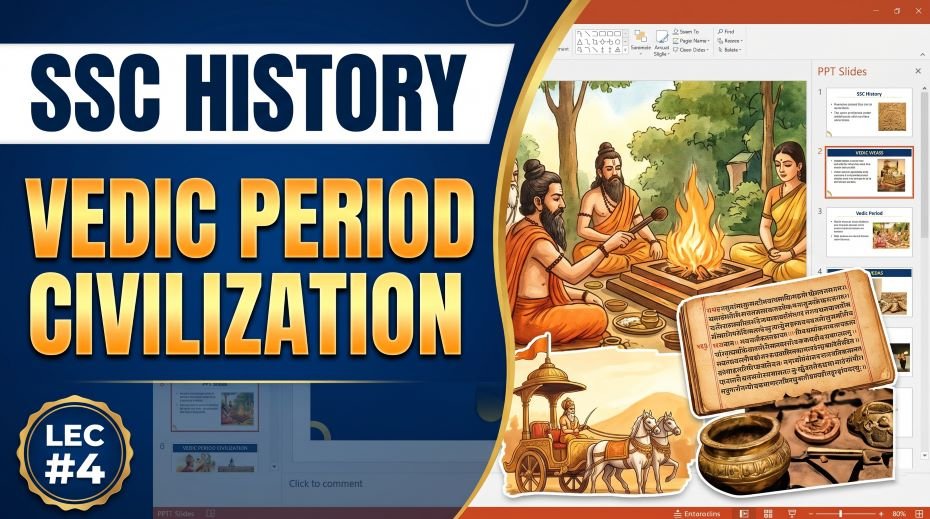
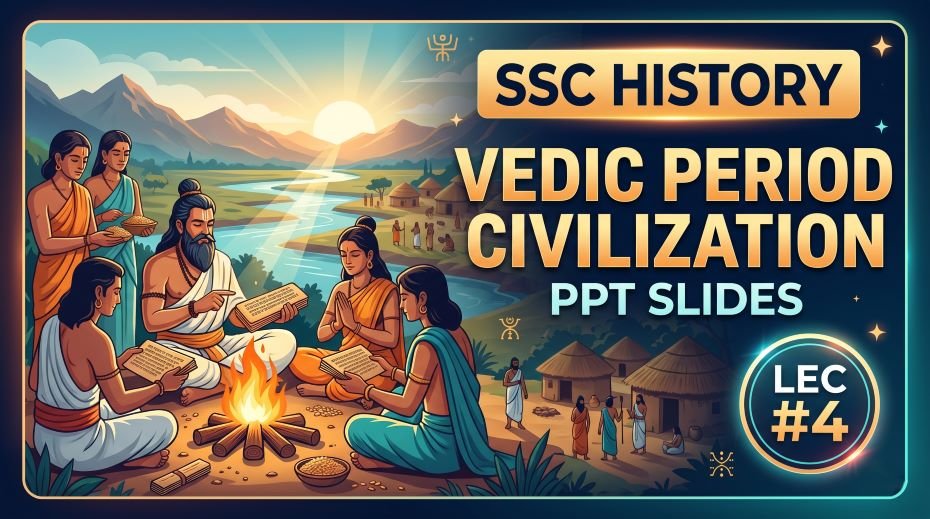
In this article we will share SSC History Vedic Period Civilization PPT Slides (LEC #4), SSC History Vedic Period – Complete Notes for SSC CGL, CHSL, CPO and MTS (.pptx) so, here is a quick overview of this lecture from the Complete Foundation Batch PPT Series before we dive into the content:
| Lecture Number | History LEC #4 |
| Serial Number in Series | #29 |
| Total PPT Slides | 149 Slides |
| File Size | 51 MB |
| Subject | History – Vedic Period (Vaidik Kaal / वैदिक काल) |
| Series Name | Complete Foundation Batch for All SSC and Other Exams (PPT Series) |
| Website | https://slideshareppt.net/ |
| Exam Relevance | SSC CGL, SSC CHSL, SSC CPO, SSC MTS – Very High (2–4 questions per exam) |
| Key Topics Covered | Four Vedas, Early & Later Vedic Society, Vedic Literature, Economy, Polity, Religion, Upanishads, Brahmanas, Aranyakas, Vedangas, Position of Women, Varna System, 16 Mahajanapadas |
SSC History Vedic Period Civilization PPT Slides (LEC #4)
Note: If you wish to download the entire SSC series (PPT slides), simply visit this redirect page. –REDIRECT PAGE
Why the Vedic Period Is One of the Most Tested Chapters in SSC History?
If the Indus Valley Civilization is India’s most mysterious ancient chapter, the Vedic Period is its most textually rich one. The Vedas – composed over nearly a thousand years – are not just religious documents. They are India’s oldest historical records, its oldest literature, and the foundation of its social, political, and philosophical traditions. For SSC exam aspirants, this means there is an enormous amount of testable content packed into one chapter.
LEC #4 of the Complete Foundation Batch PPT Series is the largest lecture in the series so far – 149 slides covering the full sweep of the Vedic Period: from the Early Vedic (Rig Vedic) age around 1500 BC to the Later Vedic period and the emergence of the 16 Mahajanapadas around 600 BC. That is nearly a thousand years of Indian history, documented through texts that are still recited today.
For SSC exams, the Vedic Period typically contributes 2–4 questions per paper. These questions are drawn from three main pools: Vedic literature (which Veda, which priest, which Upanishad, which Brahmana), Vedic society (Early vs Later Vedic differences, women’s status, varna system), and the Mahajanapadas (capitals, associated events, which was the first republic). This article covers all three pools in full.
One important connection to note: the Vedic Period is also the chapter that explains how India transitioned from small tribal settlements (like those that might have absorbed IVC people after its decline) into the large, sophisticated kingdoms and republics that eventually produced the Mauryan Empire. Understanding the Vedic Period makes every subsequent chapter of Ancient History easier to understand.
1. The Four Vedas – Complete Comparison Table
The Four Vedas are the foundation of all Vedic literature. Every detail in the table below – period, content, associated priest, Brahmana, and Upanishads – is directly testable in SSC exams. This is your single most important revision table for the Vedic Period chapter.
| Veda | Period & Overview | Key Content | Associated Priest | Brahmana | Upanishads |
| Rig Veda | Oldest Veda (~1500–1200 BC) | 1,028 hymns (suktas) in 10 Mandalas (books). Hymns of praise to gods (mainly Indra, Agni, Varuna). Contains Gayatri Mantra (3rd Mandala, dedicated to Savitri). Purusha Sukta (10th Mandala) – describes the origin of the four varnas. Most important Veda for SSC. | Hotri (priest who recites) | Aitareya | Aitareya & Kaushitaki |
| Sama Veda | Veda of Melodies (~1200–1000 BC) | 1,549 verses – almost all borrowed from Rig Veda, set to music. Considered the origin of Indian classical music. Called the ‘Veda of chants.’ | Udgatri (priest who chants/sings) | Chandogya, Jaiminiya | Chandogya & Jaiminiya |
| Yajur Veda | Veda of Sacrificial Formulas (~1200–1000 BC) | Prose and verse sacrificial formulas (yajus) for rituals. Two versions: Krishna (Black) Yajur Veda and Shukla (White) Yajur Veda. Brihadaranyaka Upanishad belongs to Shukla Yajur Veda. | Adhvaryu (priest who performs rituals) | Shatapatha (longest Brahmana) | Brihadaranyaka & Isha |
| Atharva Veda | Last Veda (~1000–800 BC) | 731 hymns. Spells, charms, incantations for daily life – disease cure, love magic, protection. Reflects popular religion, not just elite ritual. Contains early references to medicine, politics, and philosophy. | Brahman (supervisor priest) | Gopatha | Mundaka, Mandukya, Prashna |
Key SSC Facts About the Vedas – Quick Revision
- Oldest Veda: Rig Veda. Veda of melodies/music: Sama Veda. Veda of rituals: Yajur Veda. Veda of charms and spells: Atharva Veda.
- Gayatri Mantra: Found in 3rd Mandala of Rig Veda. Dedicated to Savitri (solar deity).
- Purusha Sukta: 10th Mandala of Rig Veda. Describes origin of the four varnas.
- 9th Mandala of Rig Veda: Entirely dedicated to Soma (ritual plant/drink).
- Longest Brahmana: Shatapatha Brahmana (attached to Shukla Yajur Veda).
- Satyameva Jayate: From Mundaka Upanishad. India’s national motto.
- Oldest/largest Upanishad: Brihadaranyaka Upanishad (Shukla Yajur Veda).
- Total Upanishads: 108. They are also called Vedanta (end of the Vedas).
2. Early Vedic vs Later Vedic Period – Complete Comparison Table
This comparison is one of the most frequently tested topics from the Vedic Period. SSC uses it both as direct questions (‘In which Vedic period did the varna system become hereditary?’) and as contrast questions (‘How did the status of women change between early and later Vedic periods?’). Study every row carefully.
| Aspect | Early Vedic Period (~1500–1000 BC) | Later Vedic Period (~1000–600 BC) |
| Time Period | ~1500–1000 BC (Rig Vedic Age) | ~1000–600 BC (Later / Epic Vedic Age) |
| Primary Text | Rig Veda | Sama Veda, Yajur Veda, Atharva Veda; Epics (Ramayana, Mahabharata); Puranas |
| Geographical Region | Sapta Sindhu (7 rivers of Punjab/NW region). River Sindhu (Indus) most important. | Gangetic plain (Ganga-Yamuna doab). Kuru, Panchala kingdoms dominant. River Ganga becomes most sacred. |
| Political System | Tribal system. Chief = Raja (elected/chosen). Sabha and Samiti (tribal assemblies) powerful. No hereditary kingship. | Hereditary monarchy strengthened. Elaborate Vedic rituals (Rajasuya, Ashvamedha) used to legitimise kings. Sabhas and Samitis lose power. |
| Economy | Primarily pastoral (cattle-rearing). Cow = primary unit of wealth. Agriculture secondary. Barter system. | Agriculture becomes primary occupation. Iron tools (use of iron begins). Rice (vrihi) and wheat grown. Gold coins (nishka) appear as currency. |
| Society / Varna | Early, fluid varna (class) system based on occupation. Relatively equal society. Inter-varna mobility possible. | Varna system becomes hereditary and rigid: Brahmin (priest), Kshatriya (warrior), Vaishya (merchant/farmer), Shudra (servant). Untouchability begins. |
| Position of Women | Relatively better position. Women could attend sabhas, marry by choice (swayamvara). Female scholars (brahmavadinis): Gargi, Maitreyi, Lopamudra. | Position declined sharply. Child marriage, Sati (widow immolation) mentioned. Women excluded from sabhas and religious rights. Purdah system begins. |
| Religion / Gods | Nature gods dominant: Indra (war, rain – most popular), Agni (fire), Varuna (cosmic order), Surya (sun), Usha (dawn), Vayu (wind). Simple rituals, no idol worship. | Prajapati (creator) rises. Vishnu and Rudra gain prominence. Elaborate rituals, complex Vedic sacrifices (yajnas). Rise of Brahmanical dominance. Brahma, Vishnu, Mahesh trinity emerges. |
| Type of Marriage | Love marriages, swayamvara (bride chooses). Widow remarriage allowed (niyoga system). Polyandry mentioned in some texts. | 8 forms of marriage codified (Brahma, Daiva, Arsha, Prajapatya – approved; Gandharva, Asura, Rakshasa, Paisacha – disapproved). Child marriage increases. |
| Key Assemblies | Sabha (village council, men and women), Samiti (larger tribal assembly), Vidhata (earliest tribal assembly), Gana (warrior group). | Sabha and Samiti gradually marginalised as royal power grows. Parishad (advisory council to king) becomes more important. |
| Important Rituals | Agnihotra (daily fire ritual), Soma ritual (drinking of soma juice – an intoxicating drink for gods and priests). Simple, priest-led prayers. | Rajasuya (royal consecration), Ashvamedha (horse sacrifice – king claims sovereignty over conquered territory), Vajapeya (chariot race + soma ritual). Sacrifices become very elaborate and costly. |
| Iron | Iron unknown. Bronze and copper tools. | Iron (Shyama Ayas / Krishna Ayas) introduced (~1000 BC). Enabled forest clearing and large-scale agriculture in Gangetic plain. |
| Class Structure | Tribal chief (Raja), nobles (Rajan), common people (Vis), others (Dasa – mostly conquered non-Aryans). | Fully stratified 4-varna system: Brahmin, Kshatriya, Vaishya, Shudra. Rigid boundaries, birth-based occupation. |
3. Complete Vedic Literature – From Vedas to Smritis
The Vedic Period produced an enormous body of literature over nearly 1,500 years. SSC tests specific attribution questions from this literature constantly. This table organises every major category with full detail and an exam-focused summary.
| Text Type | Description | SSC Exam Focus |
| Vedas (Samhitas) | 4 Vedas: Rig, Sama, Yajur, Atharva. ‘Samhita’ means ‘collection.’ These are the primary revealed texts (Shruti – ‘that which is heard’). Considered divine revelation, not human composition. | SSC: Which is the oldest Veda? Rig Veda. Which Veda contains music? Sama Veda. Which has spells and charms? Atharva Veda. |
| Brahmanas | Prose texts attached to each Veda. Explain the meaning and ritual procedures of the Vedic hymns. Written in complex Sanskrit. Longest: Shatapatha Brahmana (attached to Shukla Yajur Veda). Contains the story of Manu and the Great Flood. | SSC: Which is the longest Brahmana? Shatapatha. Which Veda is it attached to? Shukla Yajur Veda. Shatapatha contains the story of Manu (Indian Noah). |
| Aranyakas | ‘Forest texts’ – written for hermits and forest dwellers who could not perform elaborate rituals. Serve as a bridge between the ritual focus of Brahmanas and the philosophical focus of Upanishads. Sometimes called ‘forest books.’ | SSC: What does ‘Aranyaka’ mean? Forest book/text. What is their position in Vedic literature? Between Brahmanas (ritual) and Upanishads (philosophy). |
| Upanishads | 108 Upanishads. Also called Vedanta (‘end of Vedas’). Philosophical texts dealing with: nature of Brahman (ultimate reality), Atman (individual soul), and the relationship between the two. Key Upanishads: Brihadaranyaka (oldest and largest), Chandogya, Kena, Mundaka, Mandukya, Katha. Core concepts: Brahman, Atman, Karma, Moksha, Samsara. | SSC: How many Upanishads are there? 108. What are they also called? Vedanta. Which is the oldest/largest? Brihadaranyaka. Key SSC concept: ‘Satyameva Jayate’ comes from Mundaka Upanishad. |
| Vedangas | 6 auxiliary disciplines for understanding the Vedas: (1) Shiksha – phonetics/pronunciation, (2) Kalpa – ritual procedures, (3) Vyakarana – grammar (Panini’s Ashtadhyayi), (4) Nirukta – etymology (Yaska), (5) Chhanda – metre/prosody (Pingala), (6) Jyotisha – astronomy/astrology. | SSC: How many Vedangas are there? 6. Who wrote the grammar Vedanga (Ashtadhyayi)? Panini. Who wrote Nirukta? Yaska. Jyotisha = astronomy – earliest Indian astronomy text. |
| Upavedas | 4 secondary Vedas: (1) Ayurveda – medicine (attached to Rig/Atharva Veda), (2) Dhanurveda – archery/warfare (Yajur Veda), (3) Gandharvaveda – music and dance (Sama Veda), (4) Arthashastra / Sthapatyaveda – architecture and statecraft (Atharva Veda). | SSC: Ayurveda is attached to which Veda? Atharva Veda (sometimes Rig Veda – different traditions). Gandharvaveda = music, attached to Sama Veda. |
| Epics | Ramayana: Composed by Valmiki. ~24,000 shlokas (verses) in 7 Kandas (books). Story of Rama, Sita, Ravana. Mahabharata: Composed by Veda Vyasa. Longest epic in the world – ~100,000 shlokas in 18 Parvas (books). Story of Pandavas and Kauravas. Bhagavad Gita is part of Mahabharata (Bhishma Parva). | SSC: Who wrote Ramayana? Valmiki. Mahabharata? Veda Vyasa. Longest epic in the world? Mahabharata. Bhagavad Gita is part of which Parva? Bhishma Parva. ‘Satyameva Jayate’ from Mundaka Upanishad is India’s national motto. |
| Puranas | 18 main Puranas (Mahapuranas). Written by Veda Vyasa (traditionally). Contain legends, mythology, cosmology, genealogies of kings. Most important: Bhagavata Purana (stories of Vishnu/Krishna), Vishnu Purana, Vayu Purana (oldest Purana), Matsya Purana, Skanda Purana (largest Purana). | SSC: How many main Puranas? 18. Largest Purana? Skanda Purana. Which Purana is oldest? Vayu Purana (debated – some say Matsya). |
| Smritis / Dharmashastras | Codes of law and conduct. Written by human sages (not divinely revealed – hence ‘Smriti’ = ‘remembered’). Most important: Manu Smriti (Manusmriti) – the oldest law code in India, deals with social laws and varna duties. Also: Yajnavalkya Smriti, Narada Smriti, Parasara Smriti. | SSC: Which is the oldest law code in India? Manusmriti / Manu Smriti. Difference between Shruti and Smriti? Shruti = divine revelation (Vedas); Smriti = human memory/composition. |
Key SSC Connections from Vedic Literature
- ‘Satyameva Jayate’ (India’s national motto) – Mundaka Upanishad
- ‘Tat tvam asi’ (That thou art) – Chandogya Upanishad (Sama Veda)
- ‘Aham Brahmasmi’ (I am Brahman) – Brihadaranyaka Upanishad
- Ashtadhyayi (Sanskrit grammar) – Panini – classified under Vyakarana Vedanga
- Nirukta (etymology) – Yaska – classified under Nirukta Vedanga
- World’s longest epic – Mahabharata (Veda Vyasa) – ~100,000 shlokas
- Bhagavad Gita – part of Mahabharata, in the Bhishma Parva section
- Oldest Purana – Vayu Purana (debated). Largest Purana – Skanda Purana
- Oldest law code in India – Manusmriti (Manu Smriti)
4. Vedic Gods and Major Rituals
A. Major Vedic Deities
Vedic religion was based on nature worship – gods represented natural forces. The most important deity of the Early Vedic period was Indra (god of war and rain). The Later Vedic period saw a shift towards Prajapati and eventually the Brahma-Vishnu-Mahesh trinity. Here are the key deities SSC tests:
| God/Deity | Description | SSC Exam Focus |
| Indra | God of war, storms, and rain. Most frequently mentioned god in the Rig Veda (~250 hymns). Called ‘Purandhara’ (destroyer of cities) and ‘Vajrapani’ (holder of thunderbolt). | SSC: Who is the most mentioned god in Rig Veda? Indra. What is his weapon? Vajra (thunderbolt). |
| Agni | God of fire. Intermediary between gods and humans – offerings placed in fire reach the gods through Agni. Second most mentioned in Rig Veda. Called ‘Duta’ (messenger). | SSC: Who is the messenger god between humans and gods in Vedic religion? Agni. |
| Varuna | God of cosmic order (rita), water, and moral law. Considered the most ethical Vedic god – punishes sinners, rewards the righteous. Associated with the night sky. | SSC: Which Vedic god is associated with moral order (rita)? Varuna. |
| Surya | God of the sun. Multiple solar gods: Surya, Savitri, Mitra, Vishnu (as solar deity). Gayatri Mantra is dedicated to Savitri (solar deity). | SSC: Gayatri Mantra is dedicated to which deity? Savitri/Savitar (a solar deity). |
| Soma | God of the Soma plant and its juice – a ritual intoxicant. Soma ritual (drinking of Soma juice) was central to Vedic yajnas. Entire 9th Mandala of Rig Veda is dedicated to Soma. | SSC: Which Mandala of Rig Veda is dedicated to Soma? 9th Mandala. |
| Usha | Goddess of dawn. Celebrated in beautiful hymns in Rig Veda. One of the few female deities with a significant role. | SSC: Who is the Vedic goddess of dawn? Usha. |
| Rudra | God of storms, disease, and healing. Later identified with Shiva. Called ‘Pashupatinath’ (lord of animals) – connecting to Pashupati Seal of IVC. | SSC: Which Vedic god is the precursor of Lord Shiva? Rudra. |
| Prajapati | Later Vedic – rises as the supreme creator god, replacing Indra. In the Purusha Sukta, Prajapati creates the universe from his own body. | SSC: Which god rose to prominence in Later Vedic period as the creator? Prajapati. |
B. Major Vedic Rituals (Yajnas)
Vedic rituals (yajnas) were elaborate ceremonies involving fire offerings, Soma drinking, and recitation of Vedic hymns. SSC tests key rituals by name, purpose, and the rulers who performed them.
| Ritual Name | Description | Purpose |
| Agnihotra | Daily ritual of offering milk/ghee into fire at dawn and dusk. Every Vedic household was required to maintain the sacred fire. | Daily household ritual |
| Rajasuya | Royal consecration ceremony. Performed when a king was crowned – established his divine right to rule. Included a symbolic journey across the kingdom. | Legitimise king’s power |
| Ashvamedha | Horse sacrifice ritual. A horse was set free to roam for a year – any king who stopped it had to fight the releasing king. Used by powerful kings to assert dominance over neighbouring kingdoms. Samudragupta performed many Ashvamedha yajnas. | Assert imperial sovereignty |
| Vajapeya | Chariot race combined with Soma ritual. Performed by a king or Brahmin aspiring to higher status. ‘Vajapeya’ means ‘drink of strength.’ | Status elevation ritual |
| Soma Yajna | Ritual drinking of Soma juice (from the Soma plant – possibly Ephedra or Amanita). Offered to gods and consumed by priests. Entire 9th Mandala of Rig Veda dedicated to it. | Central Vedic ritual offering |
| Purushamedha | Human sacrifice – mentioned in later texts but considered more symbolic than real. A person was symbolically ‘sacrificed’ and then released. | Symbolic, very rare |
5. The 16 Mahajanapadas – Complete Table with Capitals and Key Facts
The 16 Mahajanapadas emerged in the Later Vedic period (~600 BC) as tribal confederacies evolved into settled kingdoms and republics. They are the political units within which Buddha and Mahavira preached, and out of which the Mauryan Empire ultimately emerged. SSC tests Mahajanapadas through capital identification, association with historical figures, and the ‘first republic’ question.
| # | Mahajanapada | Capital | Key Facts for SSC |
| 1 | Magadha | Rajgir (Girivraja), later Pataliputra (Patna) | Most powerful Mahajanapada. Rose to dominance under Haryanka, Shishunaga, Nanda, and Maurya dynasties. Later became the heart of the Mauryan Empire. Mentioned in Buddhist and Jain texts. |
| 2 | Kosala | Shravasti (modern Sahet-Mahet, UP) | Kingdom of Rama (Ramayana). Buddha was born in Kapilavastu – a dependency of Kosala. King Prasenjit was a contemporary of Buddha. |
| 3 | Vatsa | Kausambi (near Allahabad/Prayagraj, UP) | King Udayana (Vatsa) – ally/enemy of Avanti. Important commercial centre. Mentioned in Buddhist texts. |
| 4 | Avanti | Ujjain (northern Avanti) & Mahishmati (southern Avanti) | Important rival of Magadha. Later absorbed by Magadha (Shishunaga dynasty). Ujjain remains important as a religious and trade city. |
| 5 | Gandhara | Taxila (Takshashila, now Pakistan) | Famous for Taxila university – one of the world’s earliest universities. Alexander the Great passed through Gandhara (326 BC). Mentions in Rigveda and Mahabharata. |
| 6 | Kamboja | Rajapura (now Hazara, Pakistan/Afghanistan) | Known for horse breeding. Mentioned along with Gandhara in Rig Veda. Had a republican form of government (sangha/gana). |
| 7 | Kuru | Indraprastha (near Delhi) | Kingdom of the Kauravas (Mahabharata). Kuru-Panchala region was the heart of Later Vedic civilization. Kurukshetra (site of Mahabharata war) is in this region. |
| 8 | Panchala | Ahicchatra (north Panchala) & Kampilya (south Panchala) | Kingdom of the Panchalas (Mahabharata). Draupadi was a Panchala princess. Major Vedic centre. |
| 9 | Matsya | Virat Nagar (near Jaipur, Rajasthan) | The Pandavas spent their incognito exile (Agyatvas) in Matsya kingdom, at King Virata’s court. |
| 10 | Surasena | Mathura (UP) | Associated with Lord Krishna. Mathura was his birthplace. King Avantiputra of Surasena was a disciple of Buddha. |
| 11 | Chedi | Shuktimati (near Banda, MP) | King Shishupala (Krishna’s cousin) was from Chedi. Mentioned in Mahabharata. |
| 12 | Anga | Champa (near Bhagalpur, Bihar) | Kingdom of Karna (Mahabharata). Anga was often under the control of Magadha. Champa was an important trade city on the Ganga. |
| 13 | Vajji | Vaishali (Bihar) | Vajji was a confederacy of 8 clans – the world’s first known republic. Licchavi was the most powerful clan. Mahavira (founder of Jainism) was born at Vaishali. Buddha delivered his last sermon here before Mahaparinirvana. |
| 14 | Malla | Kushinara (Kushinagar) & Pava (UP) | Buddha attained Mahaparinirvana (death) at Kushinagar, in the Malla kingdom. Mahavira also died at Pava (Malla kingdom). Both were republics (gana-sangha). |
| 15 | Licchavi | Vaishali (Bihar) | Often listed separately. Part of Vajji confederacy. Famous republican state. Chandragupta I married a Licchavi princess (Kumaradevi) – legitimising Gupta rule. |
| 16 | Kashi | Varanasi (Benaras, UP) | One of the oldest continuously inhabited cities in the world. Buddha gave his first sermon at Sarnath (near Kashi) after enlightenment. Important religious centre. Often competed with Kosala for dominance. |
Most Important Mahajanapadas for SSC – Quick Revision
- Magadha (Rajgir/Pataliputra) – most powerful, base of Mauryan Empire, where Buddha spent most time
- Vajji/Licchavi (Vaishali) – world’s first republic; Mahavira born here; Buddha’s last sermon
- Kosala (Shravasti) – kingdom of Rama; King Prasenjit contemporary of Buddha
- Kashi (Varanasi) – oldest living city; Buddha’s first sermon at Sarnath (near Kashi)
- Malla (Kushinagar) – Buddha died (Mahaparinirvana) at Kushinagar; Mahavira died at Pava
- Gandhara (Taxila) – famous Taxila University; Alexander’s India entry point
- Kuru (Indraprastha/Delhi) – Mahabharata’s Kaurava kingdom; site of Kurukshetra war
- Anga (Champa/Bhagalpur) – kingdom of Karna; often controlled by Magadha
6. Additional High-Yield Vedic Period Facts for SSC
A. The Varna System – Origin and Evolution
The varna system began in the Early Vedic period as a flexible, occupation-based division mentioned in the Purusha Sukta (10th Mandala of Rig Veda). The four varnas were: Brahmin (priests), Kshatriya (warriors), Vaishya (traders/farmers), and Shudra (servants). In the Early Vedic period, switching varnas was possible. By the Later Vedic period, varna became birth-based and hereditary – the rigid caste system we associate with classical India.
B. Vedic Economy – From Cattle to Plough
- Early Vedic: Cattle was the primary unit of wealth. ‘Gavishti’ (search for cattle) meant war. ‘Gotra’ (literally: cow-pen) became the word for lineage/family group.
- Later Vedic: Agriculture became primary. Iron tools (called ‘Shyama Ayas’ or ‘Krishna Ayas’) allowed clearing of the dense forests of the Ganga plains. Rice (called ‘Vrihi’ in Vedic texts) and barley were the main crops.
- Trade: Early Vedic = barter. Later Vedic = gold coins called ‘Nishka’ begin to appear as a medium of exchange. Guild-like organisations (Shrenis) begin to form.
C. Key Sanskrit Terms SSC Asks About
- Rita – Cosmic moral order (maintained by Varuna). Later became ‘Dharma.’
- Yajna – Fire sacrifice ritual. Central to Vedic religion.
- Soma – Ritual drink consumed during yajnas. Entire 9th Mandala of Rig Veda dedicated to it.
- Shruti – ‘That which is heard’ – revealed literature (Vedas).
- Smriti – ‘That which is remembered’ – human-composed literature (epics, law codes).
- Gotra – Lineage group (literally: cattle pen).
- Gavishti – War (literally: search for cattle) – shows importance of cattle in Early Vedic economy.
- Nishka – Gold ornament used as currency in Later Vedic period.
- Gramani – Village headman in Vedic political system.
- Purohita – Royal priest/chaplain. Most important official in Vedic kingdom.
7. Podcast Discussion – Vedic Period for SSC Exams (Multiple Perspectives)
An SSC Mentor, a History Expert, and an SSC Topper discuss the Vedic Period chapter from different angles – covering study strategy, most-tested topics, and common confusion points.
| Speaker / Role | Question | Answer / Perspective |
| Host (SSC Mentor) | LEC #4 has 149 slides – the largest lecture in the series so far. Why is the Vedic Period such an extensive chapter for SSC? | Because the Vedic Period is not one topic – it is really three interlocking topics that SSC tests separately: Vedic literature (Vedas, Upanishads, Brahmanas, Vedangas), Vedic society and economy (Early vs Later Vedic), and the Mahajanapadas (which emerge directly from the Later Vedic period). Each of these alone could fill 50 slides. When you add the Vedic religion, key rituals, important women scholars, and the political evolution from tribes to kingdoms, 149 slides makes complete sense. For an SSC aspirant, the payoff is high – this chapter can easily give you 3–4 marks in CGL. |
| Guest 1 (History Expert) | Students always confuse Early Vedic and Later Vedic periods. What is the single clearest distinction between them? | The clearest distinction is the role of women and the rigidity of the varna system. In the Early Vedic period, women attended sabhas, could debate philosophy (Gargi challenged even Yajnavalkya), could choose their husbands (swayamvara), and widow remarriage was allowed. In the Later Vedic period, women were excluded from sabhas, child marriage increased, and Sati was mentioned. Similarly, the varna system went from fluid-and-occupation-based to hereditary-and-birth-based. If you remember this single contrast – early Vedic: flexible and relatively equal; later Vedic: rigid and hierarchical – you can answer almost any comparison question SSC throws at you. |
| Guest 2 (SSC Topper) | What is the one table every SSC aspirant must memorise from the Vedic Period chapter? | The four Vedas table – specifically: Veda name, associated priest, associated Brahmana, and key Upanishads. SSC regularly asks all four angles. Rig Veda (Hotri priest, Aitareya Brahmana), Sama Veda (Udgatri priest, Chandogya Brahmana, Chandogya Upanishad – largest Upanishad), Yajur Veda (Adhvaryu priest, Shatapatha Brahmana – longest Brahmana), Atharva Veda (Brahman priest, Gopatha Brahmana). If you know this table inside out, you can answer 60–70% of all Vedic literature questions in any SSC exam. |
| Host (SSC Mentor) | The 16 Mahajanapadas are listed in the syllabus as a separate chapter but this PPT covers them too. What is the SSC exam pattern for Mahajanapadas questions? | There are two types of Mahajanapada questions in SSC. First type: direct capital questions – ‘What was the capital of Magadha?’ (Rajgir, later Pataliputra), ‘What was the capital of Vajji?’ (Vaishali). Second type: association questions – ‘Where did Buddha attain Mahaparinirvana?’ (Kushinagar – Malla kingdom), ‘Where was Mahavira born?’ (Vaishali – Vajji/Licchavi), ‘Which was the first republic in the world?’ (Vajji confederacy / Licchavi). Magadha, Vaishali (Vajji/Licchavi), Kosala, and Kashi are the four most-tested Mahajanapadas. Know them cold. |
| Guest 1 (History Expert) | The Upanishads are philosophically deep texts. What specifically should an SSC aspirant know about them? | For SSC purposes, four things about Upanishads: (1) Total number = 108. (2) They are also called Vedanta (end of Vedas) – because they come at the end of Vedic literature both physically and philosophically. (3) Oldest and largest Upanishad = Brihadaranyaka Upanishad (attached to Shukla Yajur Veda). (4) Most famous Upanishad for SSC = Mundaka Upanishad – because ‘Satyameva Jayate’ (India’s national motto) comes from it. SSC also asks about the Chandogya Upanishad (attached to Sama Veda, contains the famous phrase ‘Tat tvam asi’ – ‘That thou art’). Beyond these facts, the philosophical content itself is not tested. |
| Guest 2 (SSC Topper) | Vedic women scholars – Gargi, Maitreyi, Lopamudra – come up in SSC. What exactly should students know about each? | Three scholars, three facts each. Gargi Vachaknavi: participated in the famous philosophical debate (Brahmavadin – a woman philosopher) at King Janaka’s court. She questioned Yajnavalkya and he called her the greatest philosopher. Her questions are in Brihadaranyaka Upanishad. Maitreyi: wife of sage Yajnavalkya. When Yajnavalkya offered her property before leaving for the forest, she asked instead for knowledge of the Atman. Also in Brihadaranyaka Upanishad. Lopamudra: wife of sage Agastya. A Vedic poet (brahmavadini) – she composed hymns in the Rig Veda (one of the few female authors). SSC may ask: which woman composed hymns in the Rig Veda? Answer: Lopamudra (and Vishwavara, Apala, Ghosa). |
| Host (SSC Mentor) | The national motto ‘Satyameva Jayate’ – which Upanishad is it from, and does SSC really ask about it? | Yes – this is one of the most frequently asked ‘current affairs meets history’ questions in SSC. ‘Satyameva Jayate’ (Truth alone triumphs) comes from the Mundaka Upanishad, verse 3.1.6. It was adopted as India’s national motto from the State Emblem (Ashoka’s Lion Capital from Sarnath) after independence. SSC asks this both directly (‘Satyameva Jayate is from which Upanishad?’) and indirectly (‘What is India’s national motto and its source?’). The answer is always Mundaka Upanishad – not Chandogya, not Brihadaranyaka. |
| Guest 1 (History Expert) | Why is Magadha the most important Mahajanapada – and why does it keep appearing across multiple chapters of Indian History? | Magadha is important because it is the bridge between the Vedic age and the Classical age. It starts as one of 16 Mahajanapadas, rises through the Haryanka dynasty (Bimbisara, Ajatashatru), grows further under the Shishunaga and Nanda dynasties, and then explodes under Chandragupta Maurya into the first pan-Indian empire. Magadha’s capital, Pataliputra (modern Patna), was the nerve centre of Indian politics for nearly 1,000 years. In SSC exams, Magadha connects the Mahajanapada chapter to the Mauryan chapter to the Buddhist chapter (since both Buddha and Mahavira were active in the Magadha region). It is the most connected topic in Ancient Indian History. |
| Guest 2 (SSC Topper) | Final revision strategy for the Vedic Period chapter – what should a student do in the last 48 hours before an SSC exam? | In the last 48 hours, focus on three revision sheets. Sheet 1: Four Vedas – name, period, associated priest, Brahmana, and one key Upanishad. Sheet 2: Early Vedic vs Later Vedic – 5 key contrasts (geography, women’s status, varna rigidity, economy, political system). Sheet 3: 16 Mahajanapadas – just the capital of each and one unique fact. Do not try to re-read everything – these three sheets cover 90% of what SSC tests from this chapter. Also memorise: Satyameva Jayate from Mundaka Upanishad, Gayatri Mantra from 3rd Mandala of Rig Veda dedicated to Savitri, and Shatapatha Brahmana is the longest. |
8. SSC Exam Q&A – Vedic Period (Previous Year Pattern)
These 15 questions are drawn from the question patterns of SSC CGL, CHSL, CPO, and MTS exams. Each answer is complete, exam-ready, and includes the key distinguishing detail that SSC examiners look for.
| # | Question | Answer | Exam Relevance |
| Q1 | Which is the oldest Veda, and how many Mandalas (books) does it contain? | Rig Veda is the oldest Veda (~1500–1200 BC). It contains 1,028 hymns (suktas) arranged in 10 Mandalas (chapters). The Gayatri Mantra is in the 3rd Mandala. The 9th Mandala is entirely dedicated to Soma. The Purusha Sukta (describing creation of varnas) is in the 10th Mandala. | SSC CGL, CHSL, CPO, MTS – Very High |
| Q2 | What is the Gayatri Mantra, where is it found, and to which deity is it dedicated? | The Gayatri Mantra is a sacred Vedic hymn found in the 3rd Mandala of the Rig Veda (verse 3.62.10). It is dedicated to Savitri (Savitar) – a solar deity. The mantra prays for divine guidance and wisdom. SSC often asks: ‘Gayatri Mantra is dedicated to which deity?’ Answer: Savitri/Savitar (a form of the Sun god). | SSC CGL, CHSL – Very High |
| Q3 | From which Upanishad does ‘Satyameva Jayate’ come? | ‘Satyameva Jayate’ (Truth alone triumphs) comes from the Mundaka Upanishad (verse 3.1.6). It was adopted as India’s national motto. It appears on the State Emblem of India (Ashoka’s Lion Capital from Sarnath). This is one of the most-tested connections between ancient history and national symbols. | SSC CGL, CHSL, CPO, MTS – Very High |
| Q4 | What is the difference between Shruti and Smriti literature? | Shruti (‘that which is heard’) refers to divinely revealed literature – the four Vedas (Rig, Sama, Yajur, Atharva) and their associated texts. Smriti (‘that which is remembered’) refers to human-composed literature – Epics (Ramayana, Mahabharata), Puranas, Dharmashastras (Manusmriti). Vedas = Shruti. Manusmriti, Ramayana = Smriti. | SSC CGL, CHSL – High |
| Q5 | Which is the longest Brahmana text, and which Veda is it attached to? | Shatapatha Brahmana is the longest Brahmana (100 chapters/sections). It is attached to the Shukla (White) Yajur Veda. It contains the Vedic story of Manu and the Great Flood – the Indian counterpart of Noah’s Ark. Brihadaranyaka Upanishad is also part of this Brahmana tradition. | SSC CGL, CHSL – High |
| Q6 | What were Sabha and Samiti in the Vedic period? | Sabha and Samiti were two important tribal assemblies of the Early Vedic period. Sabha was a smaller council of elders (men and women could attend). Samiti was a larger tribal assembly of the whole tribe – more democratic. Both checked the power of the king (raja). In the Later Vedic period, both lost power as hereditary monarchy strengthened. SSC asks: What were Vedic assemblies? Sabha and Samiti. | SSC CGL, CHSL – High |
| Q7 | Which Mahajanapada is considered the world’s first republic? | Vajji confederacy (specifically the Licchavi clan of Vaishali, Bihar) is considered the world’s first known republic. It had an elected council (Ganatantra), no hereditary king, and decisions were made collectively. Mahavira (founder of Jainism) was born in Vaishali. Buddha gave his last sermon here before Mahaparinirvana. | SSC CGL, CHSL, CPO – Very High |
| Q8 | Name the 6 Vedangas and their subjects. | (1) Shiksha – phonetics/pronunciation, (2) Kalpa – ritual procedures/ceremonies, (3) Vyakarana – grammar (Panini’s Ashtadhyayi is the key text), (4) Nirukta – etymology/meaning of words (Yaska wrote Nirukta), (5) Chhanda – metre and prosody (Pingala), (6) Jyotisha – astronomy and astrology (earliest astronomy text of India). | SSC CGL, CHSL – High |
| Q9 | Who were the female scholars (Brahmavadinis) of the Vedic period? | Key Vedic women scholars: (1) Gargi Vachaknavi – debated sage Yajnavalkya in the Brihadaranyaka Upanishad. (2) Maitreyi – wife of Yajnavalkya; chose knowledge of Atman over property (Brihadaranyaka Upanishad). (3) Lopamudra – wife of Agastya; composed hymns in the Rig Veda. (4) Apala, Vishwavara, Ghosa – also female composers in Rig Veda. | SSC CGL, CHSL – Moderate-High |
| Q10 | What was the Ashvamedha ritual, and which ruler performed it most? | Ashvamedha (Horse Sacrifice) was a royal ritual where a horse was released to roam freely for a year – any king who stopped it had to fight the releasing king. At the end of the year, the horse was sacrificed and the releasing king declared his supremacy. Samudragupta of the Gupta Empire is most famous for performing multiple Ashvamedha yajnas (confirmed by the Allahabad Pillar Inscription). | SSC CGL, CHSL – High |
| Q11 | What is the difference between Early Vedic and Later Vedic geographical focus? | Early Vedic (Rig Vedic): Sapta Sindhu region – the land of seven rivers, mainly the Punjab/NW frontier area. The Sindhu (Indus) was the most important river. Later Vedic: Expanded eastward to the Ganga-Yamuna doab. Ganga became the most sacred river. The shift from Sindhu to Ganga as the most important river marks the transition between the two Vedic periods. | SSC CGL, CHSL – High |
| Q12 | What is the Purusha Sukta, and why is it important? | The Purusha Sukta is a hymn in the 10th Mandala of the Rig Veda. It describes the creation of the universe and human society from the body of Purusha (the Cosmic Man). Most importantly, it is the earliest textual reference to the four varnas: Brahmins emerged from the mouth, Kshatriyas from the arms, Vaishyas from the thighs, and Shudras from the feet. It is the foundational text for understanding the Vedic social order. | SSC CGL, CHSL – High |
| Q13 | What was the capital of Magadha, and why was Magadha the most powerful Mahajanapada? | Magadha’s capital was Rajgir (Girivraja) initially, later shifted to Pataliputra (modern Patna). Magadha was the most powerful for multiple reasons: iron deposits in Jharkhand/Bihar (for weapons and tools), fertile Gangetic plain (strong agricultural base), control of river trade routes, and a series of ambitious and capable rulers (Bimbisara, Ajatashatru, Chandragupta Maurya). It eventually became the base for the Mauryan Empire. | SSC CGL, CHSL, CPO – Very High |
| Q14 | What is the significance of the Sama Veda for Indian culture? | The Sama Veda is called the ‘Veda of melodies’ or ‘Veda of chants.’ It contains 1,549 verses – almost all borrowed from the Rig Veda – but set to musical notations for chanting. The Udgatri priest used the Sama Veda during sacrificial rituals. Historically, the Sama Veda is considered the origin of Indian classical music. The Chandogya Upanishad (attached to Sama Veda) is one of the most philosophically significant Upanishads. | SSC CGL, CHSL – Moderate |
| Q15 | What was unique about the political system of the Vajji confederacy (Vaishali)? | The Vajji confederacy at Vaishali was a republican oligarchy (Ganatantra/Gana-sangha) – one of the world’s first known republics. It had no hereditary king. A council of elected representatives made decisions. The Licchavis were the dominant clan. This democratic system is mentioned in both Buddhist and Jain texts and is considered a prototype of republican governance, predating both ancient Rome and Greece. | SSC CGL, CHSL – High |
also read: SSC History Indus Valley Civilization PPT Slides (LEC #3)
9. Smart Study Strategy for the Vedic Period
Three-Sheet Method for Last-Week Revision
- Sheet 1 – Four Vedas Table: Veda name | period | associated priest | Brahmana | key Upanishad. This single sheet covers 60–70% of all Vedic literature questions in SSC.
- Sheet 2 – Early vs Later Vedic: Five key contrasts – geography (Sindhu vs Ganga), women’s status, varna rigidity, economy (cattle vs agriculture), and political system (tribal vs monarchy). These five contrasts answer most comparison questions.
- Sheet 3 – 16 Mahajanapadas: Capital of each + one unique fact (especially: Magadha, Vajji/Vaishali, Kosala, Kashi, Malla, Gandhara). Focus on the first republic fact (Vajji/Licchavi) and all events associated with Magadha.
Must-Memorise One-Liners Before Your SSC Exam
- Oldest Veda = Rig Veda. Veda of music = Sama Veda. Veda of rituals = Yajur Veda. Veda of spells = Atharva Veda.
- Gayatri Mantra = 3rd Mandala of Rig Veda, dedicated to Savitri.
- Satyameva Jayate = Mundaka Upanishad (India’s national motto).
- Longest Brahmana = Shatapatha (Shukla Yajur Veda).
- Oldest/largest Upanishad = Brihadaranyaka.
- Total Upanishads = 108. Also called Vedanta.
- World’s first republic = Vajji confederacy / Licchavi (Vaishali, Bihar).
- Magadha capital: Rajgir (Girivraja) first, then Pataliputra (Patna).
- Gargi debated Yajnavalkya (Brihadaranyaka Upanishad).
- Lopamudra composed hymns in Rig Veda.
- Ashvamedha (horse sacrifice) = assert imperial sovereignty. Samudragupta performed it most.
- Iron in India = introduced ~1000 BC in Later Vedic period. Called Shyama Ayas / Krishna Ayas.
Conclusion
The Vedic Period is the chapter that makes all of Ancient Indian History make sense. It explains how India went from the urban, trade-focused cities of the IVC to the philosophically rich, agriculturally advanced kingdoms that became the Mahajanapadas. It gave India its oldest literature, its oldest grammar, its oldest law code, its social structure, its religious traditions, and its philosophical worldview.
For SSC aspirants, this chapter rewards focused study beautifully – the questions are specific and factual, the patterns repeat across years, and the information you memorise here keeps paying dividends in every subsequent chapter of Ancient and Medieval History. The 149 slides of LEC #4 in the Complete Foundation Batch PPT Series are the most structured way to cover this chapter, and this article provides the depth that makes those slides most useful.
The next article in this series covers Buddhism, Jainism, and Shaivism – LEC #5 of the Complete Foundation Batch History PPT Series. Stay tuned for the same structured, exam-focused format.