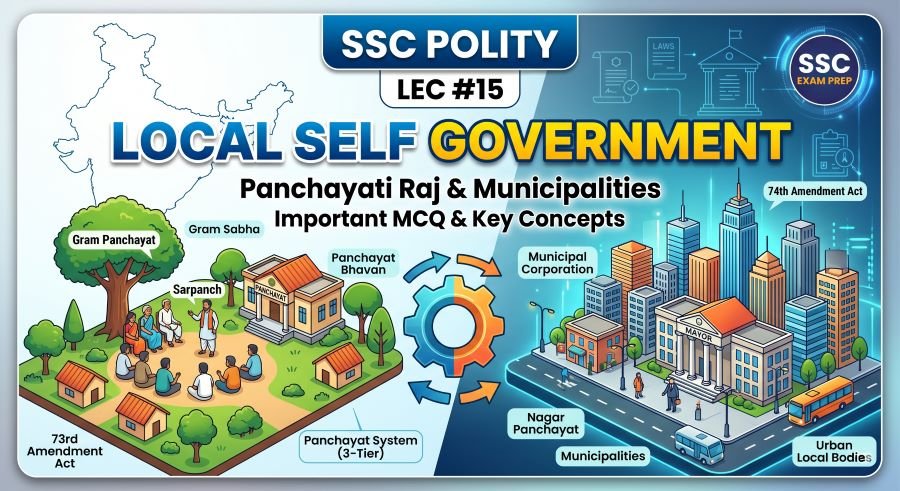
This article covers SSC Polity Local Self Government PPT Slides (LEC #15) (स्थानीय स्वशासन), part of the Complete Foundation Batch PPT Series at slideshareppt.net. Local Self Government covers the 73rd and 74th Constitutional Amendments (Panchayati Raj and Municipalities), Part IX and Part IX-A of the Constitution, the 11th and 12th Schedules, State Election Commission, and State Finance Commission. This is a high-scoring topic in SSC CGL, CHSL, CPO, and MTS exams – questions on amendment numbers, subjects in schedules, Gram Sabha, reservation provisions, and key committees appear regularly.
SSC Polity Local Self Government PPT Slides (LEC #15)
Note: Above is PPT in GOOGLE SLIDES (HTML AND IFRAME COMBINATION) and if you wish to download the Complete SSC series (PPT slides), Simply visit this redirect page – REDIRECT PAGE.
1. Local Self Government – Introduction
Local Self Government means governance at the grassroots level – closest to the people
Two types: Rural (Panchayati Raj Institutions) and Urban (Municipalities)
India is a three-tier federal system: Union Government → State Governments → Local Governments
Before 1992, local bodies existed but had no constitutional status; states could ignore or dissolve them
73rd and 74th Constitutional Amendment Acts of 1992 gave constitutional status to local bodies
Article 40 (DPSP – Gandhian Principle) directed State to organise village panchayats – this was the constitutional mandate that eventually led to the 73rd Amendment
2. 73rd and 74th Constitutional Amendments – Overview
Amendment
Year
Subject
Key Provision
73rd Constitutional Amendment
1992
Panchayati Raj Institutions (PRIs)
Added Part IX (Articles 243–243O) and 11th Schedule to the Constitution; gave constitutional status to Panchayati Raj; effective from 24 April 1993
74th Constitutional Amendment
1992
Urban Local Bodies (ULBs) / Municipalities
Added Part IX-A (Articles 243P–243ZG) and 12th Schedule; gave constitutional status to municipalities; effective from 1 June 1993
97th Constitutional Amendment
2011
Co-operative Societies
Added Part IX-B (Articles 243ZH–243ZT); gave constitutional status to co-operative societies; added Article 43B as DPSP
3. Key Constitutional Articles – Local Self Government
Article
Subject
Article 40
Directive Principle – State shall organise village panchayats (Gandhian Principle)
Article 243
Definitions for Part IX (Panchayats)
Article 243A
Gram Sabha – meetings of registered voters of a village
Article 243B
Constitution of Panchayats – 3 levels in every state
Article 243C
Composition of Panchayats
Article 243D
Reservation of seats in Panchayats – SC, ST, Women (minimum 1/3)
Article 243E
Duration of Panchayats – 5 years; fresh elections before expiry
Article 243F
Disqualification for membership of Panchayats
Article 243G
Powers, authority, and responsibilities of Panchayats (11th Schedule – 29 subjects)
Article 243H
Powers to impose taxes by Panchayats
Article 243I
Constitution of Finance Commission by Governor every 5 years
Article 243J
Audit of accounts of Panchayats
Article 243K
State Election Commission for superintendence of Panchayat elections
Article 243L
Application to Union Territories
Article 243M
Exemptions – states with less than 20 lakh population; scheduled areas; hilly areas; Nagaland, Meghalaya, Mizoram
Article 243N
Continuance of existing laws and Panchayats
Article 243O
Bar on interference by courts in Panchayat election matters
Article 243P
Definitions for Part IX-A (Municipalities)
Article 243Q
Constitution of Municipalities – 3 types
Article 243R
Composition of Municipalities
Article 243S
Wards Committees
Article 243T
Reservation of seats in Municipalities – SC, ST, Women (minimum 1/3); OBC optional
Article 243U
Duration of Municipalities – 5 years
Article 243V
Disqualification for membership
Article 243W
Powers, authority, responsibilities of Municipalities (12th Schedule – 18 subjects)
Article 243X
Powers of Municipalities to impose taxes
Article 243Y
Finance Commission for Municipalities
Article 243Z
Audit of accounts of Municipalities
Article 243ZA
Elections to Municipalities – State Election Commission
District Panchayat (Zila Parishad) → Block/Intermediate Panchayat (Panchayat Samiti) → Village Panchayat (Gram Panchayat)
States with 2-tier only
States with population less than 20 lakh may have only 2 tiers (Article 243B)
Term
5 years; fresh elections must be completed before expiry of term
Gram Sabha
Article 243A – body of all registered voters in a village; foundation of PRIs
Reservation
Article 243D – SC/ST in proportion to their population; Women minimum 1/3 of total seats; states can provide OBC reservation
State Election Commission
Article 243K – superintendence, direction, control of preparation of electoral rolls and conduct of elections to Panchayats
State Finance Commission
Article 243I – Governor constitutes every 5 years to review financial position of panchayats
Exemptions
Article 243M – not applicable to: J&K, states with population less than 20 lakh, scheduled areas (5th Schedule), hill areas of Manipur, Nagaland, Meghalaya, Mizoram
Committees recommended by
Balwant Rai Mehta Committee (1957) – first recommended 3-tier Panchayati Raj
Ashok Mehta Committee
1977 – recommended 2-tier structure; mandatory elections; reservation for women and SCs/STs
L.M. Singhvi Committee
1986 – recommended constitutional status to Panchayati Raj; directly led to 73rd Amendment
Article 243A – Gram Sabha is a body consisting of all persons registered as voters in a village
It is the ONLY directly elected body in Panchayati Raj – no elections; all voters are members
Gram Sabha approves the annual plans and budget of the Gram Panchayat
Gram Sabha elects beneficiaries for government schemes
At least 2 meetings per year compulsory (varies by state law)
L.M. Singhvi Committee called Gram Sabha the ‘foundation of democracy’
5. Eleventh Schedule – 29 Subjects for Panchayats (Article 243G)
S.No.
Subject (Panchayats – 11th Schedule)
1
Agriculture, including agricultural extension
2
Land improvement, implementation of land reforms, land consolidation, and soil conservation
3
Minor irrigation, water management, and watershed development
4
Animal husbandry, dairying, and poultry
5
Fisheries
6
Social forestry and farm forestry
7
Minor forest produce
8
Small-scale industries, including food processing industries
9
Khadi, village and cottage industries
10
Rural housing
11
Drinking water
12
Fuel and fodder
13
Roads, culverts, bridges, ferries, waterways, and other means of communication
14
Rural electrification, including distribution of electricity
15
Non-conventional energy sources
16
Poverty alleviation programmes
17
Education, including primary and secondary schools
18
Technical training and vocational education
19
Adult and non-formal education
20
Libraries
21
Cultural activities
22
Markets and fairs
23
Health and sanitation including hospitals, primary health centres, and dispensaries
24
Family welfare
25
Women and child development
26
Social welfare, including welfare of the handicapped and mentally retarded
27
Welfare of the weaker sections, and in particular, of the Scheduled Castes and Scheduled Tribes
28
Public distribution system
29
Maintenance of community assets
6. Urban Local Bodies – 74th Amendment 1992
Feature
Details
Constitutional Amendment
74th Amendment Act 1992; effective 1 June 1993
Constitutional Articles
Part IX-A – Articles 243P to 243ZG
Schedule added
12th Schedule – 18 subjects for Municipalities
3 types of Urban Local Bodies
(1) Nagar Panchayat – transitional area (rural to urban); (2) Municipal Council – smaller urban area; (3) Municipal Corporation – large urban area
Term
5 years; elections before expiry
Reservation
Article 243T – SC/ST proportional; Women minimum 1/3; OBC reservation optional for states
Wards Committee
Article 243S – Wards Committee in municipalities with population 3 lakh or more
State Election Commission
Article 243ZA – conducts municipality elections
District Planning Committee
Article 243ZD – prepares development plan for district as a whole; 4/5 members from elected Panchayat and Municipality members
Metropolitan Planning Committee
Article 243ZE – for metropolitan areas with population 10 lakh or more; prepares development plan
Finance Commission
Article 243Y – same Finance Commission as for Panchayats reviews finances of municipalities
First Municipality in India
Madras Municipal Corporation (1688) – oldest municipal body in India
Largest Municipal Corporation
Brihanmumbai Municipal Corporation (BMC) / Greater Mumbai
Types of Urban Local Bodies
Nagar Panchayat (Town Area Committee) – for transitional areas moving from rural to urban status; population typically 10,000 to 1 lakh
Municipal Council (Nagar Palika / Nagar Panchayat in some states) – for smaller urban areas; population typically 1 lakh to 10 lakh
Municipal Corporation (Mahanagar Palika / Nagar Nigam) – for large urban areas; population typically above 10 lakh
Cantonment Boards – for civilian population in cantonment areas; governed by Cantonments Act 2006; under Ministry of Defence
Township – maintained by public sector undertakings for their employees
Port Trusts – for management of port areas
7. Twelfth Schedule – 18 Subjects for Municipalities (Article 243W)
S.No.
Subject (Municipalities – 12th Schedule)
1
Urban planning including town planning
2
Regulation of land use and construction of buildings
3
Planning for economic and social development
4
Roads and bridges
5
Water supply for domestic, industrial, and commercial purposes
6
Public health, sanitation, conservancy, and solid waste management
7
Fire services
8
Urban forestry, protection of environment and promotion of ecological aspects
9
Safeguarding the interests of weaker sections of society
10
Slum improvement and upgradation
11
Urban poverty alleviation
12
Provision of urban amenities and facilities such as parks, gardens, playgrounds
13
Promotion of cultural, educational, and aesthetic aspects
14
Burials and burial grounds; cremations, cremation grounds, and electric crematoriums
15
Cattle pounds; prevention of cruelty to animals
16
Vital statistics including registration of births and deaths
17
Public amenities including street lighting, parking lots, bus stops and public conveniences
18
Regulation of slaughterhouses and tanneries
SSC Polity Local Self Government PPT Slides (LEC #15)
8. State Election Commission and State Finance Commission
State Election Commission – Articles 243K and 243ZA
State Election Commission is a constitutional body established under Article 243K (for Panchayats) and Article 243ZA (for Municipalities)
Each state has its own State Election Commission – separate from the Election Commission of India
Headed by State Election Commissioner appointed by Governor
State Election Commissioner can only be removed in same manner as HC judge (difficult)
Functions: superintendence, direction, and control of preparation of electoral rolls; conduct of elections to Panchayats and Municipalities
State Election Commission is independent from the Central Election Commission of India
State Finance Commission – Articles 243I and 243Y
Governor of each state constitutes a State Finance Commission every 5 years
SFC reviews the financial position of Panchayats and Municipalities
SFC makes recommendations on: distribution of taxes, duties, tolls between state and local bodies; grants-in-aid; measures to improve financial position of PRIs and ULBs
SFC is modelled on the pattern of the Central Finance Commission
9. District Planning Committee and Metropolitan Planning Committee
District Planning Committee – Article 243ZD
Constituted in every district to prepare a development plan for the district as a whole
At least 4/5 of members must be elected from Panchayats and Municipalities of the district (in proportion to rural-urban population ratio)
Consolidates plans prepared by Panchayats and Municipalities
Forwards plan to State Government
Metropolitan Planning Committee – Article 243ZE
Constituted for every Metropolitan area (population of 10 lakh or more)
At least 2/3 of members must be elected from elected members of Municipalities and Panchayats in the Metropolitan area
Prepares a draft development plan for the Metropolitan area as a whole
Examples of Metropolitan areas: Mumbai, Delhi, Chennai, Kolkata, Bangalore, Hyderabad
10. Key Committees on Panchayati Raj
Committee / Commission
Year
Key Recommendations
Balwant Rai Mehta Committee
1957
First to recommend 3-tier Panchayati Raj; direct elections at village level; indirect at higher levels; implemented in Rajasthan (2 Oct 1959 – first state)
Ashok Mehta Committee
1977
2-tier structure (district + mandal); compulsory elections; reservation for women, SCs, STs; political parties allowed at panchayat elections
G.V.K. Rao Committee
1985
PRIs should become vibrant living democratic institutions; district as unit of planning
L.M. Singhvi Committee
1986
Constitutional status to PRIs; Gram Sabha as foundation; reorganise villages to make panchayats viable; directly led to 73rd Amendment
Sarkaria Commission
1988
Inter-governmental relations; Panchayats as third tier of federalism
Second ARC (Administrative Reforms Commission)
2007
Strengthening decentralisation; effective devolution of functions, funds, and functionaries (3Fs) to local bodies