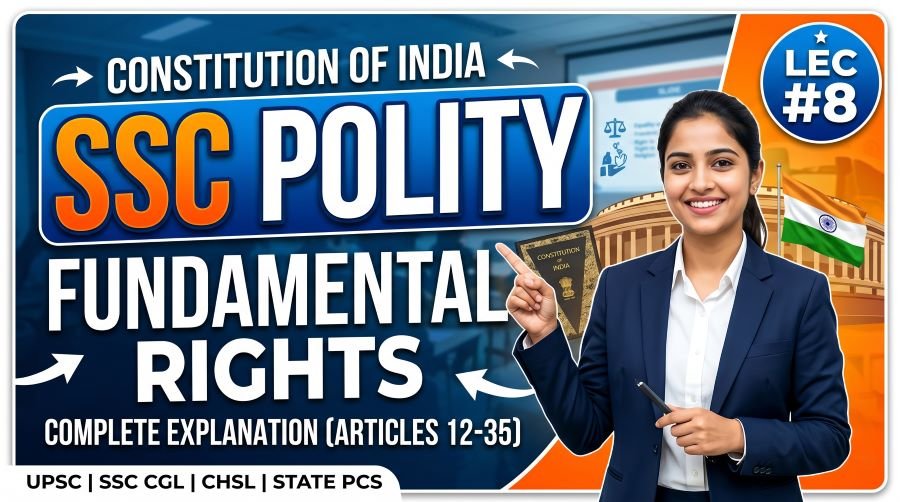
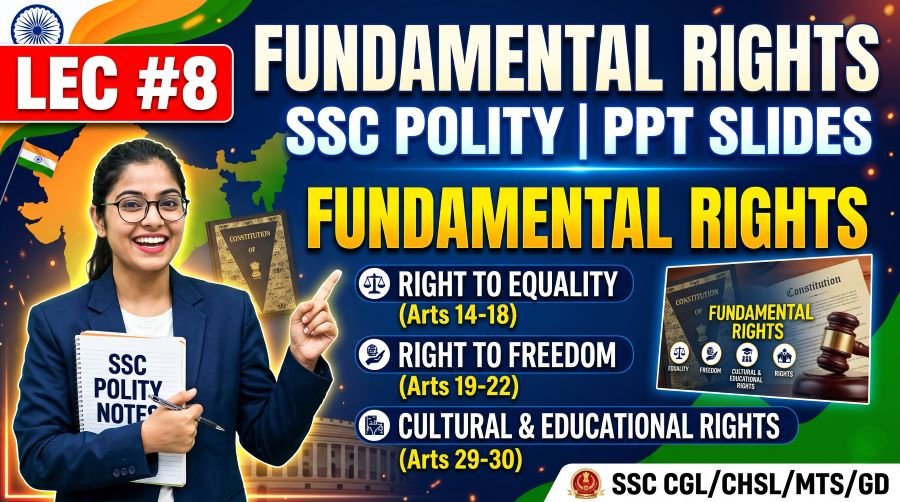
This article covers SSC Polity Fundamental Rights PPT Slides (LEC #8) (मौलिक अधिकार), part of the Complete Foundation Batch PPT Series at slideshareppt.net. Fundamental Rights is the single most tested topic in SSC CGL, CHSL, CPO, and MTS exams – 2 to 3 questions per shift come directly from this topic. This article covers all 6 Fundamental Rights (Articles 12–35), all 5 writs, key Supreme Court cases, articles on suspension of FRs, important amendments, and the expanded rights under Article 21.
Note: Above is PPT in GOOGLE SLIDES (HTML AND IFRAME COMBINATION) and if you wish to download the Complete SSC series (PPT slides), Simply visit this redirect page – REDIRECT PAGE.
1. What are Fundamental Rights?
Fundamental Rights are basic human rights guaranteed by the Indian Constitution to every citizen (and some to all persons)
Located in Part III of the Constitution – Articles 12 to 35
They are justiciable – can be enforced in the Supreme Court (Article 32) and High Courts (Article 226)
Borrowed from the American Bill of Rights (USA)
Originally 7 Fundamental Rights; currently 6 (Right to Property removed by 44th Amendment 1978 and made a legal right under Article 300A)
They are not absolute – subject to reasonable restrictions by the State
They can be suspended during a National Emergency (with limitations)
They operate as limitations on the power of the State (Article 12) – not private individuals (with some exceptions)
2. Article 12 – Definition of ‘State’
Article 12 defines what ‘State’ means for the purpose of Part III (Fundamental Rights). Any action of the ‘State’ that violates Fundamental Rights can be challenged in court.
‘State’ includes: the Government and Parliament of India
‘State’ includes: the Government and Legislature of each State
‘State’ includes: all local authorities (municipalities, panchayats, district boards)
‘State’ includes: all other authorities within or under the control of the Government of India
Supreme Court has expansively interpreted ‘other authorities’ to include: statutory bodies, government companies, institutions receiving substantial government aid
3. Article 13 – Laws Inconsistent with Fundamental Rights
Article 13(1) – All pre-Constitution laws inconsistent with FRs shall be void to the extent of inconsistency
Article 13(2) – State shall not make any law that takes away or abridges FRs; any such law is void
Article 13(3) – ‘Law’ includes any ordinance, order, bye-law, rule, regulation, notification, custom, usage
Article 13 is the basis of Judicial Review in India – courts can strike down laws violating FRs
Constitutional amendments are ‘law’ under Article 13 – but the Basic Structure cannot be destroyed (Kesavananda Bharati Case 1973)
4. Six Fundamental Rights – Overview Table
Right
Articles
Available To
Key Provisions
1. Right to Equality
14–18
Citizens + Non-Citizens (Art 14,20,21)
Equality before law, no discrimination, equal opportunity, abolition of untouchability, abolition of titles
2. Right to Freedom
19–22
Art 19 – Citizens only; Art 20,21,22 – All persons
6 freedoms (Art 19), protection against conviction (Art 20), right to life (Art 21), right to education (Art 21A), protection against arrest (Art 22)
3. Right Against Exploitation
23–24
All persons
Prohibition of trafficking and forced labour (Art 23); prohibition of child labour below 14 years in factories/mines/hazardous work (Art 24)
4. Right to Freedom of Religion
25–28
All persons
Freedom of conscience and religion (Art 25), manage religious affairs (Art 26), no compulsory tax for religion (Art 27), no religious instruction in state-funded schools (Art 28)
5. Cultural and Educational Rights
29–30
Citizens (minorities)
Protection of language/script/culture of minorities (Art 29); right of minorities to establish and administer educational institutions (Art 30)
6. Right to Constitutional Remedies
32
Citizens + Non-Citizens
Move Supreme Court directly for enforcement of Fundamental Rights; 5 writs; called ‘Heart and Soul’ by Dr. Ambedkar
5. Right to Equality – Articles 14 to 18
Article
Provision
Key Point for SSC
Article 14
Equality before law and equal protection of laws
Both available to citizens and non-citizens; borrowed from UK (equality before law) and USA (equal protection)
Article 15
Prohibition of discrimination on grounds of religion, race, caste, sex, place of birth
Only for citizens; Art 15(3) – state can make special provision for women and children; Art 15(4) – for SCs, STs, OBCs
Article 16
Equality of opportunity in public employment
Only citizens; Art 16(4) – reservation for backward classes; Art 16(4A) – reservation in promotion for SCs and STs
Article 17
Abolition of untouchability
Available to all; untouchability made a punishable offence; Protection of Civil Rights Act 1955
Article 18
Abolition of titles
State shall not confer any title; ‘Sir’, ‘Rai Bahadur’ etc. abolished; Bharat Ratna, Padma awards NOT titles (SC ruling); military titles allowed
Key Points on Article 15
Article 15(1) – State shall not discriminate on grounds of religion, race, caste, sex, place of birth
Article 15(2) – No citizen shall be denied access to shops, restaurants, hotels, public entertainment, wells, tanks, roads, public places on these grounds
Article 15(3) – State CAN make special provisions for women and children (protective discrimination)
Article 15(4) – State CAN make special provisions for socially and educationally backward classes, SCs and STs (added by 1st Amendment 1951)
Article 15(5) – State CAN make special provisions for admission to educational institutions including private unaided ones (added by 93rd Amendment 2005 – OBC reservation in private colleges)
Article 15(6) – State CAN make special provisions for Economically Weaker Sections (EWS) – added by 103rd Amendment 2019
6. Right to Freedom – Articles 19 to 22
Article 19 – Six Freedoms and Their Restrictions
Article 19 guarantees six freedoms to Indian citizens only. Note: Original Constitution had 7 freedoms – the 7th (right to acquire, hold, dispose property) was deleted by the 44th Amendment 1978.
Freedom (Article 19)
Reasonable Restrictions Under
19(1)(a) – Freedom of speech and expression
Sovereignty, integrity, security of India, friendly relations with foreign states, public order, decency, morality, contempt of court, defamation, incitement to offence
19(1)(b) – Assemble peaceably and without arms
Sovereignty, integrity, public order
19(1)(c) – Form associations or unions or co-operative societies
Sovereignty, integrity, public order, morality
19(1)(d) – Move freely throughout India
Interests of general public, protection of interests of Scheduled Tribes
19(1)(e) – Reside and settle in any part of India
Interests of general public, protection of interests of Scheduled Tribes
19(1)(g) – Practise any profession, or carry on any occupation, trade or business
Interests of general public; state can prescribe professional qualifications; state can carry on trade/business to exclusion of others
Article 20 – Protection in Respect of Conviction for Offences
Article 20(1) – Ex post facto law: No person shall be convicted of an offence except for violation of a law in force at the time of commission; no greater penalty than prescribed at time of offence
Article 20(2) – Double jeopardy: No person shall be prosecuted and punished for the same offence more than once
Article 20(3) – Self-incrimination: No person accused of any offence shall be compelled to be a witness against himself
Article 20 is available to citizens AND non-citizens
Article 20 CANNOT be suspended even during National Emergency
Article 21 – Right to Life and Personal Liberty
Article 21 states: ‘No person shall be deprived of his life or personal liberty except according to procedure established by law.’ The Supreme Court has interpreted this broadly to include many implied rights.
Right
Implied Under Article 21 (SC Interpretation)
Right to live with dignity
Cannot be kept in degrading conditions; includes right to reputation
Right to livelihood
MNU Nair Case; right to means of earning a living
Right to privacy
Justice K.S. Puttaswamy v. Union of India (2017) – declared a Fundamental Right
Right to health and medical care
State must provide basic healthcare
Right to education
Later given explicit status under Article 21A (86th Amendment 2002)
Right to free legal aid
Hussainara Khatoon case; Article 39A (DPSP) supports this
Right against solitary confinement
Cannot be held in isolation without justification
Right to speedy trial
Hussainara Khatoon case; delays in trial violate Article 21
Right against handcuffing
Prem Shankar v. Delhi Administration (1980)
Right to die with dignity (passive euthanasia)
Common Cause v. Union of India (2018) – SC allowed living will / advance directive
Article 21A – Right to Education
Added by 86th Constitutional Amendment Act 2002
Provides free and compulsory education to all children aged 6 to 14 years
Right to Education Act (RTE Act) 2009 was enacted to give effect to Article 21A
Article 45 of DPSP was also amended – now directs state to provide early childhood care and education for children below 6 years
Article 51A(k) – Fundamental Duty added: parent/guardian shall provide education to child between 6 and 14 years
Article 22 – Protection Against Arbitrary Arrest and Detention
Article 22(1) – Right to be informed of grounds of arrest; right to consult and be defended by a lawyer of choice
Article 22(2) – Right to be produced before magistrate within 24 hours of arrest (excluding travel time)
Article 22(3) – Articles 22(1) and (2) do NOT apply to: enemy aliens; persons arrested under Preventive Detention law
Article 22(4)(5) – Preventive detention: maximum 3 months without Advisory Board approval; must be informed of grounds; right to make representation
7. Right Against Exploitation – Articles 23 and 24
Article 23 – Prohibition of Traffic in Human Beings and Forced Labour
Traffic in human beings, begar (forced labour without pay), and similar forms of forced labour are prohibited
Any violation is an offence punishable by law
Available to citizens AND non-citizens
State CAN impose compulsory service for public purposes (e.g., military service) – not violation of Article 23
Bonded Labour System (Abolition) Act 1976 enacted to implement Article 23
Article 24 – Prohibition of Employment of Children in Factories
No child below 14 years shall be employed in any factory or mine or engaged in any other hazardous employment
Available to citizens AND non-citizens
Child Labour (Prohibition and Regulation) Act 1986 enacted; amended in 2016
2016 Amendment: Complete ban on employment of children below 14 in all occupations; restriction on employment of 14–18 year olds in hazardous occupations
8. Right to Freedom of Religion – Articles 25 to 28
Article
Provision
Key Point
Article 25
Freedom of conscience and free profession, practice and propagation of religion
Subject to public order, morality, health; State can regulate secular activities associated with religion; does not prevent state from making social reform laws
Article 26
Freedom to manage religious affairs
Every religious denomination has right to establish/maintain institutions, manage affairs, own property – subject to public order, morality, health
Article 27
Freedom from paying taxes for promotion of any particular religion
No person shall be compelled to pay tax for expenses of any particular religion; prevents state from using public money to promote religion
Article 28
Freedom from religious instruction in state-funded educational institutions
State schools cannot impart religious instruction; aided schools may allow it; minority schools may impart religious instruction
9. Cultural and Educational Rights – Articles 29 and 30
Article 29 – Protection of Interests of Minorities
Any section of citizens having a distinct language, script, or culture has the right to conserve it
No citizen shall be denied admission to any educational institution maintained by the State or receiving State aid on grounds of religion, race, caste, or language
Article 30 – Right of Minorities to Establish Educational Institutions
All minorities, whether based on religion or language, have the right to establish and administer educational institutions of their choice
State shall not discriminate against minority institutions when giving grants
Right under Article 30 cannot be abridged by any constitutional amendment (T.M.A. Pai Foundation Case 2002)
This right is available to religious and linguistic minorities only
10. Article 32 – Right to Constitutional Remedies and Five Writs
Article 32 is called the ‘Heart and Soul of the Constitution’ by Dr. B.R. Ambedkar. It is itself a Fundamental Right and guarantees the right to move the Supreme Court for enforcement of Fundamental Rights. The Supreme Court can issue five types of writs.
Writ
Literal Meaning
Issued Against
Purpose / Use
Habeas Corpus
You shall have the body
Any person including private individual detaining another
To produce a detained person before the court; challenge unlawful detention; most important writ for personal liberty
Mandamus
We command
Public authority, government, inferior court, tribunal, public official
To order a public authority to perform a public/legal duty it has refused to perform
Prohibition
To forbid
Inferior courts and tribunals only
To prevent an inferior court from exceeding its jurisdiction or acting contrary to rules of natural justice; issued BEFORE judgment
Certiorari
To be certified / To be informed
Inferior courts and tribunals only
To quash an order of inferior court that exceeded jurisdiction or erred in law; issued AFTER judgment
Quo Warranto
By what authority / warrant
Person claiming or occupying a public office
To enquire into the legality of claim to a public office; prevents unlawful occupation of public office
Difference Between Article 32 and Article 226
Feature
Article 32 (Supreme Court)
Article 226 (High Court)
Nature
Fundamental Right – cannot be suspended except during emergency
Constitutional right – not a Fundamental Right
Scope
Only for enforcement of Fundamental Rights
For enforcement of FRs AND any other legal right
Jurisdiction
All India jurisdiction
Within its territorial jurisdiction
Can be suspended?
Yes – by Presidential Order under Art 359 during National Emergency
Cannot be suspended
Writs issued
All 5 writs
All 5 writs (wider scope)
11. Suspension of Fundamental Rights
Situation
Which FRs Can Be Suspended
Constitutional Provision
National Emergency (Article 352)
Article 19 (6 freedoms) automatically suspended; other FRs can be suspended by Presidential Order
Article 358 – Art 19 suspended during war/external aggression emergency; Article 359 – President can suspend other FRs by order
President’s Rule (Article 356)
No automatic suspension of Fundamental Rights
State emergency does not suspend Fundamental Rights
Financial Emergency (Article 360)
No suspension of Fundamental Rights
Financial emergency does not suspend Fundamental Rights
Martial Law (Article 34)
Parliament can indemnify persons for acts done during martial law
Parliament may restrict enforcement of FRs in area under martial law
Armed Forces (Article 33)
Parliament can restrict FRs of armed forces members, police, intelligence personnel
To maintain discipline and proper discharge of duties
Which Fundamental Rights CANNOT be Suspended Even During Emergency?
Article 20 – Protection in respect of conviction (ex post facto, double jeopardy, self-incrimination)
Article 21 – Right to Life and Personal Liberty
These two articles cannot be suspended by Presidential Order even during National Emergency
12. Key Amendments Affecting Fundamental Rights
Amendment
Year
Impact on Fundamental Rights
1st Amendment
1951
Added Articles 15(4), 19(2) restrictions; added 9th Schedule to protect land reform laws from judicial review
4th Amendment
1955
Clarified that ‘adequate compensation’ in property acquisition is not justiciable
7th Amendment
1956
Reorganisation of states; minor FRs impact
24th Amendment
1971
Affirmed Parliament’s power to amend Fundamental Rights (overruled Golak Nath case)
25th Amendment
1971
Replaced ‘compensation’ with ‘amount’ for property acquisition; curtailed right to property
42nd Amendment
1976
Added Fundamental Duties (Art 51A); curtailed judicial review of FRs to some extent
44th Amendment
1978
Deleted Right to Property (Art 19(1)(f) and Art 31) from Fundamental Rights; made it a legal right under Art 300A
86th Amendment
2002
Added Article 21A – Right to Education for children aged 6–14 years
97th Amendment
2011
Added right to form co-operative societies under Article 19(1)(c)
13. Landmark Supreme Court Cases on Fundamental Rights
Case
Year
Significance
A.K. Gopalan v. State of Madras
1950
SC held that each Fundamental Right is separate; personal liberty = only Art 22 (narrow view)
Shankari Prasad v. Union of India
1951
Parliament CAN amend Fundamental Rights under Article 368
Golak Nath v. State of Punjab
1967
Parliament CANNOT amend Fundamental Rights (overruled Shankari Prasad)
Kesavananda Bharati v. State of Kerala
1973
Parliament CAN amend FRs but CANNOT destroy Basic Structure of Constitution; overruled Golak Nath
Maneka Gandhi v. Union of India
1978
Expanded Article 21; ‘procedure established by law’ must be fair, just, and reasonable; FRs are interconnected
Minerva Mills v. Union of India
1980
Reaffirmed Basic Structure Doctrine; balance between FRs and DPSPs must be maintained
Francis Coralie Mullin v. Union of India
1981
Right to live with dignity is part of Article 21
M.C. Mehta v. Union of India
1987
Expanded right to healthy environment under Article 21
Justice K.S. Puttaswamy v. Union of India
2017
Right to Privacy is a Fundamental Right under Article 21
Common Cause v. Union of India
2018
Passive euthanasia and living will upheld under Article 21 (right to die with dignity)
SSC Polity Fundamental Rights PPT Slides (LEC #8)
14. Quick Revision Fact Table – Fundamental Rights
Fact
Detail
Fundamental Rights location
Part III, Articles 12 to 35 of the Constitution
Fundamental Rights borrowed from
USA – American Bill of Rights
Number of Fundamental Rights originally
7 (including Right to Property)
Number of Fundamental Rights currently
6 (Right to Property removed by 44th Amendment 1978)
Right to Property now under
Article 300A – legal right, not Fundamental Right
Article 12 defines
‘State’ for Part III – includes Government, Parliament, State Legislatures, local authorities, other authorities
Article 13
Laws inconsistent with Fundamental Rights are void; Judicial Review power
Fundamental Rights are justiciable?
Yes – enforceable in Supreme Court (Art 32) and High Courts (Art 226)
Article 32 called by Ambedkar
‘Heart and Soul of the Constitution’
Article 32 itself is a Fundamental Right?
Yes – cannot be suspended except during National Emergency (Art 359)
Habeas Corpus can be suspended?
Yes – during National Emergency (Art 359 Presidential Order)
Untouchability abolished by
Article 17; punishable under Protection of Civil Rights Act 1955
Child labour prohibited below
14 years in factories, mines, hazardous employment (Art 24)
Right to Education added by
86th Constitutional Amendment 2002 – Article 21A
Right to Privacy declared FR by
Justice K.S. Puttaswamy Case 2017 (9-judge bench)
Right to Property removed from FRs by
44th Constitutional Amendment 1978
Bharat Ratna, Padma awards – are they titles?
No – Supreme Court ruled they are not titles under Article 18
Article 19(1)(f) – Freedom to acquire property
Deleted by 44th Amendment 1978
Article 20 protections
Protection against ex post facto law, double jeopardy, self-incrimination
Article 21A – Right to Education
Free and compulsory education for children aged 6–14 years