We will share SSC History Delhi Dynasty PPT Slides Download (LEC #16) so, The Delhi Sultanate (1206–1526 AD) – spanning 320 years and five dynasties – is the single largest chapter in SSC Medieval Indian History. It is also one of the highest-yielding chapters across all SSC exams: SSC CGL, SSC CHSL, SSC MTS, SSC CPO, and Railways NTPC papers consistently draw 4–8 questions from this chapter every exam cycle.
This article is built around the SSC History Delhi Dynasty PPT Slides – Lecture #16 – the LARGEST PPT in the entire Complete Foundation Batch series, with an extraordinary 293 slides and 90 MB (Serial Number #41) at slideshareppt.net. The sheer size of this PPT reflects how important and exam-dense this chapter is.
From Qutbuddin Aibak’s founding moment in 1206 AD to the thunderclap of the First Battle of Panipat in 1526 AD – every sultan, every reform, every monument, every battle, and every cultural contribution of the Delhi Sultanate is covered in this guide.
About the PPT Slides
| Detail | Information |
| Series Name | Complete Foundation Batch for All SSC and Other Exams (PPT Series) |
| Subject | Medieval Indian History – Delhi Dynasty (दिल्ली सल्तनत / दिल्ली राजवंश) |
| Lecture Number | Lecture #16 |
| Total PPT Slides | 293 PPT Slides – LARGEST in the entire series |
| File Size | 90 MB |
| Serial Number | #41 |
| Period Covered | 1206 AD (Mamluk dynasty founding) to 1526 AD (First Battle of Panipat) |
| Best For | SSC CGL, CHSL, MTS, CPO, GD, Railways NTPC, UPSC Prelims, State PSCs |
| Source Website | slideshareppt.net |
SSC History Delhi Dynasty PPT Slides Download (LEC #16)
Note: If you wish to download the entire SSC series (PPT slides), simply visit this redirect page. –REDIRECT PAGE
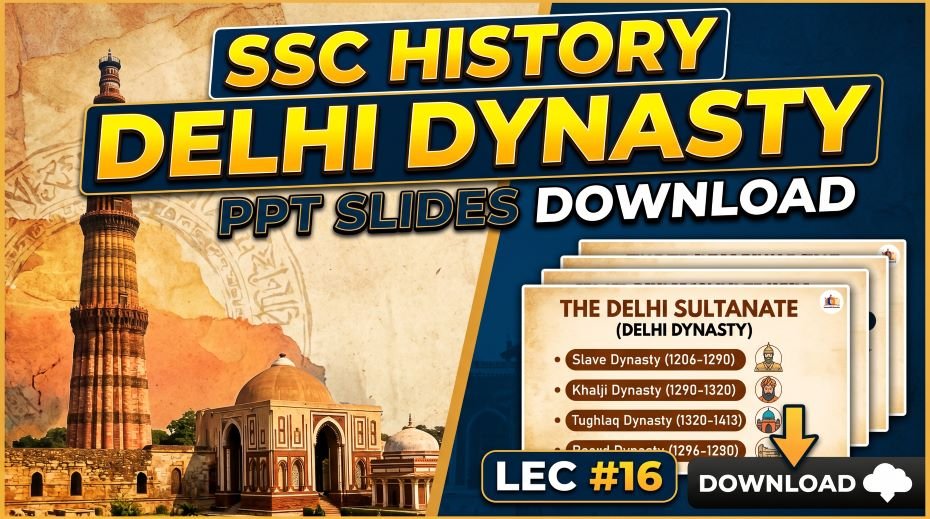
Complete Timeline Table: Delhi Sultanate – All Key Dates
This is the most important timeline in medieval Indian history for SSC purposes. Memorise every sultan, date, and key event – this single table can answer 8–10 SSC questions.
| Year (AD) | Event / Sultan | Dynasty | Key SSC Fact |
| 1206 | Qutbuddin Aibak becomes first Sultan of Delhi – Mamluk (Slave) dynasty founded | Mamluk (Slave) Dynasty | Muhammad Ghori’s general; built Quwwat-ul-Islam mosque and Qutub Minar (started); died in polo accident 1210 |
| 1210 | Iltutmish succeeds Aibak (son-in-law) | Mamluk Dynasty | Completed Qutub Minar; introduced silver tanka and copper jital coins; received investiture from Caliph of Baghdad 1229; nominated Razia as successor |
| 1229 | Caliph of Baghdad grants recognition to Iltutmish | Mamluk Dynasty | First Delhi Sultan to receive formal recognition from the Abbasid Caliph; legitimised the Sultanate |
| 1236–1240 | Razia Sultan – only woman ruler of Delhi Sultanate | Mamluk Dynasty | Nominated by her father Iltutmish; rode elephants and held court without purdah; deposed and killed 1240; Altunia was her husband |
| 1266–1287 | Balban – greatest Mamluk ruler (after Iltutmish) | Mamluk Dynasty | Established absolute monarchy; ‘blood and iron’ policy; introduced Persian court ceremonies (Sijda – prostration; Paibos – kissing feet); Diwan-i-Arz (military dept); secret spy network; destroyed the Forty – Chalisa |
| 1290 | Jalal-ud-din Khilji founds Khilji dynasty | Khilji Dynasty | 70-year-old founder; too lenient; assassinated by his nephew Alauddin Khilji in 1296 |
| 1296–1316 | Alauddin Khilji – greatest Khilji and most powerful Delhi Sultan | Khilji Dynasty | Conquered Gujarat (1297), Rajasthan (Ranthambore 1301, Chittor 1303), Malwa (1305), Devagiri (1296, 1307), Warangal (1309), Madurai (1311); Market reforms; Revenue reforms; Revenue 50% of produce; Malik Kafur as general |
| 1297 | Alauddin Khilji annexes Gujarat; acquires Malik Kafur | Khilji Dynasty | Malik Kafur (also called Hazar Dinari) was acquired as a slave in Gujarat and became Alauddin’s most trusted general for South India campaigns |
| 1303 | Alauddin Khilji’s siege of Chittor | Khilji Dynasty | Rani Padmini (Padmavati) legend associated with this siege; Chittor taken after long siege; Rajput Jauhar (mass self-immolation) tradition |
| 1305 | Alauddin conquers Malwa | Khilji Dynasty | Completes conquest of all major North Indian Rajput kingdoms |
| 1306–1311 | Malik Kafur’s South India campaigns | Khilji Dynasty | Attacked Devagiri, Warangal (Kakatiya), Dwarasamudra (Hoysala), and Madurai (Pandya); brought enormous wealth to Delhi; destroyed many South Indian temples |
| 1316 | Death of Alauddin Khilji; Malik Kafur becomes regent briefly | Khilji Dynasty | Alauddin died of illness; Malik Kafur seized control but was killed within weeks; Khilji dynasty rapidly declined |
| 1320 | Ghiyasuddin Tughlaq overthrows last Khilji; Tughlaq dynasty begins | Tughlaq Dynasty | First Tughlaq sultan; built Tughlaqabad Fort (Delhi); died in mysterious circumstances 1325 |
| 1325–1351 | Muhammad Bin Tughlaq – most controversial Delhi Sultan | Tughlaq Dynasty | Transfer of capital Daulatabad; token currency experiment; Khorasan expedition (planned but not executed); raised taxes in Doab; many rebellions; Ibn Battuta visited; ‘wisest fool’ |
| 1329 | Muhammad Bin Tughlaq introduces token currency | Tughlaq Dynasty | Copper/brass coins with the face value of silver; massive forgery; economic disaster; had to be withdrawn |
| ~1330 | Muhammad Bin Tughlaq transfers capital from Delhi to Daulatabad | Tughlaq Dynasty | Ordered entire Delhi population to move to Daulatabad (Maharashtra); later reversed; great human suffering |
| 1333 | Ibn Battuta arrives in India | Tughlaq Dynasty | Moroccan traveller; appointed as Qazi (judge) of Delhi by Muhammad Bin Tughlaq; wrote Rihla (his travel memoir) |
| 1336 | Vijayanagara Empire founded (reaction to Tughlaq expansion) | (South India) | Harihara I and Bukka I founded Vijayanagara as Hindu resistance to Tughlaq expansion in the Deccan |
| 1347 | Bahmani Sultanate established – Deccan breakaway | (Deccan) | Zafar Khan (Alauddin Hasan Bahman Shah) – rebels against Muhammad Bin Tughlaq; establishes Bahmani Sultanate |
| 1351–1388 | Firoz Shah Tughlaq – the welfare sultan | Tughlaq Dynasty | Abolished torture and mutilation; built canals, hospitals, madrasas; founded cities (Firozabad, Fatehabad, Jaunpur, Hissar, Firozpur); collected Jizya from Brahmins; founded Firoz Shah Kotla (Delhi) |
| 1388–1414 | Rapid decline – multiple weak Tughlaq rulers | Tughlaq Dynasty | Ghiyasuddin Tughlaq II, Abu Bakr, Muhammad Shah, Mahmud Shah – all weak |
| 1398 | Timur (Tamerlane) invades and sacks Delhi | External invasion | Timur’s army killed tens of thousands; Delhi completely looted; Sultanate never recovered fully; Mahmud Shah Tughlaq fled |
| 1414 | Khizr Khan founds Sayyid dynasty | Sayyid Dynasty | Governor of Punjab; claimed descent from Prophet Muhammad; established Sayyid dynasty after Tughlaq collapse |
| 1414–1451 | Sayyid Dynasty – four weak rulers | Sayyid Dynasty | Khizr Khan, Mubarak Shah, Muhammad Shah, Alam Shah; all weak; controlled little more than Delhi |
| 1451 | Bahlul Lodi overthrows last Sayyid; founds Lodi dynasty | Lodi Dynasty | First Afghan (Pashtun) dynasty of Delhi Sultanate; Bahlul Lodi treated nobles as equals unlike previous sultans |
| 1489–1517 | Sikandar Lodi – greatest Lodi sultan | Lodi Dynasty | Founded Agra city (1504); shifted capital from Delhi to Agra; patron of music and literature; strict in religion – ordered temple destruction; Amir Khusrau’s Bhanumati published under his name |
| 1504 | Sikandar Lodi founds the city of Agra | Lodi Dynasty | Agra founded in 1504 AD by Sikandar Lodi; shifted capital from Delhi to Agra – very important SSC fact |
| 1517–1526 | Ibrahim Lodi – last Delhi Sultan | Lodi Dynasty | Autocratic; alienated Afghan nobles; Daulat Khan Lodi (governor of Punjab) invited Babur to invade |
| 1526 | First Battle of Panipat – Babur defeats Ibrahim Lodi | End of Delhi Sultanate | 21 April 1526; Babur used artillery (gun powder) for first time in India; Ibrahim Lodi killed; Delhi Sultanate ends; Mughal Empire begins |
Overview: The Five Dynasties of the Delhi Sultanate
| Dynasty | Period | No. of Rulers | Founder | Last Ruler | Capital | Key Rulers |
| Mamluk (Slave) | 1206–1290 | 9 sultans | Qutbuddin Aibak | Muiz-ud-din Qaiqabad | Delhi | Qutbuddin Aibak, Iltutmish, Razia Sultan, Balban |
| Khilji | 1290–1320 | 3 sultans | Jalal-ud-din Khilji | Qutbuddin Mubarak Shah | Delhi | Alauddin Khilji |
| Tughlaq | 1320–1414 | 8 sultans | Ghiyasuddin Tughlaq | Mahmud Shah Tughlaq | Delhi | Muhammad Bin Tughlaq, Firoz Shah Tughlaq |
| Sayyid | 1414–1451 | 4 sultans | Khizr Khan | Alam Shah | Delhi | Mubarak Shah (somewhat notable) |
| Lodi | 1451–1526 | 3 sultans | Bahlul Lodi | Ibrahim Lodi | Delhi → Agra | Sikandar Lodi, Ibrahim Lodi |
Part I: Mamluk (Slave) Dynasty (1206–1290 AD)
The Mamluk dynasty – also called the Slave dynasty because its first three rulers (Qutbuddin Aibak, Iltutmish, and Balban) were former military slaves (Mamluk) – was the founding dynasty of the Delhi Sultanate. ‘Mamluk’ is the Arabic word for ‘owned’ or ‘slave’ – these were military slaves of Turkish origin who rose through military ability to hold the highest positions.
Qutbuddin Aibak (1206–1210 AD) – Founder of the Delhi Sultanate
| Aspect | Detail |
| Background | Turkish slave purchased by Muhammad Ghori; rose to become his most trusted Indian general and viceroy |
| Dynasty | Founded the Mamluk (Slave) dynasty; first Sultan of Delhi |
| Year of Sultanate | 1206 AD – after Muhammad Ghori’s assassination |
| Capital | Lahore (not Delhi initially; Delhi was used but Lahore was more administrative centre under Aibak) |
| Title | Called ‘Lakh Baksh’ (giver of lakhs) for his extreme generosity in giving gifts; also called ‘Hatem of Hindustan’ |
| Architecture Begun | Started construction of: Quwwat-ul-Islam mosque (Delhi) – first mosque built in India; Qutub Minar (foundation and first storey); Adhai Din Ka Jhonpra (mosque at Ajmer) |
| Quwwat-ul-Islam Mosque | Meaning ‘Might of Islam’; built using material from demolished Hindu and Jain temples; first mosque in India; at the Qutub Minar complex in Mehrauli, Delhi |
| Death | Died in 1210 AD in a polo (chaugan) accident at Lahore – fell from his horse while playing polo |
| Succession | Succeeded by his son-in-law Iltutmish (Shamsuddin Iltutmish) |
| SSC Relevance | ‘Who founded the Delhi Sultanate?’ = Qutbuddin Aibak (1206 AD). ‘What was his title?’ = Lakh Baksh. ‘How did he die?’ = polo accident. ‘What did he build?’ = Quwwat-ul-Islam mosque + started Qutub Minar |
Iltutmish (1210–1236 AD) – The Real Organiser of the Sultanate
| Aspect | Detail |
| Background | Son-in-law of Qutbuddin Aibak; Turkish slave who rose to become Sultan |
| Achievement | The true organiser and consolidator of the Delhi Sultanate; transformed it from a loose military occupation into a functioning empire |
| Architecture | Completed the Qutub Minar to its full height (5 storeys); added the Iltutmish Tomb within the Qutub complex; added the Hauz-i-Shamsi (reservoir) |
| Coins | Introduced the standard silver coin called the Tanka (first standardised silver coin of the Sultanate) and the copper coin Jital – the basis of the Delhi Sultanate monetary system |
| Caliph Recognition | In 1229 AD, received investiture (manshur) from the Abbasid Caliph of Baghdad – the first Delhi Sultan to receive formal Caliphal recognition; this gave the Sultanate legitimacy in the Islamic world |
| Iqta System | Developed and formalised the Iqta system – the assignment of revenue rights over territories to military officers and nobles in lieu of cash salaries |
| The Forty (Chalisa) | Created and relied on a group of 40 powerful Turkish noble-slaves called the Chalisa (The Forty); they later became too powerful and were destroyed by Balban |
| Nominated Razia | Iltutmish broke with tradition by nominating his daughter Razia as his successor – a remarkable decision |
| Death | Died 1236 AD |
| SSC Relevance | ‘Who completed the Qutub Minar?’ = Iltutmish. ‘Who introduced the Tanka coin?’ = Iltutmish. ‘First Sultan recognised by Caliph?’ = Iltutmish (1229 AD). ‘Who nominated Razia?’ = Iltutmish |
Razia Sultan (1236–1240 AD) – The Only Woman Sultan of Delhi
| Aspect | Detail |
| Background | Daughter of Iltutmish; nominated by him as successor – breaking with the tradition of male succession |
| Significance | The only woman to sit on the throne of the Delhi Sultanate; one of the very few women rulers in medieval Indian history |
| Distinctive Actions | Appeared in public without purdah (veil); held open court; rode elephants in public; wore a plain turban and tunic instead of women’s dress – these were seen as violations of Islamic convention by the Turkish nobles |
| Political Problem | Turkish nobles (especially the Chalisa group) resented being ruled by a woman; they repeatedly rebelled |
| Altunia Connection | Married Altunia (governor of Bhatinda) in an attempt to stabilise her position; he had initially been one of the rebels against her |
| Death | 1240 AD – deposed by Turkish nobles; she and Altunia were killed |
| Brother Successors | After Razia, her brothers Bahram Shah and Masud Shah ruled briefly but were also dominated by the Turkish nobles |
| SSC Relevance | ‘Only woman ruler of Delhi Sultanate’ = Razia Sultan. ‘Who nominated her?’ = Iltutmish. ‘Who was her husband?’ = Altunia. All three facts are individually tested |
Balban (1266–1287 AD) – The Iron Sultan
| Aspect | Detail |
| Full Name | Ghiyasuddin Balban; originally a Turkish slave named Bahauddin |
| Background | One of the original Forty nobles (Chalisa) under Iltutmish; rose to become the most powerful noble before becoming Sultan himself in 1266 |
| Policy Philosophy | ‘Blood and Iron’ – absolute monarchy enforced through uncompromising severity; he believed the Sultan must project an image of divine-like power and majesty |
| Theory of Kingship | Believed the Sultan was the shadow of God (Zill-i-Ilahi) on earth; monarchy was sacred and absolute; no noble should feel equal to or able to challenge the Sultan |
| Destroyed the Forty | Balban systematically eliminated the Chalisa (the forty powerful Turkish nobles) who had dominated the Sultanate since Iltutmish’s time; restored royal authority |
| Persian Court Ceremonies | Introduced two Persian court practices: Sijda (prostration – bowing to touch forehead to the ground before the Sultan) and Paibos (kissing the Sultan’s feet); these were highly controversial as some Muslim scholars considered prostration before any human being un-Islamic |
| Diwan-i-Arz | Reorganised the military through the Diwan-i-Arz (Department of Military Affairs); took personal control of the army |
| Spy Network | Created an elaborate spy network (barids) in every province to report directly to him – nothing in the empire escaped his notice |
| Treatment of Nobles | Gave no concessions to nobles; punished disobedience with extreme severity; maintained ceremonial distance – never laughed or joked in public |
| Mongol Threat | Successfully defended the Sultanate against repeated Mongol invasions from the northwest – this was his greatest political and military challenge |
| Frontier Policy | Strengthened the northwest frontier against the Mongols; appointed his sons as governors of frontier provinces |
| Death | 1287 AD; the Delhi Sultanate’s power weakened significantly after his death without a strong successor |
| SSC Relevance | Balban = Blood and Iron = destroyed the Forty (Chalisa) = Sijda and Paibos = Zill-i-Ilahi = Diwan-i-Arz. All five concepts are tested |
Qutub Minar Complex – Complete Reference
| Aspect | Detail |
| Location | Mehrauli, South Delhi |
| UNESCO Status | UNESCO World Heritage Site since 1993 |
| Qutub Minar | Started by Qutbuddin Aibak (~1193 AD – only the first storey); completed by Iltutmish (added 3 more storeys); damaged by lightning; repaired by Firoz Shah Tughlaq (added two final storeys); total 5 storeys, 72.5 metres tall; named after the Sufi saint Qutb-ud-din Bakhtiyar Kaki of Delhi |
| Quwwat-ul-Islam Mosque | Meaning ‘Power of Islam’; first mosque built in India; built by Qutbuddin Aibak using materials from 27 demolished Hindu and Jain temples; the carvings on the pillars show the original Hindu/Jain origin |
| Iltutmish Tomb | Tomb of Sultan Iltutmish within the complex; first Islamic tomb built in India |
| Iron Pillar | The ancient Iron Pillar (Gupta period, ~4th–5th century AD) stands in the courtyard of Quwwat-ul-Islam mosque; famous for being rust-free for 1,600+ years |
| Alai Minar | Alauddin Khilji started construction of Alai Minar – intended to be twice the height of Qutub Minar; never completed; only the base (which is as wide as the entire Qutub Minar) was built when he died |
| Alai Darwaza | Built by Alauddin Khilji (1311 AD) – the southern gateway to the Quwwat-ul-Islam mosque; one of the finest examples of early Indo-Islamic architecture; first building in India to use true arch and true dome |
| SSC Relevance | Who started Qutub Minar? = Qutbuddin Aibak. Who completed it? = Iltutmish. Who repaired it? = Firoz Shah Tughlaq. Height? = 72.5 metres. UNESCO? = 1993. Alai Darwaza = Alauddin Khilji = first true arch and dome in India |
Part II: Khilji Dynasty (1290–1320 AD)
The Khilji dynasty lasted only 30 years but produced the most powerful ruler in Delhi Sultanate history – Alauddin Khilji. The Khilji rulers were of Afghan-Turkish origin, not pure Turkish like the Mamluks, which made them viewed with some suspicion by the Turkish nobility.
Jalal-ud-din Khilji (1290–1296 AD)
- Jalal-ud-din Khilji was approximately 70 years old when he founded the Khilji dynasty – the oldest founder of any Delhi dynasty.
- He was known for his lenient and forgiving nature – he pardoned rebels and criminals which earned him respect but also weakened his authority.
- His most controversial act of leniency: when Sidi Maula (a popular Sufi saint) was accused of conspiring against him, he had him executed – but then wept over the death.
- He launched a successful raid on Devagiri (Maharashtra) in 1294 AD, led by his nephew Alauddin Khilji – the enormous loot from this raid gave Alauddin the resources to plan his coup.
- He was assassinated in 1296 AD by his own nephew Alauddin Khilji, whom he had loved and promoted.
SSC Exam Tip: Jalal-ud-din Khilji = 70 years old = oldest founder = lenient = killed by nephew Alauddin. These facts appear in ‘identify the first Khilji Sultan’ type questions.
Alauddin Khilji (1296–1316 AD) – The Most Powerful Delhi Sultan
Alauddin Khilji is the greatest and most powerful ruler of the Delhi Sultanate – a military genius, an innovative economic reformer, and an iron-fisted autocrat who came closer than any other ruler to making the entire Indian subcontinent submit to a single political authority.
| Aspect | Detail |
| How He Became Sultan | Murdered his uncle Jalal-ud-din Khilji at Kara (near Allahabad) in 1296; marched to Delhi with his army and declared himself Sultan |
| Theory of Kingship | Four ordinances to prevent future rebellion: (1) confiscate wealth of the nobility – no noble wealthy enough to rebel; (2) establish an efficient spy network; (3) prohibit social gatherings among nobles; (4) prohibit wine and narcotics |
| Mongol Invasions Defeated | Successfully defeated at least 5–6 major Mongol invasions of India – his greatest political achievement; Mongol leaders Kadar, Saldi, Kebek, and others were defeated; 1297 AD battle near Delhi; 1299 AD battle near Kili |
| Military Reforms | Maintained a standing army paid directly from the royal treasury (not through Iqta grants); introduced Dagh system (branding of horses) and Chehra system (physical descriptions of soldiers) to prevent fraud |
| Revenue Reforms | Set land revenue at 50% of agricultural produce (previously it had been lower); abolished additional cesses and levied only the main revenue; assessed land directly through imperial officials |
| Market Reforms (Shahana-i-Mandi) | The most innovative policy: established 4 markets in Delhi – grain market, cloth market, cattle market, and general commodities market; fixed prices for all goods; appointed market controllers (Shahna-i-Mandi) and secret intelligence officers; severe punishment for overcharging |
| Reason for Market Reforms | To maintain a large standing army at low cost – by keeping the prices of goods low, he could pay soldiers lower wages while they could still afford basic necessities |
| Military Conquests – North | Gujarat (1297) – Raja Karna defeated; Ranthambore Fort (1301) – taken from Hammira Deva; Chittor (1303) – taken from Rawal Ratan Singh (Padmini legend); Malwa (1305) – Mahlak Deva defeated; Siwana (1308); Jalor (1311) |
| Military Conquests – South | Devagiri (1296, 1307) – Ramachandra Yadava; Warangal (1309) – Prataparudra II (Kakatiya); Dwarasamudra (1311) – Veera Ballala III (Hoysala); Madurai (1311) – Vira Pandya (Pandya) |
| Malik Kafur | Alauddin’s most brilliant general for South India campaigns; acquired in Gujarat campaign as a slave; called ‘Hazar Dinari’ (worth a thousand dinars); led the campaigns to Warangal, Dwarasamudra, and Madurai |
| Amir Khusrau | Greatest poet in Alauddin’s court; called ‘Parrot of India’ (Tuti-i-Hind); wrote Khazain-ul-Futuh (Alauddin’s victories); invented the Sitar musical instrument; father of qawwali tradition; wrote in Persian and Hindi; his tomb is at Nizamuddin, Delhi |
| Architecture | Alai Darwaza (1311) – finest early Indo-Islamic gateway; Siri Fort (second city of Delhi); started Alai Minar (never completed); built a new palace complex |
| Death | Died January 1316 AD of illness; Malik Kafur briefly seized power but was killed within weeks; rapid Khilji decline followed |
SSC Exam Tip – Eight Must-Know Alauddin Facts: (1) Killed uncle Jalal-ud-din = became Sultan. (2) Defeated Mongol invasions 5–6 times. (3) Market reforms – 4 markets, fixed prices, Shahna-i-Mandi. (4) Revenue = 50% of produce. (5) Dagh and Chehra system in army. (6) Malik Kafur = general for South India. (7) Amir Khusrau = court poet = Tuti-i-Hind = sitar. (8) Alai Darwaza = first true arch and dome in India. All eight generate separate SSC questions.
Alauddin Khilji’s Market Reforms – Detailed Table
| Market / Category | Items Sold | Controller | Key Rule |
| Shahana-i-Mandi (Grain Market) | All grain (wheat, rice, barley, pulses) | Shahana (market controller) + secret spies | Strict fixed prices; no overcharging; defaulters severely punished (cutting off a part of the body) |
| Sarai-i-Adl (Cloth Market) | All cloth and textiles | Controller + spies | Fixed prices for all cloth; merchants had to display prices openly |
| Mandi for Cattle and Horses | Horses, cattle, elephants for the army | Separate controller | Fixed prices for army supply animals; strict quality standards |
| Mandi for General Commodities | Spices, dry fruits, oils, lamps, and other goods | Separate controller | Fixed prices; any merchant caught overcharging was punished |
SSC Exam Tip: Alauddin’s market reform = Shahana-i-Mandi = four markets with fixed prices = to maintain cheap army. The ‘Shahana-i-Mandi’ term is frequently tested. The PURPOSE (cheap army, not consumer welfare) is tested as a conceptual question.
Amir Khusrau – The Most Important Literary Figure of the Delhi Sultanate
| Aspect | Detail |
| Full Name | Abul Hasan Yaminuddin Khusrau; known as Amir Khusrau Dehlawi |
| Title | Tuti-i-Hind (Parrot of India) – given for his poetic brilliance |
| Period | 1253–1325 AD – served seven Delhi sultans from Balban to Ghiyasuddin Tughlaq |
| Language | Wrote in both Persian and Hindi/Hindavi; pioneer of Hindavi (early Hindi) literature |
| Court of Alauddin Khilji | His most famous patron; wrote Khazain-ul-Futuh (Treasures of Victories) about Alauddin’s conquests; also Ashiqa (a love poem); Miftah-ul-Futuh (about Jalal-ud-din’s campaigns) |
| Major Persian Works | Khamsa (five masnawis or long poems): Matla-ul-Anwar, Shirin-Khusrau, Laila-Majnun, Ayina-i-Sikandari, Hasht Bihisht |
| Music | Credited with inventing the Sitar (by modifying the Persian instrument veena/rabab); credited as the father of the Qawwali devotional music tradition |
| Sufi Connection | Was a devoted disciple of the Sufi saint Nizamuddin Auliya; his dargah (tomb) is adjacent to Nizamuddin’s dargah in Delhi |
| Historical Works | Tarikh-i-Alai (also called Khazain-ul-Futuh); Miftah-ul-Futuh; Tughlaqnama (about Ghiyasuddin Tughlaq) |
| SSC Relevance | Who was Tuti-i-Hind? = Amir Khusrau. Who invented the sitar? = Amir Khusrau. Who wrote Khazain-ul-Futuh? = Amir Khusrau. All three are very frequently tested |
Part III: Tughlaq Dynasty (1320–1414 AD)
The Tughlaq dynasty produced three of the most contrasting rulers in Indian history – Ghiyasuddin Tughlaq (the capable founder), Muhammad Bin Tughlaq (the tragic visionary), and Firoz Shah Tughlaq (the welfare-oriented builder). The dynasty lasted 94 years but declined rapidly after Timur’s invasion of 1398 AD.
Ghiyasuddin Tughlaq (1320–1325 AD) – The Founder
- Ghiyasuddin Tughlaq (also spelled Ghazi Malik) was a capable military commander who overthrew the last Khilji ruler Qutbuddin Mubarak Shah in 1320 AD.
- He was the son of a Turkish noble and a Jat (Hindu) woman – a mixed background unusual among Delhi Sultans.
- He built the imposing Tughlaqabad Fort in Delhi – a massive fortification that became the third city of Delhi.
- He reconquered Bengal which had declared independence under the Khiljis.
- He died in 1325 AD in mysterious circumstances – a wooden pavilion he was watching elephants from collapsed just after Nizamuddin Auliya (the famous Sufi saint) reportedly cursed him. This event led to the famous saying: ‘Hunuz Dilli dur ast’ (Delhi is still far away).
SSC Exam Tip: Ghiyasuddin Tughlaq = built Tughlaqabad Fort = mysterious death = conflict with Nizamuddin Auliya (‘Delhi is still far away’ saying).
Muhammad Bin Tughlaq (1325–1351 AD) – The Tragic Visionary
Muhammad Bin Tughlaq is the most controversial and intellectually fascinating ruler of the entire Delhi Sultanate. Educated, multilingual, curious, and innovative – yet his experiments failed catastrophically and his reign was marked by constant rebellions. Historians have called him ‘the wisest fool’ or ‘an ill-starred idealist’.
| Policy / Experiment | Details | Why It Failed / Result |
| Transfer of Capital from Delhi to Daulatabad (1330) | Ordered the entire population of Delhi to move to Daulatabad (Devagiri, Maharashtra) – about 1,500 km south; purpose: to rule from a more central location and better control the Deccan | The journey caused enormous suffering and death; Daulatabad was far from the traditional supply lines of North India; after a few years, the people were ordered back to Delhi; Delhi lay desolate for years |
| Introduction of Token Currency (1329) | Introduced copper/brass coins with the face value of silver coins; reason: gold and silver shortage; purpose: expand money supply | Ordinary people began forging the coins easily (every goldsmith’s house became a mint, as chroniclers said); genuine coins and forged coins flooded the market; the currency collapsed; had to be withdrawn at great loss to the treasury |
| Khorasan Expedition (planned ~1330) | Planned a massive military expedition to conquer Khorasan (Central Asia) and China; raised a large army and paid them for a year | The plan was eventually abandoned without execution; the financial cost of maintaining the army without a campaign was enormous |
| Raising Revenue in the Doab (1330s) | Increased taxes in the Doab (region between Ganga and Yamuna) at the same time a famine hit the region | Peasants were unable to pay; many fled their lands; Doab region was depopulated; agricultural collapse |
| Qarachil Expedition (~1333) | Sent an army into the Himalayan foothills (Kumaon/Nepal border) to conquer mountain kingdoms | Army decimated by disease, difficult terrain, and guerrilla attacks; very few returned |
| Many Rebellions | 22 rebellions took place during his reign across different parts of the empire | The Delhi Sultanate permanently lost control of the Deccan (Bahmani Kingdom 1347) and South India during his reign |
SSC Exam Tip – Three Muhammad Bin Tughlaq Facts Always Tested: (1) Transfer of capital to Daulatabad. (2) Token currency (copper coins with value of silver). (3) Ibn Battuta visited and wrote Rihla. The question ‘who transferred the capital to Daulatabad?’ = Muhammad Bin Tughlaq is the single most repeated fact about this ruler in SSC papers.
Ibn Battuta – The Most Important Foreign Visitor of the Tughlaq Period
| Aspect | Detail |
| Full Name | Abu Abdullah Muhammad ibn Battuta – a Moroccan (Berber) Muslim traveller and scholar |
| Period in India | 1333–1341 AD – came to India during Muhammad Bin Tughlaq’s reign; spent approximately 8 years in India |
| Position in Delhi | Muhammad Bin Tughlaq appointed him as Qazi (Islamic judge / Chief Justice) of Delhi – a prestigious position; Ibn Battuta served in this role for several years |
| Work Written | Rihla (full title: A Gift to Those Who Contemplate the Wonders of Cities and the Marvels of Travelling) – a massive account of his travels across the Islamic world, Africa, Central Asia, India, and China |
| Key Observations | Described Muhammad Bin Tughlaq as ‘the greatest Muslim king in the world’ – yet also as unpredictable and prone to violence; described the chaos of the capital transfer and token currency |
| Observations of India | Described Delhi as one of the greatest cities in the world; described India’s wealth, social customs, trade, and the Sultan’s court in remarkable detail |
| Later Missions | Muhammad Bin Tughlaq sent him as an ambassador to China (~1342 AD) |
| SSC Relevance | Who wrote Rihla? = Ibn Battuta. Who visited India during Muhammad Bin Tughlaq? = Ibn Battuta. What was his position in Delhi? = Qazi (judge) |
Firoz Shah Tughlaq (1351–1388 AD) – The Welfare Sultan
| Aspect | Detail |
| Succession | Cousin of Muhammad Bin Tughlaq; became Sultan without a succession war |
| Philosophy | Deliberately reversed Muhammad Bin Tughlaq’s harsh policies; emphasis on welfare, justice, and religious orthodoxy |
| Abolished Torture | Abolished all forms of mutilation and torture as punishment – cutting of hands, feet, nose, ears etc. were stopped; a significant humanitarian reform |
| Charitable Works | Built hospitals (Dar-ul-Shifa) and free dispensaries throughout the empire; set up a ‘marriage bureau’ (Diwan-i-Khairat) to provide dowry to orphan girls; created a ‘department of slaves’ maintaining 1,80,000 slaves in various services |
| Irrigation Works | Built 5 major canals: the most famous is the canal from the Yamuna to Hissar – one of the longest canals in medieval India; also canal from Sutlej to Ghaggar; greatly increased agricultural productivity |
| Cities Founded | Founded multiple cities: Firozabad, Fatehabad, Hissar, Jaunpur, and Firozpur (5 cities built by Firoz Shah) |
| Firoz Shah Kotla | Built the city of Firoz Shah Kotla (Firozabad) in Delhi – the fifth city of Delhi; constructed the Firoz Shah Kotla fortress; moved two Ashokan Pillars (from Meerut and Topra) to Delhi |
| Ashokan Pillars Moved | Moved the Delhi-Topra Ashokan Pillar and the Delhi-Meerut Ashokan Pillar to Delhi; these are now in the Firoz Shah Kotla area |
| Jizya on Brahmins | Made all Hindus (including Brahmins who had previously been exempt) pay Jizya – a reversal of the earlier practice |
| Books Written | Futuhat-i-Firozshahi – his autobiography; a rare example of a medieval Indian Sultan writing his own memoir |
| Naval Expedition | Launched an expedition against Jajnagar (Odisha) to recover the idols of the Jagannath Temple that had been moved; unsuccessful |
| Weakness | Military weakness; Bengal and other provinces reasserted independence; no major conquests; relied on diplomacy rather than force |
| Death | 1388 AD; rapid decline of Tughlaq dynasty followed |
| SSC Relevance | Firoz Shah Tughlaq = abolished torture = built 5 canals + 5 cities = Diwan-i-Khairat = moved Ashokan Pillars to Delhi = wrote Futuhat-i-Firozshahi |
Timur’s Invasion (1398 AD) – The Delhi Sultanate’s Near-Death
| Aspect | Detail |
| Invader | Timur (also called Tamerlane or Timur-i-Leng ‘Timur the Lame’) – the Central Asian Turkic-Mongol ruler from Samarkand (modern Uzbekistan) |
| Year | 1398–1399 AD |
| Delhi Sultan | Mahmud Shah Tughlaq (the last Tughlaq Sultan) |
| Battle | Battle of Panipat (1398 AD) – Timur’s forces easily defeated the Delhi army; Mahmud Shah fled |
| Delhi Sack | Delhi was looted for days; tens of thousands of people were killed (contemporary accounts say 100,000 or more); enormous wealth was taken back to Samarkand; artisans and craftsmen were taken captive to build Timur’s capital |
| Aftermath | Delhi lay depopulated and ruined for years after Timur left; famine and pestilence followed; Mahmud Shah Tughlaq returned to a ghost city |
| Political Impact | The Tughlaq Sultanate never recovered from this blow; the Sayyid dynasty (who ruled as nominal successors) had no real power; the invasion accelerated the fragmentation of the Delhi Sultanate into regional kingdoms |
| Why Timur Came | Officially: to wage jihad against the Delhi Sultanate which was not strict enough in enforcing Islam; practically: the enormous wealth of India |
| SSC Relevance | Timur’s invasion = 1398 AD = Mahmud Shah Tughlaq was the Sultan = Delhi looted = Sultanate permanently weakened |
Part IV: Sayyid Dynasty (1414–1451 AD) – The Weakest Delhi Dynasty
| Ruler | Period | Key Fact |
| Khizr Khan | 1414–1421 | Founded the Sayyid dynasty; was governor of Punjab under Timur; claimed descent from Prophet Muhammad; did not use the title ‘Sultan’ – used ‘Rayat-i-Ala’ (exalted standard) instead |
| Mubarak Shah | 1421–1434 | Son of Khizr Khan; used the title ‘Sultan’; attempted to reassert central authority; Yahya Sirhindi wrote Tarikh-i-Mubarak Shahi (history of the Sayyid dynasty) in his reign |
| Muhammad Shah | 1434–1445 | Weak ruler; Lodi nobles (Bahlul Lodi) became increasingly powerful |
| Alam Shah | 1445–1451 | Last Sayyid ruler; abdicated willingly in favour of Bahlul Lodi; retired to Budaun; Sayyid dynasty ends peacefully |
SSC Exam Tip: Sayyid dynasty = weakest Delhi dynasty = 4 rulers = founded by Khizr Khan (claimed Prophet’s descent, used ‘Rayat-i-Ala’ not Sultan) = ended when Alam Shah abdicated to Bahlul Lodi. The founder’s unusual title and peaceful abdication of the last ruler are distinctive testable facts.
Part V: Lodi Dynasty (1451–1526 AD) – The Last Delhi Sultanate
The Lodi dynasty was the first and only Afghan (Pashtun/Pathan) dynasty to rule the Delhi Sultanate. Unlike the Turkish Sultans who treated the nobility as subordinates, the Lodi sultans treated Afghan nobles more as equals (being of the same ethnic background), which created a different political dynamic.
Bahlul Lodi (1451–1489 AD) – The Founder
- Bahlul Lodi (also spelled Bahlol Khan Lodi) was the Afghan chief of the Punjab region who persuaded the last Sayyid ruler Alam Shah to abdicate in 1451 AD.
- He was notable for treating the Afghan nobles as equals rather than as subjects – he sat with them on the same level in court rather than on a raised throne.
- He reconquered Jaunpur (the Sharqi Sultanate) in 1479 AD – reunifying the eastern Gangetic plains with Delhi.
- He expanded the Delhi Sultanate’s effective control and gave it renewed energy after the Sayyid collapse.
SSC Exam Tip: Bahlul Lodi = founder of Lodi dynasty = first Afghan/Pashtun dynasty = treated nobles as equals = conquered Jaunpur 1479.
Sikandar Lodi (1489–1517 AD) – The Greatest Lodi Sultan
| Aspect | Detail |
| Significance | Greatest and most capable of the three Lodi sultans |
| Agra Founded | Founded the city of Agra in 1504 AD – one of the most important cities in Indian history; shifted the capital from Delhi to Agra |
| Administration | Introduced the Gaz-i-Sikandari (Sikandar’s yard) – a new standard unit of measurement for land |
| Music and Literature | Personally fond of music despite being religiously strict in other ways; translated Sanskrit medical texts into Persian; composed Persian poetry under the pen name Gulrukhi |
| Religious Policy | Strictly enforced Islamic law; ordered destruction of Hindu temples in Mathura and other places; imposed Jizya strictly |
| Bengali Hindu Ban | Prohibited Hindus from bathing at the Ganga ghats in some locations; controversial religious policies |
| Poet in Court | Jamali Kamali (real name: Sheikh Fazlullah) was his court poet; the Jamali Kamali mosque and tomb in Delhi is a beautiful Lodi-era monument |
| Death | 1517 AD; succeeded by his son Ibrahim Lodi |
| SSC Relevance | Sikandar Lodi = founded Agra 1504 AD = Gaz-i-Sikandari = pen name Gulrukhi. ‘Who founded Agra?’ = Sikandar Lodi (1504) is one of the most commonly asked SSC questions about the Lodi dynasty |
Ibrahim Lodi (1517–1526 AD) – The Last Delhi Sultan
| Aspect | Detail |
| Character | Autocratic; arrogant; tried to assert absolute royal authority (unlike his father Bahlul who treated nobles as equals); alienated the Afghan nobility |
| Noble Revolt | Daulat Khan Lodi (governor of Punjab) and Alam Khan Lodi (Ibrahim’s uncle) rebelled and invited Babur (ruler of Kabul) to invade India |
| First Battle of Panipat | 21 April 1526 AD – Babur vs Ibrahim Lodi; fought on the plains of Panipat (Haryana) |
| Babur’s Advantage | Babur used field artillery (tofkhana) for the first time in Indian warfare – also used the flanking tactic (tulughma); Indian armies had no answer to gunpowder artillery |
| Ibrahim Lodi’s Disadvantage | Did not have artillery; huge army but undisciplined; many of his nobles were half-hearted due to their rebellion against him |
| Outcome | Ibrahim Lodi was killed in battle – the only Delhi Sultan to die fighting; First Battle of Panipat ended the Delhi Sultanate and began the Mughal Empire |
| Babur’s Assessment | Babur himself praised Ibrahim Lodi’s bravery – ‘He fell as bravely as he lived’ according to Baburnama |
| SSC Relevance | First Battle of Panipat = 21 April 1526 = Babur vs Ibrahim Lodi = Ibrahim killed = Babur won using artillery = Delhi Sultanate ends = Mughal Empire begins |
Part VI: Delhi Sultanate Administration
The Delhi Sultanate developed a comprehensive administrative system blending Islamic concepts with Indian administrative traditions.
Central Administration
| Department / Post | Name | Function |
| Head of State | Sultan | Absolute monarch; head of all executive, legislative, and judicial functions; also commander-in-chief |
| Prime Minister | Wazir / Naib-i-Mamlikat | Chief executive officer; head of civil administration; managed the treasury |
| Finance Department | Diwan-i-Wizarat | Managed revenue collection, expenditure, treasury; headed by the Wazir |
| Military Department | Diwan-i-Arz | Managed military affairs; recruitment, pay, organisation of the army; headed by Ariz-i-Mamalik |
| Foreign Affairs | Diwan-i-Risalat | Managed diplomatic correspondence and foreign affairs |
| Royal Correspondence | Diwan-i-Insha | Drafted royal letters, farman (orders), and managed state correspondence; headed by Dabir-i-Khas |
| Judicial | Qazi-ul-Quzat (Chief Justice) | Highest judicial officer; interpreted Islamic law; both criminal and civil cases |
| Religious Endowments | Sadr-us-Sudur | Managed religious grants, charitable endowments, mosques, and madrasas |
| Intelligence / Spy Network | Barid-i-Mumalik | Chief of intelligence; managed network of spies (Barids) who reported on conditions throughout the empire |
| Postal System | Dak Chowkis + Horse Relay | Organised postal relay system for rapid communication across the empire |
Provincial Administration
| Level | Name | Official in Charge | Function |
| Province | Iqta (or Wilayat) | Muqti or Wali (Iqtadar) | Governor of a province; responsible for revenue collection and military defence |
| District | Shiq | Shiqdar | District officer; maintained law and order; collected revenue |
| Sub-district | Pargana | Amil + Munsif + Karkun | Revenue assessment and collection at sub-district level |
| Village | Gram | Muqaddam (headman) + Patwari (record-keeper) | Basic administrative unit; maintained village records; collected village-level taxes |
The Iqta System – The Defining Administrative Feature
- The Iqta system was the most important administrative and economic innovation of the Delhi Sultanate. An Iqta was the assignment of the revenue of a particular territory to a military officer or noble (called the Muqti or Iqtadar) in lieu of cash salary.
- The Iqtadar was responsible for: collecting revenue from his Iqta territory, maintaining a specified number of troops (horses, cavalry) ready for the Sultan, defending his territory, and remitting the surplus revenue to the central treasury.
- Iqtas were NOT hereditary – they were transferable and revocable; the Sultan could and did transfer Iqtadars from one Iqta to another to prevent them from building a permanent local power base.
- The Iqta system solved the financial problem of paying a large military force across a vast empire without a sophisticated monetary economy – but it also created the risk of powerful Iqtadars becoming de facto independent rulers.
- Alauddin Khilji disrupted the Iqta system by paying his army directly in cash from the central treasury – possible because of his market reforms keeping prices low.
SSC Exam Tip: Iqta system = revenue assignment to military officers (Muqti/Iqtadar) in lieu of salary = NOT hereditary = defining feature of Delhi Sultanate administration. The question ‘who was an Iqtadar?’ and ‘what is an Iqta?’ are standard SSC administrative questions.
Part VII: Delhi Sultanate Architecture – Indo-Islamic Style
The Delhi Sultanate period saw the systematic development of the Indo-Islamic architectural style – a fusion of Islamic structural forms (arch, dome, minaret, calligraphic decoration) with Indian craftsmanship, decorative elements, and building traditions.
Key Architectural Features Introduced During Delhi Sultanate
| Feature | Description | First Use in India |
| True Arch | A structural arch using wedge-shaped stones (voussoirs) that can bear weight above it – unlike the Indian corbelled arch which is decorative only | Alai Darwaza (1311 AD) by Alauddin Khilji is considered the first major use of the true arch in India |
| True Dome | A hemispherical roof built using radially arranged stones meeting at a keystone – distributes weight efficiently | Also introduced systematically in the Alai Darwaza and subsequent Tughlaq-Lodi architecture |
| Minaret | Tall slender tower from which the call to prayer (Azan) is given; also used as a decorative element | Qutub Minar (started by Qutbuddin Aibak, 1193 AD) is the first and greatest example in India |
| Arabesque / Calligraphy | Geometric and floral patterns + inscriptions from the Quran as primary decoration on walls and domes | Used from Quwwat-ul-Islam mosque (1193 AD) onwards |
| Screen Wall (Jali) | Perforated stone or marble screens allowing ventilation while providing privacy; intricate geometric patterns | Used from early Mamluk period; reached greatest expression in Mughal period |
| Rubble Masonry | Early Sultanate buildings (Tughlaq period especially) used rough stone rubble masonry with lime mortar – strong but plain | Tughlaqabad Fort is the best example; gave Tughlaq architecture its characteristic strength and severity |
Major Delhi Sultanate Monuments
| Monument | Builder | Period | Location | Key Features / SSC Fact |
| Quwwat-ul-Islam Mosque | Qutbuddin Aibak | 1193 AD | Mehrauli, Delhi | First mosque built in India; uses material from 27 demolished temples; UNESCO Complex |
| Qutub Minar | Started: Aibak; Completed: Iltutmish; Repaired: Firoz Shah Tughlaq | ~1193–1368 AD | Mehrauli, Delhi | 72.5 metres; 5 storeys; UNESCO 1993; tallest brick minaret in world |
| Alai Darwaza | Alauddin Khilji | 1311 AD | Qutub Complex, Delhi | First true arch and dome in India; finest early Indo-Islamic gateway |
| Tomb of Iltutmish | Iltutmish | 1235 AD | Qutub Complex, Delhi | First Islamic tomb in India; interior decorated with Quranic calligraphy |
| Siri Fort | Alauddin Khilji | ~1303 AD | Delhi | Second city of Delhi; built after first Mongol attack on Delhi in 1299 AD |
| Tughlaqabad Fort | Ghiyasuddin Tughlaq | ~1321 AD | Delhi | Third city of Delhi; massive rubble masonry walls; Ghiyasuddin’s tomb also here |
| Adilabad Fort | Muhammad Bin Tughlaq | ~1325 AD | Delhi | Extension of Tughlaqabad; massive scale |
| Firoz Shah Kotla | Firoz Shah Tughlaq | 1354 AD | Delhi | Fifth city of Delhi; Ashokan Pillar moved here; ruins still visible; famous for djinn stories in popular culture |
| Moth ki Masjid | Built by Sikandar Lodi’s minister Miyan Bua | 1505 AD | Delhi | Fine example of Lodi architecture – octagonal turrets, decorated spandrels |
| Lodi Gardens Tombs | Various Lodi rulers and nobles | 1450–1526 AD | Lodi Gardens, Delhi | Tombs of Sayyid and Lodi rulers in a beautiful garden setting; double-domed structures; precursor to Mughal tomb architecture |
SSC Exam Tip: Quwwat-ul-Islam = first mosque in India = Aibak. Qutub Minar = Aibak started, Iltutmish completed, Firoz repaired = 72.5m. Alai Darwaza = Alauddin Khilji = first true arch in India. Firoz Shah Kotla = Firoz Shah Tughlaq = 5th city of Delhi = Ashokan Pillar moved there. All four are frequently tested.
Part VIII: The Sufis and Delhi Sultanate Cultural Life
The Sufi movement was the most important cultural phenomenon of the Delhi Sultanate period. Sufi saints played a crucial role in making Islam accessible to ordinary Indians, facilitating cultural synthesis, and challenging the rigid orthodoxy of the court.
Major Sufi Orders (Silsilas) in India
| Sufi Order (Silsila) | Founder in India | Key Saints | Characteristics / SSC Fact |
| Chishti | Khwaja Moinuddin Chishti (came to India ~1192 AD) | Moinuddin Chishti (Ajmer); Qutb-ud-din Bakhtiyar Kaki (Delhi); Fariduddin Ganj-i-Shakar (Punjab); Nizamuddin Auliya (Delhi); Nasiruddin Chiragh Dehlavi | Most popular Sufi order in India; believed in love, tolerance, music (Sama); Moinuddin Chishti’s dargah at Ajmer is one of India’s most visited shrines |
| Suhrawardi | Bahauddin Zakariya (came ~13th century AD) | Bahauddin Zakariya (Multan); Sheikh Rukn-ud-din Abul Fath | Active primarily in Punjab and Sindh; more accepting of state patronage than Chishti |
| Qadiri | Shah Nimatullah (15th century) | Shah Nimatullah; Miyan Mir (Lahore) | Less prominent in early Sultanate period; more important in Mughal era |
| Naqshbandi | Khwaja Baqi Billah (17th century) | Khwaja Baqi Billah; Sheikh Ahmad Sirhindi | Most prominent during Mughal era; Sheikh Ahmad Sirhindi was influential in Aurangzeb’s orthodoxy |
SSC Exam Tip: Chishti order = most popular in India = Moinuddin Chishti (Ajmer) = Nizamuddin Auliya (Delhi) = Amir Khusrau was disciple of Nizamuddin. Moinuddin Chishti’s dargah at Ajmer = most visited Sufi shrine in India. These facts connect SSC History and Religious Culture questions.
Important Sufi Saints for SSC
| Saint | Order | Location | Period | Key SSC Fact |
| Khwaja Moinuddin Chishti | Chishti | Ajmer, Rajasthan | ~1141–1236 AD | Founder of Chishti order in India; his dargah at Ajmer (Dargah Sharif) is the most famous shrine in India; called ‘Gharib Nawaz’ (friend of the poor) |
| Qutb-ud-din Bakhtiyar Kaki | Chishti | Delhi | ~1173–1235 AD | Disciple of Moinuddin Chishti; the Qutub Minar in Delhi is named after him |
| Farid-ud-din Ganj-i-Shakar (Baba Farid) | Chishti | Pakpattan, Punjab (Pakistan) | ~1173–1265 AD | Disciples included Nizamuddin Auliya; his poetry in Punjabi was included in the Guru Granth Sahib by Guru Arjan Dev – unique Hindu-Muslim-Sikh connection |
| Nizamuddin Auliya | Chishti | Delhi | ~1238–1325 AD | Most beloved Sufi saint of Delhi; his dargah at Nizamuddin is one of Delhi’s most visited religious sites; had a famous conflict with Sultan Ghiyasuddin Tughlaq; Amir Khusrau was his devoted disciple |
| Bahauddin Zakariya | Suhrawardi | Multan, Pakistan | ~1170–1262 AD | Founder of Suhrawardi order in India; based in Multan |
Part IX: High-Frequency SSC MCQs – Delhi Sultanate Chapter
These 45 questions are the most consistently repeated MCQs from this chapter across all SSC exams.
| Question | Correct Answer | SSC Exam Reference |
| Who founded the Delhi Sultanate and in which year? | Qutbuddin Aibak (1206 AD) – founded the Mamluk (Slave) dynasty | SSC CGL 2014–2023 (appears every exam) |
| What was Qutbuddin Aibak’s title and why? | Lakh Baksh (giver of lakhs) – for his extreme generosity in giving gifts | SSC CGL 2017, SSC CHSL 2019 |
| How did Qutbuddin Aibak die? | In a polo (chaugan) accident at Lahore in 1210 AD | SSC CGL 2018, SSC CHSL 2020 |
| Who completed the Qutub Minar? | Iltutmish (Shamsuddin Iltutmish) | SSC CGL 2016, 2019, 2022 |
| What coin did Iltutmish introduce? | Silver Tanka (and copper Jital) – first standardised coins of the Delhi Sultanate | SSC CGL 2017, SSC CHSL 2019 |
| Who was the first Delhi Sultan recognised by the Caliph of Baghdad? | Iltutmish (1229 AD) | SSC CHSL 2019, SSC MTS 2021 |
| Who was Razia Sultan? | Only woman ruler of the Delhi Sultanate; daughter of Iltutmish; 1236–1240 AD | SSC CGL 2015–2022 (repeated) |
| Who was Razia Sultan’s husband? | Altunia (governor of Bhatinda) | SSC CHSL 2020, SSC MTS 2022 |
| Balban’s policy is described by which phrase? | ‘Blood and Iron’ – absolute rule through uncompromising severity | SSC CGL 2018, SSC CHSL 2021 |
| What were Sijda and Paibos introduced by Balban? | Sijda = prostration before Sultan; Paibos = kissing the Sultan’s feet – Persian court ceremonies | SSC CGL 2019, SSC CHSL 2020 |
| Who was the ‘Chalisa’ and who destroyed it? | The Forty – group of 40 powerful Turkish nobles created by Iltutmish; destroyed by Balban | SSC CGL 2017, 2020, SSC CHSL 2021 |
| Who founded the Khilji dynasty? | Jalal-ud-din Khilji (1290 AD) | SSC CHSL 2019, SSC GD 2022 |
| Who was the greatest Khilji ruler? | Alauddin Khilji (1296–1316 AD) | SSC CGL 2015–2022 (repeated) |
| Who was Malik Kafur? | Alauddin Khilji’s most trusted general; acquired as a slave in Gujarat (1297); led South India campaigns | SSC CGL 2017, SSC CHSL 2020 |
| What were Alauddin Khilji’s market reforms? | Established 4 markets with fixed prices; Shahana-i-Mandi as controller; purpose = cheap army | SSC CGL 2016, 2019, 2022 |
| What was the Dagh system of Alauddin Khilji? | Branding of horses to prevent fraud in military pay; soldiers had to bring their assigned horse for inspection | SSC CHSL 2020, SSC CPO 2022 |
| What was Alauddin’s land revenue rate? | 50% of agricultural produce (half of total produce) | SSC CGL 2018, SSC CHSL 2021 |
| Who was Amir Khusrau? | Court poet of multiple Delhi Sultans; ‘Tuti-i-Hind’ (Parrot of India); invented sitar; father of qawwali | SSC CGL 2015–2022 (repeated every exam) |
| What did Amir Khusrau write about Alauddin? | Khazain-ul-Futuh (Treasures of Victories) – also called Tarikh-i-Alai | SSC CGL 2018, SSC CHSL 2021 |
| Amir Khusrau is credited with inventing which instrument? | Sitar (modified from Persian instruments) | SSC CGL 2017, SSC CHSL 2020 |
| Who founded the Tughlaq dynasty? | Ghiyasuddin Tughlaq (1320 AD) | SSC CHSL 2019, SSC MTS 2021 |
| Which fort did Ghiyasuddin Tughlaq build? | Tughlaqabad Fort (third city of Delhi) | SSC CGL 2018, SSC CHSL 2020 |
| Muhammad Bin Tughlaq transferred the capital from Delhi to where? | Daulatabad (Devagiri, Maharashtra) | SSC CGL 2014–2022 (most tested Tughlaq fact) |
| What was Muhammad Bin Tughlaq’s token currency experiment? | Introduced copper/brass coins with the face value of silver coins; massive forgery; economic collapse; had to be withdrawn | SSC CGL 2016, 2019, 2022 |
| Which foreign traveller visited India during Muhammad Bin Tughlaq’s reign? | Ibn Battuta (Moroccan scholar) – 1333–1341 AD; wrote Rihla | SSC CGL 2015–2022 (repeated) |
| What position did Muhammad Bin Tughlaq give to Ibn Battuta? | Qazi (Chief Justice / Islamic Judge) of Delhi | SSC CGL 2018, SSC CHSL 2021 |
| What book did Ibn Battuta write? | Rihla – his travel memoir covering his journeys across the Islamic world including India | SSC CGL 2017, 2020, SSC CHSL 2021 |
| Firoz Shah Tughlaq abolished which type of punishment? | Mutilation and torture – cutting off hands, feet, nose, ears as punishment | SSC CHSL 2019, SSC MTS 2021 |
| What is Diwan-i-Khairat? | Department created by Firoz Shah Tughlaq to provide marriage assistance (dowry) to orphan girls | SSC CHSL 2020, SSC CPO 2022 |
| How many cities did Firoz Shah Tughlaq found? | Five cities: Firozabad (Delhi), Fatehabad, Hissar, Jaunpur, Firozpur | SSC CGL 2018, SSC CHSL 2021 |
| Firoz Shah Tughlaq wrote which autobiography? | Futuhat-i-Firozshahi – his personal memoir | SSC CHSL 2020, SSC GD 2022 |
| Timur invaded India in which year and during whose reign? | 1398 AD; during Mahmud Shah Tughlaq’s reign | SSC CGL 2017, SSC CHSL 2019 |
| Who founded the Sayyid dynasty? | Khizr Khan (1414 AD) – claimed descent from Prophet Muhammad | SSC CHSL 2019, SSC MTS 2021 |
| What title did Khizr Khan use instead of Sultan? | Rayat-i-Ala (Exalted Standard) | SSC CHSL 2021, SSC CPO 2022 |
| Who founded the Lodi dynasty? | Bahlul Lodi (1451 AD) | SSC CGL 2017, SSC CHSL 2020 |
| Who founded Agra and in which year? | Sikandar Lodi (1504 AD) – also shifted capital from Delhi to Agra | SSC CGL 2015–2022 (repeated every exam) |
| What was Sikandar Lodi’s pen name? | Gulrukhi – he composed Persian poetry | SSC CHSL 2019, SSC CPO 2021 |
| What is the Gaz-i-Sikandari? | A new standard unit of land measurement introduced by Sikandar Lodi | SSC CHSL 2020, SSC MTS 2022 |
| First Battle of Panipat – date, combatants, and outcome? | 21 April 1526 AD; Babur vs Ibrahim Lodi; Babur won using artillery; Ibrahim Lodi killed; Delhi Sultanate ends | SSC CGL 2014–2023 (most repeated) |
| Why did Babur win the First Battle of Panipat? | He used field artillery (gun/cannon) for the first time in India; also used the flanking tactic (tulughma) | SSC CGL 2017, 2020, SSC CHSL 2021 |
| What is the Iqta system? | Assignment of revenue of a territory to a military officer (Muqti/Iqtadar) in lieu of cash salary; NOT hereditary | SSC CGL 2016, 2019, 2022 |
| Who built the Alai Darwaza and what is its significance? | Alauddin Khilji (1311 AD); first building in India to use true arch and true dome | SSC CGL 2018, SSC CHSL 2021 |
| The Quwwat-ul-Islam mosque was built by whom? | Qutbuddin Aibak (1193 AD) – first mosque in India | SSC CGL 2016, SSC CHSL 2019 |
| Which Sufi saint’s name is the Qutub Minar associated with? | Qutb-ud-din Bakhtiyar Kaki (a Chishti saint of Delhi) | SSC CHSL 2020, SSC GD 2022 |
| Moinuddin Chishti’s dargah is at which city? | Ajmer, Rajasthan | SSC CGL 2016, 2019, 2022 |
Podcast Interview: Expert Q&A – Delhi Sultanate Deep Dive
A 10-round expert dialogue covering the Delhi Sultanate from multiple angles.
| Speaker | Question / Statement | Answer / Explanation |
| Aspirant | The Delhi Sultanate has 293 slides and 45+ MCQs. How do I prioritise for SSC? | Educator: Focus on three rulers who generate the most SSC questions. One: Alauddin Khilji – every aspect of his reign is tested: market reforms (Shahana-i-Mandi, 4 markets), military reforms (Dagh + Chehra), revenue (50%), South India campaigns (Malik Kafur), architecture (Alai Darwaza), and Amir Khusrau in his court. Two: Muhammad Bin Tughlaq – three experiments: Daulatabad transfer, token currency, Doab taxes; plus Ibn Battuta visited. Three: Firoz Shah Tughlaq – welfare activities: abolished torture, 5 canals, 5 cities, Diwan-i-Khairat, moved Ashokan Pillars, wrote Futuhat-i-Firozshahi. These three rulers can answer 6–8 SSC questions from this chapter alone. |
| Aspirant | How is the Mamluk dynasty related to Muhammad Ghori? | Educator: The connection is direct. Muhammad Ghori was the conqueror who established Muslim control over North India through the Battles of Tarain (1191–1192). When Ghori was assassinated in 1206, he had no direct heirs. His most trusted general in India was Qutbuddin Aibak – a Turkish military slave (Mamluk) who had governed the Indian territories on Ghori’s behalf since 1206. Aibak declared himself Sultan and founded the Mamluk (Slave) dynasty. The Delhi Sultanate is thus the direct political heir to Muhammad Ghori’s conquests. Understanding this connection explains why the SSC syllabus places LEC #14 (Ghori) immediately before LEC #16 (Delhi Sultanate). |
| Aspirant | What exactly were Alauddin Khilji’s market reforms and why were they important? | Educator: Alauddin needed to maintain a large standing army to defend against repeated Mongol invasions – he faced 5–6 major Mongol attacks. A large army requires enormous funds. His solution was elegant: instead of raising taxes (which would cause rebellion), keep the PRICES of goods artificially low so soldiers could be paid lower wages while still affording food, clothing, and other necessities. He set up 4 markets with fixed prices, appointed controllers (Shahna-i-Mandi) and secret spies to check compliance, and imposed brutal punishments for overcharging. It worked – he maintained the largest and most efficient army in Delhi Sultanate history at sustainable cost. The system collapsed after his death because it depended entirely on his personal enforcement. |
| Aspirant | Why is Muhammad Bin Tughlaq called ‘the wisest fool’? | Educator: Because his ideas were often genuinely visionary but his execution was catastrophically flawed. Moving the capital to Daulatabad was actually a sound strategic idea – a central location would make governing the Deccan easier. But forcibly marching the entire Delhi population 1,500 km caused enormous suffering and the plan was reversed within years. Token currency was used successfully in China – Muhammad Bin Tughlaq may have known this. But he failed to create the anti-forgery infrastructure needed to support it. The Doab revenue increase might have been reasonable in a normal year – but combined with a famine, it was devastating. He was ‘wise’ in concept, ‘foolish’ in not thinking through the practicalities. The contrast makes him the most discussed ruler in Delhi Sultanate history. |
| Aspirant | Who was Amir Khusrau and why does he appear in almost every SSC paper? | Educator: Amir Khusrau is the most important literary figure of the Delhi Sultanate because he connects to so many different testable facts. Literary: he wrote in both Persian (Khamsa, Khazain-ul-Futuh) and early Hindi/Hindavi – making him the father of Urdu/Hindi literary tradition. Musical: he is credited with inventing the sitar and with founding the Qawwali devotional music tradition. Religious: he was the devoted disciple of Nizamuddin Auliya – connecting him to the Chishti Sufi movement. Biographical: he served seven Delhi sultans from Balban to Ghiyasuddin Tughlaq – giving him a unique historical witness role. His title Tuti-i-Hind (Parrot of India) is one of the most famous epithets in Indian history. Any of these six dimensions can generate an SSC question. |
| Aspirant | What is the Iqta system and how did it create problems for the Sultanate? | Educator: The Iqta system was the Delhi Sultanate’s solution to a fundamental administrative problem: how do you pay and control thousands of military officers across a vast empire when you don’t have a modern banking and salary system? The answer was to assign the tax revenue of a specific territory to each officer – they collected their own ‘salary’ from the local peasants and could maintain their troops from this income. The problem was that powerful Iqtadars – who controlled territory, had their own troops, and collected their own revenue – were almost inevitable sources of rebellion. If the Sultan was weak (as after Balban’s death, or after Timur’s invasion), the Iqtadars could simply stop paying central taxes and become de facto independent rulers. The political fragmentation of the Sultanate’s last century was partly driven by powerful Iqtadars asserting independence. |
| Aspirant | Who founded Agra – is it Sikandar Lodi or Akbar? | Educator: Agra was founded by Sikandar Lodi in 1504 AD – he built the city and shifted the capital from Delhi to Agra. Akbar later made Agra his primary capital and built Agra Fort as we know it today (~1565 AD). So: Sikandar Lodi founded Agra the city; Akbar built Agra Fort and made it one of the greatest Mughal cities. SSC questions specifically about ‘who founded Agra’ = Sikandar Lodi (1504). Questions about the Red Fort or Agra Fort = Akbar. Don’t confuse the two. |
| Aspirant | What did Firoz Shah Tughlaq do with the Ashokan Pillars? | Educator: Firoz Shah Tughlaq had an antiquarian interest in ancient monuments – unusual for a medieval Muslim ruler. He noticed the two Ashokan Pillars (one at Topra in Haryana, one at Meerut) and decided to move them to Delhi. He had them carefully packed in silk, placed on enormous carts with thousands of workers to pull them, and brought to Delhi. The Topra Pillar was installed at Firoz Shah Kotla (his new city in Delhi) on a three-storey pavilion. The Meerut Pillar was also brought to Delhi. Both are still in Delhi today – these are the Delhi-Topra Pillar and the Delhi-Meerut Pillar mentioned in Ashokan edict studies. Firoz Shah couldn’t read the Brahmi script, but he found scholars to try to decipher it – showing genuine intellectual curiosity about India’s ancient past. |
| Aspirant | Why is the First Battle of Panipat so significant? | Educator: Because it ended 320 years of the Delhi Sultanate and began the Mughal Empire in a single afternoon. But beyond the political change, it was also a technological watershed. Babur used field artillery – gunpowder cannon – for the first time in an Indian battle. Ibrahim Lodi had a larger army, but his war elephants panicked in the face of the cannon fire and turned back on his own infantry, causing chaos. Babur also used the tulughma (flanking encirclement) tactic perfectly. The First Battle of Panipat demonstrated that the era of medieval Indian warfare based on elephant corps and cavalry charges was over; the gunpowder revolution had arrived. In this sense, it is not just the end of the Delhi Sultanate – it is the beginning of the gunpowder age in Indian history. |
| Aspirant | Where can I find the 293-slide PPT for this chapter? | Educator: The SSC History Delhi Dynasty PPT Slides – Lecture #16 – Serial #41 – is available free at slideshareppt.net. At 293 slides and 90 MB, it is the single largest PPT in the Complete Foundation Batch series – reflecting the enormous importance and density of the Delhi Sultanate chapter for SSC exams. It covers every sultan in detail with timeline charts, architecture photographs, administrative structure diagrams, and exam-focused fact boxes. After studying this article thoroughly and working through the 45 MCQs, spend 90 minutes with the PPT for complete preparation. |
How to Study This Chapter for Maximum SSC Marks
Step 1 – Five Dynasties Framework (Day 1)
- Memorise the five dynasties in order: Mamluk (1206) → Khilji (1290) → Tughlaq (1320) → Sayyid (1414) → Lodi (1451–1526).
- For each dynasty: founder, key ruler, last ruler, key event.
- Key dates to lock in: 1206 (Mamluk), 1290 (Khilji), 1320 (Tughlaq), 1398 (Timur), 1414 (Sayyid), 1451 (Lodi), 1504 (Agra founded), 1526 (Panipat I).
Step 2 – Mamluk Dynasty Deep Study (Day 2)
- Qutbuddin Aibak: Lakh Baksh, polo accident, Quwwat-ul-Islam mosque, started Qutub Minar.
- Iltutmish: completed Qutub Minar, Tanka coin, Caliph recognition 1229, nominated Razia.
- Razia: only woman Sultan, no purdah, husband Altunia, deposed 1240.
- Balban: Blood and Iron, destroyed Chalisa, Sijda + Paibos, Zill-i-Ilahi, Diwan-i-Arz.
Step 3 – Khilji and Tughlaq Deep Study (Day 3)
- Alauddin Khilji: killed uncle Jalal-ud-din, Mongol defeats (5–6 times), Market reforms (4 markets, Shahana-i-Mandi), Revenue 50%, Dagh+Chehra, Malik Kafur (South India), Amir Khusrau (Tuti-i-Hind, sitar, Khazain-ul-Futuh), Alai Darwaza (first true arch).
- Muhammad Bin Tughlaq: Daulatabad transfer, Token currency, Ibn Battuta (Rihla, Qazi of Delhi), 22 rebellions.
- Firoz Shah Tughlaq: abolished torture, 5 canals, 5 cities, Diwan-i-Khairat, moved Ashokan Pillars, Futuhat-i-Firozshahi.
Step 4 – Sayyid, Lodi, Architecture, MCQs (Day 4–5)
- Sayyid: Khizr Khan (Rayat-i-Ala, not Sultan), Mubarak Shah, 4 rulers, Alam Shah abdicated.
- Lodi: Bahlul (treated nobles as equals, conquered Jaunpur), Sikandar (founded Agra 1504, Gaz-i-Sikandari, Gulrukhi), Ibrahim (First Battle of Panipat 21 April 1526, killed, artillery).
- Architecture: Qutub Minar table, Alai Darwaza (first true arch), Firoz Shah Kotla.
- Solve all 45 MCQs. Target 90%+ accuracy.
ALSO READ: SSC History Early medieval period Rajput period PPT (LEC 15)
(FAQs):
Q1: What is the correct order of the five Delhi Sultanate dynasties?
The five dynasties in chronological order are: (1) Mamluk or Slave dynasty (1206–1290 AD) – founded by Qutbuddin Aibak; (2) Khilji dynasty (1290–1320 AD) – founded by Jalal-ud-din Khilji; (3) Tughlaq dynasty (1320–1414 AD) – founded by Ghiyasuddin Tughlaq; (4) Sayyid dynasty (1414–1451 AD) – founded by Khizr Khan; (5) Lodi dynasty (1451–1526 AD) – founded by Bahlul Lodi. A simple mnemonic: Make Khichdi To Satisfy Longing – M (Mamluk), K (Khilji), T (Tughlaq), S (Sayyid), L (Lodi).
Q2: Why is Alauddin Khilji considered the most powerful Delhi Sultan?
Alauddin Khilji was the most powerful Delhi Sultan for five reasons: military (he defeated 5–6 major Mongol invasions and conquered the entire Indian subcontinent from Punjab to Madurai – more than any other Delhi Sultan); economic (his market reforms and revenue system gave him unprecedented financial control); administrative (his direct control of the army through cash payment, Dagh, and Chehra systems made the army more loyal to him personally than any previous Sultan); geographical (he controlled the largest territory of any Delhi Sultan – from Sindh to Madurai); and architectural (Alai Darwaza introduced structural arch and dome to India – a permanent contribution to Indian architecture).
Q3: What were Muhammad Bin Tughlaq’s main experiments and why did they fail?
Muhammad Bin Tughlaq had three main experiments: (1) Transfer of capital to Daulatabad – forced the entire Delhi population to march 1,500 km south; the journey caused death and suffering; Daulatabad lacked adequate food supplies for Delhi’s large population; reversed after a few years. (2) Introduction of token currency – copper coins were given the value of silver coins; the state lacked the technology and enforcement to prevent forgery; every person with a copper vessel became a forger; economic chaos; eventually had to be called in at great loss. (3) Raising revenue in the Doab – simultaneously with a famine; peasants could not pay; agricultural land abandoned; region depopulated. The common thread was that Muhammad failed to think through the practical implementation and unintended consequences of his policies.
Q4: What was the significance of Razia Sultan?
Razia Sultan (1236–1240 AD) was the only woman to rule the Delhi Sultanate and one of the very few women to hold sovereign power in medieval Indian history. Her father Iltutmish made the remarkable decision to nominate her over his male sons, recognising her superior ability. She ruled for about four years but faced constant opposition from Turkish nobles who resented being ruled by a woman. She attempted to exercise genuine royal authority – appearing in public without purdah, holding open court, riding elephants – but this ‘unconventional’ behaviour was used as a pretext against her. She was deposed in 1240 AD and killed along with her husband Altunia. Her brief reign stands as a remarkable moment in medieval Indian history.
Q5: What happened to the Delhi Sultanate after Timur’s invasion?
Timur’s invasion of 1398 AD devastated Delhi and broke the back of the Tughlaq dynasty. The aftermath was grim: Delhi lay depopulated and ruined; famine and pestilence followed; tens of thousands had been killed or enslaved; the treasury was emptied. The last Tughlaq ruler Mahmud Shah returned to a ghost city. The Tughlaq dynasty survived on paper until 1414 but with no real power. The Sayyid dynasty (1414–1451) that followed was nominally independent but actually a tributary of the Timurids in Samarkand. Real power was wielded by regional kingdoms that declared independence: the Sharqi Sultanate of Jaunpur, the Sultanate of Malwa, the Sultanate of Gujarat, and others. The Delhi Sultanate’s control had shrunk to little more than Delhi and its immediate surroundings.
Q6: Who was Ibn Battuta and why is he important for Indian history?
Ibn Battuta (1304–1368/69 AD) was a Moroccan (Berber) Muslim traveller from Tangier who spent 29 years travelling across the Islamic world and beyond – covering approximately 75,000 miles, a record for pre-modern travel. He arrived in India in 1333 AD and spent about 8 years here, serving as the Qazi (Islamic judge) of Delhi under Muhammad Bin Tughlaq. His travel memoir Rihla (The Journey) is one of the most important historical documents about medieval India, describing the Delhi court, the urban life of Delhi, the token currency experiment, the political atmosphere under Muhammad Bin Tughlaq, and the chaos of multiple rebellions. His observations about Delhi being simultaneously ‘the greatest city in the eastern world’ and a city constantly in political crisis are a vivid portrait of the Tughlaq contradictions.
Conclusion – Your Complete Revision Package for the Delhi Sultanate
The SSC History Delhi Dynasty PPT Slides – Lecture #16 – with its record 293 slides and 90 MB is the most comprehensive resource in the entire Complete Foundation Batch series, and this article has matched that depth with the most detailed written guide in the series.
Your ultimate 15-point exam-day checklist:
- 1206 AD: Qutbuddin Aibak = Mamluk dynasty = Lakh Baksh = Quwwat-ul-Islam mosque = started Qutub Minar = polo accident death
- Iltutmish: completed Qutub Minar, Tanka coin, Caliph recognition 1229, nominated Razia Sultan
- Razia Sultan: only woman Sultan, no purdah, husband Altunia, deposed 1240
- Balban: Blood and Iron, destroyed Chalisa, Sijda+Paibos, Zill-i-Ilahi, Diwan-i-Arz
- Alauddin Khilji: killed Jalal-ud-din, 5–6 Mongol defeats, 4 markets + Shahana-i-Mandi, Revenue 50%, Dagh+Chehra, Malik Kafur (South India), Amir Khusrau (Tuti-i-Hind, sitar, Khazain-ul-Futuh), Alai Darwaza (first true arch+dome in India)
- Muhammad Bin Tughlaq: Daulatabad transfer, Token currency, Ibn Battuta (Rihla, Qazi of Delhi), 22 rebellions
- Firoz Shah Tughlaq: abolished torture, 5 canals, 5 cities (Firozabad+Fatehabad+Hissar+Jaunpur+Firozpur), Diwan-i-Khairat, moved Ashokan Pillars, wrote Futuhat-i-Firozshahi
- Timur 1398: sacked Delhi, Mahmud Shah Tughlaq fled, Sultanate never recovered
- Sayyid dynasty: Khizr Khan (Rayat-i-Ala, NOT Sultan), 4 rulers, Alam Shah abdicated to Bahlul Lodi
- Bahlul Lodi: Afghan dynasty, treated nobles as equals, conquered Jaunpur 1479
- Sikandar Lodi: founded Agra 1504 AD, Gaz-i-Sikandari, pen name Gulrukhi
- Ibrahim Lodi: First Battle of Panipat = 21 April 1526 = Babur won with artillery = Ibrahim killed = Delhi Sultanate ends = Mughal Empire begins
- Qutub Minar: Aibak started, Iltutmish completed, Firoz Shah repaired, 72.5m, UNESCO 1993
- Iqta system: revenue territory assigned to military officer (Muqti), NOT hereditary, defining feature of Sultanate administration
- Chishti Sufis: Moinuddin Chishti (Ajmer, Gharib Nawaz) = Nizamuddin Auliya (Delhi) = Amir Khusrau was disciple of Nizamuddin