Geomorphic Processes UPSC PDF Download
Today we will share the Complete Notes related to the Geomorphic Processes UPSC PDF Download, Rocks, Soil, Volcano, Weather, Climate, etc. UPSC PDF Download (UPSC PPT SLIDES) or PDF Download,The Earth’s surface is a dynamic canvas constantly shaped by natural forces that have been at work for millions of years. These forces, collectively known as geomorphic processes, sculpt and mold the landscape, giving rise to the diverse and awe-inspiring features we observe today. From the towering peaks of mountains to the meandering courses of rivers, geomorphic processes play a pivotal role in shaping the face of our planet.
Table of Contents
Geomorphic Processes UPSC PDF Download
(Lec 4)
Note:-
- If you are viewing this PPT on your phone, please make it full screen and then view it. (Press: 3 dots in PPT, then Full Screen)
- If you have a problem while clicking on next, (Just tap) on the slide instead of clicking Next Botton
- FOR A BETTER VIEW PRESS Ctrl + Shift + F ON A PC OR LAPTOP.
- Whatever is written in the PPT is different and whatever is written below is different.
UPSC Prelims PPT Bundle Product Details
(BUY ONLINE)
| Placement / Section | Details / Click To Action Text |
|---|---|
| Title | UPSC Prelims PPT Notes (BUNDLE) |
| Number of PPTs / Slides | 160+ PPTs |
| Delivery Method | Instant Access after Payment (Google Drive Folder) |
| Additional Info | Full UPSC Prelims Coverage, Study-Friendly PPT Format |
| Copyright / Ownership | Self-made Notes (slideshareppt.net) |
| Payment | Online Gateway – QR, CREDIT CARD, UPI etc… |
| Pricing / Purchase CTA |
Check Price & Buy (Redirects to Pricing Page) |
| Demo Link | View Sample Slides (Click to Open Demo) |
Unveiling the Earth’s Dynamic Canvas: A Comprehensive Exploration of Geomorphic Processes
The Earth’s surface is a canvas painted by the intricate brushstrokes of various natural processes, collectively known as geomorphic processes. These processes, shaped by internal and external forces, give rise to the diverse landscapes that adorn our planet. In this article, we delve into the fascinating world of geomorphic processes, understanding the reasons behind the Earth’s uneven terrain and exploring the agents and mechanisms responsible for this constant transformation.
Why is the surface of the earth uneven?
The unevenness of the Earth’s surface is a result of the dynamic interplay between internal and external processes. Geomorphic processes, driven by forces such as gravity, endogenic movements, and exogenic forces, sculpt and mold the Earth’s surface over geological timescales.
- The surface of the Earth is uneven due to a complex interplay of geological, geomorphic, and atmospheric processes over millions of years.
Here’s a comprehensive table outlining the reasons why the surface of the Earth is uneven:
| Factors Contributing to Uneven Earth Surface | Description |
|---|---|
| 1. Tectonic Plate Movements | The movement of Earth’s lithospheric plates leads to the creation of various landforms, such as mountains, valleys, and trenches. |
| 2. Volcanic Activity | Eruptions from volcanoes contribute to the formation of volcanic mountains, plateaus, and lava plains, adding diversity to the landscape. |
| 3. Erosion and Weathering | Continuous breakdown of rocks by weathering and subsequent removal of weathered material by erosion contribute to the creation of varied landforms. |
| 4. Glacial Activity | The movement of glaciers over time can carve out valleys, fjords, and other glacial landforms, impacting the Earth’s surface topography. |
| 5. Sedimentation and Deposition | The settling of sediments in riverbeds, coastal areas, and other regions leads to the formation of landforms such as deltas, alluvial plains, and sedimentary layers. |
| 6. Impact Craters | Meteorite or asteroid impacts can create craters, altering the landscape and leaving distinctive features on the Earth’s surface. |
| 7. Tidal and Wave Action | Coastal processes, including tides and waves, contribute to the formation of coastal landforms such as beaches, cliffs, and sea stacks. |
| 8. Human Activities | Human activities, such as mining, construction, and deforestation, can significantly alter the natural topography of the Earth’s surface. |
| 9. Isostatic Adjustments | Changes in the Earth’s crust due to the redistribution of weight, like the melting of glaciers, can lead to uplift or subsidence, impacting the surface elevation. |
| 10. Atmospheric Processes | Atmospheric phenomena, including wind erosion and deposition, influence the creation of features like sand dunes and loess deposits. |
| 11. Geological Faults | The movement along faults can result in the creation of fault lines, rift valleys, and other distinctive landforms. |
| 12. Geological Time and Natural Processes | The cumulative effects of various natural processes over geological time contribute to the overall unevenness of the Earth’s surface. |
This table highlights the diverse and interconnected factors that contribute to the complex and uneven nature of the Earth’s surface.
Gravity as a Geomorphic Agent
Gravity, an omnipresent force, plays a pivotal role in shaping the Earth’s surface. It acts as a geomorphic agent, influencing various processes that contribute to the uneven topography. Mass movements, a manifestation of gravitational pull, are responsible for events such as landslides and rockfalls, contributing to the continuous transformation of landscapes.
- Gravity, a fundamental force of nature, serves as a powerful sculptor of the Earth’s surface, influencing a myriad of geomorphic processes. This omnipresent force plays a crucial role in shaping landscapes, from the grand scale of mountain ranges to the subtle details of mass movements and erosional features. Understanding gravity as a geomorphic agent unveils its influence on the dynamic topography of our planet.
Here’s a table summarizing the role of gravity as a geomorphic agent:
| Aspect of Geomorphic Influence | Description |
|---|---|
| 1. Mass Movements | Processes involving the downslope movement of rock, soil, and debris under the influence of gravity. Examples include landslides, rockfalls, slumps, and creep. |
| Landslides | Sudden and rapid movement of rock and soil down a slope, is influenced by factors such as slope steepness, geological conditions, and rock stability. |
| Rockfalls | Gravity-driven movement of individual rock fragments, often occurring on steep slopes or cliffs. |
| Slumps | Gradual movement of a mass of rock or soil along a curved surface, influenced by factors like water saturation and slope instability. |
| Creep | Slow, continuous downslope movement of soil and rock particles, typically imperceptible over short periods but significant over time. |
| 2. Erosion and Deposition | Gravity’s influence on the movement of water and its ability to erode and deposit sediment, shapes landscapes. |
| River Erosion | Downhill flow of water in river systems, is influenced by gravity, leading to the erosion of riverbanks and the transport of sediment downstream. |
| Coastal Erosion | Gravity-driven processes at coastlines, including wave action and the downslope movement of material, contribute to the shaping of coastal landforms. |
| Sediment Transport | Gravity causes sediment to be transported downslope in rivers and other water bodies, leading to the deposition of sediment in lower-lying areas. |
| Formation of Landforms | Gravity’s role in the creation of various landforms, such as valleys, river channels, and coastal features, through erosion and deposition. |
| 3. Overall Geomorphic Impact | Gravity acts as a universal force shaping the Earth’s surface, influencing a wide range of processes and landforms over both short and long timescales. |
This table provides a concise overview of gravity’s multifaceted role as a geomorphic agent, affecting mass movements, erosion, deposition, and the overall shaping of the Earth’s diverse landscapes.
Endogenic Processes: Shaping the Earth from Within
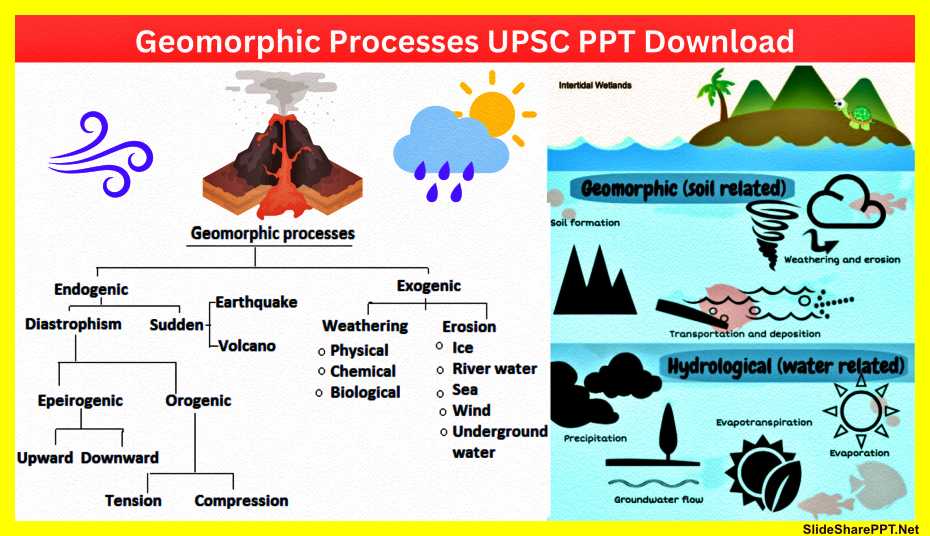
Endogenic processes originate from within the Earth and are driven by the planet’s internal heat. These processes are classified into horizontal movements (orogenic movements) and vertical movements (epeirogenic movements). Orogenic movements involve the folding, faulting, and uplifting of the Earth’s crust, contributing to the formation of mountain ranges. Epeirogenic movements, on the other hand, result in the rise or subsidence of large land masses.
Here’s a comprehensive table summarizing endogenic processes:
| Endogenic Processes | Description |
|---|---|
| 1. Horizontal Movements (Orogenic Movements) | Processes involving lateral compression, folding, and faulting of the Earth’s crust. |
| Mountain Building | The convergence of tectonic plates leads to intense pressure, causing crustal buckling and the formation of mountain ranges (e.g., the Himalayas). |
| Folding | Compression forces result in the bending and folding of rock layers, creating anticlines and synclines. |
| Faulting | Fractures in the Earth’s crust where movement occurs, include strike-slip faults, normal faults, and thrust faults. |
| 2. Vertical Movements (Epeirogenic Movements) | Processes involving the vertical displacement of large landmasses contribute to regional changes in the Earth’s surface. |
| Uplift | The raising of large portions of the Earth’s crust is often caused by magma intrusion or isostatic rebound after glacier melting. |
| Subsidence | The sinking or downward movement of the Earth’s crust, resulting from cooling and contraction or the removal of material. |
| 3. Volcanism and Earthquakes | Phenomena associated with the release of energy from within the Earth. |
| Volcanism | The movement of magma from the Earth’s mantle to the surface creates volcanic landforms such as mountains, craters, and lava plateaus. The “Ring of Fire” is a notable volcanic zone. |
| Earthquakes | The sudden release of energy along faults in the Earth’s crust leads to ground shaking and the creation of fault lines. |
| Overall Impact | Endogenic processes collectively shape the Earth’s crust, contributing to the creation of diverse landscapes and geological features. |
This table provides a structured overview of the various endogenic processes, including their subcategories and the geological phenomena they give rise to. These processes are fundamental to understanding the dynamic forces operating within the Earth, influencing its surface and contributing to the geological evolution of our planet.
Exogenic Processes: Sculpting the Earth’s Surface
Exogenic processes, also known as external processes, are forces and phenomena that shape the Earth’s surface through weathering, erosion, transportation, and deposition. These processes are driven by external agents such as weather, climate, and atmospheric elements. Understanding exogenic processes is crucial for comprehending the ongoing transformation and modification of the Earth’s landscapes. This category includes weathering, mass movements, erosion, and deposition.
Here’s a complete table summarizing exogenic processes:
| Exogenic Processes | Description |
|---|---|
| 1. Weathering | The breakdown of rocks into smaller particles at or near the Earth’s surface. |
| Chemical Weathering Processes | Involves chemical reactions altering the mineral composition of rocks. Examples include hydrolysis, oxidation, and carbonation. |
| Physical Weathering Processes | Involves the mechanical breakdown of rocks into smaller fragments. Examples include freeze-thaw cycles, abrasion, and exfoliation. |
| Biological Activity and Weathering | The influence of living organisms on weathering processes, such as plant roots breaking rocks and burrowing animals contributes to soil formation. |
| Special Effects of Weathering | Resultant landforms and features created by weathering, including inselbergs, hoodoos, and tors. |
| Significance of Weathering | The importance of weathering in soil formation, material cycling, and landscape development. |
| 2. Mass Movements | The downslope movement of rock, soil, and debris under the influence of gravity. |
| Landslides | Sudden and rapid movement of rock and soil down a slope, is influenced by factors like slope steepness, geological conditions, and rock stability. |
| 3. Erosion and Deposition | The removal and transportation of weathered material (erosion) and its settling in new locations (deposition). |
| Soil Formation | The process by which soil is created from weathered rock material. |
| Process of Soil Formation | Involves the weathering of rocks and the decomposition of organic matter. |
| Soil-Forming Factors | Factors influencing soil development, include topography, parent material, climate, biological activity, and time. |
| 4. Overall Impact | Exogenic processes collectively shape the Earth’s surface, influencing landscapes, soil development, and the cycling of Earth materials. |
This table provides a structured overview of exogenic processes, including their subcategories and the diverse phenomena associated with each process. Exogenic processes play a crucial role in shaping the Earth’s surface and contribute to the dynamic nature of landscapes and ecosystems.
Weathering: Nature’s Artistic Touch on Earth’s Canvas
Weathering is a fundamental geologic process that transforms and breaks down rocks at or near the Earth’s surface. Over time, this process shapes landscapes, creating a mosaic of landforms and contributing to the formation of soils. Weathering occurs through various chemical, physical, and biological mechanisms, working in tandem to sculpt the Earth’s crust.
Weathering is a fundamental exogenic process that breaks down rocks into smaller particles. Chemical weathering processes, involve reactions that alter the mineral composition of rocks, and physical weathering processes, such as freeze-thaw cycles and abrasion, contribute to the continuous transformation of Earth’s surface.
Here’s a comprehensive table summarizing weathering processes:
| Weathering Processes | Description |
|---|---|
| 1. Chemical Weathering Processes | Involves the alteration of rock composition through chemical reactions. |
| Hydrolysis | Water reacts with minerals in rocks, leading to the formation of new minerals and the dissolution of original components. |
| Oxidation | Oxygen reacts with minerals containing iron, forming iron oxides, commonly seen as rust. |
| Carbonation | Carbon dioxide in the atmosphere dissolves in rainwater, forming carbonic acid, which reacts with minerals like limestone. |
| 2. Physical Weathering Processes | Involves the mechanical breakdown of rocks into smaller fragments without changing their chemical composition. |
| Freeze-Thaw Cycles | Water seeps into cracks in rocks, freezes, and expands, exerting pressure and causing rocks to break. |
| Abrasion | Mechanical wearing down of rocks due to the scraping or rubbing action of other rocks, particles, or glaciers. |
| Exfoliation | The peeling away of outer layers of rocks due to pressure release as overlying rocks are eroded. |
| 3. Biological Activity and Weathering | Living organisms contribute to weathering through physical and chemical activities. |
| Plant Roots | Roots grow into crevices in rocks, exerting pressure and facilitating further weathering. |
| Burrowing Animals | Animals like rodents and insects burrow into rocks, accelerating the breakdown process. |
| 4. Special Effects of Weathering | Weathering leads to the formation of distinctive landforms and features. |
| Inselbergs | Isolated, steep-sided hills or mountains formed by the weathering resistance of underlying rocks. |
| Hoodoos | Tall, thin rock spires created by differential weathering of sedimentary rock layers. |
| Tors | Large, free-standing rock outcrops result from the weathering and erosion of surrounding rock. |
| 5. Significance of Weathering | Weathering is a critical process with far-reaching implications for the Earth’s surface and ecosystems. |
| Soil Formation | Weathering produces mineral particles that contribute to the formation of soils over time. |
| Material Cycling | The breakdown of rocks releases essential nutrients into the environment, influencing biogeochemical cycles. |
| Landscape Evolution | Weathering plays a key role in shaping the topography, creating diverse and intricate landforms. |
This table provides a structured overview of the various weathering processes, including their subcategories, mechanisms, and significance in shaping the Earth’s surface.
Mass Movements: The Dynamic Dance of Earth’s Material
Mass movements, often referred to as mass wasting, represent the downslope movement of Earth materials under the influence of gravity. These processes play a significant role in shaping landscapes and redistributing rock, soil, and debris over time. Mass movements encompass a range of phenomena, from slow, imperceptible soil creep to sudden, destructive landslides. Understanding mass movements is crucial for assessing geological hazards and comprehending the continuous evolution of the Earth’s surface.
- Mass movements, triggered by gravity, involve the downslope movement of rock and soil. Landslides, rockfalls, and mudflows are examples of mass movements that contribute to the constant reshaping of landscapes.
Here’s a table summarizing mass movements:
| Mass Movements | Description |
|---|---|
| 1. Landslides | Sudden and rapid movement of rock, soil, and debris down a slope. |
| Factors | Slope steepness, geological conditions, rock stability, and external triggers. |
| Types | Rockfalls, Rockslides, Debris Flows, Mudslides. |
| 2. Creep | Slow, continuous downslope movement of soil and rock particles. |
| Mechanism | Expansion and contraction of soil particles in response to moisture and temperature changes. |
| Indicators | Bent trees, tilted fences, or cracked pavement. |
| 3. Slumps | The gradual movement of a mass of rock or soil along a curved surface. |
| Cause | Saturated soil becomes heavy, loses strength, and slides along a curved slip plane. |
| Features | Terracelike steps along the slope. |
| 4. Flows | Movement of soil, debris, or volcanic material downslope in a fluid-like manner. |
| Types | Earthflows (slow-moving, viscous flows), Debris Flows (faster, higher proportion of coarse debris). |
| 5. Avalanches | Rapid downslope movement of snow, ice, and debris. |
| Triggers | Snowfall, rapid melting, or disturbances like earthquakes. |
| Impact | Significant in mountainous regions, posing risks to human settlements. |
| 6. Subsidence | Gradual sinking or settling of the Earth’s surface. |
| Causes | Natural processes (e.g., dissolution of underground rocks) or human activities (e.g., mining, groundwater extraction). |
| Effects | Ground cracking, tilting structures, changes in landscape elevation. |
| 7. Causes and Triggers | External factors such as heavy rainfall, rapid snowmelt, earthquakes, volcanic activity, and human activities. Geological factors include rock type, slope angle, and the presence of faults or fractures. |
| 8. Mitigation and Management | Structural measures like retaining walls, slope reinforcement, and barriers. Early warning systems for monitoring signs of potential mass movements. Land-use planning to avoid construction in high-risk areas and zoning regulations. |
| 9. Geological Significance | Mass movements contribute to the ongoing evolution of landscapes and are essential for hazard assessment in populated areas. |
This table provides a comprehensive overview of various mass movements, their characteristics, causes, triggers, mitigation measures, and geological significance.
Erosion and Deposition: The Earth’s Dynamic Sculptors
Erosion and deposition are fundamental geomorphic processes that shape the Earth’s surface by moving and redistributing soil, rock, and sediments. Driven by natural forces such as water, wind, ice, and gravity, these processes play a crucial role in carving out landscapes, forming landforms, and influencing the overall topography of the planet.
- Erosion involves the removal and transportation of weathered material, while deposition is the settling of these materials in new locations. Both processes play key roles in shaping valleys, riverbeds, and coastal features.
Here’s a table summarizing erosion and deposition processes:
| Erosion and Deposition Processes | Description |
|---|---|
| 1. Erosion | The process of wearing away or removal of soil, rock, or sediment from the Earth’s surface. |
| River Erosion | Flowing water wears away riverbanks and transports sediment downstream. Landforms include V-shaped valleys, riverbanks, and river deltas. |
| Coastal Erosion | The wearing away of coastal land by the action of waves and currents. Landforms include sea cliffs, sea caves, and coastal platforms. |
| Wind Erosion | Movement of soil and sand by the force of wind. Landforms include sand dunes, deflation hollows, and wind-carved rocks. |
| Glacial Erosion | The movement of glaciers erodes valleys and shapes landscapes. Landforms include U-shaped valleys, fjords, and glacial cirques. |
| Human-Induced Erosion | Accelerated erosion due to human activities like deforestation and agriculture. Effects include loss of topsoil, sedimentation in rivers, and increased runoff. |
| 2. Deposition | The process of settling or depositing eroded material in a new location. |
| River Deposition | Sediments carried by rivers settle when the water velocity decreases. Landforms include river deltas, alluvial plains, and riverbanks. |
| Coastal Deposition | Sediments transported by waves and currents are deposited along coastlines. Landforms include beaches, spits, and barrier islands. |
| Wind Deposition | Wind deposits sediments when its velocity decreases. Landforms include sand dunes, loess deposits, and wind-blown sandstone formations. |
| Glacial Deposition | Melting glaciers deposit sediments they carry during their movement. Landforms include moraines, drumlins, and glacial outwash plains. |
| Human-Induced Deposition | Human activities can lead to the deposition of sediments in new areas. Examples include sedimentation in reservoirs due to dam construction. |
| 3. Overall Impact | Erosion and deposition work together to shape landscapes, create landforms, and influence the Earth’s topography. The significance lies in their crucial role in the geological evolution of the Earth and the development of diverse ecosystems. |
This table provides an organized overview of erosion and deposition processes, their subcategories, associated landforms, and their combined impact on the Earth’s surface.
Soil Formation: The Earth’s Natural Recipe for Fertility
Soil formation, also known as pedogenesis, is a complex and continuous process that transforms rock into fertile soil. This intricate process involves the interaction of various factors, including climate, parent material, organisms, topography, and time. Understanding soil formation is crucial for sustainable agriculture, land management, and environmental conservation.
- Soil formation is a complex process influenced by several factors, including topography, parent material, climate, biological activity, and time.
Here’s a table summarizing key aspects of soil formation:
| Soil Formation | Description |
|---|---|
| 1. Process of Soil Formation | Soil formation involves the breakdown of rocks into smaller particles and the incorporation of organic matter. |
| Weathering | Physical and chemical processes break down rocks into mineral particles. Agents include water, wind, temperature changes, and biological activity. |
| Decomposition | Organic matter from plant and animal residues decomposes, contributing to soil fertility. Microorganisms, fungi, and soil fauna play key roles. |
| Humification | Organic materials transform into humus, a stable, dark, and nutrient-rich component. Improves soil structure, water retention, and nutrient availability. |
| 2. Soil-Forming Factors | Various factors influence the rate and nature of soil formation. |
| Topography | Slope and aspect affect water drainage, erosion, and the accumulation of organic material. |
| Parent Material | The original material from which soil forms influences its mineral composition. The weathering of different rocks produces distinct soils. |
| Climate | Temperature and precipitation impact the rate of weathering and the type of vegetation. Soils in arid regions may be more saline, while those in humid areas may be acidic. |
| Biological Activity | Plants, animals, and microorganisms contribute to organic matter and nutrient cycling. Plant roots release acids aiding mineral breakdown, and earthworms enhance soil structure. |
| Time | The longer the weathering and soil-forming processes occur, the more developed the soil becomes. Young soils may be shallow, while mature soils have distinct layers (horizons). |
| 3. Soil Horizons | Soils often exhibit distinct layers, or horizons, each with unique characteristics. |
| O Horizon (Organic) | Contains organic matter like decomposed leaves and plant material. |
| A Horizon (Topsoil) | Mineral particles mixed with organic material are rich in nutrients. Most plant roots and microbial activity occur here. |
| B Horizon (Subsoil) | Accumulation of leached minerals and materials from above horizons. May contain minerals leached down from above horizons. |
| C Horizon (Parent Material) | Weathered rock fragments, partially disintegrated. |
| R Horizon (Bedrock) | Unweathered rock. |
| Overall Significance | Understanding the factors and processes involved in soil formation is essential for land use planning, sustainable agriculture, and ecosystem management. Healthy soils are the foundation of terrestrial ecosystems, supporting plant growth, water filtration, and nutrient cycling. |
This table provides a structured overview of soil formation, encompassing the processes, influencing factors, and the distinct horizons that characterize soils.
Topography: The Canvas of Earth’s Varied Landscape
Topography refers to the surface features of a place, including the elevation, slope, and shape of the land. It is a fundamental aspect of geography that influences natural processes, ecosystems, and human activities. The intricate interplay between topography and other environmental factors contributes to the diverse landscapes that characterize our planet.
Here’s a table summarizing key aspects of topography:
| Topography | Description |
|---|---|
| 1. Definition | Topography encompasses the physical features of the Earth’s surface, including elevation, slope, and land shape. |
| 2. Factors Influencing Topography | Various factors contribute to the shaping of the Earth’s topography. |
| Tectonic Activity | Plate movements create geological features such as mountain ranges and valleys. Example: Himalayas. |
| Erosion and Weathering | Natural forces like water, wind, ice, and gravity erode and shape the land surface. Example: River valleys and coastal cliffs. |
| Volcanic Activity | Volcanic eruptions contribute to the formation of mountains, plateaus, and volcanic landscapes. Example: Hawaiian Islands. |
| Climate | Climate influences vegetation distribution, soil types, and overall landscape appearance. Example: Deserts with distinctive landforms like sand dunes. |
| Biological Processes | Plant and animal activities, such as termite mound formation or terrace creation by plant roots, influence topography. |
| 3. Importance of Topography | Topography plays a crucial role in various natural and human-related processes. |
| Hydrology | Influences water flow, river networks, and watershed formation. Example: River valleys determined by topography. |
| Ecology | Affects the distribution of plant and animal species, creating diverse ecosystems. Example: Unique flora and fauna in mountainous regions. |
| Urban Planning | Influences the layout and development of cities. Example: Coastal cities facing challenges related to sea level rise. |
| Agriculture | Determines soil types, drainage patterns, and suitability for farming. Example: Terraced fields optimizing land use on hilly terrain. |
| 4. Technological Tools for Topographic Mapping | Various tools and technologies are used to create detailed topographic maps. |
| Satellite Imaging | Satellites capture high-resolution images of the Earth’s surface. |
| LiDAR (Light Detection and Ranging) | Uses laser beams to measure distances, creating detailed 3D maps. |
| GIS (Geographic Information System) | Integrates spatial data to create detailed maps and analyze topographic features. |
This table provides a structured overview of topography, including its definition, influencing factors, significance in various fields, and the technological tools used for mapping.
Parent Material: The Geological Starting Point for Soil Formation
Parent material is a crucial component in the process of soil formation. It serves as the initial geological material from which soil develops, undergoing weathering and transformation into the fertile layer that sustains plant life. The characteristics of the parent material significantly influence the properties and composition of the resulting soil.
Here’s a table summarizing key aspects of parent material in the context of soil formation:
| Parent Material | Description |
|---|---|
| 1. Definition | Parent material refers to the unconsolidated material from which soil develops through weathering processes. |
| 2. Types of Parent Material | Different types of parent material contribute to the formation of diverse soils. |
| Residual Material | Developed in place by the weathering of the underlying bedrock. Retains some features of the original rock, influencing soil composition. |
| Transported Material | Deposited by agents like wind, water, or ice from another location. May differ significantly from the underlying bedrock, depending on the transport process. |
| Organic Material | Derived from the decomposition of plant and animal remains. Adds organic matter to the soil, influencing fertility and structure. |
| 3. Influence on Soil Formation | The parent material plays a vital role in determining the properties and composition of the resulting soil. |
| Mineral Composition | Determines the types and proportions of minerals present in the soil. Soils from granite parent material differ from those derived from limestone. |
| Texture | Affects the particle size distribution of the soil. Sandy soils originate from coarse-grained parent material, while clayey soils result from fine-grained material. |
| Chemical Composition | Determines the availability of nutrients and the pH of the soil. Soils from limestone parent material tend to be alkaline due to calcium carbonate. |
| 4. Weathering Processes | Weathering of the parent material is a key step in soil formation. |
| Physical Weathering | Breaks down rocks into smaller particles without altering their chemical composition. Freeze-thaw cycles are an example. |
| Chemical Weathering | Involves the alteration of minerals through chemical reactions. Example: conversion of feldspar into clay minerals in granite. |
| 5. Human Impact on Parent Material | Human activities can influence the parent material and subsequently impact soil formation. |
| Mining | Removal of large volumes of parent material can disrupt natural soil formation processes. |
| Land Use Changes | Clearing vegetation or altering drainage patterns can affect the rate of weathering and parent material exposure. |
This table provides a structured overview of parent material, including its definition, types, influence on soil formation, weathering processes, and the impact of human activities.
Climate: The Dynamic Atmosphere of Earth
Climate is a comprehensive and long-term pattern of weather conditions in a particular region, encompassing factors such as temperature, precipitation, humidity, wind patterns, and atmospheric pressure. It plays a fundamental role in shaping ecosystems, influencing geological processes, and determining the characteristics of a region.
Here’s a table summarizing key aspects of climate:
| Climate | Description |
|---|---|
| 1. Definition | Climate refers to the prevailing long-term weather patterns in a particular region, including temperature, precipitation, and atmospheric conditions. |
| 2. Components of Climate | Various elements contribute to the overall climate of a region. |
| Temperature | Influences the overall heat conditions in a region. Polar climates have low temperatures, while tropical climates are characterized by high temperatures. |
| Precipitation | Describes the amount and frequency of rainfall or snowfall. Deserts have low precipitation, while rainforests experience high and consistent rainfall. |
| Humidity | Refers to the amount of water vapor in the air. Coastal areas often have higher humidity levels compared to arid regions. |
| Wind Patterns | Influence temperature distribution and weather patterns. Trade winds near the equator and westerlies in the mid-latitudes. |
| Atmospheric Pressure | Affects wind patterns and weather systems. Low-pressure systems often bring stormy weather. |
| 3. Climate Classification | Climate is often classified into different types based on temperature and precipitation patterns. |
| Köppen Climate Classification | Categories include tropical, arid, temperate, polar, and more. The Amazon Rainforest falls under the Af (Tropical Rainforest) classification. |
| 4. Climate Change | Long-term alterations in the Earth’s climate are often attributed to human activities. |
| Greenhouse Gas Emissions | Human activities, such as burning fossil fuels, contribute to the increase in greenhouse gases, leading to global warming. |
| Effects on Ecosystems | Alters ecosystems, affecting plant and animal life, migration patterns, and biodiversity. |
| Rising Sea Levels | Melting ice caps and glaciers contribute to rising sea levels, affecting coastal areas. |
| 5. Impact on Geological Processes | Climate influences various geological processes, shaping landscapes over long periods. |
| Erosion and Weathering | Climate affects the rates and types of erosion and weathering in a region. |
| Glacial Activity | Climate conditions determine the extent and movement of glaciers. |
| Sea Level Changes | Climate-induced changes affect sea levels, impacting coastal landforms. |
| 6. Mitigation and Adaptation | Efforts to address and cope with climate change. |
| Renewable Energy | Transitioning to energy sources that produce fewer greenhouse gas emissions. |
| Climate Resilience | Building infrastructure and ecosystems resilient to the impacts of climate change. |
| Global Cooperation | International efforts to mitigate climate change through agreements and policies. |
This table provides a structured overview of climate, covering its definition, components, classification, impact of climate change, influence on geological processes, and strategies for mitigation and adaptation.
Biological Activity: The Living Pulse of Earth’s Systems
Biological activity refers to the various processes and interactions involving living organisms that shape and influence the environment. From microscopic bacteria to complex ecosystems, life plays a crucial role in nutrient cycling, soil formation, and the overall functioning of the planet. Understanding biological activity is essential for comprehending ecological dynamics and the interconnectedness of living organisms with their surroundings.
Here’s a table summarizing key aspects of biological activity:
| Biological Activity | Description |
|---|---|
| 1. Definition | Biological activity encompasses the functions, processes, and interactions of living organisms within ecosystems. |
| 2. Types of Biological Activity | Diverse biological processes contribute to the dynamic balance of ecosystems. |
| Photosynthesis | Conversion of sunlight into chemical energy by plants, algae, and some bacteria. Provides the foundation for most food chains and releases oxygen into the atmosphere. |
| Respiration | Utilization of oxygen by organisms to release energy from organic compounds. Supports cellular functions and contributes to carbon dioxide levels in the atmosphere. |
| Decomposition | Breakdown of dead organic matter by decomposer organisms. Recycles nutrients back into the ecosystem. |
| Nitrogen Fixation | Conversion of atmospheric nitrogen into forms usable by plants. Enhances soil fertility by providing essential nutrients. |
| Predation and Herbivory | Consumption of other organisms for energy and nutrient acquisition. Regulates population dynamics and shapes community structures. |
| 3. Role in Soil Formation | Biological activity significantly influences the formation and structure of soil. |
| Organic Matter Accumulation | Plant residues, animal remains, and microbial activity contribute to the formation of organic-rich soil horizons. Enhances soil fertility and water retention. |
| Soil Microbial Activity | Bacteria and fungi break down organic matter, releasing nutrients. Drives nutrient cycling and contributes to soil health. |
| 4. Biodiversity and Ecosystem Stability | Biodiversity, a product of biological activity, plays a crucial role in maintaining ecosystem stability. |
| Species Interactions | Mutualism, predation, and competition among species contribute to ecosystem resilience. Pollinators support plant reproduction and food webs. |
| Genetic Diversity | Variation within species enhances adaptability to environmental changes. Resistance of certain plant varieties to pests and diseases. |
| 5. Human Impact on Biological Activity | Human activities can disrupt or enhance biological processes. |
| Deforestation | Alter habitats reduce biodiversity and disrupt ecological processes. Loss of forest cover leads to changes in nutrient cycling. |
| Agricultural Practices | Chemical fertilizers and pesticides can affect soil microbial communities. Mono-cropping leads to reduced biodiversity. |
| Climate Change | Alters habitats and migration patterns, affecting species interactions. Shifts in the timing of plant flowering and animal migration. |
This table provides a structured overview of biological activity, covering its definition, types, role in soil formation, contribution to biodiversity and ecosystem stability, and the impact of human activities.
TIME: Soil Formation Over Time
Time is a crucial factor in the intricate process of soil formation. It influences the development of soil horizons, the accumulation of organic matter, and the transformation of parent material into a medium that sustains life. The dynamic interplay of various factors over time shapes the unique characteristics of soils in different regions across the globe.
Here’s a table summarizing key aspects of soil formation over time:
| Soil Formation Over Time | Description |
|---|---|
| 1. Process of Soil Formation | Soil formation is a gradual process that evolves over extended periods. |
| 2. Soil-Forming Factors and Their Evolution | Various factors contribute to soil formation, and their influence intensifies with time. |
| Weathering | Continual weathering processes break down rocks into smaller particles, contributing to soil development over time. |
| Organic Matter Accumulation | Organic matter from plant and animal residues accumulates, enriching the soil with nutrients over time. |
| Horizon Development | Soil horizons (O, A, B, C) become more distinct as weathering and organic processes continue over time. |
| Climate Influence | Climate patterns impact soil characteristics, with long-term trends shaping soil properties over time. |
| 3. Soil Development Stages | Soil formation progresses through identifiable stages over time. |
| Youthful Soils | Poorly developed horizons, limited organic matter. Initial stages of weathering and minimal organic input over time. |
| Mature Soils | Well-defined horizons, increased organic matter. Enhanced weathering, organic accumulation, and horizon differentiation over time. |
| Aged Soils | Highly developed horizons, substantial organic content. Extended weathering, continuous organic matter input, and complex soil structure over time. |
| 4. Human Impact on Soil Over Time | Human activities can accelerate or alter the natural progression of soil formation. |
| Agriculture | Farming practices can lead to accelerated soil erosion and changes in soil structure over shorter timeframes. |
| Urbanization | Construction and urban development can disturb soils, altering their composition and structure over relatively short periods. |
| Industrialization | Industrial activities may introduce pollutants into soils, affecting their quality over time. |
| 5. Importance of Long-Term Observations | Long-term monitoring provides valuable insights into soil development. |
| Research and Conservation | Long-term studies inform sustainable land management practices and conservation efforts. |
| Climate Change Impacts | Observing soil changes over time helps understand and address the impacts of climate change. |
| Ecosystem Resilience | Insights into long-term soil dynamics contribute to maintaining ecosystem resilience. |
This table provides a structured overview of how soil formation is influenced by various factors over time, the stages of soil development, human impacts, and the importance of long-term observations in understanding soil dynamics.
Table of differences between CLIMATE and WEATHER
Here’s a table outlining the key differences between climate and weather:
| Aspect | Climate | Weather |
|---|---|---|
| Definition | The long-term average of weather conditions in a particular region over an extended period (typically 30 years). | The current atmospheric conditions in a specific location at a given point in time. |
| Time Frame | Represents long-term patterns and averages. | Describes short-term atmospheric conditions, often over hours or days. |
| Scope | Encompasses the overall atmospheric conditions, including temperature, precipitation, humidity, wind patterns, and more. | Focuses on specific, immediate conditions such as temperature, humidity, precipitation, and wind at a particular moment. |
| Variability | Relatively stable and exhibits consistent patterns over the long term. | Highly variable and can change rapidly. |
| Prediction | Predicting climate involves analyzing long-term trends and averages. | Weather forecasts provide short-term predictions based on current atmospheric conditions. |
| Influence | Influences the types of ecosystems, vegetation, and overall geography in a region. | Directly impacts daily activities, clothing choices, and short-term planning. |
| Measurement | Measured using statistical data over an extended period, often decades. | Measured through direct observations, instruments, and weather stations for immediate conditions. |
| Example | The Amazon Rainforest has a tropical climate characterized by high temperatures and consistent rainfall. | Today’s weather in New York City is 25°C with a chance of afternoon showers. |
| Impacts | Impacts the overall landscape, biodiversity, and adaptation of organisms in a region. | Affects daily activities, and travel plans, and can have immediate safety implications. |
| Change Rate | Changes in climate occur gradually over an extended period. | Weather conditions can change rapidly, sometimes within hours or minutes. |
| Scale | Operates on a large scale, considering regional and global atmospheric patterns. | Operates on a smaller scale, focusing on specific locations and short-term events. |
| Mitigation and Adaptation | Strategies for climate change involve long-term efforts to reduce greenhouse gas emissions and adapt to altered conditions. | Weather-related adaptations are typically short-term, like dressing for cold weather or preparing for a storm. |
This table provides a clear distinction between climate and weather in terms of their definitions, time frames, scopes, influences, measurements, examples, impacts, change rates, scales, and mitigation/adaptation strategies.
Rocking Geology: A Comprehensive Guide to Types of Rocks and Their Characteristics
Here’s a comprehensive table outlining different types of rocks:
| Type of Rock | Formation Process | Characteristics | Examples |
|---|---|---|---|
| Igneous Rock | It is formed from the cooling and solidification of molten magma or lava. | Texture: Fine-grained or coarse-grained.
Composition: Silica content varies, influencing color (mafic, felsic). |
Granite (Intrusive)
Basalt (Extrusive) Obsidian (Extrusive) |
| Sedimentary Rock | Formed from the accumulation and cementation of mineral and organic particles. | Layers: Stratified with distinct layers.
Fossils: Often contains fossils. Texture: May be clastic, chemical, or organic. |
Limestone (Organic)
Sandstone (Clastic) Rock Salt (Chemical) |
| Metamorphic Rock | Formed from the alteration of existing rocks through heat and pressure. | Texture: Foliated (layered) or non-foliated.
Parent Rock: Original rock type influences the resulting metamorphic rock. |
Marble (from Limestone)
Slate (from Shale) Schist (from Slate) |
| Sedimentary Metamorphic Rock | Formed from the alteration of existing sedimentary rocks through heat and pressure. | Texture: Typically foliated.
Composition: Derived from the transformation of sedimentary rocks. |
Quartzite (from Sandstone)
Marble (from Limestone) |
| Volcanic Rock | Formed from volcanic activity, including both extrusive igneous rocks and volcaniclastic sediments. | Texture: Fine-grained (volcanic ash) to coarse-grained (volcanic rocks).
Composition: Reflects the mineral content of the magma. |
Basalt (Extrusive Igneous)
Pumice (Volcaniclastic) Tuff (Volcaniclastic) |
| Metamorphic Foliated Rock | Metamorphic rocks with a layered or banded appearance due to the alignment of minerals. | Texture: Foliated, often with distinct bands.
Mineral Alignment: Minerals align perpendicular to the direction of pressure. |
Slate
Schist Gneiss |
| Metamorphic Non-Foliated Rock | Metamorphic rocks without a layered or banded appearance. | Texture: Non-foliated, lacks distinct bands.
Mineral Composition: Recrystallization without preferred mineral alignment. |
– Marble – Quartzite – Hornfels |
| Organic Sedimentary Rock | Formed from the accumulation of organic materials like plant debris and shells. | Composition: Primarily composed of organic remains.
Texture: Can be clastic or non-clastic. |
Coal (from plant material)
Limestone (from marine shells) |
| Claystone | A type of fine-grained sedimentary rock composed mainly of clay minerals. | Texture: Extremely fine-grained.
Formation: Often formed in quiet, low-energy environments. |
Shale (when hardened)
Mudstone (similar, less hardened) |
| Conglomerate | A clastic sedimentary rock composed of rounded fragments embedded in a matrix. | Composition: Contains rounded pebbles, cobbles, or boulders.
Formation: Typically in high-energy environments like riverbeds. |
Conglomerate (composed of gravel-sized particles)
Breccia (composed of angular particles) |
This table provides a comprehensive overview of various types of rocks, including their formation processes, characteristics, and examples.
Conclusion:
- The study of geomorphic processes unveils the dynamic nature of the Earth’s surface, emphasizing the continuous interaction between internal and external forces. From the grandeur of mountain ranges sculpted by endogenic processes to the subtlety of soil formation influenced by exogenic forces, geomorphic processes shape the world we inhabit. As we delve deeper into these processes, we gain a profound appreciation for the ever-changing masterpiece that is the Earth’s topography.
- Geomorphic processes are the invisible artists shaping the Earth’s canvas. From the slow and steady weathering of rocks to the dramatic shifts caused by tectonic forces, these processes are the driving forces behind the ever-changing face of our planet. As we continue to explore and study these processes, we gain valuable insights into the past, present, and future of Earth’s dynamic landscape. The interdisciplinary nature of geomorphology ensures that its study remains a fascinating journey that connects geology, geography, biology, and environmental science.
Also Read: Types of Rocks and Their Formation Processes (UPSC PDF)