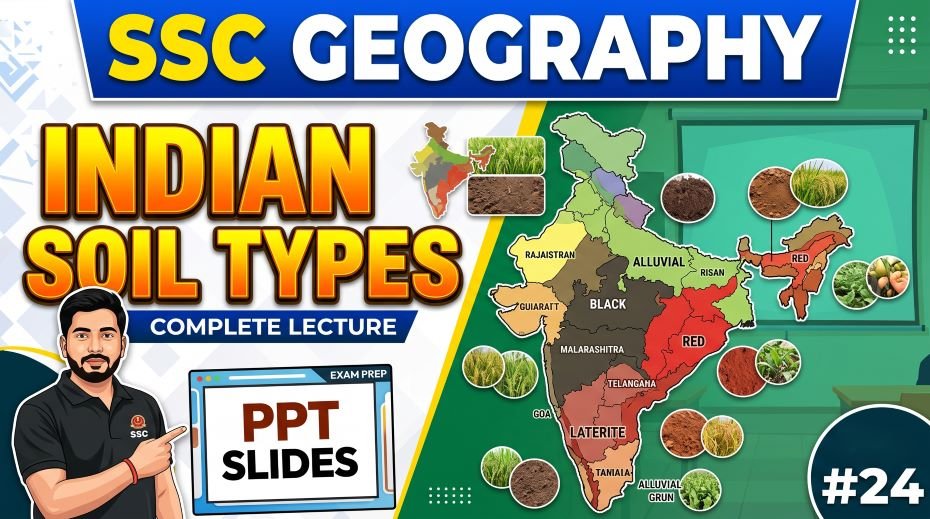
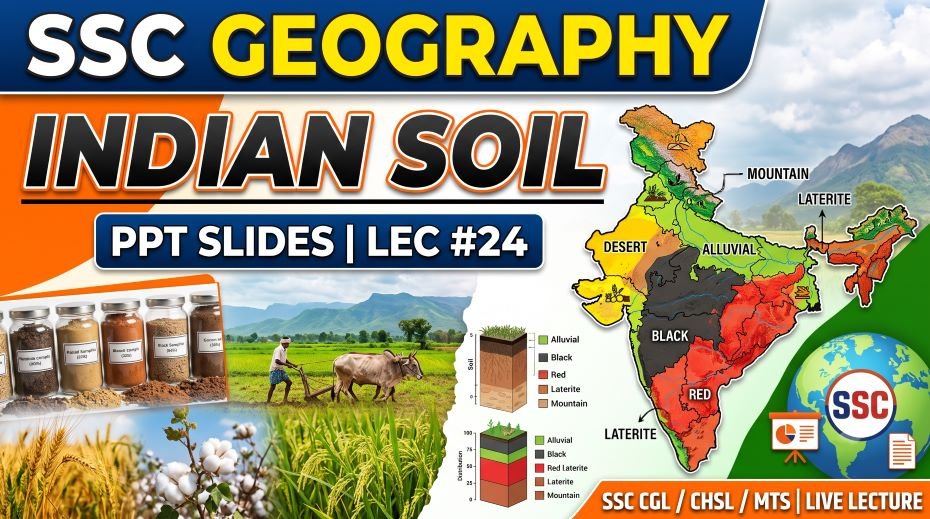
This article accompanies the SSC Geography Indian Soil PPT Slides (LEC #24) – Serial #103 of the Complete Foundation Batch for All SSC Exams PPT Series on slideshareppt.net. With 138 slides in bilingual Hindi + English format, this PPT covers Indian soils – classification, distribution, properties, crops, and conservation – in complete depth aligned to the SSC exam pattern.
Indian Soils is one of the most directly and consistently tested topics in SSC CGL, SSC CHSL, SSC MTS, SSC GD Constable, and RRB Group D General Awareness sections – with questions on soil types, their locations, associated crops, and their geological origins appearing in virtually every paper. From the fertile alluvial soils of the Gangetic plains to the famous Regur (Black cotton) soil of the Deccan Plateau and the laterite soils of the high-rainfall Western Ghats coasts, India’s soil diversity directly supports its agricultural richness.
Complete Foundation Batch for All SSC Exams (PPT Series)
Total Slides
138 PPT Slides
File Size
46 MB
Language
Hindi + English (Bilingual)
Format Available
Google Slides & Google Drive (PDF also available)
Website
www.slideshareppt.net
Target Exams
SSC CGL, SSC CHSL, SSC MTS, SSC GD Constable, RRB Group D
Suitable For
Students (self-study & marathon revision) and Teachers (classroom use)
SSC Geography Indian Soil PPT Slides (LEC #24)
Note: Above is PPT in GOOGLE SLIDES (HTML AND IFRAME COMBINATION) and if you wish to download the Complete SSC series (PPT slides), visit this Link – REDIRECT PAGE.
Indian Soils – Overview and Classification
Soil is the topmost layer of the Earth’s crust, formed over millions of years by the physical, chemical, and biological weathering of rocks, and is the foundation of all terrestrial life and agriculture. India has one of the most diverse soil profiles in the world, resulting from variations in parent rock, climate, relief, vegetation, and time of formation. The Indian Council of Agricultural Research (ICAR) classifies Indian soils into eight major types. The most important for SSC exams are: Alluvial Soil, Black Soil (Regur), Red Soil, Laterite Soil, Arid/Desert Soil, Forest Soil, Saline/Alkaline Soil, and Peaty/Marshy Soil. These eight types cover the full range of India’s agricultural landscape.
ICAR Classification of Indian Soils – Overview Table
Arid and semi-arid areas of UP, Haryana, Punjab, Rajasthan, Gujarat
Difficult to cultivate; needs treatment; some salt-tolerant crops
Peaty/Marshy Soil
पीटी / दलदली मिट्टी
~1%
Kerala backwaters, Sundarbans (West Bengal), coastal Odisha, Bihar
Rice; some areas used for aquaculture
1. Alluvial Soil (जलोढ़ मिट्टी) – Most Extensive Soil of India
Parameter
Detail
Coverage
~43% of India’s total area – the largest soil group in India
Origin
Deposited by rivers (Himalayan rivers mainly) – alluvium (river-borne sediment) accumulated over thousands of years
Main Regions
Indo-Gangetic Plain (UP, Bihar, West Bengal, Punjab, Haryana), Brahmaputra valley (Assam), coastal plains (delta regions), river valleys throughout India
Texture
Varies from sandy loam to clay; generally well-drained in upland areas (Bangar) and highly fertile in flood plains (Khadar)
Sub-types
Khadar (new alluvium – light coloured, highly fertile, renewed annually by floods); Bangar (old alluvium – darker, contains Kankar nodules, slightly less fertile)
Colour
Light grey to greyish-yellow; varies with mineral content
pH
Generally near neutral (6.5–7.5) to slightly alkaline
Mineral Content
Rich in potash, phosphoric acid; deficient in nitrogen and humus
Water Retention
Good in clay-rich areas; sandy alluvium drains quickly
Largest soil type by area in India (~43%); found mainly in Indo-Gangetic plains; Khadar is most fertile alluvium; deficient in nitrogen
2. Black Soil / Regur Soil (काली मिट्टी / रेगुर) – Cotton Soil of India
Parameter
Detail
Other Names
Regur Soil; Black Cotton Soil; Tropical Black Earth; Adobe
Coverage
~15% of India’s total area
Origin
Formed from Deccan Traps basaltic lava – ancient volcanic rock weathered over 65+ million years
Main Regions
Deccan Plateau: Maharashtra (largest coverage), Madhya Pradesh, Gujarat, Karnataka, Andhra Pradesh, Tamil Nadu (some parts)
States with Most Black Soil
Maharashtra > MP > Gujarat > Karnataka
Colour
Deep black to grey-black – colour due to titaniferous magnetite and iron and aluminium compounds
Texture
Heavy clayey; highly expansive when wet; cracks deeply when dry
Special Property
Self-ploughing / Self-mulching – shrinks and cracks when dry, expands when wet; the cracks allow air to enter and then close, incorporating organic matter; absorbs atmospheric nitrogen
Moisture Retention
Excellent – retains moisture for long periods (ideal for cotton which needs moisture between rains)
pH
Slightly alkaline (7.2–8.5)
Mineral Content
Rich in calcium carbonate, magnesium carbonate, potash; deficient in nitrogen, phosphorus, organic matter
Vidarbha (Maharashtra), Malwa Plateau (MP), Saurashtra (Gujarat) – major cotton belts of India
SSC Key Facts
Origin from Deccan Traps basalt; self-ploughing property; ideal for cotton; deficient in N & P; Maharashtra has most
3. Red Soil (लाल मिट्टी)
Parameter
Detail
Coverage
~18% of India’s total area – second largest soil type
Origin
Formed by weathering of ancient crystalline metamorphic rocks (gneiss, granite, schist) of the Gondwana/Deccan Plateau; rich in iron oxides which give red colour
Main Regions
Peninsular Plateau – Tamil Nadu, Andhra Pradesh (large areas), Karnataka, Chhattisgarh, Odisha, Jharkhand, parts of MP and Maharashtra
Colour
Red (due to presence of iron oxide – Fe₂O₃); yellowish-brown in subsurface; darker when containing humus
Texture
Sandy to clay loam; porous and coarse-grained on surface; friable texture
Fertility
Generally low fertility due to poor nitrogen, phosphorus, and humus content; good water-holding capacity in finer-grained variants
pH
Neutral to slightly acidic (6.0–7.5)
Mineral Content
Deficient in nitrogen, phosphorus, and humus; adequate iron, magnesium; sufficient potash in some areas
Major Crops
Groundnut (major), millet (jowar, bajra), pulses, tobacco, cotton (with irrigation), paddy in low-lying areas
SSC Key Facts
Red colour from Fe₂O₃ (iron oxide); formed on ancient Gondwana rocks; covers peninsular plateau; deficient in N, P, and humus
4. Laterite Soil (लैटेराइट मिट्टी)
Parameter
Detail
Meaning of ‘Laterite’
From Latin ‘later’ meaning ‘brick’ – hardens like brick on exposure to air and sunlight
Coverage
~8% of India’s total area
Formation
Formed under conditions of high temperature and heavy, alternating wet and dry seasons (tropical monsoon climate); intense leaching washes away silica and other bases, leaving iron and aluminium oxides
Main Regions
High-rainfall areas – Kerala, Karnataka (Western Ghats slopes), Goa, Meghalaya, Assam (hills), parts of West Bengal, Odisha, Maharashtra (coastal slopes), Andhra Pradesh (high rainfall zones)
Colour
Reddish-brown (iron-rich) to yellowish; brick-red when hardened
Texture
Coarse and gravelly; hardens on drying; soft when freshly excavated
Fertility
Low – severely leached; low in nitrogen, phosphorus, potassium, and calcium; acidic pH; not very suitable for direct cultivation
pH
Strongly acidic (4.5–6.0)
Special Property
Hardens irreversibly on exposure to air – used as building material (laterite blocks) in Kerala and Goa; the Konkan region still has buildings made of laterite blocks
Major Crops
Tea (Assam, Meghalaya), coffee (Karnataka), rubber (Kerala), coconut, cashew nut, tapioca; plantation crops that can tolerate acidic soil
Improvement
Addition of manures and fertilisers required; lime added to reduce acidity; mulching to retain moisture
SSC Key Facts
Name from Latin ‘brick’; formed by leaching in high rainfall; acidic; low fertility; good for tea, coffee, rubber; hardens on drying
5. Arid / Desert Soil (मरुस्थलीय मिट्टी)
Parameter
Detail
Coverage
~4% of India’s total area
Main Regions
Rajasthan (Thar Desert), western Gujarat (Kutch), some parts of southern Haryana and Punjab
Formation
Formed under extremely arid conditions; minimal rainfall prevents leaching; high salt content due to evaporation exceeding rainfall
Colour
Sandy red to pale yellow; colour depends on iron content and sand minerals
Texture
Sandy (coarse); light; porous; prone to wind erosion
Fertility
Low organic matter and humus; but soluble salts make some nutrients available; phosphorus is sometimes adequate
Usar, Reh, Kallar, Chopan, Rakar – different regional names for saline/alkaline soils
Coverage
~4% of India’s total area
Main Regions
Dry and semi-arid regions – UP (especially eastern UP and Ganga-Yamuna doab), Haryana, Punjab, Rajasthan, Gujarat, Bihar
Formation
Accumulation of salts (sodium chloride, sodium sulphate, sodium carbonate) due to high evaporation exceeding rainfall in semi-arid areas; waterlogging and overuse of chemical fertilisers
Colour
White or light grey surface crust (salt efflorescence); dark below the crust
Texture
Compact, crusted surface; impermeable in some areas
Fertility
Very poor – excess salts affect plant osmosis; most plants cannot grow; called ‘usar’ in UP (land that is difficult to cultivate)
pH
Highly alkaline (>8.5 for saline; >9.0 for alkali soils)
Major Crops
Very few crops grow naturally; salt-tolerant grasses; after reclamation: paddy, barley, salt-tolerant varieties
Reclamation
Addition of gypsum (calcium sulphate) to replace sodium with calcium; leaching with good irrigation water; growing salt-tolerant plants
SSC Key Facts
Called Usar (UP region); white salt crust on surface; alkaline; reclamation uses gypsum; problem in irrigated areas due to poor drainage
8. Peaty / Marshy Soil (पीटी / दलदली मिट्टी)
Parameter
Detail
Coverage
~1% of India’s total area – least extensive soil type
Main Regions
Kerala backwaters (Kuttanad area), Sundarbans (West Bengal), coastal Odisha, Bihar (Muzaffarpur), Almora (Uttarakhand), some parts of NE India
Formation
Formed in areas with waterlogging and poor drainage; accumulated organic matter (peat) under anaerobic (oxygen-free) conditions; high moisture content prevents complete decomposition
Colour
Dark black to brownish-black; very dark due to high organic matter content
Texture
Very light; spongy; high organic matter; highly water-absorbent
Organic Content
Very high (10–40% organic matter); highly acidic
pH
Strongly acidic (3.5–5.5)
Major Crops
Rice (especially where drained); aquaculture in some coastal peaty areas (Kuttanad, Kerala)
SSC Key Facts
Most acidic soil; high organic matter; found in Kerala backwaters (Kuttanad); Sundarbans, Bihar; waterlogged origin
All Eight Indian Soil Types – Master Comparison Table
Soil Type
% Area
Colour
pH
Key Deficiency
Ideal Crops
Key States
Alluvial
~43%
Grey to yellow
Near neutral (6.5–7.5)
Nitrogen, humus
Rice, wheat, sugarcane, jute
UP, Bihar, WB, Punjab, Haryana, Assam
Black (Regur)
~15%
Deep black
Slightly alkaline (7.2–8.5)
Nitrogen, phosphorus
Cotton, jowar, wheat, sugarcane
Maharashtra, MP, Gujarat, Karnataka
Red
~18%
Red (Fe₂O₃)
Neutral to slightly acidic (6.0–7.5)
Nitrogen, phosphorus, humus
Groundnut, millets, pulses
Tamil Nadu, AP, Karnataka, Odisha, CG
Laterite
~8%
Reddish-brown
Strongly acidic (4.5–6.0)
All major nutrients; highly leached
Tea, coffee, rubber, cashew, coconut
Kerala, Karnataka, Goa, WB, Meghalaya
Desert / Arid
~4%
Sandy red/yellow
Alkaline (8.0–9.0)
Humus, nitrogen
Millet, barley, guar (drought crops)
Rajasthan, Gujarat (Kutch)
Forest / Mountain
~8%
Dark brown
Acidic (4.5–6.0)
Variable by zone
Tea, coffee, rubber, apple, temperate fruits
Himalayas, NE India, Western Ghats
Saline / Alkaline
~4%
White surface crust
Very alkaline (>8.5)
Excess salts toxic to most plants
Salt-tolerant crops; barley after reclamation
UP, Haryana, Punjab, Rajasthan, Gujarat
Peaty / Marshy
~1%
Very dark black
Strongly acidic (3.5–5.5)
None (excess organic matter); waterlogged
Rice (drained areas)
Kerala, West Bengal, Bihar, Odisha
SSC Geography Indian Soil PPT Slides (LEC #24)
Soil Erosion – Types, Causes, and Conservation
Types of Soil Erosion
Type
Description
Key Region in India
Sheet Erosion
Uniform removal of a thin layer of soil by flowing water over a wide area
Agricultural plains; sloping land after rains
Rill Erosion
Formation of small channels (rills) on sloping land by concentrated water flow
Hilly areas; Shiwalik hills
Gully Erosion
Deep channels (gullies) cut by concentrated water flow; destroys agricultural land
Chambal Ravines (Madhya Pradesh, Rajasthan, UP) – worst case of gully erosion in India
Wind Erosion
Sand dunes move and cover productive land; topsoil blown away
Thar Desert (Rajasthan); Rann of Kutch (Gujarat)
Landslide Erosion
Mass movement of soil and rock downslope
Himalayan states; Nilgiri Hills (Tamil Nadu); NE India
Slip/Terrace Erosion
Terrace cultivation that fails; occurs on poorly managed terraced land
Himalayan areas
Soil Conservation Methods
Method
Description
Best For
Contour Ploughing
Ploughing along the contour lines (across slopes) – reduces runoff and erosion
Hilly and sloping areas
Terracing (Terrace Farming)
Creating flat platforms (terraces) along hillside slopes to prevent runoff
Himalayan areas; NE India; Rajasthan
Strip Cropping
Growing different crops in alternating strips across slopes – reduces erosion
Agricultural slopes
Shelter Belts (Wind Breaks)
Planting rows of trees to block wind and reduce wind erosion
Thar Desert; Rajasthan; Punjab
Afforestation
Planting trees on degraded or bare land to prevent erosion
Chambal ravines; denuded hills
Check Dams
Small dams across gullies to slow water flow and trap sediment
Gully erosion areas; ravines; watershed
Mulching
Covering soil surface with organic material to reduce evaporation and erosion
Agricultural land; forest floors
Crop Rotation
Alternating crops to maintain soil fertility and structure
Agricultural land generally
Watershed Management
Integrated management of an entire water catchment area
Q1: Why is Alluvial Soil the most important soil in India?
Alluvial soil covers approximately 43% of India’s total land area, making it the single largest soil group, and it coincides almost entirely with the most densely populated and agriculturally productive regions of India – the Indo-Gangetic Plain. It is formed by the deposition of silt, sand, and clay carried by Himalayan rivers over thousands of years, and its most fertile variant, Khadar, is renewed with fresh mineral-rich sediment every monsoon season. The alluvial plains of Punjab, Haryana, UP, Bihar, and West Bengal produce the bulk of India’s wheat, rice, sugarcane, and jute – making this soil the foundation of India’s food security. Without the alluvial plains, India could not support its current population.
Q2: What makes Black Soil (Regur) uniquely suited for cotton cultivation?
Black soil’s suitability for cotton arises from a unique combination of physical and chemical properties. Its self-mulching or self-ploughing property – where the soil swells when wet and cracks deeply when dry – ensures that moisture is retained for a long time between rain events, exactly matching cotton’s water requirements (it needs moisture but not waterlogging). The cracks that form during drying expose the subsoil to air, functioning as a natural aeration mechanism, and then seal shut when it rains, trapping moisture below. The soil is also naturally alkaline and rich in calcium, magnesium, and potash – all nutrients that cotton requires. Additionally, the same cracking mechanism is thought to absorb small amounts of atmospheric nitrogen, partially compensating for its nitrogen deficiency. These combined properties make Vidarbha (Maharashtra) and Malwa (MP) among India’s most significant cotton-growing belts.
Q3: Why is laterite soil low in fertility despite being found in high-rainfall areas?
The paradox of laterite soil is that it forms in high-rainfall tropical regions – particularly the Western Ghats and Northeast India – yet is one of India’s least fertile soils. The explanation lies in the process of laterisation. In regions with intense rainfall and alternating wet-dry seasons, water percolating through the soil washes out (leaches) the soluble minerals – calcium, magnesium, potassium, nitrogen, and phosphorus – that plants need, leaving behind insoluble iron and aluminium oxides that give the soil its characteristic reddish colour. This thorough leaching removes most plant nutrients, leaving an acidic, nutrient-poor residue. The only crops that thrive naturally on laterite are those adapted to acidic, leached conditions – tea, coffee, rubber, cashew, and coconut – all of which are plantation crops with specialised nutritional requirements and the ability to tolerate high acidity.
Q4: What is the Chambal Ravine problem and which soil is affected?
The Chambal Ravines represent one of India’s most severe cases of land degradation through gully erosion. The Chambal River and its tributaries in Madhya Pradesh, Rajasthan, and Uttar Pradesh flow over soft alluvial and red soils, and over centuries the river’s cutting action combined with heavy seasonal rainfall has carved millions of deep gullies and ravines into the landscape, creating a badlands topography that is completely uncultivable. The eroded land is called ‘ravine land’ and covers an estimated 3–4 million hectares across the three states, making it one of the largest stretches of degraded land in India. Reclamation efforts include afforestation, check dam construction, and grass cultivation to stabilise the gullies – but the problem remains significant. SSC exam questions on gully erosion almost always reference the Chambal ravines as the primary example.
Q5: How is saline/alkaline soil reclaimed for agriculture?
Saline and alkaline soils, known locally as Usar (in UP), Reh (in Punjab and Haryana), and Kallar (in certain regions), are formed when evaporation greatly exceeds rainfall, causing salts to accumulate at or near the soil surface. The primary reclamation method is the application of gypsum (calcium sulphate, CaSO₄) – when gypsum dissolves in soil water, the calcium ions replace the sodium ions adsorbed on soil particles, converting highly toxic sodium soil into less harmful calcium soil. The displaced sodium salts can then be leached away with good irrigation water. Other methods include deep ploughing to break up hardpan layers, flooding and draining to flush salts, adding organic matter to improve soil structure, and growing salt-tolerant crops like barley and dhaincha (Sesbania) as initial reclamation crops before transitioning to more productive varieties.
Q6: What is the difference between Red Soil and Laterite Soil, since both are reddish?
Red soil and laterite soil are both reddish in colour due to iron oxide content, but they differ significantly in origin, fertility, and properties. Red soil is formed by the weathering of ancient crystalline rocks (granite, gneiss, schist) of the Peninsular Plateau, and while it is low in nitrogen and humus, it retains the basic mineral structure of the parent rock. It is found mainly in the interior of the peninsula – Tamil Nadu, Andhra Pradesh, Odisha, Jharkhand – where rainfall is moderate. Laterite soil, in contrast, is formed specifically through the process of laterisation – intense leaching in high-rainfall tropical areas that removes almost all silica and soluble minerals, leaving only iron and aluminium oxides. It is found in the high-rainfall coastal and hillside areas – Kerala, Karnataka (Western Ghats), Goa, Meghalaya. The key difference: Red soil retains some fertility; laterite soil is almost entirely leached and much more infertile.
Q7: How does soil type connect to India’s regional agricultural identities?
India’s regional agricultural identities are inseparably linked to its soil types. The Black cotton soil of Maharashtra’s Vidarbha and Marathwada creates the cotton-farmer belt, where millions of farmers depend on cotton – contributing to the region’s agricultural vulnerability. The alluvial plains of Punjab and Haryana, with Khadar and loamy alluvial soils, are where the Green Revolution transformed India into a wheat surplus country. West Bengal and Bihar’s alluvial deltas make them India’s rice bowls. Karnataka’s forest and laterite soils support its coffee and silk industries. Kerala’s laterite and forest soils underpin its rubber, coconut, and spice economy. Tamil Nadu’s red soils support groundnut and millet farming. Understanding which soil type drives which regional agriculture and economy helps students connect soil geography to agricultural geography, economic geography, and even current affairs related to farmer distress or crop production – all of which may intersect in SSC exam questions.
Latin ‘brick’ – hardens like brick on exposure to air
Laterite pH
Strongly acidic (4.5–6.0)
Laterite crops
Tea, coffee, rubber, cashew, coconut
Most acidic soil
Peaty/Marshy Soil (pH 3.5–5.5)
Least extensive soil
Peaty/Marshy Soil (~1%)
Saline soil local name (UP)
Usar
Reclamation of saline soil
Gypsum (calcium sulphate) addition
Khadar vs Bangar
Khadar = new alluvium (most fertile); Bangar = old alluvium + Kankar
Alluvial soil deficiency
Nitrogen and humus
Chambal Ravines
Worst gully erosion in India – MP, Rajasthan, UP
Contour ploughing
Best method for sloping agricultural land
Shelter belts / windbreaks
Best method for wind erosion in desert regions
Black soil ideal crop
Cotton
Alluvial soil ideal crops
Rice, wheat, sugarcane, jute
Red soil ideal crop
Groundnut
Desert soil found in
Rajasthan (Thar Desert), Gujarat (Kutch)
Forest soil crops
Tea, coffee, rubber, apple (temperate fruits)
Peaty soil location
Kuttanad (Kerala), Sundarbans (WB), Bihar
ICAR classifies Indian soils into
8 major types
State with most black soil
Maharashtra
Kankar nodules found in
Bangar (old alluvium) – calcium carbonate
Laterite building blocks used in
Kerala and Goa (traditional construction)
Serial number of this PPT
#103 in the Complete Foundation Batch
Conclusion
Indian Soils is a topic that delivers direct, predictable, high-frequency marks in SSC and RRB exams. Questions follow a consistent pattern: which soil is ideal for cotton (Black/Regur), which is the largest soil group (Alluvial), which soil hardens like brick (Laterite), which is the most acidic (Peaty), and which is found in the Deccan Plateau (Black/Regur). Connecting soil type to its associated crops and key states completes the essential knowledge frame.
The SSC Geography Indian Soil PPT Slides (LEC #24), Serial #103, available at slideshareppt.net in bilingual Hindi + English format across 138 slides, gives you the complete visual companion for this topic. Study the master comparison table, memorise the crop-soil association table, and use the Rapid Revision Cheat Sheet in your final week before the exam. This is one of the most reliable 3–5 mark sources in every SSC and RRB General Awareness paper.