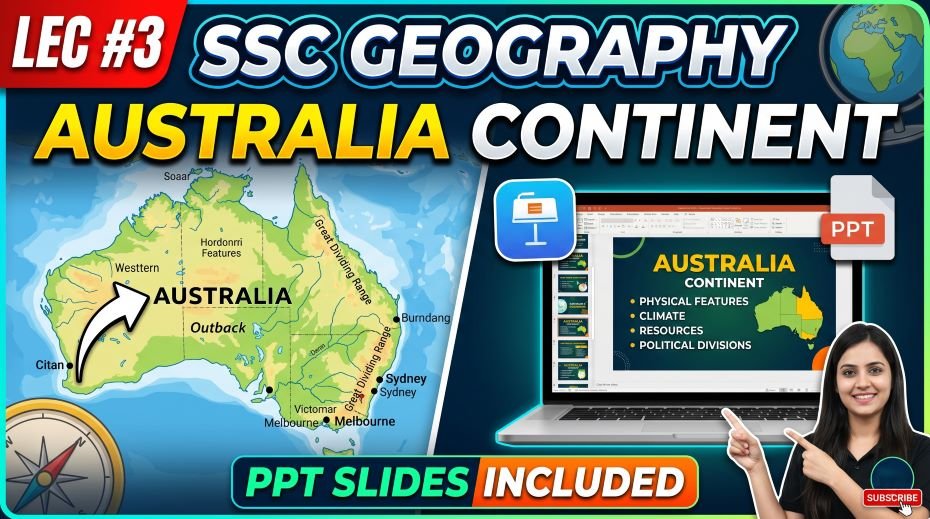
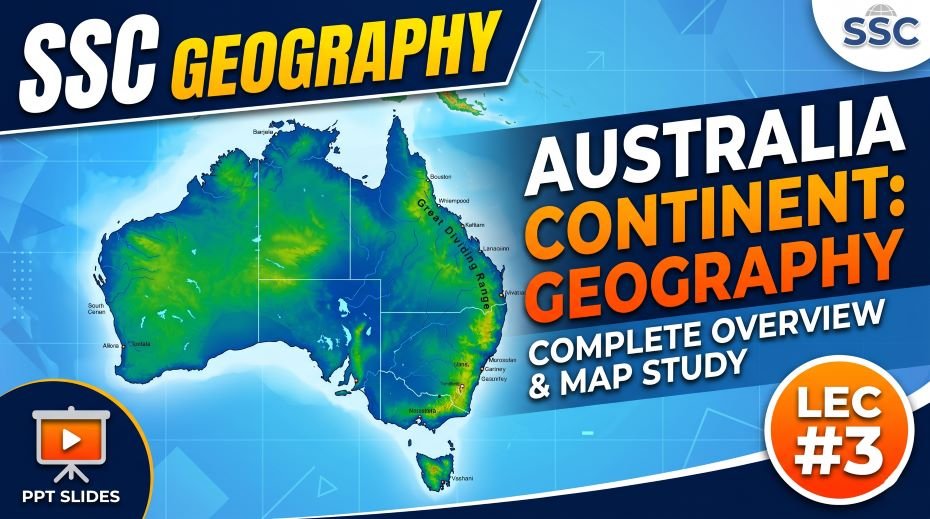
This article accompanies the SSC Geography Australia Continent PPT Slides (LEC #3) -Serial #81 of the Complete Foundation Batch for All SSC Exams PPT Series on slideshareppt.net. With 97 slides in bilingual Hindi + English format, this PPT covers the Australia Continent comprehensively. Australia is the only country in the world that is also a continent -and this unique distinction makes it one of the most asked topics in SSC CGL, SSC CHSL, SSC MTS, SSC GD Constable, and RRB Group D General Awareness sections. Questions on Australia cover its physical geography, capitals, states, rivers, deserts, mountains, climate, wildlife, economy, and its position in world geography rankings. This article provides the complete structured content -timeline, facts, comparison tables, MCQs, and a rapid revision cheat sheet -built specifically around the SSC exam pattern.
PPT Resource Overview
| Detail | Information |
| Lecture Number | LEC #3 (Geography Series) |
| Serial Number in Complete Batch | #81 |
| Subject | Geography – Australia Continent (ऑस्ट्रेलिया महाद्वीप) |
| Series Name | Complete Foundation Batch for All SSC Exams (PPT Series) |
| Total Slides | 97 PPT Slides |
| File Size | 20 MB |
| Language | Hindi + English (Bilingual) |
| Format Available | Google Slides & Google Drive (PDF also available) |
| Website | www.slideshareppt.net |
| Target Exams | SSC CGL, SSC CHSL, SSC MTS, SSC GD Constable, RRB Group D |
| Suitable For | Students (self-study & marathon revision) and Teachers (classroom use) |
SSC Geography Australia Continent PPT Slides (LEC #3)
Note: Above is PPT in GOOGLE SLIDES (HTML AND IFRAME COMBINATION) and if you wish to download the Complete SSC series (PPT slides), visit this Link – REDIRECT PAGE.
Master Timeline: Australia – History, Discovery, and Development
| Period | Event / Milestone | SSC Exam Relevance |
| ~65,000 BCE | Aboriginal Australians arrive -among the oldest continuous civilisations on Earth | Australia’s indigenous people -basic GK |
| ~50,000 BCE | Torres Strait Islander peoples inhabit northern Australia and nearby islands | Indigenous cultural geography |
| 1606 | Dutch explorer Willem Janszoon lands in Australia -first recorded European contact | First European contact with Australia |
| 1642 | Abel Tasman (Dutch) discovers Tasmania (then called Van Diemen’s Land) and New Zealand | Tasmania’s original name -frequently asked |
| 1770 | Captain James Cook charts Australia’s east coast; claims it for Britain; names it New South Wales | Cook’s voyage -very important for SSC GK |
| 1788 | First Fleet of British ships arrives; Sydney Cove established as a penal colony on 26 January | 26 January 1788 = Australia Day; Sydney founded |
| 1813 | Blue Mountains crossed for the first time -opens interior of continent for settlement | Geographic barrier crossed -Australian exploration |
| 1829 | Western Australia claimed; Australia’s entire continent now under British control | Australia as British territory |
| 1851 | Gold Rush in Victoria and New South Wales -massive population boom and immigration | Economic history of Australia |
| 1 January 1901 | Six colonies federate to form the Commonwealth of Australia -independence from Britain | Australia’s federation date -very frequently asked |
| 1908 | Canberra selected as the capital of Australia -compromise between Sydney and Melbourne | Canberra as capital -most asked SSC fact |
| 1913 | Canberra’s foundation stone laid; city officially begins construction | Capital establishment date |
| 1927 | Parliament of Australia moves from Melbourne to Canberra | Transfer of capital functions |
| 1942 | Australia fights in World War II; falls under threat from Japan; US alliance strengthened | WWII geography and alliances |
| 1948 | Snowy Mountains Hydroelectric Scheme begins -largest engineering project in Australian history | Snowy Mountains -rivers, hydropower |
| 1956 | Melbourne hosts the Summer Olympic Games | Australia hosting Olympics -GK |
| 1973 | Sydney Opera House completed -UNESCO World Heritage Site | Sydney Opera House -world geography landmark |
| 1986 | Australia Act passed -Australia becomes fully independent from UK legally | Full legal independence date |
| 2000 | Sydney hosts the Summer Olympic Games | Sydney Olympics -world events GK |
| Present Day | Australia is one of the world’s top 15 economies; member of G20, UN, Commonwealth, QUAD | Australia’s current international role |
Australia – The Only Continent That Is Also a Country
Australia holds a unique place in world geography -it is the only landmass on Earth that is simultaneously recognised as both a continent and a sovereign country. It is the world’s sixth-largest country by total area and the smallest continent by area. Located entirely in the Southern Hemisphere (and partly in the Eastern Hemisphere), Australia is surrounded by the Indian Ocean to the west and south, and the Pacific Ocean to the east.
Australia – Complete Key Facts Table
| Parameter | Detail |
| Official Name | Commonwealth of Australia |
| Capital City | Canberra (ACT -Australian Capital Territory) |
| Largest City | Sydney (New South Wales) |
| Second Largest City | Melbourne (Victoria) |
| Total Area | 7,692,024 sq km -6th largest country in world |
| World Rank by Area | 6th (after Russia, Canada, USA, China, Brazil) |
| Continent Rank by Area | Smallest continent (6th among 7 continents) |
| Population (approx.) | ~26 million (one of lowest population densities in world) |
| Population Density | ~3.5 persons per sq km -very sparse |
| Official Language | English (no official language constitutionally, but English used de facto) |
| Currency | Australian Dollar (AUD) |
| Government Type | Federal Parliamentary Constitutional Monarchy |
| Head of State | King Charles III (represented by Governor-General) |
| Head of Government | Prime Minister |
| Parliament | Federal Parliament -Senate + House of Representatives (Canberra) |
| Location | Southern Hemisphere; between Indian Ocean and Pacific Ocean |
| Latitudinal Extent | Approximately 10°S to 44°S |
| Longitudinal Extent | Approximately 114°E to 154°E |
| Time Zones | 3 main time zones (AEST, ACST, AWST) -some states have 30-min offsets |
| National Day | 26 January (Australia Day) -commemorates arrival of First Fleet in 1788 |
| Independence | 1 January 1901 (Federation); fully sovereign from 1986 |
| International Memberships | G20, UN, Commonwealth of Nations, OECD, ANZUS, QUAD, Five Eyes |
| Neighbouring Country (nearest) | Papua New Guinea (north), New Zealand (southeast -across Tasman Sea) |
| Tropic of Capricorn Passes Through | Yes -passes through central Australia at 23.5°S |
| National Animal | Red Kangaroo (also Emu and Kangaroo on coat of arms) |
| National Bird | Emu (largest bird in Australia; second largest in world after Ostrich) |
| National Flower | Golden Wattle (Acacia pycnantha) |
| National Gemstone | Opal (Australia produces ~95% of world’s opals) |
Australian States and Territories – Complete Table
| State / Territory | Capital | Abbreviation | Key Geographic / SSC Fact |
| New South Wales (NSW) | Sydney | NSW | Most populous state; largest city Sydney; Blue Mountains; Hunter Valley wine region |
| Victoria (VIC) | Melbourne | VIC | Smallest mainland state; most densely populated; Great Ocean Road; Australian Alps |
| Queensland (QLD) | Brisbane | QLD | Second largest state; Great Barrier Reef; tropical north; Sunshine Coast |
| Western Australia (WA) | Perth | WA | Largest state by area; Kimberley region; Pilbara iron ore; most isolated capital city |
| South Australia (SA) | Adelaide | SA | Lake Eyre (Kati Thanda) -lowest point in Australia; wine regions; Nullarbor Plain |
| Tasmania (TAS) | Hobart | TAS | Island state; separated from mainland by Bass Strait; coldest state; wilderness areas |
| Australian Capital Territory (ACT) | Canberra | ACT | Federal capital territory; home of Parliament House; Canberra = national capital |
| Northern Territory (NT) | Darwin | NT | Uluru (Ayers Rock) -UNESCO heritage; tropical north; Kakadu National Park; lowest population |
Physical Geography of Australia
Location and Surroundings
- Australia lies entirely in the Southern Hemisphere
- Located between the Indian Ocean (west and south) and the Pacific Ocean (east)
- The Coral Sea lies to the northeast; the Tasman Sea to the southeast (between Australia and New Zealand)
- The Timor Sea and Arafura Sea lie to the north
- The Bass Strait separates mainland Australia from the island state of Tasmania
- The Torres Strait separates Australia from Papua New Guinea to the north
Major Mountain Ranges of Australia
| Mountain Range | Location | Highest Peak | Key Facts for SSC |
| Great Dividing Range | Eastern Australia (QLD, NSW, VIC) | Mount Kosciuszko (2,228 m) | Longest mountain range in Australia; runs 3,500 km along eastern coast; separates coastal rivers from inland drainage; also called Eastern Highlands |
| Australian Alps | SE Australia (NSW and VIC) | Mount Kosciuszko (2,228 m) | Highest part of the Great Dividing Range; site of Snowy Mountains Hydroelectric Scheme; skiing destination; part of Alps National Park |
| Flinders Ranges | South Australia | St. Mary Peak (1,170 m) | Ancient mountain range in SA; important geological formations; arid landscape; popular with trekkers |
| MacDonnell Ranges | Northern Territory | Mount Zeil (1,531 m) | Runs east-west through NT near Alice Springs; ancient red rock ranges; Uluru nearby (separate formation) |
| Kimberley Plateau | Northwestern WA | Various peaks up to ~900 m | Ancient rock plateau; gorges and waterfalls; remote region; home to Aboriginal communities |
| Snowy Mountains | NSW/VIC border | Mount Kosciuszko (2,228 m) | Contains Australia’s highest peak; source of Murray and Murrumbidgee rivers; Snowy Hydro Scheme |
Major Rivers of Australia
| River | Length | States It Flows Through | Key Facts for SSC |
| Murray River | 2,508 km | NSW, VIC, SA | Longest river in Australia; flows into Southern Ocean near Adelaide; part of Murray-Darling system; most important river for irrigation |
| Darling River | 1,545 km | QLD, NSW | Longest tributary of the Murray; often dries up in drought; Murray-Darling Basin is Australia’s food bowl |
| Murrumbidgee River | 1,485 km | NSW, ACT | Major tributary of Murray; flows through Canberra region; important for agriculture in NSW |
| Lachlan River | 1,339 km | NSW | Tributary of Murrumbidgee; agricultural region |
| Cooper Creek | 1,420 km (approx.) | QLD, SA | Ephemeral river -flows only during floods; drains into Lake Eyre (Kati Thanda); Burke and Wills expedition |
| Flinders River | 840 km | QLD | Longest river draining into Gulf of Carpentaria; north-flowing |
| Fitzroy River (WA) | 733 km | WA | One of largest rivers in WA; flows through Kimberley region; seasonal flooding |
| Snowy River | 352 km | NSW, VIC | Famous for Snowy Mountains Scheme; diverted through tunnels for hydroelectricity and irrigation |
Major Lakes and Water Bodies of Australia
| Lake / Water Body | Type | Location | Key SSC Facts |
| Lake Eyre (Kati Thanda) | Salt lake / Playa lake | South Australia | Largest lake in Australia (when filled); lowest point in Australia at 15 m below sea level; usually dry; fills only during exceptional floods from Cooper Creek |
| Lake Torrens | Salt lake | South Australia | Second largest lake; usually a dry salt pan; national park |
| Lake Gairdner | Salt lake | South Australia | Third largest; salt flat used as land speed record venue |
| Lake Argyle | Reservoir (artificial) | Western Australia | Largest reservoir in Australia by volume; created by Ord River Dam; Kimberley region |
| Lake Amadeus | Salt lake | Northern Territory | Near Uluru; dry salt lake; protected as national park area |
| Great Barrier Reef Lagoon | Marine water body | Queensland (Coral Sea) | World’s largest coral reef system; UNESCO World Heritage; stretches 2,300 km; visible from space |
Deserts of Australia – Complete Table
| Desert | Area (approx.) | Location / State | Key Facts for SSC |
| Great Victoria Desert | ~424,400 sq km | WA and SA | Largest desert in Australia; hot and dry; part of the Western Plateau; rainfall very low (<250 mm) |
| Great Sandy Desert | ~267,250 sq km | Northern WA | Second largest; hot desert; sand dunes and spinifex grasslands; very remote |
| Tanami Desert | ~184,500 sq km | NT and WA | Sparsely populated; Aboriginal lands; some gold mining |
| Simpson Desert | ~176,500 sq km | SA, QLD, NT | Famous for its long parallel sand dunes -longest in world; drains into Lake Eyre; crossed by explorers |
| Gibson Desert | ~156,000 sq km | Central WA | Named after explorer Alfred Gibson who died there; very remote |
| Little Sandy Desert | ~111,500 sq km | WA | South of Great Sandy Desert; sand plains and dunes |
| Strzelecki Desert | ~80,250 sq km | SA, QLD, NSW | Named after Polish explorer Paul Strzelecki; sandy desert and gibber plains |
| Sturt Stony Desert | ~29,750 sq km | SA, QLD, NSW | Covered with polished stones (gibbers); explored by Charles Sturt |
| Tirari Desert | ~15,250 sq km | SA | North of Lake Eyre; part of the Channel Country drainage area |
Climate of Australia
Australia’s climate is diverse -ranging from tropical in the north to temperate in the south, and arid to semi-arid in the vast interior. The continent experiences the full range of climate types, which is partly why it hosts such unique and varied wildlife.
| Climate Zone | Region | Key Characteristics | States Affected |
| Tropical Rainforest | Far North Queensland | Heavy rainfall year-round; high humidity; tropical cyclones | QLD (Cape York Peninsula) |
| Tropical Savanna | Northern Australia | Wet-dry seasons; monsoon rains June–October reversed; warm year-round | NT, QLD, WA (north) |
| Arid / Desert | Interior (Outback) | Very hot summers; cold nights; rainfall under 250 mm/year; droughts | SA, WA, NT, NSW (interior) |
| Semi-Arid | Margins of interior | Low rainfall 250–500 mm; scrubland vegetation; hot summers | WA, SA, NSW, QLD (margins) |
| Mediterranean | Southwest WA and SA | Hot dry summers; mild wet winters; similar to Mediterranean Europe | SW WA, SA (Adelaide region) |
| Temperate Oceanic | Southeast Australia | Mild temperatures; year-round rainfall; four distinct seasons | VIC, SE NSW, TAS |
| Alpine / Sub-Alpine | Australian Alps | Cold winters with heavy snowfall; skiing; frost year-round above 1,500 m | NSW (Snowy Mtns), VIC |
Australia’s Unique Wildlife – SSC GK Facts
Australia’s long isolation from other landmasses has produced one of the most unique and diverse collections of wildlife on Earth. Approximately 80% of Australia’s plants, mammals, reptiles, and frogs are found nowhere else in the world.
Key Wildlife Groups
| Category | Key Species | SSC Fact |
| Marsupials | Kangaroo, Wallaby, Koala, Wombat, Tasmanian Devil, Quokka, Bandicoot | Marsupials carry young in pouch; Australia has ~70% of world’s marsupials; Red Kangaroo is largest marsupial |
| Monotremes | Platypus (Duck-billed), Echidna (Spiny Anteater) | Only egg-laying mammals in world; platypus has bill, webbed feet, and venomous spur; found only in Australia and New Guinea |
| Birds | Emu, Kookaburra, Lyrebird, Cassowary, Budgerigar, Black Swan, Cockatoo | Emu is largest bird in Australia (2nd in world after Ostrich); Emu cannot fly; Black Swan is WA’s state emblem |
| Reptiles | Saltwater Crocodile, Inland Taipan, Eastern Brown Snake, Blue-Tongued Lizard, Thorny Devil | Inland Taipan is world’s most venomous land snake; Saltwater Crocodile is world’s largest reptile |
| Marine Life | Great White Shark, Blue-Ringed Octopus, Box Jellyfish, Dugong, Whale Shark | Box Jellyfish is world’s most venomous marine creature; Blue-Ringed Octopus is deadly despite small size |
| Plants | Eucalyptus (Gum Trees), Acacia (Wattle), Banksia, Spinifex Grass, Kangaroo Paw | Australia has ~800 Eucalyptus species; Golden Wattle is national flower; Spinifex covers arid interior |
Great Barrier Reef – The World’s Largest Coral Reef System
| Parameter | Detail |
| Location | Coral Sea, off the coast of Queensland, northeastern Australia |
| Length | ~2,300 km (visible from space) |
| Area | ~344,400 sq km |
| Composition | Over 2,900 individual coral reefs and 900 islands |
| UNESCO Status | World Heritage Site since 1981 |
| Biodiversity | Over 1,500 species of fish, 4,000 mollusk species, 240 bird species, 6 species of sea turtles |
| Threats | Climate change (coral bleaching), ocean acidification, crown-of-thorns starfish, pollution |
| Nearest Major City | Cairns and Townsville (Queensland) |
| Economic Importance | Generates ~AUD 6.4 billion annually through tourism and fishing |
| SSC Importance | Very frequently asked -largest coral reef, location, UNESCO status |
Uluru (Ayers Rock) – The Sacred Monolith
| Parameter | Detail |
| Location | Northern Territory, central Australia -near Alice Springs |
| Height | 348 m above surrounding plain; 863 m above sea level |
| Circumference | ~9.4 km |
| Rock Type | Arkose (coarse-grained sandstone) |
| Age | Approximately 550–600 million years old |
| UNESCO Status | World Heritage Site (listed 1987; extended to cultural landscape 1994) |
| Ownership | Returned to the Anangu Aboriginal people in 1985; leased back to national park |
| Sacred Significance | Sacred site for the Anangu people (indigenous Australians); site of Tjukurpa (creation law) |
| Climbing Ban | Climbing permanently banned since 26 October 2019 |
| Other Name | Ayers Rock (colonial name); Uluru is the official Aboriginal name |
| Nearby Attraction | Kata Tjuta (The Olgas) -a group of 36 domed rock formations nearby |
| SSC Importance | Frequently asked -location (NT), Aboriginal connection, UNESCO status, height |
Economy of Australia – Key Facts for SSC
| Economic Parameter | Detail |
| GDP (nominal) | Approximately USD 1.7–1.8 trillion -top 15 economies in world |
| Currency | Australian Dollar (AUD) |
| Major Industries | Mining, Agriculture, Tourism, Financial Services, Education, Manufacturing |
| Top Exports | Iron ore, Coal, Natural gas (LNG), Gold, Beef, Wheat, Wool, Aluminium |
| Top Export Destinations | China (largest), Japan, South Korea, India, USA |
| Top Imports | Machinery, vehicles, pharmaceuticals, petroleum, electronics |
| Mining Significance | World’s largest exporter of iron ore, coal, and bauxite; largest lithium producer |
| Agriculture | World’s 4th largest wheat exporter; large cattle and sheep farming; merino wool famous |
| Tourism | Sydney Opera House, Great Barrier Reef, Uluru, Bondi Beach -major global destinations |
| Education Export | 3rd largest international student destination (after USA and UK) |
| Members of | G20, WTO, OECD, APEC, Commonwealth, QUAD, Five Eyes, ANZUS |
Australia Compared to All 7 Continents – Reference Table
| Continent | Area (sq km) | Population (approx.) | Highest Point | Lowest Point | Key Fact |
| Asia | 44.6 million | 4.7 billion | Mt. Everest (8,848 m) | Dead Sea (−431 m) | Largest and most populous continent |
| Africa | 30.4 million | 1.4 billion | Mt. Kilimanjaro (5,895 m) | Lake Assal (−155 m) | 2nd largest; oldest human fossils |
| North America | 24.7 million | 580 million | Denali (6,194 m) | Death Valley (−86 m) | 3rd largest; includes Greenland |
| South America | 17.8 million | 430 million | Aconcagua (6,961 m) | Laguna del Carbón (−105 m) | 4th largest; Amazon rainforest |
| Antarctica | 14.2 million | ~1,000 (researchers) | Vinson Massif (4,892 m) | Bentley Subglacial Trench (−2,555 m) | Coldest, driest, windiest; no permanent residents |
| Europe | 10.5 million | 746 million | Mont Blanc (4,808 m) | Caspian Sea (−28 m) | 6th by area; most developed; smallest continent (exc. Australia) |
| Australia | 7.7 million | ~26 million | Mt. Kosciuszko (2,228 m) | Lake Eyre (−15 m) | Smallest continent; only country-continent; driest inhabited continent |
Quick Fact Table – Australia for SSC Exams
| Question / Fact | Answer |
| Capital of Australia | Canberra |
| Largest city of Australia | Sydney |
| Australia’s area | 7,692,024 sq km -6th largest country |
| Smallest continent | Australia (7.7 million sq km) |
| Australia’s population | ~26 million (one of lowest density countries) |
| Currency of Australia | Australian Dollar (AUD) |
| When did Australia federate? | 1 January 1901 |
| Australia’s national day | 26 January (Australia Day) |
| National animal of Australia | Red Kangaroo |
| National bird of Australia | Emu (cannot fly; 2nd largest bird after Ostrich) |
| Longest river in Australia | Murray River (2,508 km) |
| Largest desert in Australia | Great Victoria Desert (~424,400 sq km) |
| Highest peak in Australia | Mount Kosciuszko (2,228 m) in Australian Alps, NSW |
| Lowest point in Australia | Lake Eyre (Kati Thanda) -15 m below sea level, SA |
| Largest lake in Australia | Lake Eyre (Kati Thanda) -when filled with water |
| World’s largest coral reef | Great Barrier Reef -off Queensland coast -2,300 km |
| Uluru (Ayers Rock) location | Northern Territory -near Alice Springs |
| Uluru’s height | 348 m above surrounding plain |
| Climbing ban on Uluru since | 26 October 2019 |
| Why is Canberra the capital? | Compromise between Sydney and Melbourne during federation negotiations |
| Tasmania is separated from mainland by | Bass Strait |
| Australia separated from PNG by | Torres Strait |
| Tropic of Capricorn passes through | Central Australia at 23.5°S |
| Australia’s time zones | 3 main zones: AEST (GMT+10), ACST (GMT+9:30), AWST (GMT+8) |
| World’s most venomous land snake | Inland Taipan (found in Australia) |
| Egg-laying mammals found only in Australia | Platypus and Echidna (Monotremes) |
| Australia produces __% of world’s opals | ~95% -national gemstone is Opal |
| Australia’s biggest trading partner | China (largest export destination) |
| Top export of Australia | Iron ore |
| Australia is member of (key groups) | G20, QUAD, Five Eyes, Commonwealth, ANZUS, OECD |
| Who discovered eastern Australia? | Captain James Cook (1770) |
| First European contact with Australia | Willem Janszoon, Dutch explorer (1606) |
| Tasmania’s original name | Van Diemen’s Land (named by Abel Tasman, 1642) |
Podcast-Style Q&A – Australia Continent
Q1: Why is Australia both a continent and a country?
Australia is the only landmass on Earth that occupies an entire continental plate by itself and has no other sovereign nations sharing it. All of the continent’s landmass is governed by the Commonwealth of Australia, making it unique as a country-continent. Every other continent is shared by multiple countries (Asia, Europe, Africa, North and South America) or is uninhabited (Antarctica). This makes the question ‘Australia is the smallest continent and sixth-largest country’ a classic SSC favourite.
Q2: Why is Canberra Australia’s capital and not Sydney or Melbourne?
When the six Australian colonies federated in 1901, both Sydney (the largest city in New South Wales) and Melbourne (the largest city in Victoria) wanted to be the national capital. Neither would accept the other’s city. As a compromise, the Constitution stated that the capital must be in New South Wales but at least 100 miles from Sydney. A site in the southern tablelands of NSW was chosen, and Canberra was purpose-built. Parliament was held in Melbourne from 1901 until the move to Canberra in 1927.
Q3: What makes the Great Barrier Reef unique and why is it threatened?
The Great Barrier Reef off the Queensland coast is the world’s largest coral reef system at approximately 2,300 km in length, visible from space, and encompassing over 344,400 sq km. It was listed as a UNESCO World Heritage Site in 1981. It supports extraordinary biodiversity -over 1,500 fish species, 4,000 mollusk species, and 6 sea turtle species. Its main threats are rising ocean temperatures (causing coral bleaching), ocean acidification from CO2 absorption, the crown-of-thorns starfish which feeds on coral, and agricultural runoff from Queensland. These threats are frequently referenced in both Geography and Environment sections of SSC papers.
Q4: What is a Marsupial and why is Australia famous for them?
Marsupials are mammals that give birth to very underdeveloped young and then carry them in a pouch (called a marsupium) on their body where the young continue to develop. Australia has around 70% of the world’s marsupial species because the continent separated from other landmasses very early in geological history, allowing these animals to evolve without competition from placental mammals. Famous Australian marsupials include the Kangaroo, Koala, Wombat, Tasmanian Devil, Wallaby, and Quokka.
Q5: What are Monotremes and which animals are examples?
Monotremes are the only mammals in the world that lay eggs instead of giving birth to live young. There are only five monotreme species alive today, all found only in Australia and New Guinea. The two most famous are the Duck-Billed Platypus and the Echidna (Spiny Anteater). The Platypus is remarkable in that it has a duck-like bill, webbed feet, is semi-aquatic, and the male has a venomous spur on its hind leg. These animals are among the most asked topics in SSC GK under Biology-Geography crossover questions.
Q6: What is the Outback and why does Australia have so many deserts?
The Outback refers to the vast, arid to semi-arid interior of Australia that is extremely sparsely populated and largely inaccessible. Australia is the world’s driest inhabited continent -about 70% of its landmass is classified as arid or semi-arid. This is because the continent lies in the subtropical high-pressure belt, which suppresses rainfall over large areas. The Great Dividing Range also blocks moisture from the Pacific from reaching the interior. Australia has 10 named deserts, with the Great Victoria Desert being the largest. The deserts are hot during the day and cold at night, with very low and unreliable rainfall.
Q7: What is the significance of Uluru and why was climbing banned?
Uluru, also known as Ayers Rock, is a massive sandstone monolith rising 348 m above the surrounding flat plain in the Northern Territory. It is approximately 550–600 million years old and changes colour dramatically at sunrise and sunset, appearing to glow red and orange. Uluru holds deep spiritual and cultural significance for the Anangu Aboriginal people, for whom it is a sacred site connected to their Tjukurpa (creation law and traditions). Despite requests from the Anangu people for decades, tourists climbed Uluru until the practice was permanently banned on 26 October 2019 out of respect for Aboriginal cultural heritage. Uluru has been a UNESCO World Heritage Site since 1987.
30 MCQ Practice Questions – Australia Continent
All questions follow SSC CGL, CHSL, MTS, and GD Constable exam patterns. Answers follow at the end.
- What is the capital city of Australia?
A) Sydney B) Melbourne C) Canberra D) Brisbane
- Australia is the ___ largest country in the world by area.
A) 4th B) 5th C) 6th D) 7th
- Which is the largest city in Australia?
A) Canberra B) Melbourne C) Brisbane D) Sydney
- Australia’s total area is approximately:
A) 5.5 million sq km B) 7.7 million sq km C) 9 million sq km D) 11 million sq km
- Australia is the ___ smallest continent.
A) 1st B) 2nd C) 3rd D) It is the smallest
- When did Australia federate as a nation?
A) 26 January 1788 B) 1 January 1901 C) 15 August 1947 D) 1 July 1931
- The longest river in Australia is:
A) Darling River B) Murrumbidgee River C) Murray River D) Snowy River
- What is the highest peak in Australia?
A) Mount Kosciuszko B) Mount Zeil C) Blue Mountain D) Flinders Peak
- The lowest point in Australia is:
A) Lake Torrens B) Great Victoria Desert C) Lake Eyre (Kati Thanda) D) Simpson Desert
- The Great Barrier Reef is located off the coast of which state?
A) New South Wales B) Victoria C) Queensland D) Western Australia
- The Great Barrier Reef is approximately ___ km long.
A) 1,000 km B) 1,500 km C) 2,300 km D) 3,000 km
- Uluru (Ayers Rock) is located in:
A) South Australia B) Western Australia C) Queensland D) Northern Territory
- Climbing on Uluru was permanently banned in:
A) 1985 B) 2000 C) 2015 D) 2019
- Which is the largest desert in Australia?
A) Simpson Desert B) Great Sandy Desert C) Gibson Desert D) Great Victoria Desert
- Which strait separates Australia from Tasmania?
A) Torres Strait B) Bass Strait C) Palk Strait D) Malacca Strait
- Which strait separates Australia from Papua New Guinea?
A) Bass Strait B) Cook Strait C) Torres Strait D) Davis Strait
- Australia’s national animal is:
A) Koala B) Platypus C) Red Kangaroo D) Emu
- What is the national bird of Australia?
A) Kookaburra B) Cassowary C) Emu D) Black Swan
- Mammals that lay eggs are called:
A) Marsupials B) Monotremes C) Placentals D) Reptilians
- Which of the following is NOT a marsupial?
A) Kangaroo B) Koala C) Platypus D) Wombat
- The world’s most venomous land snake (Inland Taipan) is found in:
A) Africa B) India C) Australia D) Brazil
- Australia produces approximately what percentage of world’s opals?
A) 50% B) 70% C) 85% D) 95%
- The Tropic of Capricorn passes through:
A) Northern Australia B) Southern Australia C) Central Australia D) Eastern Australia only
- Which Australian state has the longest coastline?
A) Queensland B) Western Australia C) New South Wales D) South Australia
- The Australian currency is:
A) Australian Pound B) Pacific Dollar C) Australian Dollar D) Oceanian Dollar
- Tasmania was originally called:
A) New Holland B) Van Diemen’s Land C) New South Wales D) Botany Bay
- Who was the first European to chart Australia’s east coast?
A) Abel Tasman B) Willem Janszoon C) James Cook D) Francis Drake
- Which city was Australia’s capital before Canberra?
A) Sydney B) Brisbane C) Melbourne D) Perth
- Lake Eyre is located in which state?
A) Victoria B) Queensland C) Western Australia D) South Australia
- Australia’s largest trading partner is:
A) USA B) Japan C) India D) China
Answer Key
| Q | Ans | Q | Ans | Q | Ans |
| 1 | C | 11 | C | 21 | C |
| 2 | C | 12 | D | 22 | D |
| 3 | D | 13 | D | 23 | C |
| 4 | B | 14 | D | 24 | B |
| 5 | D | 15 | B | 25 | C |
| 6 | B | 16 | C | 26 | B |
| 7 | C | 17 | C | 27 | C |
| 8 | A | 18 | C | 28 | C |
| 9 | C | 19 | B | 29 | D |
| 10 | C | 20 | C | 30 | D |
also read: SSC Geography Latitude and Longitude PPT Slides (LEC #2)
Rapid Revision Cheat Sheet – Australia Continent
| Topic | Key Point |
| Official name | Commonwealth of Australia |
| Capital | Canberra (ACT) -purpose-built; compromise between Sydney & Melbourne |
| Largest city | Sydney (New South Wales) |
| Area | 7,692,024 sq km -6th largest country; smallest continent |
| Population | ~26 million -very low density (~3.5/sq km) |
| Currency | Australian Dollar (AUD) |
| Federation date | 1 January 1901 |
| National Day | 26 January (Australia Day -First Fleet 1788) |
| Longest river | Murray River -2,508 km -flows into Southern Ocean |
| Murray-Darling Basin | Australia’s food bowl -most important agricultural river system |
| Highest peak | Mount Kosciuszko -2,228 m -NSW (Australian Alps) |
| Lowest point | Lake Eyre (Kati Thanda) -15 m below sea level -SA |
| Largest desert | Great Victoria Desert -~424,400 sq km -WA & SA |
| Great Barrier Reef | 2,300 km -off QLD coast -world’s largest coral reef -UNESCO 1981 |
| Uluru | 348 m -NT -sandstone monolith -UNESCO 1987 -climbing banned Oct 2019 |
| National animal | Red Kangaroo -largest marsupial |
| National bird | Emu -cannot fly -2nd largest bird in world |
| Marsupials | Carry young in pouch; ~70% of world’s species in Australia |
| Monotremes | Egg-laying mammals -Platypus and Echidna -only in Australia & New Guinea |
| Inland Taipan | World’s most venomous land snake -found in Australia |
| Tasmania separated by | Bass Strait -from mainland Australia |
| Australia from PNG | Torres Strait -separates Australia from Papua New Guinea |
| Tropic of Capricorn | Passes through central Australia at 23.5°S |
| Time zones | AEST GMT+10 / ACST GMT+9:30 / AWST GMT+8 |
| Top export | Iron ore -China is largest buyer |
| Opal production | ~95% of world’s opals -national gemstone |
| Canberra capital since | Parliament moved from Melbourne to Canberra in 1927 |
| Tasmania original name | Van Diemen’s Land (Abel Tasman, 1642) |
| Cook’s contribution | Charted east coast in 1770; claimed for Britain |
| Serial number of this PPT | #81 in the Complete Foundation Batch |
Conclusion
Australia Continent is one of the most fact-rich and exam-friendly topics in SSC Geography. From its unique status as the world’s only country-continent, to its extraordinary wildlife (marsupials and monotremes), iconic landmarks (Uluru and Great Barrier Reef), longest river (Murray), highest peak (Kosciuszko), and deepest low point (Lake Eyre) -this topic delivers direct, measurable marks in every SSC and RRB exam.
The SSC Geography Australia Continent PPT Slides (LEC #3), Serial #81, available at slideshareppt.net in bilingual Hindi + English format with 97 slides, provides a complete visual resource for this topic. Study the tables in this article carefully, practise the 30 MCQs, and keep the Rapid Revision Cheat Sheet handy for the days before your exam.
Whether you are preparing for SSC CGL, CHSL, MTS, GD Constable, or RRB Group D, a thorough command of the Australia Continent topic ensures you do not miss any question from this section. Bookmark this article and the PPT for comprehensive preparation.