This article covers SSC Polity CENTRE and STATE RELATIONS PPT Slides (LEC #16), (केंद्र और राज्य संबंध), part of the Complete Foundation Batch PPT Series at slideshareppt.net. Centre-State Relations is one of the most important and comprehensive topics for SSC CGL, CHSL, CPO, and MTS exams. Questions are asked on the three lists (Union, State, Concurrent), Articles 245–263, Parliament’s power to legislate on State List, conflict resolution between Union and State laws, financial relations, the Finance Commission, Sarkaria Commission, and the Inter-State Council.
SSC Polity CENTRE and STATE RELATIONS PPT Slides (LEC #16)
Note: Above is PPT in GOOGLE SLIDES (HTML AND IFRAME COMBINATION) and if you wish to download the Complete SSC series (PPT slides), Simply visit this redirect page – REDIRECT PAGE.
1. Centre-State Relations – Overview
India is a federal system with unitary bias – powers divided between Centre (Union) and States
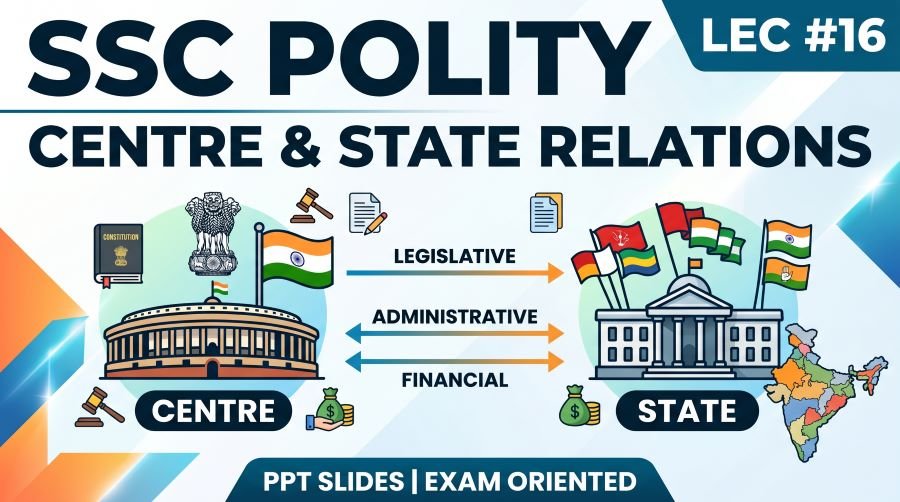
Centre-State relations are governed by three dimensions: Legislative, Administrative, and Financial
Part XI of the Constitution (Articles 245–263) deals with Legislative and Administrative relations
Part XII (Articles 264–300A) deals with Financial relations
The 7th Schedule divides legislative powers into three lists: Union List, State List, Concurrent List
India is described as ‘quasi-federal’ or ‘federal with unitary bias’ – Centre is stronger than States
The term ‘Union’ (not ‘Federation’) was deliberately chosen by framers to indicate the indissoluble nature of the Indian State
Union List has the most important and numerous subjects – Centre has exclusive power
In case of any conflict: Union List > State List; Union law > State law on Concurrent List
Residuary powers (not in any list) – with Parliament (Article 248 + Entry 97 of Union List)
Unlike USA where residuary powers are with states, in India they are with the Centre
Forests, Education, and certain other subjects were moved from State List to Concurrent List by 42nd Amendment 1976
GST subsumed many Union and State taxes after 101st Amendment 2016
4. Legislative Relations – Parliament’s Power Over State List
Under normal circumstances, Parliament cannot legislate on State List subjects. However, the Constitution provides five exceptional situations where Parliament can legislate on State List:
Situation
Article
Condition
Duration
National Interest – RS Resolution
249
Rajya Sabha passes resolution by 2/3 of members present and voting that it is necessary in national interest for Parliament to legislate on a State List subject
Resolution valid for 1 year; renewable; law ceases within 6 months after resolution lapses
National Emergency
250
During National Emergency (Article 352) – Parliament can legislate on State List subjects
Law ceases within 6 months after emergency ends
Request by States
252
If 2 or more state legislatures pass resolutions requesting Parliament to legislate on a State List subject
Law applies only to those states that passed resolution; other states may adopt later
International Treaties
253
Parliament can legislate on any subject (including State List) to implement international treaties, agreements, or conventions
No time limit – permanent law
President’s Rule in State
356
During President’s Rule – Parliament can legislate for that state on State List subjects
Law continues even after President’s Rule ends; but can be repealed/altered by state legislature after 6 months
5. Conflict Resolution Between Union and State Laws
List / Situation
Rule for Conflict Resolution
Article
Union List vs State List
Union law always prevails; Parliament has exclusive power over Union List
Article 246(1)
Concurrent List – Union vs State
If both Parliament and State Legislature make laws on same subject in Concurrent List, Union (Parliamentary) law prevails; State law void to extent of repugnancy
Article 254(1)
Concurrent List – Exception
If State law on Concurrent List subject was reserved for President’s consideration AND received President’s assent – State law prevails over Union law in that state
Article 254(2)
Residuary Powers
Parliament has exclusive power to legislate on any matter not enumerated in any List
Article 248 + Entry 97 of Union List
Concurrent List – New Union law
If Parliament later makes law on same Concurrent subject, new Union law prevails; State law becomes void to extent of repugnancy
Article 254(1)
Doctrine of Repugnancy – Article 254
If there is repugnancy (conflict) between a Union law and a State law on a Concurrent List subject, Union law prevails
The State law is void to the extent of repugnancy – not entirely void, just the conflicting part
Exception under Article 254(2): If the State law was passed after and in addition to a Central law, AND was reserved for President’s consideration and received Presidential assent, the State law shall prevail in that state
However, Parliament can at any time make a law which overrides the State law
6. Administrative Relations – Centre and States
Type
Details
Article
Union Executive Power
Extends to matters on Union List and matters where Parliament has power to legislate
Article 73
State Executive Power
Extends to matters on State List; must not impede Union’s executive power
Article 162 + Article 257
Centre’s obligation to states
Centre must protect states against external aggression and ensure constitutional governance
Article 355
State’s obligation to Centre
States must comply with laws made by Parliament; not impede Centre’s executive power
Article 256 + 257
Centre can give directions to states
Centre can give directions on construction of communication means, protection of railways, etc.
Article 257(2)(3)
All India Services
IAS, IPS, IFoS – serve both Centre and States; controlled ultimately by Centre
Article 312
Centre can confer powers on states
Parliament can by law vest powers in state officers to execute Union laws
Article 258
Delegation of functions
President can with state’s consent entrust functions to state governments
Article 258A (deleted)
Interstate disputes on water
Parliament can by law provide for adjudication of disputes on inter-state river waters
Article 262
All India Services – Article 312
All India Services (AIS) are common to both the Centre and States
Three All India Services: Indian Administrative Service (IAS), Indian Police Service (IPS), Indian Forest Service (IFoS)
Members of AIS are recruited by Centre (through UPSC) but serve both Centre and State governments
Service matters of AIS officers while on state deputation controlled by state; overall control with Centre
New All India Services can be created only if Rajya Sabha passes a resolution by 2/3 majority (Article 312)
7. Financial Relations – Centre and States
Type
Details
Article
Finance Commission
President constitutes every 5 years; recommends distribution of taxes between Centre and States
Article 280
Duties levied by Union, collected by States
Stamp duties on bills of exchange, cheques; excise on medicines etc.
Article 268
Taxes levied and collected by Union, distributed to States
Income tax, corporation tax, customs, GST (after 101st Amendment)
Article 270
Grants-in-Aid
Parliament may by law provide grants-in-aid from CFI to states in need
Article 275
Grants for special purposes
Parliament can make grants for any purpose even if not in state’s legislative field
Article 282
Borrowing by States
States can borrow within India on the security of CFoS; if state has outstanding Union loan, needs Union consent
Article 293
Consolidated Fund of State
All revenues received by state government; all loans raised by state
Article 266
State’s taxation
State can only tax subjects in State List; cannot tax subjects in Union List
7th Schedule
GST Council
101st Amendment 2016; Centre + States make joint decisions on GST rates
Article 279A
Finance Commission – Article 280 (Most Important)
President constitutes a Finance Commission every 5 years (or earlier if necessary)
Composition: Chairman + 4 other members; qualifications prescribed by Parliament
Functions: Recommends distribution of net proceeds of taxes between Centre and States; grants-in-aid to states; measures to augment Consolidated Fund of states to supplement resources of Panchayats and Municipalities
16th Finance Commission: constituted in 2023 under Dr. Arvind Panagariya; recommendations for 2026–2031
15th Finance Commission (2021–2026): recommended 41% vertical devolution to states (down from 42% in 14th FC due to J&K becoming UT)
GST and Cooperative Federalism
101st Constitutional Amendment 2016 introduced Goods and Services Tax (GST)
Added Article 246A – both Parliament and State Legislatures can make laws on GST
Added Article 279A – GST Council: Union Finance Minister (Chair) + State Finance Ministers
GST Council decides on rates, exemptions, model legislation; decisions by 3/4 majority
1/3 vote weightage to Centre; 2/3 vote weightage to all States combined
GST is considered the best example of cooperative federalism in India
8. Inter-State Relations and Coordination Mechanisms
Mechanism
Constitutional/Statutory Basis
Purpose
Inter-State Council
Article 263 – President can establish by order
Inquires into and advises on disputes between states; investigates subjects of common interest; recommends policy coordination; set up in 1990
Zonal Councils
States Reorganisation Act 1956 – statutory, not constitutional
5 zones + North-East Council; chaired by Union Home Minister; discusses development, security, social and economic planning
River Water Disputes Tribunals
Article 262 + Inter-State Water Disputes Act 1956
Adjudicate disputes on inter-state rivers; e.g., Cauvery Tribunal, Krishna Tribunal
Full Faith and Credit Clause
Article 261
Public acts, records, judicial proceedings of Union and every state shall be given full faith and credit throughout India
GST Council
Article 279A (101st Amendment 2016)
Joint body of Finance Ministers of Centre and all States; decides on GST rates; represents cooperative federalism
Finance Commission
Article 280
Recommends devolution of central taxes to states; grants-in-aid; ensures fiscal balance
Zonal Councils – Details
5 Zonal Councils created under States Reorganisation Act 1956 (statutory, not constitutional)
Northern Zone, Southern Zone, Eastern Zone, Western Zone, Central Zone
North-Eastern Council: separate body; set up under North-Eastern Council Act 1971
Each Zonal Council chaired by Union Home Minister
State CMs and 2 ministers are members from each state
Advisory body only – recommendations not binding
SSC Polity CENTRE and STATE RELATIONS PPT Slides (LEC #16)
9. Key Commissions on Centre-State Relations
Commission / Body
Year
Key Recommendations on Centre-State Relations
Sarkaria Commission
1983–1988
Governor should not be active politician; Article 356 should be sparingly used; Inter-State Council should be set up; Centre should consult states before legislating on Concurrent List; All India Services should be strengthened
Punchhi Commission
2007–2010
Governor should have fixed 5-year tenure; removal only with Supreme Court concurrence; localisation of All India Services; Inter-Governmental Council to replace Inter-State Council; Article 355 and 356 should be amended; states should get more fiscal powers
Inter-State Council
1990
Set up under Article 263; chaired by PM; inquires into disputes and recommends on subjects of common interest; meets periodically
Zonal Councils
1956
5 Zonal Councils set up under States Reorganisation Act 1956 (not constitutional bodies); chaired by Union Home Minister; advisory body; discuss matters of common interest in each zone
National Development Council (NDC)
1952
Now replaced by NITI Aayog; was a platform for Centre-State cooperation on planning and development
10. Why India Has Unitary Bias Despite Being Federal
Single Constitution for both Centre and States (except J&K earlier) – unlike USA/Australia
Residuary powers with Centre (Article 248) – unlike USA where residuary powers are with states
Single citizenship – no separate state citizenship
Integrated judiciary – single Supreme Court for whole country
All India Services – Centre recruits and controls IAS, IPS, IFoS
Emergency provisions (Articles 352, 356, 360) give Centre sweeping powers over states
Parliament can alter state boundaries and names without state’s consent (Article 3)
Governor appointed by President – Centre’s representative in states
Centre can give directions to states and states must comply (Articles 256, 257)
Under President’s Rule, Centre takes complete control of state administration
11. Cooperative Federalism in India
Cooperative federalism means Centre and States work together as partners rather than adversaries
GST Council (Article 279A) is the best example of cooperative federalism
NITI Aayog (replaced NDC in 2015) – a platform for Centre-State cooperation on development
National Integration Council – discusses communal harmony; PM chairs; all CMs are members
Inter-State Council (Article 263) – set up in 1990; PM chairs; discusses matters of common interest
District Mineral Foundation, MGNREGS, Ayushman Bharat – joint Centre-State schemes
Centrally Sponsored Schemes (CSS) – Centre funds, States implement; major example of cooperative federalism