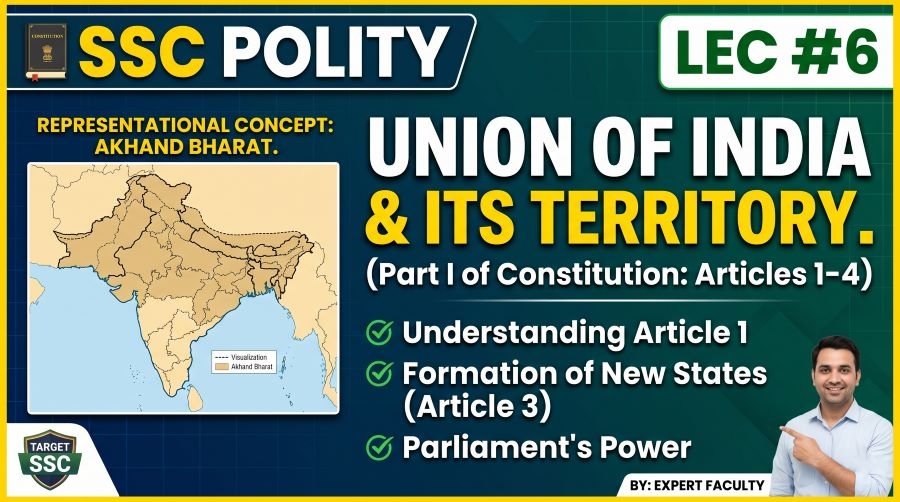
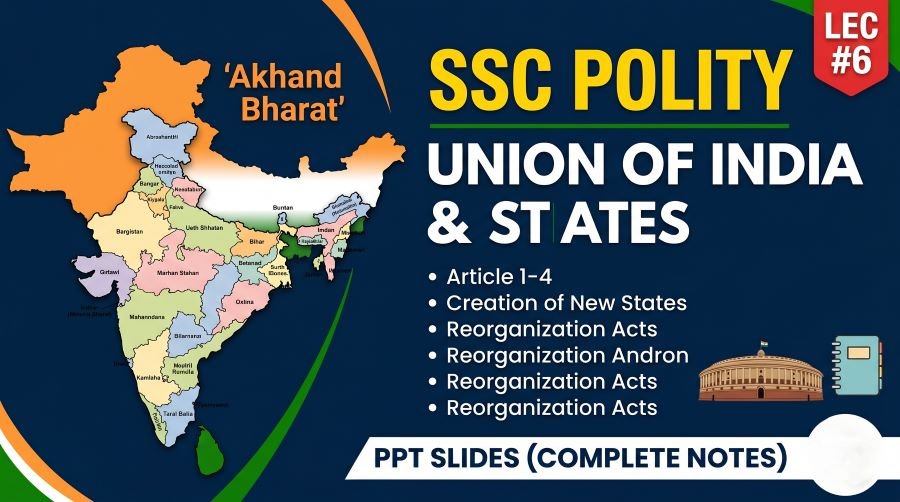
This article covers SSC Polity Union of India and States PPT Slides (LEC #6) / Reorganisation of States (राज्यों का पुनर्गठन; भारत संघ और राज्य), part of the Complete Foundation Batch PPT Series at slideshareppt.net. This lecture covers Article 1 to Article 4, Union Territories, the pre-1956 classification of states, the States Reorganisation Act 1956, and the complete history of how India’s current 28 states and 8 Union Territories were formed. Questions from this topic – especially on Article 3, linguistic states, new states, and UTs – appear in almost every SSC CGL, CHSL, CPO, and MTS exam.
SSC Polity Union of India and States PPT Slides (LEC #6)
Subject
Polity – Reorganisation of States (राज्यों का पुनर्गठन); Union of India and States (भारत संघ और राज्य); Reorganisation of States in India (भारत में राज्यों का पुनर्गठन)
Series
Complete Foundation Batch for All SSC and Other Exams (PPT Series)
SSC Polity Union of India and States PPT Slides (LEC #6)
Note: Above is PPT in GOOGLE SLIDES (HTML AND IFRAME COMBINATION) and if you wish to download the Complete SSC series (PPT slides), Simply visit this redirect page – REDIRECT PAGE.
Complete Timeline – Union of India and Reorganisation of States
Year
Event / Act
Key Significance
1947
Indian Independence Act
India and Pakistan created; Princely States free to accede
1947-1950
Integration of Princely States
Sardar Patel integrated 562 princely states into India
1950
Constitution of India enforced
Part A, B, C, D states classification introduced
1953
Andhra State created
First state carved on linguistic basis; from Madras State; after Potti Sriramulu’s fast unto death
1953
States Reorganisation Commission (SRC) set up
Fazal Ali Commission; members: Fazal Ali, K.M. Panikkar, H.N. Kunzru
1955
SRC Report submitted
Recommended reorganisation of states on linguistic basis
1956
States Reorganisation Act 1956
Reorganised India into 14 States and 6 Union Territories
1956
7th Constitutional Amendment 1956
Abolished Part A, B, C, D classification; only States and UTs
1960
Bombay State bifurcated
Maharashtra (Marathi) and Gujarat (Gujarati) created
Goa became 25th state (from UT); Arunachal Pradesh 24th, Mizoram 23rd
2000
Chhattisgarh, Jharkhand, Uttarakhand
Three new states carved from MP, Bihar, UP respectively
2014
Telangana created
29th state; carved from Andhra Pradesh on 2 June 2014
2019
J&K bifurcated
J&K and Ladakh became two Union Territories (31 Oct 2019)
2024
India has 28 States + 8 UTs
Current composition of the Indian Union
1. India as a Union of States – Article 1
Article 1 declares: ‘India, that is Bharat, shall be a Union of States’
India is called a ‘Union’ not a ‘Federation’ – a deliberate choice by the framers
Reason: The Indian Union is indestructible; states cannot secede from the Union
Unlike the USA where states came together to form a federation, India’s states are creations of the Constitution
Territory of India: (i) territories of the States, (ii) Union Territories, (iii) other territories acquired
Article 1(3): The territory of India shall comprise the territories of the States; the Union Territories; and such other territories as may be acquired
2. Parliament’s Power Over States – Articles 2, 3, and 4
Article 2 – Admission or Establishment of New States
Parliament may by law admit into the Union, or establish, new states on such terms and conditions as it thinks fit
This covers territories that are not already part of India (e.g., Sikkim in 1975, Goa after liberation from Portugal in 1961)
No prior consent of any state legislature required
Article 3 – Formation of New States and Alteration of Areas, Boundaries, Names
Parliament can: (a) form a new state by separation of territory from any state or by uniting two or more states or parts of states
Parliament can: (b) increase the area of any state
Parliament can: (c) diminish the area of any state
Parliament can: (d) alter the boundaries of any state
Parliament can: (e) alter the name of any state
Procedure: Bill must be introduced only on recommendation of the President
President must refer the Bill to the concerned State Legislature(s) for expressing views within a specified time
State Legislature’s opinion is NOT binding on Parliament – Parliament can override it
The Bill requires only a simple majority in Parliament – NOT a special majority
This makes India’s federalism asymmetric – Centre can redraw state boundaries unilaterally
Article 4 – Laws Under Articles 2 and 3 Not Constitutional Amendments
Laws made under Articles 2 and 3 are not considered constitutional amendments under Article 368
They can be passed by simple majority
This provision enables easy reorganisation of states
3. Key Articles – Union and Its Territory
Article
Subject
Article 1
Name and territory of the Union – ‘India, that is Bharat, shall be a Union of States’
Article 2
Admission or establishment of new states by Parliament
Article 3
Formation of new states; alteration of areas, boundaries, names of existing states (Parliament’s power)
Article 4
Laws made under Articles 2 and 3 not to be deemed amendments of the Constitution
Article 239
Administration of Union Territories
Article 239A
Creation of local Legislatures or Council of Ministers for certain UTs
Article 239AA
Special provisions for Delhi (NCT) – added by 69th Amendment 1991
Article 239AB
Provisions for suspension of constitutional government in UT
Article 240
Power of President to make regulations for certain UTs
Article 241
High Courts for Union Territories
Article 244
Administration of Scheduled Areas (5th Schedule) and Tribal Areas (6th Schedule)
Article 370
Special status of J&K – abrogated on 5 August 2019 by Presidential Order
Article 371
Special provisions for certain states (Maharashtra, Gujarat, Nagaland, Assam, Manipur, AP, Sikkim, Mizoram, Arunachal, Goa, Karnataka)
4. Classification of States Before 1956 (Pre-7th Amendment)
At the time of the Constitution (1950), Indian states were classified into four categories:
Category (Pre-1956)
States / Areas
Status After 1956
Part A States (9)
Former British Indian Provinces; had Governor and state legislature
Became regular States after 7th Amendment 1956
Part B States (8)
Former Princely States with legislature
Merged into States; classification abolished
Part C States (10)
Chief Commissioner’s Provinces and some smaller princely states
Some became UTs; some merged with states
Part D Territory (1)
Andaman & Nicobar Islands
Remained as Union Territory
This four-part classification was abolished by the 7th Constitutional Amendment Act 1956
After 1956: only two categories exist – States and Union Territories
The States Reorganisation Act 1956 reorganised India into 14 States and 6 Union Territories on 1 November 1956
5. States Reorganisation Commission (SRC) and Act 1956
States Reorganisation Commission (SRC) – Fazal Ali Commission
Set up in 1953 after the creation of Andhra Pradesh as the first linguistic state
Chairman: Justice Fazal Ali
Members: K.M. Panikkar and H.N. Kunzru
Report submitted in 1955 – recommended reorganisation on linguistic basis
Recommended 16 states and 3 centrally administered territories
States Reorganisation Act 1956
Passed on 31 August 1956; effective from 1 November 1956
Reorganised India into 14 States and 6 Union Territories
Principle: language as the primary basis for forming states
Has Legislature; special status under Article 239AA; 69th Amendment 1991
Puducherry
Puducherry
Lt. Governor
Has Legislature; formerly French colony
Jammu & Kashmir
Srinagar (S) / Jammu (W)
Lt. Governor
Has Legislature; created after bifurcation of J&K state in 2019 (J&K Reorganisation Act)
Ladakh
Leh
Lt. Governor
No Legislature; created in 2019 along with J&K UT
Chandigarh
Chandigarh
Administrator
Serves as capital of both Punjab and Haryana
Dadra & Nagar Haveli and Daman & Diu
Daman
Administrator
Merged into one UT by 106th Amendment 2019 (effective 2020)
Lakshadweep
Kavaratti
Administrator
Smallest UT by area and population
Andaman & Nicobar Islands
Port Blair
Lt. Governor
Strategically important; tribal reserves
SSC Polity Union of India and States PPT Slides (LEC #6)
9. Special Provisions for Certain States – Article 371
Article 371 provides special provisions for certain states to protect their regional, tribal, and cultural interests. These are NOT separatist provisions – they are protective measures within the framework of the Indian Union.
Article
State
Special Provision
371
Maharashtra & Gujarat
President may establish separate development boards for Vidarbha, Marathwada (in Maharashtra) and Saurashtra, Kutch (in Gujarat)
371A
Nagaland
Acts of Parliament do not apply to Nagaland in respect of Naga customary law, ownership of land, etc. without consent of State Assembly
371B
Assam
President may establish a committee of Assembly members from Tribal Areas
371C
Manipur
President may establish a committee of Assembly members from Hill Areas
371D & E
Andhra Pradesh / Telangana
Equitable opportunities in public employment and education for different regions
371F
Sikkim
Protection of rights and interests of Sikkim’s population
371G
Mizoram
Acts of Parliament do not apply to Mizo customary law, land ownership without State Assembly consent
371H
Arunachal Pradesh
Governor has special responsibility for law and order
371I
Goa
Minimum membership of Goa Legislative Assembly shall be 30 members
371J
Karnataka
Establish separate development board for Hyderabad-Karnataka region
10. Creation of Andhra Pradesh – First Linguistic State
After independence, India inherited boundaries drawn by the British for administrative convenience, not on linguistic lines
Demand for linguistic states was strong – especially in South India
Potti Sriramulu (a Gandhian activist) went on fast unto death for a separate Andhra state for Telugu-speaking people
He died on 15 December 1952 after 56 days of fasting – caused widespread unrest
Government was forced to act; Andhra State was created on 1 October 1953
Capital of Andhra State: Kurnool (later Hyderabad after merger with Hyderabad state in 1956)
This opened floodgates for demands from other linguistic groups – led to formation of SRC
11. Jammu & Kashmir – Abrogation of Article 370
J&K had special autonomous status under Article 370 since 1949
Article 370 allowed J&K to have its own Constitution, flag, and autonomy in all matters except Defence, Foreign Affairs, Finance, and Communications
5 August 2019: Presidential Order abrogated Article 370; J&K’s special status removed
J&K Reorganisation Act 2019 passed by Parliament
31 October 2019: J&K bifurcated into two Union Territories:
(i) Jammu & Kashmir – UT with Legislature (Lt. Governor + elected Assembly)
(ii) Ladakh – UT without Legislature (Lt. Governor only)
This reduced the number of states from 29 to 28 and increased UTs from 7 to 8
12. Special Status of Delhi – Article 239AA
Delhi is the National Capital Territory (NCT) – not an ordinary state or ordinary UT
Article 239AA added by the 69th Constitutional Amendment Act 1991
Delhi has: Lt. Governor (appointed by President) and an elected Legislative Assembly
The Legislative Assembly can make laws on State List and Concurrent List subjects EXCEPT Public Order, Police, and Land
The Union Government (through Lt. Governor) has overriding authority in Delhi
Government of NCT of Delhi Act 1991 and GNCTD (Amendment) Act 2021 further define powers
Chief Minister of Delhi is head of government but Lt. Governor has significant powers