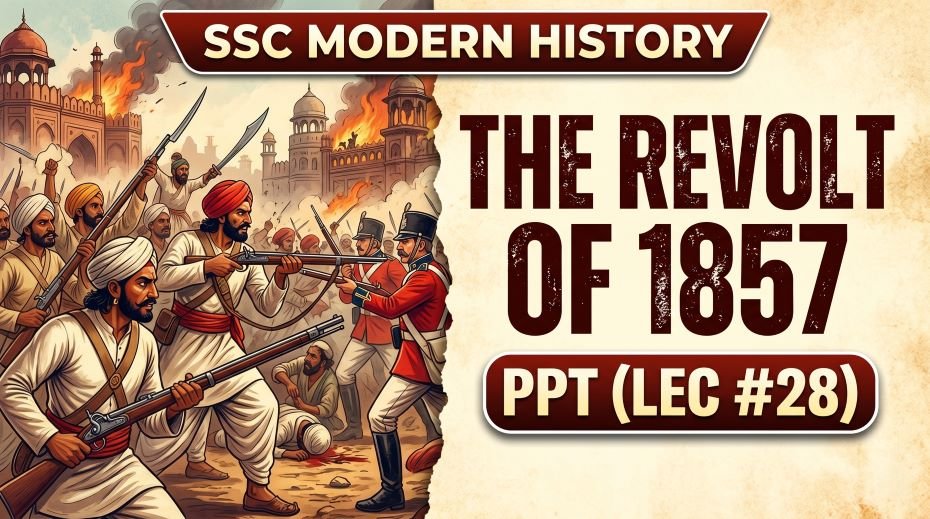
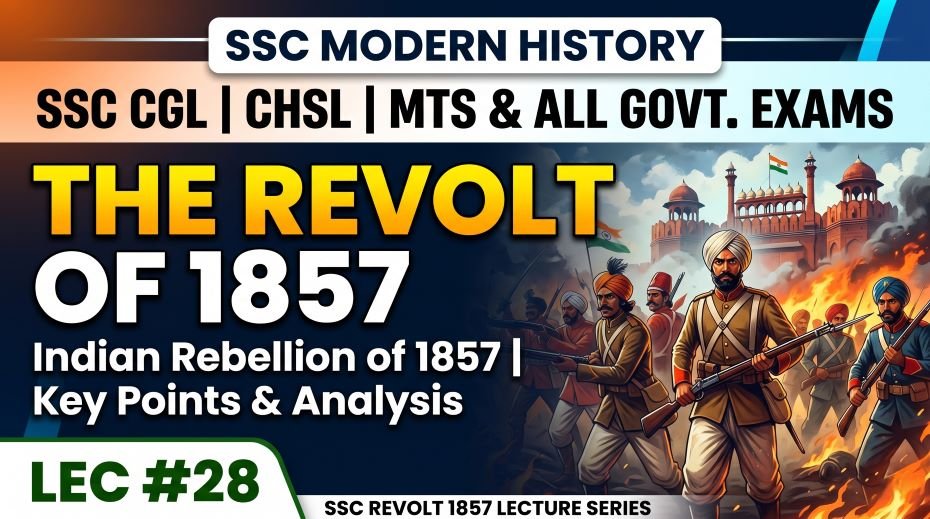
This is Lecture 28 (SSC Modern History The Revolt of 1857 PPT (LEC #28) of the Complete Foundation Batch for All SSC Exams – PPT Series by SlidesharePPT. This lecture covers Modern Indian History: The Revolt of 1857 (1857 का विद्रोह) – the single most important event in the entire SSC Modern Indian History syllabus, with 8 to 12 direct MCQs appearing in almost every SSC CGL, SSC CHSL, SSC MTS, SSC GD Constable, and RRB Group D paper.
In this article, you will find a complete study guide built around the 60-slide PPT – covering all causes (political, economic, military, and social-religious), the complete timeline from Mangal Pandey’s firing (March 29, 1857) to Tantya Tope’s hanging (April 18, 1859), all centers of revolt with leaders and their fates, historians’ views including V.D. Savarkar’s banned book, results and consequences including the Government of India Act 1858 and Queen Victoria’s Proclamation, and 30 practice MCQs with answers.
The PPT slides are embedded below – self-made, regularly updated, and fully ready for online and offline classroom use. Whether you are a teacher taking a regular batch or running a full marathon revision session before exams, or a student doing last-minute preparation for your SSC paper, you can view and use all 60 slides directly on any device – no download needed.
Section 1: PPT Resource Overview
| PPT RESOURCE OVERVIEW – LEC #28 | |
| Complete Foundation Batch for All SSC Exams | History PPT Series | The Revolt of 1857 | |
| Lecture Title | The Revolt of 1857 (1857 का विद्रोह) |
| Lecture Number | Lecture 28 (LEC #28) |
| Serial Number | #53 in the Complete Foundation Batch PPT Series |
| Total Slides | 60 High-Quality PPT Slides |
| File Size | 26 MB |
| Subject | Modern Indian History |
| Series Name | Complete Foundation Batch for All SSC and Other Competitive Exams (PPT SERIES) |
| Target Exams | SSC CGL | SSC CHSL | SSC MTS | SSC GD Constable | RRB Group D | UPSC Prelims | State PSC |
| Topics Covered | Background & Causes → Immediate Cause (Greased Cartridges) → Beginning at Meerut → Centers & Leaders → British Suppression → Historians’ Views → Results → Government of India Act 1858 → Queen’s Proclamation |
| Key Personalities | Mangal Pandey, Rani Laxmibai, Nana Sahib, Tantya Tope, Kunwar Singh, Begum Hazrat Mahal, Bahadur Shah Zafar, Bakht Khan |
| Difficulty Level | Easy to Moderate – very direct MCQs; leaders + locations + dates tested repeatedly |
| Recommended Study | 1 to 2 days (first read) | Half day (revision using tables) |
| PPT Source | slideshareppt.net |
| Best Combined With | LEC #25 (G-G & Viceroy) + LEC #27 (Civil & Tribal Uprisings) – 1857 is the bridge between the two |
| Exam Tip: 8–12 direct MCQs from 1857 Revolt appear in every SSC CGL & CHSL – single most important event in Modern Indian History | |
SSC Modern History The Revolt of 1857 PPT (LEC #28) – iframe and html given below
Note: If you wish to download the Complete SSC series (PPT slides), Simply visit this redirect page. –REDIRECT PAGE.
Section 2: Master Timeline – The Revolt of 1857 (March 1857 to April 1859)
Every key date from the greased cartridge rumours to the execution of Tantya Tope – the complete 1857 story in chronological order.
| Date | Event | Details & SSC Significance |
| 1856 | Lord Dalhousie annexes Awadh | Nawab Wajid Ali Shah exiled; Bengal Army sepoys (majority from Awadh) deeply outraged; direct military grievance created |
| 1856 | General Service Enlistment Act | Sepoys required to serve overseas; violates Hindu caste norms (crossing the sea = loss of caste); widespread resentment in Bengal Army |
| Jan 1857 | Greased cartridge rumours begin | New Enfield rifles introduced; cartridges allegedly greased with cow fat (Hindu taboo) + pig fat (Muslim taboo); soldiers refused to bite cartridges |
| 29 Mar 1857 | Mangal Pandey fires first shots | Barrackpore (near Calcutta); Mangal Pandey attacks British officers; arrested; hanged April 8, 1857; first martyr of 1857 |
| 24 Apr 1857 | 85 sepoys refuse cartridges at Meerut | 85 soldiers of 3rd Native Cavalry refuse greased cartridges; court-martialled May 9; sentenced to 10 years hard labour |
| 10 May 1857 | Revolt begins at Meerut | Sepoys break out comrades from jail; kill British officers; march to Delhi overnight – THE REVOLT OF 1857 BEGINS |
| 11 May 1857 | Sepoys reach Delhi; Bahadur Shah Zafar proclaimed | Rebel sepoys reach Red Fort; elderly Mughal Emperor Bahadur Shah Zafar (82 years old) proclaimed leader; Delhi becomes symbolic capital of revolt |
| June 1857 | Nana Sahib – Kanpur (Cawnpore) | Peshwa’s adopted son Nana Sahib joins revolt; British garrison at Cawnpore surrenders; Satichaura Ghat incident – British prisoners killed; triggers British revenge |
| June 1857 | Rani Laxmibai – Jhansi | Rani joins revolt after British refuse to accept her adopted son; defends Jhansi Fort against British forces |
| June 1857 | Begum Hazrat Mahal – Lucknow | Wife of exiled Nawab Wajid Ali Shah leads revolt in Lucknow; declared her son Birjis Qadr as Nawab; Lucknow Residency siege begins |
| July–Aug 1857 | Kunwar Singh – Bihar | 80-year-old zamindar of Jagdishpur (Arrah, Bihar) joins revolt; brilliant guerrilla commander despite age; died May 1858 |
| July 1857 | Bakht Khan – Delhi | Commander-in-chief of rebel forces at Delhi; led Bareilly troops to Delhi; real military organizer of Delhi defense |
| Sep 1857 | Delhi recaptured by British | British siege of Delhi; John Nicholson leads assault (killed in battle); Delhi falls September 20, 1857; Bahadur Shah Zafar flees to Humayun’s Tomb |
| Sep 1857 | Bahadur Shah Zafar captured | Captured at Humayun’s Tomb by Major William Hodson; his sons Mirza Mughal and Mirza Khizr Sultan shot dead by Hodson; Zafar exiled to Rangoon |
| Nov 1857 | Lucknow Residency finally relieved | First relief by Havelock (September); second relief by Colin Campbell (November); Lucknow finally captured March 1858 |
| Mar 1858 | Jhansi falls to British | Hugh Rose storms Jhansi; Rani Laxmibai escapes to Kalpi then Gwalior |
| 17 Jun 1858 | Rani Laxmibai killed | Rani Laxmibai dies fighting at Kotah-ki-Serai (Gwalior); British General Hugh Rose called her ‘the bravest and best military leader of the rebels’ |
| Jul 1858 | Nana Sahib escapes | Nana Sahib flees to Nepal; never captured; fate unknown |
| 18 Apr 1859 | Tantya Tope executed | Last major rebel commander captured and hanged; had fought 150+ battles over 18 months; guerrilla war finally ends |
| 2 Aug 1858 | Government of India Act 1858 | EIC formally dissolved; British Crown takes direct control of India; G-G becomes Viceroy; Secretary of State for India created |
| 1 Nov 1858 | Queen Victoria’s Proclamation | Read at Allahabad by Lord Canning; promised: no more annexations, respect for Indian religions and customs, equal treatment in government service; EIC era officially ends |
Section 3: Causes of the 1857 Revolt – Complete Table
The causes are divided into four categories. SSC asks both specific causes AND category-level questions (‘Which was the immediate cause?’, ‘Which was a political cause?’).
| Category | Cause | Details & SSC Significance |
| POLITICAL | Doctrine of Lapse | Dalhousie’s Doctrine of Lapse annexed Satara, Jhansi, Nagpur; Indian rulers felt no throne was safe; direct threat to princely class |
| POLITICAL | Annexation of Awadh (1856) | Annexed on grounds of ‘misgovernance’; Nawab Wajid Ali Shah exiled; deeply offended both rulers and Bengal Army sepoys from Awadh |
| POLITICAL | Disrespect to Bahadur Shah Zafar | Dalhousie announced the Mughal dynasty would end after Bahadur Shah; his successors would not be called ‘Emperor’ – humiliated Muslims across India |
| POLITICAL | Subsidiary Alliance | Deprived Indian rulers of their armies and sovereignty; created resentment among hundreds of princely states across India |
| ECONOMIC | Destruction of Indian Industries | Cheap British manufactured goods destroyed Indian handicrafts – weavers, artisans, craftsmen all displaced; economic ruin of traditional livelihoods |
| ECONOMIC | Drain of Wealth | Indian revenue extracted to Britain; peasants overtaxed; economic resentment widespread across all classes |
| ECONOMIC | Land Revenue Policies | Permanent Settlement, Ryotwari, Mahalwari – all caused massive rural distress; zamindars, taluqdars, and peasants all had grievances |
| ECONOMIC | Inam Commission (1852) | Cancelled rent-free land grants held by thousands of families in Bombay and Madras – left thousands destitute overnight |
| MILITARY | Discrimination in Army | Indian sepoys paid less than British; barred from senior ranks; treated with racial contempt; promotions based on race not merit |
| MILITARY | General Service Enlistment Act (1856) | Required sepoys to serve overseas; violated Hindu caste norms; crossing the sea meant loss of caste for upper-caste Hindus |
| MILITARY | Loss of Foreign Service Allowance | When Awadh was annexed, sepoys lost ‘foreign service’ allowance for serving there – direct pay cut |
| MILITARY | Greased Cartridges (IMMEDIATE CAUSE) | Enfield rifle P-53 cartridges allegedly greased with cow (Hindu) + pig (Muslim) fat; soldiers had to bite cartridges; both communities offended simultaneously – the spark that lit the powder keg |
| SOCIAL/RELIGIOUS | Christian Missionary Activity | Missionary schools, charitable activities perceived as prelude to forced conversion; Governor-General Dalhousie allowed missionaries to operate freely |
| SOCIAL/RELIGIOUS | Social Reform Laws | Abolition of Sati (1829), Widow Remarriage Act (1856), Age of Consent discussions – all perceived as British interference in Hindu religion |
| SOCIAL/RELIGIOUS | Racial Arrogance | British administrators treated Indians with open racial contempt; excluded Indians from clubs, railways (first class), senior positions |
Section 4: Centers of Revolt and Their Leaders
Every center, its leader, and key events. This table is the highest MCQ source in the chapter – know every leader’s location and fate.
| Center | When | Leader(s) | Key Events & SSC Facts |
| Delhi | May 11, 1857 | Bahadur Shah Zafar (symbolic leader) Bakht Khan (military commander) | Rebel sepoys from Meerut declared Bahadur Shah Zafar as Emperor; Bakht Khan (from Bareilly) was real military organizer; Delhi fell September 20, 1857; Zafar captured at Humayun’s Tomb; exiled to Rangoon; died 1862 |
| Kanpur (Cawnpore) | June 1857 | Nana Sahib Tantya Tope (general) | Nana Sahib = adopted son of last Peshwa Baji Rao II; British garrison surrendered; Satichaura Ghat incident; Nana Sahib fled to Nepal after defeat; never captured; Tantya Tope continued guerrilla war till 1859 |
| Lucknow | June 1857 | Begum Hazrat Mahal Ahmadullah Shah (Maulvi of Faizabad) | Wife of exiled Nawab Wajid Ali Shah; declared son Birjis Qadr as Nawab; famous Lucknow Residency siege; Henry Lawrence (British) killed; Havelock’s first relief (Sept); Campbell’s final relief (Nov 1857); Lucknow fell March 1858 |
| Jhansi | June 1857 | Rani Laxmibai | Rani = Manikarnika; widowed 1853 when Doctrine of Lapse applied to Jhansi; joined revolt June 1857; defended Jhansi fort; escaped to Kalpi + Gwalior; died fighting June 17, 1858 at Kotah-ki-Serai; Hugh Rose: ‘bravest rebel leader’ |
| Bareilly | 1857 | Khan Bahadur Khan | Grandson of Rohilla chief Hafiz Rahmat Khan; declared himself Nawab of Bareilly; sent forces to Delhi under Bakht Khan; Bareilly was major revolt center in UP |
| Bihar (Arrah/Jagdishpur) | July 1857 | Kunwar Singh | Zamindar of Jagdishpur; 80 years old at revolt time; brilliant guerrilla tactician; crossed Ganga under fire; died May 9, 1858 of battle wounds – one day after his greatest victory; Bihar’s greatest 1857 hero |
| Faizabad (Awadh) | 1857 | Ahmadullah Shah (Maulvi of Faizabad) | Called ‘Danka Shah’; religious leader who became military commander; fought brilliantly at Lucknow; killed by Raja of Puwain for reward money offered by British; betrayal-death like Siraj-ud-Daulah |
| Gwalior | June 1858 | Rani Laxmibai + Tantya Tope | After falling back from Jhansi, rebel forces occupied Gwalior with support of some Scindia soldiers; British under Hugh Rose retook Gwalior; Rani killed here; last major battle of 1857 |
| Assam | 1857 | Maniram Dewan | Tea planter + estate owner; hanged 1858; first person in Assam executed for 1857 revolt participation |
| Rajasthan | 1857 | Kushal Singh (Tawara) | Limited participation; most Rajput princes stayed loyal to British |
| Punjab | 1857 | Limited revolt | Punjab recently annexed (1849); heavy British military presence; Sikhs mostly remained loyal (recent enemies of Mughals); revolt did not spread significantly |
| South India | 1857 | Almost no revolt | Bombay and Madras presidencies relatively quiet; British garrison strength + recent defeat of local powers + distance from main revolt centers |
Section 5: Key Heroes – Detailed Profiles
Rani Laxmibai of Jhansi – Most Celebrated Hero
- Real name: Manikarnika Tambe; born c.1828; married Maharaja Gangadhar Rao of Jhansi
- Husband died 1853; adopted son Damodar Rao; British refused to recognize adoption under Doctrine of Lapse
- Joined revolt June 1857; defended Jhansi Fort bravely against Hugh Rose’s forces
- Escaped to Kalpi with her adopted son tied to her back; then moved to Gwalior
- Died fighting at Kotah-ki-Serai (Gwalior) on June 17, 1858 – refusing to surrender
- British commander Hugh Rose wrote: ‘Here lay the rebel Rani of Jhansi – the best and bravest of the rebel leaders’
- Symbol of Indian resistance; Subhas Chandra Bose named his women’s regiment ‘Rani of Jhansi Regiment’
Bahadur Shah Zafar – The Last Mughal
- Born 1775; 20th and last Mughal Emperor; primarily a poet (pen name ‘Zafar’ = victory)
- 82 years old when revolt broke out; reluctant leader – did not plan the revolt but was swept along
- Captured at Humayun’s Tomb by Major Hodson, September 20, 1857
- His sons Mirza Mughal and Mirza Khizr Sultan shot dead by Hodson – their heads presented to Zafar
- Tried for treason; exiled to Rangoon; died November 7, 1862 – far from Delhi
- Famous couplet expressing his grief: ‘How unfortunate is Zafar, that even for his burial he could not get two yards of earth in the land of his beloved (Delhi)’
Kunwar Singh – The Old Lion of Bihar
- Born c.1777; zamindar of Jagdishpur, Arrah, Bihar; 80 years old when revolt began
- Despite age, proved to be one of the most brilliant military commanders of the revolt
- Led guerrilla campaigns across Bihar, UP, and MP for nearly a year
- Crossed the Ganga under heavy British fire in April 1858 – epic military feat at age 80+
- Lost his arm to a British bullet while crossing the Ganga; cut it off himself and offered it to the Ganga
- Died May 9, 1858 at his ancestral home – one day after his greatest victory; wound from crossing the Ganga
- April 23 = Kunwar Singh Victory Day (Bihar)
Tantya Tope – Master of Guerrilla Warfare
- Real name: Ramchandra Pandurang Tope; Nana Sahib’s general and childhood friend
- After Kanpur fell, continued fighting across central India with Rani Laxmibai and independently
- Fought approximately 150 battles over 18 months – extraordinary staying power
- After Rani’s death (June 1858), continued guerrilla war in jungles of central India until April 1859
- Betrayed by his trusted friend Man Singh (Narwar) who handed him to British for reward money
- Captured April 7, 1859; tried by military court; hanged April 18, 1859 at Shivpuri, MP
- Considered the last hero of 1857 – revolt truly ended with his hanging
Section 6: Historians’ Views on the 1857 Revolt
Different historians called the same event by different names. This table is directly asked in SSC – ‘Who called it First War of Independence?’ is a standard MCQ.
| View / Label | School | Proponent(s) | Key Argument | SSC Note |
| ‘Sepoy Mutiny’ | British Historians | Sir John Seeley, Sir John Lawrence, Lord Canning (initially) | Just a military mutiny of disgruntled sepoys; no national character; limited to army; civilian participation was incidental | This was the OFFICIAL British view used to dismiss the revolt’s political significance; still used in some colonial-era textbooks |
| ‘First War of Indian Independence’ | Indian Nationalist Historians | V.D. Savarkar (1909 book – ‘The Indian War of Independence’) | A planned, organized war of national liberation; sepoys, princes, peasants, zamindars all united against British; proto-nationalist | Savarkar’s book was BANNED by the British – they confiscated it before publication; most nationalistic interpretation |
| ‘Feudal Reaction’ | Marxist/Left Historians | R.C. Majumdar, Ramesh Chandra Majumdar | A reactionary movement by feudal classes (zamindars, princes, taluqdars) trying to restore the old order; not progressive | Emphasized the self-interested motivation of princes and zamindars rather than nationalist sentiment |
| ‘Nationalist Revolt with Popular Support’ | Moderate Nationalist | S.N. Sen, Surendra Nath Sen (Official Historian of India’s Independence) | Had elements of both sepoy mutiny AND popular nationalist revolt; broad civilian participation makes it more than a mutiny | Indian government appointed S.N. Sen to write official history; called it a revolt with genuine nationalist character |
| ‘Civilizational Clash’ | Cultural Historians | – | Represented a conflict between two civilizations – Indian and British; revolt was the expression of a cultural crisis | Less frequently cited in SSC; occasionally in UPSC context |
| Mixed / Both | Balanced View – Modern Consensus | Most modern Indian historians | Both a sepoy mutiny AND a popular uprising with proto-nationalist elements; not fully organized nationalism but clearly more than just a military mutiny | Modern school textbooks adopt this balanced view; SSC tends to favor V.D. Savarkar’s ‘First War of Independence’ terminology |
Section 7: Results and Consequences of 1857
Immediate Consequences
- Government of India Act 1858: EIC formally dissolved; British Crown takes direct control; Secretary of State for India (Cabinet minister in London) created with 15-member India Council
- Governor-General’s post renamed Viceroy: Lord Canning = first Viceroy; represented Crown directly
- Queen Victoria’s Proclamation (November 1, 1858): Read at Allahabad by Canning; promised – no more annexations, equal access to civil service, respect for religions; in practice many promises were not kept
- End of Mughal dynasty: Bahadur Shah Zafar was the last; no successor recognized; 300-year Mughal dynasty ended
Military Reorganization
- British-to-Indian soldier ratio increased: In Bengal Army – from 1:7 to 1:2; in Bombay/Madras – 1:3
- Artillery exclusively placed under British control – no Indian soldier could operate artillery
- Indian soldiers reorganized by caste, class, and religion to prevent inter-community solidarity
- Gurkha, Sikh, and Pathan regiments expanded – communities that had stayed loyal or helped British
Long-term Impact on Indian Nationalism
- 1857 proved Indians could unite across religion, caste, and region – a foundational lesson for later nationalism
- Failure of 1857 showed the need for organized political movement with modern methods → Indian National Congress (1885)
- Queen’s Proclamation promise of equal civil service opportunity → Indians demanded actual implementation → Civil Service agitation
- 1857 became the central myth of Indian nationalism – every later movement invoked 1857 martyrs
Section 8: Podcast Q&A – Most Frequently Confused Topics
| # | Question | Expert Answer – Exam-Focused |
| Q1 | What was the immediate cause of the 1857 Revolt? Why did the greased cartridge become so explosive? | The immediate cause was the introduction of the new Enfield P-53 rifle in the British Indian Army. The rifle required soldiers to bite off the end of a greased cartridge before loading. The rumour – which spread rapidly through army cantonments – was that the grease was made from a mixture of cow fat (forbidden to Hindus) and pig fat (forbidden to Muslims). This was explosive because: (1) It offended BOTH major religious communities simultaneously – a rare combination; (2) It confirmed the deep fear that the British were trying to destroy Indian religion through the army; (3) It came on top of years of accumulated military and social grievances; (4) The cartridge issue was the one visible, tangible grievance that united Hindu and Muslim sepoys. The British argued the grease was made from mutton fat and linseed oil, but by then the rumour had already spread and the damage was done. SSC MCQ: ‘Immediate cause of 1857 revolt?’ → Greased cartridges of Enfield P-53 rifle. |
| Q2 | Who was Mangal Pandey and why is he important? What exactly did he do? | Mangal Pandey was a sepoy in the 34th Bengal Native Infantry, stationed at Barrackpore (near Calcutta). On March 29, 1857, he attacked and wounded two British officers – Lieutenant Baugh and Sergeant-Major Hewson – shouting anti-British slogans and urging his fellow sepoys to revolt. He was overpowered, court-martialled, and hanged on April 8, 1857. His regiment was subsequently disbanded. Why he is important: (1) He is considered the first visible symbol of the 1857 revolt; (2) The British initially called all Indian rebel sepoys ‘Pandeys’ – which is why the English slang word ‘Pandy’ was used for any rebel Indian soldier; (3) He is officially recognized as a martyr of India’s independence struggle; (4) His actions at Barrackpore predated the Meerut uprising by 6 weeks, showing the tension was already at breaking point. SSC MCQ: ‘First martyr of 1857?’ → Mangal Pandey. ‘Where did Mangal Pandey fire?’ → Barrackpore. |
| Q3 | What happened to the main leaders of 1857 revolt? Know each leader’s fate. | Every leader’s fate is a potential SSC MCQ: (1) Bahadur Shah Zafar: Captured at Humayun’s Tomb by Major William Hodson; his two sons shot dead by Hodson in cold blood; Zafar exiled to Rangoon, Burma; died there on November 7, 1862; buried in Rangoon (now Yangon, Myanmar); (2) Rani Laxmibai: Died fighting at Kotah-ki-Serai near Gwalior, June 17, 1858; Hugh Rose praised her; (3) Nana Sahib: Fled to Nepal after defeat; never captured; fate unknown – probably died in Nepal; (4) Tantya Tope: Betrayed by his own friend Man Singh (Narwar); captured April 7, 1859; hanged April 18, 1859 at Shivpuri (MP); (5) Begum Hazrat Mahal: Fled to Nepal; died in Kathmandu (1879); (6) Kunwar Singh: Died of battle wounds May 9, 1858 – one day after his greatest victory crossing the Ganga; (7) Bakht Khan: Died in battle near Terai (1859). Pattern: Most leaders either died fighting, were hanged, or fled to Nepal. |
| Q4 | Why did the revolt fail? What were the main reasons for its defeat? | The 1857 Revolt failed due to six key weaknesses: (1) Limited geographic spread: The revolt was concentrated mainly in UP, Bihar, Delhi, and parts of MP; Punjab, Bengal, Bombay, Madras, and South India were largely unaffected; (2) No unified leadership: Bahadur Shah Zafar was a symbolic figurehead, not a real commander; no single leader could coordinate all the centers; (3) Divided loyalties: Sikh soldiers (recently defeated by Mughals) generally stayed loyal to British; Gurkhas and many Rajput princes also supported British; (4) Military superiority: British had electric telegraph (1851 – could coordinate instantly), railways (could move troops rapidly), and superior artillery; (5) Timing failures: Various centers revolted at different times – Meerut (May 10), Lucknow (June), Jhansi (June); no simultaneous coordinated attack; (6) No support from educated Indians: The new English-educated class (product of Macaulay’s education) largely supported the British – the reform movement and the revolt were pulling in opposite directions. |
| Q5 | What were the results and consequences of the 1857 Revolt? | The revolt had six major consequences that are directly asked in SSC: (1) End of EIC rule: Government of India Act 1858 – East India Company formally dissolved; British Crown took direct control; (2) Viceroy system: Governor-General’s title changed to Viceroy – representative of the Crown; Lord Canning became first Viceroy; (3) Queen Victoria’s Proclamation (November 1, 1858): Read at Allahabad by Canning; promised no more annexations, respect for Indian religions, equal government service opportunities – but largely ignored in practice; (4) Army reorganization: Ratio of British to Indian soldiers increased; artillery placed exclusively under British control; Indian soldiers grouped by class/religion to prevent unified revolt (divide and rule in the army); (5) End of Mughal dynasty: Bahadur Shah Zafar was last Mughal emperor – dynasty ended with his capture; (6) End of Peshwaship permanently: Nana Sahib’s exile ended any Maratha political claims. Long-term consequence: The revolt planted seeds of organized Indian nationalism – the failures of 1857 taught Indians they needed better organization, broader social base, and modern political methods → led to founding of INC in 1885. |
| Q6 | What are the different names given to the 1857 Revolt and which historians gave them? | The 1857 event has been called by five different names reflecting different political perspectives: (1) ‘Sepoy Mutiny’: British colonial historians (Seeley, Lawrence, Malleson) – minimized it as a military incident without political significance; (2) ‘First War of Indian Independence’: V.D. Savarkar (1909 book ‘The Indian War of Independence 1857’) – most nationalist interpretation; book was BANNED by British; (3) ‘Mutiny and a Civilizational Conflict’: Some British historians who acknowledged civilian participation but still denied nationalist character; (4) ‘A Feudal Revolt’: Marxist historians (R.C. Majumdar) – saw it as reactionary, led by feudal classes trying to restore old order; (5) ‘A National Revolt with Mass Participation’: S.N. Sen (Indian government’s official historian) – balanced view, acknowledged both military and civilian dimensions. SSC MCQ pattern: ‘Who called 1857 revolt the First War of Independence?’ → V.D. Savarkar. ‘Whose book on 1857 was banned by British?’ → V.D. Savarkar’s ‘The Indian War of Independence.’ |
Section 9: 30 High-Frequency MCQs with Answers
Based on previous SSC CGL, CHSL, MTS, and GD Constable papers. Target: 27+ correct.
| # | Question | Answer |
| 01 | The Revolt of 1857 began at which place and on which date? | Meerut – May 10, 1857 |
| 02 | What was the immediate cause of the 1857 Revolt? | Greased cartridges of the new Enfield P-53 rifle (cow + pig fat) |
| 03 | Who was the first martyr of the 1857 Revolt? | Mangal Pandey – hanged April 8, 1857 at Barrackpore |
| 04 | Where did Mangal Pandey fire and attack British officers? | Barrackpore (near Calcutta) |
| 05 | Who was proclaimed the symbolic leader of the 1857 Revolt at Delhi? | Bahadur Shah Zafar (last Mughal Emperor, 82 years old) |
| 06 | Who was the real military commander of rebel forces at Delhi? | Bakht Khan – led Bareilly troops to Delhi |
| 07 | Bahadur Shah Zafar was captured at which location? | Humayun’s Tomb, Delhi – by Major William Hodson |
| 08 | Where was Bahadur Shah Zafar exiled and where did he die? | Exiled to Rangoon (Yangon, Myanmar); died November 7, 1862 |
| 09 | Who led the revolt in Kanpur (Cawnpore)? | Nana Sahib (adopted son of last Peshwa Baji Rao II) |
| 10 | What was Tantya Tope’s fate? | Betrayed by Man Singh; captured April 7, 1859; hanged April 18, 1859 at Shivpuri (MP) |
| 11 | Who led the revolt in Lucknow? | Begum Hazrat Mahal (wife of exiled Nawab Wajid Ali Shah) |
| 12 | What was the name of Begum Hazrat Mahal’s son declared as Nawab? | Birjis Qadr |
| 13 | Who led the revolt in Bihar and how old was he? | Kunwar Singh – 80 years old; zamindar of Jagdishpur, Arrah |
| 14 | Rani Laxmibai was the queen of which state? | Jhansi (UP) – also called Manikarnika |
| 15 | Where and when did Rani Laxmibai die? | June 17, 1858 – Kotah-ki-Serai, near Gwalior |
| 16 | Which British general called Rani Laxmibai ‘the bravest and best military leader of the rebels’? | Hugh Rose |
| 17 | Who called the 1857 revolt the ‘First War of Indian Independence’? | V.D. Savarkar – in his 1909 book (which was BANNED by British) |
| 18 | Who called it a ‘Sepoy Mutiny’? | British historians – Sir John Seeley, Sir John Lawrence |
| 19 | Government of India Act 1858 did what? | Dissolved EIC; Crown rule; G-G became Viceroy; Secretary of State for India created |
| 20 | Queen Victoria’s Proclamation was read where and by whom? | Allahabad – November 1, 1858 – by Lord Canning |
| 21 | Who was the first Viceroy of India? | Lord Canning (previously last G-G) |
| 22 | General Service Enlistment Act (1856) required what? | Sepoys to serve overseas – violated Hindu caste norms (crossing sea = loss of caste) |
| 23 | Why did Punjab NOT revolt significantly in 1857? | Sikhs recently defeated by Mughals; heavy British garrison; Punjab recently annexed (1849) |
| 24 | Ahmadullah Shah (Maulvi of Faizabad) was called? | ‘Danka Shah’ – brilliant military commander at Lucknow; betrayed and killed for British reward money |
| 25 | Nana Sahib’s fate after 1857? | Fled to Nepal; never captured; fate unknown |
| 26 | What was the Satichaura Ghat incident? | British prisoners killed at Kanpur while surrendering – triggered British revenge attacks |
| 27 | Which regiment was Mangal Pandey part of? | 34th Bengal Native Infantry – disbanded after his revolt |
| 28 | Begum Hazrat Mahal fled where after defeat? | Nepal – died in Kathmandu (1879) |
| 29 | Major reason the revolt failed was? | Limited geographic spread + no unified leadership + British military superiority (telegraph + railways) |
| 30 | V.D. Savarkar’s book on 1857 was titled? | ‘The Indian War of Independence 1857’ (1909) – banned by British before publication |
Also read: SSC Modern History Civil and Tribal Uprising PPT (LEC #27)
Section 10: Rapid Revision – Last-Day Cheat Sheet
Key Dates – Must Know
- March 29, 1857 → Mangal Pandey fires at Barrackpore
- April 8, 1857 → Mangal Pandey hanged
- May 10, 1857 → Revolt BEGINS at Meerut
- May 11, 1857 → Sepoys reach Delhi; Zafar proclaimed leader
- September 20, 1857 → Delhi recaptured; Zafar captured
- June 17, 1858 → Rani Laxmibai killed at Gwalior
- August 2, 1858 → Government of India Act – EIC ends
- November 1, 1858 → Queen Victoria’s Proclamation at Allahabad
- April 18, 1859 → Tantya Tope hanged – revolt ends
Leaders → Centers
- Delhi → Bahadur Shah Zafar (symbolic) + Bakht Khan (military)
- Kanpur → Nana Sahib + Tantya Tope
- Lucknow → Begum Hazrat Mahal + Ahmadullah Shah
- Jhansi → Rani Laxmibai
- Bihar (Arrah) → Kunwar Singh
- Bareilly → Khan Bahadur Khan
Historians → What They Called It
- V.D. Savarkar → First War of Indian Independence (book BANNED)
- British historians → Sepoy Mutiny
- S.N. Sen → National Revolt with mass participation
- R.C. Majumdar → Feudal Revolt (reactionary)
Fates – Most Asked
- Bahadur Shah Zafar → Exiled to Rangoon → died 1862
- Rani Laxmibai → Died fighting June 17, 1858 → Gwalior
- Nana Sahib → Fled to Nepal → never captured
- Tantya Tope → Hanged April 18, 1859 → Shivpuri, MP
- Begum Hazrat Mahal → Fled to Nepal → died 1879
- Kunwar Singh → Died of wounds May 9, 1858 → Jagdishpur
Conclusion
The Revolt of 1857 (LEC #28) is the single most important event in SSC Modern Indian History. It is the hinge between the era of British expansion and the era of organized Indian nationalism. The 60-slide PPT gives you the visual narrative; this guide organizes every cause, leader, center, historian’s view, and consequence into focused tables for exam-ready revision. Master the Timeline, Causes Table, Centers Table, and 30 MCQs – and this chapter will deliver marks in every SSC paper you sit.