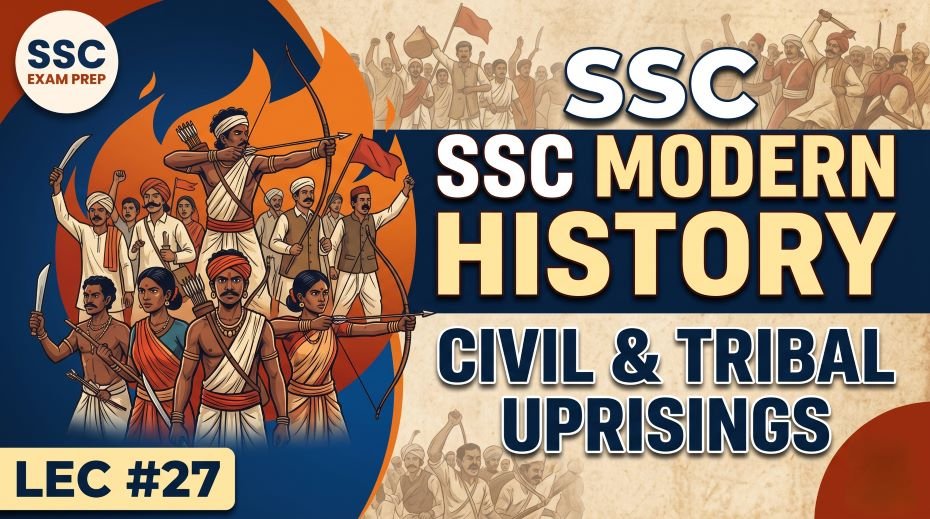
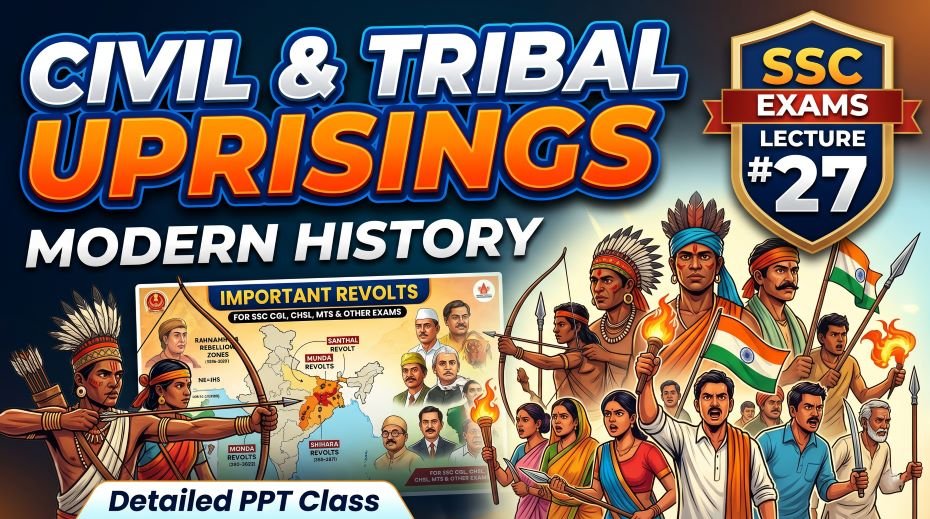
This is Lecture 27 (SSC Modern History Civil and Tribal Uprising PPT (LEC #27) of the Complete Foundation Batch for All SSC Exams – PPT Series by SlidesharePPT. This lecture covers Modern Indian History: Civil and Tribal Uprisings in India (नागरिक और आदिवासी विद्रोह) – a highly scoring chapter for SSC CGL, SSC CHSL, SSC MTS, SSC GD Constable, and RRB Group D, with 6 to 10 direct MCQs appearing in almost every SSC paper.
In this article, you will find a complete study guide built around the 141-slide PPT – covering all major tribal uprisings (Santal Hul, Munda Ulgulan, Kol Uprising, Khasi Uprising), peasant revolts (Indigo Revolt, Champaran, Kheda, Bardoli), and civil uprisings (Vellore Mutiny, Kittur Revolt, Paik Rebellion) from 1763 to 1947. The guide includes a full master timeline, four dedicated reference tables, special hero profiles for Birsa Munda, Alluri Sitarama Raju and Rani Chennamma, a Podcast-style Q&A on the most confusing topics, and 30 practice MCQs with answers.
The PPT slides are embedded below – self-made, regularly updated, and fully ready for online and offline classroom use. Whether you are a teacher conducting a regular batch or a full marathon revision session before exams, or a student doing last-minute exam preparation, you can view and use all 141 slides directly on any device, no download needed.
Section 1: PPT Resource Overview
| PPT RESOURCE OVERVIEW – LEC #27 | |
| Complete Foundation Batch for All SSC Exams | History PPT Series | Civil and Tribal Uprisings in India | |
| Lecture Title | Civil and Tribal Uprisings in India (नागरिक और आदिवासी विद्रोह) |
| Lecture Number | Lecture 27 (LEC #27) |
| Serial Number | #52 in the Complete Foundation Batch PPT Series |
| Total Slides | 141 High-Quality PPT Slides |
| File Size | 42 MB |
| Subject | Modern Indian History |
| Series Name | Complete Foundation Batch for All SSC and Other Competitive Exams (PPT SERIES) |
| Target Exams | SSC CGL | SSC CHSL | SSC MTS | SSC GD Constable | RRB Group D | UPSC Prelims | State PSC |
| Topics Covered | Sanyasi Rebellion → Pagal Panthi → Kol Uprising → Bhil Uprising → Khasi Uprising → Santal Hul → Indigo Revolt → Munda Ulgulan → Deccan Riots → Moplah Rebellions → Kuka Movement → Champaran → Kheda → Bardoli + All Tribal Uprisings |
| Key Personalities | Birsa Munda, Sidhu-Kanhu, Titu Mir, Haji Shariatullah, Tirot Sing, U Kiang Nongbah, Veer Narayan Singh, Alluri Sitarama Raju |
| Difficulty Level | Moderate – many names and dates but very pattern-based; specific leaders + locations tested |
| Recommended Study | 2 to 3 days (first read) | 1 day (revision using tables) |
| PPT Source | slideshareppt.net |
| Best Combined With | LEC #26 (Socio-Religious Reform) – Faraizi and Wahabi movements overlap with peasant uprisings |
| Exam Tip: 6–10 direct MCQs from Uprisings appear in every SSC CGL & CHSL – Birsa Munda, Santal Hul, Indigo Revolt are highest frequency | |
SSC Modern History Civil and Tribal Uprising PPT (LEC #27)
Note: If you wish to download the Complete SSC series (PPT slides), Simply visit this redirect page. –REDIRECT PAGE
Section 2: Master Timeline – Uprisings in India (1763–1947)
Every major uprising in chronological order with location, leader, and SSC significance.
| Year | Uprising / Event | Details & SSC Significance |
| 1763–1800 | Sanyasi Rebellion | Bengal/Bihar; wandering Hindu monks (Sanyasis) + Fakirs (Muslim mendicants) against EIC; disrupted British revenue collection; Bankim Chandra Chatterjee’s novel ‘Anandamath’ inspired by this |
| 1782 | Chakma Uprising | Chittagong Hill Tracts (Bengal); Chakma chief Ranu Khan led resistance against British revenue imposition and monopoly on cotton trade |
| 1800–1802 | Velu Thampi Dalawa Revolt | Travancore (Kerala); Diwan Velu Thampi opposed Subsidiary Alliance; proclamation of Kundara (1809) – called for people to revolt; committed suicide when British closed in |
| 1805–1810 | Ramosi Uprising | Western Ghats, Maharashtra; Ramosis (hill police) under Chittur Singh opposed loss of employment after British took over their traditional policing roles |
| 1806 | Vellore Mutiny | Vellore, Tamil Nadu; first major military mutiny; sepoys protested new dress code (turban, prohibition of caste marks); suppressed by British; 200 sepoys killed; forerunner of 1857 |
| 1817–1832 | Bhil Uprising | Khandesh, Rajasthan, MP; Bhil tribal chiefs led multiple uprisings against British revenue settlements that displaced traditional Bhil authority; Seva Ram and Bhojla led early revolts |
| 1820–1822 | Kutch Rebellion | Kutch (Gujarat); Fateh Muhammad led revolt against British annexation and revenue collection |
| 1824 | Kittur Uprising | Karnataka; Rani Chennamma of Kittur resisted British annexation after her husband’s death (Doctrine of Lapse forerunner); fought British troops; eventually defeated and captured |
| 1824–1825 | Ahom Revolt | Assam; Gomdhar Konwar led Ahom chiefs’ revolt against British annexation of Assam after First Anglo-Burmese War; Ahom aristocracy resisted loss of power |
| 1825 | Paik Rebellion (Odisha) | Buxi Jagabandhu Bidyadhar led Paiks (landed militia) against British revenue changes that eliminated their traditional rights; ‘First freedom fighter of Odisha’ |
| 1828–1833 | Khasi Uprising | Meghalaya; Tirot Sing Syiem (Khasi chief) led resistance against British road construction through Khasi hills and commercial intrusion; captured 1833; exiled to Dhaka |
| 1829–1830 | Jaintia Uprising | Meghalaya; U Kiang Nongbah (later 1862–63); Jaintia chiefs resisted British annexation; multiple uprisings across the century |
| 1830 | Naikda (Nayaka) Uprising | Gujarat; tribal revolt against British forest and revenue policies |
| 1831–1832 | Kol Uprising | Chota Nagpur (Jharkhand/Bihar); Kol tribal chiefs Buddhu Bhagat + Joa Bhagat led revolt against Hindu and Muslim money-lenders and zamindars replacing traditional Kol landholders; 1,000+ killed in British suppression |
| 1832 | Rampa (Ramosi) Rebellion | Andhra; Surendranath Bharat; first of several Rampa uprisings in Godavari agency |
| 1839 | Singpho Uprising | Assam; Singpho chief Nirang Phidu revolted against British opium policy and their control over the tea trade |
| 1843–1863 | Kol/Munda Multiple Uprisings | Jharkhand; series of uprisings culminating in Birsa Munda’s Ulgulan; Kol people resist land alienation and forced labour (beth begari) |
| 1855–1856 | Santal Rebellion (Hul) | Jharkhand/Bengal; Sidhu and Kanhu Murmu declared independence from British rule; ‘Hul’ = revolution in Santali; 60,000 Santals mobilized; suppressed by military; Sidhu and Kanhu killed; most important tribal revolt |
| 1857 | First War of Indian Independence | All-India; covered in detail in LEC #21 context; tribal and peasant participation alongside sepoys |
| 1858–1861 | Santhal Pargana Regulation | British attempt to protect Santals through special land laws – result of 1855 uprising; Santhal Pargana district created |
| 1859–1860 | Indigo Revolt (Nil Bidroha) | Bengal; ryots (peasants) refused to grow indigo for British planters; non-violent organized resistance; Digambar Biswas + Bishnu Biswas led; Nil Darpan play by Dinabandhu Mitra exposed conditions |
| 1875 | Deccan Riots (Poona) | Maharashtra (Pune, Ahmednagar); Maratha peasants attacked moneylender (Marwari and Brahmin) account books and debt bonds; Deccan Agriculturalists Relief Act (1879) passed in response |
| 1878–1879 | Naga Uprising | Nagaland; Naga chiefs resisted British annexation of Naga Hills; multiple uprisings across decades |
| 1879–1880 | Rampa Rebellion | Andhra; Rampa tribal chiefs against British forest and revenue policies; suppressed |
| 1879–1880 | Koyi Uprising | Godavari (Andhra); tribal uprising |
| 1881 | Kuka/Namdhari Movement | Punjab; Guru Ram Singh (Namdhari Sikhs); opposed cow slaughter, British goods; 66 Kuka members blown from cannons by British in 1872 (Ludhiana); Guru Ram Singh exiled to Rangoon; non-cooperation with British |
| 1895–1900 | Birsa Munda Uprising (Ulgulan) | Jharkhand; Birsa Munda declared himself ‘Dharati Aba’ (Father of Earth); mobilized Mundas against British forest laws, land alienation, missionary influence; Ulgulan = Great Tumult; arrested 1900; died in prison at age ~25 |
| 1900 | Bastar Uprising (Bhumkal) | Chhattisgarh; Gunda Dhur led Bastar tribes against British forest and administrative policies |
| 1905–1908 | Swadeshi Era – peasant activism | Bengal; partition of Bengal triggers peasant and tribal participation in political movements |
| 1916–1917 | Moplah (Mappila) Rebellions | Malabar, Kerala; Muslim peasants (Moplahs) against Hindu landlords and British; series of uprisings 1836–1921; 1921 uprising under Khilafat banner was largest – Ali Musliyar led; British declared martial law |
| 1917 | Champaran Satyagraha – Gandhi | Bihar; Gandhi’s FIRST satyagraha in India; indigo farmers (tinkathia system); Gandhi investigates conditions; British forced to repeal Tinkathia regulations |
| 1918 | Kheda Satyagraha – Gandhi | Gujarat; peasants demand revenue remission after crop failure; Gandhi + Vallabhbhai Patel; British eventually accept peasants’ demand |
| 1919 | Jallianwala Bagh | Punjab; massacre triggers mass peasant + urban participation in non-cooperation |
| 1921 | Moplah Uprising | Malabar; largest Moplah revolt; Ali Musliyar; British and Hindu landlords targeted; controversial – INC condemned violence; 2,000+ deaths; British suppress with martial law |
| 1922 | Alluri Sitarama Raju – Rampa Rebellion | Andhra; Alluri Sitarama Raju (‘Manyam Veerudu’ – Hero of the Jungle) combined non-cooperation + armed resistance; raided police stations for guns; killed 1923 |
| 1928 | Bardoli Satyagraha | Gujarat; Vallabhbhai Patel leads peasants against unjust revenue increase; successful – revenue hike cancelled; Patel given title ‘Sardar’ by peasants |
| 1940s | Tebhaga Movement | Bengal; share-cropper demand for 2/3 of harvest (tebhaga = three shares); Communist Party supported; 1946–47 |
| 1946 | Punnapra-Vayalar Uprising | Kerala; workers’ revolt; Communist-led; suppressed by Travancore state police |
Section 3: Why Uprisings Happened – Five Root Causes
Every uprising in this chapter can be traced to one or more of these five causes. Memorize this framework to answer any ’cause’ MCQ.
1. Land Alienation
- Permanent Settlement (Bengal, 1793): Made zamindars absolute owners; Kol, Santal, and other tribal communities lost traditional land rights overnight
- Ryotwari Settlement (South India): Individual peasant-British revenue contract; moneylenders exploited peasants; debt bondage became systematic
- Mahalwari Settlement (North India): Village-level revenue; disrupted traditional village headman authority
2. Forest Laws
- Indian Forest Act 1865 and 1878: Reserved forests; banned tribal podu/jhum (shifting cultivation), grazing, collection of forest produce, hunting
- Mundas, Khonds, Bhils, Gonds, Rampa tribes all lost forest-based livelihoods simultaneously
- Forest laws are the primary cause of most tribal uprisings in the 1870s–1920s
3. Economic Exploitation
- Indigo tinkathia system: Peasants forced to grow indigo at below-market prices → Champaran + Nil Bidroha
- Usurious moneylending: 50–500% interest rates; debt bondage; zamindars took land for non-payment → Deccan Riots, Pabna
- Forced labour (beth begari): Mundas, Kols, Santals forced to work without wages for landlords
4. Loss of Traditional Authority
- Bhils lost hill-guard (police) roles and land grants; Paiks lost military-land rights; Polygars lost territorial authority
- British administrative systems made traditional tribal chiefs legally irrelevant
5. Cultural and Religious Threats
- Missionary activity: Conversion perceived as cultural destruction
- New army dress codes (Vellore 1806, 1857): Removal of caste marks seen as forced conversion
- Interference in tribal practices: Khond Meriah suppression; Kuka cow slaughter issue
Section 4: Tribal Uprisings – Complete Reference Table
All major tribal uprisings with location, leader, cause, and SSC significance. Santal Hul and Birsa Munda Ulgulan are the two highest-frequency SSC topics in this table.
| Uprising | Year | Location | Leader(s) | Cause | SSC Key Facts |
| Sanyasi Rebellion | 1763–1800 | Bengal/Bihar | Majnu Shah (Fakir); Bhabani Pathak (Sanyasi) | EIC revenue pressure; famine of 1770 devastation; restrictions on movement | Bangkim Chandra’s ‘Anandamath’ inspired by this; considered first major anti-British resistance in Bengal |
| Bhil Uprising | 1817–1832 | Khandesh, Rajasthan, MP | Seva Ram, Bhojla, Hiriya Bhil | Loss of traditional Bhil authority; British revenue settlements; forest restrictions | Multiple uprisings over 15 years; Bhils were traditional hill guards – British displaced them |
| Kol Uprising | 1831–32 | Chota Nagpur (Jharkhand) | Buddhu Bhagat, Joa Bhagat | Land alienation; zamindars + moneylenders replacing Kol chiefs; forced labour | 1,000+ Kols killed in suppression; direct precursor to Santal and Munda uprisings |
| Khasi Uprising | 1828–33 | Meghalaya | Tirot Sing Syiem | British road construction through Khasi Hills; commercial intrusion; annexation | Tirot Sing captured 1833; exiled to Dhaka where he died; Meghalaya’s most revered hero |
| Ahom Revolt | 1828 | Assam | Gomdhar Konwar | British annexation after First Burmese War; Ahom aristocracy displaced | First major resistance in Assam against British; Ahom kingdom had ruled for 600 years before British |
| Khond (Kondh) Uprising | 1837–56 | Odisha (Koraput, Kalahandi) | Chakra Bisoi | British interference in Khond religious practice (Meriah human sacrifice suppression); land and forest policies | British tried to suppress Meriah rites; Khonds resisted both suppression and land alienation |
| Santal Hul (Rebellion) | 1855–56 | Jharkhand/Bengal Santhal Pargana | Sidhu Murmu + Kanhu Murmu + Chand + Bhairav | Land alienation by zamindars + moneylenders; EIC revenue oppression; forced labour; declared independence from British | MOST IMPORTANT tribal uprising; 60,000 Santals mobilized; Sidhu declared ‘Thakur (God) has ordered us to fight’; both leaders killed; SSC highest-frequency tribal revolt |
| Rampa Rebellion | 1879–80 & 1922–23 | Andhra (Godavari Hills) | Alluri Sitarama Raju (1922) | Forest Restriction Act; ban on traditional podu (shifting cultivation); police oppression | Alluri Sitarama Raju = ‘Manyam Veerudu’; combined non-cooperation with armed resistance; raided British police stations; killed 1923; Telugu hero |
| Munda Ulgulan | 1899–1900 | Jharkhand (Ranchi) | Birsa Munda | Land alienation (diku = outsider zamindars); forest laws; missionary influence; forced labour (beth begari) | Birsa declared ‘Dharati Aba’; fought to restore Munda land rights; arrested 1900; died in Ranchi jail ~age 25; national hero; Jan 15 = Birsa Munda Jayanti; Jharkhand state created on his birth date |
| Bastar Uprising (Bhumkal) | 1910 | Chhattisgarh (Bastar) | Gunda Dhur | Forest restrictions; forced labour; British administrative intrusion into Bastar kingdom | Bhumkal = earthquake in Gondi language; Gunda Dhur escaped but his commanders captured; largest tribal uprising in central India |
| Naga Uprising | 1879–80 & later | Nagaland (Naga Hills) | Various Naga chiefs | British annexation of Naga Hills; resistance to administrative control | Multiple uprisings; Nagas maintained fierce resistance; Naga National Council formed later |
| Tana Bhagat Movement | 1914–20 | Jharkhand (Gumla, Simdega) | Jatra Bhagat | Land alienation; forced labour; cattle levy; inspired by Birsa Munda; pacifist protest | Jatra Bhagat founded Tana Bhagat (pure devotees) movement; non-violent; aligned with Gandhi’s Non-Cooperation |
Section 5: Peasant Uprisings – Complete Reference Table
All major peasant uprisings. Champaran, Kheda, Bardoli (Gandhi–Patel era) and Indigo Revolt are the highest-frequency SSC topics here.
| Uprising | Year | Location | Leader(s) | Cause | SSC Key Facts |
| Indigo Revolt (Nil Bidroha) | 1859–60 | Bengal (Nadia, Pabna, Murshidabad) | Digambar Biswas + Bishnu Biswas | Forced indigo cultivation (tinkathia system); European planters forced peasants to grow indigo at fixed low prices; peasants couldn’t grow food crops | Nil Darpan play by Dinabandhu Mitra (1860) exposed planter brutality; translated into English by Rev. James Long (prosecuted for it); first large-scale peasant resistance in Bengal |
| Pabna Agrarian League | 1873–76 | Pabna, Bengal | Ishan Chandra Roy + Shambhu Pal + Khoodi Mullah | Zamindars illegal enhancement of rent; illegal evictions; peasants organized legal resistance – unique: used courts, not violence | First organized peasant political movement; used legal + non-violent methods; Bankim Chandra Chatterjee supported it; influenced Tenancy Act 1885 |
| Deccan Riots | 1875 | Pune, Ahmednagar (Maharashtra) | Vasudev Balwant Phadke (partly) – peasant-spontaneous | High revenue + debt bondage to Marwari and Brahmin moneylenders after 1857; peasants burned debt account books (khatas) | Deccan Agriculturalists Relief Act (1879) passed in response; showed peasant anger at money-lender exploitation |
| Kuka/Namdhari Movement | 1840s–1872 | Punjab (Ludhiana, Amritsar) | Guru Ram Singh (Bhaini Sahib) | Cow slaughter; British goods; Namdhari Sikh purism; complete non-cooperation with British | 66 Kuka leaders blown from cannons at Ludhiana (1872) by Deputy Commissioner Cowan; Guru Ram Singh exiled to Rangoon; inspired later non-cooperation ideas |
| Moplah (Mappila) Rebellions | 1836–1921 | Malabar, Kerala | Ali Musliyar (1921); Haji Kunhali; multiple | Hindu landlords (janmis) oppressing Muslim tenants; British supporting landlords; Islamic religious grievances; 1921 under Khilafat banner | Series of 32 outbreaks 1836–1919; 1921 was largest; B.R. Ambedkar criticized it as communal; INC condemned violence; British suppressed with martial law; 2,000+ killed |
| Champaran Satyagraha | 1917 | Champaran, Bihar | Mahatma Gandhi (first satyagraha in India) | Tinkathia system – planters forced peasants to grow indigo on 3/20th (teen-kathia) of land at fixed price; bonded-like conditions | Gandhi’s FIRST satyagraha on Indian soil; arrived Feb 1917; went door-to-door collecting evidence; British forced to appoint inquiry commission; tinkathia abolished; SSC MCQ: ‘Gandhi’s first satyagraha in India?’ → Champaran 1917 |
| Kheda Satyagraha | 1918 | Kheda, Gujarat | Mahatma Gandhi + Vallabhbhai Patel | Crop failure due to floods + plague; peasants demanded revenue remission (legally entitled if yield below 1/4th); British refused initially | Patel’s first major political action; British eventually accepted peasants’ demand; Patel emerges as peasant leader; Kheda = Kaira district |
| Bardoli Satyagraha | 1928 | Bardoli, Gujarat | Vallabhbhai Patel | 30% revenue enhancement by British despite poor agricultural conditions; Patel organized total non-payment of tax | Patel given title ‘SARDAR’ (leader/chieftain) by women of Bardoli; highly successful – British cancelled the revenue hike; textbook example of non-violent peasant resistance |
| Tebhaga Movement | 1946–47 | Bengal | Bhawani Sen + Communist Party | Share-croppers demanded 2/3 (tebhaga = three-shares) of harvest instead of traditional 1/2; massive participation | Last major peasant uprising before independence; Communist-organized; government eventually passed Bengal Bargadars Temporary Regulation Act |
| Telangana Armed Struggle | 1946–51 | Hyderabad (Telangana) | Communist Party of India; Ravi Narayan Reddy | Oppression by Nizam’s deshmukhs (landlords); forced labour; land redistribution demand | Largest armed peasant revolt in Indian history; lasted after independence; Indian Army operation ended it 1951; contributed to creation of Andhra Pradesh state |
Section 6: Civil and Military Uprisings – Complete Reference Table
Civil and military uprisings including Vellore Mutiny, Kittur Revolt, Paik Rebellion, and 1857-era leaders.
| Uprising | Year | Location | Leader | Cause | SSC Key Facts |
| Vellore Mutiny | 1806 | Vellore, Tamil Nadu | Indian sepoys | New dress regulations – turban, removal of caste marks and earrings; rumour of forced conversion to Christianity | FIRST major military mutiny; forerunner of 1857; 200 sepoys killed; British officers killed before suppression; Governor William Bentinck (different from G-G Bentinck) recalled |
| Kittur Revolt | 1824–29 | Kittur, Karnataka | Rani Chennamma of Kittur | British annexed Kittur after Raja’s death – no male heir (pre-Doctrine of Lapse similar case); Rani refused to accept | Rani Chennamma = first woman to fight British; captured 1824; died in prison 1829; inspired later Rani Laxmibai; October 22 = Kittur Utsav in Karnataka |
| Paik Rebellion | 1817 | Odisha (Khurda) | Buxi Jagabandhu Bidyadhar | British abolished Paik system (landed militia with land rights); revenue extraction; Puri jagannath temple administration | ‘First freedom fighter of Odisha’; Buxi Jagabandhu led thousands of Paiks; British suppressed; he hid in forests for years before surrendering |
| Velu Thampi Revolt | 1808–09 | Travancore, Kerala | Velu Thampi Dalawa (Diwan) | Subsidiary Alliance demands; EIC Resident’s interference in Travancore administration; revenue extraction | Kundara Proclamation (1809) called people to revolt; Velu Thampi committed suicide when British closed in; last independent Travancore resistance |
| Polygar Wars | 1799–1805 | Tamil Nadu (Tirunelveli, Madurai) | Veerapandiya Kattabomman + Dheeran Chinnamalai | British annexation of Polygar territories; revenue demands; loss of traditional Polygar authority | Kattabomman executed 1799; Dheeran Chinnamalai hanged 1805; Tamil Nadu heroes; ‘Polygar’ = Palayakkarar = local chieftains |
| Diwan Velu Thampi Revolt | 1808 | Kerala (Travancore) | Velu Thampi Dalawa | Subsidiary Alliance; British Resident’s arrogance; Travancore’s financial crisis due to British demands | Velu Thampi’s Kundara Proclamation is called the ‘first declaration of independence’ in South India |
| Waghera Uprising | 1818–20 | Gujarat (Okha) | Waghera chiefs | British annexation and revenue impositions in Kathiawar | Wagheras = seafaring community; multiple outbreaks; eventually settled by treaty |
| Rani Laxmibai – Jhansi | 1857–58 | Jhansi (UP) | Rani Laxmibai | Doctrine of Lapse – husband died, adopted son not recognized; Jhansi annexed 1853; joined 1857 revolt | Died fighting June 17, 1858 at Kotah-ki-Serai; Hugh Rose (British commander) called her ‘the bravest and best military leader of the rebels’ |
| Tantya Tope – 1857 | 1857–59 | Central India | Ramchandra Pandurang (Tantya Tope) | 1857 revolt; Peshwa Baji Rao II’s adopted son Nana Sahib’s general; fought guerrilla war even after 1857 | Executed April 18, 1859; last major 1857 rebel commander; fought 150+ battles in 18 months of guerrilla warfare |
Section 7: Key Heroes – Most-Tested Personalities
Birsa Munda – Must-Know Facts
- Born: November 15, 1875 – Ulihatu village, Khunti, Jharkhand
- Led: Ulgulan (Great Tumult) 1899–1900 – Munda tribal uprising
- Title: ‘Dharati Aba’ (Father of Earth); followers called ‘Birsaits’
- Fought: Land alienation (diku zamindars), forest laws, missionary influence, beth begari (forced labour)
- Arrested: February 3, 1900 at Jamkopai forest
- Died: June 9, 1900 in Ranchi Jail – aged approximately 25 (official cause: cholera)
- Legacy: Jharkhand created November 15 (his birthday); portrait in Parliament; appears on stamps and currency
Sidhu and Kanhu – Santal Hul Leaders
- Brothers from Bhognadih village, Santhal Pargana
- Declared Thakur (God) had commanded them to fight – gave the revolt divine authority
- Mobilized approximately 60,000 Santals – largest tribal mobilization before 1857
- Both killed during British suppression of the Hul (1856)
- June 30 = Hul Diwas (commemorated in Jharkhand)
Alluri Sitarama Raju – Telugu Tribal Hero
- Born: 1897, Andhra Pradesh – Godavari Hills area
- Led: Rampa Rebellion 1922–23 against Madras Forest Act restrictions
- Unique: Combined Gandhi’s Non-Cooperation with armed resistance – unusual for that era
- Raided British police stations at Chintapalli, Krishna Devi Peta, Rajavommangi to seize weapons
- Called ‘Manyam Veerudu’ (Hero of the Jungle) by tribal people
- Captured and shot dead by British, May 7, 1923 – aged 26
- 2022 film ‘RRR’ (S.S. Rajamouli) features a character loosely based on him
Rani Chennamma of Kittur
- First woman to take up arms against the British (1824) – before Rani Laxmibai (1857)
- Fought British annexation of Kittur (Karnataka) after her husband Raja Mallasarja died
- Won a battle against British forces (Commissioner Thackeray killed during attack)
- Captured 1824; died in prison in Bailhongal, 1829
- October 22–24 = Kittur Utsav celebrated annually in Karnataka
Section 8: Podcast Q&A – Most Frequently Confused Topics
| # | Question | Expert Answer – Exam-Focused |
| Q1 | Which tribal uprising was the most important and why? What are the SSC must-know facts about the Santal Hul? | The Santal Rebellion (Hul) of 1855–56 is the most important tribal uprising for SSC. Key facts: (1) Location: Santhal Pargana, Bengal (now Jharkhand/Bihar border); (2) Leaders: Sidhu Murmu and Kanhu Murmu (brothers), plus Chand and Bhairav; (3) Cause: Land alienation by zamindars and money-lenders (mahajans) who charged 50–500% interest and took Santal land; forced labour; EIC revenue oppression; (4) Scale: Approximately 60,000 Santals mobilized – unprecedented for a tribal revolt; (5) Declaration: Sidhu declared that ‘Thakur (God) has commanded us to fight’; symbolic spiritual authority behind the revolt; (6) Outcome: British used army and military police; Sidhu and Kanhu both killed; revolt suppressed; (7) Result: British created Santhal Pargana as a separate district with special protections (Santhal Pargana Regulation, 1855). SSC also asks: ‘Hul’ means revolution in Santali language; June 30 is celebrated as Hul Diwas in Jharkhand. |
| Q2 | Who was Birsa Munda and what was the Ulgulan? Why is he a national hero? | Birsa Munda (1875–1900) was a Munda tribal leader from Jharkhand who led the Ulgulan (Great Tumult) of 1899–1900. He is a national hero for four reasons: (1) He declared himself ‘Dharati Aba’ (Father of Earth) and claimed divine authority – his followers called themselves ‘Birsaits’; (2) He fought on three fronts simultaneously: against land alienation by dikus (outsiders/zamindars), against forest laws that denied Mundas traditional forest rights, and against missionary influence; (3) He mobilized the entire Munda community – his movement was simultaneously religious, political, and agrarian; (4) He was only about 25 years old when he died in Ranchi Jail (June 9, 1900) – making him one of India’s youngest heroes. Legacy: Jharkhand state was created on November 15 – Birsa Munda’s birth anniversary; he appears on Indian currency; his portrait hangs in Parliament. SSC direct MCQ: ‘Ulgulan is associated with?’ → Birsa Munda. |
| Q3 | What was the Indigo Revolt (Nil Bidroha) and what was Nil Darpan? | The Indigo Revolt (1859–60) was a peasant uprising in Bengal where ryots (peasants) refused to grow indigo for European planters under the oppressive tinkathia (teen-kathia) system. Under this system, planters forced peasants to cultivate indigo on at least 3/20ths of their land at a price fixed by the planters – far below market rate. The peasants could not grow food crops on this land. Leaders Digambar Biswas and Bishnu Biswas organized the resistance in Nadia district. The key literary connection: Nil Darpan (Mirror of Indigo, 1860) was a play by Dinabandhu Mitra that depicted the brutal conditions of indigo peasants. Reverend James Long translated it into English and was prosecuted by the British for publishing it – this caused a huge controversy in England and Parliament. The revolt led to the Indigo Commission (1860) which found conditions exploitative. SSC asks: ‘Nil Darpan was written by?’ → Dinabandhu Mitra. |
| Q4 | What is the difference between Champaran, Kheda, and Bardoli Satyagrahas? | All three were Gandhi-era peasant movements but with important distinctions: Champaran Satyagraha (1917, Bihar): Gandhi’s FIRST satyagraha on Indian soil; against the tinkathia indigo system; Gandhi went door-to-door collecting evidence himself; British appointed an inquiry commission; tinkathia abolished. Kheda Satyagraha (1918, Gujarat): Peasants demanded revenue remission after crop failure; legally entitled if harvest below 1/4th; British initially refused; Gandhi + Vallabhbhai Patel led; British eventually conceded; Patel’s debut on the national stage. Bardoli Satyagraha (1928, Gujarat): Patel led without Gandhi; against a 30% revenue hike; complete non-payment of tax; British cancelled the hike; Patel given title ‘SARDAR’ by the women of Bardoli. Memory hook: Champaran = Gandhi’s first; Kheda = Patel’s debut; Bardoli = Patel becomes ‘Sardar’. |
| Q5 | Who was Alluri Sitarama Raju and why is he called ‘Manyam Veerudu’? | Alluri Sitarama Raju (1897–1923) was a tribal leader from the Godavari Hills of Andhra Pradesh who led the Rampa Rebellion of 1922–23. He is called ‘Manyam Veerudu’ (Hero of the Forest/Jungle) because he fought a guerrilla campaign in the deep forests of the Eastern Ghats. What made him unique: (1) He combined Gandhi’s Non-Cooperation Movement with armed resistance – unusual during a period of non-violent politics; (2) He raided British police stations specifically to obtain firearms for his guerrilla campaign; (3) His movement was against the Madras Forest Act which restricted the Rampa tribes’ traditional podu (shifting cultivation) and forest rights; (4) He had a cult-like following – believed to have supernatural powers; (5) He was captured and shot dead by British forces in 1923, aged only 26. He is a major Telugu cultural hero – multiple films have been made about him, including the 2022 film ‘RRR’ (loosely based on him and Komaram Bheem). |
| Q6 | What were the common causes of ALL uprisings in this chapter? What pattern can I use to answer SSC questions? | All civil, tribal, and peasant uprisings of this period shared 5 common root causes – memorize this pattern to answer any SSC ’cause’ question: (1) LAND ALIENATION: British revenue settlements (Permanent Settlement in Bengal, Ryotwari in South, Mahalwari in North) transferred land from traditional communities to zamindars, moneylenders, and British planters; (2) FOREST LAWS: British reserved forests and banned tribal communities’ traditional rights – shifting cultivation (podu/jhum), collecting forest produce, grazing, hunting; (3) ECONOMIC EXPLOITATION: Forced cultivation (indigo tinkathia), debt bondage at exploitative interest rates, revenue demands even during crop failure; (4) LOSS OF TRADITIONAL AUTHORITY: British administrative systems replaced traditional tribal chiefs, Polygar warriors, Paik soldiers, Bhil hill-guards – making them economically redundant; (5) CULTURAL THREAT: Missionary activity, new dress codes, interference with religious practices (Meriah suppression, cow slaughter) – all perceived as threats to identity. Pattern for SSC: When asked ‘What caused the [X] uprising?’ – pick the most relevant from these 5 causes based on the community. |
Section 9: 30 High-Frequency MCQs with Answers
Based on previous SSC CGL, CHSL, MTS, and GD Constable papers. Target: 27+ correct.
| # | Question | Answer |
| 01 | Which was the FIRST major military mutiny in India before 1857? | Vellore Mutiny (1806, Tamil Nadu) |
| 02 | Sanyasi Rebellion (1763–1800) was in which region? | Bengal/Bihar – wandering Sanyasis + Fakirs against EIC |
| 03 | Which novel was inspired by the Sanyasi Rebellion? | Anandamath by Bankim Chandra Chatterjee |
| 04 | Who led the Khasi Uprising (1828–33)? | Tirot Sing Syiem – captured 1833, exiled to Dhaka |
| 05 | Santal Rebellion (Hul) was led by? | Sidhu Murmu and Kanhu Murmu (1855–56) |
| 06 | ‘Hul’ means what in Santali language? | Revolution / Revolt |
| 07 | Santhal Pargana district was created as a result of which uprising? | Santal Rebellion (Hul) of 1855–56 |
| 08 | Kol Uprising (1831–32) was led by? | Buddhu Bhagat and Joa Bhagat – Chota Nagpur (Jharkhand) |
| 09 | Birsa Munda’s uprising is called? | Ulgulan (Great Tumult) – 1899–1900 |
| 10 | ‘Dharati Aba’ title was given to? | Birsa Munda (Father of Earth) |
| 11 | Birsa Munda died in? | Ranchi Jail (June 9, 1900) – aged approximately 25 |
| 12 | Jharkhand state was created on which date – significance? | November 15 – Birsa Munda’s birth anniversary |
| 13 | Indigo Revolt (Nil Bidroha) was in which year and where? | 1859–60, Bengal (Nadia, Pabna districts) |
| 14 | Nil Darpan play was written by? | Dinabandhu Mitra (1860) |
| 15 | Who translated Nil Darpan into English and was prosecuted? | Reverend James Long |
| 16 | What was the tinkathia system? | Forced cultivation of indigo on 3/20ths of peasant land at fixed low prices |
| 17 | Champaran Satyagraha (1917) was Gandhi’s? | First satyagraha on Indian soil – against tinkathia indigo system |
| 18 | Kheda Satyagraha (1918) was led by? | Gandhi and Vallabhbhai Patel – revenue remission demand |
| 19 | Title ‘Sardar’ was given to Patel after which movement? | Bardoli Satyagraha (1928) – by women of Bardoli |
| 20 | Deccan Riots (1875) were in? | Pune and Ahmednagar, Maharashtra – against moneylender debt bondage |
| 21 | Deccan Agriculturalists Relief Act (1879) was passed in response to? | Deccan Riots of 1875 |
| 22 | Alluri Sitarama Raju is called? | ‘Manyam Veerudu’ (Hero of the Jungle) – Rampa Rebellion 1922–23, Andhra |
| 23 | Kuka / Namdhari Movement was led by? | Guru Ram Singh – Punjab; 66 members blown from cannons 1872 |
| 24 | Rani Chennamma of Kittur fought against? | British annexation after her husband’s death (1824) – Karnataka |
| 25 | Buxi Jagabandhu is called? | ‘First freedom fighter of Odisha’ – Paik Rebellion 1817 |
| 26 | Moplah (Mappila) Rebellions were in? | Malabar (Kerala) – Muslim peasants against Hindu landlords + British; 1921 was largest |
| 27 | Pagal Panthi Movement was led by? | Karam Shah and Tipu Shah – Mymensingh, Bengal – peasant uprising |
| 28 | Ahom Revolt (1828) in Assam was led by? | Gomdhar Konwar – against British annexation after Burmese War |
| 29 | Bhumkal Uprising (1910) in Bastar was led by? | Gunda Dhur – Chhattisgarh – forest and administrative grievances |
| 30 | Common cause linking ALL tribal uprisings in British India? | Land alienation + forest law restrictions + loss of traditional rights + economic exploitation |
Section 10: Rapid Revision – Last-Day Cheat Sheet
Top 10 Uprisings – Location + Leader
- Santal Hul (1855–56) → Jharkhand/Bengal → Sidhu + Kanhu Murmu
- Munda Ulgulan (1899–1900) → Jharkhand → Birsa Munda
- Kol Uprising (1831–32) → Chota Nagpur → Buddhu Bhagat
- Khasi Uprising (1828–33) → Meghalaya → Tirot Sing Syiem
- Indigo Revolt (1859–60) → Bengal → Digambar Biswas + Bishnu Biswas
- Champaran (1917) → Bihar → Gandhi (first satyagraha in India)
- Kheda (1918) → Gujarat → Gandhi + Patel
- Bardoli (1928) → Gujarat → Vallabhbhai Patel (became ‘Sardar’)
- Deccan Riots (1875) → Maharashtra → spontaneous peasant revolt
- Vellore Mutiny (1806) → Tamil Nadu → first military mutiny
Must-Remember SSC Direct MCQs
- Ulgulan = Birsa Munda | Hul = Santal | Bhumkal = Bastar (Gunda Dhur)
- Nil Darpan = Dinabandhu Mitra | Tinkathia = Champaran indigo system
- Sardar title = Patel from Bardoli | First woman vs British = Rani Chennamma
- First satyagraha in India = Champaran 1917 | First military mutiny = Vellore 1806
- Manyam Veerudu = Alluri Sitarama Raju | Dharati Aba = Birsa Munda
- Anandamath inspired by = Sanyasi Rebellion | Jharkhand created = Nov 15 (Birsa birthday)
also read: SSC Modern History Socio Religious Reform PPT (LEC #26)
Conclusion
Civil and Tribal Uprisings (LEC #27) reveals the deep roots of Indian resistance – decades before organized nationalism. From the Sanyasi Rebellion (1763) to Bardoli Satyagraha (1928), ordinary Indians – tribal communities, peasants, and local leaders – resisted British exploitation with remarkable courage. The 141-slide PPT covers every uprising in detail; this guide organizes them into four focused tables for rapid exam revision. Master the tribal uprisings table, the peasant uprisings table, and the 30 MCQs – and this chapter will consistently deliver marks.