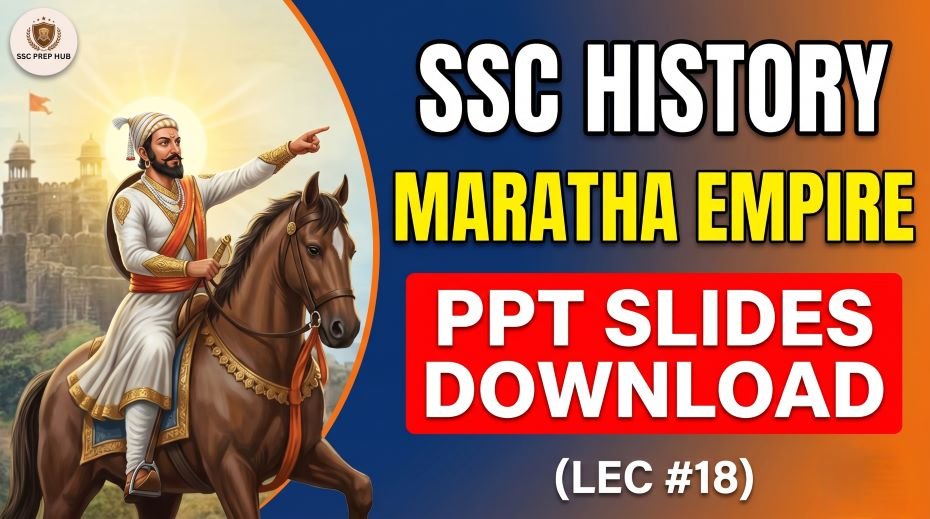
Today we will share SSC History Maratha Empire PPT Slides Download (LEC #18) so, The Maratha Empire is one of the most inspiring chapters in Indian history – the story of how a small community of hill warriors from the Western Ghats rose to challenge the mighty Mughal Empire and build an empire that stretched from the Himalayas to the Kaveri River and from Bengal in the east to Attock (in modern Pakistan) in the northwest. At its peak in the 18th century, the Maratha Confederacy controlled more of India than any other power.
This article is built around the SSC History Maratha Empire PPT Slides – Lecture #18 – from the Complete Foundation Batch PPT Series (Serial Number #43) at slideshareppt.net. The PPT contains 181 slides covering the complete Maratha story – from Shivaji’s birth to the Third Anglo-Maratha War – in exam-focused detail.
For SSC CGL, SSC CHSL, SSC MTS, SSC CPO, Railways NTPC, and UPSC Prelims aspirants, the Maratha Empire chapter consistently delivers 3–5 marks per exam. This guide covers every testable fact.
About the PPT Slides
| Detail | Information |
| Series Name | Complete Foundation Batch for All SSC and Other Exams (PPT Series) |
| Subject | Medieval Indian History – Maratha Empire (मराठा साम्राज्य) |
| Lecture Number | Lecture #18 |
| Total PPT Slides | 181 PPT Slides |
| File Size | 62 MB |
| Serial Number | #43 |
| Period Covered | ~1627 AD (Shivaji’s birth) to 1818 AD (Third Anglo-Maratha War) |
| Best For | SSC CGL, CHSL, MTS, CPO, GD, Railways NTPC, UPSC Prelims, State PSCs (especially Maharashtra) |
| Source Website | slideshareppt.net |
SSC History Maratha Empire PPT Slides Download (LEC #18)
Note: If you wish to download the entire SSC series (PPT slides), simply visit this redirect page. –REDIRECT PAGE
Complete Timeline Table: Maratha Empire – All Key Dates
This master timeline covers the full Maratha story from Shivaji’s birth to the end of Maratha power. Every date here has generated SSC MCQs.
| Year (AD) | Event | Key Person | Key SSC Fact |
| 1627 or 1630 | Birth of Shivaji Maharaj at Shivneri Fort | Shivaji Maharaj (born to Shahaji Bhonsle and Jijabai) | Shivneri Fort (near Junnar, Maharashtra) = birthplace; exact year debated – 1627 or 1630; mother Jijabai = greatest influence |
| 1646 | Shivaji captures Torna Fort – first military exploit | Shivaji (age ~16) | First fort captured independently; beginning of Maratha power |
| 1647–1655 | Shivaji captures multiple forts in Western Ghats | Shivaji | Rapidly expanded control over the Sahyadri/Western Ghats region; guerrilla warfare (Ganimi Kava) |
| 1659 | Battle of Pratapgad – Shivaji kills Afzal Khan | Shivaji vs Afzal Khan (Bijapur general) | Afzal Khan came to negotiate; Shivaji killed him with a tiger-claw weapon (Wagh Nakh); Bijapuri army routed |
| 1660 | Battle of Pavan Khind – Baji Prabhu Deshpande’s sacrifice | Baji Prabhu Deshpande holds the pass | Baji Prabhu held Pavan Khind (narrow mountain pass) against numerically superior Mughal/Bijapur forces to allow Shivaji to escape; died heroically; one of the great sacrifices in Maratha history |
| 1664 | Shivaji sacks Surat (first time) | Shivaji vs Surat (Mughal-controlled port city) | Looted the wealthy port of Surat; enormous wealth taken; shocked the Mughals and the European trading companies |
| 1665 | Treaty of Purandar – Shivaji surrenders 23 forts to Aurangzeb | Shivaji + Mirza Raja Jai Singh (Mughal general) | Signed after Mughal general Jai Singh defeated Shivaji militarily; Shivaji gave up 23 forts and 400,000 hun; agreed to go to Aurangzeb’s court |
| 1666 | Shivaji visits Aurangzeb’s court at Agra – imprisoned and escapes | Shivaji vs Aurangzeb (at Agra) | Aurangzeb insulted Shivaji by placing him among lower-ranking officers; Shivaji openly protested; was placed under house arrest; escaped by hiding in fruit baskets (traditional account); returned to Maharashtra |
| 1670 | Shivaji sacks Surat (second time) | Shivaji | Looted Surat again; recovered all forts lost at Treaty of Purandar within 4 months of escape from Agra |
| 1674 | Coronation (Rajyabhishek) of Shivaji at Raigad Fort | Shivaji – becomes Chhatrapati (Lord of the Umbrella/Sovereign) | First formal Maratha coronation; took the title Chhatrapati (sovereign king); Raigad Fort = capital; organised court and administration |
| 1677 | Shivaji’s Karnataka campaign – attacked Karnataka and South India | Shivaji | Expanded into Karnataka, Tamil Nadu region; showed pan-Indian ambitions |
| 1680 | Death of Shivaji Maharaj at Raigad Fort | Shivaji | Died at Raigad Fort; age approximately 50; succeeded by his son Sambhaji |
| 1680–1689 | Sambhaji’s reign – captured and executed by Aurangzeb | Sambhaji (Shivaji’s elder son) | Fought Aurangzeb vigorously; captured by Aurangzeb’s forces in 1689; publicly tortured and executed; became a Maratha martyr |
| 1689–1700 | Rajaram’s reign | Rajaram (Shivaji’s younger son) | Continued resistance against Aurangzeb from the Jinji Fort in Tamil Nadu; guerrilla warfare kept the Maratha flame alive |
| 1700–1707 | Tarabai acts as regent for young Shivaji III | Tarabai (Rajaram’s widow) | Most capable Maratha woman leader; held the empire together against Aurangzeb despite enormous pressure; continued guerrilla resistance |
| 1707 | Death of Aurangzeb; Maratha revival begins | Aurangzeb (died at Ahmadnagar) | Aurangzeb’s death released the Maratha prisoner Shahu (son of Sambhaji); Shahu’s release began a new phase |
| 1707–1749 | Shahu’s reign – established Peshwa system | Chhatrapati Shahu | Released by Mughals; had to fight Tarabai for legitimacy; established Peshwa as hereditary prime minister; gave Peshwas enormous power |
| 1713–1720 | Balaji Vishwanath – first hereditary Peshwa | Balaji Vishwanath | First Peshwa to make the position hereditary; effective consolidator of Maratha power after Aurangzeb’s wars |
| 1720–1740 | Baji Rao I – greatest Peshwa | Baji Rao I (Baji Rao Ballal Vishwanath) | Greatest Peshwa; expanded Maratha Empire more than anyone after Shivaji; never lost a battle; Battle of Palkhed (1728) vs Nizam; expanded into Malwa, Gujarat, Bundelkhand; reached Delhi |
| 1728 | Battle of Palkhed – Baji Rao I defeats Nizam-ul-Mulk | Baji Rao I vs Nizam-ul-Mulk (Hyderabad) | Brilliant manoeuvre warfare; Baji Rao bypassed Nizam’s army, marched deep into Nizam’s territory; Nizam had to sue for peace; one of the greatest tactical victories in Maratha history |
| 1740 | Death of Baji Rao I at Raverkhedi | Baji Rao I | Died suddenly of fever at age 40; succeeded by his son Balaji Baji Rao (Nana Sahib) |
| 1740–1761 | Balaji Baji Rao (Nana Sahib) as Peshwa | Balaji Baji Rao (Nana Sahib) | Maratha Empire at its greatest extent; but lost the disastrous Third Battle of Panipat (1761) |
| 1757 | Battle of Plassey – British defeat Nawab of Bengal | British (Clive) vs Siraj-ud-Daulah | Simultaneous with Maratha peak – British also rising in India; Marathas distracted by Panipat |
| 1761 | Third Battle of Panipat – devastating Maratha defeat | Marathas (Vishwasrao + Bhau Sahib) vs Ahmad Shah Abdali (Durrani) | 17 January 1761; Marathas completely routed; Vishwasrao (son of Nana Sahib Peshwa) killed; Bhau Sahib (Vishwasrao’s uncle) killed; Nana Sahib died of shock; empire severely weakened |
| 1761–1772 | Madhav Rao I – the restorer | Peshwa Madhav Rao I | Greatest post-Panipat Peshwa; rapidly rebuilt Maratha power; reasserted control over much of India within 10 years; died at age 27 of tuberculosis – a tragic early death |
| 1772 | Death of Madhav Rao I – Maratha infighting begins | Madhav Rao I died | Rapid succession of weak Peshwas; power struggles; Maratha Confederacy becomes fractious |
| 1775–1782 | First Anglo-Maratha War | British East India Company vs Maratha Confederacy | Ended with Treaty of Salbai (1782) – status quo ante; neither side conclusively won; British gained Salsette Island |
| 1803–1805 | Second Anglo-Maratha War | British vs Marathas (Scindias and Bhonsles mainly) | British defeated Daulat Rao Scindia and Raghuji Bhonsle; Delhi and Agra captured by British; Shah Alam II (Mughal) came under British protection |
| 1817–1818 | Third Anglo-Maratha War | British (Lord Hastings) vs Marathas | Complete Maratha defeat; Peshwa Baji Rao II surrendered; Maratha power permanently destroyed; British control of entire India now effective |
| 1818 | Last Peshwa Baji Rao II surrenders to British | Peshwa Baji Rao II | Sent to Bithur (near Kanpur) as a pensioner; adopted son Nana Sahib later became a key leader in 1857 Revolt |
Part I: Background – Rise of the Marathas
The Maratha Empire did not arise in a vacuum. Understanding its origins helps explain why the Marathas became such a powerful and resilient force in Indian history.
Geographical and Social Background
- The Marathas came from the Western Ghats (Sahyadri ranges) of Maharashtra – rugged, forested mountain terrain that made their homeland difficult to invade and easy to defend.
- This terrain shaped their military tactics – mountain forts (called gadhs) were the backbone of their power; they developed guerrilla warfare (Ganimi Kava) that exploited their knowledge of local terrain against larger, slower armies.
- The Maratha people were predominantly farmers, cattle-herders, and soldiers from the Deccan Plateau – tough, hardy, and deeply attached to their land and faith.
- The Bhakti movement saints of Maharashtra – particularly Sant Tukaram (a contemporary of Shivaji) and Sant Ramdas (Shivaji’s spiritual guide and mentor) – inspired a strong sense of Hindu religious identity and resistance to Islamic rule.
- Sant Ramdas (Samarth Ramdas Swami) wrote the Dasbodh – a spiritual and practical guide; he is considered Shivaji’s guru and the spiritual inspiration for the Maratha liberation movement.
Political Background – The Deccan Sultanates
- In the 17th century, the Deccan was controlled by the Bijapur Sultanate (Adil Shahi) and the Golconda Sultanate (Qutb Shahi) – the surviving Deccan Sultanates after the Bahmani fragmentation.
- The Mughal Empire under Aurangzeb was pushing southward, trying to eliminate the Deccan Sultanates and extend Mughal control over all of India.
- Shivaji’s father Shahaji Bhonsle served as a general for the Bijapur Sultan – giving the young Shivaji exposure to military command, court politics, and the geography of the Deccan.
- Shivaji’s mother Jijabai was deeply religious and nationalist; she raised him on the stories of Ram and Krishna and the heroic warriors of Indian tradition – instilling in him a vision of a Hindu Swarajya (self-rule).
SSC Exam Tip: Sant Ramdas = Shivaji’s spiritual mentor = wrote Dasbodh. Jijabai = Shivaji’s mother = greatest influence on his character. Both facts are tested in SSC papers. The term Ganimi Kava = Shivaji’s guerrilla warfare = SSC frequently asks about Shivaji’s military strategy.
Part II: Shivaji Maharaj (1627/1630–1680 AD) – The Founder
Chhatrapati Shivaji Maharaj is one of the greatest rulers and military geniuses in Indian history. He founded an independent Hindu kingdom (Swarajya) in the face of two powerful opponents – the Bijapur Sultanate and the Mughal Empire – through brilliance, courage, diplomatic skill, and an unmatched ability to inspire loyalty.
Shivaji Maharaj – Complete Profile
| Aspect | Detail |
| Birth | 19 February 1627 (or February 1630 – dates debated); at Shivneri Fort, Junnar, Maharashtra |
| Parents | Father: Shahaji Bhonsle (general of Bijapur Sultan); Mother: Jijabai (daughter of Lakhuji Jadhavrao) |
| Spiritual Mentor | Sant Ramdas (Samarth Ramdas Swami) – wrote Dasbodh; inspired the concept of Hindu Swarajya |
| Guardian | Dadoji Kondadev – his teacher and administrator of his father’s jagir in Pune; trained him in administration, military tactics, and statecraft |
| Military Strategy | Ganimi Kava (guerrilla warfare) – lightning raids, ambushes, swift retreats, use of mountain terrain; also maintained a strong navy (Blue Water Policy) to control the Konkan coast |
| First Conquest | 1646: captured Torna Fort (near Pune) – his first independent military exploit at age 16; renamed it Prachandagad |
| Battle of Pratapgad (1659) | Bijapur Sultan sent his general Afzal Khan to neutralise Shivaji; Afzal Khan tried to kill Shivaji during a supposed peace meeting; Shivaji killed him with a Wagh Nakh (tiger-claw) weapon and an iron-capped gauntlet; Bijapuri army then routed |
| Wagh Nakh | A fist-weapon with curved iron blades (like a tiger’s claw) worn on the hand; Shivaji used it to kill Afzal Khan; one of the most iconic weapons in Indian military history |
| Surat Raids (1664 and 1670) | Shivaji raided and looted the wealthy port city of Surat twice (1664 and 1670); shocked the Mughals and foreign trading companies; demonstrated Maratha naval reach |
| Treaty of Purandar (1665) | After defeat by Mughal general Mirza Raja Jai Singh, Shivaji signed the Treaty of Purandar; surrendered 23 forts (kept 12); agreed to visit Aurangzeb’s court; this was a temporary setback |
| Agra Incident (1666) | Visited Aurangzeb’s court at Agra; insulted when placed among minor nobles; openly protested; placed under house arrest; famously escaped by hiding in large fruit/sweet baskets; returned to Maharashtra |
| Post-escape Recovery | Within 4 months of escaping Agra, recovered all 23 forts he had surrendered at Purandar; defied the Mughals completely |
| Second Surat Raid (1670) | Sacked Surat a second time – a direct challenge to Mughal authority |
| Coronation at Raigad (1674) | On 6 June 1674 at Raigad Fort – formally crowned as Chhatrapati (Lord of the Umbrella = sovereign king) in a grand ceremony; Gagabhatta of Varanasi conducted the coronation; took the title Haindava Dharmoddhaarak (upholder of the Hindu faith) |
| Capital | Raigad Fort (initially); Rajgad and other forts also used |
| Navy | Built the first significant Maratha navy; controlled the Konkan coast; forts like Sindhudurg and Vijaydurg were key naval bases; naval commander: Kanhoji Angre (later period) |
| Death | 3 April 1680 at Raigad Fort; exact cause uncertain – possibly illness; aged approximately 50 |
SSC Exam Tip – Seven Must-Know Shivaji Facts: (1) Born at Shivneri Fort. (2) Battle of Pratapgad 1659 = killed Afzal Khan with Wagh Nakh. (3) Treaty of Purandar 1665 = surrendered 23 forts to Mirza Raja Jai Singh. (4) Escaped Aurangzeb’s court at Agra 1666. (5) Coronation at Raigad Fort 1674 = title Chhatrapati. (6) Ganimi Kava = guerrilla warfare. (7) Spiritual mentor = Sant Ramdas. All seven generate separate SSC questions.
Key Battles and Events of Shivaji’s Reign
| Year | Event | Opponent | Outcome / SSC Significance |
| 1646 | Capture of Torna Fort | – | First independent conquest; renamed Prachandagad |
| 1656 | Capture of Javali | Chandrarao More | Defeated local deshmukh; secured the Western Ghats |
| 1659 | Battle of Pratapgad | Afzal Khan (Bijapur general) | Afzal Khan killed with Wagh Nakh; Bijapuri army routed; Maratha power proclaimed |
| 1660 | Battle of Pavan Khind | Siddi Jauhar (Bijapur general) | Baji Prabhu Deshpande sacrificed himself to allow Shivaji to escape; a legendary act of loyalty |
| 1664 | First Sack of Surat | Mughal city; Inayat Khan (governor) | Enormous wealth looted; demonstrated Maratha reach |
| 1665 | Treaty of Purandar | Mirza Raja Jai Singh (Mughal general) | Shivaji surrendered 23 forts; agreed to serve Mughal emperor; a low point |
| 1666 | Agra incident and escape | Aurangzeb | Imprisoned; escaped; defied Mughals openly |
| 1670 | Second Sack of Surat | Mughal city | Looted again; recovered all forts lost at Purandar |
| 1670 | Battle of Sinhagad | Udaybhan (Mughal commander) | Tanaji Malusare (Shivaji’s trusted commander) captured Sinhagad at night; Tanaji killed; Shivaji famously said ‘Gad aala pan sinha gela’ – the fort came but the lion is gone |
| 1674 | Rajyabhishek (Coronation) | – | Crowned Chhatrapati at Raigad; formal founding of Maratha state |
| 1677 | Karnataka campaign | Bijapur and local rulers | Extended Maratha power into Karnataka and Tamil Nadu |
SSC Exam Tip: The Battle of Sinhagad (1670) and Tanaji Malusare’s sacrifice (‘Gad aala pan sinha gela’) is a well-known Maratha legend and occasionally tested in SSC papers. More frequently tested: Battle of Pratapgad (Afzal Khan), Treaty of Purandar (23 forts, Jai Singh), Agra escape, and Coronation at Raigad 1674.
Part III: Shivaji’s Administration – Ashta Pradhan and Revenue System
Ashta Pradhan – Council of Eight Ministers
Shivaji created one of the most well-organised administration systems of his era. The centrepiece was the Ashta Pradhan (Council of Eight Ministers) – eight ministers each responsible for a specific aspect of governance.
| Minister | Title | Function |
| 1. Prime Minister | Peshwa (Mukhya Pradhan) | Head of the council; overall in charge of administration; the most important position; after Shivaji, this position became hereditary and the Peshwas became the de facto rulers |
| 2. Revenue Minister | Amatya (Mazumdar) | Managed revenue accounts; finance minister |
| 3. Foreign Affairs | Waqia Navis (Sumant / Dabir) | Foreign affairs; correspondence with other states; protocol |
| 4. Home Affairs | Mantri (Waqia Navis) | Internal affairs; intelligence; personal secretary to the king |
| 5. Religious Affairs | Pandit Rao (Danadhyaksha) | Religious and charitable activities; Brahmins’ welfare; grants to scholars |
| 6. Law/Justice | Nyayadhish (Chief Justice) | Chief judge; administered justice |
| 7. Military Affairs | Senapati (Sar-i-Naubat) | Commander-in-chief of the army; military planning |
| 8. Correspondence | Sachiv (Shuru Navis) | Royal correspondence; drafted letters and documents |
SSC Exam Tip: Ashta Pradhan = Shivaji’s council of eight ministers = the Peshwa (Prime Minister) was the head. The two most tested positions are the Peshwa (which became the most important after Shivaji) and the Senapati (military commander). Questions often ask: ‘How many ministers were in Shivaji’s Ashta Pradhan?’ = 8.
Revenue System – Chauth and Sardeshmukhi
| Tax | Amount | Basis / Purpose | Who Paid It |
| Chauth | 1/4 (25%) of the assessed revenue of a territory | Originally demanded as ‘protection money’ – in exchange for NOT raiding a territory; later became a regular tribute collected from territories under Maratha influence but not directly ruled by them | Kingdoms and territories adjacent to Maratha territory; later expanded to large parts of the Mughal Empire |
| Sardeshmukhi | 1/10 (10%) of the assessed revenue of a territory | Shivaji claimed the traditional right of hereditary headman (deshmukh) over all of Maharashtra; this was an additional 10% levy based on that claim | Same territories as Chauth; paid in addition to Chauth |
| Total Maratha Levy | 35% (25% + 10%) | Combined Chauth and Sardeshmukhi = 35% of assessed revenue | Areas under Maratha influence |
SSC Exam Tip: Chauth = 1/4 (25%) of revenue = Maratha tribute. Sardeshmukhi = 1/10 (10%) of revenue = additional Maratha tribute based on Shivaji’s claim as hereditary deshmukh. Combined = 35%. These percentages and definitions are very frequently tested in SSC papers.
Shivaji’s Military System
- Shivaji built a disciplined, professional, and merit-based military – unusual for the era when most armies consisted of feudal levies loyal to local lords.
- He paid his soldiers directly from the state treasury in cash – not through jagir grants – ensuring their loyalty was to the state, not to individual commanders.
- The Maratha army had three main components: cavalry (the main striking force), fort-garrisons (defending the network of hill forts), and navy (for the Konkan coast).
- He forbade his soldiers from looting holy places or harming women and children during campaigns – an unusual code of conduct for 17th century warfare.
- He instituted a comprehensive system of hill forts (approximately 360 forts at his death) – each garrisoned and provisioned – that served as both military strongholds and administrative centres.
- He built the Maratha navy using locally constructed ships and employed Koli fishermen as sailors – making it one of the earliest indigenous Indian navies.
- Important naval commander after Shivaji: Kanhoji Angre (Angria) – the most feared Maratha naval admiral who successfully resisted the British, Dutch, and Portuguese naval power on the Konkan coast.
Part IV: Successors of Shivaji
Sambhaji (1680–1689 AD)
- Sambhaji was the elder son of Shivaji who succeeded him in 1680 after a brief succession dispute.
- He was an able military leader and personally led many campaigns against Aurangzeb’s massive Mughal army.
- He gave shelter to Prince Akbar (Aurangzeb’s rebellious son) – which infuriated Aurangzeb further.
- In 1689, Sambhaji was captured by the Mughal general Mukarrab Khan near Sangameshwar.
- Aurangzeb had Sambhaji publicly tortured and executed in a particularly brutal manner on 11 March 1689 – trying to break Maratha resistance by killing their leader.
- The execution backfired: instead of breaking Maratha morale, it united the Marathas with renewed determination and made Sambhaji a great martyr.
SSC Exam Tip: Sambhaji = Shivaji’s son = captured and executed by Aurangzeb 1689 = became a Maratha martyr whose death united the Marathas. His capture near Sangameshwar and his heroic execution are testable facts.
Rajaram (1689–1700 AD) and Tarabai (1700–1707 AD)
- Rajaram (Shivaji’s younger son) continued the Maratha resistance from the distant Jinji Fort in Tamil Nadu after the Mughals occupied Raigad.
- The Jinji Fort (also called Gingee, Tamil Nadu) became the Maratha capital in exile during the most dangerous phase of Aurangzeb’s Deccan campaign – it held out for 8 years (1689–1698) under siege.
- After Rajaram’s death in 1700, his widow Tarabai took over as regent for her infant son Shivaji III.
- Tarabai is one of the most capable women leaders in Indian history – she organised the Maratha armies and continued guerrilla warfare against Aurangzeb until his death in 1707.
- Aurangzeb died in 1707 without defeating the Marathas – his greatest failure.
SSC Exam Tip: Tarabai = Rajaram’s widow = regent for Shivaji III = continued Maratha resistance after Rajaram’s death = held the empire against Aurangzeb until 1707. She is a frequently tested Maratha woman leader.
Part V: The Peshwas – When Ministers Became Emperors
After Shivaji’s death and the chaos of Aurangzeb’s Deccan wars, real power in the Maratha Empire gradually shifted from the Chhatrapati (king) to the Peshwa (prime minister). This transition was completed under Chhatrapati Shahu who gave the Peshwas increasing powers, eventually making the position hereditary.
Chhatrapati Shahu (1707–1749 AD)
- Shahu was the son of Sambhaji – captured as a child by Aurangzeb and kept as a Mughal prisoner for 18 years.
- After Aurangzeb’s death in 1707, Shahu was released by the new Mughal emperor and returned to Maharashtra.
- He had to fight Tarabai (who had held power in his absence) for recognition as the legitimate Chhatrapati.
- Shahu recognised that capable administrators were more important than his own direct rule; he increasingly relied on his able Peshwa Balaji Vishwanath and later Baji Rao I.
- He formally recognised the Peshwa position as hereditary in the family of Balaji Vishwanath – transforming the nature of Maratha governance.
SSC Exam Tip: Chhatrapati Shahu = Sambhaji’s son = captured by Aurangzeb = released 1707 = made Peshwaship hereditary = real power shifted to Peshwas.
Key Peshwas – The Real Rulers of the Maratha Empire
| Peshwa | Period | Key Achievement / SSC Fact |
| Balaji Vishwanath Bhat | 1713–1720 | First hereditary Peshwa; helped Shahu win the succession struggle; rebuilt Maratha finances after Aurangzeb’s wars; negotiated the 1719 Treaty with the Mughals giving Marathas the Chauth and Sardeshmukhi rights over the Deccan and South India |
| Baji Rao I (Baji Rao Ballal) | 1720–1740 | GREATEST PESHWA; greatest military commander after Shivaji; never lost a battle; expanded the Maratha Empire to its greatest extent through lightning cavalry campaigns; Battle of Palkhed (1728) vs Nizam; reached Delhi; Battle of Bhopal (1737) – defeated Mughal army near Bhopal |
| Balaji Baji Rao (Nana Sahib) | 1740–1761 | Maratha Empire at maximum territorial extent; BUT suffered the catastrophic Third Battle of Panipat (1761); died of shock on hearing about the defeat |
| Madhav Rao I | 1761–1772 | Greatest post-Panipat Peshwa; ‘the boy wonder’; rebuilt Maratha power remarkably in 10 years; died at age 27 of tuberculosis – deeply mourned |
| Narayan Rao | 1772–1773 | Assassinated by his own uncle Raghunathrao – an act of treachery that deeply damaged Maratha unity |
| Sawai Madhav Rao (Madhav Rao II) | 1774–1795 | Child Peshwa under regency; Nana Phadnavis was the real power; empire maintained |
| Baji Rao II | 1796–1818 | Last Peshwa; weak, incompetent, betrayed Maratha chiefs to the British; surrendered to British in 1818; Maratha power ends |
Baji Rao I – The Greatest Peshwa
| Aspect | Detail |
| Full Name | Vishwanath Baji Rao Ballal (Baji Rao Peshwa I) |
| Period | 1720–1740 AD |
| Age at Appointment | Only 20 years old when appointed as Peshwa by Chhatrapati Shahu |
| Military Record | Never lost a single battle in his 20-year career as Peshwa – an extraordinary record |
| Key Battle 1: Palkhed (1728) | Fought against Nizam-ul-Mulk (Asaf Jah I) of Hyderabad; instead of direct battle, Baji Rao bypassed the Nizam’s army with his fast cavalry and invaded the Nizam’s heartland territory; Nizam was forced to sue for peace on Maratha terms; called a masterpiece of manoeuvre warfare |
| Key Battle 2: Battle of Bhopal (1737) | Baji Rao’s forces advanced to Delhi (the Mughal capital) in 1737 while the main Mughal army was busy elsewhere; the Mughal court panicked; then at Battle of Bhopal, Baji Rao routed a large Mughal-Nizam coalition army; effectively ended Mughal military power in central India |
| Expansion | Extended Maratha power into: Malwa (MP), Gujarat, Bundelkhand, Rajasthan, and the Gangetic plains; effectively made the Mughals Maratha tributaries |
| Capital | Moved the Peshwa’s seat of power to Pune (Poona) – which became the effective capital of the Maratha Empire |
| Personal Life | Famous for his love affair with Mastani (a Muslim princess and daughter of Chhindwara chief Chhatrasal); Mastani bore him a son named Shamsher Bahadur; the relationship was controversial in orthodox Brahmin society |
| Death | 28 April 1740 at Raverkhedi (MP) – died suddenly of fever at age 40; his death was a great loss for the Maratha Empire |
| SSC Quote about him | Baji Rao I is often quoted as saying: ‘Let us strike at the trunk of the withered tree and the branches will fall themselves’ – referring to his strategy of attacking Delhi directly rather than fighting peripheral battles |
SSC Exam Tip: Baji Rao I = greatest Peshwa = never lost a battle = Battle of Palkhed 1728 (vs Nizam) = Battle of Bhopal 1737 (vs Mughals near Delhi) = expanded Maratha Empire enormously. These four facts are the most tested about Baji Rao I in SSC papers.
Part VI: The Three Battles of Panipat – Comparative Summary
The three Battles of Panipat are among the most important battles in Indian history. Each one determined the fate of a major Indian empire. Panipat (in modern Haryana) became the decisive battlefield of India because it sits at the entrance to the Gangetic plains from the northwest – the natural gateway for invasions from Central Asia and Afghanistan.
| Feature | First Battle of Panipat (1526) | Second Battle of Panipat (1556) | Third Battle of Panipat (1761) |
| Date | 21 April 1526 | 5 November 1556 | 14 January 1761 |
| Combatants | Babur (Mughal) vs Ibrahim Lodi (Delhi Sultan) | Akbar’s forces (Bairam Khan) vs Hemu (Vikramaditya) | Ahmad Shah Abdali/Durrani (Afghan) vs Marathas (Vishwasrao + Bhau Sahib) |
| Winner | Babur (Mughal) | Akbar/Bairam Khan (Mughal) | Ahmad Shah Abdali (Afghan) |
| Loser Killed? | Ibrahim Lodi (killed) | Hemu (captured; Bairam Khan executed him) | Vishwasrao (killed in battle); Bhau Sahib (killed in battle) |
| What Ended | Delhi Sultanate (1206–1526) | Sur dynasty’s challenge to Mughal rule | Maratha dream of pan-Indian empire |
| What Began | Mughal Empire | Akbar’s effective Mughal rule | Rapid decline of Maratha power and rise of British |
| Significance | Changed India from Sultanate to Mughal rule | Secured Mughal Empire against all challenges | Ended Maratha imperial ambitions; opened door for British |
| SSC Importance | Most tested overall (1526 + Babur + artillery) | Frequently tested (1556 + Hemu + Bairam Khan) | Critically tested (1761 + Abdali + Vishwasrao killed) |
SSC Exam Tip: All three Battles of Panipat dates and outcomes are tested. The most frequently tested single fact is the Third Battle of Panipat (1761) – Marathas defeated by Ahmad Shah Abdali = Vishwasrao killed. The question ‘Third Battle of Panipat was fought between?’ = Marathas and Ahmad Shah Abdali (Durrani) appears in almost every SSC exam.
Part VII: Third Battle of Panipat (1761) – The Maratha Tragedy
| Aspect | Detail |
| Date | 14 January 1761 (Makar Sankranti) |
| Location | Panipat, Haryana |
| Maratha Side | Vishwasrao (son of Peshwa Balaji Baji Rao – Nana Sahib); Bhau Sahib (Vishwasrao Bhau – Nana Sahib’s cousin and military commander); Ibrahim Khan Gardi (artillery commander, originally in Mughal service) |
| Afghan Side | Ahmad Shah Abdali (Durrani) – ruler of Afghanistan; allied with Najib-ud-Daulah (Rohilla chief) and Shuja-ud-Daulah (Nawab of Awadh) |
| Background | Marathas had been expanding north, reaching Delhi and even Afghanistan; Ahmad Shah Abdali was called in by opponents of Maratha expansion to stop them |
| Battle Outcome | Catastrophic Maratha defeat; Vishwasrao killed; Bhau Sahib killed; Ibrahim Khan Gardi captured and executed; tens of thousands of Maratha soldiers killed; the battle was lost partly because the Marathas’ supply lines were cut off and soldiers were starving before the battle |
| Casualty Figures | Estimates range from 28,000 to 75,000 Maratha dead; additionally thousands of camp followers (men, women, children) were killed or enslaved – a national tragedy for the Marathas |
| Nana Sahib’s Fate | Peshwa Balaji Baji Rao (Nana Sahib) was at Pune when he received the news of the defeat; he died of shock and grief on 23 June 1761 |
| Why Marathas Lost | (1) Supply crisis – Marathas were far from home and ran out of food and fodder; (2) Afghan cavalry superiority; (3) Maratha over-extension – they had too many enemies simultaneously; (4) Lack of coordination with potential allies (Shuja-ud-Daulah sided with Abdali) |
| Long-term Impact | Maratha power permanently weakened; they never recovered enough to become the dominant pan-Indian power; British took advantage of the post-Panipat power vacuum to expand rapidly |
| Short-term Recovery | Madhav Rao I (Peshwa 1761–1772) brilliantly rebuilt Maratha power within 10 years – reasserting control over Delhi and much of central India |
Part VIII: Maratha Confederacy – The Five Chiefs
After the Third Battle of Panipat (1761), the Maratha Empire evolved from a centralised state under the Peshwa into a loose confederacy of five major Maratha chiefs, each controlling a different region.
| Maratha Chief | Dynasty Name | Capital | Territory | Key Historical Figure |
| Peshwas | Bhatt family (Bhat) | Pune (Poona) | Maharashtra, Konkan, parts of Madhya Pradesh | Baji Rao I (greatest), Madhav Rao I (restorer), Baji Rao II (last) |
| Bhonsles of Nagpur | Bhonsle family | Nagpur | Vidarbha (eastern Maharashtra), Berar, Odisha | Raghuji Bhonsle I; Mudhoji II (Appa Sahib) |
| Scindias (Shindes) | Scindia family | Gwalior | Malwa, Rajputana, parts of UP and Delhi area | Mahadaji Scindia (Mahadji Shinde) – the greatest post-Panipat Maratha military leader; restored Maratha prestige; appointed regent by the Mughal Emperor; Daulat Rao Scindia (lost to British in 2nd Anglo-Maratha War) |
| Holkars | Holkar family | Indore | Western Malwa, parts of Rajputana | Malhar Rao Holkar (founder); Ahilyabai Holkar (greatest, 1767–1795 – one of India’s greatest women rulers, built temples across India); Yashwant Rao Holkar (fought British 2nd Anglo-Maratha War) |
| Gaekwads (Gaikwads) | Gaekwad family | Baroda (Vadodara) | Gujarat | Damaji Gaekwad (consolidated); later dynasty became princely state under British; Sayajirao Gaekwad III was a famous reformist ruler |
SSC Exam Tip: The five Maratha chiefs – Peshwas (Pune), Bhonsles (Nagpur), Scindias (Gwalior), Holkars (Indore), Gaekwads (Baroda) – are frequently tested as a group. Know the capital city of each. Mahadaji Scindia and Ahilyabai Holkar are the two most individually tested post-Panipat Maratha figures.
Ahilyabai Holkar (1767–1795 AD) – The Saint-Queen
| Aspect | Detail |
| Full Name | Ahilyabai Holkar |
| Period | 1767–1795 AD as ruler of Indore (Malwa) |
| Background | Daughter-in-law of Malhar Rao Holkar (founder of Holkar dynasty); became ruler after her father-in-law’s death and her son’s death |
| Administration | Considered one of the greatest administrators in Indian history; ruled justly, maintained law and order, promoted trade and agriculture |
| Temple Building | Built or restored hundreds of Hindu temples and ghats across India – at Varanasi, Gaya, Somnath, Mathura, Haridwar, Puri, Kashi Vishwanath; created sacred sites for pilgrimage across the subcontinent |
| Kashi Vishwanath Temple | The current Kashi Vishwanath Temple at Varanasi was built by Ahilyabai Holkar in 1777 AD – after Aurangzeb had demolished the earlier temple in the 17th century |
| Welfare Works | Dug wells, built dharamshalas (rest houses), funded poor, ensured justice |
| Capital | Maheshwar (on the Narmada River) – she built a beautiful city here including the Maheshwar Fort and ghats |
| Textile Patronage | Revived the Maheshwari silk textile tradition at Maheshwar – still famous today |
| Reputation | Called ‘Philosopher Queen of Maheshwar’; described by historians as an enlightened and just ruler; John Keay described her as ‘one of the most remarkable rulers of any era’ |
| SSC Relevance | ‘Who rebuilt the Kashi Vishwanath Temple at Varanasi?’ = Ahilyabai Holkar. ‘Ahilyabai Holkar ruled which state?’ = Indore (Holkar dynasty) |
Mahadaji Scindia (Mahadji Shinde) – The Post-Panipat Restorer
- Mahadaji Scindia (~1730–1794 AD) was the greatest Maratha military and diplomatic figure of the post-Panipat era.
- He was the grandson of Ranoji Scindia (founder of the Scindia dynasty) and built the Maratha presence in North India to its greatest post-Panipat extent.
- He captured Delhi in 1771 and effectively became the protector of the Mughal Emperor Shah Alam II – the Mughals recognised him as ‘Regent Plenipotentiary’ (Vakil-ul-Mutlaq).
- He reorganised his army using European-trained officers – particularly Benoit de Boigne (a French military officer) – creating a formidable modern infantry-and-artillery force.
- In the Second Anglo-Maratha War (1803), his successor Daulat Rao Scindia was defeated by the British general Arthur Wellesley (later Duke of Wellington) at the Battles of Assaye and Argaon.
SSC Exam Tip: Mahadaji Scindia = captured Delhi 1771 = regent of Mughal Empire = reorganised army with European officers. His capture of Delhi is the most tested fact about him.
Part IX: Anglo-Maratha Wars – End of Maratha Power
| War | Period | Cause | Key Events / Battles | Outcome / Treaty |
| First Anglo-Maratha War | 1775–1782 AD | Disputed Peshwaship; British backed Raghunathrao (Raghoba) against the Maratha Regency Council | Battle of Wadgaon (1779) – Maratha victory, British surrendered; Battle of Sipri and others – British recovered | Treaty of Salbai (1782) – status quo ante; British returned territories; gained Salsette Island; neither side decisively won |
| Second Anglo-Maratha War | 1803–1805 AD | Peshwa Baji Rao II signed Treaty of Bassein (1802) with British for protection against Holkars and Scindias; other Maratha chiefs opposed this | Battle of Assaye (1803) – Arthur Wellesley defeats Daulat Rao Scindia; Battle of Laswari – Lake defeats Scindia; Battle of Argaon – Wellesley defeats Bhonsle | British gained Delhi, Agra, Orissa; Mughal Emperor Shah Alam II under British protection; Scindias and Bhonsles signed subsidiary alliance treaties |
| Third Anglo-Maratha War | 1817–1818 AD | Pindaris (bandits) used Maratha territory as base; British under Lord Hastings determined to end Maratha power; Peshwa Baji Rao II tried to resist | Battle of Kirkee (1817) – British defeat Peshwa’s forces near Pune; Battle of Koregaon (1818) – Bhima Koregaon battle (famous today); Battle of Ashti – final Maratha defeat | Peshwashahi (Peshwa system) abolished; Peshwa Baji Rao II surrendered and sent to Bithur as pensioner; entire Maratha Confederacy broken up; British control over all of India |
SSC Exam Tip: Third Anglo-Maratha War = 1817–1818 = Lord Hastings = ended Maratha power completely. First Anglo-Maratha War ended with Treaty of Salbai (1782). Second Anglo-Maratha War = Arthur Wellesley at Battle of Assaye. All three wars, their dates, and their outcomes are testable.
Part X: Maratha Cultural Contributions
| Area | Contribution / Detail |
| Language | Maratha Empire promoted Marathi language and literature; Marathi became the court language alongside Persian; great Marathi literature flourished under Peshwa patronage |
| Religion | Strong devotion to Vithoba (Vitthal) at Pandharpur – the Varkari tradition; also Shaiva devotion; the Bhakti saints (Tukaram, Ramdas) were deeply influential |
| Music | Natyasangeet (musical theatre) tradition; Lavani (folk music and dance) flourished |
| Temple Building | Ahilyabai Holkar rebuilt or restored hundreds of temples across India – greatest Maratha contribution to temple culture |
| Architecture | Pune, Nashik, Satara, Kolhapur have beautiful Peshwa-era palaces and wadas (mansions); Maheshwar built by Ahilyabai; Shaniwar Wada (Pune) – the Peshwa’s palace complex |
| Administration | Ashta Pradhan system; Chauth and Sardeshmukhi; land revenue surveys; sophisticated record-keeping in Modi script; Maratha administrative traditions influenced the Bombay Presidency |
| Military Innovation | Ganimi Kava (guerrilla warfare); mountain fort system; first significant Indian navy; use of cavalry for rapid manoeuvre warfare |
| Legacy | Maratha Empire ended organised Muslim rule in India (particularly in the Deccan); provided a period of Hindu resurgence after Mughal dominance; the Maratha spirit (assertive, independent, dharmic) has been a major influence on Maharashtra’s culture |
High-Frequency SSC MCQs: Maratha Empire Chapter
These 35 questions represent the most consistently repeated MCQs from this chapter across SSC CGL, CHSL, MTS, CPO, GD, and Railways NTPC previous year papers.
| Question | Correct Answer | SSC Exam Reference |
| Where was Shivaji Maharaj born? | Shivneri Fort (near Junnar, Maharashtra) | SSC CGL 2016, 2019, SSC CHSL 2021 |
| Who was Shivaji’s mother? | Jijabai (daughter of Lakhuji Jadhavrao) | SSC CHSL 2019, SSC MTS 2021 |
| Who was Shivaji’s spiritual mentor / guru? | Sant Ramdas (Samarth Ramdas Swami) – wrote Dasbodh | SSC CGL 2017, 2020, SSC CHSL 2021 |
| What was Ganimi Kava? | Shivaji’s guerrilla warfare strategy – lightning raids, ambushes, use of mountain terrain | SSC CGL 2018, SSC CHSL 2020 |
| Battle of Pratapgad (1659) – what happened? | Shivaji killed Bijapur general Afzal Khan using a Wagh Nakh (tiger-claw weapon) | SSC CGL 2017, 2019, 2022 |
| What is a Wagh Nakh? | An iron fist-weapon with curved claws like a tiger’s; used by Shivaji to kill Afzal Khan | SSC CHSL 2020, SSC GD 2022 |
| Treaty of Purandar (1665) was signed between whom? | Shivaji and Mirza Raja Jai Singh (Mughal general) – Shivaji surrendered 23 forts | SSC CGL 2018, SSC CHSL 2021 |
| How many forts did Shivaji surrender in the Treaty of Purandar? | 23 forts (kept 12) | SSC CGL 2019, SSC CHSL 2021 |
| What happened at Agra in 1666? | Aurangzeb insulted Shivaji; placed under house arrest; Shivaji escaped (traditionally: hid in fruit baskets) | SSC CGL 2017, 2020, SSC CHSL 2021 |
| Where was Shivaji’s coronation held and what title did he take? | Raigad Fort (1674); title Chhatrapati (sovereign) | SSC CGL 2015–2022 (repeated every exam) |
| What is Chhatrapati? | Title meaning ‘Lord of the Umbrella’ or ‘Sovereign King’; used by Shivaji after his coronation at Raigad | SSC CGL 2018, SSC CHSL 2020 |
| What was the Ashta Pradhan? | Shivaji’s council of eight ministers; Peshwa (PM) was the head | SSC CGL 2016, 2019, 2022 |
| What was Chauth? | 1/4 (25%) of assessed revenue collected by Marathas as tribute from territories under their influence | SSC CGL 2015–2022 (repeated) |
| What was Sardeshmukhi? | 1/10 (10%) of assessed revenue; additional Maratha tribute based on claim of hereditary deshmukh rights | SSC CGL 2017, SSC CHSL 2019 |
| Who killed Sambhaji and how did he die? | Captured by Mughal general Mukarrab Khan in 1689; publicly tortured and executed by Aurangzeb on 11 March 1689 | SSC CHSL 2019, SSC MTS 2021 |
| Who was Tarabai? | Rajaram’s widow; regent for young Shivaji III; held the Maratha Empire against Aurangzeb after 1700 | SSC CHSL 2020, SSC CPO 2022 |
| Who was the first hereditary Peshwa? | Balaji Vishwanath Bhat (1713–1720) | SSC CGL 2017, SSC CHSL 2020 |
| Who was the greatest Peshwa? | Baji Rao I (1720–1740) – never lost a battle; expanded the Maratha Empire enormously | SSC CGL 2016, 2019, 2022 |
| Battle of Palkhed (1728) – who fought and who won? | Baji Rao I vs Nizam-ul-Mulk of Hyderabad; Baji Rao I won through brilliant manoeuvre warfare | SSC CGL 2018, SSC CHSL 2021 |
| Who was Peshwa during the Third Battle of Panipat? | Balaji Baji Rao (Nana Sahib) – he died of shock after hearing about the defeat | SSC CGL 2017, 2020, SSC CHSL 2021 |
| Third Battle of Panipat (1761) – who fought and who won? | Ahmad Shah Abdali (Durrani/Afghan) vs Marathas (Vishwasrao + Bhau Sahib); Abdali won; Vishwasrao killed | SSC CGL 2014–2023 (most repeated Maratha battle) |
| Who was killed in the Third Battle of Panipat (1761)? | Vishwasrao (Nana Sahib’s son/heir) and Bhau Sahib | SSC CGL 2018, SSC CHSL 2020 |
| Who rebuilt Maratha power after the Third Battle of Panipat? | Peshwa Madhav Rao I (1761–1772) – ‘the boy wonder’; rebuilt empire within 10 years | SSC CGL 2019, SSC CHSL 2021 |
| What are the five Maratha Confederacy states and their capitals? | Peshwas (Pune), Bhonsles (Nagpur), Scindias (Gwalior), Holkars (Indore), Gaekwads (Baroda) | SSC CGL 2016, 2019, 2022 |
| Who was Ahilyabai Holkar? | Ruler of Indore (Holkar dynasty, 1767–1795); rebuilt Kashi Vishwanath Temple at Varanasi; great administrator and temple builder | SSC CGL 2017, 2020, SSC CHSL 2021 |
| Kashi Vishwanath Temple at Varanasi was built by whom? | Ahilyabai Holkar in 1777 AD | SSC CGL 2018, SSC CHSL 2021, SSC GD 2022 |
| Who was Mahadaji Scindia? | Greatest post-Panipat Maratha leader; captured Delhi 1771; became regent of Mughal Empire; reorganised army with European officers | SSC CGL 2019, SSC CHSL 2022 |
| First Anglo-Maratha War ended with which treaty? | Treaty of Salbai (1782) | SSC CGL 2017, SSC CHSL 2020 |
| Second Anglo-Maratha War – which British general won the Battle of Assaye (1803)? | Arthur Wellesley (later Duke of Wellington) | SSC CGL 2018, SSC CHSL 2021 |
| Third Anglo-Maratha War ended Maratha power completely. Who was the last Peshwa? | Baji Rao II (surrendered to British in 1818) | SSC CGL 2016, 2019, 2022 |
| What was the Treaty of Bassein (1802)? | Peshwa Baji Rao II signed with British to get their military support against other Maratha chiefs – a turning point that gave British foothold in Maratha affairs | SSC CHSL 2020, SSC CPO 2022 |
| The Third Battle of Panipat was fought on which date? | 14 January 1761 (Makar Sankranti) | SSC CHSL 2021, SSC GD 2022 |
| Who was Ahmad Shah Abdali? | Ruler of Afghanistan (Durrani Empire); won the Third Battle of Panipat (1761) against the Marathas | SSC CGL 2017, 2020, SSC CHSL 2021 |
| Sant Ramdas wrote which text? | Dasbodh – a spiritual and practical guide; he was Shivaji’s mentor | SSC CGL 2018, SSC CHSL 2020 |
| Which Scindia ruler was defeated by Arthur Wellesley at Battle of Assaye (1803)? | Daulat Rao Scindia (in Second Anglo-Maratha War) | SSC CHSL 2021, SSC GD 2022 |
Podcast Interview: Expert Q&A – Maratha Empire Deep Dive
A 9-round expert dialogue covering the Maratha Empire from multiple perspectives.
| Speaker | Question / Statement | Answer / Explanation |
| Aspirant | What makes the Maratha Empire unique compared to other medieval Indian empires? | Educator: Three things make the Marathas genuinely unique. First, they were the first Indian power in 500 years to challenge and break the dominance of an established Islamic empire – specifically the mighty Mughal Empire under Aurangzeb, who spent 25 years and virtually all his resources trying to destroy them and failed. Second, they developed and perfected Ganimi Kava – guerrilla warfare – as a strategic doctrine, using the Western Ghats terrain to neutralise armies that were numerically vastly superior. Third, their rise was deeply connected to a popular religious and cultural movement (the Bhakti saints, especially Sant Ramdas), making them not just a military-political force but a cultural and spiritual one. No other Indian empire had this combination of military innovation, popular support, and spiritual identity. |
| Aspirant | The escape from Agra is a famous story. What actually happened? | Educator: In 1666, Shivaji visited Aurangzeb’s court as per the Treaty of Purandar agreement. Aurangzeb insulted him by placing him among minor 5,000 Zat mansabdars – below his expected status as a great king. Shivaji openly protested and stormed out – which Aurangzeb saw as insolence. He placed Shivaji under house arrest in Agra. According to popular Maratha tradition, Shivaji and his son Sambhaji escaped by hiding in large baskets of sweets or fruit sent as ‘charity donations’ to Brahmins; the guards were fooled into letting the baskets pass. Historians debate the exact method but the escape itself is historically verified. Shivaji returned to Maharashtra and within 4 months had recovered all 23 forts he had surrendered at Purandar – a remarkable comeback. |
| Aspirant | What exactly is Chauth and why was it so controversial? | Educator: Chauth means ‘one-fourth’ – Shivaji demanded 25% of the assessed revenue of any territory as a tribute, in exchange for NOT raiding it. The Mughals and Deccan Sultanates considered this extortion – paying to be left alone. But for Shivaji and the Marathas, it was a legitimate political assertion: we control this territory sufficiently to demand tribute; you pay us or we will devastate your land. Over time, Chauth evolved from a protection payment into a regular administrative tax collected from territories under Maratha political influence. By the Peshwa era, the Marathas collected Chauth from vast territories including Bengal, Punjab, and central India. The right to collect Chauth from the Deccan was formally recognised by the Mughals in the 1719 treaty negotiated by Balaji Vishwanath. |
| Aspirant | Why was the Third Battle of Panipat (1761) such a disaster for the Marathas? | Educator: Four compounding factors. One: Supply crisis – the Marathas had marched far from home and their supply lines were cut off by Abdali’s forces; by battle day, the soldiers had been on short rations for weeks and were physically weakened. Two: Military overextension – the Marathas had too many enemies at once; potential Hindu allies like the Rajputs and Jats refused to support them, partly because of how the Marathas had treated them earlier. Three: Ahmad Shah Abdali was a brilliant military commander who used superior Afghan cavalry and controlled the terrain. Four: Tactical mistakes on battle day – Vishwasrao was killed early in the battle, disrupting Maratha command. The combination was fatal. The Marathas lost between 28,000 and 75,000 soldiers – an entire generation of Maratha military leadership was wiped out. |
| Aspirant | Who was Baji Rao I and why is he called the greatest Peshwa? | Educator: Baji Rao I (1720–1740) is called the greatest Peshwa for one reason above all others: he never lost a battle in 20 years of continuous military campaigning – an extraordinary record. He combined the Maratha tradition of fast cavalry raids with genuine strategic vision – he understood that to make the Marathas the supreme power in India, he needed to control the Gangetic plains and contain the Mughals and Nizam simultaneously. His Battle of Palkhed (1728) against the Nizam is considered a masterpiece of manoeuvre warfare – he bypassed the Nizam’s army entirely and invaded the Nizam’s undefended heartland, forcing surrender without a direct engagement. He reached Delhi in 1737 and shocked the Mughals out of their capital. He died at 40 – if he had lived another 20 years, the map of India might look very different. |
| Aspirant | Ahilyabai Holkar rebuilt the Kashi Vishwanath Temple – why is this significant? | Educator: It is significant for three reasons. First, the original Kashi Vishwanath Temple had been demolished by Aurangzeb in the 17th century – a great humiliation for Hindus – and replaced by a mosque. Ahilyabai built a new temple alongside the mosque in 1777 AD – restoring the pilgrimage site. Second, she did this entirely from her own treasury (as the ruler of Indore) – not asking for Mughal or Peshwa permission, demonstrating that Maratha power had reached the point where Hindu rulers could openly rebuild temples even in the most sacred Hindu cities. Third, Ahilyabai’s temple building programme across India – at Varanasi, Gaya, Somnath, Mathura, Haridwar, Puri – was the most systematic restoration of Hindu sacred sites since Vijayanagara. For SSC: ‘Who built the Kashi Vishwanath Temple at Varanasi?’ = Ahilyabai Holkar (the current temple, 1777 AD). |
| Aspirant | How did the Maratha Empire end? Was it purely British military force? | Educator: Not purely military – it was a combination of British military superiority and Maratha political self-destruction. The Marathas were never definitively defeated in open battle by the British – the Treaty of Salbai (1782) after the First Anglo-Maratha War was essentially a stalemate. But in the Second and Third Anglo-Maratha Wars, the Maratha chiefs fought separately rather than together – Scindias, Holkars, Peshwas, and Bhonsles all made their own deals with or against the British at different times. The final blow was the Treaty of Bassein (1802) – when Peshwa Baji Rao II, who was weak and frightened of his own Maratha rivals, invited the British for protection. Once a Maratha chief invited the British in, the entire Confederacy was compromised. The Third Anglo-Maratha War (1817–1818) was really the formal end of what had already been decided politically. |
| Aspirant | Who was Mahadaji Scindia and how significant was his capture of Delhi? | Educator: Mahadaji Scindia (1730–1794) was the greatest post-Panipat Maratha military and political figure. His capture of Delhi in 1771 – just 10 years after the catastrophic Third Battle of Panipat – was an astonishing recovery. He effectively made himself the protector of the Mughal Emperor Shah Alam II and received the title ‘Regent Plenipotentiary’ (Vakil-ul-Mutlaq) – meaning he ran the Mughal Empire’s administration on the emperor’s behalf. At his peak in the 1780s–1790s, Mahadaji controlled Delhi, Agra, and large parts of Rajputana and central India. He also modernised his army by hiring European military officers, particularly Benoit de Boigne, who trained his infantry in European-style discipline and drill. His capture of Delhi represents the Marathas at their maximum post-Panipat power. His successor Daulat Rao Scindia lost to Arthur Wellesley (later Duke of Wellington) in 1803, beginning the British takeover of central India. |
| Aspirant | Where can I find the 181-slide PPT for this chapter? | Educator: The SSC History Maratha Empire PPT Slides – Lecture #18 – Serial #43 – is available free at slideshareppt.net. At 181 slides and 62 MB, it covers Shivaji’s entire career, the Peshwa era, the three Battles of Panipat comparison, the five Maratha chiefs, the Anglo-Maratha Wars, and Maratha culture and administration in a structured, visual, exam-focused format. After studying this article and working through the 35 MCQs, spending 60 minutes with the PPT slides will give you complete preparation for this chapter. |
How to Study This Chapter for Maximum SSC Marks
Step 1 – Shivaji Maharaj Deep Study (Day 1)
- Born at Shivneri Fort; mother Jijabai; mentor Sant Ramdas (Dasbodh); guardian Dadoji Kondadev.
- Key events: Battle of Pratapgad 1659 (Afzal Khan killed, Wagh Nakh), Treaty of Purandar 1665 (23 forts to Jai Singh), Agra escape 1666, Coronation at Raigad 1674 (Chhatrapati).
- Administration: Ashta Pradhan (8 ministers, Peshwa = head); Chauth (25%) + Sardeshmukhi (10%).
Step 2 – Post-Shivaji and Peshwas (Day 2)
- Sambhaji (1680–1689): executed by Aurangzeb = became martyr = united Marathas.
- Tarabai (1700–1707): held empire against Aurangzeb after Rajaram’s death.
- Peshwas in order: Balaji Vishwanath (first hereditary) → Baji Rao I (greatest, Palkhed 1728, Bhopal 1737, never lost) → Balaji Baji Rao/Nana Sahib (Panipat 1761) → Madhav Rao I (restorer).
Step 3 – Three Battles of Panipat Comparison (Day 3)
- 1st: 1526 = Babur vs Ibrahim Lodi = Mughal Empire begins.
- 2nd: 1556 = Bairam Khan (Akbar) vs Hemu = Mughal rule secured.
- 3rd: 14 January 1761 = Ahmad Shah Abdali vs Marathas = Vishwasrao killed = Maratha decline begins.
- Maratha Confederacy: 5 chiefs = Peshwas (Pune), Bhonsles (Nagpur), Scindias (Gwalior), Holkars (Indore), Gaekwads (Baroda).
Step 4 – Anglo-Maratha Wars and MCQ Sprint (Day 4–5)
- First AMW (1775–1782): Treaty of Salbai. Second AMW (1803–1805): Arthur Wellesley + Battle of Assaye. Third AMW (1817–1818): Lord Hastings = Peshwa Baji Rao II surrendered.
- Special figures: Ahilyabai Holkar (Indore, Kashi Vishwanath Temple 1777), Mahadaji Scindia (Delhi 1771, regent).
- Solve all 35 MCQs. Target 90%+ accuracy.
also read: SSC History Mughal Empire PPT Slides Download (LEC #17)
(FAQs):
Q1: When was Shivaji Maharaj born – 1627 or 1630?
This is a genuine historical debate. The most widely accepted date in Maharashtra and in official records is 19 February 1630. However, some historians and the Maharashtra government at various times have also accepted 1627. For SSC exam purposes, both dates appear in different papers – the most commonly given answer in SSC papers is 1627 (for birth year) and the specific date 19 February 1630 for those who accept 1630. The safest answer for SSC is: ‘born at Shivneri Fort, Maharashtra (exact year debated – 1627 or 1630).’ The location (Shivneri Fort) is universally accepted and more frequently tested than the exact year.
Q2: What exactly was the Treaty of Purandar (1665) and why did Shivaji agree to it?
The Treaty of Purandar was signed in June 1665 between Shivaji and the Mughal general Mirza Raja Jai Singh (a Rajput general in Aurangzeb’s service who was one of the most able commanders of the era). By this treaty, Shivaji agreed to: (1) surrender 23 of his approximately 35 forts (retaining only 12); (2) pay a large sum of money (400,000 hun); (3) personally visit Aurangzeb’s court and offer his service; (4) provide military service to the Mughals in the Deccan. Shivaji agreed because Jai Singh had militarily defeated him in a difficult campaign, isolating him from his allies. The agreement was a tactical retreat – Shivaji was biding his time. He never actually collaborated with the Mughals in good faith and used the Agra visit as an opportunity to embarrass Aurangzeb before escaping.
Q3: What is the significance of Baji Rao I’s Battle of Palkhed (1728)?
The Battle of Palkhed (1728) is considered one of the most brilliant examples of manoeuvre warfare in Indian history. Baji Rao I faced the Nizam-ul-Mulk’s forces in the Deccan. Instead of engaging the Nizam in a direct battle (which the Nizam expected), Baji Rao bypassed the Nizam’s army entirely with his fast-moving Maratha cavalry and invaded the Nizam’s own home territory – destroying crops, capturing towns, and threatening Hyderabad itself. The Nizam had to give up his strategic position and chase the Marathas – but on their ground. He was eventually forced to sue for peace at a location unfavourable to him. Baji Rao achieved his political objective without a major pitched battle – a perfect example of strategic manoeuvre. This battle is compared to the best cavalry manoeuvres in military history.
Q4: Why did the Marathas lose the Third Battle of Panipat?
The Maratha defeat at the Third Battle of Panipat (1761) resulted from multiple factors: their supply lines had been cut off for weeks before the battle, leaving soldiers starving; they failed to win over potential Hindu allies (Rajputs, Jats, Awadh) who might have tipped the balance; Ahmad Shah Abdali was a superior cavalry commander who controlled the terrain; the death of Vishwasrao early in the battle disrupted Maratha command structure; and the Marathas’ strategic overextension had already made them deeply unpopular in North India. The famous phrase after the battle was: ‘the loss was national; every household in Maharashtra mourned’ – reflecting how deeply the defeat affected the Maratha people.
Q5: Who was the most important woman leader in Maratha history?
There are two strong candidates. Tarabai (regent 1700–1707) deserves recognition for holding the Maratha Empire together against Aurangzeb’s full military power after her husband Rajaram’s death – arguably saving the Maratha kingdom at its most desperate moment. Ahilyabai Holkar (1767–1795) deserves recognition for her 28 years of just and enlightened administration of Indore, her temple-building programme across India (including the current Kashi Vishwanath Temple at Varanasi), and her creation of the textile traditions of Maheshwar. For SSC exams, Ahilyabai Holkar is more frequently tested because of the specific, dateable fact about the Kashi Vishwanath Temple (1777 AD) and her identification with Indore (Holkar dynasty).
Q6: What is the difference between the First, Second, and Third Anglo-Maratha Wars?
First Anglo-Maratha War (1775–1782): British backed Raghunathrao (Raghoba) against the Maratha Regency; ended with Treaty of Salbai (1782) – effectively a stalemate; neither side won decisively. Second Anglo-Maratha War (1803–1805): triggered by Peshwa Baji Rao II’s Treaty of Bassein (1802) with the British; Arthur Wellesley defeated Daulat Rao Scindia at Battle of Assaye; British gained Delhi and Agra; Mughal Emperor came under British protection. Third Anglo-Maratha War (1817–1818): decisive British victory under Lord Hastings; Peshwa Baji Rao II surrendered; Peshwaship abolished; Maratha Confederacy broken up completely; British supremacy over all of India established.
Conclusion – Your Complete Revision Package for the Maratha Empire
The SSC History Maratha Empire PPT Slides – Lecture #18 – with its 181 slides and 62 MB is a comprehensive resource for one of the most inspiring chapters in Indian history. This article has provided the complete written guide to match.
Your ultimate 12-point exam-day checklist:
- Shivaji born at Shivneri Fort; mother Jijabai; mentor Sant Ramdas (Dasbodh); Ganimi Kava = guerrilla warfare
- Battle of Pratapgad 1659 = Afzal Khan killed with Wagh Nakh; Treaty of Purandar 1665 = 23 forts to Mirza Raja Jai Singh; Agra escape 1666
- Coronation at Raigad 1674 = title Chhatrapati; capital Raigad Fort
- Ashta Pradhan = 8 ministers = Peshwa (PM) was head; Chauth = 25%; Sardeshmukhi = 10%
- Sambhaji executed by Aurangzeb 1689 = became martyr. Tarabai held empire 1700–1707 against Aurangzeb
- Peshwas: Balaji Vishwanath (first hereditary) → Baji Rao I (greatest, never lost, Palkhed 1728, Bhopal 1737) → Nana Sahib (Third Panipat 1761) → Madhav Rao I (restorer, died age 27)
- Three Battles of Panipat: 1526 (Babur vs Lodi), 1556 (Akbar vs Hemu), 1761 (Abdali vs Marathas = Vishwasrao killed = 14 Jan 1761)
- Five Maratha Chiefs: Peshwas (Pune), Bhonsles (Nagpur), Scindias (Gwalior), Holkars (Indore), Gaekwads (Baroda)
- Ahilyabai Holkar = Indore = Kashi Vishwanath Temple Varanasi 1777 AD = saint-queen. Mahadaji Scindia = captured Delhi 1771 = regent of Mughal Empire
- 1st Anglo-Maratha War (1775–1782) = Treaty of Salbai. 2nd (1803–1805) = Arthur Wellesley + Battle of Assaye. 3rd (1817–1818) = Lord Hastings = Maratha power ends
- Last Peshwa = Baji Rao II = surrendered 1818 = sent to Bithur; Treaty of Bassein 1802 = turning point that gave British foothold
- Maratha decline: political fragmentation + British military superiority + Peshwa Baji Rao II’s Treaty of Bassein betrayal.