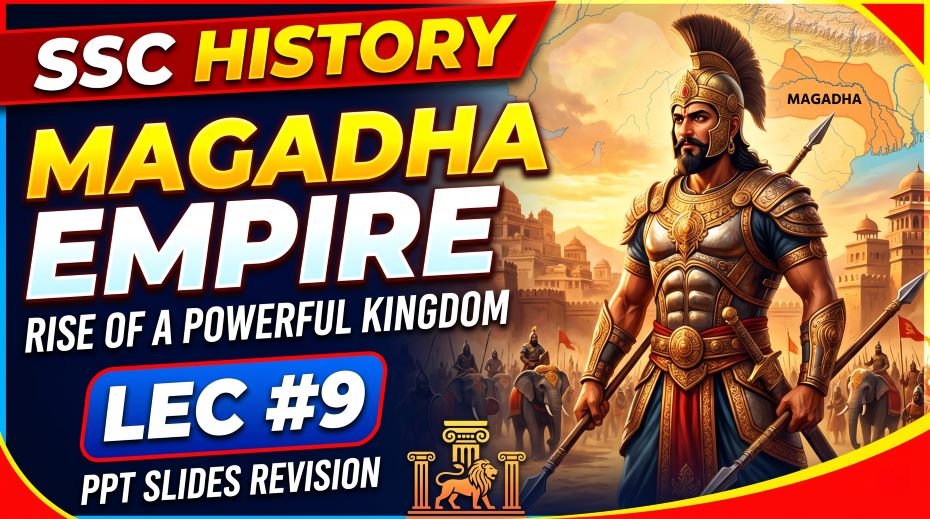
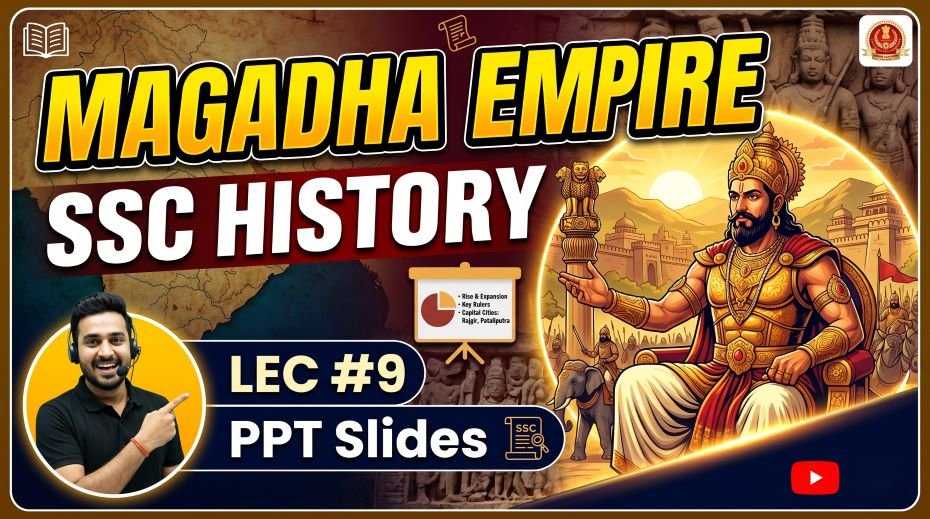
We shared the SSC History Magadha Empire PPT Slides LEC #9 so, Master the Magadha Empire chapter with this all-in-one SSC study guide based on History LECTURE #9 PPT Slides. 102 slides | 31 MB | Serial #34. Covers Haryanka, Shishunaga, Nanda, Maurya, and Gupta dynasties with rulers, timelines, Ashoka’s Dhamma, Arthashastra, Megasthenes, 30+ MCQs, and expert Q&A for SSC CGL, CHSL, MTS, CPO, Railways NTPC, and UPSC Prelims.
If there is one chapter that decides your SSC History score more than any other, it is the Magadha Empire. From Bimbisara’s first conquest in 544 BC to Ashoka’s rock edicts that still stand across the subcontinent, and from Chanakya’s Arthashastra to the Gupta golden age – the Magadha Empire chapter is a goldmine of SSC MCQs that appear every single year across every major competitive exam.
This article is a complete study guide built around the SSC History Magadha Empire PPT Slides – Lecture #9 – from the Complete Foundation Batch PPT Series (Serial Number #34) at slideshareppt.net. The PPT contains 102 slides and gives you the most exam-focused, visually structured coverage of the Magadha Empire available for free.
About the PPT Slides
| Detail | Information |
| Series Name | Complete Foundation Batch for All SSC and Other Exams (PPT Series) |
| Subject | History – Magadha Empire (मगध साम्राज्य) |
| Lecture Number | Lecture #9 |
| Total PPT Slides | 102 PPT Slides |
| File Size | 31 MB |
| Serial Number | #34 |
| Era Covered | 6th Century BC to 6th Century AD (Ancient India) |
| Best For | SSC CGL, CHSL, MTS, CPO, GD, Railways NTPC, UPSC Prelims, State PSCs |
| Source Website | slideshareppt.net |
SSC History Magadha Empire PPT Slides LEC #9
Note: If you wish to download the entire SSC series (PPT slides), simply visit this redirect page. –REDIRECT PAGE
Complete Timeline Table: Magadha Empire – All Key Dates
This is the single most important table in this entire chapter. Study it until you can recall every date, ruler, and event without looking.
| Year (BC/AD) | Event | Key Person | Dynasty / Period |
| ~544 BC | Bimbisara becomes king of Magadha; first great ruler | Bimbisara | Haryanka Dynasty |
| ~544 BC | Magadha annexes Anga – first expansion | Bimbisara | Haryanka Dynasty |
| ~492 BC | Ajatashatru (Kunika) kills Bimbisara and ascends throne | Ajatashatru | Haryanka Dynasty |
| ~483 BC | First Buddhist Council held at Rajagriha | Ajatashatru (patron); Mahakassapa (presided) | Haryanka Dynasty |
| ~460 BC | Udayin founds Pataliputra as new capital of Magadha | Udayin | Haryanka Dynasty |
| ~413 BC | Shishunaga overthrows last Haryanka king; founds new dynasty | Shishunaga | Shishunaga Dynasty |
| ~383 BC | Second Buddhist Council at Vaishali | Kalashoka (patron); Sabbakami (presided) | Shishunaga Dynasty |
| ~345 BC | Mahapadma Nanda overthrows Shishunaga dynasty | Mahapadma Nanda | Nanda Dynasty |
| ~327–325 BC | Alexander the Great invades India; Battle of Hydaspes (326 BC) | Alexander vs Porus | Nanda Dynasty period |
| ~321 BC | Chandragupta Maurya overthrows Dhana Nanda; Maurya Empire begins | Chandragupta Maurya + Chanakya | Maurya Dynasty |
| ~305 BC | Chandragupta defeats Seleucus Nicator; Treaty signed; Megasthenes sent as ambassador | Chandragupta Maurya vs Seleucus | Maurya Dynasty |
| ~300 BC | Chanakya (Kautilya) compiles the Arthashastra | Chanakya / Kautilya | Maurya Dynasty |
| ~298 BC | Chandragupta Maurya abdicates; adopts Jainism; dies at Shravanabelagola | Chandragupta Maurya | Maurya Dynasty |
| ~298–273 BC | Bindusara’s reign; called Amitraghata (slayer of foes) | Bindusara | Maurya Dynasty |
| ~273 BC | Ashoka becomes Emperor after War of Succession | Ashoka | Maurya Dynasty |
| ~261 BC | Kalinga War – the turning point in Ashoka’s life | Ashoka | Maurya Dynasty |
| ~260 BC | Ashoka converts to Buddhism after Kalinga carnage | Ashoka | Maurya Dynasty |
| ~250 BC | Third Buddhist Council at Pataliputra | Ashoka (patron); Moggaliputta Tissa (presided) | Maurya Dynasty |
| ~250 BC | Ashoka sends Buddhist missions abroad – Sri Lanka (son Mahendra, daughter Sanghamitra) | Ashoka | Maurya Dynasty |
| ~232 BC | Death of Ashoka | Ashoka | Maurya Dynasty |
| ~185 BC | Pushyamitra Shunga assassinates Brihadratha; Shunga dynasty begins | Pushyamitra Shunga | Shunga Dynasty |
| ~73 BC | Shunga dynasty ends; Kanva dynasty begins | Vasudeva Kanva | Kanva Dynasty |
| ~28 BC | Kanva dynasty ends; Satavahana power rises in Deccan | Simuka (founder of Satavahanas) | Satavahana Dynasty |
| ~319 AD | Gupta Empire founded by Chandragupta I | Chandragupta I | Gupta Dynasty |
| ~335–375 AD | Samudragupta – Napolean of India; greatest military campaigns | Samudragupta | Gupta Dynasty |
| ~375–415 AD | Chandragupta II (Vikramaditya) – Golden Age; defeated Shakas | Chandragupta II / Vikramaditya | Gupta Dynasty |
| ~405–411 AD | Fa-Hien (Faxian) – Chinese Buddhist pilgrim visits India | Fa-Hien | Gupta Dynasty (Chandragupta II) |
| ~415–455 AD | Kumaragupta I reign; founded Nalanda University | Kumaragupta I | Gupta Dynasty |
| ~455–467 AD | Skandagupta fights and repels the Huna invasions | Skandagupta | Gupta Dynasty |
| ~550 AD | Gupta Empire completely collapses due to Huna invasions | Last Gupta kings | Gupta Dynasty ends |
Part I: Haryanka Dynasty – The Founders of Magadha’s Greatness
The Haryanka Dynasty (c. 544–413 BC) was the first ruling house of Magadha that put the kingdom on the path to empire. Its three most important rulers – Bimbisara, Ajatashatru, and Udayin – each made a foundational contribution.
Bimbisara (~544–492 BC) – The Empire Builder
- Bimbisara is considered the true founder of Magadha’s greatness and its first historically verifiable great king.
- He pursued an aggressive policy of territorial expansion, beginning with the conquest and annexation of the neighbouring kingdom of Anga (capital: Champa). This was Magadha’s first major conquest.
- He was equally skilled at diplomacy. He used matrimonial alliances strategically – marrying Kosaladvai (princess of Kosala), Chellana (a Licchavi princess from Vaishali), and Khema (a princess from Madra kingdom). Each marriage brought diplomatic benefits.
- His marriage to the Licchavis gave him access to Vaishali’s trade routes and political support.
- Bimbisara was a personal friend and supporter of Gautama Buddha. He gave the Buddha the Veluvana (Bamboo Grove) near Rajagriha as a gift, which became the first Buddhist monastery.
- He was also a contemporary of Vardhamana Mahavira.
- He was killed by his own son Ajatashatru, who imprisoned him and starved him to death.
SSC Exam Tip: Bimbisara = first great Magadha king + Anga annexation + friend of Buddha + Veluvana gift + killed by Ajatashatru. These five facts together generate at least 3–4 SSC questions per year.
Ajatashatru (~492–460 BC) – The Warrior King
- Ajatashatru (also called Kunika) killed his father Bimbisara and seized the throne – making him the first of several patricidal kings in Indian history.
- He was an aggressive military king who expanded Magadha more than any previous ruler.
- His most famous military achievement was defeating and annexing the powerful Vajji Confederacy (Republic of Vaishali) – which had resisted Magadha for generations.
- He used two newly invented war machines in the siege of Vaishali: (1) Mahashilakantaka – a massive catapult that hurled large stones at enemy fortifications; (2) Rathamushala – a war chariot with a swinging, rotating mace that could sweep enemy troops from open ground.
- He fought with Kosala under King Prasenajit (who was his own maternal uncle) and eventually forced Kosala to give its Kashi territory to Magadha.
- He was the royal patron of the First Buddhist Council held at the Saptaparni Cave near Rajagriha in ~483 BC, shortly after the Buddha’s death.
- Despite being the son of Buddha’s friend, Ajatashatru himself was initially opposed to Buddhism but later became a supporter.
SSC Exam Tip: Ajatashatru’s two weapons – Mahashilakantaka (catapult) and Rathamushala (mace-chariot) – are the most distinctively testable facts about him. Also remember: he patronised the First Buddhist Council.
Udayin (~460–444 BC) – Founder of Pataliputra
- Udayin (also called Udayabhadra) was the son of Ajatashatru and the third great ruler of the Haryanka dynasty.
- His single most important contribution to Indian history: he founded the new capital city of Pataliputra (modern Patna, Bihar).
- He chose the location brilliantly – at the confluence (sangam) of the Ganga, Son (Sone), and Punpun rivers. This made Pataliputra one of the most strategically located and commercially rich cities in ancient India.
- Pataliputra served as the capital of the Nanda Empire, the Maurya Empire, and the Gupta Empire – the three greatest empires of ancient India.
- Udayin was himself a follower of Jainism, which is notable given Magadha’s close association with Buddhism.
SSC Exam Tip: Pataliputra was founded by Udayin – this is one of the most asked facts in SSC Ancient History. Pataliputra = modern Patna = confluence of Ganga and Son rivers.
Part II: Shishunaga Dynasty (~413–345 BC)
The Shishunaga Dynasty came to power when Shishunaga, a minister (amatya) of the last Haryanka king Nagadasaka, led a popular rebellion and overthrew him. It was a palace revolution, not a military conquest from outside.
| Ruler | Period (BC) | Key Achievement / SSC Fact |
| Shishunaga | ~413–395 BC | Founder of the dynasty; defeated and absorbed Avanti into Magadha – ending the century-long rivalry between Magadha and Avanti; also defeated Vatsa |
| Kalashoka (Kakavarna) | ~395–367 BC | Held the Second Buddhist Council at Vaishali (~383 BC); briefly shifted capital to Vaishali before returning to Pataliputra; assassinated according to some accounts |
| Ten Sons of Kalashoka | ~367–345 BC | Later Shishunaga rulers; dynasty ended when Mahapadma Nanda seized power |
SSC Exam Tip: Shishunaga conquered Avanti – ending Magadha’s last major rival in the west. Second Buddhist Council = Vaishali = Kalashoka’s reign. These two facts from this dynasty are repeatedly tested.
Part III: Nanda Dynasty (~345–321 BC) – The Richest Pre-Maurya Empire
The Nanda Dynasty marked a dramatic turning point in Indian history – it was the first dynasty of non-Kshatriya origin to rule a major Indian empire, and it created the largest and wealthiest empire India had seen before the Mauryas.
Mahapadma Nanda – The Empire Maker
- Mahapadma Nanda overthrew the last Shishunaga ruler and founded the Nanda dynasty around 345 BC.
- He is described in the Puranas as a son of the last Shishunaga king by a Shudra woman – making him the first non-Kshatriya emperor of India.
- Ancient texts give him the titles Sarvakshatrantaka (destroyer of all Kshatriyas) and Ekarat (the sole sovereign), reflecting his complete military dominance over all rivals.
- He expanded Magadha in every direction, conquering Kalinga (Odisha), and pushing into central India, making Magadha the largest state India had ever seen.
- He built an immense treasury, which earned the Nandas the reputation of being the wealthiest dynasty in India.
Dhana Nanda – The Last Nanda King
- Dhana Nanda was the ninth and last ruler of the Nanda dynasty (the eighth son of Mahapadma Nanda).
- In Greek sources, he is referred to as Agrammes or Xandrames.
- He possessed the largest army of his era – ancient sources record up to 200,000 infantry, 20,000 cavalry, 2,000 war chariots, and 3,000–6,000 war elephants.
- It was this enormous army that Alexander’s soldiers refused to face, causing Alexander to stop at the Beas River in 326 BC and turn back.
- Despite his military strength, Dhana Nanda was reputedly greedy, cruel, and deeply unpopular. His heavy taxation alienated merchants and Brahmins alike.
- He was overthrown in 321 BC by Chandragupta Maurya, with the brilliant strategic planning of his mentor Chanakya (Kautilya).
SSC Exam Tip: Mahapadma Nanda = Sarvakshatrantaka + Ekarat. Dhana Nanda = Agrammes (Greek) = last Nanda = overthrown by Chandragupta 321 BC. Both rulers generate frequent MCQs.
Part IV: Maurya Dynasty (321–185 BC) – India’s First Pan-Indian Empire
The Maurya Empire stands as the greatest empire in ancient Indian history – the first time the entire Indian subcontinent (from the Himalayas to the tip of South India, from Afghanistan in the west to Bangladesh in the east) came under a single political authority. Three rulers dominate this era: Chandragupta Maurya, Bindusara, and Ashoka the Great.
Chandragupta Maurya (321–298 BC) – The Empire’s Architect
- Chandragupta Maurya is the founder of the Maurya Empire. He overthrew Dhana Nanda in 321 BC with the strategic guidance of his brilliant minister Chanakya (also called Kautilya or Vishnugupta).
- He is one of the most remarkable figures in ancient world history – a young man of humble birth (exact origins debated – possibly Kshatriya, possibly of the Moriya clan) who built India’s greatest empire.
- After unifying the Gangetic plains, he turned northwest and defeated the remnant Greek governors left behind by Alexander.
- In ~305 BC, he fought and defeated Seleucus Nicator, Alexander’s general who had taken over the eastern portion of Alexander’s empire. The peace treaty included Seleucus giving large territories (Arachosia, Gedrosia, Paropamisadae) to Chandragupta, and giving his daughter in marriage to Chandragupta.
- In return, Chandragupta gave Seleucus 500 war elephants – which Seleucus used to defeat other Greek successors of Alexander.
- Seleucus sent his ambassador Megasthenes to Chandragupta’s court at Pataliputra. Megasthenes wrote a detailed account of Maurya India called Indica.
- Chandragupta’s empire stretched from Afghanistan in the northwest to Bangladesh in the east, and from the Himalayas in the north to the Deccan Plateau in the south.
- In his final years, Chandragupta converted to Jainism under the influence of the Jain saint Bhadrabahu.
- He abdicated the throne in ~298 BC, went to Shravanabelagola in Karnataka with Bhadrabahu, and performed Sallekhana (Jain ritual of fasting unto death) – a remarkable ending for India’s greatest empire builder.
SSC Exam Tip: Chandragupta + Chanakya + 321 BC. Treaty with Seleucus: 500 elephants for territory. Megasthenes came to his court and wrote Indica. He died at Shravanabelagola after adopting Jainism. All five facts are commonly tested.
Chanakya (Kautilya / Vishnugupta) and the Arthashastra
- Chanakya (also known as Kautilya and Vishnugupta) is one of the greatest political thinkers, strategists, and economists in world history – often compared to Machiavelli of Europe.
- He was a professor at Taxila University before becoming Chandragupta’s mentor and Prime Minister.
- He authored the Arthashastra – a comprehensive treatise on statecraft, economic policy, military strategy, espionage, and law.
- The Arthashastra is divided into 15 books (Adhikaranas) covering everything from how a king should govern, how revenue should be collected, how a spy network should be run, to how wars should be conducted.
- It was rediscovered by R. Shamasastry in 1905 AD from a manuscript in the Oriental Research Institute, Mysore – after being lost for nearly 2,000 years.
- The Arthashastra mentions that Pataliputra had a sophisticated municipal administration run by a committee of 30 officers divided into 6 boards of 5 each.
- It also provides a detailed description of the Maurya spy system (Gupta-Char system), which Chandragupta used to gather intelligence and eliminate enemies.
SSC Exam Tip: Arthashastra = written by Chanakya/Kautilya = 15 books = rediscovered by R. Shamasastry in 1905. This is a very high-frequency set of SSC facts.
Megasthenes and the Indica
| Detail | Information |
| Who | Megasthenes – Greek ambassador sent by Seleucus Nicator |
| When | ~305–297 BC |
| To Whose Court | Chandragupta Maurya’s court at Pataliputra |
| Work Written | Indica – a detailed account of Maurya India |
| Key Descriptions | Pataliputra’s city administration (city divided into 6 wards); no slavery in India; India had 118 tribes; seven-fold division of Indian society; Magadha had the largest army |
| Status of Original | Original Indica is lost; survives only in fragments quoted by later Greek writers like Strabo, Arrian, and Diodorus |
| SSC Relevance | Very frequently asked: who was Megasthenes, what did he write, to whose court did he go |
Bindusara (298–273 BC) – The Neglected Middle Emperor
- Bindusara was the son of Chandragupta Maurya and the father of Ashoka – often called the ‘forgotten emperor’ sandwiched between two giants.
- His most celebrated title was Amitraghata – meaning ‘slayer of foes’ or ‘destroyer of enemies’. In Greek sources he is called Amitrochates.
- He expanded the Maurya Empire southward into the Deccan, conquering large parts of South India.
- He maintained diplomatic relations with the Seleucid Empire (Syria); he reportedly requested the Greek king Antiochus I to send him sweet wine, dried figs, and a philosopher. Antiochus replied he could send wine and figs, but philosophers were not for sale.
- Bindusara is associated with the Ajivika sect of ascetics.
- He appointed Ashoka as Viceroy of Ujjain during his lifetime.
SSC Exam Tip: Bindusara = Amitraghata (or Amitrochates in Greek) = expanded empire into South India. His title is the most tested fact about him.
Ashoka the Great (273–232 BC) – The World’s Greatest Ruler?
Ashoka is widely regarded as one of the greatest rulers in world history – not just for the size of his empire, but for his transformation from a warrior-king to a champion of non-violence, welfare, and religious tolerance after the Kalinga War.
| Aspect | Details |
| Dynasty | Maurya – third Maurya emperor |
| Period | 273–232 BC (approximately 40 years) |
| Succession | Won a bloody war of succession after Bindusara’s death; allegedly killed 99 brothers (traditional account – likely exaggerated) |
| Early Reign | Known as Chandashoka (Fierce Ashoka) in early years – aggressive military campaigns |
| Kalinga War | Fought in ~261 BC against Kalinga (modern Odisha); Ashoka won but the scale of devastation (reportedly 1 lakh killed, 1.5 lakh deported) caused him profound remorse |
| Conversion | Converted to Buddhism after Kalinga War; became a follower of the Buddhist monk Upagupta |
| Post-Kalinga Name | Called Dharmashoka (Righteous Ashoka) after conversion; also known as Priyadarshi (beloved of the gods) |
| Dhamma Policy | Promoted Dhamma – a code of ethical conduct based on non-violence, religious tolerance, respect for elders, kindness to animals, and welfare of subjects |
| Rock Edicts | Inscribed his messages on rocks across the empire – Major Rock Edicts (14 groups), Minor Rock Edicts, and Separate Rock Edicts |
| Pillar Edicts | Inscribed messages on polished sandstone pillars – Major Pillar Edicts (7 groups) and Minor Pillar Edicts |
| Script | Most edicts written in Brahmi script (read left to right); some northwestern edicts in Kharosthi (read right to left); some in Aramaic and Greek |
| Language | Mostly Prakrit; some in Greek and Aramaic for northwestern provinces |
| Lion Capital | The famous Ashoka Pillar at Sarnath – with four lions back to back – became India’s National Emblem |
| Third Buddhist Council | Held at Pataliputra ~250 BC under his patronage; presided by Moggaliputta Tissa |
| Buddhist Missions | Sent his son Mahendra (Mahinda) and daughter Sanghamitra to Sri Lanka to spread Buddhism; also sent missions to Syria, Egypt, Macedonia, Cyrene, and Epirus |
| Welfare Works | Built roads, planted trees, dug wells, built rest houses (dharamshalas), established hospitals for humans and animals |
| Death | Died ~232 BC; empire rapidly declined after his death |
Ashoka’s Edicts – Key Facts for SSC
| Edict / Pillar | Location | Key Message / Content |
| Rock Edict XIII (Major Rock Edict 13) | Shahbazgarhi, Mansehra (Pakistan) | Describes the Kalinga War and Ashoka’s remorse; most important edict for understanding Ashoka’s transformation |
| Rock Edict XII | Multiple locations | Promotes religious tolerance; respect for all sects |
| Rock Edict II & III | Multiple locations | Welfare measures; medical facilities for humans and animals |
| Pillar Edict VII | Topra (Delhi) Pillar | Summary of Ashoka’s entire Dhamma policy |
| Sarnath Pillar (Lion Capital) | Sarnath, Varanasi UP | Four lions back to back; Dharma Chakra below – became India’s National Emblem |
| Sanchi Stupa | Sanchi, Madhya Pradesh | Ashoka built or expanded this famous Buddhist stupa; now a UNESCO World Heritage Site |
| Bhabru / Bairat Edict | Near Jaipur, Rajasthan | Shows Ashoka’s personal faith in Buddhism; references the Triratna (Buddha, Dhamma, Sangha) |
| Kandahar Bilingual Edict | Kandahar, Afghanistan | Written in both Greek and Aramaic; shows extent of Maurya Empire |
SSC Exam Tip: Ashoka’s Lion Capital at Sarnath = India’s National Emblem. Kalinga War = 261 BC. Third Buddhist Council = Pataliputra = ~250 BC. Ashoka sent Mahendra and Sanghamitra to Sri Lanka. Script of edicts = Brahmi. All six facts are among the most repeated in SSC history papers.
Decline of the Maurya Empire
- Ashoka’s death in 232 BC triggered a rapid fragmentation of the Maurya Empire.
- The later Maurya kings were weak and the empire broke into eastern and western halves.
- The last Maurya emperor was Brihadratha, who was assassinated in 185 BC by his commander-in-chief Pushyamitra Shunga – who then founded the Shunga dynasty.
- Reasons for decline: succession disputes, weakening of military under Ahimsa policy, economic strain of maintaining a huge empire, loss of provinces to foreign invaders, and strong local governors gaining independence.
Part V: Post-Maurya Dynasties of Magadha
Shunga Dynasty (185–73 BC)
- Founded by Pushyamitra Shunga, a Brahmin commander who killed the last Maurya king Brihadratha in 185 BC.
- Pushyamitra was a staunch Hindu and is associated with a revival of Brahmanical religion and Vedic rituals (he performed the Ashvamedha Yajna – horse sacrifice – twice).
- He fought off the Greek (Indo-Greek) king Menander (Milinda) who invaded from the northwest.
- The Shunga dynasty is associated with beautiful art – the Sanchi Stupa gateways (toranas) and the Bharhut Stupa railings were built during this period.
- The famous grammarian Patanjali (who wrote the Mahabhashya – commentary on Panini’s Ashtadhyayi) lived during Pushyamitra’s reign.
- The Shunga dynasty ended in 73 BC when the last Shunga king Devabhuti was killed by his Brahmin minister Vasudeva Kanva.
SSC Exam Tip: Pushyamitra Shunga = killed last Maurya Brihadratha = performed Ashvamedha Yajna = Patanjali was his contemporary. These four facts are regularly tested.
Kanva Dynasty (73–28 BC)
- The Kanva dynasty was founded by Vasudeva Kanva who killed the last Shunga king Devabhuti.
- It was a very short-lived dynasty of four kings ruling for about 45 years.
- The Kanva dynasty ended around 28 BC when the Satavahanas (from the Deccan) absorbed the remaining Kanva territories.
Part VI: Gupta Empire (319–550 AD) – The Golden Age of India
The Gupta Empire is universally called India’s Golden Age – a period of unparalleled achievement in science, mathematics, astronomy, literature, art, and philosophy. Though not a direct continuation of the Magadha Empire, the Guptas were based in the same Gangetic heartland and are considered the culmination of ancient Indian civilisation.
Chandragupta I (~319–335 AD) – The Empire Founder
- Chandragupta I is the true founder of the Gupta Empire. He took the title Maharajadhiraja (great king of kings) – the first Gupta ruler to use this title.
- He strengthened the empire through a key matrimonial alliance – marrying Kumaradevi of the powerful Licchavi clan of Nepal.
- He started the Gupta Era (Gupta Samvat) in 319–320 AD – a new calendar that marks his coronation.
SSC Exam Tip: Chandragupta I started the Gupta Era (319–320 AD). He married Kumaradevi (Licchavi princess). He was the first to use the title Maharajadhiraja.
Samudragupta (~335–375 AD) – The Napoleon of India
- Samudragupta is considered the greatest military genius of ancient India. The historian V.A. Smith gave him the title ‘Napoleon of India’ for his almost uninterrupted series of military conquests.
- Our primary source for Samudragupta’s conquests is the Allahabad Pillar Inscription (Prayagraj Prashasti) – composed by his court poet Harishena.
- The inscription describes his policy in detail: in the north he defeated kings and annexed their territories; in the south he defeated kings and then restored them (Dharmavijayi – righteous conquest).
- He defeated 9 kings of North India, 12 kings of South India, 5 frontier kingdoms, and received tribute from the Kushans and Sri Lanka.
- Samudragupta was not only a great warrior but also a highly cultured man. He was an accomplished musician who played the veena – depicted on his coins.
- He is also called Kaviraja (king of poets) because he composed poetry himself.
- He performed the Ashvamedha Yajna (horse sacrifice) to proclaim his sovereignty over all conquered territories.
SSC Exam Tip: Samudragupta = Napoleon of India (V.A. Smith’s title) = Allahabad Pillar Inscription (Harishena) = played veena = Kaviraja. These five facts are extremely frequently tested in SSC CGL.
Chandragupta II / Vikramaditya (~375–415 AD) – The Golden Age Emperor
- Chandragupta II is arguably the greatest of the Gupta emperors. He is also known as Vikramaditya – a legendary title meaning ‘Sun of Valour’.
- His most celebrated military achievement was defeating the Western Kshatrapa (Shaka) rulers of western India (Gujarat and Rajasthan), completing the unification of the Indian subcontinent under Gupta rule.
- He extended the empire to its greatest extent – from the Arabian Sea in the west to the Bay of Bengal in the east.
- The Chinese Buddhist pilgrim Fa-Hien (Faxian) visited India during his reign (~405–411 AD) and left a detailed account of Gupta society, describing India as a land of peace, prosperity, and religious freedom.
- His court at Ujjain was home to the Navaratna – the nine gems (nine brilliant scholars and artists), the most famous of whom was Kalidasa – the greatest Sanskrit poet and playwright in Indian history.
- Kalidasa’s works include: Shakuntala, Meghaduta, Kumarasambhava, Raghuvamsha, Malavikagnimitra, and Vikramorvasiya.
- Other Navaratna members included Aryabhata (mathematician-astronomer who declared the earth is round and rotates on its axis, calculated pi, and explained eclipses scientifically).
- Iron Pillar of Delhi – in the Qutub Minar complex – was erected during the Gupta period and is famous for being rust-free for 1,600+ years, demonstrating the metallurgical mastery of ancient India.
SSC Exam Tip: Chandragupta II = Vikramaditya = defeated Shakas = Fa-Hien visited = Kalidasa in his court = Navaratna. All of these facts are highly tested. Kalidasa wrote Shakuntala – probably the most asked literary fact in SSC Ancient History.
Kumaragupta I (~415–455 AD) and Skandagupta (~455–467 AD)
- Kumaragupta I is famous for founding Nalanda University – the greatest university of the ancient world, attracting students from China, Korea, Japan, Tibet, Mongolia, Sri Lanka, and Southeast Asia.
- Nalanda University is located in Bihar and was in operation from roughly the 5th century AD to the 12th century AD when it was destroyed by Mohammad Bin Bakhtiyar Khilji.
- Skandagupta was the last great Gupta emperor. He successfully repelled the Huna invasions – the fierce Central Asian tribes who were destroying empires across Eurasia.
- Despite Skandagupta’s military success against the Hunas, the repeated invasions drained the Gupta treasury and weakened the empire irreversibly.
- After Skandagupta’s death (~467 AD), the Gupta Empire rapidly fragmented due to continued Huna pressure, local governors declaring independence, and lack of strong central rulers.
SSC Exam Tip: Kumaragupta = founded Nalanda University. Skandagupta = defeated the Hunas. Both are common SSC questions.
Gupta Empire – Key Achievements in Science, Literature, and Art
| Field | Achievement / Scholar / Work | SSC Relevance |
| Mathematics | Aryabhata – invented the concept of zero, calculated value of pi (3.1416), declared earth is round and rotates, explained solar and lunar eclipses scientifically; wrote Aryabhatiya | Very high – Aryabhata’s inventions are repeatedly tested |
| Astronomy | Aryabhata’s Aryabhatiya; Varahamihira wrote Brihat Samhita (encyclopaedia of astronomy) | Varahamihira = Brihat Samhita = Gupta period |
| Literature | Kalidasa – greatest Sanskrit poet and playwright; Shakuntala, Meghaduta, Kumarasambhava | Kalidasa = Shakuntala = most repeated SSC literary fact |
| Medicine | Sushruta Samhita (surgery text) and Charaka Samhita (medicine text) – both from this era or compiled in this era | Both texts frequently asked in SSC Science/History overlap questions |
| Philosophy | Vishnu Sharma wrote Panchatantra – the famous collection of animal fables | Panchatantra = Vishnu Sharma = Gupta period; frequently asked |
| Metallurgy | Iron Pillar of Delhi – rustless for 1600+ years; shows advanced metallurgical knowledge | Iron Pillar = Gupta period = famous for being rust-free |
| Architecture | Cave temples at Ajanta (paintings), Ellora, and Gupta temple architecture (Dashavatar Temple, Deogarh) | Ajanta cave paintings = Gupta period largely |
| Travel / Source | Fa-Hien (Chinese pilgrim) visited during Chandragupta II’s reign; described peaceful India | Fa-Hien = Chandragupta II = very commonly tested |
Complete Dynasty Summary Table: Magadha Empire to Gupta Empire
| Dynasty | Period | Founder | Last Ruler | Capital | Key Ruler / Key Fact |
| Haryanka | ~544–413 BC | Bimbisara | Nagadasaka | Rajagriha → Pataliputra | Bimbisara + Ajatashatru + Udayin (founded Pataliputra) |
| Shishunaga | ~413–345 BC | Shishunaga | Kalashoka | Rajagriha / Vaishali / Pataliputra | Conquered Avanti; 2nd Buddhist Council at Vaishali |
| Nanda | ~345–321 BC | Mahapadma Nanda | Dhana Nanda | Pataliputra | Largest pre-Maurya empire; deterred Alexander; overthrown by Chandragupta |
| Maurya | 321–185 BC | Chandragupta Maurya | Brihadratha | Pataliputra | Chandragupta + Chanakya; Ashoka’s Kalinga War; first pan-Indian empire |
| Shunga | 185–73 BC | Pushyamitra Shunga | Devabhuti | Pataliputra / Vidisha | Brahmanical revival; Ashvamedha Yajna; Patanjali; Sanchi gateways |
| Kanva | 73–28 BC | Vasudeva Kanva | Susarman | Pataliputra | Short-lived; ended by Satavahanas |
| Gupta | 319–550 AD | Sri Gupta / Chandragupta I | Skandagupta / Vishnugupta | Pataliputra → Ujjain | Samudragupta (Napoleon of India); Chandragupta II (Vikramaditya); Kalidasa; Aryabhata; Nalanda |
High-Frequency SSC MCQs: Magadha Empire Chapter
These are the most consistently repeated questions based on analysis of SSC CGL, CHSL, MTS, CPO, GD, and Railway NTPC previous year papers.
| Question | Correct Answer | SSC Exam Reference |
| Who was the first great king of Magadha? | Bimbisara (Haryanka dynasty) | SSC CGL 2015, 2018, SSC MTS 2021 |
| Bimbisara was a contemporary of which two religious leaders? | Both Gautama Buddha and Mahavira | SSC CHSL 2018, SSC GD 2022 |
| Which kingdom did Bimbisara annex first? | Anga (capital: Champa) | SSC CGL 2017, SSC MTS 2020 |
| Bimbisara gifted which garden/grove to Buddha? | Veluvana (Bamboo Grove) near Rajagriha | SSC CHSL 2021, SSC CPO 2022 |
| What were Ajatashatru’s two special weapons? | Mahashilakantaka (catapult) and Rathamushala (mace-chariot) | SSC CGL 2019, SSC CPO 2021 |
| Who founded Pataliputra? | Udayin (son of Ajatashatru, Haryanka dynasty) | SSC CGL 2016, 2019, 2022 (very frequently asked) |
| What was the original capital of Magadha? | Rajagriha (Rajgir, Bihar) | SSC CHSL 2018, SSC MTS 2020 |
| Which dynasty overthrew the Haryanka dynasty? | Shishunaga dynasty (Shishunaga was originally a minister) | SSC CHSL 2019, SSC GD 2021 |
| Second Buddhist Council was held where and under whose patronage? | Vaishali; under Kalashoka | SSC CGL 2018, SSC CHSL 2020 |
| Shishunaga’s greatest achievement was defeating which kingdom? | Avanti | SSC CHSL 2021, SSC MTS 2022 |
| What title was given to Mahapadma Nanda? | Sarvakshatrantaka and Ekarat | SSC CGL 2019, SSC CPO 2022 |
| Who was the last king of the Nanda dynasty? | Dhana Nanda (Agrammes in Greek) | SSC CGL 2017, SSC CHSL 2021 |
| Who overthrew the Nanda dynasty? | Chandragupta Maurya (with Chanakya) | SSC CGL 2015–2023 (most repeated transition) |
| What did Chandragupta Maurya give to Seleucus in the 305 BC treaty? | 500 war elephants | SSC CGL 2018, SSC CPO 2020 |
| Who was Megasthenes and what did he write? | Greek ambassador to Chandragupta’s court; wrote Indica | SSC CGL 2016, 2019, SSC CHSL 2020 |
| Who wrote the Arthashastra? | Chanakya (Kautilya / Vishnugupta) | SSC CGL 2015–2022 (repeated every year) |
| In which year was the Arthashastra rediscovered and by whom? | 1905 AD; by R. Shamasastry | SSC CGL 2018, SSC CHSL 2021 |
| What was Bindusara’s title? | Amitraghata (slayer of enemies) / Amitrochates (Greek) | SSC CGL 2017, SSC CHSL 2020 |
| Kalinga War was fought in which year? | ~261 BC | SSC CGL 2014–2022 (most repeated Ashoka date) |
| What event changed Ashoka’s personality? | The Kalinga War – scale of death and destruction caused remorse and conversion to Buddhism | SSC CGL 2016, SSC MTS 2021 |
| Ashoka’s edicts were written primarily in which script? | Brahmi (most edicts); Kharosthi (northwestern edicts) | SSC CGL 2019, SSC CHSL 2020 |
| Third Buddhist Council was held where and under whose patronage? | Pataliputra; under Ashoka (~250 BC) | SSC CGL 2017, 2020, SSC CHSL 2021 |
| Ashoka sent which two people to Sri Lanka to spread Buddhism? | Son Mahendra (Mahinda) and daughter Sanghamitra | SSC CHSL 2019, SSC GD 2022 |
| Which pillar’s lion capital became India’s National Emblem? | Ashoka Pillar at Sarnath | SSC CGL 2015–2023 (extremely frequently asked) |
| Who killed the last Maurya king Brihadratha? | Pushyamitra Shunga (185 BC) – founder of Shunga dynasty | SSC CGL 2017, SSC CHSL 2019 |
| Who was Patanjali and when did he live? | Grammarian who wrote Mahabhashya; contemporary of Pushyamitra Shunga | SSC CHSL 2020, SSC CPO 2022 |
| Who is called the Napoleon of India? | Samudragupta | SSC CGL 2015–2022 (most repeated Gupta MCQ) |
| What is the Allahabad Pillar Inscription about? | Records Samudragupta’s military conquests; composed by his court poet Harishena | SSC CGL 2018, SSC CHSL 2021 |
| Chandragupta II is also known by which title? | Vikramaditya | SSC CGL 2016, SSC CHSL 2019, 2022 |
| Who visited India during Chandragupta II’s reign? | Fa-Hien (Chinese Buddhist pilgrim, ~405–411 AD) | SSC CGL 2017, 2020, SSC MTS 2021 |
| Who wrote Shakuntala? | Kalidasa (court poet of Chandragupta II / Vikramaditya) | SSC CGL 2015–2023 (most repeated literary question) |
| Who founded Nalanda University? | Kumaragupta I | SSC CGL 2019, SSC CHSL 2021 |
| Who was Aryabhata and what was his contribution? | Gupta-era mathematician-astronomer; invented zero concept, calculated pi, declared earth rotates, explained eclipses; wrote Aryabhatiya | SSC CGL 2016–2022 (appears almost every year) |
| Which ruler of the Gupta dynasty repelled the Huna invasions? | Skandagupta | SSC CHSL 2020, SSC GD 2022 |
ALSO READ: SSC History Mahajanapadas PPT Slides (LEC 8)
Podcast Interview: Expert Q&A – Magadha Empire Deep Dive
This Q&A presents the chapter from multiple angles – conceptual understanding, exam strategy, memory techniques, and historical significance.
| Speaker | Question / Statement | Answer / Explanation |
| Aspirant | Why is the Magadha Empire the most important single chapter for SSC History? | Educator: Because it spans from 544 BC to 550 AD – over a thousand years of the most consequential history in India. Every major development of ancient India connects to Magadha or its successor empires: the birth of Buddhism and Jainism, Alexander’s invasion, the Maurya Empire (India’s greatest ancient empire), Ashoka’s Dhamma, and the Gupta Golden Age. SSC papers consistently draw 4–6 questions from this era. If you master this one chapter, you gain an almost guaranteed 4 marks in every exam. |
| Aspirant | What is the best way to remember all the dynasties of Magadha in sequence? | Educator: Use HSN – M – S – K – G. That is Haryanka, Shishunaga, Nanda – then Maurya – then Shunga – then Kanva – then Gupta. Each dynasty has one unique identifier: Haryanka = Bimbisara and Pataliputra. Shishunaga = defeated Avanti. Nanda = Mahapadma and Dhana Nanda. Maurya = Chandragupta and Ashoka. Shunga = Pushyamitra killed Brihadratha. Kanva = short, 4 kings. Gupta = Golden Age, Samudragupta, Vikramaditya. |
| Aspirant | Chanakya and Arthashastra appear in every SSC paper. What exactly should I know? | Educator: Know five things precisely. One: Chanakya is also called Kautilya and Vishnugupta – all three names are used in questions. Two: He wrote the Arthashastra – a treatise on statecraft and political economy, not a religious text. Three: It has 15 books (Adhikaranas). Four: It was rediscovered by R. Shamasastry in 1905 AD from Mysore. Five: It describes the Maurya spy system (gupta-char) and the city administration of Pataliputra in great detail. If you know these five, you will answer every Arthashastra MCQ correctly. |
| Aspirant | How should I study the difference between the Buddhist Councils? I keep mixing them up. | Educator: Use this pattern – location name tells you the king. First Council at Rajagriha – Rajagriha was the Magadha capital so the king was Ajatashatru. Second Council at Vaishali – Kalashoka shifted capital briefly to Vaishali, so it was under Kalashoka. Third Council at Pataliputra – Pataliputra was Ashoka’s capital, so Ashoka. Fourth Council in Kashmir – Kanishka of the Kushan Empire. One location, one king. Practise this pattern until it becomes automatic. |
| Aspirant | What is the single most important date from Ashoka’s reign for SSC? | Educator: The Kalinga War – 261 BC. It is probably the single most tested date in all of SSC Ancient History. The Kalinga War transformed Ashoka from Chandashoka (cruel Ashoka) to Dharmashoka (righteous Ashoka). It led to his conversion to Buddhism, his Dhamma policy, his rock and pillar edicts, and his Buddhist missions abroad. From one event – 261 BC – you can answer 5–7 different SSC questions. That is why it is the most important date. |
| Aspirant | Why is Samudragupta called the Napoleon of India? | Educator: Because like Napoleon Bonaparte of France, Samudragupta was a military genius who won almost every battle he fought and significantly expanded his empire through relentless campaigning. He defeated 9 kings of North India, 12 kings of South India, 5 frontier kingdoms, and received tribute from foreign rulers including the Kushans and Sri Lanka. The title was given by historian V.A. Smith. Remember: Napoleon = Samudragupta; Napoleon’s victory inscription = Allahabad Pillar (written by his court poet Harishena). Both facts are tested. |
| Aspirant | What should I know about Fa-Hien for SSC? | Educator: Fa-Hien (or Faxian) was a Chinese Buddhist pilgrim who visited India between 405–411 AD during the reign of Chandragupta II (Vikramaditya). He came specifically to study Buddhism and collect Buddhist scriptures. His account describes India during the Gupta Golden Age as a prosperous, peaceful country with low crime and religious freedom. He described how people were neither taxed heavily nor threatened by the government. For SSC, the key facts are: Fa-Hien = Chinese pilgrim = Chandragupta II’s reign = 405–411 AD. Never confuse him with Hieun Tsang (Xuanzang), who visited during Harsha’s reign in the 7th century AD. |
| Aspirant | Kalidasa comes up in almost every SSC paper. What are the minimum facts I need? | Educator: Absolute minimum four: One – Kalidasa was the court poet of Chandragupta II (Vikramaditya). Two – He wrote Shakuntala – a famous Sanskrit play (nataka) – his most celebrated work. Three – He wrote Meghaduta – a Sanskrit lyric poem (messenger poem). Four – He was one of the Navaratna (nine gems) of Chandragupta II’s court. Bonus: He also wrote Kumarasambhava, Raghuvamsha, Malavikagnimitra, and Vikramorvasiya. Of all these, Shakuntala is most commonly asked. |
| Aspirant | Where can I find the complete PPT slides for this chapter? | Educator: The SSC History Magadha Empire PPT Slides – Lecture #9 – from the Complete Foundation Batch series at slideshareppt.net has all 102 slides covering everything from Bimbisara to the Gupta Empire in a visual, exam-structured format. It is free, well-organised, and covers every fact that appears in SSC papers. Spend 90 minutes going through the slides after studying this article, and you will have complete coverage of this chapter. |
How to Study This Chapter for Maximum SSC Marks
Step 1 – Read the Timeline (Day 1)
- Read the complete Timeline Table from top to bottom. Do not memorise – just understand the flow.
- Identify the major transitions: Haryanka → Shishunaga → Nanda → Maurya → Shunga → Kanva → Gupta.
- Note the beginning and end dates of each dynasty.
Step 2 – Deep Study by Dynasty (Day 2–4)
- Day 2: Haryanka (Bimbisara, Ajatashatru, Udayin) + Shishunaga + Nanda.
- Day 3: Maurya Dynasty – Chandragupta, Chanakya, Arthashastra, Megasthenes, Bindusara, Ashoka (full coverage).
- Day 4: Shunga, Kanva, Gupta Dynasty (Chandragupta I, Samudragupta, Chandragupta II, Kumaragupta, Skandagupta) + Gupta achievements table.
Step 3 – MCQ Sprint (Day 5–6)
- Solve all 34 MCQs from the table above without looking at answers first.
- Check answers and revise any dynasty where you scored below 80%.
- Solve 2 sets of previous year SSC CGL and CHSL papers on this topic.
Step 4 – Rapid Revision (Exam Eve)
- Review: Complete Dynasty Summary Table + key dates (321 BC, 305 BC, 273 BC, 261 BC, 185 BC, 319 AD, 550 AD).
- Recall: Arthashastra = Chanakya = 15 books = Shamasastry 1905. Ashoka = Kalinga 261 BC = Brahmi script = Lion Capital = Sarnath.
- Recall: Samudragupta = Napoleon of India. Vikramaditya = Kalidasa + Fa-Hien. Kumaragupta = Nalanda. Aryabhata = zero + pi + earth rotates.
(FAQs):
Q1: What are the three most important dates from the Maurya Empire for SSC?
321 BC – Chandragupta Maurya founds the Maurya Empire by defeating Dhana Nanda. 261 BC – Ashoka’s Kalinga War and his subsequent conversion to Buddhism. 185 BC – Pushyamitra Shunga assassinates Brihadratha, ending the Maurya Empire. These three dates together represent three different types of questions (beginning, turning point, and end) and appear regularly in SSC papers.
Q2: What is the difference between Arthashastra and Indica?
Arthashastra was written by Chanakya (Kautilya) – an Indian author – and covers statecraft, economics, military strategy, and governance. It is a prescriptive text (how a king should rule). Indica was written by Megasthenes – a Greek ambassador – and describes what he observed at Chandragupta Maurya’s court and in Maurya India. It is a descriptive text (what India was actually like). Both are primary sources for Maurya history.
Q3: Why is Ashoka considered one of the greatest rulers in world history?
Ashoka’s greatness lies in his transformation after the Kalinga War. He was already the ruler of the largest empire in ancient India, but he chose to abandon conquest and instead devoted his reign to the welfare of his subjects. He inscribed his laws on rocks and pillars in people’s own languages, built roads and hospitals, promoted religious tolerance, sent Buddhist missions abroad, and abolished cruel punishments. His Dhamma was a secular ethical code, not a religious imposition – making him remarkably ahead of his time.
Q4: Who is Aryabhata and why is he important?
Aryabhata (476–550 AD) was a Gupta-era mathematician and astronomer who made discoveries that were revolutionary for his time. He correctly calculated the value of pi (approximately 3.1416), explained that the earth rotates on its axis (which causes day and night), correctly explained solar and lunar eclipses as the shadow of the earth and moon, and worked extensively with algebraic methods. He wrote the Aryabhatiya. He is considered the father of Indian mathematics and astronomy.
The Navaratna (Nine Gems) were the nine brilliant scholars and artists in the court of Chandragupta II (Vikramaditya). The most famous was Kalidasa (the greatest Sanskrit poet). Other notable members included Aryabhata (mathematician), Varahamihira (astronomer), Vararuchi (grammarian), Amarasimha (lexicographer), Dhanvantari (physician), Kshapanaka, Shanku, and Vetala Bhatta. SSC exams ask about the Navaratna, which king’s court they were in, and specifically which member wrote which work.
Q6: When was Nalanda University founded and who destroyed it?
Nalanda University was founded by Kumaragupta I of the Gupta dynasty in the 5th century AD (approximately 415–455 AD). It flourished for over 700 years, attracting students from across Asia. The Chinese pilgrim Hieun Tsang studied there in the 7th century AD. Nalanda University was destroyed around 1193 AD by Mohammad Bin Bakhtiyar Khilji, a military commander of the Delhi Sultanate, who burned its massive library – reportedly burning for three months.
Conclusion – Your Complete Revision Package for Magadha Empire
The SSC History Magadha Empire PPT Slides – Lecture #9 – with its 102 slides is one of the most comprehensive and exam-focused resources for this vast chapter. This article has organised every important fact from Bimbisara (544 BC) to the end of the Gupta Empire (~550 AD) in a single structured guide.
Your ultimate revision checklist:
- Dynasties in order: Haryanka → Shishunaga → Nanda → Maurya → Shunga → Kanva → Gupta
- Haryanka: Bimbisara (Anga + Veluvana + Buddha) → Ajatashatru (catapult + Vaishali + First Buddhist Council) → Udayin (founded Pataliputra)
- Shishunaga: defeated Avanti; Kalashoka = 2nd Buddhist Council at Vaishali
- Nanda: Mahapadma = Sarvakshatrantaka; Dhana Nanda = last Nanda = overthrown by Chandragupta 321 BC
- Maurya: Chandragupta + Chanakya + 321 BC + Arthashastra (15 books, Shamasastry 1905) + Megasthenes (Indica) + Treaty Seleucus 305 BC (500 elephants) + Jainism + Shravanabelagola
- Bindusara = Amitraghata; Ashoka = Kalinga War 261 BC = Dharmashoka = Brahmi script = Lion Capital Sarnath = 3rd Buddhist Council Pataliputra = Mahendra + Sanghamitra to Sri Lanka
- Maurya ends 185 BC: Pushyamitra Shunga kills Brihadratha
- Gupta: Chandragupta I (319 AD, Maharajadhiraja, Gupta Era); Samudragupta (Napoleon of India, Allahabad Pillar, Harishena, veena); Chandragupta II (Vikramaditya, defeated Shakas, Fa-Hien, Kalidasa, Navaratna)
- Gupta achievements: Aryabhata (zero, pi, earth rotates, Aryabhatiya); Kalidasa (Shakuntala, Meghaduta); Nalanda (Kumaragupta I); Skandagupta defeated Hunas; Gupta ends ~550 AD
Download the PPT slides from slideshareppt.net, read this article twice, and work through the 34 MCQs every day in your final revision week. The Magadha Empire chapter will become your strongest scoring area.