This article is built around the SSC History Vijayanagar and Bahmani Empire PPT Slides LEC #7 – from the Complete Foundation Batch PPT Series (Serial Number #32) available at slideshareppt.net. The PPT package contains 124 slides and covers Vijayanagar and Bahmani history in comprehensive, exam-focused detail.
The Vijayanagar Empire and the Bahmani Sultanate together represent the most dynamic, culturally rich, and militarily intense period of medieval South Indian history. For SSC CGL, SSC CHSL, SSC MTS, SSC CPO, SSC GD, Railway NTPC, and UPSC Prelims candidates, this chapter is a guaranteed source of two to five marks in every General Awareness section.
From the founding of Vijayanagara in 1336 AD to the catastrophic Battle of Talikota in 1565 AD, and from the rise of Zafar Khan’s Bahmani Kingdom in 1347 AD to its eventual fragmentation into five Deccan Sultanates – every fact you need for your SSC exam is covered in this guide.
Quick Facts: About the PPT Slides
| Detail | Information |
| Series Name | Complete Foundation Batch for All SSC and Other Exams (PPT Series) |
| Subject | History – Vijayanagar and Bahmani Empire (विजयनगर और बहमनी साम्राज्य) |
| Lecture Number | Lecture #7 |
| Total PPT Slides | 124 PPT Slides |
| File Size | 32 MB |
| Serial Number | #32 |
| Best For | SSC CGL, CHSL, MTS, CPO, GD, Railways NTPC, UPSC Prelims |
| Source Website | slideshareppt.net |
SSC History Vijayanagar and Bahmani Empire PPT Slides LEC #7
Note: If you wish to download the entire SSC series (PPT slides), simply visit this redirect page. –REDIRECT PAGE
Complete Timeline Table: Vijayanagar and Bahmani Empire – All Key Dates
This is the single most important table for your exam preparation. Read it at least three times and attempt to recall it without looking before exam day.
| Year (AD) | Event | Key Person / Ruler | Empire / Region |
| 1336 | Vijayanagar Empire founded | Harihara I and Bukka Raya I (Sangama Brothers) | Vijayanagar Empire |
| 1336–1485 | Sangama Dynasty rules Vijayanagar | Harihara I, Bukka I, Deva Raya I, Deva Raya II | Vijayanagar Empire |
| 1347 | Bahmani Sultanate founded | Zafar Khan (titled: Alauddin Hasan Bahman Shah) | Bahmani Sultanate |
| 1347–1422 | Early Bahmani rule from Gulbarga | Alauddin Hasan Bahman Shah to Firuz Shah Bahmani | Bahmani Sultanate |
| 1397–1422 | Golden Age of early Bahmani – Firuz Shah Bahmani’s reign | Firuz Shah Bahmani | Bahmani Sultanate |
| 1406 | Deva Raya I builds famous canal and dam on Tungabhadra | Deva Raya I | Vijayanagar Empire |
| 1422–1435 | Ahmad Shah I shifts capital to Bidar | Ahmad Shah I Wali Bahmani | Bahmani Sultanate |
| 1443 | Persian traveller Abdur Razzaq visits Vijayanagara | Abdur Razzaq (visitor) | Vijayanagar Empire |
| 1446–1465 | Deva Raya II – greatest early Vijayanagar ruler | Deva Raya II (Immadi Deva Raya) | Vijayanagar Empire |
| 1463–1481 | Mahmud Gawan serves as Prime Minister of Bahmani | Mahmud Gawan | Bahmani Sultanate |
| 1481 | Mahmud Gawan executed | Muhammad Shah III (ordered execution) | Bahmani Sultanate |
| 1485–1505 | Saluva Dynasty established at Vijayanagar | Saluva Narasimha | Vijayanagar Empire |
| 1490 | Bahmani Kingdom begins fragmentation – Bijapur breaks away | Yusuf Adil Shah | Deccan Sultanates |
| 1490 | Berar becomes independent from Bahmani | Fathullah Imad Shah | Deccan Sultanates |
| 1495 | Ahmadnagar breaks away from Bahmani | Malik Ahmad Nizam Shah | Deccan Sultanates |
| 1498 | Golconda gains independence from Bahmani | Sultan Quli Qutb Shah | Deccan Sultanates |
| 1505–1570 | Tuluva Dynasty at Vijayanagar – greatest era | Vira Narasimha, Krishnadeva Raya | Vijayanagar Empire |
| 1509–1529 | Krishnadeva Raya – greatest ruler of Vijayanagar | Krishnadeva Raya | Vijayanagar Empire |
| 1510 | Portuguese capture Goa (impacts Vijayanagar trade) | Albuquerque (Portuguese) | Deccan / Coastal India |
| 1512 | Golconda finally independent under Qutb Shahi | Sultan Quli Qutb Shah | Deccan Sultanates |
| 1518 | Bidar breaks away – last Deccan Sultanate | Amir Barid Shah I | Deccan Sultanates |
| 1518 | Bahmani Kingdom completely dissolved | Last Bahmani Sultan: Kalimullah Shah | Bahmani Sultanate |
| 1520 | Krishnadeva Raya defeats Bijapur; captures Raichur | Krishnadeva Raya | Vijayanagar Empire |
| 1565 | Battle of Talikota – Vijayanagara destroyed | Alliance: Bijapur + Ahmadnagar + Golconda + Bidar vs Rama Raya | Vijayanagar Empire |
| 1570–1646 | Aravidu Dynasty – last rulers of Vijayanagar | Tirumala Raya | Vijayanagar Empire |
| 1646 | Vijayanagar Empire completely ends | Last ruler: Sriranga III | Vijayanagar Empire |
Part I: The Vijayanagar Empire – Complete Study Notes
Origin and Founding of the Vijayanagar Empire
The Vijayanagar Empire was founded in 1336 AD by two brothers – Harihara I (also called Hakka) and Bukka Raya I – who were sons of Sangama. The empire takes its name from its capital city, Vijayanagara, meaning ‘City of Victory’, located on the southern banks of the Tungabhadra River in present-day Karnataka.
- The Sangama brothers are said to have been feudatories of the Hoysala kingdom who later came under the influence of the saint-philosopher Vidyaranya (also known as Madhavacharya).
- Vidyaranya (or Madhavacharya) is credited with inspiring and guiding the founding of the empire, giving it a strong Hindu identity and philosophical foundation.
- The empire was established as a Hindu kingdom to resist Muslim expansion into South India – primarily from the Bahmani Sultanate to the north.
- The capital city Hampi (ruins of Vijayanagara) is now a UNESCO World Heritage Site in Karnataka.
SSC Exam Tip: The Vijayanagar Empire was founded in 1336 AD by Harihara I and Bukka Raya I. Vidyaranya (Madhavacharya) is their spiritual mentor. These are very frequently asked facts.
The Four Dynasties of the Vijayanagar Empire
The Vijayanagar Empire spanned over 300 years and was ruled by four successive dynasties. Understanding which rulers belonged to which dynasty is critical for SSC exams.
| Dynasty | Period | Key Rulers | Important Facts |
| Sangama Dynasty | 1336–1485 AD | Harihara I, Bukka I, Harihara II, Deva Raya I, Deva Raya II | Founded the empire; Deva Raya II was the greatest Sangama ruler; enrolled Muslim archers in army |
| Saluva Dynasty | 1485–1505 AD | Saluva Narasimha, Narasimha II | Short-lived dynasty; Saluva Narasimha restored order after Sangama decline |
| Tuluva Dynasty | 1505–1570 AD | Vira Narasimha, Krishnadeva Raya, Achyuta Raya, Sadashiva Raya (under Aliya Rama Raya) | Greatest era of Vijayanagar; Krishnadeva Raya was the most powerful ruler; empire reached its zenith |
| Aravidu Dynasty | 1570–1646 AD | Tirumala Raya, Sriranga I, Venkata II, Sriranga III | Post-Talikota decline; empire fragmented; finally ended in 1646 AD |
Krishnadeva Raya – The Greatest Ruler of Vijayanagar
Krishnadeva Raya (1509–1529 AD) is universally regarded as the greatest ruler of the Vijayanagar Empire and one of the most distinguished rulers of medieval India. His reign represents the absolute zenith of Vijayanagar power, culture, and prosperity.
- He belonged to the Tuluva Dynasty.
- He defeated the Sultan of Bijapur and captured the strategic fort of Raichur in 1520 AD.
- He fought and defeated the Gajapati rulers of Odisha and expanded the empire eastward.
- He maintained excellent diplomatic relations with the Portuguese (who had arrived in India by then), which gave him access to superior horses for his cavalry.
- Krishnadeva Raya was himself a great scholar and poet. He wrote the Telugu literary classic Amuktamalyada (also called Vishnu-chitta-iya), a celebrated work in Telugu literature.
- He was also the patron of the Ashtadiggajas – a group of eight famous Telugu poets in his court. The most famous among them was Allasani Peddana, considered the greatest Telugu poet.
- The foreign traveller Domingo Paes visited Vijayanagara during his reign and described the empire’s wealth and grandeur in glowing terms.
SSC Exam Tip: Krishnadeva Raya wrote Amuktamalyada in Telugu. His court had eight poets called Ashtadiggajas. Allasani Peddana was the greatest. These facts are consistently tested in SSC CGL and CHSL.
Important Rulers of the Sangama Dynasty
- Harihara I (1336–1356 AD) – Founder of the empire; established the capital Vijayanagara.
- Bukka Raya I (1356–1377 AD) – Expanded the empire and strengthened its administration.
- Deva Raya I (1406–1422 AD) – Built a famous dam and canal on the Tungabhadra River for irrigation; a great civil engineer-king.
- Deva Raya II (1446–1465 AD) – The greatest ruler of the Sangama dynasty; incorporated Muslim archers and cavalry into his army to counter the Bahmani military advantage; the Persian traveller Abdur Razzaq visited his court.
SSC Exam Tip: Deva Raya II enrolled Muslim soldiers into the Vijayanagar army – an unusual, frequently tested fact. Abdur Razzaq (1443 AD) described Vijayanagara as ‘a city like which the eye of no traveller has seen.’
Administration and Economy of the Vijayanagar Empire
- The king was the supreme authority, assisted by a council of ministers (Pradhana Mandala).
- The empire was divided into provinces called Rajyas or Mandalams, then into Nadus (districts), and further into Sthalas (sub-districts) and Gramas (villages).
- Provincial governors called Nayakas (or Nayankara system) collected revenue and maintained armies for the emperor.
- Vijayanagar had a highly developed trade economy – especially cotton textiles, spices, precious stones, and horses.
- The empire had active trade with the Arab world, Persia, China, and the Portuguese. The port of Calicut and Bhatkal were important trading centres.
- Land revenue was the primary source of state income, supplemented by taxes on trade, mines, and crafts.
Art, Architecture, and Culture Under Vijayanagar
- Vijayanagar architecture is a unique blend of Dravidian, Chalukyan, and Islamic styles.
- The Virupaksha Temple at Hampi is one of the oldest functioning temples in India, still active today.
- The Vittala Temple at Hampi, famous for its stone chariot and musical pillars, is a UNESCO-recognised masterpiece.
- Krishnadeva Raya built the Hazara Rama Temple and the Krishnaswamy Temple within the royal enclosure at Hampi.
- Telugu and Kannada literature flourished under royal patronage. Sanskrit was also widely used.
- The famous Hampi bazaar was one of the longest and most prosperous market streets in medieval India.
The Battle of Talikota (1565 AD) – The End of an Empire
The Battle of Talikota, fought on 23 January 1565 AD, was one of the most decisive and catastrophic battles in Indian history. It effectively ended the Vijayanagar Empire as a dominant power.
- The battle was fought between the Vijayanagar forces (under Aliya Rama Raya) and a combined alliance of four Deccan Sultanates: Bijapur, Ahmadnagar, Golconda, and Bidar.
- Aliya Rama Raya was the de facto ruler (regent) of Vijayanagar at that time, acting on behalf of the nominal king Sadashiva Raya.
- The battle is sometimes called the Battle of Bannihatti or Rakkasa-Tangadi after the exact locations on the battlefield.
- During the battle, two Muslim generals serving in the Vijayanagar army switched sides and turned against Rama Raya – a betrayal that proved fatal.
- Aliya Rama Raya was captured and beheaded during the battle itself.
- After the victory, the four Deccan Sultanate armies marched to Vijayanagara city and looted and burned it for months. The magnificent capital was reduced to ruins.
- The empire survived in a weakened form under the Aravidu Dynasty until 1646 AD, but never recovered its former glory.
SSC Exam Tip: Battle of Talikota = 1565 AD = Alliance of four Deccan Sultanates vs Aliya Rama Raya = destruction of Vijayanagara city. The year 1565 is one of the most frequently asked years in SSC History papers.
Important Foreign Travellers Who Visited Vijayanagar
| Traveller | Country / Origin | Period of Visit | Ruler During Visit | What They Described |
| Abdur Razzaq | Persia (Iran) | 1443 AD | Deva Raya II | Called Vijayanagara the greatest city; described its markets and wealth |
| Nicolo Conti | Italy (Venice) | 1420 AD | Deva Raya I | Described population as 9 lakh; noted the practice of widow immolation |
| Domingo Paes | Portugal | 1520–1522 AD | Krishnadeva Raya | Praised Krishnadeva Raya as the best king; described Vijayanagara’s prosperity |
| Fernao Nuniz | Portugal | 1535–1537 AD | Achyuta Raya | Wrote a detailed chronicle of Vijayanagar history and kings |
| Ibn Battuta | Morocco | 14th century | Multiple rulers | Described the commercial wealth and temple towns of South India |
SSC Exam Tip: Abdur Razzaq and Domingo Paes are the two most frequently asked foreign travellers related to Vijayanagar in SSC exams. Remember which ruler they visited.
Part II: The Bahmani Sultanate – Complete Study Notes
Foundation of the Bahmani Kingdom
The Bahmani Sultanate was founded in 1347 AD in the Deccan region (present-day northern Karnataka and Telangana) by Zafar Khan, a noble who rebelled against the Delhi Sultanate under Muhammad Bin Tughlaq.
- Zafar Khan assumed the title of Alauddin Hasan Bahman Shah upon declaring independence in 1347 AD.
- The name ‘Bahmani’ is derived from his assumed title ‘Bahman Shah’.
- The first capital of the Bahmani Sultanate was Gulbarga (now Kalaburagi in Karnataka).
- The capital was later shifted to Bidar (in present-day Karnataka) by Ahmad Shah I around 1422–1425 AD.
- The Bahmani Sultanate was in almost constant conflict with the Vijayanagar Empire over the Raichur Doab region – the fertile land between the Krishna and Tungabhadra rivers.
SSC Exam Tip: Bahmani Kingdom – 1347 AD – Zafar Khan – Alauddin Hasan Bahman Shah – Gulbarga (first capital). All five facts are regularly tested.
Important Rulers of the Bahmani Sultanate
| Ruler | Period | Key Achievements / Facts |
| Alauddin Hasan Bahman Shah (Zafar Khan) | 1347–1358 AD | Founder of Bahmani Kingdom; declared independence from Delhi Sultanate |
| Muhammad Shah I | 1358–1375 AD | Fought first major war with Vijayanagar; defeated Bukka Raya I |
| Mujahid Shah | 1375–1378 AD | Continued conflicts with Vijayanagar |
| Firuz Shah Bahmani | 1397–1422 AD | Most learned ruler; scholar and linguist; knew many languages; promoted education and architecture; shifted capital planning toward Bidar |
| Ahmad Shah I Wali | 1422–1436 AD | Shifted capital from Gulbarga to Bidar; known as Wali (saint) for his spiritual temperament |
| Alauddin Ahmad Shah II | 1436–1458 AD | Fought with Deva Raya II of Vijayanagar |
| Humayun Shah Bahmani | 1458–1461 AD | Called the ‘Tyrant’ (Zalim) for his cruelty |
| Muhammad Shah III | 1463–1482 AD | Reign saw greatest territorial expansion under PM Mahmud Gawan; later had Gawan executed |
| Mahmud Shah Bahmani | 1482–1518 AD | Last powerful Sultan; empire collapsed during his reign into five Deccan Sultanates |
Mahmud Gawan – The Greatest Prime Minister of the Bahmani Sultanate
Mahmud Gawan (1411–1481 AD) was a Persian merchant who came to India and rose to become the most capable and powerful Prime Minister (Wakil-us-Sultanat) of the Bahmani Sultanate under Muhammad Shah III.
- He was originally a merchant from Gawan (in Gilan, Persia) – hence the name Mahmud Gawan.
- Mahmud Gawan expanded the Bahmani Kingdom to its greatest territorial extent, conquering Goa (from the Vijayanagar-allied Kadamba dynasty), Konkan, Orissa, and parts of Andhra.
- He reformed the revenue system and reorganised the provinces of the Bahmani Sultanate to reduce the power of ambitious governors.
- He built the famous Madrasa (college) at Bidar – Mahmud Gawan’s Madrasa – which was a great centre of learning with a library of 3,000 manuscripts.
- He was a great scholar himself, corresponding with scholars across the Islamic world.
- Due to court intrigues and jealousy from rivals who forged a letter in his name, Sultan Muhammad Shah III had Mahmud Gawan executed in 1481 AD. This proved to be the beginning of the end for the Bahmani Sultanate.
SSC Exam Tip: Mahmud Gawan built a famous Madrasa at Bidar. He was executed in 1481 AD. After his death, the Bahmani Kingdom began to collapse. These are high-frequency SSC facts.
The Five Deccan Sultanates – Fragmentation of the Bahmani Kingdom
After the execution of Mahmud Gawan in 1481 AD, the Bahmani Sultanate rapidly weakened. The powerful governors of its five provinces declared independence one by one, creating five independent Deccan Sultanates.
| Deccan Sultanate | Year of Independence | Founder | Capital | Dynasty Name |
| Bijapur (Adil Shahi) | 1490 AD | Yusuf Adil Shah | Bijapur | Adil Shahi Dynasty |
| Berar (Imad Shahi) | 1490 AD | Fathullah Imad Shah | Ellichpur | Imad Shahi Dynasty |
| Ahmadnagar (Nizam Shahi) | 1495 AD | Malik Ahmad Nizam Shah | Ahmadnagar | Nizam Shahi Dynasty |
| Golconda (Qutb Shahi) | 1512 AD | Sultan Quli Qutb Shah | Golconda | Qutb Shahi Dynasty |
| Bidar (Barid Shahi) | 1518 AD | Amir Barid Shah I | Bidar | Barid Shahi Dynasty |
SSC Exam Tip: The five Deccan Sultanates – Bijapur, Berar, Ahmadnagar, Golconda, Bidar – is one of the most repeated SSC questions. Memorise them as: BIG AB or Be-Bi-Ah-Go-Bi. SSC often asks which one is NOT a Deccan Sultanate, so know all five precisely.
Vijayanagar vs Bahmani – The Perpetual Conflict
The conflict between the Vijayanagar Empire and the Bahmani Sultanate was one of the longest-running military rivalries in Indian history, lasting almost 200 years. The main flashpoint was the Raichur Doab – the fertile region between the Krishna and Tungabhadra rivers.
| Battle / Event | Year | Vijayanagar Side | Bahmani / Deccan Side | Outcome |
| First Battle of Raichur (Vijayanagar vs Bahmani) | 1398 AD | Bukka Raya I | Bahmani forces | Bahmani victory; Vijayanagar pays heavy compensation |
| Deva Raya II vs Bahmani | 1446–1458 AD | Deva Raya II | Alauddin Ahmad Shah II Bahmani | Inconclusive; Deva Raya enrolled Muslim archers in response |
| Krishnadeva Raya captures Raichur | 1520 AD | Krishnadeva Raya | Ismail Adil Shah (Bijapur) | Decisive Vijayanagar victory; Raichur captured |
| Battle of Talikota | 1565 AD | Aliya Rama Raya | 4 Deccan Sultanates combined | Devastating Vijayanagar defeat; Hampi destroyed |
High-Frequency SSC MCQs: Vijayanagar and Bahmani Empire
Based on analysis of SSC CGL, CHSL, MTS, CPO, and GD previous papers, these are the most repeatedly asked questions from this chapter.
| Question | Correct Answer | SSC Exam Reference |
| In which year was the Vijayanagar Empire founded? | 1336 AD | SSC CGL 2016, 2019, SSC MTS 2021 |
| Who founded the Vijayanagar Empire? | Harihara I and Bukka Raya I (Sangama brothers) | SSC CHSL 2018, SSC CPO 2020 |
| Who was the spiritual mentor / inspiration behind the Vijayanagar Empire? | Vidyaranya (Madhavacharya) | SSC CGL 2017, SSC CHSL 2022 |
| What is the modern name for the capital of the Vijayanagar Empire? | Hampi (UNESCO World Heritage Site), Karnataka | SSC CGL 2018, SSC GD 2021 |
| Which ruler is called the greatest of the Vijayanagar Empire? | Krishnadeva Raya | SSC CGL 2015–2023 (multiple years) |
| What Telugu literary work was written by Krishnadeva Raya? | Amuktamalyada | SSC CGL 2019, SSC CHSL 2021 |
| What were the eight poets in Krishnadeva Raya’s court called? | Ashtadiggajas | SSC CGL 2020, SSC MTS 2022 |
| Who was the greatest poet among the Ashtadiggajas? | Allasani Peddana | SSC CHSL 2021, SSC CPO 2023 |
| Which foreign traveller praised Krishnadeva Raya as the best king? | Domingo Paes (Portuguese) | SSC CGL 2017, SSC CHSL 2019 |
| Which Persian traveller visited Vijayanagar during Deva Raya II’s reign? | Abdur Razzaq (1443 AD) | SSC CGL 2016, 2021, SSC CHSL 2020 |
| The Battle of Talikota was fought in which year? | 1565 AD | SSC CGL 2014–2023 (most repeated) |
| Which four kingdoms united to defeat Vijayanagar at Talikota? | Bijapur, Ahmadnagar, Golconda, Bidar | SSC CGL 2018, SSC CPO 2021 |
| In which year was the Bahmani Sultanate founded? | 1347 AD | SSC CGL 2016, 2020, SSC CHSL 2019 |
| What title did Zafar Khan take when founding the Bahmani Kingdom? | Alauddin Hasan Bahman Shah | SSC CHSL 2020, SSC MTS 2021 |
| What was the first capital of the Bahmani Sultanate? | Gulbarga (Kalaburagi) | SSC CGL 2019, SSC CPO 2022 |
| Who shifted the Bahmani capital from Gulbarga to Bidar? | Ahmad Shah I Wali | SSC CHSL 2021, SSC GD 2022 |
| Who was the most famous Prime Minister of the Bahmani Sultanate? | Mahmud Gawan | SSC CGL 2015, 2017, 2022 |
| Where did Mahmud Gawan build his famous Madrasa (college)? | Bidar | SSC CHSL 2019, SSC CPO 2021 |
| How many Deccan Sultanates emerged from the Bahmani Kingdom? | Five (Bijapur, Berar, Ahmadnagar, Golconda, Bidar) | SSC CGL 2016–2022 (repeated) |
| Which Deccan Sultanate is known as the Adil Shahi kingdom? | Bijapur | SSC CGL 2018, SSC CHSL 2022 |
| Which Deccan Sultanate is associated with the Qutb Shahi dynasty? | Golconda | SSC CGL 2020, SSC MTS 2023 |
| Krishnadeva Raya captured the fort of Raichur from which kingdom? | Bijapur (Ismail Adil Shah) | SSC CGL 2021, SSC CHSL 2022 |
| Deva Raya II enrolled soldiers of which religion in his army? | Muslim soldiers (to counter Bahmani cavalry and archers) | SSC CGL 2017, SSC MTS 2021 |
| What river’s banks was the Vijayanagara capital situated on? | Tungabhadra River | SSC CHSL 2018, SSC GD 2022 |
Podcast Interview: Expert Q&A – Vijayanagar and Bahmani Empire Deep Dive
This Q&A section presents the chapter from multiple perspectives – historical, exam-strategy, and conceptual – to help you build a rounded understanding.
| Speaker | Question / Statement | Answer / Explanation |
| Aspirant | Which topic comes up more in SSC – Vijayanagar or Bahmani? | Educator: Both come up frequently, but Vijayanagar tends to appear in more questions because of Krishnadeva Raya – who has at least 5–6 unique testable facts. The Battle of Talikota (1565 AD) is probably the single most repeated date in medieval South Indian history in SSC papers. However, Bahmani questions about the five Deccan Sultanates also appear regularly, often as ‘which is NOT a Deccan Sultanate’ type questions. |
| Aspirant | I always get confused about which dynasty Krishnadeva Raya belonged to. How do I remember? | Educator: Use the order: Sangama, Saluva, Tuluva, Aravidu – SSTA. Krishnadeva Raya belongs to Tuluva – the T in SSTA. The Tuluva dynasty was the most powerful and Krishnadeva Raya was its greatest ruler. Remember: Tuluva = Top ruler = Krishnadeva Raya. |
| Aspirant | Can you simplify why the Battle of Talikota is so important historically? | Educator: It is the battle that ended 230 years of the Vijayanagar Empire as a major power. Before 1565, Vijayanagar was the wealthiest and most powerful Hindu kingdom in India. After 1565, the magnificent capital of Hampi was looted and burned for months. It is a watershed moment – before Talikota, Hindu power dominated South India; after Talikota, the Deccan Sultanates and later the Mughals moved in. |
| Aspirant | Mahmud Gawan was a merchant who became Prime Minister – how should I remember this? | Educator: Think of it this way – the Bahmani Sultanate had two unusual leaders who were not born royals. Shamasuddin Shah was a merchant who became king of Kashmir, and Mahmud Gawan was a merchant who became the most powerful Prime Minister in the Deccan. Both outsider-merchants-becoming-rulers facts are SSC exam favourites. For Mahmud Gawan, also remember: Madrasa at Bidar, executed 1481 AD. |
| Aspirant | How do I remember all five Deccan Sultanates? | Educator: Use the mnemonic BIG AB – Bijapur, (Bidar is the second B), Ahmadnagar, Golconda, and Berar. Or try: ‘Big Ahmed Goes Bidar Berar’ – Bijapur, Ahmadnagar, Golconda, Bidar, Berar. Practice writing these five names until you can do it in under 30 seconds. SSC examiners love to include one fake name like ‘Malwa’ or ‘Jaunpur’ and ask you to identify the odd one out. |
| Aspirant | Which Vijayanagar ruler got Muslims to join his army and why is that important? | Educator: That was Deva Raya II of the Sangama dynasty. He noticed that the Bahmani Sultanate had vastly superior cavalry – they imported horses from Arabia and Persia – and their archers were highly skilled. To counter this military disadvantage, Deva Raya II pragmatically enrolled Muslim cavalry riders and archers into his own army. It is a remarkable example of medieval realpolitik – a Hindu king using Muslim soldiers to fight another Muslim kingdom. |
| Aspirant | Abdur Razzaq versus Domingo Paes – how do I keep them straight? | Educator: Simple formula. Abdur Razzaq = Persian + 1443 AD + Deva Raya II. Domingo Paes = Portuguese + 1520 AD + Krishnadeva Raya. Persian comes before Portuguese in time, just as Deva Raya II comes before Krishnadeva Raya in the dynasty list. Use that sequence as your memory anchor. |
| Aspirant | Is Hampi worth studying for SSC beyond just knowing it is a UNESCO site? | Educator: Absolutely. Hampi was the capital of the greatest medieval Hindu empire in India. For SSC, know: it was on the Tungabhadra River, the Virupaksha Temple and Vittala Temple (stone chariot, musical pillars) are there, and it was destroyed after the Battle of Talikota in 1565 AD. The ruins of Hampi are a UNESCO World Heritage Site since 1986. All these individual facts have appeared in SSC papers. |
| Aspirant | Where can I find the complete PPT notes for this chapter? | Educator: The SSC History Vijayanagar and Bahmani Empire PPT Slides – Lecture #7 – from the Complete Foundation Batch series at slideshareppt.net is one of the best free resources. It has 124 slides covering everything from the founding of both empires to the Battle of Talikota and the five Deccan Sultanates, with visual diagrams and easy-to-recall layouts. |
How to Study This Chapter for Maximum SSC Marks
Step 1 – Build the Foundation (Day 1)
- Read the Complete Timeline Table slowly. Do not try to memorise yet – just understand the sequence of events.
- Identify the two main empires: Vijayanagar (1336–1646 AD) and Bahmani (1347–1518 AD).
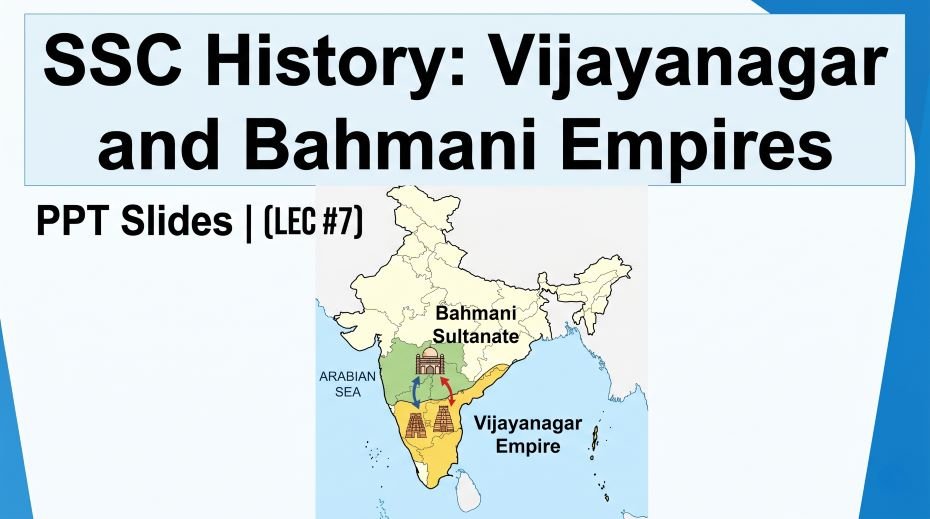
- Understand their geography: Vijayanagar in the south (Karnataka), Bahmani in the Deccan (northern Karnataka, Telangana, Maharashtra).
Step 2 – Deep Study of Key Facts (Day 2–4)
- Memorise the Four Dynasties of Vijayanagar using SSTA.
- Study Krishnadeva Raya in full – dynasty, dates, achievements, literary works, foreign visitors, court poets.
- Study the Battle of Talikota – 1565 AD, four kingdoms, Aliya Rama Raya, destruction of Hampi.
- Memorise all five Deccan Sultanates using BIG AB mnemonic.
- Study Mahmud Gawan – merchant background, Bidar Madrasa, execution 1481 AD.
Step 3 – MCQ Practice (Day 5–6)
- Solve all 24 MCQs from the High-Frequency SSC MCQ table in this article.
- Then attempt 3–4 sets of previous year SSC papers on medieval history.
- Aim for 90%+ accuracy in this chapter.
Step 4 – Rapid Revision (Exam Eve)
- Review: Timeline Table + Comparative Summary + Five Deccan Sultanates table.
- Recall key dates: 1336 (Vijayanagar founded), 1347 (Bahmani founded), 1565 (Battle of Talikota), 1481 (Mahmud Gawan executed).
- Recall key names: Harihara-Bukka (founders), Krishnadeva Raya (greatest), Abdur Razzaq-Domingo Paes (travellers), Mahmud Gawan (PM Bahmani).
Quick Comparison: Vijayanagar Empire vs Bahmani Sultanate
| Feature | Vijayanagar Empire | Bahmani Sultanate |
| Founded | 1336 AD | 1347 AD |
| Founders | Harihara I and Bukka Raya I | Zafar Khan (Alauddin Hasan Bahman Shah) |
| Capital | Vijayanagara (Hampi), Karnataka | Gulbarga → Bidar |
| Religion | Hindu kingdom | Islamic Sultanate |
| Location | South India (south of Krishna River) | Deccan (between Vindhyas and Krishna River) |
| Greatest Ruler | Krishnadeva Raya (Tuluva Dynasty) | Firuz Shah Bahmani (scholar); Mahmud Gawan (PM) |
| Literary Achievement | Krishnadeva Raya wrote Amuktamalyada in Telugu | Firuz Shah Bahmani knew many languages; patronised scholars |
| Famous Architecture | Virupaksha Temple, Vittala Temple, Hampi bazaar | Mahmud Gawan’s Madrasa at Bidar |
| End of Empire | Battle of Talikota 1565 AD; final end 1646 AD | Broke into 5 Deccan Sultanates; completely ended 1518 AD |
| Key Conflict | Constant wars with Bahmani over Raichur Doab | Constant wars with Vijayanagar over Raichur Doab |
| Foreign Travellers | Abdur Razzaq, Nicolo Conti, Domingo Paes | Ibn Battuta mentioned Deccan region |
also read: SSC History New States PPT Slides (LEC #6)
Recommended Books and Resources for This Chapter
| Resource | Type | Why Use It |
| SSC History Vijayanagar and Bahmani PPT Slides LEC #7 (slideshareppt.net) | PPT (124 slides) | Best visual resource; 124 slides; exam-focused; free |
| NCERT Class 7 – Our Pasts II (Chapter on Delhi Sultans and Vijayanagar) | Textbook | Simple language; ideal for beginners |
| NCERT Class 11 – Themes in Indian History II | Textbook | Primary source-based; detailed analysis of Vijayanagar |
| Old NCERT Medieval India by Satish Chandra | Book | Best detailed reference for Vijayanagar and Bahmani |
| Spectrum’s Brief History of Medieval India | Book | SSC-specific quick notes; very popular among aspirants |
| Lucent’s General Knowledge (History Section) | Book | Best for last-minute date-and-fact revision |
Frequently Asked Questions (FAQs)
Q1: What is the most important date from this chapter for SSC?
The Battle of Talikota – 1565 AD – is the single most repeated date from this chapter in SSC exams. After that, 1336 AD (Vijayanagar founded) and 1347 AD (Bahmani founded) are equally critical.
Q2: Which dynasty did Krishnadeva Raya belong to?
Krishnadeva Raya belonged to the Tuluva Dynasty – the third of the four dynasties of the Vijayanagar Empire. The sequence is: Sangama → Saluva → Tuluva → Aravidu.
Q3: What happened to the Bahmani Sultanate?
The Bahmani Sultanate broke into five independent Deccan Sultanates between 1490 and 1518 AD. These are: Bijapur (Adil Shahi), Berar (Imad Shahi), Ahmadnagar (Nizam Shahi), Golconda (Qutb Shahi), and Bidar (Barid Shahi). The process was accelerated by the execution of Mahmud Gawan in 1481 AD.
Q4: Who was Vidyaranya and what is his connection to Vijayanagar?
Vidyaranya, also known as Madhavacharya, was a great Hindu philosopher and saint of the Advaita Vedanta tradition. He is credited as the spiritual inspiration and mentor who encouraged Harihara I and Bukka Raya I to establish the Vijayanagar Empire as a Hindu kingdom to resist Muslim expansion into South India.
Q5: What were the Ashtadiggajas?
The Ashtadiggajas were the eight celebrated Telugu poets in the court of Krishnadeva Raya. They represented the pinnacle of Telugu literary achievement. The greatest among them was Allasani Peddana, who authored Manucharitra (also called Svaroochi Sambhava) and is considered the ‘grandfather of Telugu poetry’ (Andhra Kavita Pitamaha).
Q6: Why is the Tungabhadra River important in this chapter?
The Tungabhadra River was the lifeblood of the Vijayanagar Empire. The capital city Vijayanagara (modern Hampi) was located on its southern banks. The river provided water for irrigation, acted as a natural boundary and defence, and supported the region’s agricultural economy. Deva Raya I also built a famous canal and dam on the Tungabhadra to improve irrigation.
Conclusion – Your Complete Revision Package
The SSC History Vijayanagar and Bahmani Empire PPT Slides – Lecture #7 – with its 124 slides is one of the best free resources available for SSC History preparation. This article has covered every exam-relevant fact from both empires in one place.
Your four golden facts to remember from this chapter:
- 1336 AD – Vijayanagar founded by Harihara I and Bukka Raya I – capital Hampi on Tungabhadra River
- Krishnadeva Raya (Tuluva Dynasty) – greatest ruler – wrote Amuktamalyada – Ashtadiggajas – foreign visitors Abdur Razzaq and Domingo Paes
- 1347 AD – Bahmani Kingdom founded by Zafar Khan as Alauddin Hasan Bahman Shah – capital Gulbarga then Bidar
- 1565 AD – Battle of Talikota – four Deccan Sultanates defeated and destroyed Vijayanagara – five Deccan Sultanates: Bijapur, Berar, Ahmadnagar, Golconda, Bidar
Download the PPT from slideshareppt.net, revise this article daily in the final week, and practise the 24 MCQs provided above. You will be able to answer every question this chapter can produce in your SSC exam.