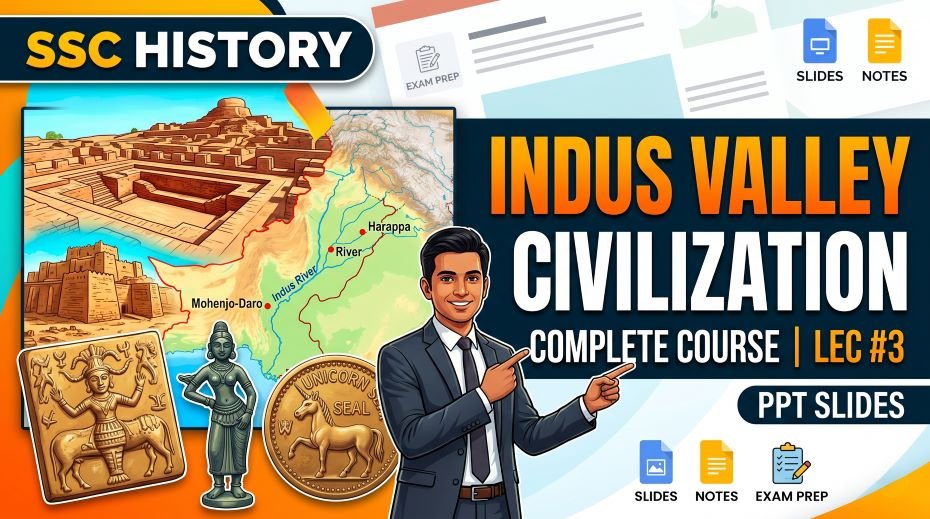
We will share SSC History Indus Valley Civilization PPT Slides (LEC #3), SSC History Indus Valley Civilization – Complete Notes for SSC CGL, CHSL, CPO and MTS so, before we dive in, here is a quick overview of this PPT lecture from the Complete Foundation Batch series:
| Lecture Number | History LEC #3 |
| Serial Number in Series | #28 |
| Total PPT Slides | 126 Slides |
| File Size | 47 MB |
| Subject | History – Indus Valley Civilization (Sindhu Ghati Sabhyata / सिंधु घाटी सभ्यता) |
| Series Name | Complete Foundation Batch for All SSC and Other Exams (PPT Series) |
| Website | https://slideshareppt.net/ |
| Exam Relevance | SSC CGL, SSC CHSL, SSC CPO, SSC MTS, SSC GD – Very High (2–4 questions per exam) |
| Key Topics Covered | IVC Introduction, Major Sites, Town Planning, Economy, Trade, Art, Religion, Script, Decline |
SSC History Indus Valley Civilization PPT Slides (LEC #3)
Note: If you wish to download the entire SSC series (PPT slides), simply visit this redirect page. –REDIRECT PAGE
Why Indus Valley Civilization Is a Must-Study for SSC Exams?
The Indus Valley Civilization – also known as the Harappan Civilization or Sindhu Ghati Sabhyata – is one of the four great ancient civilisations of the world, alongside Mesopotamia (Iraq), Ancient Egypt, and Ancient China. It flourished between approximately 3300 BC and 1300 BC, making it older than the Roman Empire, older than Classical Greece, and roughly contemporary with the Egyptian pyramids.
For SSC exam aspirants, this chapter is non-negotiable. In the last decade of SSC CGL, CHSL, CPO, and MTS papers, the Indus Valley Civilization has contributed between 2 and 4 questions in almost every exam. The questions come from specific, factual angles – who excavated which site, what was found where, what makes one site unique, what IVC did not have – and every single one of these angles is covered in this 126-slide PPT lecture.
This article covers everything in that lecture in a structured, exam-ready format. We begin with the PPT overview, move through the complete IVC timeline, cover all 14 major sites with their unique finds, break down the key features of IVC life and culture, and finish with a podcast-style discussion and a comprehensive Q&A table based on previous SSC paper patterns.
One important note before you begin: the IVC chapter has been updated significantly in recent years. Rakhigarhi (Haryana) is now confirmed as the largest IVC site – larger than Mohenjo-daro. Dholavira became a UNESCO World Heritage Site in 2021. The 2019 DNA study from Rakhigarhi has changed the debate on IVC origins. All of these updates are reflected in this article and in the PPT series.
1. Complete Indus Valley Civilization Timeline – From Mehrgarh to Modern Discoveries
Use this table to understand both the ancient history of IVC and the modern history of how it was discovered. Both angles are tested in SSC exams – ancient dates (when did IVC peak?) and discovery dates (who found what and when?).
| Date | Event / Phase | Key Facts for SSC Exams |
| ~7000 BC | Mehrgarh (Pre-IVC) | Earliest Neolithic settlement in South Asia. Located in Balochistan (present-day Pakistan). Shows beginnings of farming, animal domestication, and pottery – the direct ancestor culture of IVC. |
| ~3300 BC | Early Harappan Phase begins | Pre-urban phase. Simple settlements, early pottery, beginnings of trade. IVC culture starts taking shape across the Indus river system. |
| ~2600 BC | Mature Harappan Phase begins | Peak of IVC – largest and most sophisticated urban phase. Major cities (Harappa, Mohenjo-daro, Lothal, Dholavira) fully established with grid-planned streets and advanced drainage. |
| ~2500 BC | Great Bath constructed at Mohenjo-daro | The Great Bath – the world’s earliest large public water tank – built at Mohenjo-daro. Believed to be used for ritual bathing. Still standing today. One of the most-asked SSC facts about IVC. |
| ~2300–1900 BC | IVC Trade with Mesopotamia at its peak | Seals, beads, and pottery found in both Mesopotamia (Iraq) and IVC sites confirm active trade. IVC traders called ‘Meluhha’ in Mesopotamian records. Lothal’s dockyard facilitated sea trade. |
| 1921 AD | Discovery of Harappa | Harappa (Punjab, Pakistan) excavated by Daya Ram Sahni under the direction of John Marshall (Director General of ASI). First IVC site to be discovered. The entire civilization is named after this site. |
| 1922 AD | Discovery of Mohenjo-daro | Mohenjo-daro (Sindh, Pakistan) excavated by R.D. Banerji. Name means ‘Mound of the Dead’ in Sindhi. Largest IVC city. Great Bath, Great Granary, and Dancing Girl bronze statue found here. |
| ~1900 BC | Late / Declining Harappan Phase begins | Mature Harappan culture starts declining. Cities are gradually abandoned. Evidence of reduced trade, smaller structures, and population movement eastward (towards Ganga plains). |
| ~1300–1000 BC | IVC fully declines | The Harappan civilization had fully wound down by this point. Causes debated: climate change, drying of Saraswati river, Aryan invasion theory (now largely discredited), floods, internal decline. |
| 1946 AD | Excavation of Lothal begins | Lothal (Gujarat, India) excavated by S.R. Rao. Lothal had the world’s earliest known dockyard – direct evidence of IVC’s maritime trade with Mesopotamia and Oman. |
| 1953 AD | Kalibangan excavated | Kalibangan (Rajasthan, India) excavated by A. Ghosh. Pre-Harappan ploughed field found here – world’s oldest evidence of ploughing (farming). Also has fire altars – suggests early fire worship. |
| 1967 AD | Surkotada excavated (Gujarat) | Surkotada (Gujarat, India) – only IVC site where horse bones have been found. Also notable for its oval grave (burial customs evidence). |
| 1990 AD | Dholavira excavated | Dholavira (Rann of Kutch, Gujarat, India) excavated by R.S. Bisht. Second largest IVC site in India and one of the best preserved. Famous for a large signboard with Indus script – the world’s oldest signboard. Named a UNESCO World Heritage Site in 2021. |
| 2014–ongoing | Rakhigarhi confirmed as largest IVC site | Rakhigarhi (Haryana, India) is now confirmed as the largest known IVC site – larger even than Mohenjo-daro. DNA studies here (2019) challenged the Aryan Migration Theory significantly. |
2. Indus Valley Civilization – Essential Background
A. What Is the Indus Valley Civilization?
The Indus Valley Civilization was a Bronze Age urban culture that developed in the river valleys of the Indus River (and its tributaries, including the now-dried Ghaggar-Hakra river) in what is now Pakistan and northwestern India. At its peak, it covered approximately 1.25 million square kilometres – larger than ancient Mesopotamia and Egypt combined. It had over 1,400 known sites, of which around 900 are in India and 500 in Pakistan.
B. Other Names for IVC
- Harappan Civilization – named after Harappa, the first site to be excavated (1921).
- Indus Valley Civilization – named after the Indus (Sindhu) River system in which it developed.
- Sindhu Ghati Sabhyata (सिंधु घाटी सभ्यता) – the Hindi name used in Indian textbooks.
- Mohenjo-daro Civilization – an older term, less used today.
C. Geographical Extent – The Extremes
- Northernmost site: Manda (Akhnoor, Jammu) – on the Chenab river
- Southernmost site: Daimabad (Maharashtra) – where the famous bronze chariot was found
- Easternmost site: Alamgirpur (Meerut, UP) – in the Ganga-Yamuna doab
- Westernmost site: Sutkagendor (Balochistan, near Iran border)
D. IVC’s Contemporaries – The Four Great Ancient Civilisations
- Indus Valley Civilization: ~3300–1300 BC (South Asia)
- Mesopotamia (Sumerian/Babylonian): ~3500–500 BC (modern Iraq)
- Ancient Egypt: ~3100–30 BC (North Africa)
- Ancient China (Yellow River): ~2100–221 BC
SSC sometimes asks: Which ancient civilisation was contemporary with IVC? All three above. Which was geographically the largest? IVC at its peak.
3. Major Indus Valley Civilization Sites – Complete Table with Excavators and Key Finds
This is the highest-yield section for SSC exams. Every site has at least one unique feature that makes it test-worthy. The table below covers all 14 major sites with their location, excavator, year, and key finds. Focus especially on the bold unique facts for each site – those are what SSC tests.
| Site Name | Location | Excavator (Year) | Key Finds / SSC Facts |
| Harappa | Montgomery, Punjab (Pakistan) | Daya Ram Sahni (1921) | Granary (outside citadel), coffin burial, workers’ quarters, 6 granaries in a row, red sandstone male torso sculpture, evidence of craft industry |
| Mohenjo-daro | Larkana, Sindh (Pakistan) | R.D. Banerji (1922) | Great Bath, Great Granary (inside citadel), Dancing Girl (bronze), Priest-King statue (steatite), Pashupati Seal, largest IVC city, best-preserved. ‘Mound of the Dead.’ |
| Lothal | Saragwala, Gujarat (India) | S.R. Rao (1954) | World’s first dockyard (evidence of maritime trade), bead-making factory, Persian Gulf connections, chess-like game board, evidence of rice husk – earliest rice in India |
| Kalibangan | Hanumangarh, Rajasthan (India) | A. Ghosh (1953) | Pre-Harappan ploughed field (world’s oldest evidence of ploughing), fire altars, camel bones found, both pre-Harappan and Harappan layers |
| Dholavira | Rann of Kutch, Gujarat (India) | R.S. Bisht (1990) | World’s oldest signboard (10 large Indus script symbols), unique water management system (16 reservoirs), three divisions (unlike usual two), UNESCO World Heritage Site 2021 |
| Rakhigarhi | Hisar, Haryana (India) | Amarendra Nath (1997) | Largest IVC site (larger than Mohenjo-daro), ongoing DNA studies, complete city layout. 2019 ancient DNA study published from here. |
| Surkotada | Kutch, Gujarat (India) | J.P. Joshi (1967) | Only IVC site where horse bones found, oval-shaped grave (burial evidence), small settlement with citadel and lower city |
| Banawali | Fatehabad, Haryana (India) | R.S. Bisht (1973) | Oval-shaped settlement (unlike usual rectangular), lapis lazuli found, Harappan plough found, both pre-Harappan and Harappan phases |
| Chanhudaro | Sindh (Pakistan) | N.G. Majumdar (1931) | Only IVC site with no citadel. Evidence of bead-making, bronze-casting, inkpot found – only site showing use of ink. Footprint of a dog chasing a cat found on a brick! |
| Kot Diji | Sindh (Pakistan) | F.A. Khan (1955) | Important pre-Harappan site. Evidence of fortification. Shows transition from early to mature Harappan culture. |
| Alamgirpur | Meerut, UP (India) | Y.D. Sharma (1958) | Easternmost known IVC site. Located in Ganga-Yamuna doab – shows eastward expansion of IVC culture. Cloth impression on a trough found. |
| Sutkagendor | Balochistan (Pakistan – near Iran border) | Aurel Stein (1927) | Westernmost known IVC site. Located on trade route to Mesopotamia. Shows IVC’s geographical extent westward. |
| Manda | Akhnoor, Jammu (India) | J.P. Joshi (1977) | Northernmost known IVC site. Located on Chenab river bank. |
| Daimabad | Ahmednagar, Maharashtra (India) | S.A. Sali (1974) | Southernmost IVC site. Bronze chariot with two oxen and driver found here – rare bronze art of IVC. |
Memory Trick: Superlatives of IVC Sites
- LARGEST (India): Rakhigarhi, Haryana
- LARGEST (Pakistan): Mohenjo-daro, Sindh
- FIRST DOCKYARD (world’s oldest): Lothal, Gujarat
- OLDEST PLOUGHED FIELD (world’s oldest): Kalibangan, Rajasthan
- THREE DIVISIONS (not two): Dholavira, Gujarat – UNESCO World Heritage Site 2021
- NO CITADEL: Chanhudaro, Sindh
- HORSE BONES (only site): Surkotada, Gujarat
- WORLD’S OLDEST SIGNBOARD: Dholavira, Gujarat
- NORTHERNMOST: Manda, Jammu
- SOUTHERNMOST: Daimabad, Maharashtra (bronze chariot found here)
- EASTERNMOST: Alamgirpur, Meerut, UP
- WESTERNMOST: Sutkagendor, Balochistan
4. Key Features of the Indus Valley Civilization – Town Planning, Economy, Religion, Art, Script, Decline
The PPT series covers IVC features across multiple slides under six major categories. This table organises all of them into one reference sheet – with the specific SSC exam angle for each feature.
| Category | Feature | Details | SSC Exam Focus |
| Town Planning | Grid Pattern Streets | Streets intersected at right angles – dividing cities into blocks. Streets ran North-South and East-West. Width maintained consistently. First urban planning system in the world. | SSC asks: What is the most remarkable feature of IVC towns? Answer: Grid-planned streets and advanced drainage. |
| Town Planning | Two-Part City Layout | Every major IVC city had two parts: (1) Citadel (raised, western side) – housed granary, public buildings, Great Bath. (2) Lower Town (eastern, larger) – residential area. Exception: Dholavira had THREE divisions. | SSC asks: Which IVC site had three divisions instead of two? Answer: Dholavira. |
| Town Planning | Drainage System | World’s most advanced drainage system of the ancient world. Underground brick-lined drains connected every house to main street drains. Covered with bricks/stone slabs. Manholes for cleaning. | SSC: What is the most unique engineering achievement of IVC? Drainage system – more advanced than contemporaneous Mesopotamia and Egypt. |
| Town Planning | Great Bath (Mohenjo-daro) | 12.8m long, 7m wide, 2.4m deep. Bitumen-sealed floor (waterproofing). Steps on both ends. Surrounded by verandahs and small rooms. Purpose: ritual bathing. Called ‘earliest public water tank in the world.’ | SSC: Where is the Great Bath? Mohenjo-daro. What was it used for? Ritual/religious bathing. |
| Economy | Agriculture | Wheat, barley, rice (at Lothal – earliest evidence in India), cotton (first civilisation to grow cotton), sesame, mustard. Use of plough confirmed at Kalibangan (world’s oldest ploughed field). | SSC: Which civilisation grew cotton first? IVC/Harappans. Where is the earliest ploughed field? Kalibangan. |
| Economy | Trade – Internal | Standardised weights and measures (binary system: 1,2,4,8,16,32…). Standardised bricks (ratio 1:2:4). No coins found – barter trade likely. Extensive road/river-based trade network. | SSC: Did IVC people use coins? No – no coins found; barter system used. What was the IVC weight system? Standardised, binary ratio. |
| Economy | Trade – External (Maritime) | Lothal’s dockyard (world’s first) facilitated trade with Mesopotamia, Oman, Bahrain, and Persian Gulf. IVC called ‘Meluhha’ in Mesopotamian cuneiform texts. Carnelian beads and IVC seals found in Mesopotamia. | SSC: Which IVC site had the world’s first dockyard? Lothal. What did Mesopotamian texts call IVC? Meluhha. |
| Religion | Mother Goddess | Terracotta figurines of a female figure (often interpreted as Mother Goddess) are the most common religious find. Suggests fertility cult or goddess worship dominant. | SSC: Which deity was worshipped in IVC? Evidence of Mother Goddess worship through terracotta figurines. |
| Religion | Pashupati Seal | Found at Mohenjo-daro. Shows a yogi-like figure seated in meditation, surrounded by four animals (elephant, tiger, rhino, buffalo) and two deer below. Identified as proto-Shiva / Lord of Animals (Pashupati). | SSC: What is the Pashupati Seal? Found at Mohenjo-daro, shows a figure surrounded by animals – considered proto-Shiva. |
| Religion | Fire Altars | Found at Kalibangan (Rajasthan) and Lothal. Suggests fire worship or Vedic-type rituals. Important because it connects IVC religion to later Vedic practices. | SSC: Which IVC site has evidence of fire altars? Kalibangan and Lothal. |
| Art & Craft | Dancing Girl | Bronze sculpture (lost-wax / cire perdue technique). Found at Mohenjo-daro. Shows a young girl with bangles and necklace, hand on hip. Evidence of advanced metallurgy and artistic sophistication. | SSC: Where was the Dancing Girl found? Mohenjo-daro. What technique was used? Lost-wax (cire perdue) casting. |
| Art & Craft | Priest-King Statue | Steatite (soap-stone) sculpture found at Mohenjo-daro. Shows a bearded man with a trefoil-patterned robe (shawl). Called ‘Priest-King’ – suggests a ruler-priest figure in IVC society. | SSC: Where was the Priest-King found? Mohenjo-daro. What is it made of? Steatite. |
| Art & Craft | Seals | ~2,000+ seals found. Square/rectangular, made of steatite. Have animal motifs (unicorn most common, bull, elephant) and Indus script. Used for trade/identification. Unicorn seal is the most common IVC seal. | SSC: What is the most common animal on IVC seals? Unicorn. What material were seals made of? Steatite. |
| Script | Indus Script (Undeciphered) | Pictographic script – ~400+ signs identified. Written right-to-left (boustrophedon – alternate lines in opposite directions). Still NOT deciphered by anyone – one of the great unsolved mysteries of history. | SSC: Has the Indus Valley script been deciphered? No – still undeciphered. In which direction was it written? Right-to-left (or boustrophedon). |
| Decline | Theories of Decline | Multiple theories: (1) Climate change and desertification – drying of Ghaggar-Hakra (ancient Saraswati) river. (2) Floods at Mohenjo-daro. (3) Aryan Invasion (now largely discredited by DNA evidence). (4) Epidemic/disease. Most historians now favour climate and river-drying theory. | SSC: What caused IVC’s decline? Most accepted: climate change and drying of the Saraswati/Ghaggar-Hakra river system. |
5. Additional High-Yield IVC Facts for SSC Exams
A. IVC and the Horse Debate
One of the most contested topics in IVC studies is the horse. Vedic culture is closely associated with horses (horse sacrifice, chariots), but IVC has almost no horse evidence – only Surkotada has debated horse bone finds. This is used as an argument against the ‘Aryan = IVC’ theory. SSC occasionally asks about this as a trick question.
B. The Saraswati (Ghaggar-Hakra) River
A large number of IVC sites (over 500 in India) are located along the dried Ghaggar-Hakra river bed – which many historians identify as the ancient Saraswati River mentioned in Vedic texts. The drying of this river is now considered one of the primary causes of IVC’s decline. This also forms the basis for calling IVC the ‘Saraswati Civilization’ by some historians – a politically debated term.
C. IVC and No Iron
The Indus Valley Civilization was a Bronze Age culture. Iron was completely unknown to IVC people. They used copper and bronze for tools, weapons, and art. The use of iron in India begins only in the later Vedic Period (around 1000 BC) – roughly 1,000 years after IVC’s peak.
D. Standardised Bricks – A Unique Feature
IVC bricks follow a consistent length-to-width-to-height ratio of 4:2:1 across all sites – from Harappa in Pakistan to Lothal in Gujarat. This standardisation across such a vast geographical area is remarkable and suggests a centralised system of production or strong cultural uniformity. SSC sometimes asks about IVC brick ratios.
E. First Civilisation to Grow Cotton
The Harappans were the world’s first known cotton growers. Cotton cloth impressions were found at Mohenjo-daro. The Greeks called India ‘Sindon’ (from Sindhu), meaning ‘land of cotton.’ This fact is tested in SSC in the form: ‘Which ancient civilisation first cultivated cotton?’ Answer: Indus Valley / Harappan Civilization.
6. Podcast Discussion – Indus Valley Civilization for SSC Exams (Multiple Perspectives)
Three voices – an SSC Mentor, a History Expert, and an SSC Topper – break down the IVC chapter from different angles, covering study strategy, commonly confused facts, and exam-specific tips.
| Speaker / Role | Question | Answer / Perspective |
| Host (SSC Mentor) | The Indus Valley Civilization has 126 PPT slides – the biggest lecture so far in this series. What makes IVC such a vast topic for SSC? | Because IVC is tested at every level of the SSC exam – from a simple ‘who excavated Harappa’ question in MTS to a complex ‘which site has the oldest ploughed field’ question in CGL. The sheer number of sites (14+ major ones, each with unique findings), the variety of topics (town planning, trade, art, religion, script), and the frequency with which new discoveries update the knowledge base – like Rakhigarhi overtaking Mohenjo-daro as the largest site – means there is genuinely a lot to cover. 126 slides reflects how seriously SSC takes this chapter. |
| Guest 1 (History Expert) | IVC is often called the most ‘mysterious’ ancient civilisation. Why is that, and does the mystery matter for SSC preparation? | Three things make IVC genuinely mysterious: the script remains undeciphered, we do not know what language IVC people spoke, and we still do not know exactly what caused the civilisation to collapse. The mystery matters for SSC because examiners love to ask about what we do NOT know about IVC – ‘Has the Indus script been deciphered?’ (No), ‘Were coins used?’ (No evidence found), ‘Was the horse domesticated in IVC?’ (Only Surkotada has horse bones – disputed). The absences in IVC are as important as the finds. |
| Guest 2 (SSC Topper) | What is the fastest way to memorise all the IVC sites for SSC – there are so many? | Group them by superlatives – that is the SSC examiner’s favourite trick. Largest site: Rakhigarhi (India), Mohenjo-daro (Pakistan). Westernmost: Sutkagendor. Easternmost: Alamgirpur. Northernmost: Manda. Southernmost: Daimabad. First dockyard: Lothal. Oldest ploughed field: Kalibangan. No citadel: Chanhudaro. Three divisions: Dholavira. Horse bones: Surkotada. Great Bath: Mohenjo-daro. If you memorise the superlative linked to each site, you have cracked 80% of IVC site questions in SSC. |
| Host (SSC Mentor) | The Great Bath at Mohenjo-daro is described in the PPT in great detail. Why does SSC keep asking about it? | Because the Great Bath is the most iconic single structure of IVC – like the Taj Mahal for Mughal History. SSC uses it to test multiple things from one structure: What are its dimensions? Where is it located? What was it used for? What waterproofing technology was used? The answer that it was sealed with bitumen (a form of natural tar) is a favourite trick question – students often forget the technical detail. The fact that it is called ‘the earliest public water tank in the world’ is another frequently tested claim. Know everything about the Great Bath and you have locked in an easy mark. |
| Guest 1 (History Expert) | IVC trade with Mesopotamia is a key topic. What should an SSC aspirant specifically know about it? | Three facts are essential. First: IVC was called ‘Meluhha’ in Mesopotamian cuneiform records – SSC has asked this directly. Second: Lothal’s dockyard is direct physical evidence of maritime trade – the harbour was connected to a river estuary and could dock large boats. Third: IVC seals (especially with unicorn motifs) have been found in Mesopotamia (modern Iraq), and Mesopotamian goods have been found at IVC sites – confirming two-way trade. The time period for this peak trade was approximately 2300–1900 BC. If you know these three facts, you can answer any IVC trade question in SSC. |
| Guest 2 (SSC Topper) | The Pashupati Seal is mentioned in every SSC history book. What exactly do students need to know about it? | Four things – location, description, interpretation, and significance. Location: found at Mohenjo-daro. Description: square steatite seal showing a figure seated cross-legged in a yoga-like pose, surrounded by four animals (elephant, tiger, rhino, buffalo) and two deer at his feet. Interpretation: the seated figure is interpreted as Proto-Shiva or Pashupati (Lord of Animals). Significance: it is the earliest known representation of a deity resembling Shiva – suggesting that Shaivism has roots in the IVC period. SSC often asks ‘Where was the Pashupati Seal found?’ – the answer is always Mohenjo-daro, not any other site. |
| Host (SSC Mentor) | The Indus Script is still undeciphered. Does that create any exam confusion for students? | Occasionally – students sometimes write in exams that ‘the Indus script has been partially deciphered’ or confuse it with Brahmi (which James Prinsep decoded in 1837). Be absolutely clear: the Indus Valley script is completely undeciphered as of today. About 400 signs have been identified. It was written right-to-left (or boustrophedon – alternating right-to-left and left-to-right in successive lines). It is pictographic – each sign represents an object or idea, not a sound. SSC exams test the ‘still not deciphered’ fact directly and also ask about its direction of writing. |
| Guest 1 (History Expert) | Was IVC a peaceful civilisation? SSC sometimes asks about IVC’s political and social structure. | This is a fascinating question. Unlike Mesopotamia and Egypt, IVC has no evidence of kings, palaces, or monuments glorifying rulers. No weapons of mass warfare have been found. No large armies are depicted. This has led historians to call IVC a ‘remarkably egalitarian’ civilisation – or at least one that did not express power through monuments the way Egypt (pyramids) or Mesopotamia (ziggurats) did. SSC may ask: ‘Which ancient civilisation had no evidence of kings or warfare?’ – IVC fits that description. The absence of temples (no confirmed temple structure found yet) also distinguishes IVC from every other ancient civilisation. |
| Guest 2 (SSC Topper) | Final quick-fire revision tip for the entire IVC chapter before an SSC exam? | Use the STAND acronym: S – Sites and their excavators and unique finds. T – Town planning (grid streets, drainage, citadel vs lower town). A – Art and crafts (Dancing Girl, Priest-King, seals, pottery). N – No coins, no deciphered script, no confirmed temples, no iron – four important ‘no’s of IVC. D – Decline theories (climate change and river drying being the strongest current theory). If you can speak for 30 seconds on each letter of STAND, you are fully prepared for every IVC question in SSC CGL, CHSL, CPO, and MTS. |
7. SSC Exam Q&A – Indus Valley Civilization (Previous Year Pattern)
These 15 questions are based on the actual question patterns of SSC CGL, CHSL, CPO, and MTS exams. Every answer is complete and exam-ready.
| # | Question | Answer | Exam Relevance |
| Q1 | Who excavated Harappa and Mohenjo-daro, and in which years? | Harappa: Daya Ram Sahni (1921). Mohenjo-daro: R.D. Banerji (1922). Both excavations were conducted under the direction of John Marshall, then Director General of the Archaeological Survey of India (ASI). The IVC civilization is named ‘Harappan’ after Harappa. | SSC CGL, CHSL, CPO, MTS – Very High |
| Q2 | What is the full time period of the Indus Valley Civilization? | IVC existed from approximately 3300 BC to 1300 BC. The Mature (peak) Harappan phase was from 2600 BC to 1900 BC. The pre-Harappan ancestor culture at Mehrgarh dates back to ~7000 BC. | SSC CGL, CHSL – High |
| Q3 | Which is the largest known site of the Indus Valley Civilization? | Rakhigarhi (Haryana, India) is now confirmed as the largest IVC site – larger than Mohenjo-daro (previously considered the largest). Rakhigarhi covers over 350 hectares. Important 2019 ancient DNA study was conducted here. | SSC CGL, CHSL – Very High (updated fact) |
| Q4 | Where was the world’s first dockyard found, and which IVC site does it belong to? | The world’s first known dockyard was found at Lothal (Gujarat, India), excavated by S.R. Rao in 1954. The dockyard was connected to a river estuary and evidence suggests it was used for loading and unloading cargo from ships trading with Mesopotamia. | SSC CGL, CHSL, CPO – Very High |
| Q5 | What is the Great Bath, and where is it located? | The Great Bath is the world’s earliest known large public water tank, located at Mohenjo-daro (Sindh, Pakistan). It measures 12.8m x 7m x 2.4m (depth). Its floor was sealed with bitumen (natural tar) for waterproofing. It was likely used for ritual or ceremonial bathing. | SSC CGL, CHSL – Very High |
| Q6 | Which IVC site has evidence of the world’s oldest ploughed field? | Kalibangan (Rajasthan, India), excavated by A. Ghosh in 1953. A pre-Harappan ploughed field was found with two sets of furrows at right angles – indicating two crops were grown simultaneously. Fire altars were also found at Kalibangan. | SSC CGL, CHSL, CPO – High |
| Q7 | What is the Pashupati Seal, and where was it found? | The Pashupati Seal is a steatite (soapstone) seal found at Mohenjo-daro. It shows a yogi-like figure seated in padmasana (lotus position), surrounded by four animals (elephant, tiger, rhinoceros, buffalo) with two deer below. The figure is interpreted as Proto-Shiva / Pashupati (Lord of Animals). | SSC CGL, CHSL – Very High |
| Q8 | What is unique about Chanhudaro among all IVC sites? | Chanhudaro (Sindh, Pakistan) is the only known IVC site that did NOT have a citadel. It is also known for evidence of bead-making workshops and bronze casting. A famous find: a brick with the paw-print of a dog that was chasing a cat – preserved from over 4,000 years ago. | SSC CGL, CHSL – High (trick question) |
| Q9 | Has the Indus Valley script been deciphered? What do we know about it? | No – the Indus Valley script has NOT been deciphered yet. It is one of the great unsolved mysteries of ancient history. Approximately 400 signs have been identified. It is pictographic (signs represent objects/concepts). The direction of writing was right-to-left, sometimes boustrophedon (alternating directions in successive lines). | SSC CGL, CHSL, CPO – Very High |
| Q10 | Which IVC site is known for its unique three-part city division? | Dholavira (Rann of Kutch, Gujarat, India), excavated by R.S. Bisht from 1990. While most IVC cities had two divisions (citadel and lower town), Dholavira had three: Citadel, Middle Town, and Lower Town. It is also famous for the world’s oldest signboard – large Indus script symbols displayed publicly. UNESCO World Heritage Site since 2021. | SSC CGL, CHSL – High |
| Q11 | Which was the first civilisation to cultivate cotton? | The Indus Valley Civilization (Harappans) were the first people in the world known to have grown and used cotton. Greeks later called India ‘Sindon’ (from Sindhu/Sindh), meaning ‘land of cotton.’ Cotton cloth impression was found at Mohenjo-daro. | SSC CGL, CHSL, MTS – High |
| Q12 | What were IVC seals made of, and what was the most common animal depicted on them? | IVC seals were primarily made of steatite (soapstone). They were square or rectangular. The most commonly depicted animal was the unicorn (a one-horned bull-like creature). Other animals include the bull, elephant, rhinoceros, and tiger. Seals were used for trade identification and administrative purposes. | SSC CGL, CHSL – High |
| Q13 | Which IVC site is the only one where horse bones have been found? | Surkotada (Kutch, Gujarat, India), excavated by J.P. Joshi in 1967. Horse bones were found here – this is significant because the horse is generally associated with the later Aryan/Vedic culture. The finding is still debated among historians. | SSC CGL, CHSL – Moderate (trick question) |
| Q14 | What are the four major ‘absences’ in IVC that make it unique among ancient civilisations? | The four famous ‘NO’s of IVC: (1) No coins found – barter system was likely used. (2) No confirmed temples discovered – unusual for an ancient civilisation. (3) No iron tools found – only copper and bronze. (4) No deciphered script – still unknown language. SSC regularly tests these absences. | SSC CGL, CHSL – High |
| Q15 | What is the most widely accepted theory for the decline of the Indus Valley Civilization? | The most accepted current theory is climate change and the drying of the Ghaggar-Hakra river (believed to be the ancient Saraswati river) – which disrupted agriculture and trade. Other theories include floods at Mohenjo-daro, epidemic, and internal economic collapse. The older Aryan Invasion Theory is now largely discredited by DNA evidence from Rakhigarhi (2019). | SSC CGL, CHSL – High |
read also: SSC History Introduction and Timeline PPT Slides (LEC #2)
8. Smart Study Strategy for IVC – How to Prepare This Chapter
Use the STAND Method
- S – Sites: Know each site’s location, excavator, year, and ONE unique find. Start with the 12 superlatives (largest, smallest, northernmost, etc.).
- T – Town Planning: Grid streets, two-part city (citadel + lower town), world-class drainage, Great Bath, standardised bricks.
- A – Art and Culture: Dancing Girl (Mohenjo-daro, bronze, lost-wax technique), Priest-King (Mohenjo-daro, steatite), Pashupati Seal (proto-Shiva), Unicorn seals (most common), terracotta figurines (Mother Goddess).
- N – NOT present in IVC: No iron, no coins, no deciphered script, no confirmed temples, no horse (except Surkotada debate). These ‘absences’ are as important as the finds.
- D – Decline: Climate change, drying of Saraswati/Ghaggar-Hakra river. Aryan Invasion Theory discredited by 2019 Rakhigarhi DNA study.
High-Priority Revision Checklist Before Exam
- Harappa (1921, Daya Ram Sahni) and Mohenjo-daro (1922, R.D. Banerji) – always together
- Lothal = world’s first dockyard (S.R. Rao, 1954, Gujarat)
- Kalibangan = world’s oldest ploughed field + fire altars (A. Ghosh, 1953, Rajasthan)
- Dholavira = 3 divisions + world’s oldest signboard + UNESCO 2021 (R.S. Bisht, 1990, Gujarat)
- Rakhigarhi = largest IVC site (India) + 2019 DNA study (Haryana)
- Chanhudaro = no citadel (Sindh, Pakistan)
- Surkotada = only site with horse bones (Gujarat)
- Great Bath = Mohenjo-daro, bitumen-sealed, ritual bathing
- Pashupati Seal = Mohenjo-daro, proto-Shiva, four animals surrounding
- Dancing Girl = Mohenjo-daro, bronze, lost-wax technique
- IVC script = undeciphered, pictographic, right-to-left, ~400 signs
- First cotton growers = IVC/Harappans
- Meluhha = IVC’s name in Mesopotamian records
Conclusion
The Indus Valley Civilization is one of the most rewarding chapters to study for SSC exams – not because it is easy, but because it is specific. Every fact in this chapter has a clear, testable answer. Who excavated what, what was found where, what IVC did not have, what made each site unique – these are all precise, memorisable facts that translate directly into marks.
The 126 slides of LEC #3 in the Complete Foundation Batch PPT Series are the most comprehensive visual coverage of IVC available for SSC preparation. Use those slides alongside this article – the slides give you the visual memory of site maps, artefact images, and quick-reference charts, while this article gives you the depth and context.
The next article in this series covers the Vedic Period – LEC #4 of the Complete Foundation Batch History PPT Series. Stay tuned to this blog for the same structured, exam-focused coverage of every chapter.