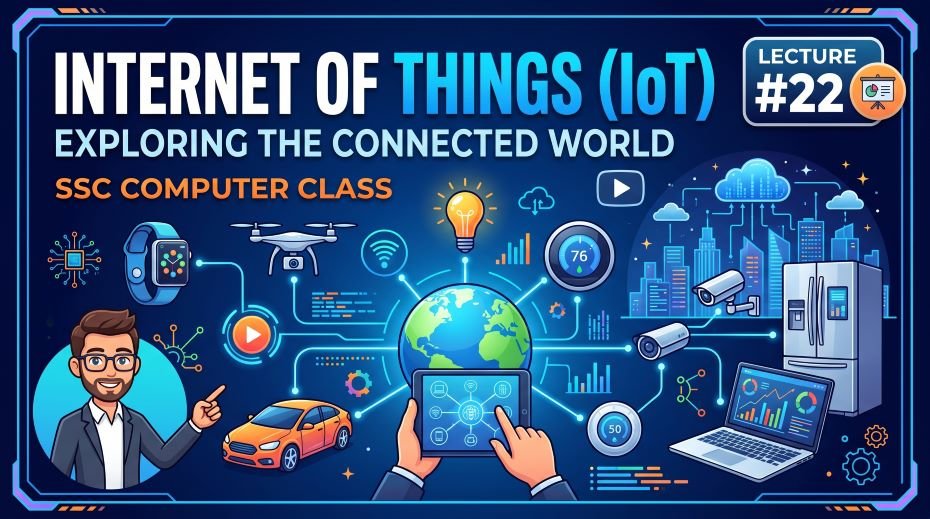
We will share SSC Computer Class Internet of Things PPT Slides (LEC #22) so, if you are preparing for SSC CGL, SSC CHSL, SSC MTS, RRB NTPC, or any other competitive exam, Internet of Things (IoT) is a topic you cannot skip. It appears regularly in the Computer Awareness section and carries easy marks if you know the right concepts. This article covers everything from the LEC #22 PPT slides – definitions, architecture, protocols, applications, security, Indian government initiatives, abbreviations, practice MCQs, and a revision capsule – all in one place.
Lecture Details
| Parameter | Details |
| Lecture Number | LEC #22 |
| Topic | Internet of Things (IoT) |
| Subject | Computer Awareness – SSC Foundation Batch |
| Total Slides | 36 |
| File Size | 5 MB |
| Exam Relevance | SSC CGL, SSC CHSL, SSC MTS, SSC CPO, RRB NTPC, RRB Group D, UPSSSC PET |
SSC Computer Class Internet of Things PPT Slides (LEC #22)
NOTE: IF YOU WANT TO DOWNLOAD COMPLETE SSC SERIES (PPT SLIDES) – JUST VISIT THIS REDIRECT PAGE
What Is the Internet of Things (IoT)?
The Internet of Things (IoT) is the network of physical devices, vehicles, appliances, and other objects embedded with sensors, software, and connectivity that allows them to collect and exchange data over the internet – without requiring human-to-human or human-to-computer interaction.
The term was coined by Kevin Ashton in 1999 while he was working at the MIT Auto-ID Center. At its core, IoT means giving everyday objects the ability to send and receive data, making them “smart.”
| Aspect | Details |
| Full Form | Internet of Things |
| Term Coined By | Kevin Ashton |
| Year Coined | 1999 |
| Core Concept | Physical devices connected to the internet, exchanging data automatically |
| Communication Type | Machine-to-Machine (M2M) – no human intervention needed |
| Unique Identifier | Each device gets a unique IP address or UID |
| Related Technologies | AI, Cloud Computing, Big Data, 5G, Edge Computing |
| Global IoT Devices (2024) | 15+ Billion active devices worldwide |
History and Evolution of IoT
Understanding the timeline of IoT helps answer fact-based questions in SSC and RRB exams.
| Year | Milestone |
| 1982 | First internet-connected machine – a Coke vending machine at Carnegie Mellon University |
| 1990 | John Romkey created the first publicly demonstrated internet-connected device – a toaster |
| 1999 | Kevin Ashton coined the term “Internet of Things” at MIT Auto-ID Center |
| 2000 | LG launched the first internet-enabled refrigerator |
| 2008 | Number of devices connected to the internet exceeded the world’s human population |
| 2011 | IPv6 launched – providing enough IP addresses for every IoT device on Earth |
| 2015 | Major cloud IoT platforms launched (AWS IoT, Microsoft Azure IoT Hub) |
| 2020+ | 5G deployment began accelerating IoT adoption globally |
| 2024 | 15+ Billion IoT devices are actively connected worldwide |
How Does IoT Work?
IoT operates through a simple four-step process. This is frequently tested in exams.
| Step | Stage | What Happens | Example |
| 1 | Sensing | Sensors collect real-world data such as temperature, motion, or pressure | Temperature sensor in an AC reads room temperature |
| 2 | Connectivity | Data is transmitted to the cloud or a gateway via Wi-Fi, Bluetooth, or 4G/5G | AC sends temperature data to the cloud via Wi-Fi |
| 3 | Processing | Cloud or edge computing analyzes the data, often using AI or rule engines | Cloud determines the room is too warm and issues a cooling command |
| 4 | Action | An actuator responds, or the user receives a notification through an app | AC adjusts temperature automatically; user gets an alert on their phone |
Core Components of IoT
| Component | Function | Examples |
| Sensors / Actuators | Sensors collect data from the environment; actuators take physical action based on commands | Temperature sensor, GPS module, camera, motor, LED |
| Connectivity | Transfers data between devices and the cloud or server | Wi-Fi, Bluetooth, Zigbee, 4G/5G, LoRa, RFID, NFC |
| IoT Gateway | Acts as a bridge between IoT devices and the cloud; also handles protocol conversion | Raspberry Pi, Arduino-based gateways |
| Cloud Platform | Stores, processes, and analyzes IoT data at scale | AWS IoT Core, Microsoft Azure IoT Hub, Google Cloud IoT |
| Edge Computing | Processes data close to the source device rather than sending everything to the cloud | Smart camera doing object detection on-device |
| User Interface | Allows humans to monitor and control IoT devices | Mobile apps, web dashboards, voice assistants |
| Security Layer | Encrypts data, authenticates devices, and prevents unauthorized access | TLS/SSL encryption, device certificates, firewalls |
IoT Architecture – The Four Layers
IoT architecture is commonly described in four layers. This is one of the highest-priority topics for SSC and RRB Computer Awareness.
| Layer | Name | Function | Examples |
| Layer 1 | Perception Layer (Sensing Layer) | Collects real-world data through sensors, cameras, and RFID readers | Temperature sensor, barcode scanner, CCTV camera |
| Layer 2 | Network Layer (Transport Layer) | Transmits data from devices to processing systems via the internet or local networks | Wi-Fi, 4G/5G, Bluetooth, Ethernet, Zigbee |
| Layer 3 | Middleware Layer (Processing Layer) | Processes, filters, and stores data; manages connected devices | AWS IoT Core, Azure IoT Hub, Edge computing nodes |
| Layer 4 | Application Layer (Business Layer) | Delivers services to end users through specific applications | Smart home app, healthcare monitoring dashboard, fleet tracker |
Exam tip: Remember the order from bottom to top – Perceive, Network, Process, Apply.
IoT Protocols and Wireless Technologies
IoT Communication Protocols
| Protocol | Full Form | Key Feature | Best Used For |
| MQTT | Message Queuing Telemetry Transport | Lightweight publish-subscribe model; very low bandwidth usage | Sensors, low-power devices, most IoT deployments |
| CoAP | Constrained Application Protocol | Designed for microcontrollers and resource-constrained devices | Ultra-low power IoT sensors and embedded systems |
| HTTP/HTTPS | HyperText Transfer Protocol (Secure) | Standard web protocol; heavier than MQTT | Web-based IoT dashboards and APIs |
| AMQP | Advanced Message Queuing Protocol | Reliable queuing for complex enterprise IoT systems | Enterprise-level IoT messaging |
| WebSocket | WebSocket Protocol | Full-duplex, real-time communication over a single TCP connection | Real-time IoT monitoring and control interfaces |
IoT Wireless Technologies
| Technology | Range | Power Use | Best For |
| Wi-Fi | Up to 100 m | Medium to High | Smart home devices, IP cameras, smart TVs |
| Bluetooth / BLE | Up to 100 m | Very Low | Wearables, fitness trackers, health monitors |
| Zigbee | Up to 100 m | Very Low | Smart home mesh networks – bulbs, door sensors |
| Z-Wave | Up to 30 m | Low | Home automation – smart locks, thermostats |
| LoRaWAN | Up to 15 km | Ultra Low | Agriculture, smart city – soil sensors, weather stations |
| NB-IoT | Cellular range | Low | Smart meters, smart parking systems |
| 4G / 5G LTE | Cellular coverage | Medium | Connected cars, drones, industrial IoT |
| RFID | A few cm to several meters | Passive (zero) | Inventory tracking, toll systems (FASTag), logistics |
| NFC | Up to 4 cm | Very Low | Contactless payments, access control, smart cards |
IoT vs Traditional Internet
| Parameter | Traditional Internet | Internet of Things |
| Primary Users | Humans | Machines and devices |
| Type of Interaction | Human-to-Computer | Machine-to-Machine (M2M) |
| Devices Used | PCs, laptops, smartphones | Sensors, actuators, embedded systems |
| Data Volume | Moderate – generated by users | Massive – continuous streams from sensors |
| Power Source | Mostly mains powered | Often battery or energy harvesting |
| Processing Location | Centralized cloud or server | Distributed – edge, fog, and cloud combined |
| Main Purpose | Information exchange between people | Automation and monitoring of the physical world |
| Security Challenges | Data privacy, phishing, malware | Device security, firmware vulnerabilities, botnets |
IoT Applications by Domain
| Domain | IoT Application | Indian Example |
| Smart Home | Automated lighting, security cameras, smart locks, voice assistants | Amazon Echo and Google Home used in Indian metro cities |
| Smart City | Traffic management, smart parking, waste management, smart street lighting | Smart Cities Mission – Pune, Bhopal, Indore, Surat |
| Healthcare | Remote patient monitoring, wearable health trackers, smart hospitals | AIIMS telemedicine, Apollo health wearables |
| Agriculture | Soil moisture monitoring, drone-based spraying, weather-based irrigation | ISRO’s Kisan IoT; smart irrigation projects in Maharashtra |
| Industrial (IIoT) | Predictive maintenance, asset tracking, factory automation | Tata Motors and L&T automated manufacturing plants |
| Transportation | Vehicle tracking, smart traffic signals, connected cars | FASTag RFID-based toll collection, GPS fleet tracking |
| Energy | Smart electricity meters, demand-response systems, remote grid monitoring | BSES and Tata Power smart meters in Delhi |
| Retail and Logistics | Inventory tracking, cold chain monitoring, warehouse automation | Amazon and BigBasket warehouse automation in India |
| Environment | Air quality monitoring, flood detection, pollution sensors | SAFAR – IoT-based AQI monitoring in 8 Indian cities |
Smart Home – IoT in Everyday Life
Smart Home is the most relatable IoT application and appears frequently in SSC exam questions. A smart home uses internet-connected devices that can be controlled remotely through a smartphone or voice commands.
| Category | IoT Devices | Function |
| Lighting | Smart bulbs, LED strips | Auto on/off based on occupancy; controlled by app or voice |
| Security | Smart cameras, video doorbells, smart locks | 24/7 remote monitoring, face detection, remote door control |
| Climate Control | Smart air conditioners, smart thermostats | Automatic temperature adjustment; energy-saving scheduling |
| Entertainment | Smart TVs, smart speakers | Voice-controlled media playback and content streaming |
| Kitchen | Smart refrigerators, smart microwaves | Expiry alerts, remote preheating, automated routines |
| Energy Management | Smart plugs, smart meters | Track electricity use; cut power to standby devices remotely |
| Safety | Smoke detectors, CO detectors, water leak sensors | Instant smartphone alerts; automatic shutoff valves |
Industrial IoT – Industry 4.0
Industrial IoT (IIoT), also called Industry 4.0, refers to the use of IoT in manufacturing, energy, logistics, and heavy industry. It is an increasingly common exam topic.
| IIoT Application | How It Works | Business Benefit |
| Predictive Maintenance | Sensors monitor machine vibration, temperature, and noise to predict failures before they happen | Reduces unplanned downtime by up to 50% |
| Asset Tracking | RFID or GPS tags track equipment, tools, and vehicles in real time | Prevents loss; optimizes asset utilization |
| Quality Control | Computer vision cameras detect product defects on the production line | Near-zero defect rate; reduced material waste |
| Supply Chain Visibility | IoT sensors track goods from factory to customer | Real-time shipment visibility; cold chain integrity |
| Energy Optimization | Smart meters and sensors monitor energy consumption across the factory floor | Energy cost reductions of 15 to 30 percent |
| Worker Safety | Wearable sensors detect toxic gases, heat stress, and worker fatigue | Accident prevention; regulatory compliance |
Edge Computing vs Fog Computing vs Cloud Computing in IoT
| Parameter | Cloud Computing | Fog Computing | Edge Computing |
| Processing Location | Centralized remote data centers | Intermediate gateway nodes between device and cloud | At or right beside the IoT device itself |
| Latency | High – 100 ms to 500 ms | Medium – 10 ms to 50 ms | Very low – 1 ms to 10 ms |
| Bandwidth Use | High – all data sent to cloud | Medium – pre-filtered data forwarded | Low – most processing done locally |
| Real-Time Response | Not suitable for real-time control | Suitable for moderate real-time needs | Best for critical real-time applications |
| Typical Examples | AWS IoT, Azure IoT Hub for large-scale analytics | Smart factory gateways, Cisco Fog nodes | Autonomous vehicles, medical implants, smart cameras |
IoT Security – Challenges and Best Practices
IoT security is a critical issue and is regularly tested in SSC Computer Awareness sections.
Common IoT Security Threats
| Threat | Description | Notable Example |
| Default Credentials | Devices shipped with factory passwords (admin/admin) that users never change, making them easy to compromise | Mirai Botnet attack (2016) – used default-password cameras to conduct DDoS attacks |
| Firmware Vulnerabilities | Unpatched device firmware with known security flaws | Smart router and TV firmware exploits |
| Man-in-the-Middle Attack | Attacker intercepts data between the IoT device and the cloud | Eavesdropping on medical device data transmissions |
| DDoS via IoT Botnet | Compromised IoT devices flood servers with traffic to take them offline | Mirai botnet took down Dyn DNS servers in 2016, affecting Twitter, Netflix, and Amazon |
| Physical Tampering | Attacker physically accesses a device to extract data or alter its firmware | ATM card skimmers; smart meter tampering |
| Privacy Breach | Smart devices silently collect sensitive personal data | Always-on microphones in smart speakers |
IoT Security Best Practices
| Security Measure | Description |
| Strong Authentication | Use unique device certificates and multi-factor authentication instead of default passwords |
| End-to-End Encryption | Encrypt data in transit using TLS/SSL and at rest using AES-256 |
| Regular OTA Updates | Push firmware patches wirelessly (Over-The-Air) to fix vulnerabilities as they are discovered |
| Network Segmentation | Keep IoT devices on a separate network (VLAN) isolated from critical business systems |
| Zero Trust Architecture | Verify every device on every connection – trust nothing by default |
| Anomaly Detection | Use AI-based monitoring to flag unusual IoT device behavior as a sign of compromise |
IoT in India – Government Initiatives
| Initiative | Ministry / Department | IoT Application |
| Smart Cities Mission | MoHUA (Ministry of Housing and Urban Affairs) | IoT-based traffic management, smart utilities, and public safety systems in 100 cities |
| Digital India | MeitY (Ministry of Electronics and Information Technology) | IoT as part of the national digital infrastructure strategy |
| Make in India | DPIIT (Department for Promotion of Industry and Internal Trade) | Encourages domestic IoT device manufacturing to reduce import dependency |
| BharatNet | Department of Telecommunications (DoT) | Broadband connectivity to 2.5 lakh gram panchayats, enabling rural IoT deployment |
| National IoT Policy | MeitY | Targets 15 billion IoT connections in India by 2030 |
| FASTag | NHAI and Ministry of Road Transport | RFID-based automatic toll collection mandated on all Indian national highways from 2021 |
| SAFAR | Ministry of Earth Sciences | IoT sensor network monitoring air quality index (AQI) in 8 Indian cities in real time |
| PM-KUSUM Scheme | Ministry of New and Renewable Energy | IoT-enabled smart solar pumps for farmers to enable precision irrigation |
IoT Abbreviations – Quick Reference
| Abbreviation | Full Form |
| IoT | Internet of Things |
| M2M | Machine-to-Machine |
| IIoT | Industrial Internet of Things |
| MQTT | Message Queuing Telemetry Transport |
| CoAP | Constrained Application Protocol |
| AMQP | Advanced Message Queuing Protocol |
| HTTP | HyperText Transfer Protocol |
| RFID | Radio Frequency Identification |
| NFC | Near Field Communication |
| BLE | Bluetooth Low Energy |
| LoRa | Long Range (Radio) |
| LoRaWAN | Long Range Wide Area Network |
| NB-IoT | Narrowband Internet of Things |
| GPS | Global Positioning System |
| OTA | Over-The-Air (firmware update) |
| TLS | Transport Layer Security |
| AES | Advanced Encryption Standard |
| DDoS | Distributed Denial of Service |
| MFA | Multi-Factor Authentication |
| AQI | Air Quality Index |
| AMI | Advanced Metering Infrastructure |
| CGM | Continuous Glucose Monitor |
| VLAN | Virtual Local Area Network |
| API | Application Programming Interface |
| SDK | Software Development Kit |
| MoHUA | Ministry of Housing and Urban Affairs |
| MeitY | Ministry of Electronics and Information Technology |
| NHAI | National Highways Authority of India |
Key Points to Remember Before Your Exam
- IoT stands for Internet of Things – physical devices connected to the internet to collect and exchange data automatically.
- The term was coined by Kevin Ashton in 1999 at the MIT Auto-ID Center.
- The first publicly demonstrated IoT device was John Romkey’s internet-connected toaster (1990).
- IoT works in four steps: Sensing → Connectivity → Processing → Action.
- The four layers of IoT architecture are: Perception → Network → Middleware → Application.
- MQTT (Message Queuing Telemetry Transport) is the most widely used IoT messaging protocol, based on a publish-subscribe model.
- RFID (Radio Frequency Identification) is the technology behind India’s FASTag electronic toll system.
- NFC (Near Field Communication) has a maximum range of about 4 cm and is used for contactless payments.
- M2M (Machine-to-Machine) is the direct predecessor of IoT – IoT is broader and uses cloud, AI, and the internet.
- IIoT (Industrial Internet of Things) is also known as Industry 4.0.
- The Mirai Botnet attack (2016) used IoT devices with default passwords to conduct one of history’s largest DDoS attacks.
- Edge Computing offers the lowest latency (1–10 ms) and is best for real-time IoT applications like autonomous vehicles.
- LoRa (Long Range) technology covers up to 15 km and is ideal for agricultural IoT applications.
- India’s National IoT Policy (MeitY) targets 15 billion IoT connections by 2030.
- SAFAR, managed by the Ministry of Earth Sciences, uses IoT sensors to monitor AQI in 8 Indian cities.
- OTA stands for Over-The-Air – the method used to push firmware updates to IoT devices wirelessly.
- Smart Cities Mission is managed by MoHUA and targets 100 cities with IoT-based urban infrastructure.
- BharatNet connects 2.5 lakh gram panchayats with broadband, enabling rural IoT deployment.
READ ALSO: SSC Computer Class Big Data Processing PPT Slides (LEC #21)
FAQ:
Who coined the term Internet of Things, and when?
Kevin Ashton coined the term in 1999 while working at the MIT Auto-ID Center. He used it in a presentation to describe a system where physical objects are connected to the internet via RFID. The year 1999 and the name Kevin Ashton are both individually tested in SSC exams.
What are the four layers of IoT architecture?
The four layers are: (1) Perception Layer – sensors and physical devices that collect data. (2) Network Layer – communication infrastructure that transmits data via Wi-Fi, Bluetooth, 4G/5G, etc. (3) Middleware Layer – cloud or edge platforms that process and store data. (4) Application Layer – end-user apps and dashboards that deliver services. Remember them in order: Perceive, Network, Process, Apply.
What is MQTT and why is it important in IoT?
MQTT stands for Message Queuing Telemetry Transport. It is a lightweight, publish-subscribe messaging protocol designed for low-bandwidth or unreliable networks. It is the most commonly used protocol in IoT because it consumes very little battery and bandwidth, making it ideal for sensors and embedded devices. It operates on a broker model – devices publish data to a broker, and applications subscribe to receive it.
What is the difference between Edge Computing and Fog Computing in IoT?
Edge Computing processes data at or immediately beside the IoT device itself, offering the lowest latency (1–10 ms). It is used in autonomous vehicles and medical implants. Fog Computing processes data at intermediate gateway nodes between the device and the cloud, with medium latency (10–50 ms). It is used in smart factory gateways. Cloud Computing processes data at centralized remote servers, with higher latency (100–500 ms). It is best for large-scale analytics and storage rather than real-time control.
What was the Mirai Botnet attack and how does it relate to IoT?
The Mirai Botnet attack occurred in October 2016. Attackers infected thousands of IoT devices – mainly IP cameras and routers that still used their factory default passwords – and turned them into a botnet. This botnet was used to conduct a massive DDoS attack on Dyn DNS servers, taking down major websites including Twitter, Netflix, Reddit, and Amazon. It demonstrated that insecure IoT devices are a serious threat to broader internet infrastructure.
FASTag is India’s electronic toll collection system mandated by NHAI and the Ministry of Road Transport. Each FASTag is an RFID (Radio Frequency Identification) tag affixed to a vehicle’s windshield. When the vehicle passes through a toll plaza, an RFID reader automatically reads the tag and deducts the toll amount from a linked bank account or wallet. This is a practical IoT application that eliminates the need for stopping at toll booths and has been mandatory on all national highways since 2021.
What is India’s National IoT Policy?
India’s National IoT Policy was drafted by MeitY (Ministry of Electronics and Information Technology). Its primary target is 15 billion IoT connections in India by 2030. Supporting this goal are several government schemes including Smart Cities Mission, BharatNet, Digital India, Make in India, and FASTag. The policy aims to build a domestic IoT manufacturing ecosystem and deploy IoT across agriculture, healthcare, transportation, and urban infrastructure.
What is the difference between IoT and M2M?
M2M (Machine-to-Machine) refers to direct point-to-point communication between two devices, typically over cellular or wired networks and often without any internet connection. IoT is broader – it requires internet connectivity and typically involves cloud computing, AI, big data analytics, and user-facing applications. M2M is considered a precursor or subset of IoT. An old vending machine that reports inventory via SMS is M2M; a smart vending machine with cloud analytics and a management dashboard is IoT.
Practice MCQs – Internet of Things
1. Who coined the term “Internet of Things”?
A) Tim Berners-Lee
B) Vint Cerf
C) Kevin Ashton
D) John Romkey
Answer: C – Kevin Ashton coined the term in 1999.
2. Which protocol is most widely used for lightweight IoT messaging?
A) HTTP
B) FTP
C) SMTP
D) MQTT
Answer: D – MQTT (Message Queuing Telemetry Transport) is the standard for low-bandwidth IoT messaging.
3. FASTag, used on Indian national highways, is based on which technology?
A) NFC
B) Bluetooth
C) RFID
D) Zigbee
Answer: C – FASTag uses RFID (Radio Frequency Identification).
4. Which layer of IoT architecture collects real-world data through sensors?
A) Application Layer
B) Network Layer
C) Perception Layer
D) Middleware Layer
Answer: C – The Perception Layer (also called Sensing Layer) collects data via sensors and cameras.
5. The Mirai Botnet attack in 2016 primarily exploited which IoT vulnerability?
A) Weak APIs
B) Default device credentials
C) Missing TLS certificates
D) Physical device tampering
Answer: B – Mirai exploited default factory passwords (admin/admin) that device owners never changed.
6. Which computing model offers the lowest latency for real-time IoT processing?
A) Cloud Computing
B) Grid Computing
C) Fog Computing
D) Edge Computing
Answer: D – Edge Computing processes data at the device itself, achieving 1–10 ms latency.
7. India’s National IoT Policy (MeitY) targets how many IoT connections by 2030?
A) 5 Billion
B) 10 Billion
C) 15 Billion
D) 20 Billion
Answer: C – The policy targets 15 Billion IoT connections in India by 2030.
8. Which wireless technology has the longest range and is ideal for agricultural IoT?
A) NFC
B) Bluetooth
C) LoRa
D) Zigbee
Answer: C – LoRa (Long Range) covers up to 15 km, making it ideal for rural sensor networks.
9. SAFAR, India’s IoT-based air quality monitoring system, is managed by which ministry?
A) MeitY
B) Ministry of Earth Sciences
C) MoHUA
D) Ministry of Agriculture
Answer: B – SAFAR is managed by the Ministry of Earth Sciences.
10. IIoT stands for:
A) International Internet of Things
B) Integrated Internet of Things
C) Industrial Internet of Things
D) Intelligent Internet of Things
Answer: C – IIoT is Industrial Internet of Things, also called Industry 4.0.
11. CoAP stands for:
A) Connected Application Protocol
B) Cloud-Adaptive Protocol
C) Constrained Application Protocol
D) Core API Protocol
Answer: C – CoAP (Constrained Application Protocol) is designed for microcontrollers and ultra-low-power IoT devices.
12. NFC technology has a maximum effective range of approximately:
A) 4 cm
B) 10 cm
C) 30 cm
D) 1 meter
Answer: A – NFC works at very close range, typically up to 4 cm.
13. Smart Cities Mission in India is administered by which ministry?
A) MeitY
B) DPIIT
C) MoHUA
D) Department of Telecommunications
Answer: C – MoHUA (Ministry of Housing and Urban Affairs) manages the Smart Cities Mission.
14. In IoT, OTA refers to:
A) Open Technology Architecture
B) Over-The-Air
C) Online Task Automation
D) Optical Transfer Algorithm
Answer: B – OTA (Over-The-Air) is the method of pushing firmware or software updates to IoT devices wirelessly.
15. Which government initiative provides rural broadband to enable IoT in Indian villages?
A) Smart Cities Mission
B) Make in India
C) FASTag
D) BharatNet
Answer: D – BharatNet connects 2.5 lakh gram panchayats with high-speed broadband.