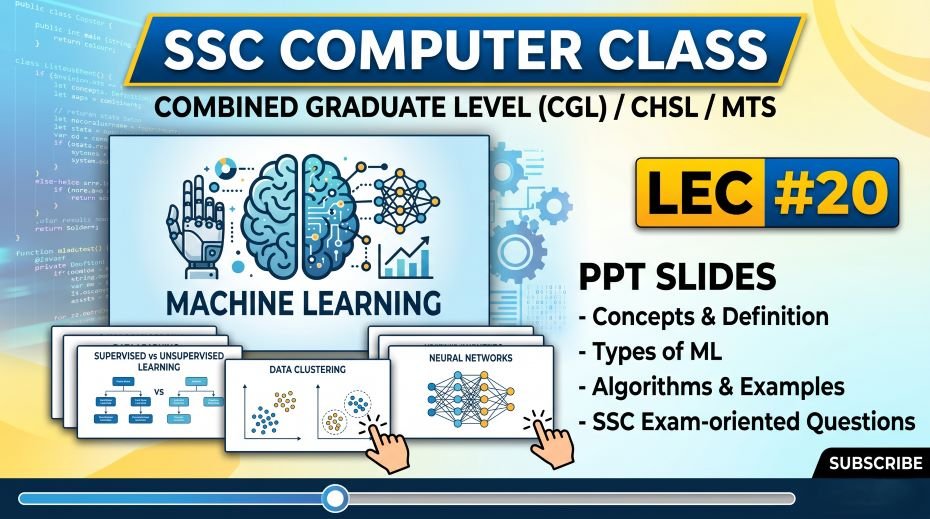
We will share Machine Learning Notes for SSC, SSC Computer Class Machine Learning PPT Slides (LEC #20), Every time Netflix recommends a show you want to watch, every time your email filters spam automatically, every time a bank flags a suspicious transaction without human intervention, Machine Learning is working in the background. It is the technology that transformed computing from following explicit rules to learning from experience, and it has become one of the most important topics in SSC Computer Awareness.
Lecture 20 of the Complete Foundation Batch for All SSC and Other Exams PPT Series covers Machine Learning (यंत्र अधिगम) across 38 comprehensive PPT slides. This module focuses on ML theory, classical algorithms, the complete ML workflow, evaluation metrics, and practical applications.
Detail
Information
Subject
Machine Learning (यंत्र अधिगम / मशीन लर्निंग)
Lecture Number
LEC 20
Total Slides
38 PPT Slides
File Size
8 MB
Series Name
Complete Foundation Batch for All SSC and Other Exams (PPT Series)
Serial Number
#020
Best For
SSC CGL, CHSL, MTS, CPO, JE, Banking, Railways, and all competitive exams
Machine Learning (ML) is a branch of Artificial Intelligence that enables computer systems to automatically learn and improve from experience (data) without being explicitly programmed for each task. The term was coined by Arthur Samuel in 1959 at IBM. He defined it as the field of study that gives computers the ability to learn without being explicitly programmed. In Hindi, it is called Yantra Adhigam (यंत्र अधिगम).
Aspect
Detail
Full Name
Machine Learning
Hindi Name
यंत्र अधिगम (Yantra Adhigam) / मशीन लर्निंग
Term Coined By
Arthur Samuel (American computer scientist at IBM)
Year
1959
Definition
Field giving computers the ability to learn without being explicitly programmed
Formal Definition (Tom Mitchell 1997)
A program learns from experience E for task T if performance on T improves with experience E
Human writes explicit rules; computer follows them
System automatically discovers rules from data
Input-Output
Rules + Data = Output
Data + Output = Learned Model (rules)
Adaptability
Cannot adapt; rules updated manually
Adapts automatically with more data
Best For
Simple, well-defined problems with clear rules
Complex problems; patterns too hard to write manually
Example
Tax calculator (fixed formula)
Spam detection (too many fraud patterns to define)
Scalability
Rules multiply exponentially with complexity
Performance improves naturally with more data
Types of Machine Learning: Complete Classification
1. Supervised Learning
Algorithm is trained on labeled data where each example has a correct answer. It learns to map inputs to correct outputs by minimizing prediction errors.
Feature
Detail
Training Data
Input features + Correct output labels (both required)
Goal
Learn a mapping: Input X to Output Y
Two Sub-Types
Classification (predict category) and Regression (predict number)
Key Challenge
Overfitting: memorizes training data, fails on new data
Algorithms
Linear Regression, Logistic Regression, Decision Tree, Random Forest, SVM, KNN, Naive Bayes, XGBoost
Examples
Email spam detection, house price prediction, cancer diagnosis, image classification
Sub-Type
Task
Output Type
Algorithms
Examples
Classification
Predict which category an input belongs to
Discrete class label (Yes/No, A/B/C)
Logistic Regression, Decision Tree, SVM, KNN, Random Forest, Naive Bayes
An agent learns by interacting with an environment, receiving rewards for correct actions and penalties for wrong ones, gradually learning a policy that maximizes cumulative reward.
RL Component
Definition
Analogy
Agent
The learner and decision-maker; the ML model
Student learning to play chess
Environment
Everything the agent interacts with
The chessboard and opponent
State (S)
Current situation observed from the environment
Current arrangement of pieces on board
Action (A)
Possible decisions the agent can take
Available legal chess moves
Reward (R)
Feedback after each action; positive good, negative bad
Gaining/losing points for each move
Policy
The learned strategy: mapping from states to actions
Chess strategy: if opponent does X, do Y
Goal
Maximize cumulative reward over time
Win the chess game
Feature
Supervised Learning
Unsupervised Learning
Reinforcement Learning
Training Data
Labeled (input + correct output)
Unlabeled (input only)
Interaction with environment
Feedback
Explicit correct answers
No feedback; finds patterns independently
Reward/penalty after each action
Goal
Learn input-to-output mapping
Discover hidden structure
Learn optimal action policy
Main Tasks
Classification, Regression
Clustering, Dimensionality Reduction
Game playing, robot control, optimization
Examples
Spam filter, price predictor
Customer segmentation, anomaly detection
AlphaGo, self-driving car training
Additional ML Types
ML Type
Definition
Key Examples
Semi-Supervised Learning
Small labeled + large unlabeled data combined for training
Speech recognition with few labels; medical imaging with limited expert labels
Self-Supervised Learning
Model creates its own labels from data structure; no human labeling
GPT language models (predict next word); image inpainting tasks
Transfer Learning
Pre-trained model reused as starting point for new related task
ResNet fine-tuned for COVID X-ray detection; BERT fine-tuned for sentiment analysis
Online Learning
Model updates incrementally as new data arrives; no full retraining
Stock trading; fraud detection adapting to new patterns in real time
Federated Learning
Model trained across decentralized devices without sharing raw data; privacy-preserving
Google Gboard keyboard predictions (learns on device without sending text to Google)
Key Machine Learning Algorithms
Classification Algorithms
Algorithm
How It Works
Best For
Interpretable?
Logistic Regression
Uses sigmoid function to estimate probability of class membership
Binary classification; fast baseline model
Yes – highly interpretable
Decision Tree
Creates if-then-else rules by splitting data on best features
Interpretable models; mixed data types
Yes – very interpretable
Random Forest
Ensemble of many decision trees; majority vote wins
Most practical problems; reduces overfitting of single tree
Moderate – less than single tree
SVM (Support Vector Machine)
Finds maximum margin hyperplane; kernel trick for non-linear data
High-dimensional data; text classification
Moderate
K-Nearest Neighbours (KNN)
Classifies by majority class of K nearest neighbours
Simple baseline; small datasets; complex boundaries
Yes – very intuitive
Naive Bayes
Bayes theorem with feature independence assumption; probabilistic
Text classification; spam filtering; fast training
Yes – probabilistic and transparent
XGBoost
Sequential ensemble; each model corrects previous model’s errors
Q1. What is Machine Learning and who coined the term?
Machine Learning is a branch of AI where computer systems learn automatically from data without being explicitly programmed. The term was coined by Arthur Samuel in 1959 at IBM: giving computers the ability to learn without being explicitly programmed. In Hindi it is Yantra Adhigam (यंत्र अधिगम). Tom Mitchell gave a formal definition in 1997: a program learns from experience E for task T if performance on T improves with experience E.
Q2. What are the three types of Machine Learning?
The three main types are: Supervised Learning (trains on labeled data; learns input-to-output mapping; used for classification and regression), Unsupervised Learning (trains on unlabeled data; discovers hidden patterns; used for clustering and dimensionality reduction), and Reinforcement Learning (agent learns through reward and penalty feedback from environment interaction; used in AlphaGo and game-playing AI).
Q3. What is the difference between Classification and Regression?
Both are Supervised Learning tasks. Classification predicts a discrete category or class label such as spam or not spam, disease A or B or C. Regression predicts a continuous numerical value such as house price, temperature, or salary. Classification algorithms include Logistic Regression, Decision Tree, SVM, and KNN. Regression algorithms include Linear Regression, Ridge, and Lasso.
Q4. What is overfitting and how do you prevent it?
Overfitting occurs when a model memorizes training data including its noise and fails to generalize to new unseen data. Signs: very low training error but high test error. Solutions include L1/L2 Regularization, Dropout (for neural networks), K-Fold Cross-Validation, collecting more training data, Feature Selection to remove irrelevant features, and Early Stopping during training.
Q5. What is the difference between Precision and Recall?
Precision = TP/(TP+FP) measures what fraction of positive predictions were actually correct. Use when false positives are costly, like a spam filter where you do not want real emails flagged as spam. Recall = TP/(TP+FN) measures what fraction of actual positives were correctly identified. Use when false negatives are costly, like cancer detection where you cannot afford to miss real cancer cases. F1-Score is the harmonic mean of both.
Q6. What is K-Means Clustering?
K-Means is an unsupervised clustering algorithm that groups similar data points together. Steps: randomly place K centroids, assign each point to the nearest centroid, recalculate centroids as the mean of each cluster, repeat until centroids no longer move. The main limitation is that K must be specified in advance. K-Means works best with spherical-shaped clusters and is sensitive to outliers.
Q7. What is K-Fold Cross-Validation?
K-Fold Cross-Validation is a technique for reliably evaluating ML model performance. Data is split into K equal folds. The model trains K times, each time using a different fold as the test set and the remaining K-1 folds as training. Performance is averaged across all K trials, giving a more reliable estimate than a single train/test split and helping detect overfitting.
Q8. How many slides are in the Machine Learning PPT (LEC 20)?
The Machine Learning Complete Batch PPT (LEC 20) contains 38 slides. It is Serial Number 020 of the Complete Foundation Batch for All SSC and Other Exams PPT Series. The file size is 8 MB and is available for free download at https://slideshareppt.net/.
Conclusion: Machine Learning Powers the Digital World
Machine Learning (LEC 20) is the intellectual core of modern AI. It transformed computing from following explicit rules to learning from experience, and now powers everything from medical diagnosis to fraud detection to personalized recommendations. With 38 slides covering the complete ML curriculum — definition and history, three main learning types with all subtypes, classical algorithms, the full ML workflow, overfitting and regularization, evaluation metrics, cross-validation, feature engineering, and real-world applications — this module gives you complete preparation for every ML question in SSC Computer Awareness.
Key focus areas for exam: Arthur Samuel coined ML in 1959; three types (Supervised with labeled data, Unsupervised with unlabeled data, Reinforcement with reward/penalty); Classification vs Regression; K-Means clustering; Overfitting and L1/L2 regularization; Accuracy/Precision/Recall/F1-Score metrics; Confusion Matrix (FP=Type I Error, FN=Type II Error). Download the free 8 MB PDF from https://slideshareppt.net/ and pair with LEC 17 (AI) and LEC 19 (Deep Learning) for complete AI preparation.