
We will share Logic Gates Notes for SSC – The Building Blocks of Every Digital Device, SSC Computer Batch Logic Gates PPT Slides (LEC #16), From the processor in your smartphone to the traffic signal controller on the road, from an ATM machine to a satellite in space, every digital device operates using the same fundamental building blocks: logic gates. These tiny electronic circuits, capable only of processing 0s and 1s, are the physical hardware that makes Boolean algebra real. They are the bridge between mathematics and machinery.
Lecture 16 of the Complete Foundation Batch for All SSC and Other Exams PPT Series covers Logic Gates (तार्किक द्वार) across 62 comprehensive PPT slides. While LEC 15 (Boolean Algebra) focused on the mathematical theory, LEC 16 goes deeper into the practical hardware aspects of logic gates: their symbols, truth tables, real-world implementations, circuit combinations, timing diagrams, and applications.
Whether you are searching for logic gates notes for SSC, logic gates in Hindi, types of logic gates with truth tables, universal gate NAND and NOR, logic gates applications, two-level logic, multi-input gates, or a free logic gates PDF for competitive exams, this article is your complete reference. Let us get started.
| Detail | Information |
| Subject | Logic Gates (तार्किक द्वार) |
| Lecture Number | LEC 16 |
| Total Slides | 62 PPT Slides |
| File Size | 25 MB |
| Series Name | Complete Foundation Batch for All SSC and Other Exams (PPT Series) |
| Serial Number | #016 |
| Best For | SSC CGL, CHSL, CPO, JE Computer Science, Banking, and all competitive exams |
| Language | English + Hindi (Bilingual) |
| Format | PPT / PDF |
| Website | https://slideshareppt.net |
SSC Computer Batch Logic Gates PPT Slides (LEC #16)
NOTE: IF YOU WANT TO DOWNLOAD COMPLETE SSC SERIES – JUST VISIT THIS REDIRECT PAGE
What Are Logic Gates? Definition and Basic Concept
A logic gate is an electronic circuit that implements a basic Boolean operation. It takes one or more binary inputs (each being either 0 or 1) and produces a single binary output according to a specific logical rule (its Boolean function).
Logic gates are the fundamental hardware building blocks of all digital electronics. They are implemented using transistors, diodes, and resistors on integrated circuit (IC) chips. A modern computer processor contains billions of transistors, which form logic gates, which form functional units like ALUs and memory cells.
In Hindi, logic gates are called Tarkik Dwar (तार्किक द्वार) or Mantikiy Darwaza (मांतिकीय दरवाजा). The term ‘tarkik’ means logical, and ‘dwar’ means gate or door, perfectly describing their function as controlled gates that pass or block logical signals.
| Aspect | Detail |
| Definition | Electronic circuit implementing a Boolean operation on binary inputs to produce one binary output |
| Hindi Name | तार्किक द्वार (Tarkik Dwar) |
| Built Using | Transistors, diodes, resistors on silicon integrated circuit chips |
| Input Signals | Binary: 0 (Low voltage, ~0V) or 1 (High voltage, ~3.3V or 5V) |
| Output Signal | One binary output: 0 or 1, determined by the gate’s Boolean function |
| Represented By | Standardized symbols (IEEE and IEC standards) in circuit diagrams |
| Described By | Truth tables (all input combinations and corresponding outputs) |
| Grouped Into | Basic Gates (AND, OR, NOT), Universal Gates (NAND, NOR), Special Gates (XOR, XNOR) |
| Application | Processors, memory, calculators, communication systems, every digital device |
Classification of Logic Gates
Logic gates are classified into three main categories based on their function and properties. This classification is tested in SSC exams:
| Category | Gates Included | Key Characteristic |
| Basic Gates | AND, OR, NOT | The three fundamental gates from which all other gates are derived; correspond directly to the three basic Boolean operations |
| Universal Gates | NAND, NOR | Any Boolean function can be implemented using ONLY NAND gates or ONLY NOR gates; eliminates need for multiple gate types in chip manufacturing |
| Special / Derived Gates | XOR (Exclusive OR), XNOR (Exclusive NOR) | Cannot be directly derived from a single basic gate; require combinations; detect equality or inequality of inputs |
| Compound Gates | AND-OR, OR-AND, AND-OR-INVERT (AOI) | Combinations of basic gates optimized for specific logic functions; used in complex circuit design |
Basic Gates: AND, OR, and NOT in Complete Depth
AND Gate: Detailed Notes
The AND gate produces output 1 ONLY when ALL its inputs are 1. If any single input is 0, the output is 0 regardless of other inputs.
| Feature | AND Gate Details |
| Boolean Expression | F = A · B (also written as F = AB or F = A AND B) |
| Logic Symbol | D-shaped symbol with flat left side; inputs on left, output on right |
| Circuit Analogy | Two switches connected in SERIES: both must be closed (ON) for current to flow |
| Key Rule | ALL inputs must be 1 for output to be 1 |
| Number of Inputs | 2, 3, or more inputs possible (2-input AND is most common) |
| IC Example | 7408 (Quad 2-input AND gate IC) |
| Special Cases | A · 0 = 0 always; A · 1 = A; A · A = A; A · A’ = 0 |
AND Gate Truth Table (2-Input):
| Input A | Input B | Output F = A · B | Memory Aid |
| 0 | 0 | 0 | Any 0 input = 0 output |
| 0 | 1 | 0 | Any 0 input = 0 output |
| 1 | 0 | 0 | Any 0 input = 0 output |
| 1 | 1 | 1 | ALL 1 inputs = 1 output (ONLY this case) |
AND Gate Truth Table (3-Input): F = A · B · C
| A | B | C | Output F = ABC |
| 0 | 0 | 0 | 0 |
| 0 | 0 | 1 | 0 |
| 0 | 1 | 0 | 0 |
| 0 | 1 | 1 | 0 |
| 1 | 0 | 0 | 0 |
| 1 | 0 | 1 | 0 |
| 1 | 1 | 0 | 0 |
| 1 | 1 | 1 | 1 (ONLY when all three inputs are 1) |
OR Gate: Detailed Notes
The OR gate produces output 1 when AT LEAST ONE input is 1. The output is 0 only when ALL inputs are 0.
| Feature | OR Gate Details |
| Boolean Expression | F = A + B (read as ‘A OR B’) |
| Logic Symbol | Curved shield shape with curved left side; inputs on left, output on right |
| Circuit Analogy | Two switches connected in PARALLEL: either one closed (ON) makes current flow |
| Key Rule | ANY input being 1 makes output 1 |
| Number of Inputs | 2, 3, or more inputs possible |
| IC Example | 7432 (Quad 2-input OR gate IC) |
| Special Cases | A + 0 = A; A + 1 = 1 always; A + A = A; A + A’ = 1 |
OR Gate Truth Table (2-Input):
| Input A | Input B | Output F = A + B | Memory Aid |
| 0 | 0 | 0 | ALL 0 inputs = 0 output (ONLY this case) |
| 0 | 1 | 1 | Any 1 input = 1 output |
| 1 | 0 | 1 | Any 1 input = 1 output |
| 1 | 1 | 1 | Any 1 input = 1 output |
NOT Gate (Inverter): Detailed Notes
The NOT gate has exactly ONE input and ONE output. It inverts the input: 0 becomes 1 and 1 becomes 0. It is the simplest gate.
| Feature | NOT Gate Details |
| Boolean Expression | F = A’ (read as ‘A complement’, ‘NOT A’, or ‘A bar’) |
| Logic Symbol | Triangle pointing right with a small circle (bubble) at the output |
| The Bubble | The small circle on the output represents inversion; it appears on NAND and NOR symbols too |
| Key Rule | Always inverts: 0 becomes 1, 1 becomes 0 |
| Number of Inputs | Always exactly ONE input |
| IC Example | 7404 (Hex Inverter – 6 NOT gates in one IC) |
| Special Cases | (A’)’ = A (double inversion returns original) |
NOT Gate Truth Table (1-Input):
| Input A | Output F = A’ |
| 0 | 1 (0 inverted = 1) |
| 1 | 0 (1 inverted = 0) |
Universal Gates: NAND and NOR in Complete Depth
NAND and NOR are the two most important gates from a manufacturing and design perspective. They are called Universal Gates because every other Boolean function can be built using only NAND gates or only NOR gates.
NAND Gate: Detailed Notes
NAND = NOT AND. The NAND gate is simply an AND gate followed by a NOT gate. Its output is the complement of what an AND gate would give.
| Feature | NAND Gate Details |
| Boolean Expression | F = (A · B)’ = (AB)’ (read as ‘A NAND B’ or ‘NOT A AND B’) |
| Logic Symbol | AND gate symbol with a small inversion bubble at the output |
| Key Rule | Output is 0 ONLY when ALL inputs are 1; otherwise output is 1 |
| Universal Gate | YES – any logic function can be built using only NAND gates |
| Why Universal? | NOT can be made from NAND; OR can be made from NANDs; AND can be made from NANDs |
| IC Example | 7400 (Quad 2-input NAND gate – one of the most widely used ICs ever made) |
| Equivalence | (AB)’ = A’ + B’ by De Morgan’s First Theorem |
NAND Gate Truth Table (2-Input):
| A | B | A·B (AND) | Output F = (A·B)’ | Memory Aid |
| 0 | 0 | 0 | 1 | 0,0 → AND gives 0 → NOT gives 1 |
| 0 | 1 | 0 | 1 | 0,1 → AND gives 0 → NOT gives 1 |
| 1 | 0 | 0 | 1 | 1,0 → AND gives 0 → NOT gives 1 |
| 1 | 1 | 1 | 0 | 1,1 → AND gives 1 → NOT gives 0 (ONLY case output is 0) |
NAND Gate Truth Table (3-Input): F = (A·B·C)’
| A | B | C | A·B·C | Output F = (ABC)’ |
| 0 | 0 | 0 | 0 | 1 |
| 0 | 0 | 1 | 0 | 1 |
| 0 | 1 | 0 | 0 | 1 |
| 0 | 1 | 1 | 0 | 1 |
| 1 | 0 | 0 | 0 | 1 |
| 1 | 0 | 1 | 0 | 1 |
| 1 | 1 | 0 | 0 | 1 |
| 1 | 1 | 1 | 1 | 0 (only when ALL inputs are 1) |
NOR Gate: Detailed Notes
NOR = NOT OR. The NOR gate is an OR gate followed by a NOT gate. Its output is the complement of what an OR gate would give.
| Feature | NOR Gate Details |
| Boolean Expression | F = (A + B)’ (read as ‘A NOR B’ or ‘NOT A OR B’) |
| Logic Symbol | OR gate symbol with a small inversion bubble at the output |
| Key Rule | Output is 1 ONLY when ALL inputs are 0; otherwise output is 0 |
| Universal Gate | YES – any logic function can be built using only NOR gates |
| Why Universal? | NOT can be made from NOR; AND can be made from NORs; OR can be made from NORs |
| IC Example | 7402 (Quad 2-input NOR gate IC) |
| Equivalence | (A+B)’ = A’ · B’ by De Morgan’s Second Theorem |
NOR Gate Truth Table (2-Input):
| A | B | A+B (OR) | Output F = (A+B)’ | Memory Aid |
| 0 | 0 | 0 | 1 | 0,0 → OR gives 0 → NOT gives 1 (ONLY case output is 1) |
| 0 | 1 | 1 | 0 | 0,1 → OR gives 1 → NOT gives 0 |
| 1 | 0 | 1 | 0 | 1,0 → OR gives 1 → NOT gives 0 |
| 1 | 1 | 1 | 0 | 1,1 → OR gives 1 → NOT gives 0 |
NAND vs NOR: Key Comparison
| Feature | NAND Gate | NOR Gate |
| Full Form | NOT AND | NOT OR |
| Boolean Expression | F = (AB)’ | F = (A+B)’ |
| Output is 0 when… | ALL inputs are 1 | ANY input is 1 |
| Output is 1 when… | ANY input is 0 | ALL inputs are 0 |
| De Morgan Equivalent | A’ + B’ | A’ · B’ |
| Universal Gate | Yes | Yes |
| IC Number (2-input) | 7400 | 7402 |
| Implemented Using | AND + NOT gate | OR + NOT gate |
| Circuit Preference | Preferred in CMOS logic design | Used in specific applications |
Special Gates: XOR and XNOR in Complete Depth
XOR Gate (Exclusive OR): Detailed Notes
The XOR (Exclusive OR) gate produces output 1 when its inputs are DIFFERENT (one is 0 and one is 1). It produces 0 when inputs are SAME (both 0 or both 1).
| Feature | XOR Gate Details |
| Boolean Expression | F = A XOR B = A circle-plus B = A’B + AB’ |
| Logic Symbol | OR gate shape with an additional curved line on the input side |
| Key Rule | Output 1 when inputs are DIFFERENT; 0 when SAME |
| Alternative Name | Exclusive OR, Half Adder Sum gate |
| IC Example | 7486 (Quad 2-input XOR gate IC) |
| Special Properties | A XOR 0 = A; A XOR 1 = A’ (complement); A XOR A = 0; A XOR A’ = 1 |
| Application | Binary adder (Sum output), parity checker, comparator, encryption/decryption |
XOR Gate Truth Table (2-Input):
| A | B | Output F = A XOR B | Inputs Same/Different? | Memory Aid |
| 0 | 0 | 0 | SAME (both 0) | Same inputs → 0 |
| 0 | 1 | 1 | DIFFERENT | Different inputs → 1 |
| 1 | 0 | 1 | DIFFERENT | Different inputs → 1 |
| 1 | 1 | 0 | SAME (both 1) | Same inputs → 0 |
XNOR Gate (Exclusive NOR): Detailed Notes
The XNOR gate is the complement of XOR. It produces output 1 when inputs are SAME and 0 when inputs are DIFFERENT. It is used as an equality detector.
| Feature | XNOR Gate Details |
| Boolean Expression | F = A XNOR B = (A XOR B)’ = A’B’ + AB |
| Logic Symbol | XOR gate symbol with a small inversion bubble at the output |
| Key Rule | Output 1 when inputs are SAME; 0 when DIFFERENT |
| Alternative Name | Exclusive NOR, Equality Detector |
| IC Example | 74266 (Quad 2-input XNOR gate IC) |
| Special Properties | A XNOR 0 = A’; A XNOR 1 = A; A XNOR A = 1; A XNOR A’ = 0 |
| Application | Equality checking, error detection, digital comparators |
XNOR Gate Truth Table (2-Input):
| A | B | Output F = A XNOR B | Inputs Same/Different? | Memory Aid |
| 0 | 0 | 1 | SAME (both 0) | Same inputs → 1 |
| 0 | 1 | 0 | DIFFERENT | Different inputs → 0 |
| 1 | 0 | 0 | DIFFERENT | Different inputs → 0 |
| 1 | 1 | 1 | SAME (both 1) | Same inputs → 1 |
XOR vs XNOR: Head-to-Head Comparison
| Feature | XOR Gate | XNOR Gate |
| Full Name | Exclusive OR | Exclusive NOR |
| Symbol | Circle-plus (plus inside circle) | Circle-plus with output bubble |
| Boolean Expression | A’B + AB’ | A’B’ + AB = (A XOR B)’ |
| Output 1 when | Inputs are DIFFERENT | Inputs are SAME |
| Output 0 when | Inputs are SAME | Inputs are DIFFERENT |
| Called | Inequality Detector | Equality Detector |
| A XOR A | Always 0 | A XNOR A = Always 1 |
| A XOR A’ | Always 1 | A XNOR A’ = Always 0 |
| Primary Application | Binary adder Sum, parity generation | Comparator, error detection, encryption |
Universal Gate Properties: Building Any Gate from NAND or NOR
The Universal Gate property is one of the most important and most tested concepts in Logic Gates. Here is a complete, detailed breakdown of how to implement every basic gate using only NAND gates or only NOR gates:
Implementing All Basic Gates Using ONLY NAND Gates
| Gate to Implement | NAND Implementation | Circuit Description | Boolean Proof |
| NOT Gate | NAND(A, A) = 1 NAND gate | Connect both inputs of NAND to the same input A | (A·A)’ = A’ (since A·A=A) |
| AND Gate | NAND followed by NOT | 2 NAND gates: first NAND(A,B), then NAND result with itself | [(AB)’]’ = AB |
| OR Gate | 3 NAND gates | NOT A using NAND, NOT B using NAND, then NAND(A’,B’) | (A’·B’)’ = A+B (De Morgan’s) |
| NOR Gate | 4 NAND gates | Build OR from 3 NANDs, then add NOT using 1 NAND | NOT(A+B) = (A+B)’ |
| XNOR Gate | 5 NAND gates | Complex combination; requires 5 NAND gates | Implements A’B’+AB |
| XOR Gate | 4 NAND gates | More efficient XOR using 4 NANDs than XNOR | Implements A’B+AB’ |
Implementing All Basic Gates Using ONLY NOR Gates
| Gate to Implement | NOR Implementation | Circuit Description | Boolean Proof |
| NOT Gate | NOR(A, A) = 1 NOR gate | Connect both inputs of NOR to the same input A | (A+A)’ = A’ |
| OR Gate | NOR followed by NOT | 2 NOR gates: first NOR(A,B), then NOR result with itself | [(A+B)’]’ = A+B |
| AND Gate | 3 NOR gates | NOT A using NOR, NOT B using NOR, then NOR(A’,B’) | (A’+B’)’ = A·B (De Morgan’s) |
| NAND Gate | 4 NOR gates | Build AND from 3 NORs, then add NOT using 1 NOR | NOT(A·B) = (A·B)’ |
| XOR Gate | 5 NOR gates | Complex combination of NOR gates | Implements A’B+AB’ |
| XNOR Gate | 4 NOR gates | Combination of NOR gates | Implements A’B’+AB |
Logic Gate ICs: Integrated Circuits Reference
Logic gates are manufactured as Integrated Circuits (ICs). Knowing the IC numbers for standard logic gates is useful for SSC JE and practical digital electronics knowledge:
| IC Number | Gate Type | Number of Gates | Inputs Per Gate | Series |
| 7400 | NAND (2-input) | 4 gates (Quad) | 2 | TTL 74xx Series |
| 7402 | NOR (2-input) | 4 gates (Quad) | 2 | TTL 74xx Series |
| 7404 | NOT (Inverter) | 6 gates (Hex) | 1 | TTL 74xx Series |
| 7408 | AND (2-input) | 4 gates (Quad) | 2 | TTL 74xx Series |
| 7410 | NAND (3-input) | 3 gates (Triple) | 3 | TTL 74xx Series |
| 7411 | AND (3-input) | 3 gates (Triple) | 3 | TTL 74xx Series |
| 7420 | NAND (4-input) | 2 gates (Dual) | 4 | TTL 74xx Series |
| 7421 | AND (4-input) | 2 gates (Dual) | 4 | TTL 74xx Series |
| 7427 | NOR (3-input) | 3 gates (Triple) | 3 | TTL 74xx Series |
| 7430 | NAND (8-input) | 1 gate | 8 | TTL 74xx Series |
| 7432 | OR (2-input) | 4 gates (Quad) | 2 | TTL 74xx Series |
| 7486 | XOR (2-input) | 4 gates (Quad) | 2 | TTL 74xx Series |
| 74266 | XNOR (2-input) | 4 gates (Quad) | 2 | TTL 74xx Series |
Logic Gate Families: TTL and CMOS Technologies
Logic gates are manufactured using different semiconductor technologies called logic families. Each family has different electrical characteristics. SSC JE and advanced papers sometimes ask about logic families:
| Feature | TTL (Transistor-Transistor Logic) | CMOS (Complementary Metal-Oxide Semiconductor) |
| Full Form | Transistor-Transistor Logic | Complementary Metal-Oxide Semiconductor |
| Supply Voltage | 5V (VCC) | 3.3V, 5V (VDD) – wide range |
| Power Consumption | High (draws current even when idle) | Very Low (draws power only when switching) |
| Speed | Fast | Moderate to Fast |
| Noise Immunity | Moderate | High |
| Fan-Out | 10 (can drive 10 other TTL inputs) | 50+ (can drive many CMOS inputs) |
| Logic 0 Level | 0 to 0.8V | 0 to 1/3 VDD |
| Logic 1 Level | 2.0 to 5V | 2/3 VDD to VDD |
| IC Series | 74xx, 74LSxx, 74Sxx | 4000 series, 74HCxx, 74HCTxx |
| Most Common Use | Older digital systems; legacy equipment | Modern digital systems; processors; mobile devices |
| NAND Gate Example | 7400 (NAND TTL) | 4011 (NAND CMOS) |
Multi-Input Logic Gates: Extending Beyond 2 Inputs
Real digital circuits often need gates with more than 2 inputs. Understanding how multi-input gates work is important for SSC JE:
| Gate | 3-Input Truth Table Summary | Output Rule | Boolean Expression |
| 3-Input AND | Output is 1 ONLY when A=1, B=1, and C=1 (1 out of 8 rows) | ALL three inputs must be 1 | F = A·B·C |
| 3-Input OR | Output is 0 ONLY when A=0, B=0, and C=0 (1 out of 8 rows) | ANY one input being 1 gives output 1 | F = A+B+C |
| 3-Input NAND | Output is 0 ONLY when A=1, B=1, and C=1 (1 out of 8 rows) | Complement of 3-input AND | F = (A·B·C)’ |
| 3-Input NOR | Output is 1 ONLY when A=0, B=0, and C=0 (1 out of 8 rows) | Complement of 3-input OR | F = (A+B+C)’ |
| 3-Input XOR | Output is 1 when ODD number of inputs are 1 (1 or 3 inputs = 1) | Odd parity detector | F = A XOR B XOR C |
Key Insight for Multi-Input XOR: A 3-input XOR outputs 1 when an ODD number of inputs are 1. This makes it useful for parity generation and error detection in digital communications.
Logic Gate Applications: Where Each Gate Is Used
Understanding the real-world applications of each logic gate demonstrates depth of knowledge for SSC JE and advanced exams:
| Logic Gate | Primary Applications | Why This Gate Is Best Suited |
| AND Gate | Security systems (both conditions must be met), alarm circuits requiring multiple triggers, digital multiplication | All conditions must be true simultaneously; multiplication in binary |
| OR Gate | Emergency systems (any one trigger activates alarm), OR conditions in database queries, digital addition concept | At least one condition being true is enough |
| NOT Gate (Inverter) | Signal inversion, clock signal generation, building more complex gates | Simple complement operation; essential in all complex circuits |
| NAND Gate | Computer processor logic design, SRAM cell design, standard cell-based chip design | Universal gate; minimizes chip area; most commonly manufactured gate |
| NOR Gate | NOR-based latches and flip-flops, PLDs (Programmable Logic Devices), static RAM cells | Universal gate; efficient for certain circuit topologies |
| XOR Gate | Binary half adder (sum output), parity generator and checker, comparators, CRC error detection, encryption | Detects when two bits differ; essential for arithmetic circuits |
| XNOR Gate | Digital comparators (equality test), error detection systems, XNOR-based neural networks | Detects when two bits are equal; used for equivalence checking |
Timing Diagrams: Understanding Gate Behavior Over Time
A timing diagram shows how logic gate outputs change over time in response to changing inputs. Understanding timing diagrams is important for SSC JE and practical digital electronics:
- The horizontal axis represents time; the vertical axis represents logic levels (0 or 1)
- High (1) is shown as a horizontal line at the top; Low (0) as a horizontal line at the bottom
- Transitions between 0 and 1 are shown as vertical lines (idealized as instantaneous)
- AND gate timing: output goes HIGH only when ALL inputs are simultaneously HIGH
- OR gate timing: output goes HIGH whenever ANY input goes HIGH
- NOT gate timing: output is always the mirror image (complement) of the input
- NAND gate timing: output is HIGH except when ALL inputs are simultaneously HIGH
- NOR gate timing: output is HIGH only when ALL inputs are simultaneously LOW
- XOR gate timing: output pulses HIGH whenever exactly ONE input changes state relative to the other
- Propagation Delay: the tiny time delay between input change and output change in real gates
Logic Gate Combinations: Building Complex Functions
Real digital circuits combine multiple gates to implement complex Boolean functions. Here are important combination circuits built from basic gates:
AND-OR Circuit (Sum of Products Realization)
An AND-OR circuit implements a Sum of Products (SOP) Boolean expression directly: multiple AND gates whose outputs feed into a single OR gate.
| Circuit | Structure | Example | Application |
| AND-OR | Multiple AND gates → one OR gate | F = AB + CD + EF | Direct SOP implementation; most common 2-level circuit |
| OR-AND | Multiple OR gates → one AND gate | F = (A+B)(C+D)(E+F) | Direct POS implementation |
| AND-OR-INVERT (AOI) | AND-OR with NOT at output | F = (AB + CD)’ | Very efficient in CMOS technology; faster and smaller than AND-OR + separate NOT |
| OR-AND-INVERT (OAI) | OR-AND with NOT at output | F = ((A+B)(C+D))’ | Efficient POS complement implementation |
| NAND-NAND | Two levels of NAND gates | Equivalent to AND-OR | Most common 2-level NAND-only circuit; same as SOP |
| NOR-NOR | Two levels of NOR gates | Equivalent to OR-AND | Most common 2-level NOR-only circuit; same as POS |
Key Gate Combinations and Their Equivalents
| Combination | Result | Boolean Proof |
| NOT after AND = NAND | A NAND B | (AB)’ = NAND(A,B) |
| NOT after OR = NOR | A NOR B | (A+B)’ = NOR(A,B) |
| NOT before both inputs of NAND = OR | A OR B | NAND(A’,B’) = (A’B’)’ = A+B (De Morgan’s) |
| NOT before both inputs of NOR = AND | A AND B | NOR(A’,B’) = (A’+B’)’ = A·B (De Morgan’s) |
| NAND-NAND (2 level) = AND-OR | SOP equivalent | NAND(NAND(A,B), NAND(C,D)) = AB+CD |
| NOR-NOR (2 level) = OR-AND | POS equivalent | NOR(NOR(A,B), NOR(C,D)) = (A+B)(C+D) |
Positive Logic vs Negative Logic
Logic gates can use two different conventions for assigning voltage levels to logic values. This is tested in SSC JE:
| Feature | Positive Logic | Negative Logic |
| Definition | Higher voltage level = Logic 1 (True); Lower voltage level = Logic 0 (False) | Higher voltage level = Logic 0 (False); Lower voltage level = Logic 1 (True) |
| Standard | Most widely used convention; assumed unless stated otherwise | Used in specific applications; less common |
| AND Gate in Positive Logic | Functions as AND | Functions as OR in negative logic |
| OR Gate in Positive Logic | Functions as OR | Functions as AND in negative logic |
| NAND in Positive Logic | Functions as NAND | Functions as NOR in negative logic |
| Equivalence | AND(positive) = OR(negative); NAND(positive) = NOR(negative) | The duality of positive and negative logic |
| Practical Impact | Standard TTL and CMOS logic uses positive logic | Some older communication systems used negative logic |
Wired Logic: AND and OR from Direct Wire Connections
In some technologies, logic operations can be performed simply by connecting outputs together with a wire, without an explicit gate. This is called Wired Logic or Implicit Logic:
| Type | Technology | How It Works | Equivalent Gate |
| Wired-AND | Open-Collector TTL | Multiple open-collector outputs tied to a common pull-up resistor; output is LOW if any output pulls low | Implements AND: all must be HIGH for output to be HIGH |
| Wired-OR | Tri-State logic, ECL | Multiple outputs connected; output is HIGH if any output drives HIGH | Implements OR: any HIGH output makes output HIGH |
| Wired-AND in CMOS | Not applicable (avoid) | CMOS outputs should not be directly wired; use proper gates | Bus connections use tri-state buffers instead |
Complete Logic Gate Summary: Master Reference Table
| Gate | Symbol Mark | Boolean Expr | Key Rule | Output when all 0 | Output when all 1 | Universal? | IC No. |
| AND | Flat-left D | F=AB | ALL must be 1 | 0 | 1 | No | 7408 |
| OR | Curved both | F=A+B | ANY one = 1 | 0 | 1 | No | 7432 |
| NOT | Triangle+bubble | F=A’ | Invert input | 1 | 0 | No | 7404 |
| NAND | AND+bubble | F=(AB)’ | ANY 0 gives 1 | 1 | 0 | YES | 7400 |
| NOR | OR+bubble | F=(A+B)’ | ALL must be 0 | 1 | 0 | YES | 7402 |
| XOR | Curved+extra | F=A’B+AB’ | DIFFERENT = 1 | 0 | 0 | No | 7486 |
| XNOR | XOR+bubble | F=A’B’+AB | SAME = 1 | 1 | 1 | No | 74266 |
Exam Frequency: Logic Gate Topics and Priority for SSC
| Topic | Exam Frequency | Difficulty | Priority |
| AND, OR, NOT truth tables (2-input) | Very High | Easy | Must Study First |
| NAND truth table (output 0 only when all inputs 1) | Very High | Easy | Must Study First |
| NOR truth table (output 1 only when all inputs 0) | Very High | Easy | Must Study First |
| NAND and NOR are Universal Gates | Very High | Easy | Must Study First |
| XOR: output 1 when inputs DIFFERENT | Very High | Easy | Must Study First |
| XNOR: output 1 when inputs SAME | Very High | Easy | Must Study First |
| Gate IC numbers (7400=NAND, 7402=NOR, 7404=NOT, 7408=AND, 7432=OR) | High | Medium | Important |
| Implementing NOT using NAND (or NOR) gates | High | Medium | Important |
| Implementing AND using NAND gates | High | Medium | Important |
| Implementing OR using NAND gates | High | Medium | Important |
| De Morgan’s: (AB)’ = A’+B’; (A+B)’ = A’B’ | Very High | Medium | Must Study First |
| 3-input AND/OR/NAND/NOR output rules | High | Easy-Medium | Important |
| XOR special properties (A XOR A=0; A XOR 1=A’) | Medium-High | Medium | Important |
| Timing diagrams for basic gates | Medium | Medium | Good to Know (JE level) |
| Logic families: TTL vs CMOS | Medium | Medium-Hard | Good to Know (JE level) |
| NAND-NAND = AND-OR (SOP) | Medium | Hard | SSC JE level |
| Positive vs Negative Logic | Low-Medium | Hard | Advanced only |
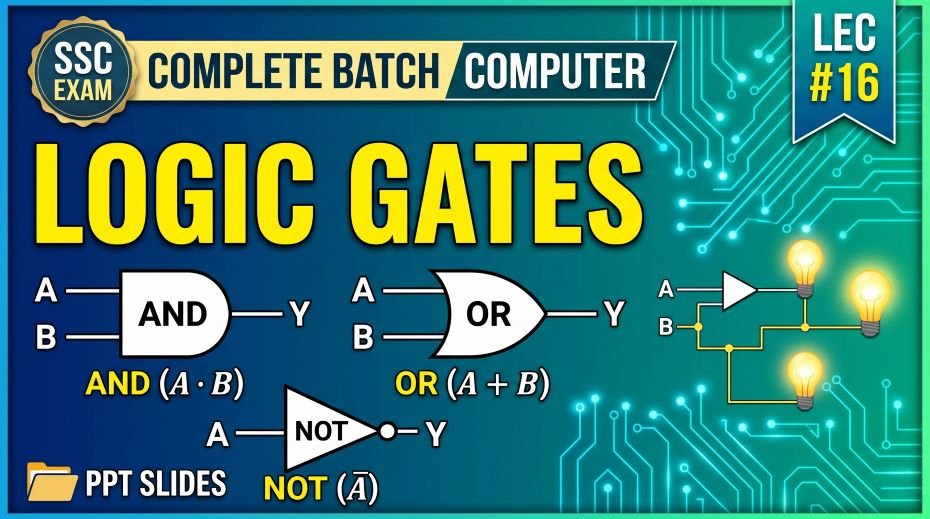
Quick Revision: Top 35 Logic Gate Facts for SSC Exams
- Logic gates are electronic circuits that perform Boolean operations on binary inputs
- In Hindi, logic gates are called Tarkik Dwar (तार्किक द्वार)
- There are 7 standard logic gates: AND, OR, NOT, NAND, NOR, XOR, XNOR
- AND gate output is 1 ONLY when ALL inputs are 1
- OR gate output is 1 when ANY input is 1
- NOT gate (Inverter) produces the opposite of its input (1 input, 1 output)
- NAND gate output is 0 ONLY when ALL inputs are 1 (opposite of AND)
- NOR gate output is 1 ONLY when ALL inputs are 0 (opposite of OR)
- XOR gate output is 1 when inputs are DIFFERENT
- XNOR gate output is 1 when inputs are SAME (opposite of XOR)
- NAND and NOR are called Universal Gates
- Universal Gate means any Boolean function can be built using ONLY that gate type
- NOT gate can be made from NAND: NAND(A,A) = A’
- NOT gate can be made from NOR: NOR(A,A) = A’
- OR gate from NAND: NAND(A’,B’) = A+B (De Morgan’s)
- AND gate from NOR: NOR(A’,B’) = A·B (De Morgan’s)
- 7400 IC = Quad 2-input NAND gates (most widely used TTL IC)
- 7402 IC = Quad 2-input NOR gates
- 7404 IC = Hex Inverter (6 NOT gates)
- 7408 IC = Quad 2-input AND gates
- 7432 IC = Quad 2-input OR gates
- 7486 IC = Quad 2-input XOR gates
- TTL logic family uses 5V supply; standard IC series is 74xx
- CMOS logic family has very low power consumption; standard series is 4000 and 74HCxx
- A 3-input AND gate output is 1 only when A=B=C=1 (only 1 row out of 8 is HIGH)
- A 3-input OR gate output is 0 only when A=B=C=0 (only 1 row out of 8 is LOW)
- 3-input XOR output is 1 when an ODD number of inputs are 1
- XOR is used in binary adder Sum output; XNOR is used in equality comparators
- A XOR 0 = A (no change); A XOR 1 = A’ (complement)
- A XOR A = 0 (always); A XOR A’ = 1 (always)
- NAND-NAND two-level circuit is equivalent to AND-OR (SOP implementation)
- NOR-NOR two-level circuit is equivalent to OR-AND (POS implementation)
- The small circle (bubble) on a gate symbol represents inversion
- Logic 1 = HIGH voltage (approx 2V to 5V in TTL); Logic 0 = LOW voltage (0 to 0.8V in TTL)
- Propagation delay is the time taken for output to respond to an input change in a real gate
Practice Problems: Logic Gate Output Determination
Practice determining the output of logic gate circuits. Cover the answer column and work each one out:
| Circuit / Expression | Given Inputs | Output | Working |
| F = A · B (AND) | A=1, B=0 | 0 | 1 AND 0 = 0 |
| F = A + B (OR) | A=0, B=0 | 0 | 0 OR 0 = 0 |
| F = A’ (NOT) | A=1 | 0 | NOT 1 = 0 |
| F = (AB)’ (NAND) | A=1, B=1 | 0 | (1·1)’ = 1′ = 0 |
| F = (AB)’ (NAND) | A=1, B=0 | 1 | (1·0)’ = 0′ = 1 |
| F = (A+B)’ (NOR) | A=0, B=0 | 1 | (0+0)’ = 0′ = 1 |
| F = (A+B)’ (NOR) | A=0, B=1 | 0 | (0+1)’ = 1′ = 0 |
| F = A XOR B | A=1, B=1 | 0 | Same inputs: 0 |
| F = A XOR B | A=1, B=0 | 1 | Different inputs: 1 |
| F = A XNOR B | A=0, B=0 | 1 | Same inputs: 1 |
| F = ABC (AND) | A=1, B=1, C=0 | 0 | Any 0 input: 0 |
| F = A+B+C (OR) | A=0, B=0, C=1 | 1 | Any 1 input: 1 |
| F = (ABC)’ (NAND) | A=1, B=1, C=1 | 0 | All 1s → AND=1 → NOT=0 |
| F = (A+B+C)’ (NOR) | A=0, B=0, C=0 | 1 | All 0s → OR=0 → NOT=1 |
| F = AB + CD | A=1,B=1,C=0,D=1 | 1 | AB=1, CD=0; 1+0=1 |
| F = (A+B)(C+D) | A=0,B=0,C=1,D=1 | 0 | (A+B)=0, (C+D)=1; 0·1=0 |
| F = A’B + AB’ | A=0, B=1 | 1 | A’B: 1·1=1; AB’: 0·0=0; 1+0=1 (XOR) |
| F = A’B’ + AB | A=1, B=1 | 1 | A’B’: 0·0=0; AB: 1·1=1; 0+1=1 (XNOR) |
| NAND(A,A) | A=0 | 1 | (0·0)’=0’=1 → NOT gate |
| NAND(A’,B’) where A=1,B=1 | A’=0, B’=0 | 1 | (0·0)’=0’=1 = A+B = 1+1 = 1 |
Study Plan: 4 Days to Master Logic Gates for SSC
Day 1: Basic Gates – AND, OR, NOT
- Study AND gate: Boolean expression, circuit analogy (series switches), key rule (ALL must be 1), 2-input and 3-input truth tables
- Study OR gate: Boolean expression, circuit analogy (parallel switches), key rule (ANY 1 gives output 1), truth tables
- Study NOT gate: expression, key rule (invert), why only 1 input and 1 output
- Draw all three truth tables from memory without looking at notes
Day 2: Universal Gates – NAND and NOR
- Study NAND gate completely: expression, truth table, IC number (7400), De Morgan equivalent
- Study NOR gate completely: expression, truth table, IC number (7402), De Morgan equivalent
- Master the NAND vs NOR comparison table
- Practice implementing NOT, AND, OR using only NAND gates and only NOR gates
Day 3: Special Gates – XOR and XNOR, Plus Gate ICs
- Study XOR gate: expression (A’B+AB’), truth table, special properties (A XOR A=0), applications (adder)
- Study XNOR gate: expression (A’B’+AB), truth table, equality detector property
- Memorize IC numbers: 7400 (NAND), 7402 (NOR), 7404 (NOT), 7408 (AND), 7432 (OR), 7486 (XOR)
- Study TTL vs CMOS differences
Day 4: Applications, Combinations, and Practice
- Study gate applications: where each gate is used in real systems
- Study AND-OR, NAND-NAND circuit equivalences
- Solve all 20 practice problems in this article independently
- Solve 30 to 40 logic gate questions from SSC previous year papers
READ ALSO: SSC Computer Boolean Algebra PPT Slides (LEC #15)
(FAQs)
Q1. What are logic gates and how many types are there?
Logic gates are electronic circuits that perform Boolean operations on binary inputs (0 or 1) and produce a single binary output. There are 7 standard types: AND, OR, NOT, NAND, NOR, XOR, and XNOR. These are classified into Basic Gates (AND, OR, NOT), Universal Gates (NAND, NOR), and Special Gates (XOR, XNOR).
Q2. Why are NAND and NOR called Universal Gates?
NAND and NOR are called Universal Gates because any Boolean logic function can be implemented using only NAND gates, or alternatively using only NOR gates. This means you can build NOT, AND, OR, XOR, XNOR, and any other function from a single gate type. The proof is that NOT can be made from NAND(A,A), AND from two NANDs, OR from three NANDs, and so on for all other gates.
Q3. What is the difference between XOR and XNOR gates?
XOR (Exclusive OR) gives output 1 when the two inputs are DIFFERENT and 0 when they are SAME. XNOR (Exclusive NOR) is the exact opposite: output 1 when inputs are SAME and 0 when DIFFERENT. XOR is the inequality detector used in binary adders and parity circuits. XNOR is the equality detector used in comparators and error-checking circuits.
Q4. What is the IC number for NAND gate?
The most common 2-input NAND gate IC is the 7400 (Quad 2-input NAND), which contains 4 independent 2-input NAND gates in a single IC package. It is the most widely manufactured logic IC in history. Other NAND ICs include 7410 (Triple 3-input NAND), 7420 (Dual 4-input NAND), and 7430 (Single 8-input NAND).
Q5. What is the key difference between TTL and CMOS logic families?
TTL (Transistor-Transistor Logic) uses bipolar transistors, operates at 5V, and has relatively high power consumption even when idle. CMOS (Complementary Metal-Oxide Semiconductor) uses field-effect transistors (MOSFETs), can operate from 3.3V to 15V, and consumes very little power (only when switching). Modern digital devices use CMOS because of its low power consumption, which extends battery life and reduces heat generation.
Q6. How can you implement a NOT gate using only NAND gates?
Connect both inputs of a 2-input NAND gate to the same signal A. The output is NAND(A,A) = (A·A)’ = A’ (since A·A = A by the Idempotent law). This creates a NOT gate (inverter) using a single NAND gate. Similarly, NOR(A,A) = (A+A)’ = A’ creates a NOT gate from a single NOR gate.
Q7. How many slides are in the Logic Gates PPT (LEC 16)?
The Logic Gates Complete Batch PPT (LEC 16) contains 62 slides. It is Serial Number 016 of the Complete Foundation Batch for All SSC and Other Exams PPT Series. The file size is 25 MB and is available for free download at https://slideshareppt.net.
Q8. What is the output of a 3-input NAND gate when all inputs are 1?
When all inputs of a 3-input NAND gate are 1, the output is 0. This is the only input combination that gives output 0 for a NAND gate. For all other input combinations (where at least one input is 0), the 3-input NAND gate output is 1. Remember the rule: NAND output is 0 ONLY when ALL inputs are 1; all other cases give output 1.
Conclusion: Logic Gates Are the Atoms of the Digital Universe
Logic gates (LEC 16) complete the digital electronics trilogy of the Complete Foundation Batch PPT Series, alongside Data Representation (LEC 12) and Boolean Algebra (LEC 15). These three lectures together provide a complete understanding of how computers represent information in binary, how Boolean mathematics governs the processing of that information, and how logic gates are the physical electronic hardware that makes it all real.
The 62-slide LEC 16 module covers every dimension of logic gates: definitions and classification, all 7 gate types with complete truth tables and detailed properties, Universal Gate implementations (building any gate from NAND or from NOR), gate IC numbers, TTL vs CMOS logic families, multi-input gates, timing diagrams, gate combination circuits (AND-OR, NAND-NAND equivalences), positive vs negative logic, and practical applications of each gate type.
For SSC exam success, your absolute priorities are: know all 7 truth tables from memory, know that NAND and NOR are Universal Gates, know that NAND(A,A) = A’ (NOT from NAND), know the XOR vs XNOR difference (different=1 vs same=1), know the IC numbers (7400=NAND, 7402=NOR, 7404=NOT, 7408=AND, 7432=OR), and know De Morgan’s theorems. These areas cover the vast majority of logic gate questions in any SSC exam.
Download the free 25 MB PDF from https://slideshareppt.net, follow the 4-day study plan, work through all 20 practice problems, and complete this chapter knowing that logic gates will always be a source of guaranteed marks in your SSC Computer Awareness sections.