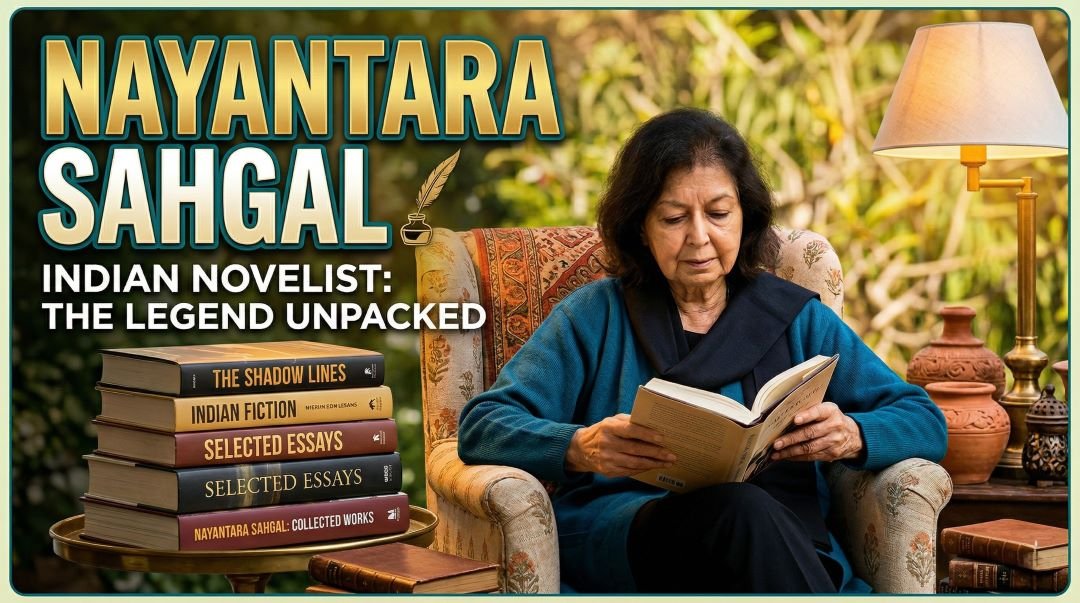
In this article we will discuss everything about Nayantara Sahgal – Nayantara Sahgal Biography PDF and PPT Slides Download, Books, Famous Works, Awards and Complete Legacy – her biography in English, biography in Hindi and Bengali context, all novels and books in chronological order, famous works including Rich Like Us, Plans for Departure, Mistaken Identity, A Time to Be Happy, Storm in Chandigarh, The Day in Shadow, A Situation in New Delhi, her husband Vishwa Nath Kaul, age, birth date, birth place, whether she is alive or not, her autobiography, her contribution in English literature, awards, and her complete legacy as the niece of Jawaharlal Nehru, the daughter of Vijaya Lakshmi Pandit, and one of the most significant and most consistently courageous political novelists in the history of Indian writing in English.
Nayantara Sahgal is a writer whose entire literary career has been an act of moral and political witness. Born into the family that led India’s independence movement, the niece of Jawaharlal Nehru and the daughter of Vijaya Lakshmi Pandit, she grew up at the very centre of Indian history. And she has spent her writing life bearing honest, unflinching witness to that history – to the idealism of the independence movement and to the betrayals of its promise; to the Emergency of 1975-77 and to the authoritarianism it represented; to the slow corruption of Indian democracy and to the dangers of Hindu nationalism. She is, by any honest accounting, the most important political novelist in the history of Indian literature in English.
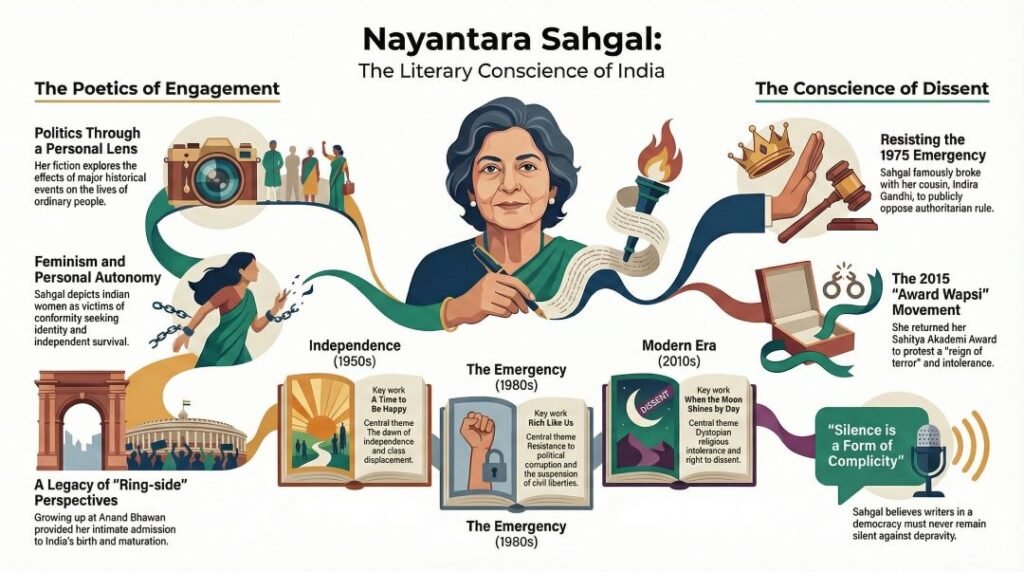
She has also been one of the most consistently courageous. In 2015, she returned her Sahitya Akademi Award in protest at what she described as the climate of intolerance and violence that had developed under the new government – an act that triggered the wider ‘Award Wapsi’ movement and made her, in her late eighties, a figure of national controversy and national admiration.
Nayantara Sahgal Biography Table (Biodata / Author Profile)
| Biographical Detail | Information |
| Full Name | Nayantara Sahgal (born Nayantara Pandit) |
| Date of Birth / Birth Date | May 10, 1927 |
| Born Place / Birth Place | Allahabad, United Provinces, British India (now Uttar Pradesh, India) – born into the Nehru family at Anand Bhavan, the ancestral home of the Nehru family in Allahabad that served as a centre of the Indian independence movement; Allahabad was one of the most politically and intellectually significant cities in colonial India |
| Age | As of 2025, Nayantara Sahgal is 97 years old – born May 10, 1927 |
| Is Nayantara Sahgal Alive or Not? | Yes – Nayantara Sahgal is alive as of 2025. She was born on May 10, 1927, and continues to be one of the most active and most outspoken literary and political voices in India. She lives in Dehradun, Uttarakhand. |
| Nationality | Indian |
| Family / The Nehru Connection | Nayantara Sahgal is the niece of Jawaharlal Nehru – India’s first Prime Minister – and the daughter of Vijaya Lakshmi Pandit, one of India’s most distinguished diplomats and the first woman president of the United Nations General Assembly. She is thus Indira Gandhi’s first cousin. Her family background places her at the absolute centre of modern Indian political history, and this background – its idealism, its contradictions, its eventual betrayals – is the subject of virtually all her fiction and non-fiction. |
| Father | Ranjit Sitaram Pandit – a Sanskrit scholar, lawyer, and Indian nationalist; he was imprisoned by the British during the independence movement and died in 1944 while in prison, at the age of 42. His death, while Nayantara was still in her teens, was a formative experience that deepened her understanding of the personal cost of political commitment. |
| Mother | Vijaya Lakshmi Pandit (1900-1990) – one of India’s most distinguished public figures; a senior leader of the Indian National Congress; India’s first woman to hold a cabinet position; India’s Ambassador to the Soviet Union, the United States, and the United Kingdom; the first woman president of the United Nations General Assembly (1953). One of the most accomplished women of her generation in any country. |
| Husband | Nayantara Sahgal has been married three times. Her first husband was Gautam Sahgal, whom she married in 1949 and divorced in 1967 – from this marriage she took the surname ‘Sahgal’ by which she is universally known. Her second husband was E.N. Mangat Rai, an ICS (Indian Civil Service) officer, whom she married in 1979 and who died in 1997. Her third husband (or long-term companion) is Vishwa Nath Kaul – a retired diplomat; searches for ‘Vishwa Nath Kaul’ in connection with Nayantara Sahgal reflect this relationship. |
| Vishwa Nath Kaul | Vishwa Nath Kaul is Nayantara Sahgal’s companion in her later years – a retired diplomat with whom she has been associated. Searches for his name in connection with Sahgal reflect the interest of readers and students in her personal life and her marriages. |
| Did Nayantara Sahgal Ever Get Married? | Yes – Nayantara Sahgal married three times: first to Gautam Sahgal (1949-1967); then to E.N. Mangat Rai (1979-1997, until his death); and she has been associated with Vishwa Nath Kaul in her later years. |
| Children | Three daughters and two sons from her first marriage to Gautam Sahgal |
| Education | Wellesley College, Massachusetts, USA (B.A.) – she studied in the United States, reflecting the family’s cosmopolitan outlook and connections; she returned to India after independence and began her writing career in the newly independent nation |
| Autobiography | Nayantara Sahgal has written two autobiographical works: Prison and Chocolate Cake (1954) – a memoir of her childhood growing up in the Nehru household during the independence movement, when the men of the family were repeatedly imprisoned by the British; and From Fear Set Free (1962) – an account of the breakdown of her first marriage and her personal struggle for independence. These are among the most valuable memoirs available for understanding the Nehru family from the inside. |
| What Is the Name of the Autobiography Written by Nayantara Sahgal? | Nayantara Sahgal has written two autobiographical works: Prison and Chocolate Cake (1954), a memoir of her childhood in the Nehru household, and From Fear Set Free (1962), a personal memoir about her first marriage and divorce. Prison and Chocolate Cake is the more famous of the two and is the autobiography most commonly referred to in academic and literary discussions. |
| Most Famous Book | Rich Like Us (1985) is widely regarded as Nayantara Sahgal’s most famous book – the novel that brought her the widest international recognition and that won her the Sahitya Akademi Award and the Commonwealth Writers’ Prize. It is set during the Emergency (1975-77) and is her most searching examination of the relationship between political power and individual freedom. |
| First Novel | A Time to Be Happy (1958) – her debut novel; set in the years immediately before and after Indian independence; the first of her explorations of the personal and political dimensions of India’s transition from colony to independent nation. |
| Awards | Sahitya Akademi Award (1986, for Rich Like Us); Commonwealth Writers’ Prize (1987, for Rich Like Us); Sinclair Prize for Fiction; various honorary doctorates; in 2015 she returned the Sahitya Akademi Award in protest at what she described as a climate of intolerance in India – triggering the ‘Award Wapsi’ movement |
| Contribution in English Literature | Nayantara Sahgal’s contribution to Indian English literature is among the most important and most sustained of any Indian writer. She was the first major Indian novelist to make Indian political life – specifically the relationship between the personal and the political in the context of post-independence India – the central subject of serious literary fiction. Her novels document the history of independent India from the inside, with the authority of one who was present at its creation and who has observed its every subsequent development with the honesty and the courage that she learned from the best traditions of her family. |
| Award Wapsi Movement 2015 | In October 2015, Nayantara Sahgal returned her Sahitya Akademi Award in protest at what she described as the silence of the Sahitya Akademi in the face of a growing climate of intolerance, violence against minorities, and attacks on writers and intellectuals in India. Her action triggered a wider ‘Award Wapsi’ (Award Return) movement in which dozens of other writers and artists returned their awards in solidarity. The movement made Sahgal, at the age of 88, one of the most prominent and most controversial voices in Indian public life. |
Nayantara Sahgal Biography PDF and PPT Slides Download (.PPTX)
Who Is Nayantara Sahgal? What Is She Famous For?
Nayantara Sahgal is an Indian novelist, memoirist, and political commentator, born on May 10, 1927, in Allahabad – the niece of Jawaharlal Nehru, India’s first Prime Minister, and the daughter of Vijaya Lakshmi Pandit, one of India’s most distinguished diplomats. She is alive as of 2025, living in Dehradun at the age of 97, and she remains one of the most outspoken literary and political voices in India.
She is famous above all as the author of Rich Like Us (1985) – her most celebrated novel, winner of the Sahitya Akademi Award and the Commonwealth Writers’ Prize, set during the Emergency period of 1975-77 and widely regarded as one of the greatest Indian political novels of the twentieth century. She is also famous for Plans for Departure (1985), Mistaken Identity (1988), A Time to Be Happy (1958), Storm in Chandigarh (1969), The Day in Shadow (1971), and A Situation in New Delhi (1977) – a body of political fiction that is unmatched in scope, consistency, and moral seriousness in the history of Indian writing in English.
She is famous, too, for her autobiographies – Prison and Chocolate Cake (1954) and From Fear Set Free (1962) – which are among the most valuable personal accounts of the Nehru family and of the independence era available in literature. And she is famous for her political journalism and commentary – particularly for the 2015 Award Wapsi episode, when she returned her Sahitya Akademi Award in protest at what she described as a climate of intolerance in India, triggering a national controversy and a wider movement of solidarity among Indian writers and artists.
She is the most important political novelist in Indian literature in English, and she has earned that distinction through a lifetime of writing that combines literary seriousness with political courage and personal honesty.
Nayantara Sahgal Biography in English: Early Life, Born Place and Education
Nayantara Sahgal was born on May 10, 1927, in Allahabad – one of the most politically and intellectually significant cities in colonial India, and the home of the Nehru family. She was born at Anand Bhavan – the ancestral Nehru family home that served as one of the centres of the Indian independence movement – into a family that was already at the heart of India’s most important political and historical transformation.
Her father, Ranjit Sitaram Pandit, was a Sanskrit scholar, lawyer, and Indian nationalist who was repeatedly imprisoned by the British for his participation in the independence movement. He died in 1944, while still in prison, at the age of 42 – a loss that Nayantara experienced at the age of 16 and that left an enduring mark on her understanding of what political commitment costs and what it means. Her mother, Vijaya Lakshmi Pandit, was one of the most remarkable Indian women of the twentieth century: a senior Congress leader, India’s first woman cabinet minister, Ambassador to the Soviet Union, the United States, and Britain, and the first woman president of the United Nations General Assembly.
Her uncle was Jawaharlal Nehru – the man who would become India’s first Prime Minister and who shaped the political and cultural life of the new nation more profoundly than any other single individual. Growing up in the Nehru household – surrounded by the leaders of the independence movement, listening to the political discussions of the adults around her, experiencing directly the sacrifices and the commitments of the independence struggle – gave Nayantara Sahgal a political formation that was unique in Indian literary history. She did not merely observe the independence movement from outside; she grew up inside it.
She was educated in India before going to Wellesley College in Massachusetts, USA – one of the most prestigious liberal arts colleges in America – where she took her B.A. degree. The American education gave her both a direct experience of the world beyond India and a perspective on Indian independence from outside that would shape her subsequent writing. She returned to India after independence and began her writing career in the newly independent nation.
Her first book, Prison and Chocolate Cake (1954), was a memoir of her childhood – the title refers to the combination of privation (her father’s imprisonment) and privilege (the chocolate cake that her aunt Nehru would occasionally send to the family) that characterised her unusual upbringing. It was an immediate success and established her as a writer of unusual gifts.
Nayantara Sahgal Husband: Marriages and Personal Life
Nayantara Sahgal has been married three times – a fact that is itself characteristic of a woman who has consistently refused to allow social convention to override personal honesty and personal choice.
Her first husband was Gautam Sahgal, whom she married in 1949 – two years after Indian independence, when she was 22 years old. The marriage produced three daughters and two sons, but it eventually broke down, and the couple divorced in 1967. It is from this first marriage that she took the surname ‘Sahgal’ – the name by which she is universally known as a writer. The breakdown of the first marriage and the personal struggle that accompanied it is the subject of her second autobiography, From Fear Set Free (1962).
Her second husband was E.N. Mangat Rai – an ICS (Indian Civil Service) officer who was among the most distinguished administrators of the post-independence period. They married in 1979 and were together until his death in 1997. This second marriage was, by all accounts, a deeply happy one – a partnership between two people who shared intellectual interests, political values, and a commitment to the ideals of the Nehruvian era.
In her later years, Nayantara Sahgal has been associated with Vishwa Nath Kaul – a retired diplomat. Searches for ‘Vishwa Nath Kaul’ in connection with Nayantara Sahgal reflect this relationship, which has been mentioned in several interviews and profiles.
Nayantara Sahgal All Books: Complete List in Chronological Order
Nayantara Sahgal has published a substantial body of work across more than six decades – novels, memoirs, political non-fiction, and biographical essays. Here is her complete bibliography in chronological order:
| Year | Title | Type / Summary |
| 1954 | Prison and Chocolate Cake | Memoir / Autobiography – her debut book and one of her most celebrated works. A memoir of her childhood growing up in the Nehru family household during the years of the independence movement, when the men of the family – her father, her uncle Jawaharlal, and others – were repeatedly imprisoned by the British. The title captures the paradox of her childhood: the prison (the political reality of British colonial rule and its cost to her family) and the chocolate cake (the warmth, the privilege, and the luxury that coexisted with the political struggle in the Nehru household). One of the most vivid and most personal accounts of the independence era available in Indian literature. |
| 1958 | A Time to Be Happy | Novel – her debut novel; set in the years immediately before and after Indian independence; following the lives of characters who are navigating the political and personal transitions of this extraordinary historical moment. The first of Sahgal’s explorations of the relationship between the personal and the political in the context of India’s emergence as an independent nation. The title, taken from a poem, sets the tone: a moment of hope, of possibility, and of the difficult work of making good on the promises of independence. |
| 1962 | From Fear Set Free | Memoir / Autobiography – her second autobiographical work; an account of the breakdown of her first marriage and of her personal struggle for independence and self-determination. A remarkably honest and courageous work for its time – a woman from one of India’s most prominent families writing openly about the failure of her marriage and about the personal and social cost of asserting her own independence. One of the most important feminist documents in the history of Indian women’s writing. |
| 1963 | Storm in Chandigarh | Novel – exploring political conflict and personal relationships in the context of the reorganisation of Indian states; set against the background of the dispute between Punjab and Haryana over the city of Chandigarh. One of her political novels in which the personal lives of the characters mirror the larger political conflicts of the society around them. Demonstrates her consistent method: using intimate human stories to illuminate the political forces that shape them. |
| 1965 | The Freedom Movement in India | Non-fiction – a historical account of the Indian independence movement; drawing on her intimate personal knowledge of the movement and its leaders to produce a work that is both historically rigorous and personally immediate. An important contribution to the historiography of Indian independence. |
| 1967 | A Voice for Freedom | Non-fiction / Political essays – a collection of her political writing and commentary; reflecting her growing engagement with the political life of post-independence India and her willingness to speak out on the issues of the day. |
| 1968 | Indira Gandhi: Her Road to Power | Political biography / Non-fiction – an early and important study of Indira Gandhi, written while Gandhi was rising to power. Sahgal’s relationship with Indira Gandhi – her first cousin, with whom she had a complex, difficult, and ultimately adversarial relationship – gives this study a unique authority and a unique emotional complexity. As Gandhi moved toward the authoritarianism that would culminate in the Emergency, Sahgal’s assessment of her became increasingly critical. |
| 1970 | The Day in Shadow | Novel – exploring the personal and political dimensions of divorce in the context of Indian society; the story of Simrit, a woman who has left a difficult marriage and is navigating the social and legal complexities of divorce in India. One of her most personal novels, drawing on her own experience of divorce. Also a meditation on what it means for a woman to assert her own freedom in a society that places enormous social pressure on women to remain in marriage regardless of its quality. |
| 1977 | A Situation in New Delhi | Novel – set in New Delhi in the political crisis of the early 1970s; exploring the relationship between the political world of India’s capital and the personal lives of the characters who inhabit it. One of her most directly political novels – a portrait of the political culture of Delhi that draws on her intimate knowledge of that world. |
| 1978 | A Voice for Freedom (collected essays) | Non-fiction – a further collection of her political writing; demonstrating the breadth and the consistency of her political engagement across the decades of independent India’s life. |
| 1982 | Indira Gandhi: Her Road to Power (revised edition) | Revised and expanded political biography – updating her assessment of Indira Gandhi in the light of the Emergency (1975-77) and its aftermath; a more critical and more complex portrait than the earlier edition. |
| 1985 | Rich Like Us | Novel – her most famous and most widely celebrated work; winner of the Sahitya Akademi Award (1986) and the Commonwealth Writers’ Prize (1987). Set during the Emergency (1975-77), the novel follows two women – Rose, an Englishwoman who has spent her adult life in India as the wife of an Indian businessman, and Sonali, a civil servant who refuses to collaborate with the authoritarian demands of the Emergency government. The novel is both a precise and devastating portrait of the Emergency and a meditation on the relationship between political power and personal integrity, on the meaning of freedom, and on what it means to resist. |
| 1985 | Plans for Departure | Novel – also published in 1985 (it won the Commonwealth Writers’ Prize alongside Rich Like Us); set in British India at the turn of the twentieth century; following Anna Hansen, a young Danish woman who comes to India and encounters the political and social world of the British Raj. Sahgal’s only historical novel, set outside her usual contemporary period; demonstrating her capacity to explore the same political and moral questions she addresses in her contemporary fiction through a historical setting. |
| 1988 | Mistaken Identity | Novel – a political satire set in the India of the 1930s, during the freedom movement; telling the story of Bhushan Singh, a young man of mixed class background who is mistaken for a revolutionary by the British authorities. The novel uses this case of mistaken identity as a comic and satirical frame for exploring the political and social hierarchies of colonial India and the contradictions of the independence movement. |
| 1995 | Lesser Breeds | Novel – set in the context of the Second World War and its impact on India; exploring the relationship between India’s independence movement and the global political upheavals of the 1940s; continuing her sustained engagement with the history of modern India. |
| 2001 | Before Freedom: Nehru’s Letters to His Sister | Non-fiction / Editorial – a collection of Jawaharlal Nehru’s letters to his sister Vijaya Lakshmi Pandit (Sahgal’s mother), edited and introduced by Sahgal; a uniquely personal literary project that allowed her to engage with the private correspondence of her uncle and her mother and to bring that correspondence to a wider public. An important addition to the literature of the Nehru era. |
| 2008 | Nehru’s India: Essays on the Maker of a Nation | Non-fiction – a collection of essays on Jawaharlal Nehru and his vision for India; reflecting Sahgal’s lifelong engagement with her uncle’s legacy and her assessment of what that legacy means for contemporary India. One of her most sustained and most authoritative contributions to the literature on Nehru. |
| 2010 | The Story of India | Non-fiction – a historical and cultural account of India, drawing on her extraordinary knowledge of Indian history and on her personal connections to the major figures of modern Indian political life. |
| 2017 | When the Moon Shines by Day | Novel – her most recent novel; set in contemporary India; exploring the rise of Hindu nationalism and its threat to the secular, democratic values that Sahgal has spent her entire career defending. Written when she was 90 years old. A final, undiminished demonstration of her political and literary engagement. |
Rich Like Us: Complete Analysis
Rich Like Us (1985) is Nayantara Sahgal’s most famous novel – the work most associated with her name, the one most frequently assigned in courses on Indian literature, and the one most widely regarded as her masterpiece. It won both the Sahitya Akademi Award (1986) and the Commonwealth Writers’ Prize (1987) – a double recognition that confirmed its standing as one of the major works of Indian fiction of the twentieth century.
| Aspect | Detail |
| Full Title | Rich Like Us |
| Author | Nayantara Sahgal |
| Published | 1985 |
| Awards | Sahitya Akademi Award (1986); Commonwealth Writers’ Prize (1987) |
| Setting | India during the Emergency (1975-1977) – the period when Prime Minister Indira Gandhi declared a state of emergency, suspended civil liberties, imprisoned political opponents, and imposed press censorship. The Emergency remains one of the most controversial episodes in Indian democratic history. |
| Two Protagonists | Rose – an Englishwoman who came to India years earlier as the wife of Ram, a wealthy Indian businessman; she has spent her adult life in India, has deeply identified with the country and its people, and is now an old woman navigating the Emergency’s chaos. Sonali – a young IAS (Indian Administrative Service) officer who is asked by the Emergency government to facilitate the clearing of slum dwellers to make way for a business deal connected to the prime minister’s son. Sonali refuses – and pays the professional and personal price for her refusal. |
| Rich Like Us Novel Summary | The novel weaves together the stories of Rose and Sonali against the background of the Emergency. Rose, now old, reflects on her long life in India – her marriage to Ram, her relationship with Ram’s Indian wife (Ram has two wives, in the old style), and the India she has loved and that is now being transformed by authoritarianism. Sonali, in the novel’s present, faces the choice that defines the Emergency for all honest officials: to cooperate with a government that is demanding illegal and immoral actions, or to resist and face the consequences. Sonali resists. The novel uses these two stories to ask the central question: what does freedom mean? What does it cost? And who is willing to pay? |
| The Emergency | The Emergency (June 1975 – March 1977) was declared by Prime Minister Indira Gandhi after the Allahabad High Court found her guilty of electoral malpractice and ordered her removal from office. Rather than resign, Gandhi declared a state of emergency, suspended fundamental rights, imprisoned thousands of political opponents (including opposition leaders like Jayaprakash Narayan and Morarji Desai), imposed press censorship, and allowed her son Sanjay Gandhi to run a parallel, unaccountable power structure. The Emergency lasted 21 months. Rich Like Us is one of the most important literary responses to this period. |
| Sahgal and Indira Gandhi | The Emergency was declared by Sahgal’s first cousin, Indira Gandhi – making Rich Like Us also a deeply personal document. Sahgal had watched Gandhi’s gradual movement toward authoritarianism with growing alarm, and her novel is partly an act of personal reckoning with a cousin she had known since childhood and whose decisions she now found morally indefensible. The novel does not name Indira Gandhi directly, but the political context is unmistakable, and the novel is explicitly a response to the Emergency. |
| Central Themes | Political power and its corruption; the Emergency and its meaning for Indian democracy; the relationship between personal integrity and political complicity; the experience of the outsider (Rose, the Englishwoman) who loves India and is horrified by what is being done to it; the cost of resistance; the meaning of freedom; the relationship between the personal and the political |
| Why It Is Her Most Famous Book | Rich Like Us is Sahgal’s most famous book because it combines her deepest personal and political preoccupations – the Emergency, the betrayal of Nehruvian idealism, the cost of individual resistance to authoritarian power – with her finest literary achievement: the two women’s stories are brilliantly constructed, the historical portrait of the Emergency is precise and devastating, and the novel’s moral vision is clear, complex, and deeply moving. |
| Rich Like Us Novel – Contribution in English Literature | Rich Like Us is one of the most important contributions to Indian English literature of the twentieth century – a novel that placed the political life of independent India at the centre of serious literary fiction with an authority and a honesty that no other Indian novelist could have matched. It remains a defining text for anyone seeking to understand both the Emergency and the tradition of Indian political fiction. |
Plans for Departure: Analysis
Plans for Departure (1985) was published in the same year as Rich Like Us and, like Rich Like Us, won the Commonwealth Writers’ Prize. It is Sahgal’s only historical novel – set in British India at the turn of the twentieth century rather than in the contemporary period that is her usual fictional home.
The novel follows Anna Hansen, a young Danish woman who comes to India at the beginning of the twentieth century and finds herself navigating the world of the British Raj – its social hierarchies, its racial politics, its relationship to the Indian society it rules, and the early stirrings of Indian nationalism that will eventually bring it down. Anna is an outsider in a double sense: she is neither British nor Indian, and her position between the two worlds gives her a perspective on both that the novel uses to great effect.
Plans for Departure demonstrates that Sahgal’s preoccupations – the relationship between power and freedom, the question of who has the right to resist and the cost of resistance, the experience of the person who stands between cultures and refuses to be entirely claimed by either – are not limited to the contemporary period but are permanent features of Indian political and social life. The novel is also a meditation on the Raj itself – on what British rule in India meant, what it cost, and what it left behind.
Mistaken Identity: Analysis
Mistaken Identity (1988) is Nayantara Sahgal’s contribution to the tradition of the comic political novel – a satire set in the India of the 1930s, during the freedom movement, in which the comedy of a case of mistaken identity is used to explore the social and political hierarchies of colonial India.
Bhushan Singh, the novel’s protagonist, is a young man of mixed class background – neither entirely of the educated nationalist elite nor of the rural peasantry – who is mistaken by the British authorities for a revolutionary. The mistake leads him into a series of comic and occasionally dangerous situations that illuminate the contradictions of colonial Indian society: the class hierarchies within the independence movement, the British administration’s paranoid misreading of Indian political life, and the gap between the rhetoric and the reality of the nationalist cause.
Mistaken Identity is less widely discussed than Rich Like Us but is an important part of Sahgal’s bibliography – demonstrating her range and her capacity for comedy alongside the more serious political fiction for which she is best known.
A Time to Be Happy: First Novel Analysis
A Time to Be Happy (1958) is Nayantara Sahgal’s debut novel – the first of her explorations of the personal and political dimensions of India’s transition from colony to independent nation. The title is taken from a poem and sets the tone for the novel: this is a moment of hope, of possibility, of the difficult work of making good on the promises of independence.
The novel is set in the years immediately before and after Indian independence – the late 1940s – and follows the lives of characters who are navigating this extraordinary historical transition. Some are members of the Indian elite who must decide what role they will play in the new India; others are members of the British community who must come to terms with the end of the Raj; and others are ordinary Indians whose lives are being transformed by forces they can barely understand.
A Time to Be Happy establishes the central method of all Sahgal’s subsequent fiction: using the intimate stories of individual characters – their loves, their marriages, their friendships, their professional choices – to illuminate the larger political and historical forces that shape their lives. The novel is both a personal story and a historical document, and the tension between these two dimensions gives it a richness and a resonance that purely personal or purely political novels cannot achieve.
The question ‘Which is the first novel written by Nayantara Sahgal?’ is answered clearly: A Time to Be Happy (1958) is her first novel.
Storm in Chandigarh: Analysis
Storm in Chandigarh (1969) is one of Nayantara Sahgal’s most directly political novels – set against the background of the reorganisation of Indian states and the dispute between Punjab and Haryana over the city of Chandigarh, which both states claimed as their capital after the linguistic reorganisation of 1966.
The novel uses this specific political dispute as the backdrop for a story about the relationship between political conflict and personal life – about how the public, political storms of a society penetrate the private lives of the people who inhabit it, and about how personal integrity and personal freedom can be maintained in the face of political pressure and social upheaval.
Storm in Chandigarh demonstrates Sahgal’s consistent method: she is never interested in politics as an abstract system but always as a force that shapes and sometimes destroys individual lives. Her political fiction is also always personal fiction, and this combination gives it a power that purely political analysis cannot achieve.
The Day in Shadow: Analysis
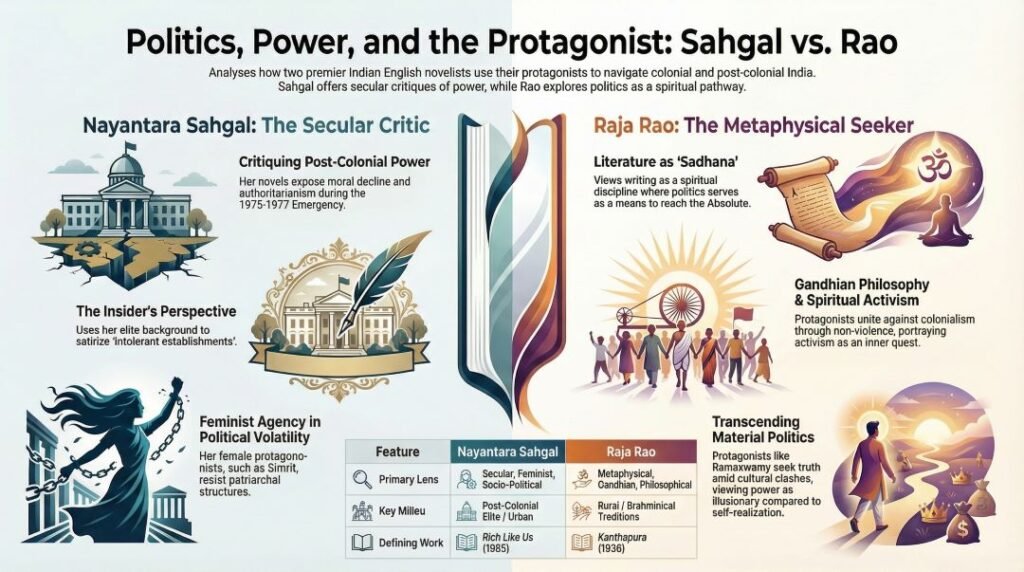
The Day in Shadow (1971) is one of Nayantara Sahgal’s most personal novels – the story of Simrit, a woman who has left a difficult marriage and is navigating the social and legal complexities of divorce in India. The novel draws directly on Sahgal’s own experience of divorce from her first husband Gautam Sahgal in 1967.
The novel explores what it means for a woman – particularly a woman from a prominent Indian family, with all the social expectations and social pressures that entails – to assert her own freedom by leaving a marriage that is making her unhappy. Simrit’s decision to leave is not made easily, and the novel traces the full cost of that decision: the social criticism, the legal complications, the personal pain, and the slow, difficult emergence of a new independent self.
The Day in Shadow is both a personal document and a political one – Sahgal uses Simrit’s story to explore the broader question of women’s freedom in Indian society, the social structures that constrain women’s choices, and the relationship between personal liberty and the larger political freedoms that Sahgal has always cared about. For Sahgal, the personal and the political are never separate.
A Situation in New Delhi: Analysis
A Situation in New Delhi (1977) is set in the political world of India’s capital in the crisis-ridden early 1970s – in the period leading up to and just after the Emergency. It is one of Sahgal’s most directly political novels, a portrait of the political culture of Delhi that draws on her intimate knowledge of that world.
The novel follows a cast of characters – politicians, civil servants, intellectuals, foreigners – who are all navigating the moral and political landscape of a democracy under increasing pressure. The ‘situation’ of the title is both specific (a particular political crisis) and general (the permanent situation of a democracy that must constantly defend its values against the pressures of power and expediency).
A Situation in New Delhi anticipates the Emergency – which was declared in 1975, before the novel was published in 1977 – in its portrait of a political culture in which the institutions of democracy are being steadily eroded and in which individuals must choose between complicity and resistance. It is one of the most prescient of Sahgal’s political novels.
Nayantara Sahgal Autobiography
Nayantara Sahgal has written two autobiographical works – both of which are important literary and historical documents as well as personal memoirs.
Prison and Chocolate Cake (1954) is her first and most celebrated memoir – an account of her childhood growing up in the Nehru family household during the years of the independence movement. The title captures the paradox of her upbringing: the prison (the British colonial repression that repeatedly imprisoned her father and uncle) and the chocolate cake (the warmth, the luxury, and the extraordinary intellectual stimulation of a childhood spent in one of India’s most remarkable family households). The memoir gives readers a unique window into the private world of the Nehru family – the political discussions, the personal relationships, the sacrifices and the privileges that coexisted in the home of India’s independence leaders. It is one of the most valuable personal accounts of the independence era available in any language.
From Fear Set Free (1962) is her second memoir – a more personally painful and more personally brave work; an account of the breakdown of her first marriage and of her struggle to find an independent identity outside the social and family expectations that had defined her life. It is one of the most honest books written by any woman from India’s establishment class about the personal cost of asserting female independence.
The question ‘What is the name of the autobiography written by Nayantara Sahgal?’ is answered by both these titles, with Prison and Chocolate Cake being the most famous and most commonly studied.
Nayantara Sahgal’s Contribution in English Literature
Nayantara Sahgal’s contribution to Indian English literature – and to the broader tradition of political fiction in English – is one of the most significant and most sustained of any Indian writer. Here is a summary of her major contributions:
- She was the first major Indian novelist to make the political life of independent India – the relationship between the personal and the political in the post-independence context – the central subject of serious literary fiction. This was a pioneer act: before Sahgal, Indian fiction in English was largely concerned with social life, family relationships, and the cultural dimensions of Indian experience; Sahgal brought political history and political morality to the centre of the novel.
- She created the tradition of the Indian political novel in English – a tradition that later writers, including Rohinton Mistry (A Fine Balance, which is partly a response to the same Emergency period), have worked within. The literary framework she established – using the intimate stories of individual characters to illuminate the political forces that shape their lives – has become one of the defining methods of Indian political fiction.
- She was one of the first Indian women writers to write openly and honestly about the personal experience of women in Indian society – including divorce, the social pressure on women to remain in marriage, and the personal cost of female independence. From Fear Set Free (1962) is an important early document in the tradition of Indian feminist writing.
- She provided, through her fiction and her non-fiction, the most authoritative literary account available of the Nehru era and its legacy – from the idealism of the independence movement, through the complex achievements and failures of Nehru’s own rule, to the Emergency and the betrayal of Nehruvian values by Indira Gandhi, and beyond to the rise of Hindu nationalism. No other writer has documented this history from the inside, with this degree of personal knowledge and this degree of moral seriousness.
- Through the 2015 Award Wapsi episode, she demonstrated that a literary voice can still have direct political consequence – that a writer’s act of protest can trigger a wider movement of resistance and can put questions of cultural freedom and political tolerance on the national agenda. At 88, she showed that literary courage is not a quality of youth.
Nayantara Sahgal and the Emergency: Political Context
The Emergency (June 1975 – March 1977) is the defining event of Nayantara Sahgal’s political fiction – the moment when the democratic values she had inherited from her family were most directly threatened and most directly betrayed. The Emergency was declared by her cousin Indira Gandhi, which gave Sahgal’s response to it a unique personal as well as political dimension.
Sahgal had watched Indira Gandhi’s rise to power with admiration and then with growing alarm. She had written about Gandhi as early as 1968 (Indira Gandhi: Her Road to Power) and had seen in Gandhi’s consolidation of power the seeds of the authoritarianism that would eventually produce the Emergency. When Gandhi declared the Emergency in June 1975 – suspended civil liberties, imprisoned thousands of political opponents, imposed press censorship – Sahgal’s response was one of moral outrage and literary action.
Rich Like Us (1985) was that literary action – a novel that placed the Emergency at the centre of its story and that examined its meaning with the precision and the honesty that only a writer with Sahgal’s personal knowledge and moral courage could bring. The novel is not merely a document of the Emergency; it is a meditation on what the Emergency revealed about India – about the fragility of democratic institutions, about the corruptions of power, and about the question of what individual citizens owe to their society and to their own integrity when democratic values are under threat.
Nayantara Sahgal and the Award Wapsi Movement 2015
In October 2015, Nayantara Sahgal – then 88 years old – returned her Sahitya Akademi Award in protest at what she described as the silence of the Sahitya Akademi (India’s national academy of letters) in the face of a growing climate of intolerance, violence against minorities and Dalits, and attacks on writers and intellectuals in India. In her letter returning the award, she wrote that India was on a perilous path: that the minority community was living in fear, that dissenters were being murdered, and that the cultural atmosphere in the country had become hostile to the free expression of ideas.
Her action triggered the ‘Award Wapsi’ (Award Return) movement – a wave of protests in which dozens of other writers, scientists, filmmakers, and artists returned their national awards in solidarity. The movement was widely covered in both the Indian and the international press, and it put Sahgal – a woman who had been writing and speaking out for more than sixty years – at the centre of a national controversy.
The government and its supporters attacked the movement as politically motivated and as an affront to India’s democratic institutions. Sahgal and her fellow protesters responded that protecting democratic institutions – including the freedom of expression – was precisely what they were doing. The controversy demonstrated, once again, that Sahgal’s literary and political voice retains its power and its relevance, and that her moral courage – learned in the household of the independence movement – has not diminished with age.
Nayantara Sahgal’s Writing Style
| Element | Detail |
| Prose Style | Clear, elegant, and authoritative – Sahgal writes with the confidence of a woman who has been observing and thinking about Indian political life from the inside for the whole of her life. Her prose is never obscure or experimental; it is the prose of someone who wants to be understood, who has important things to say, and who trusts the reader’s intelligence. |
| Political Intelligence | Her most distinctive quality is political intelligence – the ability to understand the relationship between political structures and individual lives, to see how power works and what it costs, and to render that understanding in fictional form without sacrificing either political accuracy or human complexity. No other Indian novelist in English has this quality to the same degree. |
| The Personal and the Political | Sahgal’s central method is the interweaving of personal stories with political history – using the intimate lives of her characters to illuminate the larger political forces that shape them. This method reflects her conviction that the personal and the political are inseparable: that what happens in the public world of politics directly shapes what happens in the private world of individuals. |
| Historical Authority | Her fiction has a historical authority – a sense of being written from inside the events it describes – that comes from her unique position as the niece of Nehru, the cousin of Indira Gandhi, and a woman who has lived through all the major episodes of post-independence Indian history from a position of informed, engaged observation. |
| Moral Clarity | Sahgal writes with moral clarity – she is not morally simple, and she understands complexity and contradiction; but she does not use complexity as an excuse to avoid moral judgment. Her fiction is clear about what is right and what is wrong, even when it acknowledges that the situation is complicated. |
| Influences | The English novel of political and social observation (E.M. Forster, George Orwell); the tradition of Indian political biography and memoir (her uncle Nehru was himself a distinguished prose writer); and the personal experience of living through the political history she describes |
Nayantara Sahgal Awards
| Award | Year | For / Detail |
| Sahitya Akademi Award | 1986 | For Rich Like Us (1985) – India’s most prestigious literary honour; returned in 2015 as part of the Award Wapsi protest |
| Commonwealth Writers’ Prize | 1987 | For Rich Like Us (1985) – one of the most prestigious international literary prizes for Commonwealth fiction |
| Sinclair Prize for Fiction | 1985 | For Plans for Departure – recognising her contribution to Commonwealth literary fiction |
| Various Honorary Doctorates | Various | Honorary doctorates from Indian and international universities recognising her contribution to Indian literature and to India’s public life |
Nayantara Sahgal Life Timeline
| Year | Key Event |
| 1927 | Born on May 10 in Allahabad, United Provinces, British India – at Anand Bhavan, the Nehru family home; daughter of Ranjit Sitaram Pandit and Vijaya Lakshmi Pandit; niece of Jawaharlal Nehru |
| 1930s-1940s | Grows up in the Nehru household during the years of the independence movement; witnesses the repeated imprisonments of her father and uncle by the British; lives through the political intensity and the personal sacrifice of the independence struggle |
| 1944 | Her father, Ranjit Sitaram Pandit, dies in prison at the age of 42 – a formative loss that deepens her understanding of what political commitment costs |
| 1947 | Indian independence – the moment her entire childhood and family history have been directed toward; she witnesses the arrival of independence from inside the family of the man who leads the new nation |
| Late 1940s | Attends Wellesley College, Massachusetts, USA – takes her B.A. degree; returns to India after independence |
| 1949 | Marries Gautam Sahgal – takes the surname ‘Sahgal’; the couple have three daughters and two sons |
| 1954 | Prison and Chocolate Cake published – her debut book; a memoir of her extraordinary childhood in the Nehru household; immediately successful and widely read |
| 1958 | A Time to Be Happy published – her debut novel; the first of her political novels of independent India |
| 1962 | From Fear Set Free published – her second memoir; a courageous account of the breakdown of her first marriage |
| 1963 | Storm in Chandigarh published – one of her early political novels |
| 1967 | Divorces Gautam Sahgal |
| 1968 | Indira Gandhi: Her Road to Power published – her first sustained political analysis of her cousin’s rise to power |
| 1970 | The Day in Shadow published – a novel drawing directly on her experience of divorce |
| 1975-1977 | The Emergency – declared by Indira Gandhi; Sahgal is one of its most determined critics; the Emergency becomes the central event of her political fiction |
| 1977 | A Situation in New Delhi published |
| 1979 | Marries E.N. Mangat Rai – an ICS officer; the couple are together until his death in 1997 |
| 1985 | Rich Like Us and Plans for Departure both published – her most celebrated year as a novelist |
| 1986 | Rich Like Us wins the Sahitya Akademi Award – India’s most prestigious literary honour |
| 1987 | Rich Like Us wins the Commonwealth Writers’ Prize |
| 1988 | Mistaken Identity published |
| 1995 | Lesser Breeds published |
| 1997 | E.N. Mangat Rai dies – the death of her second husband, with whom she had been deeply happy |
| 2001 | Before Freedom: Nehru’s Letters to His Sister published – editing her uncle’s letters to her mother |
| 2008 | Nehru’s India: Essays on the Maker of a Nation published |
| 2015 | Returns Sahitya Akademi Award in protest at climate of intolerance in India – triggers the Award Wapsi movement; becomes a national figure of controversy and admiration at the age of 88 |
| 2017 | When the Moon Shines by Day published – her most recent novel; exploring the rise of Hindu nationalism |
| 2025 | Alive and living in Dehradun, Uttarakhand, at the age of 97; continues to be one of the most active and most outspoken literary and political voices in India |
10 Lines About Nayantara Sahgal for Students
- Nayantara Sahgal was born on May 10, 1927, in Allahabad, India – the niece of Jawaharlal Nehru, India’s first Prime Minister, and the daughter of Vijaya Lakshmi Pandit, India’s first woman president of the United Nations General Assembly.
- She is alive as of 2025, living in Dehradun, Uttarakhand, at the age of 97 – one of the oldest and most active literary and political voices in India.
- She was educated at Wellesley College, Massachusetts, USA, and returned to India after independence to begin her writing career.
- She has been married three times: to Gautam Sahgal (1949-1967), to E.N. Mangat Rai (1979-1997), and she has been associated with Vishwa Nath Kaul in her later years.
- Her most famous novel is Rich Like Us (1985) – set during the Emergency (1975-77); winner of the Sahitya Akademi Award (1986) and the Commonwealth Writers’ Prize (1987).
- Her first novel was A Time to Be Happy (1958), and her first book was Prison and Chocolate Cake (1954) – a memoir of her childhood in the Nehru household.
- She is the most important political novelist in Indian literature in English – her novels document the history of independent India from the inside with an authority, a honesty, and a moral seriousness unmatched by any other Indian writer.
- In 2015, she returned her Sahitya Akademi Award in protest at the growing climate of intolerance in India – triggering the nationwide Award Wapsi movement.
- Her contribution to Indian English literature includes pioneering the tradition of the Indian political novel, providing the authoritative literary account of the Nehru era and the Emergency, and demonstrating throughout her career that literary courage and political integrity are inseparable.
- She has written novels, memoirs, political biographies, and essays – a body of work that spans more than six decades and that remains among the most important contributions to Indian literature in English.
Nayantara Sahgal Short Biography
Nayantara Sahgal (born May 10, 1927, Allahabad, India; alive as of 2025, age 97) is an Indian novelist, memoirist, and political commentator. Niece of Jawaharlal Nehru; daughter of Vijaya Lakshmi Pandit. Educated at Wellesley College, USA (B.A.). Married three times: Gautam Sahgal (1949-1967); E.N. Mangat Rai (1979-1997); associated with Vishwa Nath Kaul in later years. Author of nine novels – A Time to Be Happy (1958), Storm in Chandigarh (1963), The Day in Shadow (1970), A Situation in New Delhi (1977), Rich Like Us (1985), Plans for Departure (1985), Mistaken Identity (1988), Lesser Breeds (1995), When the Moon Shines by Day (2017) – and two memoirs – Prison and Chocolate Cake (1954) and From Fear Set Free (1962) – plus political non-fiction including Indira Gandhi: Her Road to Power and Nehru’s India. Rich Like Us won the Sahitya Akademi Award (1986, returned 2015) and the Commonwealth Writers’ Prize (1987). She triggered the Award Wapsi movement in 2015 by returning her award in protest at what she described as a climate of intolerance in India. Lives in Dehradun, Uttarakhand.
Read Also: G.V. Desani Biography PDF and PPT Slides Download (.PPTX)
Conclusion:
Nayantara Sahgal has been writing and speaking out for more than seventy years. She has outlived most of the political figures she wrote about – her uncle Nehru, her cousin Indira Gandhi, most of the leaders of the independence movement whose household she grew up in. She has seen the India that she witnessed being born in 1947 go through independence, democracy, Emergency, economic reform, and the rise of forces that she believes threaten the secular, democratic values on which that India was founded. And she has documented all of it – in fiction and in non-fiction, with honesty and with courage.
Rich Like Us will endure as one of the great novels of independent India – a work that places the Emergency and its meaning at the centre of serious literary fiction with an authority and a moral vision that no other novel has matched. Prison and Chocolate Cake will endure as one of the most valuable personal accounts of the independence era. And her life – as the daughter of a woman who was the first female president of the United Nations General Assembly, as the niece of the man who led India to independence, as a writer who has never flinched from speaking the truth about the India she loves – will endure as an example of what it means to live with integrity in the middle of history. She is 97 years old and she is still speaking. That, perhaps, is the most eloquent testimony to her legacy.