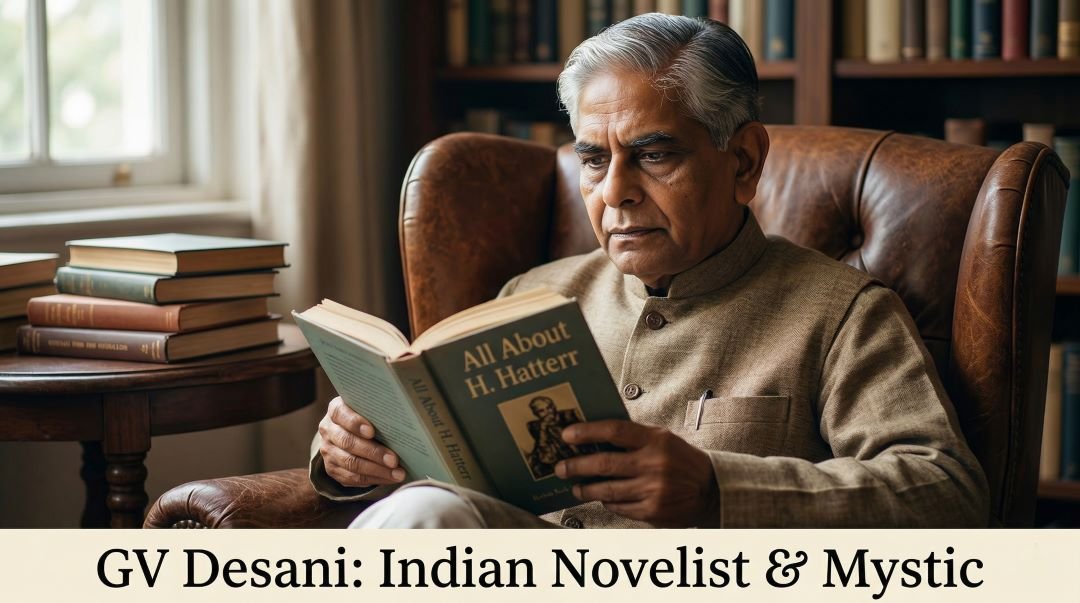
In this article we will discuss everything about G.V. Desani – G.V. Desani Biography PDF and PPT Slides Download – his full name, biography, books including All About H. Hatterr (1948) and its complete summary and analysis, Hali and Collected Stories, The Benaras That Was, his writing style, his famous works, his awards, his life as a Kenyan-born British-educated Indian writer and Buddhist philosopher, journalist, broadcaster, and academic, and his complete legacy as one of the most original, most eccentric, and most permanently fascinating writers in the entire history of Indian writing in English.
G.V. Desani is a writer who occupies a unique and solitary position in Indian literary history. He published one novel – All About H. Hatterr, in 1948 – and that single novel was enough to earn him the admiration of T.S. Eliot, Anthony Burgess, Saul Bellow, and Salman Rushdie, and to secure his place as a genuine precursor of the postmodern novel. He was a Kenyan-born, British-educated Indian of Sindhi origin, a Buddhist philosopher who studied in Tibetan monasteries, a journalist, a BBC broadcaster, a lecturer, and eventually a professor at the University of Texas at Austin. He lived one of the most extraordinary lives of any Indian writer in the twentieth century, and he produced, from that life, one novel that continues to astonish, disturb, and delight every reader who discovers it.
He is not widely known outside specialist literary circles – but among those who know him, the reaction is almost always the same: why has no one told me about this writer before?
A Complete Article Covering G.V. Desani Full Name, Biography, All About H. Hatterr Summary and Analysis, Hali and Collected Stories, The Benaras That Was, Writing Style, Awards, and His Permanent Legacy as One of the Most Original and Most Undervalued Writers in the History of Indian Literature in English
G.V. Desani Biography Table (Biodata / Author Profile)
| Biographical Detail | Information |
| Full Name | Govindas Vishnoodas Desani – he is universally known as G.V. Desani; his full name reflects his Sindhi Hindu background; ‘Govindas’ and ‘Vishnoodas’ are both names that reference the Hindu deity Vishnu (‘Govinda’ is a name of Krishna, an avatar of Vishnu; ‘Vishnoodas’ means ‘servant of Vishnu’) |
| G.V. Desani Full Name | Govindas Vishnoodas Desani – the answer to the frequently asked question ‘What is G.V. Desani’s full name?’ |
| Date of Birth | July 8, 1909 |
| Born Place | Nairobi, Kenya (then British East Africa) – making him one of the very few major Indian writers of the twentieth century to have been born in Africa; his birth in Kenya was a result of his family’s presence in the South Asian merchant and professional diaspora that had settled in East Africa during the period of British colonial rule |
| Date of Death | November 8, 2000 |
| Age at Death | 91 years – he lived a long life, though his literary career was concentrated in a remarkably short period |
| Place of Death | Austin, Texas, USA – where he had been a professor at the University of Texas |
| Nationality / Identity | Kenyan-born, British-educated Indian writer – his identity defies simple national categorisation; he was of Indian (Sindhi) origin, born in British East Africa (Kenya), educated in Britain, later a practising Buddhist in India and a professor in the United States; his life was as boundary-crossing and as categorisation-defying as his novel |
| Ethnicity / Origin | Indian – specifically of Sindhi origin; the Sindhi community is one of the great merchant and trading communities of South Asia, spread across the world through diaspora; Desani’s Sindhi background gave him a relationship with Indian culture and identity that was always at an angle – formed outside India, in the diaspora, before being deepened by years of study in India |
| Education | Largely self-educated – he did not attend university in the conventional sense; he educated himself through extraordinarily wide reading, through his work as a journalist and broadcaster, through years of study in India (including periods in ashrams and with Hindu and Buddhist teachers), and through his own intellectual curiosity. This self-education is itself visible in All About H. Hatterr, which is the novel of a voracious, undisciplined, idiosyncratic, and ultimately magnificent self-educated mind. |
| Career | Journalist; BBC broadcaster (he worked at the BBC in London during the 1940s, producing programmes on India and on Indian culture for the BBC Eastern Service); lecturer; Buddhist philosopher and teacher; novelist; short story writer; Professor of Philosophy and Asian Studies at the University of Texas at Austin (from the 1960s until his retirement) |
| Buddhist Philosophy | G.V. Desani was a serious, committed, and practising Buddhist philosopher – not merely a dabbler in Eastern religion but someone who spent years in study with genuine teachers, who practised meditation seriously, who visited Buddhist and Hindu monasteries in India and in Tibet, and who taught Buddhist and Indian philosophy at university level. His Buddhism was not a fashionable interest but a deep, sustained, and intellectually rigorous engagement with the tradition. It shaped his thinking, his writing, and his understanding of human nature. |
| Famous Works | All About H. Hatterr (1948) – his only novel and his masterpiece; Hali and Collected Stories (1950, later editions) – his play Hali and his collected short stories; The Benaras That Was – a prose work about the sacred city of Varanasi |
| First and Only Novel | All About H. Hatterr (1948) – his sole novel; one of the most original and most formally innovative works in the entire history of Indian writing in English; a precursor to the postmodern novel; admired by T.S. Eliot, Anthony Burgess, Saul Bellow, and Salman Rushdie |
| Awards / Recognition | Desani did not receive major literary prizes during his lifetime – a reflection of the marginal position his work occupied in the literary establishment; but his recognition came from fellow writers and from critics who understood the importance of what he had achieved. T.S. Eliot praised All About H. Hatterr on its publication; Anthony Burgess called it one of the most important works in the Indian literary tradition; Salman Rushdie acknowledged Desani as a precursor in Midnight’s Children. |
| Hali – Who Wrote It? | Hali is a play written by G.V. Desani – published together with his collected stories in Hali and Collected Stories. It is a poetic drama, and it is very different in tone and form from All About H. Hatterr – more lyrical, more philosophical, more overtly concerned with questions of Indian spiritual life. |
| The Benaras That Was | A prose work by G.V. Desani – a meditation on Varanasi (Benaras/Benares), the sacred city on the banks of the Ganges that has been one of the spiritual centres of Hindu civilisation for thousands of years. Desani spent time in Varanasi as part of his years of study in India, and The Benaras That Was reflects the depth of his engagement with Hindu sacred geography and with the specific atmosphere of this extraordinary city. |
| Nalini – Who Wrote It? | Nalini is a play – the search term ‘Nalini play written by’ appears in the context of G.V. Desani searches because Nalini is sometimes associated with his dramatic writing. Desani wrote dramatic and poetic works alongside his fiction, and Nalini is one of these – a lesser-known work that is sometimes studied alongside Hali in courses on Indian drama in English. |
| University of Texas | G.V. Desani was a Professor of Philosophy and Asian Studies at the University of Texas at Austin from the 1960s until his retirement – a position that gave him a stable academic base in the United States and that connected him to the tradition of Asian Studies scholarship in American universities. He taught Indian and Buddhist philosophy and was regarded by his students as a remarkable, eccentric, and deeply learned teacher. |
G.V. Desani Biography PDF and PPT Slides Download (.PPTX)
Who Is G.V. Desani? What Is He Famous For?
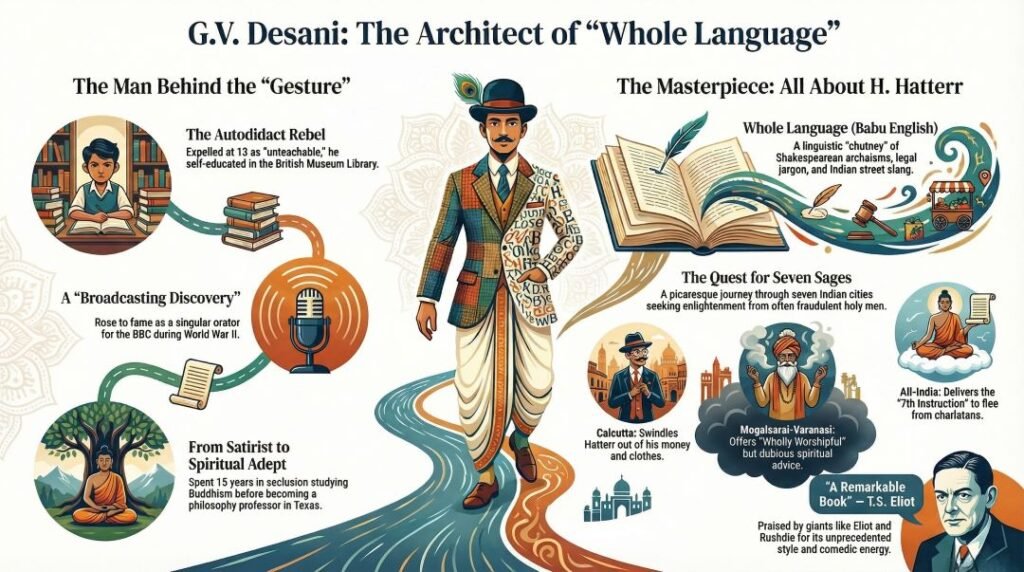
G.V. Desani – full name Govindas Vishnoodas Desani – was a Kenyan-born, British-educated Indian writer, journalist, broadcaster, Buddhist philosopher, and academic, born on July 8, 1909, in Nairobi, British East Africa (Kenya), and died on November 8, 2000, in Austin, Texas, USA. He is famous above all as the author of All About H. Hatterr (1948) – his only novel, and one of the most original, most formally innovative, and most permanently astonishing works in the entire history of Indian literature in English.
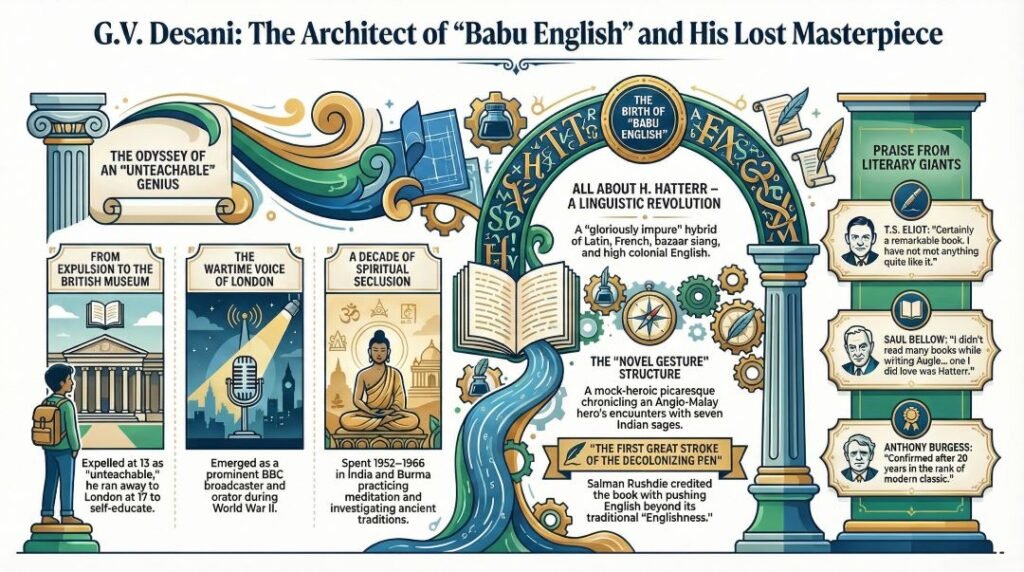
He is famous for a literary achievement of the most unusual kind: the achievement of a single book. Many writers produce large bodies of work and are famous for it; Desani produced one novel, several short stories, a play, and some prose writings – and the single novel was enough to earn him a permanent place in literary history. T.S. Eliot, one of the most important literary figures of the twentieth century, praised All About H. Hatterr on publication. Anthony Burgess – the author of A Clockwork Orange – called it a work of central importance to the Indian literary tradition. Salman Rushdie acknowledged Desani’s novel as a major precursor to Midnight’s Children, both in its linguistic experimentation and in its portrait of a hybrid, boundary-crossing Indian identity.
He is famous, too, for the extraordinary life he lived: born in Kenya, educated in Britain, a practising Buddhist who spent years in Indian ashrams and Tibetan monasteries, a BBC broadcaster, a journalist, a professor at the University of Texas at Austin, and a man whose very identity – Kenyan-born, Indian by origin, British by education, American by eventual residence, Buddhist by conviction – embodied the cross-cultural, boundary-crossing condition that his novel explores with such ferocious wit and energy.
G.V. Desani Biography in English: Early Life, Born Place and Education
G.V. Desani was born on July 8, 1909, in Nairobi – then the capital of British East Africa, the territory that would later become Kenya. His birth in Nairobi was a result of his family’s presence in the South Asian merchant and professional diaspora that had settled in East Africa during the period of British colonial rule. The Sindhi community – of which Desani’s family was part – was one of the great trading communities of South Asia, with networks spread across the world; and East Africa, with its British-built infrastructure and its opportunities for trade, had attracted substantial numbers of Sindhi, Gujarati, and other South Asian merchants and professionals from the late nineteenth century onwards.
Growing up in this diasporic, cross-cultural world – neither fully Indian nor fully East African nor fully British, always existing between categories – shaped Desani’s sensibility in ways that are directly visible in his fiction. The protagonist of All About H. Hatterr, Hatterr himself, is a man of mixed Indian-European parentage, educated in a colonial institution, speaking a wildly hybrid English, and pursuing Wisdom through encounters with seven Indian sages – a figure whose very existence is defined by his inability to fit into any single cultural category. This is Desani’s own experience, transformed into fiction.
Desani educated himself largely through reading, through his work as a journalist and broadcaster, and through years of study in India with Hindu and Buddhist teachers. He came to Britain, where he worked as a journalist and, during the Second World War, as a broadcaster at the BBC’s Eastern Service – a service that produced programmes in Indian languages and about Indian subjects for audiences in India and among the Indian diaspora. It was during his years in Britain that he wrote All About H. Hatterr – a novel that drew on his entire cross-cultural formation and that was published in 1948, the year after Indian independence.
After the publication of All About H. Hatterr, Desani spent years in India – studying with Hindu teachers, spending time in ashrams, visiting Varanasi (the experience that produced The Benaras That Was), and deepening his engagement with Buddhist philosophy and practice. He eventually moved to the United States, where he became a Professor of Philosophy and Asian Studies at the University of Texas at Austin – a position that suited his extraordinary range of intellectual interests and his capacity to engage seriously with both Western and Indian philosophical traditions. He died in Austin on November 8, 2000, at the age of 91.
G.V. Desani Books: Complete List
G.V. Desani’s published output is small but of extraordinary significance. Here is a complete account of his works:
| Year | Title | Type / Summary |
| 1948 | All About H. Hatterr | His only novel – and his masterpiece. One of the most original, most formally innovative, and most permanently fascinating works in the history of Indian literature in English. The story of Hatterr – a man of mixed Indian-European parentage, born in Penang, educated in a colonial institution, who travels across India in search of Wisdom, visiting seven sages in seven Indian cities. Each sage gives Hatterr a lesson; each lesson is immediately subverted, misunderstood, or rendered comic by the circumstances of Hatterr’s life. The novel is written in a language of extraordinary inventiveness – a hybrid English that mixes classical literary diction with slang, pidgin, Indian vocabulary, neologism, and comic wordplay. T.S. Eliot praised it on publication; Anthony Burgess called it one of the most important works in the Indian literary tradition; Salman Rushdie acknowledged it as a major precursor to Midnight’s Children. |
| 1950 / Various | Hali and Collected Stories | His play Hali together with his collected short stories – published in a single volume. Hali is a poetic drama, very different in tone from All About H. Hatterr: more lyrical, more philosophical, more overtly concerned with questions of Indian spiritual life and with the encounter between the individual soul and the demands of tradition and society. The short stories demonstrate the same linguistic inventiveness and the same cross-cultural vision as the novel, in a shorter and more concentrated form. |
| Various | The Benaras That Was | A prose meditation on Varanasi (Benaras / Benares) – the sacred city on the banks of the Ganges. Desani spent time in Varanasi during his years of study in India, and this work reflects the depth of his engagement with Hindu sacred geography, with the specific atmosphere of this ancient city, and with the relationship between the sacred and the everyday that is so particular to Varanasi. A lesser-known but important work in his bibliography. |
| Various | Nalini | A dramatic work – sometimes grouped with Hali in discussions of his dramatic writing. Less widely known and less widely available than Hali, but part of the complete picture of his output as a writer who worked across multiple literary forms. |
| Various | Essays and Journalism | Desani produced a substantial body of journalism, essays, and non-fiction writing over his career – work for newspapers, magazines, and the BBC that engaged with questions of Indian culture, politics, philosophy, and literature. Much of this material has not been collected in book form, but it forms an important background to his literary work and is a resource for scholars researching his career and his ideas. |
All About H. Hatterr: Complete Summary and Analysis
All About H. Hatterr (1948) is G.V. Desani’s only novel – and it is one of those books that are easier to describe in terms of what they are not than in terms of what they are. It is not a conventional novel; it is not a social realist portrait of Indian life; it is not a straightforward satire; it is not a philosophical allegory; it is not a comic novel in any ordinary sense. It is all of these things simultaneously, and it is also something that none of these categories can capture – a work of genuinely radical formal and linguistic invention that reads as though no one had written a novel before and the author had decided to see what the form could do if it were pushed to its absolute limits.
| Aspect | Detail |
| Full Title | All About H. Hatterr: A Gesture |
| Author | G.V. Desani |
| Published | 1948 (Francis Aldor, London; revised editions published subsequently by Penguin, Farrar Straus & Giroux, and others) |
| Subtitle | The subtitle ‘A Gesture’ is itself characteristic of Desani’s approach – it positions the novel not as a definitive statement but as a provisional, imperfect, comic reaching-toward something that cannot be fully grasped |
| Protagonist | H. Hatterr – a man of mixed Indian and European parentage, born in Penang (Malaysia), raised and educated in a colonial institution in India, who speaks a wildly hybrid English and who has decided to pursue Wisdom by visiting seven Indian sages in seven Indian cities. His full name is Hatterr – the ‘H.’ is never explained, which is itself characteristic of the novel’s playful relationship with identity and naming. |
| Hatterr’s Origins | Hatterr is the child of an unnamed Indian woman and a European seafarer – a parentage that makes him, quite literally, a product of the colonial encounter. He is not fully Indian and not fully European; he belongs to neither world and is claimed by neither. His search for Wisdom is partly a search for an identity and a way of being in the world that can accommodate his hybrid, uncategorisable existence. |
| The Structure | The novel is structured around Hatterr’s seven encounters with seven sages in seven Indian cities – each sage represents a different tradition of Indian wisdom (Hindu, Muslim, Buddhist, Jain, and others), and each encounter produces a lesson that Hatterr spectacularly fails to learn or apply. Between these framing encounters, Hatterr’s life unfolds in all its chaotic, comic, occasionally tragic detail – his marriage, his professional misadventures, his encounters with a range of extraordinary characters. |
| All About H. Hatterr 1948 – Historical Context | The novel was published in 1948 – the year after Indian independence and the year of Partition. This historical context is important: Hatterr’s hybrid, boundary-crossing identity – neither fully Indian nor fully European, claimed by no single national or cultural tradition – is itself a comment on the moment of Indian independence, when the question of what ‘Indian’ identity would mean in the post-colonial world was being urgently debated. Desani’s novel is one of the most prescient and most formally radical responses to this moment. |
| All About H. Hatterr Summary (Brief) | Hatterr, a man of mixed Indian-European parentage living in Calcutta, decides to seek Wisdom by visiting seven Indian sages in seven cities. Each sage imparts a lesson; each lesson is immediately subverted by the comic disasters of Hatterr’s life. Between these philosophical encounters, Hatterr navigates marriage (his wife Blanche is a recurring presence), work, love, misunderstanding, and the general chaos of existence. The novel ends with Hatterr battered, philosophically undaunted, and still in pursuit of Wisdom – a conclusion that is both comic and genuinely moving. |
| All About H. Hatterr Summary (Detailed) | The novel opens with a framing device: Hatterr’s ‘friend’ – a somewhat unreliable narrator – introduces us to Hatterr and his story. We learn that Hatterr has been educated at a missionary school in India, that he speaks English with a combination of colonial formality and wildly inventive idiosyncratic usage, and that he has decided to pursue Wisdom by visiting the Seven Sages of India. The seven sections of the novel follow Hatterr’s visits to seven cities – Calcutta, Rangoon, Madras, Bombay, Hyderabad, Banares (Varanasi), and Delhi – where he encounters sages representing different Indian philosophical traditions. Each sage gives Hatterr a lesson; each lesson is immediately tested and found comic when applied to the realities of Hatterr’s life. Interspersed with these philosophical encounters are the various misadventures of Hatterr’s domestic and professional life – his difficult marriage to Blanche, his various jobs and their disasters, his encounters with rogues, saints, and ordinary people. The novel’s comic energy comes from the collision between Hatterr’s earnest pursuit of Wisdom and the relentless refusal of reality to cooperate with philosophical lessons. The final chapters bring Hatterr back to his starting point – not with Wisdom achieved but with the pursuit continuing, undaunted by failure. |
| The Language | The language of All About H. Hatterr is one of the most discussed and most celebrated features of the novel – and one of the most important things about it. Desani invents a hybrid English for Hatterr that draws on: classical literary English (Elizabethan, Augustan, Victorian); Indian English in all its colonial and post-colonial varieties; slang from multiple registers; pidgin; neologism and portmanteau words; comic misspelling and mispronunciation; Sanskrit, Hindi, and Urdu vocabulary; legal and bureaucratic jargon; and the formal language of Indian officialdom. The result is a language that is simultaneously comic and beautiful, disorienting and deeply expressive – a language that could only have been invented by someone who stood outside English, who saw it from the perspective of the multilingual world he inhabited, and who had the linguistic genius to create something genuinely new from the encounter. |
| What Is the Writing Style of Desani? | Desani’s writing style – the question frequently asked in academic and literary discussions – is best described as: multilingual, hybridised, comic, formally experimental, philosophically serious beneath its comic surface, and deeply original. It is a style that draws on the full range of the English literary tradition while refusing to be confined by any single strand of it; that incorporates Indian linguistic and cultural material without either romanticising or condescending to it; and that uses comedy as a vehicle for genuine philosophical inquiry. It is unlike any other style in Indian or in English literature. |
| Influence on Later Indian Writing | All About H. Hatterr is one of the most important precursor texts in the history of Indian writing in English. Salman Rushdie acknowledged its influence on Midnight’s Children – specifically the linguistic hybridisation, the comic exuberance, and the portrait of a hybrid Indian identity that is the product of colonial history. The novel can also be seen as a precursor to the work of Amitav Ghosh (particularly in its cross-cultural, boundary-crossing vision) and of many other writers who have explored the linguistic possibilities opened up by Indian English in the postcolonial world. |
| T.S. Eliot’s Praise | T.S. Eliot praised All About H. Hatterr on publication – a recommendation from one of the most important literary figures of the century. Eliot recognised the novel’s formal originality and its linguistic achievement, and his endorsement helped establish the novel’s reputation in British literary circles. |
| Anthony Burgess on Hatterr | Anthony Burgess – the author of A Clockwork Orange, himself a writer deeply interested in linguistic innovation – was one of the most vocal champions of All About H. Hatterr. He called it one of the most important works in the Indian literary tradition and praised its linguistic invention as a genuine achievement – the creation of a new literary language for a new kind of Indian experience. Burgess wrote about the novel extensively and is largely responsible for keeping it in critical discussion during the decades when it might otherwise have fallen out of sight. |
| Saul Bellow’s Admiration | Saul Bellow – the American Nobel laureate and one of the most important novelists of the twentieth century – was another major admirer of All About H. Hatterr. Bellow’s own interest in the philosophical dimensions of the comic novel, in the figure of the intellectual buffoon who pursues Wisdom through the chaos of modern life, may have made him particularly receptive to Desani’s achievement. |
| Salman Rushdie’s Acknowledgement | Salman Rushdie, in his collection of essays Imaginary Homelands and in various interviews, acknowledged All About H. Hatterr as a major precursor to Midnight’s Children – both in its linguistic experimentation and in its portrait of a hybrid, boundary-crossing Indian identity. Rushdie’s acknowledgement was crucial in bringing Desani’s novel back to wider critical and readerly attention in the 1980s and 1990s. |
| Why It Is Important | All About H. Hatterr is important for several reasons: it is the first truly formally innovative novel in Indian literature in English – the first to break with the realist conventions that dominated Indian fiction before 1948; it invented a hybrid literary English for Indian fiction before anyone else did; it explored the question of Indian identity in the postcolonial world with a complexity and a formal daring that would not be matched until Midnight’s Children in 1981; and it did all of this in 1948, before Indian independence had even had time to settle into a new cultural consensus. |
Hali and Collected Stories: Analysis
Hali and Collected Stories is G.V. Desani’s second major published work – containing his verse play Hali and his collected short stories. It was first published in 1950, shortly after All About H. Hatterr, and it represents a very different dimension of Desani’s literary personality from the novel – quieter, more lyrical, more directly engaged with questions of Indian spiritual life.
Hali: The Play
Hali is a poetic drama – a play written in verse, in a style that draws on both the Western tradition of verse drama (Shakespeare, Marlowe, the classical tragic form) and on Indian dramatic traditions. It is very different from All About H. Hatterr in tone and register: where the novel is comic, energetic, linguistically explosive, and philosophically subversive, Hali is lyrical, elegiac, philosophically earnest, and formally more conventional.
The play explores questions of Indian spiritual life – questions of duty, sacrifice, love, and the relationship between the individual soul and the demands of tradition and of the divine. It can be read as a meditation on the Bhagavad Gita and on the philosophical questions that the Gita raises: what does duty require? What is the relationship between action and renunciation? How does a person live with integrity in a world that makes integrity impossible?
Hali is less widely known and less widely discussed than All About H. Hatterr, but it is an important work in Desani’s bibliography – demonstrating that his literary range extended well beyond the comic novel form and that his engagement with Indian philosophical traditions was serious, sustained, and formally sophisticated.
The question ‘Who wrote the play Hali?’ appears frequently in academic searches – the answer is G.V. Desani.
The Short Stories
The short stories collected in Hali and Collected Stories demonstrate the same qualities – the linguistic invention, the cross-cultural vision, the philosophical seriousness beneath the comic surface – that characterise All About H. Hatterr, but in a shorter and more concentrated form. The stories draw on Desani’s experience of the Indian diaspora in East Africa, his years in Britain, his time in India, and his engagement with Buddhist and Hindu philosophy.
The stories are less frequently studied than the novel but are important for the complete picture of Desani’s literary achievement. They show that his formal and linguistic inventiveness was not simply a feature of the novel form – it was intrinsic to his vision and to his understanding of what literary language could do.
The Benaras That Was: Analysis
The Benaras That Was is one of G.V. Desani’s prose works – a meditation on Varanasi (also known as Benaras or Benares), the ancient sacred city on the banks of the Ganges in Uttar Pradesh, India, that has been one of the spiritual centres of Hindu civilisation for thousands of years.
Desani spent time in Varanasi during his years of intensive study in India – years in which he engaged directly with Hindu and Buddhist teachers, practised meditation, and attempted to ground his intellectual understanding of Indian philosophy in the actual living reality of Indian sacred life. Varanasi is the perfect setting for this kind of encounter: it is a city that seems to exist simultaneously in the present and in eternity, where the daily rituals of bathing, prayer, cremation, and pilgrimage at the ghats on the Ganges create an atmosphere of vivid, physical, unavoidable engagement with the facts of birth, death, and the sacred.
The Benaras That Was is both a documentary record of this engagement and a literary meditation on what the sacred city means – on what it preserves, on what has been lost or changed, and on the relationship between the ancient spiritual inheritance of India and the modernity that is beginning to transform it. The ‘that was’ of the title is both nostalgic (this is the Varanasi that existed at a particular moment in time) and philosophical (this is the Varanasi of a particular way of seeing, which may or may not still be available).
The work is less widely known than All About H. Hatterr but is important for understanding the depth and seriousness of Desani’s engagement with Indian spiritual life – the engagement that underlies the more visible comic and linguistic surface of the novel.
G.V. Desani as Buddhist Philosopher
G.V. Desani was not merely interested in Buddhism as a philosophical system – he was a serious, committed, and practising Buddhist philosopher whose engagement with the tradition was sustained over many decades and was grounded in direct practice as well as intellectual study.
His engagement with Buddhism began during his years in India, where he studied with both Hindu and Buddhist teachers. He spent time in ashrams and in monastic settings, practising meditation and engaging directly with teachers in the living traditions of Indian philosophical and spiritual life. His Buddhism was deeply Indian in character – connected to the Theravada and Mahayana traditions as they existed in the Indian subcontinent and in Tibet, rather than to the Western-influenced forms of Buddhism that became fashionable in Europe and America from the 1960s onwards.
His Buddhist philosophical convictions are visible throughout All About H. Hatterr – in the novel’s sustained engagement with the question of how to live wisely, in Hatterr’s encounters with sages representing different Indian philosophical traditions (including Buddhism), and in the novel’s fundamental orientation toward the idea that human beings are capable of Wisdom even if they are also, reliably and comically, incapable of attaining it. The comedy of the novel is Buddhist comedy in the deepest sense: it arises from the gap between human aspiration and human limitation, and it treats that gap with compassion rather than contempt.
At the University of Texas, Desani taught Indian and Buddhist philosophy – a position that gave his scholarly and philosophical engagement with these traditions an institutional form and a new audience. His students remembered him as an extraordinary teacher: eccentric, demanding, deeply learned, and capable of conveying the living significance of philosophical ideas with a vividness and an urgency that formal academic teaching rarely achieves.
G.V. Desani as BBC Broadcaster and Journalist
Before writing All About H. Hatterr, G.V. Desani had an extensive career as a journalist and broadcaster – a career that gave him both a platform and a set of skills that would directly shape his fiction.
He worked at the BBC’s Eastern Service in London during the 1940s – the wartime years in which the BBC Eastern Service was producing programmes for audiences in India and among the Indian diaspora, covering the war, Indian politics and culture, and the debate over Indian independence. Working at the BBC brought Desani into the heart of the British literary and intellectual establishment at one of its most dynamic moments: London in the 1940s was a city of refugees, exiles, and intellectuals from across the former and current British Empire, and the BBC Eastern Service brought together some of the most interesting minds of the period.
His career as a journalist gave him a fluency with the English language – specifically with the variety of registers and styles that English journalism requires – that contributed directly to the linguistic range and flexibility of All About H. Hatterr. The novel’s hybrid English is partly the product of a man who had learned to write for multiple audiences, in multiple registers, for multiple purposes – and who had then decided to use all of those registers simultaneously in a single work of fiction.
He also worked as a lecturer – giving public lectures on Indian philosophy, culture, and literature in Britain – before moving to his academic position in the United States. This combination of journalism, broadcasting, and lecturing gave him an unusually broad public engagement with ideas, and his fiction reflects the energy and the directness of someone who has spent years trying to communicate complex ideas to diverse audiences.
G.V. Desani Writing Style: Complete Analysis
| Element | Detail |
| The Hybrid English | The defining feature of Desani’s writing style is the creation of a hybrid English for Hatterr – a language that mixes classical literary diction, Indian English in all its varieties, slang, pidgin, neologism, comic wordplay, Sanskrit and Hindi vocabulary, legal and bureaucratic jargon, and the formal conventions of colonial Indian officialdom. This language is unlike anything else in literature: simultaneously comic and beautiful, disorienting and deeply expressive. |
| What Is the Writing Style of Desani? | Desani’s writing style is multilingual, hybridised, formally experimental, philosophically serious beneath its comic surface, and completely original. It has been compared to James Joyce (in its linguistic inventiveness and its willingness to push language to its limits), to Laurence Sterne (in its comic narrative structure and its playful relationship with conventions of the novel), to Lewis Carroll (in its wordplay and its logic of comic illogic), and to no one at all (because nothing quite like it had existed before). |
| Comedy and Philosophy | One of the most important features of Desani’s style is the relationship between comedy and philosophy – the way in which comic situations and comic language are used to explore genuinely serious philosophical questions. The comedy is never merely decorative; it is the medium through which Desani explores the gap between human aspiration and human limitation, between the pursuit of Wisdom and the chaos of experience. |
| Narrative Voice | The novel uses a complex, layered narrative voice – the ‘friend’ who introduces Hatterr’s story, Hatterr’s own voice, and various interpolated documents and testimonies – that plays with the conventions of the novel as a form and that refuses any single authoritative perspective |
| Intertextuality | The novel is extraordinarily intertextual – it is full of references, allusions, parodies, and quotations from a vast range of literary, philosophical, and religious sources; Indian, European, and classical; serious and comic; the novel is itself a kind of comic encyclopaedia of the world’s wisdom traditions, seen through the distorting lens of Hatterr’s unreliable comprehension |
| Influence of Joyce | The most frequent literary comparison made to All About H. Hatterr is to James Joyce – particularly to Ulysses in its linguistic inventiveness and to Finnegans Wake in its willingness to push language beyond conventional limits. Desani was aware of Joyce and had read him; but the comparison, while illuminating, can also be misleading: where Joyce’s linguistic invention arises from the European modernist tradition, Desani’s arises from the specific experience of the colonial and postcolonial multilingual world, and is rooted in a very different cultural and philosophical context. |
| The Sentence | Desani’s sentences in All About H. Hatterr are often extraordinary constructions – long, accumulative, self-qualifying, self-interrupting, full of parenthetical asides and comic digressions, simultaneously formal and chaotic. They enact in their very structure the experience of a mind that has too much knowledge and too little wisdom, that is simultaneously reaching for clarity and producing confusion. |
G.V. Desani’s Importance in Indian Literature
G.V. Desani’s importance in Indian literature rests on a small number of specific and substantial achievements:
- He wrote All About H. Hatterr – the first truly formally innovative novel in Indian literature in English; the first work to break decisively with the realist conventions that dominated Indian fiction before 1948; and the first work to invent a genuinely hybrid literary English for Indian fiction. These are foundational achievements in the history of the tradition.
- He anticipated by more than three decades the linguistic experimentation and the exploration of hybrid Indian identity that would make Salman Rushdie’s Midnight’s Children (1981) a landmark of world literature. Rushdie himself acknowledged this. Desani did it first, and he did it in 1948.
- He was one of the first Indian writers to take seriously the question of what it means to be Indian in the modern, postcolonial, cross-cultural world – not as a political question but as a literary and philosophical one. Hatterr’s hybrid identity, his inability to fit into any single cultural category, his comic pursuit of Wisdom across the landscape of Indian philosophical traditions – all of this is a serious engagement with questions of identity, belonging, and meaning that are central to the postcolonial Indian experience.
- He brought to Indian fiction a philosophical seriousness – rooted in his deep engagement with Buddhist and Hindu philosophy – that few other Indian novelists of his generation could match. The comedy of All About H. Hatterr is not a cover for philosophical shallowness; it is the vehicle for a genuinely deep and genuinely original philosophical vision.
- He was recognised by some of the most important literary figures of the twentieth century – T.S. Eliot, Anthony Burgess, Saul Bellow, Salman Rushdie – as a writer of major importance. This recognition, from writers of very different traditions and very different sensibilities, is itself a measure of the quality and the significance of his achievement.
G.V. Desani Life Timeline
| Year | Key Event |
| 1909 | Born on July 8 in Nairobi, British East Africa (Kenya) – the son of a family of Sindhi Indian origin settled in East Africa as part of the South Asian merchant and professional diaspora |
| 1909–1920s | Early childhood in East Africa and India; grows up in the cross-cultural, diasporic world of the Sindhi community in British East Africa; begins his self-education through wide and voracious reading |
| 1920s–1930s | Moves to Britain; establishes himself as a journalist and public intellectual in London; begins writing and lecturing on Indian culture and philosophy; develops the cross-cultural literary intelligence that will produce All About H. Hatterr |
| 1930s–1940s | Works as a journalist for British and Indian publications; begins working at the BBC’s Eastern Service in London – producing programmes on India and Indian culture for audiences in India and among the Indian diaspora; continues his self-education through reading and through encounters with the remarkable group of intellectuals, writers, and exiles gathered in wartime London |
| Late 1930s–1940s | Writes All About H. Hatterr – a process that draws on his entire cross-cultural formation, his linguistic range, his philosophical reading, and his experience of the colonial and diasporic world |
| 1948 | All About H. Hatterr published – immediately praised by T.S. Eliot; recognised by discerning critics as a work of major originality; but too formally radical for mainstream literary recognition |
| 1950 | Hali and Collected Stories published – containing his verse play Hali and his short fiction |
| 1950s | Spends extended periods in India – studying with Hindu and Buddhist teachers, spending time in ashrams, visiting sacred sites including Varanasi (producing The Benaras That Was); deepening his engagement with Buddhist philosophy and practice |
| Late 1950s–early 1960s | Moves to the United States; begins his association with the University of Texas at Austin |
| 1960s onwards | Professor of Philosophy and Asian Studies at the University of Texas at Austin – teaching Indian and Buddhist philosophy; regarded by students as a remarkable, eccentric, and deeply learned teacher; continues to write but produces no further major works of fiction |
| 1970s–1980s | All About H. Hatterr is rediscovered and championed by Anthony Burgess and later by Salman Rushdie – whose acknowledgement in Midnight’s Children (1981) brings Desani’s novel back to wider critical and readerly attention; new editions of All About H. Hatterr are published by Penguin and Farrar Straus & Giroux |
| 1981 | Salman Rushdie’s Midnight’s Children published – Rushdie’s acknowledgement of Desani as a major precursor brings All About H. Hatterr to a new generation of readers and critics |
| 1980s–1990s | Growing academic recognition of Desani’s importance in the history of Indian writing in English; his work begins to be taught in Indian literature courses in British, American, and Indian universities; interviews and scholarly studies appear |
| 2000 | Dies on November 8 in Austin, Texas, USA – at the age of 91; mourned in the literary worlds of India, Britain, and the United States as one of the most original writers in the history of Indian literature in English |
| 2000–present | Posthumous recognition continues to grow; All About H. Hatterr remains in print and continues to find new readers; academic interest in his work continues to develop; he is increasingly recognised as a foundational figure in the history of postcolonial and South Asian literary modernism |
G.V. Desani Awards and Recognition
G.V. Desani did not receive major literary prizes during his lifetime – a reflection partly of the marginal position his work occupied in the literary establishment and partly of the difficulty of categorising or evaluating a work as formally radical as All About H. Hatterr using the conventional criteria of literary prize committees. But recognition came to him from a different direction – from fellow writers and from critics who understood, better than prize committees, the importance of what he had achieved.
| Form of Recognition | Detail |
| T.S. Eliot | Praised All About H. Hatterr on publication in 1948 – one of the most important literary endorsements available; Eliot’s recognition of the novel’s formal originality and its linguistic achievement helped establish its reputation in British literary circles |
| Anthony Burgess | Called All About H. Hatterr one of the most important works in the Indian literary tradition; wrote about the novel extensively in his criticism and in his introductions to later editions; is largely responsible for keeping it in critical discussion during the decades when it might otherwise have been forgotten |
| Saul Bellow | Nobel laureate; expressed admiration for All About H. Hatterr; his endorsement brought the novel to the attention of the American literary world |
| Salman Rushdie | Acknowledged Desani as a major precursor to Midnight’s Children in Imaginary Homelands and various interviews; Rushdie’s acknowledgement was the single most important factor in bringing Desani’s novel back to wide readerly and critical attention in the 1980s and 1990s |
| University of Texas | His academic position at the University of Texas at Austin was itself a form of recognition – an institutional acknowledgement of his extraordinary range of knowledge and his capacity to teach Indian and Buddhist philosophy at the highest level |
| Inclusion in Rushdie’s Anthology | Salman Rushdie and Elizabeth West’s anthology The Vintage Book of Indian Writing 1947-1997 included Desani – placing him in the company of the major figures of Indian writing in English and confirming his canonical status in the tradition |
| Academic Recognition | Growing scholarly attention to his work from the 1980s onwards – articles, dissertations, and book chapters situating him within the history of Indian modernism and postcolonialism; his work is now taught in Indian literature courses in Britain, the United States, and India |
10 Lines About G.V. Desani for Students
- G.V. Desani – full name Govindas Vishnoodas Desani – was born on July 8, 1909, in Nairobi, British East Africa (Kenya), and died on November 8, 2000, in Austin, Texas, USA.
- He was a Kenyan-born, British-educated Indian writer of Sindhi origin – a journalist, BBC broadcaster, Buddhist philosopher, and academic whose life spanned three continents and embodied the cross-cultural, boundary-crossing condition he explored in his fiction.
- He is famous above all as the author of All About H. Hatterr (1948) – his only novel, one of the most formally original and linguistically inventive works in the entire history of Indian literature in English.
- All About H. Hatterr tells the story of Hatterr, a man of mixed Indian-European parentage, who travels across India visiting seven sages in seven cities in search of Wisdom – a comic, philosophical, and linguistically extraordinary novel.
- The novel was praised by T.S. Eliot on publication; championed by Anthony Burgess and Saul Bellow; and acknowledged by Salman Rushdie as a major precursor to Midnight’s Children.
- He also wrote Hali – a verse drama – and a collection of short stories (published together as Hali and Collected Stories), and The Benaras That Was, a prose meditation on the sacred city of Varanasi.
- He was a serious, committed Buddhist philosopher who spent years studying with Hindu and Buddhist teachers in India and who taught Indian and Buddhist philosophy at the University of Texas at Austin.
- His writing style is unique in Indian and in English literature: a hybrid English that mixes classical literary diction, Indian English, slang, pidgin, neologism, and comic wordplay to create a language as original as any in modern fiction.
- He is recognised as one of the most important precursor figures in Indian literary modernism – a writer who anticipated the linguistic experimentation and the exploration of hybrid Indian identity that would make Rushdie’s Midnight’s Children a landmark of world literature, but did it three decades earlier.
- Despite his importance, he remains less widely known than he deserves – one of those writers whom readers discover with a shock of recognition and astonishment, wondering why no one told them about him sooner.
G.V. Desani Short Biography (Profile / Biodata)
G.V. Desani (full name: Govindas Vishnoodas Desani; born July 8, 1909, Nairobi, British East Africa; died November 8, 2000, Austin, Texas, USA) was a Kenyan-born, British-educated Indian writer, journalist, broadcaster, Buddhist philosopher, and academic of Sindhi origin. Largely self-educated, he worked as a journalist, lecturer, and BBC broadcaster in Britain before publishing his only novel, All About H. Hatterr (1948) – praised by T.S. Eliot, championed by Anthony Burgess and Saul Bellow, and acknowledged by Salman Rushdie as a major precursor to Midnight’s Children. He also published Hali and Collected Stories (1950), containing his verse play Hali and his short fiction, and The Benaras That Was, a prose meditation on Varanasi. A committed Buddhist philosopher, he spent years in study in India before becoming a Professor of Philosophy and Asian Studies at the University of Texas at Austin, where he taught until his retirement. He died in Austin in 2000 at the age of 91. All About H. Hatterr remains his masterpiece – one of the most original works in Indian literary history.
Read also: Shashi Deshpande Biography PDF and PPT Slides Download
Conclusion:
G.V. Desani published one novel. That should not be enough to secure a permanent place in literary history – and yet it is, because the novel is All About H. Hatterr, and All About H. Hatterr is one of those rare works that changes what literature thinks it can do. Before 1948, no Indian novelist writing in English had invented a hybrid literary language of the kind that Desani creates for Hatterr. No Indian novelist had brought to the form such a combination of formal radicalism, philosophical seriousness, and sheer comic energy. No Indian novelist had explored the question of hybrid, postcolonial Indian identity with the depth and the daring that Desani brings to Hatterr’s story.
He did all of this in 1948 – the year of Indian independence, the year before the literary world had even begun to think about what Indian writing in English might become. He was decades ahead of his moment, and his moment, in the form of mainstream literary recognition, largely missed him. But the writers who followed – particularly Rushdie – understood what he had done, and they made sure that his work was not forgotten.
All About H. Hatterr is still in print. It is still finding readers. And every reader who discovers it for the first time has the same experience – of encountering something completely unlike anything they have read before, something that seems to have arrived from a different literary universe, something that insists on being read at full attention because it is doing more, on every page, than any other novel they have encountered. That is the hallmark of the genuine original. G.V. Desani is the genuine original of Indian literature in English.