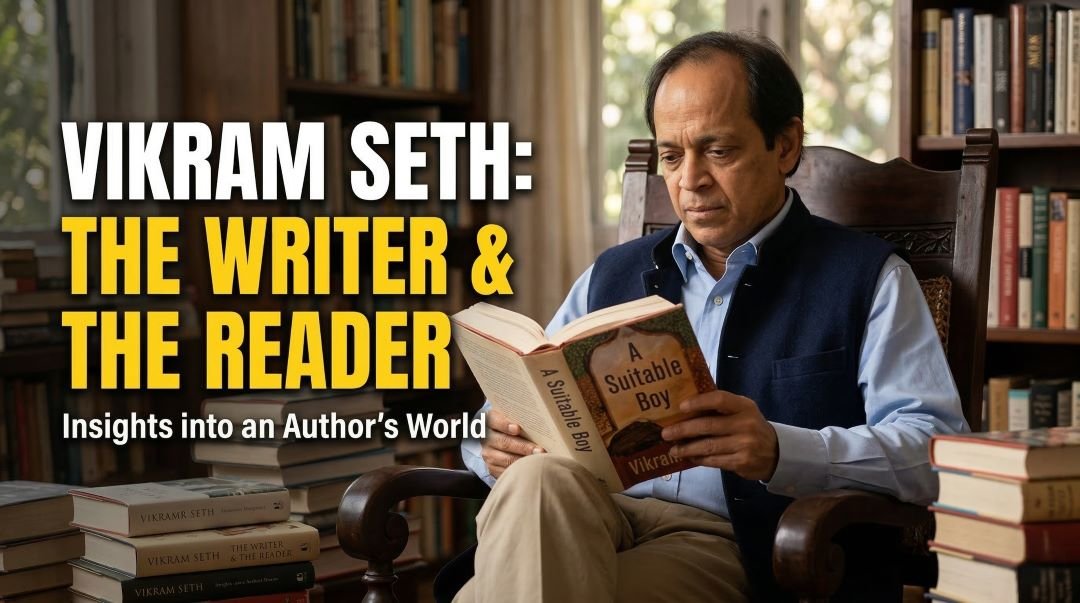
In this article we will discuss everything about Vikram Seth, Vikram Seth Biography PDF and PPT Slides Download, His Full Biography, Books, Poems, Famous Works, Awards and Complete Legacy – his biography in English (in 100 words, 200 words, and 500 words), all books in chronological order, famous works including A Suitable Boy, An Equal Music, The Golden Gate, Two Lives, From Heaven Lake, Beastly Tales from Here and There, Mappings, The Humble Administrator’s Garden, Arion and the Dolphin, A Suitable Girl, his famous poems, wife, parents, education, Padma Shri award year, writing style, and his complete legacy as one of India’s most versatile, most celebrated, and most beloved writers, A Complete Article Covering Vikram Seth Biography in English, A Suitable Boy, An Equal Music, The Golden Gate, Two Lives, All Books in Chronological Order, Famous Poems, Wife, Parents, Education, Padma Shri Award Year, Writing Style, and His Complete Legacy as One of India’s Greatest Living Writers
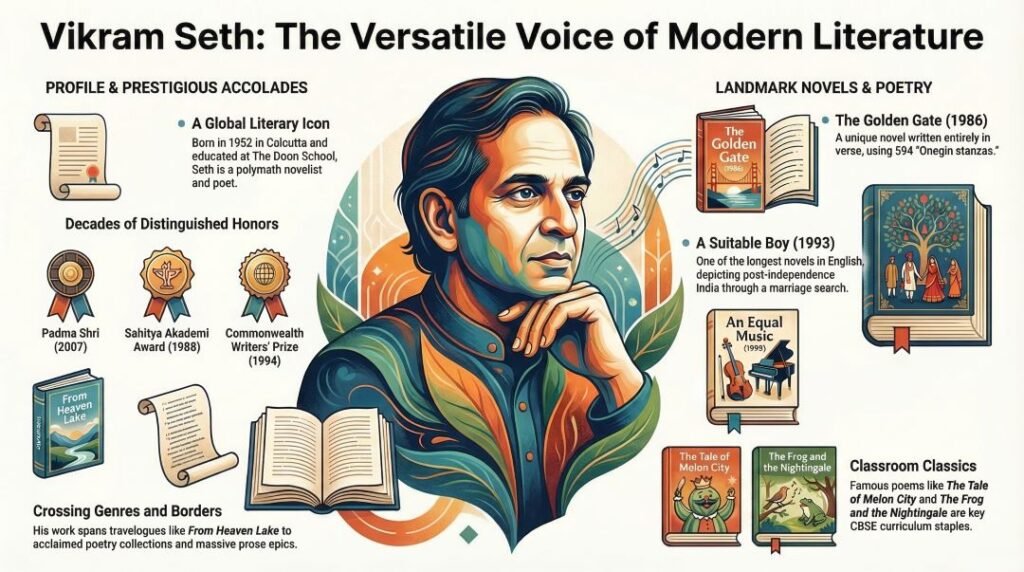
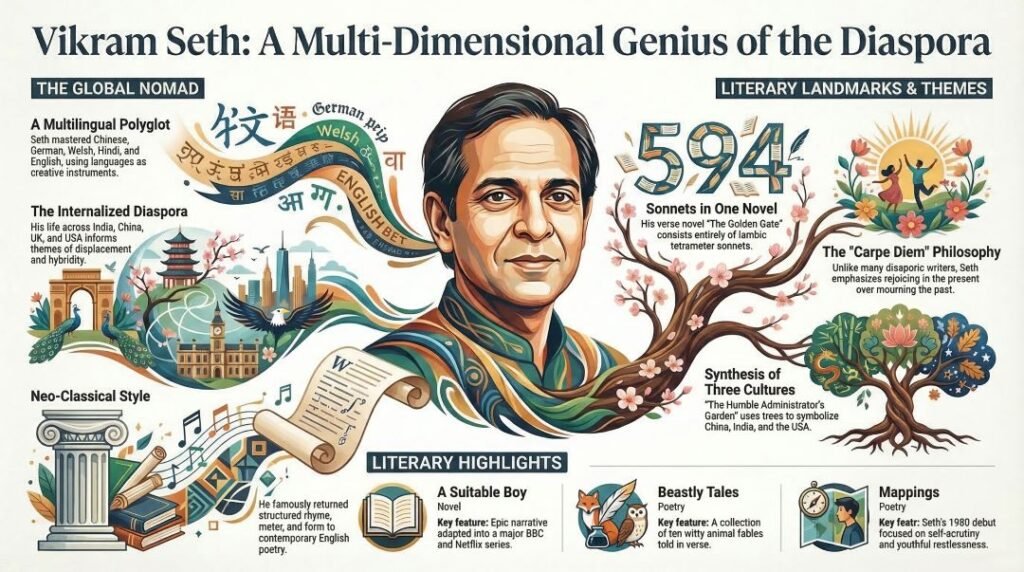
Vikram Seth is a writer who defies every category that the literary world tries to impose on him. He is Indian and British and American in his formation; he writes novels and poetry and travel writing and opera librettos and children’s books and biography and memoir; he writes with equal confidence in the novel in verse (The Golden Gate), the doorstop realist novel (A Suitable Boy, at 1,349 pages one of the longest novels in the English language), the chamber music novel (An Equal Music), and the personal memoir (Two Lives). He is, by any measure, one of the most versatile and most accomplished literary figures of his generation – and in A Suitable Boy he has written one of the great novels of the twentieth century.
He was born in Calcutta in 1952 and is, as of the writing of this article, alive and working. He lives between London and India, and he continues to be one of the most significant literary presences in the Indian and international literary world.
Vikram Seth Biography Table (Biodata / Author Profile)
| Biographical Detail | Information |
| Full Name | Vikram Seth |
| Date of Birth | June 20, 1952 |
| Born Place | Calcutta (now Kolkata), West Bengal, India – born into a distinguished, highly educated Indian family; his father Prem Nath Seth was a senior executive at Bata India; his mother Leila Seth became one of India’s most distinguished jurists – the first woman to become Chief Justice of a State High Court in India (Himachal Pradesh High Court) and later a judge of the Supreme Court of India |
| Is Vikram Seth Alive? | Yes – Vikram Seth is alive. He was born on June 20, 1952, and continues to live and work as of 2024-2025. He lives between London and India. He has spoken publicly about his ongoing work on A Suitable Girl – the long-awaited sequel to A Suitable Boy – as well as other projects. |
| Nationality | Indian (by birth and identity); he also holds British citizenship; his formation is cross-cultural – Indian, British, American, and Chinese |
| Father | Prem Nath Seth – a senior executive at Bata India, the Indian subsidiary of the Czech shoe manufacturer; the family moved frequently because of his father’s career, which gave Vikram Seth an early experience of different Indian cities and regions |
| Mother | Leila Seth (1930-2017) – one of India’s most distinguished and most celebrated jurists; the first woman to top the bar examination in England; the first woman to become Chief Justice of a State High Court in India (Himachal Pradesh, 1984); later a judge of the Supreme Court of India; the author of a celebrated memoir, On Balance (2003). Vikram Seth’s memoir Two Lives is partly a tribute to the generation that preceded his parents – specifically to his great-uncle Shanti Behari Seth and his German-Jewish wife Henny Caro. |
| Parents | Father: Prem Nath Seth (Bata India executive). Mother: Leila Seth (Supreme Court judge and jurist). Both parents were accomplished, distinguished individuals – his mother’s legal career was groundbreaking in the history of Indian women’s rights and professional achievement. |
| Wife / Partner | Vikram Seth has never married. He came out as gay in 2012, when he spoke publicly about the impact of Section 377 of the Indian Penal Code – the colonial-era law that criminalised homosexual relations – on his own life and on the lives of other LGBT Indians. His partner is Philippe Honore – a French violinist based in London. Seth has spoken about his relationship with Honore in several interviews, and the relationship is widely understood to have been the inspiration for An Equal Music, whose protagonist Michael is a musician and whose central relationship involves music, love, and loss. |
| Philippe Honore | Philippe Honore is a French classical violinist and Vikram Seth’s long-term partner. He is based in London and performs as a soloist and chamber musician. Seth has acknowledged that An Equal Music was inspired by, and written in part for, Honore. The novel’s deep, precise engagement with the world of classical music – its practice, its performances, its emotional stakes – reflects Seth’s intimate knowledge of that world through his relationship with a professional musician. |
| Education | The Doon School, Dehradun (one of India’s most prestigious boarding schools); Corpus Christi College, Oxford University (Philosophy, Politics and Economics – B.A.); Stanford University (graduate study in Economics – he worked toward a Ph.D. but did not complete it); Nanjing University, China (he studied Mandarin Chinese and classical Chinese literature); and he audited courses in Creative Writing at Stanford. His education is one of the most extraordinary of any living Indian writer – spanning three continents and combining the humanities, social sciences, and creative arts. |
| Academic Career | He was a graduate student (though not a faculty member) at Stanford; his academic connections have been primarily through his literary career rather than through formal academic positions |
| Padma Shri Award Year | Vikram Seth received the Padma Shri – one of India’s highest civilian honours – in 1988, awarded by the Government of India in recognition of his contribution to Indian literature. The award was given in the same year that A Suitable Boy was attracting international attention and recognition. |
| Other Awards | WH Smith Literary Award (for A Suitable Boy, 1994); Commonwealth Writers’ Prize; Sahitya Akademi Award; Padma Shri (1988); Honorary doctorates from several universities; various poetry prizes for The Golden Gate and his verse collections |
| Genre Range | Novels (A Suitable Boy, An Equal Music, The Golden Gate); Poetry (Mappings, The Humble Administrator’s Garden, All You Who Sleep Tonight, Beastly Tales from Here and There, Three Chinese Poets, The Rivered Earth); Travel Writing (From Heaven Lake); Biography/Memoir (Two Lives); Children’s Books (Arion and the Dolphin, The Elephant and the Tragopan); Opera Libretto (Arion and the Dolphin) |
| What Is He Famous For? | A Suitable Boy – one of the longest and most celebrated novels in the English language; The Golden Gate – a novel entirely in verse (sonnet form), set in San Francisco; An Equal Music – a novel about a classical musician and his lost love; Two Lives – a deeply personal biographical memoir about his great-uncle and his German-Jewish wife; his poetry, particularly All You Who Sleep Tonight; and his extraordinary versatility across multiple literary forms and genres |
| Writing Languages | English (primary); he has also translated from Chinese (Three Chinese Poets, 1992) and from other languages |
Vikram Seth Biography PDF and PPT Slides Download (.PPTX)
Who Is Vikram Seth? What Is He Famous For?
Vikram Seth is an Indian novelist, poet, travel writer, librettist, biographer, memoirist, and children’s writer – born on June 20, 1952, in Calcutta – and he is one of the most versatile and most accomplished literary figures in the world today. He is famous above all as the author of A Suitable Boy (1993) – at 1,349 pages one of the longest novels ever published in a single volume in the English language, and one of the great realist novels of the twentieth century. He is also famous for The Golden Gate (1986) – a novel written entirely in verse, in the sonnet form, set in San Francisco – and for An Equal Music (1999) – a deeply felt novel about a musician’s lost love.
He is famous, too, for the sheer range of what he does: there is no other living writer who has produced work of the highest quality in the novel, the verse novel, the travel book, the biography, the poetry collection, the children’s book, and the opera libretto. This range is not the product of dilettantism – each of these forms has been mastered with the same care and commitment – but of a genuinely multifarious literary intelligence that refuses to be confined by genre.
He is alive – born June 20, 1952, he is in his early seventies as of 2025 – and he remains an active literary presence, working on A Suitable Girl (the long-awaited sequel to A Suitable Boy), speaking publicly about LGBT rights in India, and continuing to write poetry. He came out publicly as gay in 2012, and his partner is the French violinist Philippe Honore.
He received the Padma Shri from the Government of India in 1988. He has also received the WH Smith Literary Award, the Commonwealth Writers’ Prize, and the Sahitya Akademi Award, among many other honours.
Vikram Seth Biography in English: Early Life, Parents, Born Place and Education
Vikram Seth was born on June 20, 1952, in Calcutta – the great city of Bengal that has long been the intellectual and cultural capital of India. He was born into a distinguished and accomplished Indian family. His father, Prem Nath Seth, was a senior executive at Bata India – the Indian subsidiary of the Czech multinational shoe manufacturer – and the family moved frequently during Vikram’s childhood as his father’s career required relocation to different Indian cities. This experience of different Indian cities and regions enriched Seth’s sense of India as a diverse, complex, and irreducibly plural nation – a sense that would later shape the epic canvas of A Suitable Boy.
His mother, Leila Seth (1930-2017), was one of the most remarkable Indian women of her generation – a jurist who became the first woman to top the bar examination in England, the first woman to become Chief Justice of a State High Court in India (the Himachal Pradesh High Court, 1984), and subsequently a judge of the Supreme Court of India. She was also a published author – her memoir On Balance (2003) is one of the finest literary memoirs by any Indian jurist – and a public figure whose advocacy for gender equality, constitutional rights, and the reform of archaic laws (including Section 377) shaped the landscape of Indian public life over several decades. The influence of Leila Seth’s intellectual rigour, her commitment to justice, and her extraordinary personal achievement on her son’s imagination is visible throughout his work – particularly in the strong, complex female characters that populate A Suitable Boy.
Seth was educated at The Doon School in Dehradun – one of India’s most prestigious and most intellectually demanding boarding schools, which has educated many of India’s political, intellectual, and cultural leaders – before going to Corpus Christi College, Oxford, where he studied Philosophy, Politics and Economics and took his B.A. degree. He then went to Stanford University in California, where he began graduate study in Economics and worked toward a Ph.D. He did not complete the doctorate – the Stanford years were, instead, the period in which he became a serious writer, auditing courses in Creative Writing and immersing himself in the San Francisco literary and cultural world that would become the setting of The Golden Gate.
Between his years at Oxford and Stanford, he spent time at Nanjing University in China, studying Mandarin Chinese and classical Chinese literature – an experience that produced his first major published work, the travel memoir From Heaven Lake: Travels Through Sinkiang and Tibet (1983), which he wrote after hitchhiking from China back to India through Tibet and Nepal. The book won the Thomas Cook Travel Award and announced him as a writer of exceptional gifts.
Vikram Seth Wife / Partner: The Philippe Honore Connection
Vikram Seth has never married. He came out publicly as gay in 2012, writing a poem called ‘Through Love’s Great Power’ in response to proposed amendments to Section 377 of the Indian Penal Code that would have re-criminalised homosexual relations in India. The poem and the accompanying public statement were a significant act of personal courage – Vikram Seth is one of the most prominent Indian writers to have spoken openly about his sexual identity and about the impact of discriminatory law on the lives of LGBT Indians.
His long-term partner is Philippe Honore – a French classical violinist based in London. Honore is a highly regarded chamber musician and soloist who has performed extensively in Europe. Seth has spoken about their relationship in interviews and has acknowledged, indirectly, that his novel An Equal Music (1999) was inspired by his life with Honore: the novel’s world of professional classical musicians in London, its emotional landscape of love and loss, and its deep, technically precise engagement with the practice of chamber music all reflect Seth’s intimate knowledge of that world through his partnership with a professional musician.
An Equal Music is dedicated ‘To Philippe’ – a dedication that, combined with the novel’s content and Seth’s subsequent public statements, makes the connection between the novel and his relationship with Honore clear. The novel’s protagonist, Michael, is a violist, and the novel explores the relationship between music, love, memory, and loss with a depth and a specificity that only an author who has lived closely with a professional musician could achieve.
Vikram Seth All Books: Complete List in Chronological Order
Vikram Seth has published across an extraordinary range of genres – novels, verse novels, poetry collections, travel writing, biography, children’s books, and opera librettos. Here is his complete bibliography in chronological order:
| Year | Title | Type / Summary |
| 1980 | Mappings | His debut poetry collection – published while he was a student at Stanford; an early demonstration of his gift for verse and his range of forms and subjects. The collection shows the influence of classical Chinese poetry (which he was studying at Nanjing) and of the English lyric tradition. |
| 1983 | From Heaven Lake: Travels Through Sinkiang and Tibet | His debut prose work – a travel memoir recounting his journey by hitchhiking and local transport from Nanjing, China, through Xinjiang (Sinkiang), Tibet, and Nepal back to India. Written with warmth, humour, and acute observation. Won the Thomas Cook Travel Award. An early classic of travel writing and one of the finest first-person accounts of travelling through Tibet and Xinjiang available in English. |
| 1985 | The Humble Administrator’s Garden | His second poetry collection – including poems written in China and poems reflecting on Indian and Western subjects. The title is taken from the name of a famous classical garden in Suzhou, China, which Seth visited during his time at Nanjing. A further development of the classical and cross-cultural influences that shape his poetry. |
| 1986 | The Golden Gate: A Novel in Verse | His first novel – and one of the most formally extraordinary works in American or Indian literature. The entire novel is written in verse, using a 14-line stanza (the ‘Onegin stanza’) based on the stanza form of Alexander Pushkin’s verse novel Eugene Onegin (translated by Charles Johnston, whose translation Seth used as his model). Set in San Francisco in the early 1980s, the novel follows a group of young urban professionals – John, Janet, Liz, Phil, and others – as they navigate love, work, friendship, and the anxieties of the Reagan-era American decade. The Golden Gate was an immediate critical sensation: praised for the audacity of its formal ambition, the elegance and wit of its verse, and the depth of its characterisation. It established Seth as a major literary figure. |
| 1990 | All You Who Sleep Tonight | One of his most celebrated poetry collections – containing some of his most widely read and most anthologised poems, including the title poem, ‘Telephone’ (‘All you who sleep tonight / Far from the ones you love, / No hand to left or right’), and many others. The collection demonstrates the range and depth of his lyric gift – from the intimate to the philosophical, from the personal to the political. ‘All You Who Sleep Tonight’ is one of the most beautiful short poems written in English in the second half of the twentieth century. |
| 1991 | Beastly Tales from Here and There | A collection of verse fables – ten stories in verse, drawing on fable traditions from India, China, Greece, and the Ukraine, featuring animals as their central characters. The collection is both a serious engagement with the fable as a literary form and a highly entertaining series of moral tales written with wit, warmth, and an infectious pleasure in the craft of verse. Suitable for readers of all ages, though it is not exclusively a children’s book. |
| 1992 | Three Chinese Poets: Translations of Poems by Wang Wei, Li Bai, and Du Fu | A translation collection – Seth’s own translations of classical Chinese poetry by three of the Tang dynasty’s greatest poets: Wang Wei, Li Bai (Li Po), and Du Fu (Tu Fu). Drawing on his study of classical Chinese at Nanjing University, Seth produces English translations that are both faithful to the original and beautifully readable as English poems. One of the finest collections of classical Chinese poetry in English translation. |
| 1993 | A Suitable Boy | His most famous work – and one of the great novels of the twentieth century. At 1,349 pages, it is one of the longest novels ever published in a single volume in the English language. Set in newly independent India in the early 1950s, the novel follows the widowed Mrs. Rupa Mehra’s determination to find ‘a suitable boy’ for her daughter Lata, against the backdrop of four interconnected families – the Mehras, the Kapoors, the Chatterjis, and the Khans – and the social, political, and cultural life of post-Partition India. The novel was an international bestseller and won the WH Smith Literary Award (1994). It was adapted for BBC television in 2020, directed by Mira Nair. |
| 1999 | An Equal Music | His second novel – very different in scale and setting from A Suitable Boy. Michael, an English violist living in London, is reunited with Julia, a pianist whom he loved and lost years ago and who is now married. The novel follows their renewed and doomed relationship, set against the world of professional classical music in London, Bath, Venice, and Vienna. Written with great emotional depth and technical precision about the practice and experience of music. Dedicated ‘To Philippe’ – understood to be his partner Philippe Honore. One of his most personal and most beautifully written works. |
| 1999 | Arion and the Dolphin | A children’s book and opera libretto – the story of the Greek poet Arion, who is saved from drowning by a dolphin after being thrown overboard by sailors. Originally written as the libretto for a children’s opera commissioned by English National Opera, with music by Alec Roth. A charming and imaginatively rich retelling of a classical myth. |
| 2005 | Two Lives | A biographical memoir – one of his most personal and most moving books. The ‘two lives’ are those of his great-uncle Shanti Behari Seth (known as Shanti Uncle) – an Indian dentist who settled in Berlin and then in London – and his great-aunt Henny Caro (nee Gerda Caro) – a German-Jewish woman who married Shanti Uncle and whose family was largely destroyed in the Holocaust. Seth weaves together Shanti Uncle’s memories, Henny’s letters, archival research, and his own personal recollections to create a biography that is simultaneously a history of the twentieth century’s greatest tragedies and a deeply personal meditation on family, love, memory, and loss. |
| 2009 | The Rivered Earth | A poetry collection accompanying a series of musical settings – the collection contains four poem sequences, each set to music by the composer Alec Roth (with whom Seth also collaborated on Arion and the Dolphin). The poems were performed as a song cycle and later published as a standalone collection. A further demonstration of Seth’s lifelong engagement with music as both a subject and a formal influence on his writing. |
| Forthcoming | A Suitable Girl | The long-awaited sequel to A Suitable Boy – a novel Seth has been working on for many years. Set in contemporary India rather than in the 1950s, it follows a new generation of the families from A Suitable Boy – including Lata’s daughter – as they navigate marriage, career, and identity in the very different India of the 21st century. Seth has spoken about the novel in interviews and has given public readings from it, but as of 2025 it has not yet been published. It is one of the most anticipated literary events in contemporary Indian literature. |
A Suitable Boy: Complete Reference Guide
| Aspect | Detail |
| Full Title | A Suitable Boy |
| Author | Vikram Seth |
| Published | 1993 (Viking Press, UK; HarperCollins, USA) |
| Length | 1,349 pages – one of the longest novels ever published in a single volume in the English language; comparable in length to War and Peace and Les Miserables |
| Setting | Newly independent India, 1951-1952 – the period immediately following Partition and Independence, when India was still forming its democratic institutions, debating its constitutional principles, and navigating the enormous social changes brought by Independence |
| Genre | Literary fiction; family saga; realist novel; social and political novel |
| Central Question | Mrs. Rupa Mehra’s determination to find ‘a suitable boy’ for her daughter Lata – a question that drives the plot and that is also a meditation on the nature of love, marriage, duty, and the choices available to educated women in newly independent India |
| Main Characters | Lata Mehra (the protagonist – a young woman who must choose between three suitors: Kabir, Haresh, and Amit); Mrs. Rupa Mehra (her widowed mother); the four connected families – Mehras, Kapoors, Chatterjis, and Khans – each representing a different strand of Indian social and political life |
| The Three Suitors | Kabir Durrani – a Muslim student, passionate and unsuitable in Mrs. Mehra’s view because of his religion; Haresh Khanna – a practical, self-made shoe manufacturer, steady and reliable; Amit Chatterji – a sensitive, intellectual poet. Lata’s choice among these three is the novel’s central narrative question. |
| Historical and Political Context | The novel is set against the background of the first Indian general elections; the debate over land reform (the zamindari abolition – the ending of the landlord system); Hindu-Muslim relations in the aftermath of Partition; the beginning of India’s democratic journey. These political and historical events are rendered with great specificity and authority. |
| Scope and Ambition | The novel aims to do for newly independent India what Tolstoy did for Napoleonic Russia – to render an entire society, in all its diversity, contradictions, and humanity, in a single work of fiction. The comparison with Tolstoy is apt: like War and Peace, A Suitable Boy moves between the intimate and the epic, between the individual consciousness and the social canvas. |
| Critical Reception | Universally praised on publication – described as a masterpiece by reviewers in both India and the West; celebrated for its scope, its characterisation, its social observation, its humour, and its emotional depth. The novel sold enormously – it was one of the best-selling literary novels of the 1990s – and has remained in print continuously since its publication. |
| WH Smith Literary Award | Won the WH Smith Literary Award in 1994 – one of the most prestigious British literary prizes; confirmed the novel’s standing as the major literary event of its year. |
| TV Adaptation | Adapted for BBC television in 2020 – a six-part series directed by Mira Nair (who also directed the film of Jhumpa Lahiri’s The Namesake), starring Tabu, Ram Kapoor, and Ishaan Khatter. The adaptation was widely seen and generated renewed interest in the novel. |
| A Suitable Boy in Kathmandu | Vikram Seth has a well-documented personal connection to Nepal and Kathmandu from his earlier travels (documented in From Heaven Lake). References to ‘Vikram Seth books Kathmandu’ in search results reflect both this biographical connection and the availability of his books in Kathmandu’s bookshops – which stock A Suitable Boy and his other works for the large international readership that passes through the city. |
| Legacy | A Suitable Boy is widely regarded as one of the great novels of the postcolonial world – a work that belongs in the company of the greatest novels of the twentieth century. It is regularly taught in universities worldwide and appears on lists of the greatest novels in English. Its sequel, A Suitable Girl, is one of the most anticipated literary events in contemporary Indian literature. |
The Golden Gate: Novel in Verse – Complete Analysis
| Aspect | Detail |
| Full Title | The Golden Gate: A Novel in Verse |
| Author | Vikram Seth |
| Published | 1986 (Random House, USA) |
| Form | A novel written entirely in verse – using a 14-line stanza (the ‘Onegin stanza’) derived from Alexander Pushkin’s verse novel Eugene Onegin, as translated by Charles Johnston. The entire novel – including the plot, characterisation, dialogue, social commentary, and a table of contents – is written in this single stanza form. |
| Setting | San Francisco and its surroundings – the Bay Area of California – in the early 1980s; the Reagan era, the height of the Cold War, the nuclear anxiety of the period, and the social world of young urban professionals in California |
| Central Characters | John Brown – a Silicon Valley engineer who is lonely and looking for love; Janet Hayakawa – his ex-girlfriend; Liz Dorati – a sculptor; Phil Weiss – a peace activist; Liz’s brother Ed, a gay Catholic; various others |
| Plot Summary | John, lonely in his San Francisco apartment, is persuaded by his friend Janet to place a personal ad. He meets Liz; they fall in love; their relationship develops and then encounters obstacles; the novel traces the interweaving of several lives – love, friendship, creativity, political commitment, and sexuality – against the background of early-1980s San Francisco |
| Formal Achievement | The Golden Gate is one of the most formally daring works in modern literature – the decision to write a contemporary novel set in California entirely in the Pushkinian sonnet stanza is both audacious and, as the novel proves, completely successful. The stanza form imposes a discipline that far from constraining the narrative actually gives it a particular music, wit, and momentum. |
| Wit and Humour | One of the novel’s most celebrated qualities is its wit – the verse form allows Seth a kind of comic lightness and verbal play that prose cannot easily achieve; the novel is genuinely funny as well as genuinely moving. |
| Critical Reception | The Golden Gate was an immediate critical sensation – praised for its formal audacity, its wit, its warmth, and its remarkable achievement in making a 20th-century American story work in a classical verse form. Gore Vidal called it ‘the Great Californian Novel’. It won the Commonwealth Writers’ Prize for Best First Published Book from Europe and Canada. |
| An Equal Stillness Connection | ‘An equal stillness’ is a phrase that appears in the context of Seth’s musical and meditative interests; it also recalls the title An Equal Music, and reflects the quality of concentrated, attentive calm that characterises Seth’s best writing in both poetry and fiction. |
An Equal Music: Complete Analysis
| Aspect | Detail |
| Full Title | An Equal Music |
| Author | Vikram Seth |
| Published | 1999 (Phoenix House / Orion, UK; Broadway Books, USA) |
| Dedication | ‘To Philippe’ – his partner Philippe Honore, the French violinist; the dedication confirms the personal and emotional genesis of the novel |
| Protagonist | Michael Holme – an English violist, a member of the Maggiore String Quartet, living in London; a man of talent and sensitivity who is haunted by his past |
| Central Relationship | Michael’s love for Julia McNicholl – a pianist whom he loved and lost a decade ago and who is now married with a son. Julia is also going deaf – a detail that gives the novel’s meditation on music and loss a particular emotional intensity, since she is losing the very faculty through which she lives most fully. |
| Musical World | The novel is set in the world of professional classical music in London, Bath, Venice, and Vienna – and its portrayal of that world is one of the most technically precise and emotionally accurate in all of fiction. Seth researched the novel through his relationship with Philippe Honore and his intimate knowledge of the world of chamber music – the practices of rehearsal, performance, and musical interpretation are rendered with extraordinary authenticity. |
| The Music | The novel’s title comes from a line by John Donne: ‘And makes with her fair wings an equal music.’ Classical music – particularly the chamber music repertoire: Schubert, Bach, Beethoven, Brahms – is not merely a setting for the novel but its emotional and philosophical substance; the novel argues, implicitly, that music can express what language cannot, and that the experience of great music is inseparable from the experience of love. |
| Central Themes | Love and its loss; the relationship between music and emotion; memory and the impossibility of recovering the past; the life of a professional musician – its discipline, its precariousness, its rewards; deafness as a metaphor for the diminishment that time and loss impose on all human experience; the moral complexity of loving someone who belongs to another |
| Critical Reception | Universally praised – celebrated for the precision and depth of its portrayal of the musical world, for the emotional authenticity of its characters, and for the beauty of its prose. Some critics found the novel’s emotional intensity occasionally overwhelming; most regarded it as a major achievement and a worthy successor to A Suitable Boy (even though it is a very different kind of book). |
| An Equal Music Novel vs A Suitable Boy | The two novels are complementary rather than comparable – A Suitable Boy is vast, social, comic, and epic; An Equal Music is intimate, private, musical, and elegiac. Together they demonstrate the extraordinary range of Seth’s novelistic imagination. |
Two Lives: Biography and Memoir
| Aspect | Detail |
| Full Title | Two Lives |
| Author | Vikram Seth |
| Published | 2005 (Little, Brown, UK; HarperCollins, USA) |
| Genre | Biographical memoir; family history; personal narrative |
| The Two Lives | The two lives of the title are those of Vikram Seth’s great-uncle Shanti Behari Seth (Shanti Uncle) – an Indian dentist who settled in Berlin in the 1930s, survived the Second World War in London, and lived to the age of 93 – and his great-aunt Henny Caro (nee Gerda Caro) – a German-Jewish woman who married Shanti Uncle, whose family was largely destroyed in the Holocaust, and who died in 1989. |
| Henny’s Story | The most devastating and most historically important thread in Two Lives is the story of Henny’s family – German Jews who were unable or unwilling to leave Germany as the Nazi regime tightened its grip in the 1930s and 1940s. Seth reconstructs Henny’s family history from letters and archives, and the result is one of the most moving accounts of the Holocaust’s impact on a single family available in literature. The letters – which Seth discovered in Shanti Uncle’s house after his death – provide a direct, personal window into the experience of a Jewish family facing annihilation. |
| Seth’s Personal Voice | Two Lives is also a personal memoir – Seth writes about his own relationship with Shanti Uncle and Henny, his childhood visits to their London home, and the ways in which their lives and their example shaped his own. The personal voice gives the historical and biographical material an emotional grounding that makes the book both more immediate and more moving. |
| Research | Seth spent years researching Two Lives – travelling to Germany, India, and Israel; interviewing surviving witnesses; working through archives and letters. The research is thorough and the historical sections of the book are rigorously documented without losing any of the emotional immediacy of the personal narrative. |
| Critical Reception | Widely praised as one of the finest examples of the biographical memoir in contemporary literature – celebrated for the depth of its research, the beauty of its writing, the emotional honesty of its personal voice, and the historical importance of Henny’s family story. It is regularly cited as one of Seth’s finest works, alongside A Suitable Boy and An Equal Music. |
From Heaven Lake: Travel Writing
From Heaven Lake: Travels Through Sinkiang and Tibet (1983) was Vikram Seth’s first published book and one of the finest travel memoirs in modern literature. It recounts his journey – undertaken in the summer of 1981, after his year of study at Nanjing University – from Nanjing westward through Xinjiang (Sinkiang) and Tibet to Nepal and finally India, travelling by hitchhiking, local buses, and whatever transport was available.
The book’s title refers to Heaven Lake (Tianchi) in Xinjiang – a beautiful alpine lake in the Tian Shan mountains that Seth visited early in his journey. The journey itself took him through some of the most remote and least visited regions of China and Tibet – areas that were largely closed to Western travellers at the time – and the book combines acute observation, genuine intellectual curiosity, and an infectious sense of adventure and humour.
The book won the Thomas Cook Travel Award – at that time the most prestigious prize for travel writing in Britain – and announced Seth as a writer of exceptional gifts. It remains one of the best accounts of travelling through Tibet and Xinjiang available in English, and its account of Tibet carries particular historical significance given the changes that have occurred in the region since Seth’s journey.
From Heaven Lake established several qualities that would characterise all of Seth’s subsequent work: the precision of his observation, his ability to engage sympathetically and intelligently with people of different cultures and backgrounds, his gift for the telling detail, and the ease and elegance of his prose.
Vikram Seth Famous Poems: Complete Guide
Vikram Seth is both a novelist and a poet of the first rank – his poetry is as important a part of his literary achievement as his novels, and some of his poems are among the most widely read and most anthologised in contemporary literature.
| Poem / Collection | Detail |
| All You Who Sleep Tonight (poem) | Seth’s most famous single poem – and one of the most beautiful and most moving short poems written in English in the second half of the twentieth century. The poem addresses all those who lie awake at night, separated from the people they love: ‘All you who sleep tonight / Far from the ones you love, / No hand to left or right, / And emptiness above.’ Four stanzas of perfect simplicity and emotional depth – a poem that many readers know by heart and that has brought comfort to an enormous number of people in situations of loneliness and grief. |
| All You Who Sleep Tonight (collection, 1990) | The collection in which the title poem appears – containing many of Seth’s finest lyrics across a range of subjects: love, loss, travel, India, the political moment. The collection established him as one of the most accomplished lyric poets writing in English. |
| Mappings (1980) | His debut poetry collection – published while he was a student at Stanford; showing the influence of classical Chinese poetry and of the English lyric tradition; the first demonstration of his poetic gifts. |
| The Humble Administrator’s Garden (1985) | His second collection – named after the famous classical garden in Suzhou, China; containing poems written in China and reflecting on Indian and Western subjects; further developing the cross-cultural range that characterises all his work. |
| Beastly Tales from Here and There (1991) | Ten verse fables drawing on fable traditions from India, China, Greece, and Ukraine – a celebration of the verse narrative form and of the moral wisdom embedded in traditional fables. Both a delight for children and a sophisticated literary achievement. |
| The Rivered Earth (2009) | A collection of four poem sequences written in collaboration with the composer Alec Roth – performed as a song cycle and published as a standalone collection; demonstrating Seth’s deep and enduring engagement with music as both subject and formal influence. |
| Three Chinese Poets (1992) | Seth’s own translations of Tang dynasty Chinese poetry – Wang Wei, Li Bai, and Du Fu; demonstrating his mastery of classical Chinese literature and producing translations that are genuinely beautiful as English poems. |
| Vikram Seth Poem Class 11 | Vikram Seth’s poems – particularly ‘All You Who Sleep Tonight’ and poems from Beastly Tales – appear on the Class 11 (and other) curriculum in Indian schools and are widely studied by students across India. His accessible, formally elegant verse makes his poems ideal for school study. |
| Famous Poems in English | Among his most famous individual poems in English are: ‘All You Who Sleep Tonight’; ‘Telephone’; ‘A Little Night Music’; ‘Soon’; ‘Work and Freedom’; and various poems from Beastly Tales and The Rivered Earth. |
Vikram Seth Books in Kathmandu and Books in Hindi
Searches for ‘Vikram Seth books Kathmandu’ reflect both his biographical connection to Nepal (documented in From Heaven Lake, which ends with his arrival in Nepal after his journey through Tibet) and the availability of his books in Kathmandu’s bookshops, which serve a large international readership of travellers passing through the city. A Suitable Boy, An Equal Music, The Golden Gate, and Two Lives are all readily available in Kathmandu’s main bookshops, and Seth’s work is widely known and appreciated in Nepal as well as in India.
Searches for ‘Vikram Seth books in Hindi’ reflect the interest of Hindi-speaking readers in translations of his work. A Suitable Boy has been translated into Hindi and into many other Indian languages, and the translations have given Seth’s work a readership far beyond the English-speaking population of India. The novel’s setting in the Hindi heartland of north India – its fictional city of Brahmpur is set in a region recognisably similar to the Gangetic plains of Uttar Pradesh – makes it particularly resonant for Hindi-speaking readers, who recognise the social world Seth portrays with a vividness and intimacy that comes from Seth’s deep knowledge of north Indian culture.
Vikram Seth Education: Complete Details
Vikram Seth’s education is one of the most extraordinary of any living Indian writer – spanning three continents, combining the humanities, social sciences, economics, and creative arts, and including serious training in two languages (English and Mandarin Chinese) other than his mother tongue.
- The Doon School, Dehradun – one of India’s most prestigious boarding schools; a rigorous intellectual and social formation; the school has produced many of India’s leading politicians, professionals, and cultural figures
- Corpus Christi College, Oxford University – B.A. in Philosophy, Politics and Economics; an education in analytical thinking, political theory, and economic reasoning that gave Seth the intellectual framework for the historical and political dimensions of A Suitable Boy
- Stanford University, California – graduate study in Economics; worked toward a Ph.D. but did not complete the degree; audited Creative Writing courses; the Stanford years were the period in which he became a serious writer and in which The Golden Gate was conceived and written
- Nanjing University, China – study of Mandarin Chinese and classical Chinese literature; produced From Heaven Lake (1983) and Three Chinese Poets (1992); gave Seth the cross-cultural breadth that distinguishes his work from that of all other Indian writers in English
Vikram Seth Padma Shri Award Year
Vikram Seth received the Padma Shri – one of India’s four highest civilian honours, awarded by the Government of India in recognition of distinguished service to the nation in various fields – in 1988. The award was given in recognition of his contribution to Indian literature, encompassing From Heaven Lake (1983), The Humble Administrator’s Garden (1985), The Golden Gate (1986), and All You Who Sleep Tonight (1990, though this was published slightly later, the award was given in acknowledgment of his emerging body of work).
The Padma Shri award year – 1988 – is a frequently searched detail, and it is worth noting that this was one of the earliest Padma awards given to a writer who was not yet at the peak of his fame. It represented the Government of India’s recognition that Seth was already an exceptional literary talent, even before the publication of A Suitable Boy (1993), which would make him internationally famous. He has subsequently received many other honours, including the WH Smith Literary Award and the Sahitya Akademi Award.
Is Vikram Seth Alive?
Yes – Vikram Seth is alive. He was born on June 20, 1952, and as of 2025 he is in his early seventies. He lives between London and India and remains an active public and literary figure. He has given interviews and public readings in recent years, spoken publicly about his ongoing work on A Suitable Girl (the sequel to A Suitable Boy), and continued to be involved in literary and cultural life in both India and Britain.
He came out publicly as gay in 2012, writing a poem and public statement in response to proposed amendments to Section 377 of the Indian Penal Code, and has since been a visible presence in discussions of LGBT rights in India. His partner, the French violinist Philippe Honore, is also alive and continues to perform.
The question ‘Is Vikram Seth alive?’ appears frequently in searches – partly because of his long silence between publications (An Equal Music was published in 1999; Two Lives in 2005; and the long-awaited A Suitable Girl has been anticipated for many years without yet being published), which has led some readers to wonder about his current status. He is alive, working, and – on the evidence of what he has shared publicly – continuing to develop as a writer.
A Suitable Girl: The Long-Awaited Sequel
A Suitable Girl is the title of the long-awaited sequel to A Suitable Boy – a novel that Vikram Seth has been working on for many years and that, as of 2025, has not yet been published. The novel is set in contemporary India – the India of the 21st century – rather than in the 1950s of A Suitable Boy, and it follows a new generation of the families from the original novel, including Lata’s daughter.
Seth has given public readings from A Suitable Girl at literary festivals and has spoken about the novel in interviews. Readers have been waiting for it since at least 2010, when Seth first spoke publicly about his work on the sequel. The delay – which Seth himself has spoken about, acknowledging that the book has been difficult to write – has given A Suitable Girl a kind of legendary status in Indian literary culture: it is both the most eagerly anticipated sequel in Indian fiction and a book whose very unfinishedness has become a subject of literary conversation.
When it is eventually published, A Suitable Girl will be one of the major literary events of the decade – a return to the world and the characters that have meant so much to such a large number of readers, and a chance to see how Seth’s India of the 1950s has become the India of the present.
Arion and the Dolphin: Children’s Book and Opera
Arion and the Dolphin (1994) is Vikram Seth’s children’s book – a retelling of the ancient Greek myth of Arion, the poet and musician of Corinth who was saved from drowning by a dolphin after being thrown overboard by sailors who wanted his prize money. The story combines Seth’s love of myth and narrative with his deep engagement with music – Arion is a musician, and his music is what draws the dolphin to save him.
The book was originally written as the libretto for a children’s opera commissioned by English National Opera, with music by the composer Alec Roth (with whom Seth also collaborated on The Rivered Earth). The opera has been performed multiple times and has introduced a new generation of children to both classical mythology and the operatic form.
As a standalone children’s book, Arion and the Dolphin demonstrates Seth’s ability to write for younger readers with the same clarity, warmth, and imaginative vividness that characterise his adult work.
Vikram Seth Writing Style and Prose Analysis
| Element | Detail |
| Prose Style (Fiction) | Seth’s prose in A Suitable Boy and An Equal Music is clear, warm, and elegant – closer to the tradition of the great 19th-century English and Indian realist novel than to the experimental modernism of some of his contemporaries. He writes with a painter’s eye for detail and a musician’s ear for rhythm, and his prose moves with a naturalness and ease that conceals the art behind it. |
| Verse Style | In The Golden Gate and his poetry collections, Seth writes with a technical mastery and a formal precision that is unusual among contemporary poets – he uses traditional forms (the sonnet, the quatrain, the stanza) with the ease of a writer who has thoroughly internalised the formal tradition and can innovate within it without straining against it. His verse is always clear, never obscure – accessibility is a deliberate value. |
| Humour | One of Seth’s most distinctive and most beloved qualities – his fiction and his verse are genuinely funny; the humour is never forced or separate from the serious purposes of the work but is integral to the way he sees the world. The comedy of A Suitable Boy – the aunts, the weddings, the social comedy of north Indian professional life – is both hilarious and deeply human. |
| Range and Versatility | No other living writer covers the range that Seth covers – novel, verse novel, travel writing, biography, poetry, opera, children’s books – and covers it all at a consistently high level. This range reflects not a dilettante’s curiosity but a genuine literary intelligence that finds each form naturally suited to a different kind of subject and emotional material. |
| Emotional Depth | Beneath the wit and elegance of his surface style, Seth’s writing is animated by a deep and genuine emotional seriousness – the capacity to be moved, and to move the reader, that distinguishes the greatest writers from the merely accomplished. Two Lives, An Equal Music, and A Suitable Boy all achieve moments of genuine emotional power that are unforgettable. |
| Music as Influence | Music – particularly classical music – is not merely a subject of Seth’s writing but a formal influence on it; the qualities he values in music (precision, economy, emotional depth, formal control, the ability to express what language cannot) are the same qualities he seeks in his writing. His relationship with Philippe Honore and his lifelong love of classical music are both reflected in the musical qualities of his prose and verse. |
| Cross-Cultural Vision | Seth’s writing is shaped by a genuinely cross-cultural formation – Indian, British, American, Chinese – that gives it a breadth of perspective unusual among Indian writers in English. He does not write from within a single cultural tradition but from a position of engagement with multiple traditions, and this gives his work a universality that transcends national or ethnic categories. |
Vikram Seth Awards: Complete List
| Award | Year | For / Detail |
| Padma Shri | 1988 | Awarded by the Government of India in recognition of his contribution to Indian literature – one of India’s four highest civilian honours |
| Thomas Cook Travel Award | 1983 | For From Heaven Lake: Travels Through Sinkiang and Tibet – at that time the most prestigious prize for travel writing in Britain |
| Commonwealth Writers’ Prize | 1986/1987 | For The Golden Gate – Best First Published Book from Europe and Canada |
| WH Smith Literary Award | 1994 | For A Suitable Boy – one of the most prestigious British literary prizes |
| Sahitya Akademi Award | Various | India’s most prestigious literary honour – awarded by the national academy of letters |
| Various honorary doctorates | Various | From British and Indian universities in recognition of his literary achievement |
Vikram Seth Biography in 100 Words
Vikram Seth was born on June 20, 1952, in Calcutta, India. Educated at The Doon School, Oxford (PPE), Stanford (Economics), and Nanjing (Chinese), he is a novelist, poet, travel writer, biographer, and librettist. His debut travel memoir From Heaven Lake (1983) won the Thomas Cook Award. His verse novel The Golden Gate (1986) was a critical sensation. A Suitable Boy (1993) – 1,349 pages – is one of the great novels of the 20th century. An Equal Music (1999) and Two Lives (2005) followed. He received the Padma Shri in 1988 and the WH Smith Award in 1994. He is alive, working on A Suitable Girl. His partner is French violinist Philippe Honore.
Vikram Seth Biography in 200 Words
Vikram Seth was born on June 20, 1952, in Calcutta, India, to Prem Nath Seth (a Bata India executive) and Leila Seth (who became India’s first female State High Court Chief Justice and a Supreme Court judge). He was educated at The Doon School, Dehradun; Corpus Christi College, Oxford (Philosophy, Politics and Economics); Stanford University (Economics); and Nanjing University, China (Mandarin and classical Chinese literature).
His debut work, From Heaven Lake (1983), a travel memoir about hitchhiking from China through Tibet to India, won the Thomas Cook Travel Award. His verse novel The Golden Gate (1986), set in San Francisco and written entirely in the Pushkinian sonnet stanza, won the Commonwealth Writers’ Prize and established him as a major literary figure. A Suitable Boy (1993) – at 1,349 pages one of the longest novels in English – won the WH Smith Literary Award (1994) and became an international bestseller. An Equal Music (1999), a novel about a musician’s lost love dedicated to his partner Philippe Honore, and Two Lives (2005), a biographical memoir about his great-uncle and his German-Jewish wife, followed. He also published poetry collections including All You Who Sleep Tonight (1990), translations of Chinese poetry, verse fables, and the children’s opera Arion and the Dolphin. He received the Padma Shri in 1988 and remains alive and working, with A Suitable Girl forthcoming.
Vikram Seth Biography in 500 Words
Vikram Seth was born on June 20, 1952, in Calcutta, India – the son of Prem Nath Seth, a senior executive at Bata India, and Leila Seth, who would become one of India’s most distinguished jurists: the first woman to top the bar examination in England, the first female Chief Justice of a State High Court in India, and a judge of the Supreme Court. These two parents – the practical man of business and the formidably accomplished woman of law – gave Seth both the social breadth and the intellectual seriousness that characterise all his work.
He was educated at The Doon School in Dehradun – one of India’s most intellectually demanding boarding schools – before going to Corpus Christi College, Oxford, where he studied Philosophy, Politics and Economics. He then pursued graduate study in Economics at Stanford University in California, where he did not complete his Ph.D. but instead became a serious writer, auditing creative writing courses and beginning the work that would become The Golden Gate. In between Oxford and Stanford, he spent a year at Nanjing University in China, studying Mandarin Chinese and classical Chinese literature – an experience that transformed his literary imagination and produced his first published work.
From Heaven Lake: Travels Through Sinkiang and Tibet (1983) – a travel memoir recounting his journey by hitchhiking from China through Tibet and Nepal back to India – won the Thomas Cook Travel Award and announced him as a writer of exceptional gifts. The Golden Gate (1986) – a novel written entirely in the Pushkinian sonnet stanza, set among young urban professionals in San Francisco – was a critical sensation that won the Commonwealth Writers’ Prize and established his name internationally.
A Suitable Boy (1993) – at 1,349 pages one of the longest novels in the English language – is his most celebrated work: an epic portrayal of newly independent India in the early 1950s, following four interconnected families and Mrs. Rupa Mehra’s quest to find a suitable boy for her daughter Lata. The novel won the WH Smith Literary Award in 1994, was an international bestseller, and was adapted for BBC television by Mira Nair in 2020. It is regularly cited as one of the great novels of the twentieth century.
An Equal Music (1999), dedicated to his partner the French violinist Philippe Honore, is a deeply felt novel about a musician’s lost love, set in the world of professional classical music. Two Lives (2005) is a biographical memoir about his great-uncle and his German-Jewish wife whose family was largely destroyed in the Holocaust. His poetry collections – particularly All You Who Sleep Tonight (1990), whose title poem is one of the most beautiful short lyrics in contemporary English – demonstrate that he is as accomplished a poet as he is a novelist.
Seth received the Padma Shri in 1988 and has received many other awards. He came out publicly as gay in 2012. He is alive and working as of 2025, living between London and India, and working on A Suitable Girl – the long-awaited sequel to A Suitable Boy.
10 Lines About Vikram Seth for Students
- Vikram Seth was born on June 20, 1952, in Calcutta (Kolkata), India, to Prem Nath Seth and the distinguished jurist Leila Seth – India’s first female State High Court Chief Justice.
- He was educated at The Doon School; Corpus Christi College, Oxford (PPE); Stanford University (Economics); and Nanjing University, China (Mandarin and classical Chinese literature).
- His debut work, From Heaven Lake (1983), a travel memoir about travelling from China through Tibet to India, won the Thomas Cook Travel Award.
- The Golden Gate (1986), a novel written entirely in verse using the Pushkinian sonnet stanza and set in San Francisco, won the Commonwealth Writers’ Prize and established him as a major international literary figure.
- A Suitable Boy (1993) – at 1,349 pages one of the longest novels in English – is his most celebrated work and one of the great novels of the twentieth century; it won the WH Smith Literary Award (1994) and was adapted for BBC TV by Mira Nair (2020).
- An Equal Music (1999), dedicated to his partner French violinist Philippe Honore, is a deeply felt novel about a musician’s lost love set in the world of classical music.
- Two Lives (2005) is a biographical memoir about his great-uncle and his German-Jewish wife – one of the most moving books about the Holocaust and family memory in contemporary literature.
- His poetry collection All You Who Sleep Tonight (1990) contains some of the most widely read and most anthologised English poems of the late twentieth century.
- He received the Padma Shri from the Government of India in 1988, and has since received the WH Smith Literary Award, the Sahitya Akademi Award, and many other honours.
- He is alive and working as of 2025, living between London and India, and working on A Suitable Girl – the long-awaited sequel to A Suitable Boy.
Vikram Seth – Timeline
Here is the complete Vikram Seth Life Timeline table:
| Year | Key Event |
|---|---|
| 1952 | Born on June 20 in Calcutta (Kolkata), West Bengal, India – son of Prem Nath Seth (Bata India executive) and Leila Seth (future Supreme Court judge) |
| 1952–1960s | Early childhood; family moves frequently across India due to father’s career with Bata India; grows up experiencing the diversity of Indian cities and regions |
| 1960s | Joins The Doon School, Dehradun – one of India’s most prestigious boarding schools; receives a rigorous academic and intellectual formation |
| Late 1960s | Admitted to Corpus Christi College, Oxford University – studies Philosophy, Politics and Economics (PPE); B.A. degree |
| Early 1970s | Goes to Nanjing University, China – studies Mandarin Chinese and classical Chinese literature; a transformative cross-cultural experience |
| 1981 | Makes the journey that will produce his first book – hitchhikes from Nanjing, China, westward through Xinjiang (Sinkiang) and Tibet to Nepal and India |
| 1980 | Mappings published – his debut poetry collection, written during his Stanford years |
| 1983 | From Heaven Lake: Travels Through Sinkiang and Tibet published – his debut prose work; wins the Thomas Cook Travel Award; announces him as a writer of exceptional gifts |
| 1983–1986 | Graduate study in Economics at Stanford University, California; does not complete Ph.D.; audits Creative Writing courses; immerses himself in the San Francisco literary world; writes The Golden Gate |
| 1985 | The Humble Administrator’s Garden published – his second poetry collection |
| 1986 | The Golden Gate: A Novel in Verse published – a novel written entirely in the Pushkinian sonnet stanza, set in San Francisco; wins the Commonwealth Writers’ Prize; immediate critical sensation |
| 1988 | Receives the Padma Shri – one of India’s highest civilian honours – from the Government of India in recognition of his contribution to Indian literature |
| 1990 | All You Who Sleep Tonight published – his most celebrated poetry collection; the title poem becomes one of the most widely read and most anthologised lyrics in contemporary English |
| 1991 | Beastly Tales from Here and There published – ten verse fables drawing on traditions from India, China, Greece, and Ukraine |
| 1992 | Three Chinese Poets: Translations of Poems by Wang Wei, Li Bai, and Du Fu published – his own translations of Tang dynasty classical Chinese poetry |
| 1993 | A Suitable Boy published – at 1,349 pages one of the longest novels in the English language; set in newly independent India in the early 1950s; becomes an immediate international bestseller and critical triumph |
| 1994 | A Suitable Boy wins the WH Smith Literary Award – one of the most prestigious British literary prizes |
| 1994 | Arion and the Dolphin published – children’s book and opera libretto (with composer Alec Roth); retelling of the Greek myth of the poet-musician saved by a dolphin |
| 1999 | An Equal Music published – his second novel; a deeply personal work about a musician’s lost love, dedicated ‘To Philippe’ (his partner, French violinist Philippe Honore); universally praised |
| 2005 | Two Lives published – a biographical memoir about his great-uncle Shanti Behari Seth and his German-Jewish wife Henny Caro; one of his most personal and most moving works; a profound engagement with Holocaust history and family memory |
| 2009 | The Rivered Earth published – four poem sequences written in collaboration with composer Alec Roth; performed as a song cycle |
| 2012 | Comes out publicly as gay – writes the poem ‘Through Love’s Great Power’ and a public statement in response to proposed amendments to Section 377 of the Indian Penal Code; one of the most prominent Indian writers to speak openly about LGBT rights |
| 2013 onwards | Working on A Suitable Girl – the long-awaited sequel to A Suitable Boy; set in contemporary India; gives public readings from the manuscript at literary festivals; publication date still awaited as of 2025 |
| 2017 | His mother, Leila Seth – one of India’s most distinguished jurists – dies; a profound personal loss |
| 2020 | BBC television adaptation of A Suitable Boy airs – six-part series directed by Mira Nair; starring Tabu, Ram Kapoor, and Ishaan Khatter; generates renewed worldwide interest in the novel |
| 2025 | Alive and working – lives between London and India; continues to be one of the most significant literary presences in Indian and international literary culture; A Suitable Girl remains anticipated |
Vikram Seth Short Biography (Profile / Biodata)
Vikram Seth (born June 20, 1952, Calcutta, India; alive as of 2025) is an Indian novelist, poet, travel writer, biographer, librettist, and children’s writer. Son of Prem Nath Seth and jurist Leila Seth. Educated at The Doon School; Corpus Christi College, Oxford (B.A., PPE); Stanford University (graduate Economics); Nanjing University (Mandarin Chinese). Partner: Philippe Honore (French violinist). Came out as gay 2012. Padma Shri (1988). Published works: Mappings (1980); From Heaven Lake (1983, Thomas Cook Award); The Humble Administrator’s Garden (1985); The Golden Gate (1986, Commonwealth Writers’ Prize); All You Who Sleep Tonight (1990); Beastly Tales from Here and There (1991); Three Chinese Poets (1992); A Suitable Boy (1993, WH Smith Award 1994); Arion and the Dolphin (1994); An Equal Music (1999); Two Lives (2005); The Rivered Earth (2009). Forthcoming: A Suitable Girl (sequel to A Suitable Boy).
Also read: Bharati Mukherjee Biography PDF and PPT Slides Download
Conclusion: Vikram Seth’s Enduring Legacy
Vikram Seth has given Indian literature in English – and world literature – some of its most permanently valuable works. A Suitable Boy is one of the great novels of the twentieth century: an achievement of scope, humanity, and literary craft that places Seth in the company of Tolstoy and Dickens as a writer who can render an entire society in fiction without losing the individual human beings within it. The Golden Gate is one of the most formally daring literary experiments of the last fifty years – and the fact that it succeeds completely, that the reader forgets the verse form is there and simply reads with delight, is itself a measure of Seth’s mastery. An Equal Music and Two Lives are each, in their very different ways, works of lasting emotional power. His poetry has given pleasure and comfort to an enormous number of readers, and ‘All You Who Sleep Tonight’ is one of those rare poems that has passed directly into people’s lives – recited at funerals, shared between friends, carried in memory as a way of making sense of loneliness.
He is also a writer whose life embodies some of the most important themes of our time: the cross-cultural intellectual who belongs to no single national tradition; the gay man who came out at personal and professional cost and who has spoken publicly about the impact of discriminatory law on LGBT lives in India; the son of a remarkable mother whose own achievements have shaped his understanding of what women can do and what the world can be.
A Suitable Girl, when it arrives, will be one of the great literary events of the decade – a reunion with characters that readers have loved for thirty years. Until then, Seth’s existing body of work remains more than sufficient to establish him as one of the most important and most beloved writers of his generation.