In this article we will discuss everything about Jhumpa Lahiri – Jhumpa Lahiri Biography PDF and PPT Slides, books in chronological order, famous works, short stories, critical perspectives, criticism and analysis, Jhumpa Lahiri Biography, Books, Famous Works, Criticism and Complete Legacy and Covering Jhumpa Lahiri Biography, Books in Chronological Order, Famous Works, Short Stories, Critical Analysis, Criticism, Awards and Legacy, The Namesake critical analysis, Interpreter of Maladies, Unaccustomed Earth, The Lowland summary, Whereabouts, Roman Stories, her Italian connection, her husband and family, her Pulitzer Prize, awards, writing style, and her complete legacy as one of the most celebrated Indian-American authors writing today.
Jhumpa Lahiri is a name that has shaped the landscape of contemporary literature in ways that few writers from any background ever manage. Born to Bengali immigrant parents, raised between two cultures, and educated at some of America’s finest universities, she became the author whose debut short story collection Interpreter of Maladies won the Pulitzer Prize for Fiction in 2000 – an achievement that announced the arrival of one of the most distinctive literary voices of her generation. Since then she has published novels, story collections, essays, translations, and an entire body of work written originally in Italian – a language she adopted as her creative home, reinventing herself in the most radical and courageous way a writer can.
This comprehensive article covers all her work, all her keywords, all critical perspectives, and everything a student, researcher, or general reader needs to know about Jhumpa Lahiri and her writing.
Jhumpa Lahiri Biography Table (Biodata / Author Bio)
The table below provides every essential biographical fact about Jhumpa Lahiri – from her birth in London to her life across the United States and Italy:
| Biographical Detail | Information |
| Full Name | Nilanjana Sudeshna Lahiri – her pen name and the name she uses professionally is Jhumpa Lahiri |
| Pen Name / Known As | Jhumpa Lahiri – ‘Jhumpa’ was a childhood nickname that stuck and became her professional identity |
| Date of Birth | July 11, 1967 |
| Born Place | London, England – she was born to Bengali immigrant parents who had moved from Calcutta, India, to England |
| Nationality | American (she grew up in the United States and is an American citizen; she also has deep connections to India and Italy) |
| Ethnicity / Origin | Indian-American; her parents are Bengali, from Calcutta, West Bengal, India – she is often described as Indian in background, American in upbringing, and Italian by literary adoption |
| Father | Amar Lahiri – a librarian at the University of Rhode Island; a Bengali immigrant who moved the family from England to the United States when Jhumpa was a child |
| Mother | Tapati Lahiri – a Bengali woman who maintained strong connections to Indian culture and language within the family home |
| Husband | Alberto Vourvoulias-Bush – a journalist and editor of Venezuelan-Greek heritage; they married in 1999. Jhumpa Lahiri’s husband has played a significant role in her life as a writer. |
| Children | Two children: a son, Octavio, and a daughter, Noor |
| Education | B.A. (English Literature) – Barnard College, Columbia University; M.A. (English), M.A. (Creative Writing), M.A. (Comparative Literature), Ph.D. (Renaissance Studies) – Boston University. One of the most extensively educated authors in contemporary American literature. |
| Languages | English (primary literary language until mid-career); Bengali (spoken at home; she understands it deeply); Italian (adopted as her creative literary language from 2012 onwards); she has also translated from Italian to English |
| Professions / Career | Novelist, short story writer, essayist, translator, editor, professor of creative writing (Princeton University) |
| First Published Work | A Temporary Matter – published in The New Yorker in 1998; this story became the opening story of Interpreter of Maladies |
| Debut Collection | Interpreter of Maladies (1999) – her Pulitzer Prize-winning debut |
| Most Famous Work | Interpreter of Maladies (1999) – Pulitzer Prize for Fiction 2000; and The Namesake (2003) – her debut novel, later adapted into a major Bollywood-style film by Mira Nair |
| Pulitzer Prize Book | Interpreter of Maladies (1999) – won the Pulitzer Prize for Fiction in 2000 |
| Other Awards | PEN/Hemingway Award; Addison Metcalf Award; The Frank O’Connor International Short Story Award; National Book Critics Circle Award nomination; DSC Prize for South Asian Literature; numerous honorary degrees |
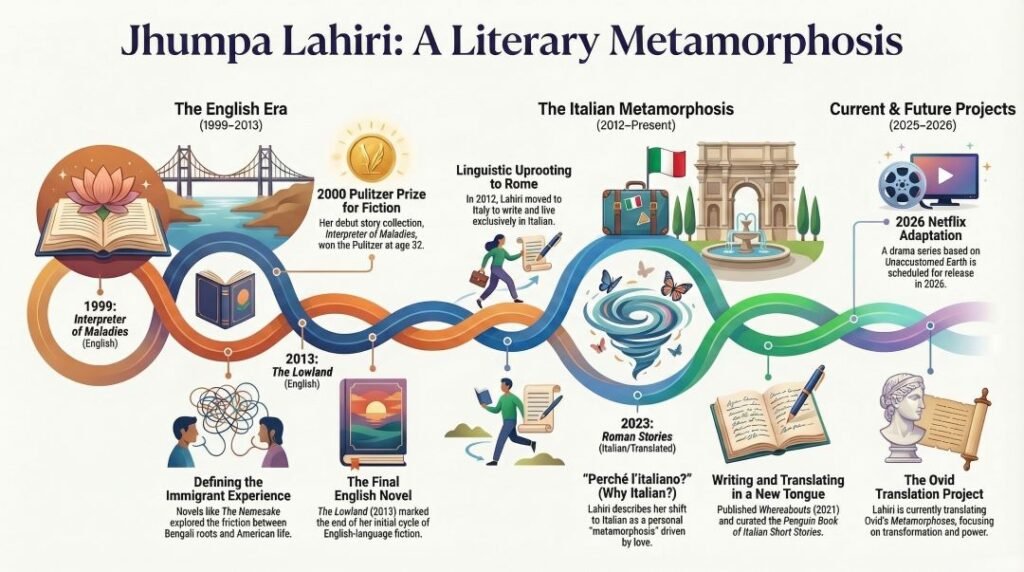
| Italian Connection | In 2012 Lahiri moved to Rome with her family and committed to learning and writing in Italian. Her memoir In Other Words (2015) documents this linguistic and cultural transformation. She has since edited The Penguin Book of Italian Short Stories (2019) and published Roman Stories (2023), written originally in Italian. |
| Academic Position | Professor of Creative Writing at Princeton University – one of the most prestigious creative writing positions in American academia |
| Website | Jhumpa Lahiri’s work and updates can be found through her publisher (Penguin Random House / Knopf) and through Princeton University’s Lewis Center for the Arts |
| What Does She Write About? | Identity, belonging, displacement, immigration, the Bengali-American experience, the relationship between language and self, marriage, grief, memory, cultural translation, and the experience of living between worlds |
Jhumpa Lahiri Biography PDF and PPT Slides Download (.PPTX)
Who Is Jhumpa Lahiri? What Is She Famous For?
Jhumpa Lahiri is an Indian-American author, born in London on July 11, 1967, to Bengali immigrant parents, and raised primarily in Rhode Island, USA. She is famous as the author of Interpreter of Maladies (1999) – the short story collection that won the Pulitzer Prize for Fiction in the year 2000, making her one of the youngest and most celebrated recipients of that prize. She is also famous for The Namesake (2003), her debut novel about a Bengali immigrant family in America, which was adapted into a critically acclaimed film directed by Mira Nair.
She is famous, too, for one of the most remarkable acts of literary reinvention in recent memory: in 2012, she moved her family to Rome and began learning Italian from scratch – eventually adopting it as her primary creative language. Her memoir In Other Words (2015), written in Italian and translated into English by Ann Goldstein, documents this transformation. Since then she has edited The Penguin Book of Italian Short Stories (2019) and published Roman Stories (2023), written originally in Italian. This makes her one of the very few major literary figures to write at the highest level in a language that is not their mother tongue – placing her in rare company alongside Beckett (who wrote in French) and Conrad (who wrote in English).
She is currently a Professor of Creative Writing at Princeton University, one of the most prestigious positions in American academic literary life.
Jhumpa Lahiri Biography in English: Early Life, Born Place and Education
Jhumpa Lahiri was born Nilanjana Sudeshna Lahiri on July 11, 1967, in London, England, where her Bengali parents had settled as part of the wave of South Asian immigration to Britain in the mid-20th century. Her father, Amar Lahiri, was a librarian; her mother, Tapati Lahiri, maintained a deeply Bengali household. When Jhumpa was a young child, the family moved to the United States, settling in Kingston, Rhode Island, where her father had taken a position at the University of Rhode Island.
Growing up in Rhode Island, Jhumpa Lahiri experienced from childhood what would become the central subject of her fiction: the experience of living between two worlds. At home, the family maintained Bengali language, culture, food, and customs. Outside, she navigated American life, American schools, and the expectations of American society. The dissonance between these two worlds – the private world of Bengali immigrant life and the public world of mainstream America – became the lens through which she would eventually see all human experience.
She attended South Kingstown High School in Rhode Island before going on to Barnard College, Columbia University, where she studied English Literature and graduated with a B.A. From Barnard she went on to Boston University, where she earned four graduate degrees: an M.A. in English, an M.A. in Creative Writing, an M.A. in Comparative Literature, and a Ph.D. in Renaissance Studies. This extraordinary range of graduate training reflects the intellectual seriousness and breadth that characterises all her writing.
It was during her years of graduate study and early academic career that she began seriously writing fiction. Her first published story – A Temporary Matter – appeared in The New Yorker in 1998. A year later, the collection in which it appeared, Interpreter of Maladies, was published by Houghton Mifflin. In 2000, it won the Pulitzer Prize for Fiction.
Jhumpa Lahiri Husband and Family
Jhumpa Lahiri married Alberto Vourvoulias-Bush in 1999 – the same year Interpreter of Maladies was published and just before the Pulitzer Prize catapulted her to international fame. Her husband is a journalist and editor of Venezuelan-Greek heritage, and the cross-cultural nature of their marriage – a Bengali-American woman and a Venezuelan-Greek man – reflects the broader themes of her work: the negotiation of multiple cultural identities, the experience of displacement, and the creation of new forms of belonging.
They have two children: a son named Octavio and a daughter named Noor. In 2012, the family made the dramatic decision to move to Rome, Italy, where Jhumpa Lahiri began the process of learning Italian that would transform her creative life. This family relocation – and the personal and linguistic transformation it catalysed – is the subject of her memoir In Other Words (2015). The family subsequently returned to the United States, where Lahiri now holds her position at Princeton University.
Jhumpa Lahiri Books: Complete List in Chronological Order
Jhumpa Lahiri’s books span a remarkable range – from Pulitzer Prize-winning short fiction to Italian-language essays and translations. Here is her complete bibliography in chronological order:
| Year | Title | Summary / Detail |
| 1999 | Interpreter of Maladies | Her debut short story collection – nine stories exploring the lives of Indian and Indian-American characters negotiating identity, marriage, grief, and cultural displacement. Won the Pulitzer Prize for Fiction in 2000. Also won the PEN/Hemingway Award and the Addison Metcalf Award. One of the most celebrated debut collections in American literary history. Published by Houghton Mifflin. |
| 2003 | The Namesake | Her debut novel – the story of Ashoke and Ashima Ganguli, a Bengali couple who immigrate from Calcutta to Massachusetts, and their American-born son Gogol (later renamed Nikhil) Ganguli. The novel traces Gogol’s struggle with his unusual name, his identity as the American child of Indian immigrants, and his complicated relationship with his heritage. Adapted into a film by Mira Nair (2006) starring Tabu and Kal Penn. A landmark novel in Indian-American literature. |
| 2008 | Unaccustomed Earth | Her second short story collection – eight stories and a novella-length triptych (the ‘Hema and Kaushik’ stories). More formally ambitious than Interpreter of Maladies – the stories are longer, darker, and more structurally complex. Explores second-generation Indian-American experience, grief, mortality, and the residue of the past on the present. Debuted at number one on the New York Times bestseller list – the first short story collection to do so in many years. Won the Frank O’Connor International Short Story Award. |
| 2013 | The Lowland | Her second novel – shortlisted for the Man Booker Prize and the National Book Award. Set between Calcutta and Rhode Island, it tells the story of two brothers, Subhash and Udayan Ganguli, separated by temperament and ultimately by the Naxalite revolutionary movement in 1960s-70s India. A dark, brooding, formally accomplished novel about political violence, grief, marriage, and the long shadows cast by the past. One of her most ambitious and most admired works. |
| 2015 | In Other Words (In altre parole) | A memoir written in Italian – documenting her decision to move to Rome in 2012, her immersion in the Italian language, and the creative and personal transformation that followed. Translated into English by Ann Goldstein. A remarkable work of literary self-examination – at once a language memoir and a meditation on identity, belonging, and the relationship between self and language. One of the most unusual and intellectually fascinating books she has written. |
| 2016 | The Clothing of Books (Il vestito dei libri) | A slim essay on book cover design and the relationship between a book’s visual presentation and its literary identity. Originally a lecture given at the Academy of Fine Arts in Bologna. Written in Italian. |
| 2019 | The Penguin Book of Italian Short Stories (Editor) | A major anthology of Italian short fiction – edited by Jhumpa Lahiri and published by Penguin. Features stories by 40 Italian authors, each with a short introduction by Lahiri. An important work of literary editorship and cultural translation – bringing Italian short fiction to an anglophone audience. Connects directly to her Italian literary project and her commitment to Italian literature. |
| 2021 | Whereabouts (Dove mi trovo) | A short, lyrical novel – originally written in Italian and self-translated into English by Lahiri. The unnamed narrator, a woman living alone in an unnamed Italian city, reflects on solitude, place, memory, and the strange, rich texture of everyday life. Unlike her earlier work in its near-plotlessness – a series of vignettes rather than a conventional narrative. A spare, beautiful, meditative work that shows the full influence of her Italian literary immersion. |
| 2023 | Roman Stories (Racconti romani) | Her most recent collection – nine stories set in Rome, written originally in Italian and translated into English by Lahiri herself (in collaboration with Todd Portnowitz). The stories explore immigrant life in Rome – Bangladeshi, African, and other immigrant communities in the Italian capital – as well as the experience of foreigners and temporary residents in the city. A deeply Italian book that also connects to her lifelong concern with displacement and belonging. |
Interpreter of Maladies: Complete Reference Guide
Interpreter of Maladies is Jhumpa Lahiri’s debut short story collection, published by Houghton Mifflin in 1999. It is the book that made her famous – and, in the view of many critics and readers, it remains her most perfect work. Here is a complete reference guide:
| Aspect | Detail |
| Full Title | Interpreter of Maladies |
| Author | Jhumpa Lahiri |
| Published | 1999 (Houghton Mifflin, USA) |
| Pulitzer Prize | Won the Pulitzer Prize for Fiction in 2000 – one of the most celebrated Pulitzer wins in recent decades |
| Other Awards | PEN/Hemingway Award; Addison Metcalf Award; O. Henry Award (for the title story); New Yorker Debut of the Year |
| Number of Stories | Nine short stories |
| First Story | A Temporary Matter – the story of Shukumar and Shoba, a couple whose marriage begins to fall apart after the death of their stillborn child; set during a series of planned power cuts in their Boston neighbourhood |
| Title Story | Interpreter of Maladies – the story of Mr. Kapasi, an interpreter for a doctor who also works part-time as a tour guide, and the Das family – an Indian-American couple and their children visiting India; a story of failed communication, longing, and misunderstanding |
| Other Key Stories | When Mr. Pirzada Came to Dine; Mrs. Sen’s; This Blessed House; The Treatment of Bibi Haldar; The Third and Final Continent; A Real Durwan; Sexy |
| Central Themes | The experience of immigration and cultural displacement; the gap between cultures and generations; loneliness and failed communication in marriage; the persistence of the past; grief and loss; the search for belonging; the experience of Indians in America and Americans in India |
| Writing Style | Precise, restrained, quietly powerful prose; deeply sympathetic to all her characters; a gift for the revealing detail; emotionally resonant without being sentimental; influenced by Chekhov, Alice Munro, and the tradition of the modern short story |
| Why It Won the Pulitzer | The collection was praised for the maturity and authority of its prose, the depth of its characterisation, the subtlety of its thematic vision, and its capacity to illuminate universal human experiences – loneliness, grief, displacement – through the specific lens of the Indian-American experience |
| Mrs. Sen’s (Summary) | The story of Mrs. Sen, an Indian woman living in America who babysits a young American boy, Eliot. The story explores her profound homesickness, her inability to adapt to American life, and the cultural gulf between her and the America around her. The fish she tries to get – which she can only cut properly – becomes a powerful symbol of the India she has lost. |
| Hell Heaven (from Unaccustomed Earth) | Often grouped with the Interpreter of Maladies stories in discussions – Hell Heaven is a story from Unaccustomed Earth that explores the quiet tragedy of an Indian immigrant woman’s unrequited love for a Bengali man, told through the eyes of her daughter. A masterpiece of restrained emotion. |
| A Temporary Matter (Summary) | The opening story of the collection – Shukumar and Shoba, whose marriage has become silent and distant after the death of their stillborn child, are forced to spend evenings together during planned power cuts. They begin sharing secrets in the dark – and the story builds to a devastating final revelation. One of the most widely anthologised and studied of Lahiri’s stories. |
| Only Goodness (from Unaccustomed Earth) | A story from Unaccustomed Earth about a Bengali-American sister and her alcoholic brother – exploring sibling love, guilt, and the ways families are damaged by secrets and by the gap between parents’ expectations and children’s lives. |
| The Third and Final Continent | The final story of Interpreter of Maladies – a tender, quietly triumphant story of an Indian immigrant who has lived in London and Cambridge before settling in Boston, and his encounter with an ancient, lonely American woman. Often cited as one of the most moving stories in the collection. |
The Namesake: Critical Analysis
The Namesake is Jhumpa Lahiri’s debut novel, published in 2003 by Houghton Mifflin. It is her most widely read and most widely taught work, and it represents – along with Interpreter of Maladies – her most fully achieved exploration of the Indian-American experience. Here is a complete critical analysis:
| Aspect | Detail |
| Full Title | The Namesake |
| Author | Jhumpa Lahiri |
| Published | 2003 (Houghton Mifflin, USA) |
| Genre | Literary fiction / Novel |
| Film Adaptation | Adapted into a film by Mira Nair (2006), starring Tabu (as Ashima Ganguli), Irfan Khan (as Ashoke Ganguli), and Kal Penn (as Gogol/Nikhil Ganguli) |
| Central Characters | Ashoke Ganguli (the father); Ashima Ganguli (the mother); Gogol (later Nikhil) Ganguli (the son) |
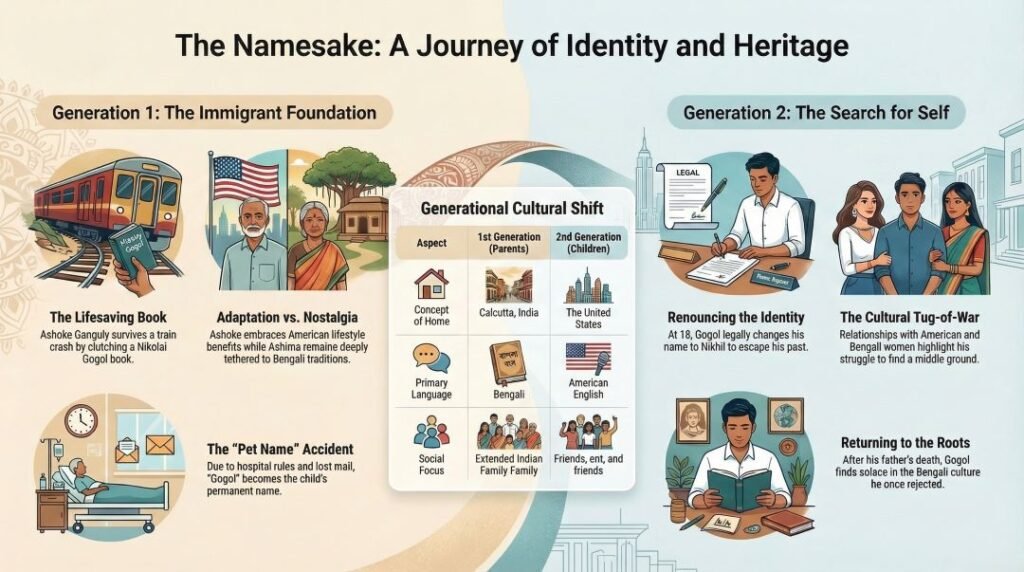
| The Name | Gogol Ganguli is named after the Russian writer Nikolai Gogol – whose story ‘The Overcoat’ Ashoke was reading when he survived a devastating train crash in India. The name, a ‘pet name’ rather than a ‘good name’ in the Bengali tradition, becomes the source of Gogol’s lifelong struggle with identity. |
| Nose Gogol Connection | The title of Nikolai Gogol’s famous story ‘The Nose’ is directly relevant – the novel is full of Gogolian echoes. The Russian Gogol’s themes of identity, the absurd, and the burden of the self resonate throughout the novel. |
| Central Themes | The burden and gift of names and identity; the immigrant experience and its effect on the second generation; the relationship between parents and children across cultural generations; the search for selfhood; the meaning of home; grief and loss; marriage and its complications; the specific experience of being Indian in America |
| Plot Summary | The novel follows Ashoke and Ashima Ganguli from their arranged marriage in Calcutta through their life as immigrants in Cambridge and Boston, Massachusetts. Their son Gogol grows up as an American, struggles with his Bengali heritage, rejects and then ultimately embraces aspects of his identity, and works through a series of relationships before settling into a more peaceful understanding of who he is. |
| Critical Reception | Widely praised as a landmark of Indian-American literature; celebrated for the tenderness and precision of its characterisation, particularly of Ashima Ganguli, whom many critics regard as one of the most fully realised immigrant women in contemporary fiction; some critics found its structure episodic |
| Namesake Meaning | A namesake is someone who shares the name of another – the novel’s title reflects the way Gogol is ‘named after’ Gogol without fully understanding or choosing that inheritance |
| The Namesake Novel vs Film | The novel is widely regarded as richer and more complex than the film adaptation, though the film was praised for its casting, particularly Tabu’s portrayal of Ashima |
| JSTOR / Academic Study | The Namesake is one of the most studied texts in South Asian-American literature – there is a substantial body of academic criticism on JSTOR and in journals of postcolonial studies, diaspora studies, and American literature. Key critical themes include: diaspora and second-generation identity; the politics of naming; the representation of Bengali culture in American fiction; gender and immigration; the mother-son relationship |
| Critical Perspectives | Critics including Vijay Mishra (on the postcolonial diaspora), Deepika Bahri (on South Asian-American identity), and many others have written about The Namesake in relation to questions of diaspora, hybridity, and the politics of cultural identity in immigrant fiction |
Unaccustomed Earth: Summary and Critical Analysis
Unaccustomed Earth (2008) is Jhumpa Lahiri’s second short story collection – more formally ambitious, darker, and in many ways more powerful than Interpreter of Maladies. It debuted at number one on the New York Times bestseller list – a remarkable achievement for a book of short stories.
The collection takes its title from a line by Nathaniel Hawthorne: ‘Human nature will not flourish, any more than a potato, if it be planted and replanted, for too long a series of generations, in the same worn-out soil. My children have had other birthplaces, and, so far as their nature is concerned, in other lands. Put the idea to the test, and see whether it may not germinate and grow upon the Unaccustomed Earth.’
The collection contains eight stories and a three-part novella (the Hema and Kaushik stories). The stories are longer, more psychologically complex, and more formally varied than those of Interpreter of Maladies. They explore second-generation Bengali-American experience, parent-child relationships, grief, desire, and the residue of the past on the present. The Hema and Kaushik triptych – three connected stories following two Bengali-American characters from childhood to adulthood – is often cited as Lahiri’s most structurally ambitious short fiction.
The Lowland: Summary and Critical Analysis
The Lowland (2013) is Jhumpa Lahiri’s second novel – her most formally ambitious and, in the view of many critics, her most fully realised long-form work. It was shortlisted for the Man Booker Prize and the National Book Award for Fiction.
The novel’s plot begins in Calcutta in the 1960s, where two brothers – Subhash and Udayan Ganguli – grow up inseparable. Udayan, the more passionate and politically committed of the two, becomes involved in the Naxalite movement – the Maoist revolutionary movement that swept through Bengal in the late 1960s and early 1970s. Subhash, the quieter, more cautious brother, leaves India to pursue a Ph.D. in Rhode Island. When Udayan is killed by the police, Subhash returns to India and makes the extraordinary decision to marry Udayan’s pregnant widow, Gauri, and take her back to America with him.
The novel follows the consequences of this decision over several decades – the strange, damaged marriage between Subhash and Gauri; the daughter Bela, who grows up not knowing the truth about her parentage; Gauri’s intellectual life and her ultimate decision to abandon her family to pursue an academic career in philosophy. It is a novel about political violence, its aftermath, and the long shadows it casts over the lives of those who survive it.
Critical reception was overwhelmingly positive. The novel was praised for the ambition of its structure, the depth of its historical research (the Naxalite sections are vividly and accurately rendered), the complexity of its female characterisation (particularly Gauri), and the seriousness of its engagement with political history. Some critics found the Gauri sections cold; others considered her the most interesting character Lahiri has ever created.
Whereabouts (Dove mi trovo): Summary and Analysis
Whereabouts (2021) is Jhumpa Lahiri’s third novel – originally written in Italian as Dove mi trovo and self-translated into English by Lahiri herself. It is her most experimental and most formally unconventional work – a series of brief, lyrical vignettes narrated by an unnamed woman living alone in an unnamed Italian city (clearly Rome).
The novel has almost no conventional plot. Instead, it is organised by place – each chapter is named after a location (At the Sea, At the Counter, In the Mountains, In the Doorway, On the Street) – and traces the narrator’s movements through the city and through memory. The narrator is a woman of middle age, a professor, living alone after the end of a relationship, navigating solitude, friendship, the presence of the dead (particularly her parents), and the texture of daily urban life.
The book is unlike anything Lahiri wrote before her Italian period – spare, plotless, meditative, closer to prose poetry than conventional fiction. It has been compared to the work of Italian writers like Natalia Ginzburg and Elena Ferrante in its attention to the interior life and to the specific atmosphere of Italian urban life. Critical reception was generally positive, though some readers accustomed to the more narrative-driven pleasures of her earlier work found it unsatisfying.
Roman Stories: Summary and Analysis
Roman Stories (Racconti romani, 2023) is Jhumpa Lahiri’s most recent collection – nine stories set in Rome, written originally in Italian and translated into English by Lahiri herself in collaboration with Todd Portnowitz. It is in some ways her most political book – the stories focus not on Indian-American experience but on immigrant life in Rome itself: Bangladeshi workers, African men and women navigating an indifferent city, foreign academics, temporary residents.
The stories are set among Rome’s less visible populations – the immigrants who clean apartments, build monuments, navigate bureaucracy, and live between cultures in a city that is simultaneously one of the most beautiful in the world and one of the most exclusionary. In this sense, the Roman Stories represent a significant expansion of Lahiri’s thematic range – moving from the specific Bengali-American experience that shaped her early work to a broader engagement with the global experience of displacement and belonging.
Critical reception was positive, with reviewers praising the compression and precision of the stories, the clarity of Lahiri’s Italian-influenced prose, and the seriousness of the book’s engagement with contemporary immigration to Europe.
In Other Words (In altre parole): The Italian Memoir
In Other Words (In altre parole, 2015) is Jhumpa Lahiri’s memoir of her Italian experience – one of the most unusual and intellectually fascinating literary memoirs of recent years. Written entirely in Italian (with Lahiri’s English text withheld from the original Italian publication), it was translated into English by Ann Goldstein, the celebrated translator of Elena Ferrante.
The memoir documents Lahiri’s long, distant love affair with the Italian language (which she first encountered as a student), her decision in 2012 to move her family to Rome and commit fully to Italian, and the strange, disorienting, ultimately liberating experience of writing in a language that is not one’s mother tongue. Lahiri describes learning Italian as a form of escape from the ‘prison’ of English – the language in which she was expected to write, the language in which she was already famous, the language that had shaped all her previous work.
The memoir also works as a meditation on identity, language, and selfhood – asking what it means to express oneself in a borrowed language, and whether the self that emerges in that borrowed language is more or less authentic than the self shaped by one’s mother tongue. These are deeply personal questions for Lahiri, who grew up speaking Bengali at home, living in English, and having no language – until Italian – that felt entirely her own.
The Penguin Book of Italian Short Stories
The Penguin Book of Italian Short Stories (2019) is a major anthology edited by Jhumpa Lahiri – featuring forty Italian writers, ranging from canonical figures of the 20th century (Italo Calvino, Natalia Ginzburg, Alberto Moravia, Elsa Morante) to contemporary writers less known to anglophone audiences.
Each story is presented with a brief introduction by Lahiri, in which she discusses the writer’s significance and the qualities that drew her to the story. The anthology is both a work of cultural translation – making Italian short fiction available to English-language readers – and a document of Lahiri’s own literary education in Italian. The writers she includes and the way she talks about them reveal a great deal about the Italian literary tradition that has shaped her own Italian-language writing.
The anthology was warmly received both as a reference work and as a piece of literary editorship in its own right. It has become a standard English-language guide to Italian short fiction.
Jhumpa Lahiri Short Stories: Key Works and Summaries
Jhumpa Lahiri’s short stories are arguably her finest achievement. Here is a guide to her key stories and what makes each one significant:
| Story Title | Collection / Summary |
| A Temporary Matter | Interpreter of Maladies. A couple, Shukumar and Shoba, whose marriage has withered after the death of their stillborn child, are forced to spend evenings together during planned power cuts. In the candlelit evenings, they share secrets they have never told each other – building to a final devastating revelation. One of her most perfectly constructed and most emotionally devastating stories. |
| Interpreter of Maladies | Interpreter of Maladies. Mr. Kapasi, a tour guide and interpreter for a local doctor, takes the Das family – American tourists of Indian origin – on a visit to the Sun Temple at Konarak. He develops a brief, intense fantasy about Mrs. Das; she confides a secret to him; the story ends in quiet mutual misunderstanding. A masterclass in the rendering of failed communication and longing. |
| Mrs. Sen’s | Interpreter of Maladies. Mrs. Sen babysits young Eliot while her husband is at the university. She is homesick for India in ways she cannot articulate – the story is built around her attempts to get fresh fish (which she can only cut the Indian way) and her inability to learn to drive. A quiet, deeply moving portrait of displacement. |
| When Mr. Pirzada Came to Dine | Interpreter of Maladies. Told from the perspective of a young Indian-American girl, Lilia, whose family hosts a Pakistani professor, Mr. Pirzada, for dinner throughout the autumn of 1971 – as the Bangladesh Liberation War unfolds and Mr. Pirzada waits for news of his family in Dhaka. A beautifully restrained story about politics, anxiety, and the friendship between a child and an adult stranger. |
| The Third and Final Continent | Interpreter of Maladies. The narrator – an Indian man who has lived in London and Cambridge – arrives in Boston and rents a room from the ancient, fiercely proper Mrs. Croft. The story of his quiet companionship with this very old American woman, and his gradual settling into American life. The final pages – in which he reflects on his life in America – are among the most moving in Lahiri’s work. |
| Hell Heaven | Unaccustomed Earth. Told through the eyes of an unnamed Indian-American woman looking back on her childhood, this is the story of her mother’s unrequited love for Pranab Kaku, a charismatic Bengali student who visits their family. A story about suppressed desire, loyalty, and the gap between public performance and private longing. |
| Only Goodness | Unaccustomed Earth. Sudha, a successful Bengali-American woman, watches her brother Rahul’s alcoholism destroy his life and ultimately damage her family. A dark, unsparing story about sibling love, guilt, and the limits of what one person can do for another. |
| Hema and Kaushik (Triptych) | Unaccustomed Earth. A three-part novella following two Bengali-American characters – Hema and Kaushik – from childhood, through young adulthood, to a devastating conclusion. The most formally ambitious of Lahiri’s short fiction – three separate stories, each in a different voice and time period, building to a final section of extraordinary emotional power. |
| Roman Stories | Roman Stories (2023). Nine stories set in Rome – exploring immigrant life in the Italian capital among Bangladeshi workers, African immigrants, foreign academics, and temporary residents. More politically engaged than her earlier work; written in Italian and self-translated. |
Jhumpa Lahiri Criticism and Critical Perspectives
Jhumpa Lahiri has been the subject of sustained critical attention since the publication of Interpreter of Maladies in 1999. Here is a comprehensive account of the critical perspectives on her work:
| Critical Perspective / Area | Detail |
| Diaspora and Identity | The most prominent strand of Jhumpa Lahiri criticism focuses on her representation of the South Asian diaspora – particularly the Bengali-American experience. Critics including Vijay Mishra (who theorises the distinction between the ‘old diaspora’ of labour migration and the ‘new diaspora’ of professional migration) have discussed how Lahiri’s work represents the specific experience of educated, middle-class Indian immigrants and their children in America. Her characters are typically professionals – engineers, professors, librarians – not working-class immigrants, and critics have noted both the particularity and the limitations of this social range. |
| Postcolonial Reading | Many critics read Lahiri through the lens of postcolonial theory – particularly the question of cultural hybridity (Homi Bhabha’s concept of the ‘third space’ between cultures) and the politics of representation in diaspora fiction. Questions frequently asked include: who does she represent? Is her Bengali-American experience representative or particular? Does her work reinforce or challenge Western stereotypes about India and South Asian immigrants? |
| Gender and Female Experience | A significant body of criticism focuses on Lahiri’s representation of Indian and Indian-American women – particularly the figure of the immigrant wife and mother (Ashima Ganguli in The Namesake; Mrs. Sen; various unnamed women in Unaccustomed Earth). Critics have discussed the way Lahiri renders the interior life of women who have given up careers, friendships, and familiar cultural contexts to follow husbands to a foreign country – and the quiet, devastating cost of this sacrifice. |
| The ‘Exotic’ Debate | Some critics – notably the novelist Bharati Mukherjee and others – have suggested that Lahiri’s work, particularly Interpreter of Maladies, was celebrated in part because it confirmed Western literary tastes for a certain kind of ‘exotic’ but accessible immigrant narrative. This is a serious and ongoing critical debate about the politics of literary reception and the conditions under which ‘ethnic’ writers achieve mainstream success. |
| Language and the Italian Turn | Lahiri’s decision to write in Italian has generated substantial critical discussion – both enthusiastic (those who see it as a remarkable act of literary courage and creative reinvention) and sceptical (those who see it as a form of privilege – only a writer who is already famous and financially secure can afford to abandon her established audience and language). The critical discussion of In Other Words, Whereabouts, and Roman Stories has engaged deeply with questions about language, selfhood, and the politics of literary multilingualism. |
| JSTOR and Academic Resources | The academic critical literature on Jhumpa Lahiri is substantial and growing. JSTOR contains dozens of peer-reviewed articles on her work, covering all the topics above. Key journals for finding Lahiri criticism include: MELUS (Multi-Ethnic Literature of the United States), South Asian Review, Journal of Postcolonial Writing, and Modern Fiction Studies. Students researching Lahiri criticism should begin with a JSTOR search for ‘Jhumpa Lahiri’ filtered to peer-reviewed sources. |
| Comparison with Other Writers | Lahiri is frequently compared to – and has explicitly cited as influences – Alice Munro (for her mastery of the short story form), Anton Chekhov (for her precision and restraint), Nathaniel Hawthorne (whose ‘Unaccustomed Earth’ phrase she used as an epigraph), and Mavis Gallant (for her portraits of displacement). In the Italian period, she is compared to Natalia Ginzburg, Elena Ferrante, and other Italian prose writers noted for their spare, powerful style. |
| Review and Reception | Initial critical reception of all her books has been overwhelmingly positive in the mainstream press – The New York Times, The New Yorker, The Guardian, The Times Literary Supplement – with particular praise for her prose style, characterisation, and emotional depth. Unaccustomed Earth and The Lowland both received the widest critical consensus of her career. |
What Does Jhumpa Lahiri Write About?
Jhumpa Lahiri’s writing is centrally concerned with the experience of displacement – the condition of living between cultures, languages, and versions of the self. More specifically, she writes about:
- Immigration and its emotional cost – the grief, loneliness, and disorientation of leaving one’s country and culture behind
- The Bengali-American experience – the specific culture, food, language, and customs of the Bengali immigrant community in the United States
- Second-generation identity – the experience of growing up as the child of immigrants, caught between the culture of the home and the culture of the outside world
- Marriage and its complications – many of her stories explore the ways couples grow apart, fail to communicate, or are damaged by grief and by the gap between expectation and reality
- Grief and loss – the death of children, parents, siblings, and the long aftermath of grief in human relationships
- Names and language – from the naming of Gogol Ganguli to her Italian memoir, Lahiri is deeply interested in the relationship between language, names, and identity
- The Italian experience – in her later work, she writes about Rome, Italian immigrant communities, and the experience of living in and between languages
- Solitude and belonging – the experience of being alone, of not fitting in, and of the human search for a place to belong
Jhumpa Lahiri Writing Style and Prose Analysis
Jhumpa Lahiri’s writing style has been praised by critics and readers since the publication of Interpreter of Maladies. Here is a complete analysis of her prose style and technique:
| Element | Detail |
| Prose Style Overall | Precise, restrained, quietly powerful; characterised by an economy of means – she achieves large emotional effects through small, carefully observed details; never overwrought or sentimental; deeply empathetic to all her characters, including those who behave badly or are easy to dismiss |
| Sentence Structure | Clean, clear, measured sentences; she avoids the long, accumulative sentences of writers like Henry James or Nirad C Chaudhuri; her prose moves at a deliberate, calm pace that is itself an expression of the emotional restraint she values |
| Characterisation | Her greatest gift – she creates characters of extraordinary psychological depth and specificity; her Indian and Indian-American characters feel fully realised and particular rather than representative or symbolic |
| Use of Detail | Lahiri is a writer of the specific detail – the food, the clothes, the objects, the customs of Bengali life are rendered with loving precision; these details are never merely descriptive but always carry emotional and thematic weight |
| Narrative Voice | She uses both first-person and third-person narration; she is equally comfortable inhabiting male and female perspectives, young and old, first-generation and second-generation characters |
| Influences | Alice Munro (short story mastery); Anton Chekhov (restraint, sympathy, the ‘slice of life’ technique); Mavis Gallant (displacement and expatriate experience); Nathaniel Hawthorne (as epigraph source and spiritual ancestor); Italian period: Natalia Ginzburg, Anna Maria Ortese, Elena Ferrante |
| The Italian Style | Her Italian-language writing is noticeably different in style from her English-language work – sparser, more abstract, more concerned with atmosphere and interiority than with plot and characterisation; the Italian prose of Whereabouts and Roman Stories is closer to prose poetry than to conventional realism |
| Emotional Register | She writes in a tone of contained, quiet sadness that is never maudlin – her stories and novels are emotionally devastating but in an understated way; the effect is cumulative rather than immediately apparent |
Jhumpa Lahiri Awards: Complete List
| Award | Year | For / Detail |
| Pulitzer Prize for Fiction | 2000 | Interpreter of Maladies (1999) – one of the most celebrated Pulitzer wins in recent memory; announced her as a major new voice in American literature |
| PEN/Hemingway Award | 2000 | Interpreter of Maladies – for a distinguished first book of fiction by an American author |
| Addison Metcalf Award | 2000 | Interpreter of Maladies – awarded by the American Academy of Arts and Letters |
| Frank O’Connor International Short Story Award | 2008 | Unaccustomed Earth – the world’s most valuable short story prize |
| DSC Prize for South Asian Literature | 2015 | The Lowland |
| National Book Award Finalist | 2013 | The Lowland |
| Man Booker Prize Shortlist | 2013 | The Lowland |
| New Yorker Debut of the Year | 1998/1999 | For her first published story, A Temporary Matter |
| Honorary Degrees | Various | From Bowdoin College, Williams College, and other institutions |
| National Humanities Medal | 2014 | Awarded by President Barack Obama at the White House |
Jhumpa Lahiri and India: The Indian Connection
Despite growing up in America and spending much of her adult life there, India – and specifically Bengal – remains central to Jhumpa Lahiri’s identity as a writer. She has spoken extensively in interviews about the Bengali world of her childhood home: the Bengali food, language, music, and customs that her parents maintained in their American house, and the annual trips to Calcutta that connected her to the family and culture she was growing up apart from.
This connection is visible throughout her work. The characters of Interpreter of Maladies and The Namesake are rooted in a very specific Bengali culture – the educated, middle-class, Calcutta Bengali culture of her parents’ generation. The food – in particular – is described with extraordinary specificity and love: the fish, the dal, the rice, the sweets that mark Bengali celebrations and connect diaspora families to the home they have left behind.
The Lowland is her most explicitly ‘Indian’ novel – its first third is set in Calcutta, and it engages directly with the political history of Bengal in the 1960s and 1970s, including the Naxalite movement. The research behind this section of the novel is evident in its historical accuracy and its feeling for the texture of Calcutta life in that period.
At the same time, Lahiri has been clear that she does not consider herself simply an ‘Indian’ writer or a ‘Bengali’ writer – she is a writer who happens to be of Bengali origin, and the full range of her work, particularly her Italian-language work, cannot be reduced to a single national or cultural identity.
Jhumpa Lahiri and Italian Literature
Jhumpa Lahiri’s relationship with Italian literature and the Italian language is one of the most remarkable stories in contemporary literary life. She first encountered Italian as a student and felt an immediate, deep attraction to the language – an attraction she could not fully explain but which she has described in In Other Words as a form of love: inexplicable, overwhelming, and completely transforming.
In 2012, she moved her family to Rome and committed fully to the Italian language – reading only in Italian, writing only in Italian, refusing to speak English except when necessary. This period of total immersion transformed her as a writer. She began writing in Italian – producing work that was, she has said, freer and less self-conscious than her English writing, because she had no established identity to protect in Italian, no reputation that could be damaged by failure.
The result was a remarkable body of Italian-language work: the memoir In Other Words (2015), the essay The Clothing of Books (2016), the anthology The Penguin Book of Italian Short Stories (2019), the novel Whereabouts (2021), and the story collection Roman Stories (2023). This body of work has made her one of the few living writers to have achieved serious critical success in two completely different languages – a distinction that places her in genuinely rare literary company.
As an editor, she brought Italian short fiction to anglophone audiences through The Penguin Book of Italian Short Stories – an anthology that showcases forty Italian writers across the 20th and early 21st centuries and has become a standard reference for readers interested in Italian literature in English translation.
Jhumpa Lahiri Life Timeline
| Year | Key Event |
| 1967 | Born on July 11 in London, England, to Bengali immigrant parents Amar and Tapati Lahiri |
| 1970s (early) | Family moves from England to Kingston, Rhode Island, USA; father takes up position as librarian at the University of Rhode Island; Jhumpa grows up between Bengali home culture and American public life |
| 1980s | Attends South Kingstown High School, Rhode Island |
| 1989 | Graduates with B.A. in English Literature from Barnard College, Columbia University |
| 1989-1993 | Pursues graduate studies at Boston University – earns M.A. in English, M.A. in Creative Writing, M.A. in Comparative Literature, and Ph.D. in Renaissance Studies |
| 1998 | First story, A Temporary Matter, published in The New Yorker – announced a major new literary voice |
| 1999 | Interpreter of Maladies published by Houghton Mifflin; marries Alberto Vourvoulias-Bush |
| 2000 | Interpreter of Maladies wins the Pulitzer Prize for Fiction – catapulting Lahiri to international fame |
| 2000 | Also wins PEN/Hemingway Award and Addison Metcalf Award for Interpreter of Maladies |
| 2003 | The Namesake published – her debut novel; becomes a bestseller |
| 2006 | Film adaptation of The Namesake directed by Mira Nair, starring Tabu, Irfan Khan, and Kal Penn |
| 2008 | Unaccustomed Earth published – debuted at number one on the New York Times bestseller list; wins Frank O’Connor International Short Story Award |
| 2012 | Moves family to Rome, Italy; begins full immersion in Italian language and culture |
| 2013 | The Lowland published – shortlisted for Man Booker Prize and National Book Award |
| 2014 | Receives National Humanities Medal from President Barack Obama |
| 2015 | In Other Words (In altre parole) published – Italian-language memoir of her linguistic transformation; translated by Ann Goldstein |
| 2019 | Edits and publishes The Penguin Book of Italian Short Stories |
| 2020 onwards | Returns to United States; joins faculty of Princeton University as Professor of Creative Writing |
| 2021 | Whereabouts (Dove mi trovo) published – originally written in Italian, self-translated |
| 2023 | Roman Stories (Racconti romani) published – nine stories set in Rome, written in Italian, self-translated |
10 Lines About Jhumpa Lahiri for Students
- Jhumpa Lahiri (full name: Nilanjana Sudeshna Lahiri) was born on July 11, 1967, in London, England, to Bengali immigrant parents, and grew up in Rhode Island, USA.
- She studied English Literature at Barnard College (Columbia University) and earned four graduate degrees – including a Ph.D. – from Boston University.
- Her debut short story collection, Interpreter of Maladies (1999), won the Pulitzer Prize for Fiction in 2000 – one of the most celebrated literary debuts in American history.
- Her debut novel, The Namesake (2003), tells the story of the Bengali-American Ganguli family and the son named Gogol, and was adapted into a film by Mira Nair (2006).
- Her second story collection, Unaccustomed Earth (2008), debuted at number one on the New York Times bestseller list and won the Frank O’Connor International Short Story Award.
- Her second novel, The Lowland (2013), was shortlisted for both the Man Booker Prize and the National Book Award for Fiction.
- In 2012, she moved to Rome and began writing exclusively in Italian – producing the memoir In Other Words (2015), the novel Whereabouts (2021), and the collection Roman Stories (2023).
- She edited The Penguin Book of Italian Short Stories (2019) – a major anthology of Italian short fiction for anglophone readers.
- She received the National Humanities Medal from President Barack Obama in 2014.
- She is currently a Professor of Creative Writing at Princeton University, one of the most prestigious creative writing positions in American academia.
Jhumpa Lahiri Short Biography (Profile / Biodata)
Jhumpa Lahiri (full name: Nilanjana Sudeshna Lahiri; born July 11, 1967, London, England) is an Indian-American author, essayist, editor, and professor. Born to Bengali immigrant parents, she grew up in Rhode Island, USA. She holds a B.A. from Barnard College (Columbia University) and four graduate degrees from Boston University, including a Ph.D. in Renaissance Studies. She married journalist Alberto Vourvoulias-Bush in 1999 and has two children, Octavio and Noor. Her debut collection Interpreter of Maladies (1999) won the Pulitzer Prize for Fiction (2000). Her debut novel The Namesake (2003) was adapted into a film by Mira Nair. Her second collection, Unaccustomed Earth (2008), reached number one on the New York Times bestseller list. Her second novel, The Lowland (2013), was shortlisted for the Man Booker Prize and the National Book Award. From 2012 she committed to writing in Italian – producing the memoir In Other Words (2015), the novel Whereabouts (2021), and the story collection Roman Stories (2023). She edited The Penguin Book of Italian Short Stories (2019). She received the National Humanities Medal from President Obama in 2014. She is currently Professor of Creative Writing at .
Also read: Nirad C Chaudhuri Biography PDF and PPT Slides Download
Conclusion:
Jhumpa Lahiri is one of the most significant literary figures of her generation – a writer whose work has permanently changed the landscape of American literature, South Asian-American writing, and the global literature of displacement and belonging. Beginning with the extraordinary achievement of Interpreter of Maladies and continuing through the formal ambitions of The Lowland and the remarkable reinvention of the Italian period, her literary career has been one of consistent seriousness, courage, and growth.
- Her legacy is multiple. She opened the door for South Asian-American writers who came after her – a door that had not been opened in quite the same way before. She demonstrated that the Bengali-American experience – specific, particular, rooted in the details of food, language, custom, and domestic life – could be rendered with such universality and such literary craft that it would speak to readers of every background. The Pulitzer Prize confirmed what many readers already knew: that Interpreter of Maladies was not just an ‘immigrant story’ but a work of literary art that deserved a place alongside the greatest collections in the American short story tradition.
- The Italian turn – which surprised and divided many of her admirers – has proven, in retrospect, to be one of the most courageous and consequential decisions in recent literary life. In Other Words, Whereabouts, and Roman Stories demonstrate that Lahiri is not merely a Bengali-American writer who happened to be successful, but a genuinely world-class literary intelligence capable of reinventing herself completely and writing at the highest level in a language she acquired as an adult.
- She remains – as a writer, a teacher at Princeton, a translator, and an editor – one of the most important and most multifaceted figures in contemporary world literature. Her work, across all its phases and all its languages, will be read and taught and argued over for many generations to come.